Spiritual Distancing

“And lead us not into temptation, but deliver us from evil.” Matthew 6:13

For over a year now, we’ve been hearing the term “social distancing” in relation to COVID-19. Social distancing generally refers to keeping a “safe” distance from others in public, to reduce the spread of the virus (normally about 6 feet). It may also refer to using a mask whenever you are in a public building, or whenever you interact with someone who is 6 feet away or closer– especially at stores, doctor’s offices, church, school, etc.

Photo by Anna Tarazevich on Pexels.com

Most people accept that social distancing is a temporary measure and meant to help keep you from getting (or giving) the disease. It is not a normal social practice, but one we choose to adopt for the good of everyone around us. However, there are many questions as to the effectiveness of social distancing after more than a year– what about those who have already had COVID, and should have antibodies? Should they be required to wear masks and keep their distance? What about those who refuse to practice social distancing? What about those who practice social distancing to the best of their ability who STILL get COVID?

Photo by Gustavo Fring on Pexels.com

These are all valid questions. But I want to look at the contrast between social distancing and “spiritual” distancing. We don’t want to “catch” COVID, but how vigilant are we in avoiding the contamination of sin? How often do we distance ourselves from those who claim to be “healthy” Christians while continuing with sinful practices? How often do we remain in situations rife with temptation, or compromise on “little things” in our own lives?
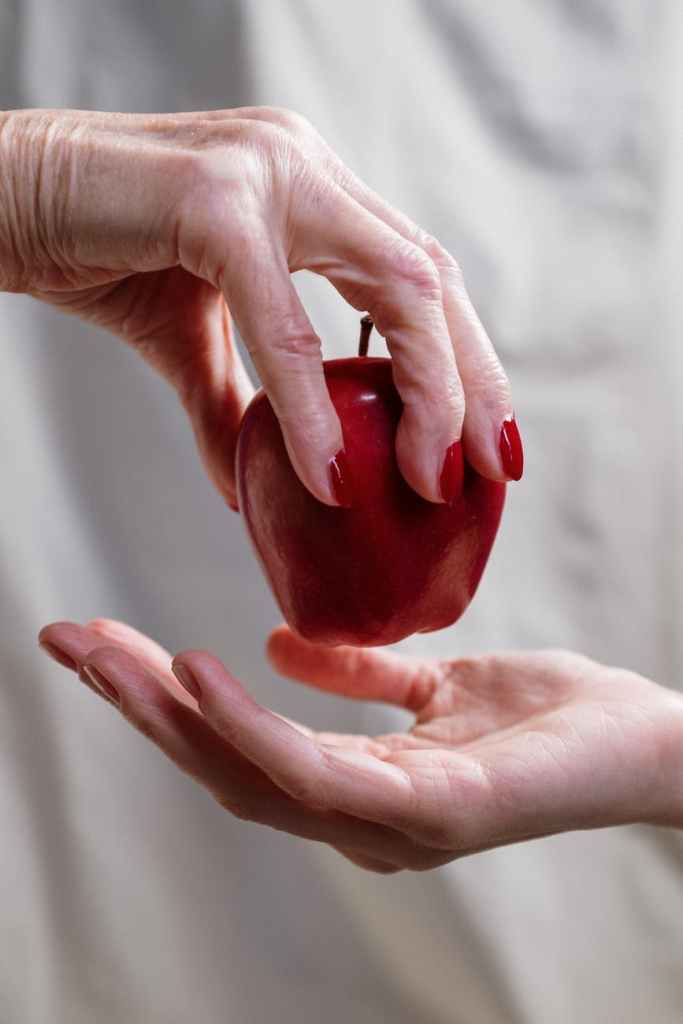
Photo by cottonbro on Pexels.com

I’m not talking about walking around in a spiritual “bubble,” refusing to interact with anyone who has a sinful past, or with lost souls who need to hear the Good News of Salvation. Nor should we deny and cover up our own faults and failures. But if our lives are supposed to reflect the ministry and teaching of Jesus Christ; if we REALLY want to live the kind of lives that honor Him and lead others to want to honor Him, shouldn’t we be every bit as careful about sin as we are about COVID?

We are instructed multiple times throughout Scripture to “resist” the devil, to “flee” from temptation, to invite the Holy Spirit to “guard” our hearts and minds, and to “do battle” with spiritual foes. We are quick to put on masks before we enter the grocery– are we putting on the Armor of God at the same time?

Social distancing is public, and very visible. We can see who is practicing and who is not. We can judge others just by seeing if they are wearing a mask or keeping their distance. Spiritual distancing is private and largely invisible to the public. But God still sees and knows. I confess, I have been guilty of walking into situations and relationships without “wearing a mask” or putting on my spiritual armor.

10 Finally, be strong in the Lord and in his mighty power. 11 Put on the full armor of God, so that you can take your stand against the devil’s schemes. 12 For our struggle is not against flesh and blood, but against the rulers, against the authorities, against the powers of this dark world and against the spiritual forces of evil in the heavenly realms. 13 Therefore put on the full armor of God, so that when the day of evil comes, you may be able to stand your ground, and after you have done everything, to stand. 14 Stand firm then, with the belt of truth buckled around your waist, with the breastplate of righteousness in place, 15 and with your feet fitted with the readiness that comes from the gospel of peace. 16 In addition to all this, take up the shield of faith, with which you can extinguish all the flaming arrows of the evil one. 17 Take the helmet of salvation and the sword of the Spirit, which is the word of God.18 And pray in the Spirit on all occasions with all kinds of prayers and requests. With this in mind, be alert and always keep on praying for all the Lord’s people.

Ephesians 6:10-18 NIV via biblegateway.com (emphasis added).
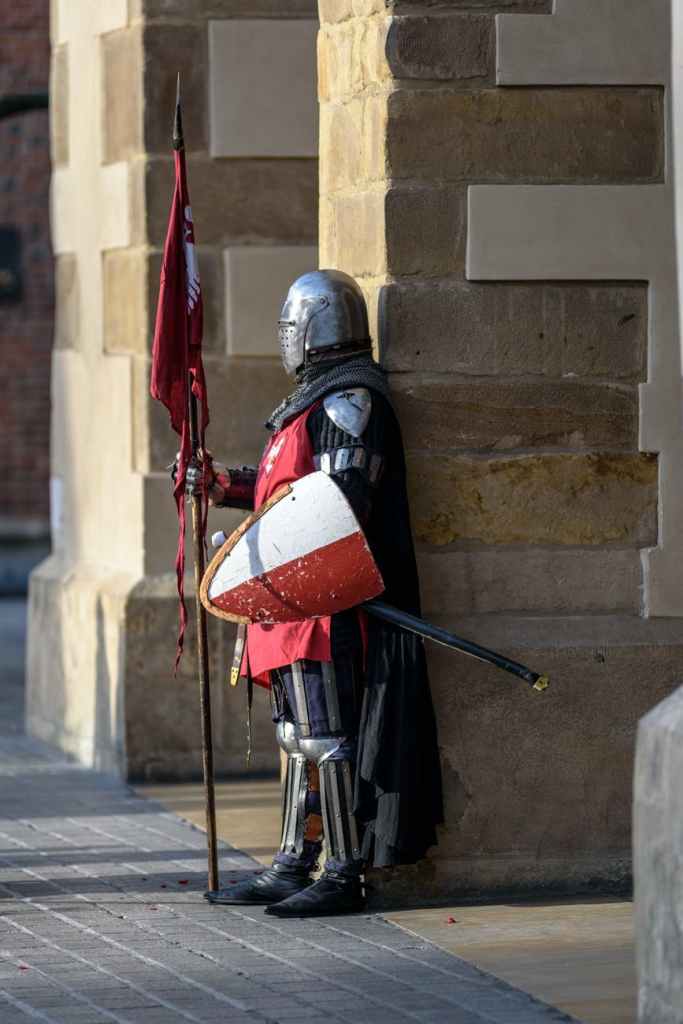
Photo by PhotoMIX Company on Pexels.com

We should keep our distance from sin and temptation whenever possible, but we must also be ready to “stand firm” and protected by God’s armor, which includes persistently pursuing prayer! We wouldn’t walk into a situation where we knew we would be exposed to COVID without taking any precautions. Why would we deliberately expose ourselves to sinful practices? Why do we make excuses for compromising in our listening and viewing habits? Why do we get involved in fruitless arguments or gossip? Worse, why would we tempt others to be complacent about sin? Why do we stay silent as we watch other Christians struggling? Why aren’t we standing firm, suiting up, and praying “on all occasions?”

Photo by Keira Burton on Pexels.com

Just like with COVID, we can practice spiritual distancing and still fall into the “sickness” of sin. But God makes a two-fold promise–through the death and resurrection of Jesus Christ, the “virus” of sin is defeated and its effects neutralized. Even though we will face a physical death, we can have new and eternal spiritual life through faith by grace (Ephesians 2:8-9; John 11:25, others..) But we also have the forgiveness of sins– the knowledge that God will heal us and redeem the effects of our individual sinful choices when we confess and repent of them.

Photo by Polina Tankilevitch on Pexels.com

COVID is not a joke; nor is it harmless. I know from experience. Both my husband and I had it earlier this year. My husband was in the hospital for a week, and is still struggling to regain full health. I still have a diminished sense of smell, and other problems as a result of my illness. But Sin if a far greater threat than COVID. COVID has claimed many lives, but Sin has claimed billions of souls, and robbed them of life and hope.

Let’s keep our distance, wear our armor, and let’s get praying!

Photo by Binti Malu on Pexels.com

Praying For My Children From Another Mother

(Dedicated to all those who are step-mothers, adoptive mothers, foster mothers, or in other ways entrusted with children not of their womb.)

I did not give birth to them, Father. They are not the children of my womb; they are still the children of my heart.

Photo by Ketut Subiyanto on Pexels.com

And I know you love them more than I do. That they are YOUR children first, last, and foremost.

God, Thank You for giving me the privilege of letting me be part of their lives; for allowing me to share their hopes and dreams, their failures and their struggles; their smiles and their tears. Thank you for their unique interests and personalities. Thank you for their laughter, and their questions. Thank you for their hugs, and their pouts, and more questions…

Photo by cottonbro on Pexels.com

Father, help me to see them with your eyes– not through the lens of my own hopes or expectations; or my inadequacies and fears–help me to see who they are, and who you created them to be. Help me to help them to see how special they are in your eyes.

Help me to honor these children by not dishonoring the mother who gave them birth. May I never cause her children to despise her–or themselves– because of what I say about her. But help me to protect these precious children from anyone–anyone– who would hurt, abuse, exploit, or endanger them. May our home be a safe place to learn love and forgiveness and healing in a world of broken families.

Photo by Migs Reyes on Pexels.com

Help me to honor my husband as the leader in our home. Help me to model how to be a true “help-mate” and partner– not a nag; nor a dishrag–a strong, compassionate, supportive, and respectful team player.

Help me to foster good relationships among all the children of this household– to love them each differently, and yet the same. To be fair to each individual, giving them guidance and “space” according to their needs. To do and say all in my power to help each child feel secure in our love and secure in their “place” as part of this family.

Help me to forgive and ask forgiveness freely– through outbursts, baggage, fears, and tantrums– theirs and mine!

Most of all, help me to introduce each one to Your all-encompassing love, Your wisdom, and Your eternal care. May they see you in the things I say and do; in the way we love and forgive as a family; in the way we seek the best together.

Photo by Pixabay on Pexels.com

In the name of Jesus, whose earthly father was entrusted with a similar gift,

Amen

The Lord is My Shepherd

Psalm 100:3 Christian Standard Bible (CSB):

3 Acknowledge that the Lord is God.
He made us, and we are his—
his people, the sheep of his pasture.

Psalm 23 New King James Version (NKJV)
The Lord the Shepherd of His People
A Psalm of David.
23 The Lord is my shepherd;
I shall not [a]want.
2 He makes me to lie down in [b]green pastures;
He leads me beside the [c]still waters.
3 He restores my soul;
He leads me in the paths of righteousness
For His name’s sake.
4 Yea, though I walk through the valley of the shadow of death,
I will fear no evil;
For You are with me;
Your rod and Your staff, they comfort me.
5 You prepare a table before me in the presence of my enemies;
You anoint my head with oil;
My cup runs over.
6 Surely goodness and mercy shall follow me
All the days of my life;
And I will [d]dwell in the house of the Lord
[e]Forever.
Footnotes:
Psalm 23:1 lack
Psalm 23:2 Lit. pastures of tender grass
Psalm 23:2 Lit. waters of rest
Psalm 23:6 So with LXX, Syr., Tg., Vg.; MT return
Psalm 23:6 Or To the end of my days, lit. For length of days

http://www.biblegateway.com

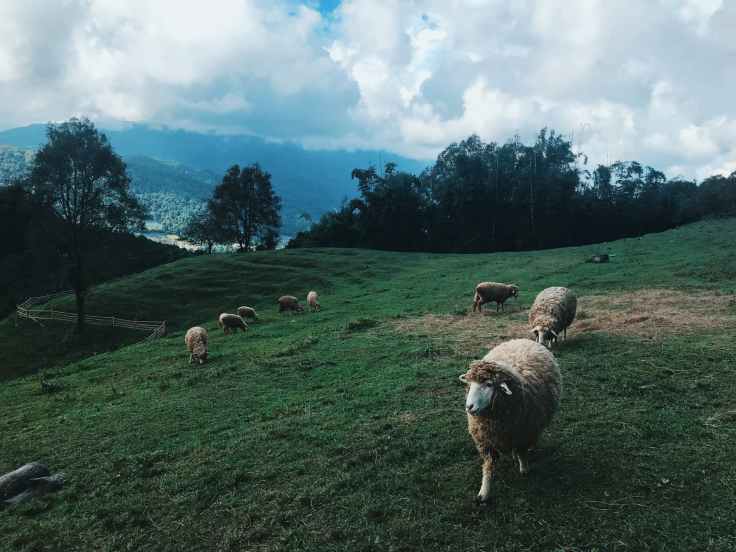
The Bible is filled with imagery of sheep and shepherds. Growing up, I lived in the countryside, but we never raised sheep, and I had little experience with livestock of any kind. We had one neighbor who had sheep, however, and he shared a lot of insight into why we should pay attention to what sheep can teach us about ourselves, and our God.

Photo by Trinity Kubassek on Pexels.com

Not only does God use the imagery of sheep and shepherds, He uses examples throughout the Bible of actual sheep and shepherds. Abraham, Isaac, Jacob, the sons of Jacob, David, and the prophet Amos– all were shepherds. When the Messiah was born, the first announcement went to shepherds in the fields, keeping night-watch over their flocks!

Jesus used stories of sheep and shepherds in his parables, as well. There is a lot to understand, and I am not qualified to teach anyone about shepherding, but there are several wonderful principles that don’t require a lot of in-depth knowledge:

  • Sheep NEED a shepherd. There are breeds of mountain sheep that live independently, but the Bible stories speak of domesticated sheep…they are “high maintenance” animals– they need food and water, shelter, protection, and a lot of guidance and supervision! We NEED God–He understands our situations, our weaknesses, and our strengths, far better than we do. He knows the future; He has a plan, and He provides all that we need. We may not see the road ahead–we may not see the green pasture or the still waters where He wants to lead us–but He IS the WAY, the truth, and the life (John 14:6), and we can trust Him to get us there.
Photo by Chama on Pexels.com
  • Sheep need to be sheared. Left unsheared, the sheep’s wool will become matted, filthy, and a potential source of danger and disease. The sheep cannot get rid of its wool on its own. However, once the old wool is sheared off, the sheep is clean, and new wool can grow. Not only does God provide for our immediate needs, He provides for our renewal and growth–physical, emotional, and spiritual growth. Sometimes, that means we need to be “sheared” of habits, people, or situations that have become “matted”, and filthy. We haven’t even noticed the change, and we don’t see the danger. God wants to free us from the “baggage” we accumulate, and help us experience new growth.
  • Sheep depend on others to stay safe, healthy, and fed–there may be “lone wolves”, but there are no “lone sheep”. God will bring us into “flocks”. We learn to eat together, travel together, rest together, live together, and follow our shepherd’s voice together. Trying to be a “lone sheep” makes for a lot of trouble!
Photo by Ekrulila on Pexels.com
  • Shepherds make great sacrifices to care for their sheep– they provide, protect, rescue, heal, guide, and clean their sheep. A good shepherd is watchful, faithful, caring, and gentle, even as s/he must be strong, brave, and fiercely protective, risking their lives (or even giving their lives) for their flocks. Jesus, our Good Shepherd, knows each one of us intimately– He knows how to heal and guide us. He wants us to recognize His voice above all others, and to stay close to Him. He died to redeem you and me!
Photo by Magda Ehlers on Pexels.com

May we trust our Good Shepherd today, and every day. May we spend time acknowledging Him as our loving and faithful Shepherd, and call out to Him– in praise, in adoration, in supplication, and in loving gratitude.

Blog at WordPress.com.

Up ↑