Have you ever noticed in reading through the Bible how often God shows up, not on the occasion of fanfare and praise, but on the occasion of a whimper? When all hope seems lost, and a heart is so broken it can no longer call out– when words are useless and all that is left is a dull, exhausted moaning?
God “inhabits the praise of His people” (Psalm 22:3), but He is also “close to the brokenhearted” (Psalm 34:18). We work so hard to get close to the heart of God, but sometimes, we need to be broken to actually get there. We need to experience the God who finds us in our failures and rescues us from disasters– even those of our own making. God loves us enough to come to us in our brokenness– and He loves us too much to leave us there. God is not a “fairy godfather” who will magically make our circumstances comfortable and painless. But He is a true Father, who will provide comfort and strength to get back up and face the future with hope and courage.
Long ago, a woman named Hagar was despondent. She was a slave who was told by her mistress to sleep with the master so he could have a son. Hagar got pregnant when her mistress couldn’t, and she became proud and disdainful toward her mistress. When she was punished for her arrogance, she ran away into the desert–a foolish and impulsive act, as she had nowhere to go and no one to support her or her unborn son. An angel found her by a spring of water and told her to return and submit to her mistress. Several years later, she and her son, Ishmael, were sent into the desert because of Ishmael’s contempt for his brother. Ishmael was near death, and his mother in despair. Not being able to watch her son die, she moved a short distance away and began to sob. But another angel came and showed Hagar a well of water. He reminded her that God had seen her the first time she ran to the desert, and He had heard her crying this time, too. Hagar was not a queen; she was not a warrior princess or the daughter of a noble. She was not righteous or innocent. She was a rebellious slave; the victim of a sinful scheme, but headstrong and rash. God did not stop her from running away; He did not give her victory over her mistress. But God rescued Hagar and Ishmael. And He blessed them both– on the occasion of a whimper. (See Genesis 16 and Genesis 21)
Today, don’t be afraid to whimper. Don’t pretend that everything is under your control– it isn’t. But be willing to look and listen for the ways that God will show himself. It may be in the words of a stranger; it may be in the beauty of a sunset; it may even be that song on the radio, or a cool drink of water in the middle of a desert. God doesn’t always rescue us from sorrow and pain. Sometimes He rescues us through it.
(Note: this is an edited and updated post from a couple of years ago.)
“What a fellowship; what a joy divine, Leaning on the Everlasting Arms…”
Bethel Church, Penn Twp., Michigan
Years ago, growing up in a small community, and attending a tiny rural church in southwestern Michigan, we sang this song often at church. As a child, I liked the tune, but had little idea what the song meant. In fact, when I was very small, before I could read, I misunderstood the lyrics– I thought the congregation was singing “wienies” on the everlasting arms. I made my grandmother laugh when she heard my interpretation! She helpfully corrected me. So I knew the basics. I knew the word fellowship– that was what we called the pot-luck meals and social times we had in the church basement. I knew that Joy was like happiness, only better. I knew that “divine” referred to God and Heaven, and Holy things. But I also knew that leaning was frowned upon– I was told to stand up straight, sit up straight, and never lean back on the two hind legs of the chair in class. How could there by fellowship, and divine joy in leaning? And what were the Everlasting Arms? It sounded like the name of a hotel. It was a long time before I began to understand the joy of leaning, or even falling into the “everlasting” arms of the Savior.
As I have lived, I have grown to understand and cherish these words. There IS a fellowship and a joy divine in learning to lean on the Everlasting Arms of Jesus; to experience the strength and peace that passes my own understanding when I trust fully in Him, instead of in my own plans, whims, dreams, or wishes. There is no shame in leaning on God– in fact, if we don’t learn to lean on the solid wisdom and faithfulness of God, we will slouch into bad habits, “fall” into false teaching, or simply collapse in our own limitations and weaknesses, much like a chair leaning on just two legs! And this fellowship is not only with my Creator, Sustainer, and Savior; it is with all the brothers and sisters around the world who have learned to trust Him, too. I can travel to foreign countries, with different languages and customs, and still feel the kinship and “belonging” with other Christians. It is deeper and more mysterious than just the recognition that we are fellow human beings. It goes even deeper than the love for others who are loved by God. It is the recognition that God’s Holy Spirit surrounds us, flows in and through us, strengthens us, and unites us IN HIM. We are fellow travelers; fellow workers; fellow members of a universal family– one that is more inclusive than nationality, race, ethnicity, language, ideology, or denomination. We can (and do) lean on the ONE who is eternally trustworthy, eternally faithful to walk beside us, empower us, comfort and heal us, and lead us home. And we can lean on each other, knowing that our mutual strength comes from Him.
I love worship services, and I’m thankful that we have an active church where people worship; where the Bible is taught and revered; where families and individuals are welcomed and loved. But I sometimes miss the old “prayer meetings” in the church where I grew up. Every Wednesday night, while the children were (supposedly quietly) playing games, singing songs, and listening to the great stories of the Bible, a faithful (and sometimes rag-tag) group of adults were upstairs in a huddle. Some pulled up chairs and sat in a circle; others knelt the whole time. They prayed for nearly an hour–prayers of thanksgiving and prayers of urgent needs; prayers expressing worship, and prayers expressing inadequacies and failures; prayers for the children downstairs, for other members of the church family; prayers for the community, the country, and the world. As I became a teenager and a young adult, I was privileged to join in. I watched wise, older men and women express their confidence in God’s provision, and pour out their hearts for their children and grandchildren. I listened to young adults asking for wisdom and guidance as they raised families and witnessed to co-workers. I felt the joy and grief and true “fellowship” that came when several hearts turned as one to God.
I have since attended many “prayer meetings”– some planned, some spur-of-the-moment; some held in churches; others held in homes or dorm rooms, even on street corners or grocery stores; some lasting only a few minutes; others lasting hours. I am blessed to be able to attend a weekly “prayer meeting” on Wednesday mornings at my local church. There is something mystical about communal prayer– listening and sharing in prayer with others. The prayers of God’s people are compared to incense– and communal prayer is like a delicately-balanced blend of fragrances, infusing the very room with blessing, and even a touch of Glory. (For more about how prayer is likened to incense, see https://the-end-time.org/2017/06/13/how-is-incense-like-prayer/) It is yet another miracle of the power of prayer, that we can combine hearts and voices to honor God; to lift up very human concerns to the One powerful enough to hold each one in the palm of His hand. It should not replace personal prayer and Bible Study, or communal worship services, but it is a wonderful practice for any Christian to “come alongside” in prayer with fellow believers. It is also humbling to think about how such a seemingly small act can have far-reaching consequences.
God “inhabits” the praises of His people (Psalm 22:3). When we show up and participate in communal worship and prayer, we get a greater sense of God’s presence, His power, His Glory, His Love, and His eternal purpose. What a Fellowship! What a Joy, Divine!
This weekend, my husband, our middle grandson, and I all participated in “Field Day.” This is a 24-hour simulation and contest for amateur radio (Ham radio) operators (like David and I) to test our skills and practice our hobby. Thousands of “Hams” across the United States and Canada spend this time trying to make as many radio contacts as possible. But the object is to try to do it under “field” conditions– many groups or clubs literally set up tents in fields during this time (weather permitting!) and use solar or battery power only. There are also ways to earn “bonus” points by setting up in a public area and teaching or training young people (like our grandson) or inviting other non-licensed people to transmit under supervision. The overall goal is to have fun and share the importance of amateur radio. At the same time, we’re testing both our equipment and our skill under situations that mimic an emergency, like an extended power outage or a natural disaster, when effective and organized radio communication may help save lives.
We aren’t trying to “win” the competition, but we do try to do our best– rising to the challenge. It was a lot of fun this year to see our grandson get excited about making contact with people from Canada, and many areas of the U.S. in states he has never visited in “real life!” In previous years, we have joined up with a local club, or invited friends or neighbors to contest with us. Each year, there is the triumph or making a “difficult” contact– someone from across the continent, or someone from a remote area. And every year there is the frustration of “the ones that got away”– listening in and finding the right frequency, but being unable to both receive AND send the message necessary for a valid contact
Every year during Field Day, I am reminded of how tenuous radio communication can be. Radios are the original “wireless” communication– the forerunners of our modern cell phones. Operators must “tune” their radios to pick up on the sound waves floating through the air. There are billions of sound waves, all floating around the atmosphere. We cannot hear them with our “naked” ears– and a good thing, too! We would never be able to distinguish all the noises that pass around and above us every moment. In fact, when radios pick up on just a single frequency at a time, much of what we hear is buzzing “static.” Most modern radios and cell phones use special equipment, such as filters and “repeaters” to find specific sound waves, translate them, amplify them “above” the static, and allow us to hear messages clearly. Field Day forces us to operate without a lot of these “helpers.” Voices and Morse Code transmissions must be carefully “brought out” of the surrounding static in order to receive even simple messages. And even if I can hear someone else’s message, they must be able to hear my response, or it isn’t a true “contact.”
Field Day also reminds me of prayer– and gives me reason to rejoice! Just imagine the overwhelming volume of prayer on a typical day! With over 8 billion people on the earth, even if only a tenth of them pray on any given day, that’s still millions of prayers all rising up and floating around the universe. And God hears them all! He doesn’t just hear the “noise” of prayer– He hears our hearts! He feels our pain– and our praise! In fact, the Bible even says of our praise, that God “inhabits” the Praises of His People (Israel– see Psalm 22:3) God rides the wavelengths of our worship! And He surrounds the soundwaves of our grieving. God doesn’t have to strain to hear us, or to understand the emotion behind our prayers. Praying is not like sending a message into radio airspace. We never have to wonder if God will be able to hear us through the static! We never have to know the frustration of screaming out into the universe and being lost in the noise.
But listening through the static on Field Day also challenges me…Am I “tuning in” to God’s messages to me? Do I surround myself with extra “static” as I go through my day? Or do I spin my dial, trying to find other voices; other messages to fill the space of my life? If God inhabits praise– Am I offering Him any dwelling space? Or have I filled it up with empty praises and pursuits? And, as God’s witness and ambassador, how well am I listening to those around me? Am I busy adding my “noise” to conversations when I should be “tuning in” to someone else’s need?
Today looks like a great day for a Prayer-themed “Field Day.” Time to test my communication with God– both sending Him praise and petition, and listening for His answer above all else! And it’s a great day for spreading the great news of God’s desire to listen to us– no matter what static we live in!
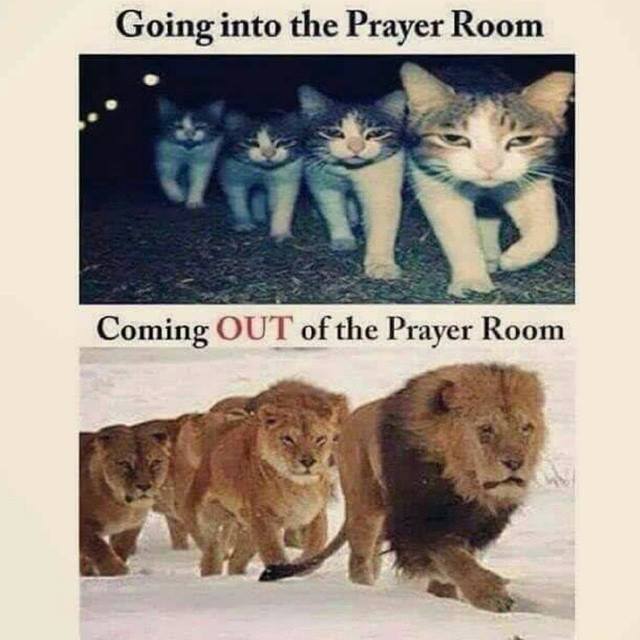
I attend a mid-week prayer meeting. Sometimes we have a dozen or two in attendance. The other day, we had just five. But God shows up every week! There is a mystical, spiritual quality in communal prayer– voices raised in praise, thanksgiving, and intercession; voices raised in agreement, in harmony, and in support. We spend nearly an hour in prayer; some stay after to pray longer, some stay silent for most or all of the hour, just listening and giving spiritual support by their presence. We also spend some time reading scripture, sharing updates on missionaries and community outreach programs, or updates on requests from previous weeks. And, in listening to others pray, we can “hear” their hearts and get to know them a little better. But this is not meant as a social hour. We are there for one purpose– to pray. It is a commitment to pray faithfully, to pray consistently, and to pray humbly and gratefully.
We are blessed to have the opportunity to gather publicly and freely to pray. But what about those who cannot? Not everyone has the freedom in their weekly schedule to attend our prayer meeting (or other meetings that might be scheduled throughout the community). Not everyone lives in an area where public prayer is safe and encouraged. Some people are shut in. Some face persecution for their faith– public gatherings increase the risk of violence and arrest.
Most prayers happen in seclusion and isolation. And sometimes, this can lead us to believe that personal prayer is a small thing. One silent prayer in a room somewhere in Michigan may seem tiny and frail. It can seem puny and ineffective. And praying in isolation or under threat can feel even smaller and lonelier. We trust that God hears us, but we can feel so weak, so ineffectual. We long for support and communion. Praying in a group “feels” stronger, and more “important,” surrounded by fellow believers and hearing the voices chiming in with praise and heartfelt requests.
I value and appreciate meeting and praying with other believers, but most of my prayers are personal– said in silence in my own home. I pray by myself, often with my Prayer Journal in front of me; sometimes, just lying in bed, or sitting at my workspace. Yet, I never pray alone! Jesus, in The Lord’s Prayer, taught His disciples to pray to “Our Father.” But He must have known that they would also pray personal prayers. He did not teach them to say “My Father,” or “My God.” Surely, when we are alone, we can use those terms (as Jesus Himself did in the Garden of Gethsemane). But I think Jesus was acknowledging that God “inhabits the praise of His people” (Psalm 22:3)– and that when we pray, we are mystically and spiritually joined with God– Father, Son, and Spirit– and also with the family of other believers. And their prayers join with ours. When I pray, alone in a darkened room or closet, I may be physically separated from believers in Pakistan or Colombia, but I am spiritually linked with them (and they with me) in ways I don’t fully comprehend. I can’t hear their prayers; I can’t understand their language, and I don’t know their needs. Nor do they know mine. But God knows them all, and knits them all together in ways that bring Glory and Honor to Him! Praying with our Wednesday group (or any time I pray with other believers) helps me better feel this connection, but it goes beyond what we experience in corporate prayer. None of my “puny” prayers is lost in the fugue of a hundred thousand other prayers prayed in that moment– instead, they blend in with other silent cries and unspoken expressions of praise from all over the globe. They rise up like the notes of a never-ending symphony!
Prayer is so much more powerful and deeper than we imagine! Today, let’s pray–together–knowing that whatever our situation or circumstance, we will never pray alone!
















 Pursuing Prayer