God’s Mysterious Ways

I write about prayer as a pursuit. Prayer is, at once, both simple and mysteriously complex.

It is a simple thing to pray–to direct one’s thoughts and words toward God. It is no more difficult than having a conversation with another person.

And yet it is not the same as talking to another person. God’s ways are not our ways. He is Holy, Sovereign, and Almighty. We come to God in need, but God has no “needs.” He has no need to confide in us, or ask for our help, or plead with us. Instead, He chooses to share with us His promises and His plans. He allows us to be part of His great work, and asks us to be His hands and feet and voice in this world. He pleads with us to come and spend time with Him and walk in relationship with Him.

I spent some time recently reviewing the life of George Muller. https://www.georgemuller.org/ George Muller was born over 200 years ago. He was, by his own admission, a liar and a thief in his early years. But when we came to Christ, his life changed dramatically. His life was a series of miracles that attested to his great faith and active practice of prayer. Muller founded several orphanages in England, and he did all of it through prayer. He never did traditional fund-raising: he never asked anyone for money or donations, he didn’t take out loans, he didn’t find “partners” or “sponsors” to pay for any of the needs. He simply prayed. He prayed for money to buy buildings. He prayed that God would send workers. He prayed for food and clothing and furniture that the children would need. And he vowed to take in any (and as many) children who came.
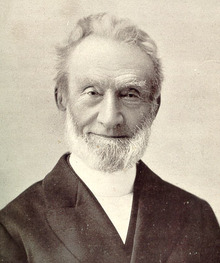
The stories of George Muller’s faith are legendary. He prayed for money to start one orphanage– he ended up with enough for several! He prayed for supplies– people came and gave furniture. Milk wagons broke down and the milk was donated to the orphanage. One story states that there was no food one morning. Muller prayed. Shortly afterward, he went to the door, and there, on the doorstep, lay a 50-lb. bag of rice. No one knows who left it or how it got there. God showed up in miracle after miracle in Muller’s life. And that doesn’t mean that his life was without struggle or heartache. He agonized over friends who were unsaved; he prayed for them over a period of years. One close friend remained unsaved until after Muller’s death. He experienced the heartbreak of losing his wife. But he was consistent in his witness about the power of prayer.

Muller prayed about everything– as we all should, all the time. (Philippians 4:6, 1Thessalonians 5:17) Little, seemingly unimportant things; huge, seemingly impossible things. God cares about them all. He is the Almighty– there is nothing so big (or so tiny) that He cannot do it! There is no heartache or struggle that He doesn’t want to hear about! Nothing can separate us from His Love (Romans 8:38). No matter what we’re going through, we can bring it to God.

But God’s ways– powerful, compassionate, miraculous– remain mysterious. We can trust that God will hear our prayers. But we cannot predict how, or when, or if He will let us see the answers we seek. Nor can we predict how God will use our simple prayers to impact the world around us! George Muller’s orphanages helped more than 2,000 homeless children survive, grow, and in many cases thrive and contribute to the lives of countless others. And the stories of his faith and the hundreds of small but significant miracles he experienced have inspired generations of people for more than a century and a half! And his story is not unique–we have an amazing “cloud of witnesses” (Hebrews 12:1) throughout history testifying to the power of God to hear and answer prayer in mysterious, miraculous, even mischievous ways! From finding lost keys to feeding multitudes; from protecting kittens to rescuing captives; from stretching budgets to saving souls– God’s ways are mysterious, Holy, and wholly good.

Prayer can be such a simple thing– and it can have eternal impact!

Choosing to Pray

Yesterday, I voted in a primary election. In a few months, I will vote in a general election for President. I live in a nation of choices. I can choose to vote for any of the listed candidates, or I can write in a name. I can choose not to vote at all. I can choose how to spend my money– I can invest, purchase, pay my bills (or not), gamble it away, or give the money to charity. I choose what to do with my time– I can sleep all day, go to work on time or arrive late, I can spend all my time on-line, or I can binge-watch movies or TV shows. I can keep a consistent schedule, or I can take each day’s time as it comes. I can choose where to go– I can stay indoors in my apartment, I can walk all over town, or I can get in my car and drive to another city. I can choose my attitude and outlook; I can choose my political and social stands, and I can choose my beliefs. Others may apply pressure and coercion, but they can’t take away my right to choose.,. For better or for worse!

However, my choices have consequences. If I choose to act against the law of the land, it is very likely that I will be caught and punished. I may be fined, or jailed. I may face a trial. In many countries, I may be executed for doing things that would be allowed in my home country. If I choose not to pay my bills or not to go to work, I may face economic hardship as a result– late fees, loss of a job, and a difficult time finding future employment. If I choose to eat only junk food, or no food at all, I will experience health issues. The choices I made today in the voting booth, and the choices I will make in November will have consequences– most of which I cannot predict with any accuracy. I think I know what will happen– and others may predict dire consequences if I don’t vote “their” way– and my one small vote may not seem consequential, but it counts! Even my small actions have a ripple effect on the rest of my life, and the way in which I conduct it. I will either “show up” or I will “stand back.” I will either accept responsibility in the small things and large, or I will try to blame others. I will practice self-control and discipline, or I will drift through life at the whim of emotions, influences, peer pressure, and deceptions.

When it comes to prayer, I also have choices. There are times when I feel “compelled” to pray– circumstances beyond my understanding or control will cause me to want to cry out for divine help. Hearing about others’ needs make me want to ask God to work in their circumstances. Sometimes, I feel waves of gratitude and worship that cause me to sing and praise God for His character, His faithfulness, and the blessings He has poured out in my life. But I am not required to pray. I choose to pray. Sometimes, my choice to pray is simple, natural, and automatic. At other times, it is a sacrifice to pray. Prayer is more than just “an option” in my life. It really is a pursuit. I choose to keep a prayer journal. I choose to focus on prayer every day– both in practice and in testimony (as in this blog entry).

So today, I will join with others this morning in corporate prayer. I will pray alone at home. I will pray throughout the day for my community, and for individuals as they come to mind or show up in my prayer journal. And some of the prayers will come naturally; others will require me to dig deep, to confess my own failures, and admit my need for God’s Grace, His Wisdom, and His Strength.

And the consequences? Well, I can’t predict how my prayers may impact my own life or the lives of others. I don’t know how God will choose to answer my prayers. I don’t pray because God always does what I want– I trust Him to do what is BEST; and I have learned that His timing and His ways ARE the best!–but I pray because I know it is the best and first action I should take in any situation. I’m not perfect in prayer. I don’t always pray first. I don’t always listen for God’s answer when I DO pray. And I also know the consequences of NOT praying– worry, confusion, anger, restlessness, disappointment, and more. Oh, I may not experience all of these things instantly. But eventually, my choices and their consequences lead to frustration when they are not coupled with prayer, trust, and obedience.

I hope you are praying, trusting, and following God today. I hope that is your choice every day. God will not force you to come to Him. But He is ALWAYS right there when you do! Your choice to pray may not change the world instantly, but it WILL have consequences!

When I voted yesterday, I got a sticker, proclaiming to everyone that I had made the choice to vote. What might happen if Christians (myself included) were bold enough to proclaim our choice to pray every day and in all circumstances!?

Give Thanks!

At least once each month, I want to share some practical thoughts about pursuing a life of prayer. Since we are in the Thanksgiving season, I thought I would share some ideas about giving thanks.

It’s easy enough to say, “Thank You!” when we receive a gift or someone does something special for us. After all, it’s just two small words, and they are (usually) welcome words at that. But what are some practical ways to grow in our expression of thankfulness and gratitude this season?

  • Of course, we can make a list– “Count Your Blessings”– of all the things we have to be grateful for. But what do we do with the list AFTER we write or type it out? What are some ways to keep a running list of blessings? In what ways can you keep a list visible and interactive? Keep a special journal. Challenge yourself to fill it with all the things you have (tangible and intangible). Keep a whiteboard where the family can add things each week. Can your family fill the white board? Can you fill an entire notebook?
  • Make thankfulness shareable each day. Thank the cashier at the grocery store. Thank your children when they go above and beyond (and see if it doesn’t happen more often!) with their chores. Thank your parents. Thank your spouse. Thank your pastor. Point out to others when there are things that make you grateful– a beautiful day, a favorite sweater, a good meal at a restaurant (or at home!) It will naturally grow thankfulness in your prayer life if you are growing thankfulness in your other relationships– and vise versa!
  • Demonstrate thankfulness– practice random acts of kindness. Be an encourager. Give compliments freely. Donate. Volunteer. Take positive action. You might give OTHERS a reason to be thankful, as well.
  • Seek out gratitude. On days when it seems hard to give thanks, look for it. Look backward– remember better days, and God’s faithfulness in other hard times. Look forward– look at the promises of God for the future. Look sideways– rejoice with those who rejoice. Instead of comparing your lot with others, join in their happiness. Look for ways to be glad for others, just as you would want them to join in your happiness. This is easier to write than to put into practice, but practice will make it easier to do.
  • Practice starting prayer with praise and thanksgiving. It is so tempting, especially when we are facing trials and an unknown future, to start our prayers ASKING, instead of ADORING. It won’t change your situation, but it will change your attitude when you begin with THANKS!
  • Break down your big “thank yous” into little ones. “Thank you for my house..” can become “Thank you for the floors and the roof and the bedroom and the kitchen and the dishes in my kitchen and the tub in the bathroom and for running water…” You get the idea. It will amaze you how detailed God is in meeting ALL our needs!
  • Practice the art of “letting go” of what you do NOT need, and keeping what you will actually use. How much of your clutter can help others? How much stress comes from hanging on to things we no longer need or use? There are many websites and books on this topic; some from a Buddhist perspective, but the idea is valid for all faiths. Jesus said, “Where your treasure is, there will your heart be also.” Matthew 6:21 “Seek first the kingdom of God and His righteousness, and all these things will be added to you.” Matthew 6:33 It is possible to have TOO MUCH to be thankful for! And it is possible to be more thankful for less!
  • Break the complaining habit! Whenever you find yourself complaining, try to stop and replace your complaint with a thank you for something else in your life. Having a bad hair day? Thank God for comfy shoes! Having a difficult day with a teenage child? Thank God that you survived your own teenage years!

Thanksgiving is so much more than just a holiday. It is a way of life– a pursuit that relates very directly to the pursuit of Prayer!

Prayer and Fasting

I had to fast overnight for some bloodwork I had done this morning. No food for 12 hours; no water for 8 hours before the blood draw. It shouldn’t seem like such a difficult thing, but at 9 or 10 p.m., I imagined I smelled food. My mouth watered– and then it felt dry. I felt woozy and weak. Surely I could have just a cracker or some orange juice, right? But no, I finished the fast and rejoiced to eat breakfast after the blood draw was complete. And simple scrambled eggs tasted sooo good! Oddly, I have often gone several hours without food and without all the imagined side effects I felt last night. The actions were the same, but the focus was on what I was doing, not what I was missing.

Fasting has become popular in recent years. I know several people who practice intermittent fasting for weight loss and other health benefits. Others fast for religious reasons (other than prayer); some people give up certain foods ritually, for Lent or other festivals. Some even fast in dangerous ways (anorexia, etc.) Fasting is usually about our relationship (sometimes an unhealthy relationship) with food.

Prayer, on the other hand, is all about our relationship with God. And when the Bible speaks of Prayer and Fasting, it is also about our relationship with God. The Bible gives many examples of fasting– even “extreme” fasting. Moses, King David, Jesus, and the Apostles all practiced it. Sometimes entire groups (churches), cities (Nineveh–see Jonah, chapter 3), and nations (Israel/Judah) fasted. The Bible also gives us many reasons to do fasting, including repentance of personal or national sin, deep personal struggles, and focusing on a single issue, such as the unsaved, the persecution of fellow Christians, seasons of famine, or ongoing injustices. But the Bible isn’t specific with guidelines and rules about fasting, because, like prayer, it is primarily a pursuit. It’s not about the extremes or the number of days, or the amount of food we “give up.” It is about the pure pursuit of God’s sufficiency. God is not impressed by whether we fast for one day or forty; He does not count the number of calories we might have consumed or the amount of weight we lost. He doesn’t measure the strength of our will power or our “success.” He isn’t impressed by posturing and virtue signaling. What He does ask is that we pray with complete focus and integrity, without the distractions that food, entertainment, and even sleep can sometimes become.

We can fast for hours or days– miss one meal or fifteen–and still “miss” the blessing of prayer, because we are focused on what we are doing (or not doing) instead of focusing on what God is doing. We can also “fast” in ways that have nothing to do with food– turn off the TV or phone, retreat from crowds and busyness, even “fast” from sleep! The point is not that WE are “better” for fasting, but that fasting is “better” for US!

Today, consider a small “fast”– replace a coffee break, snack, meal, hour of social media, or that extra 15 minutes of sleep with some time alone and wholly abandoned to God. Not only will we come away refreshed and not “missing” whatever we traded, but we will more fully enjoy those same activities or foods when they take their rightful priorities. Remember, prayer and fasting is not a contest or a ritual, it is a pursuit and an adventure! Enjoy it!

Some thoughts:

  • 1) Fasting is as individualized as praying. There is no perfect “formula.” But there are several helpful suggestions. You can set a time limit (one day; 12 hours, etc. without food or a certain activity) or a food/activity limit (only one meal a day for seven days, only one television program per night for a week). You can plan days or weeks ahead to fast for a definite period, or you can decide spontaneously to start fasting until you feel led to stop. One caveat– Fasting is not a game. It IS a commitment, and shouldn’t be done without a real desire to get closer to God.
  • 2) Having said that, fasting isn’t about your will power, or success/failure. Sometimes, circumstances will prevent you from completing a planned fast. Certain health issues or family situations may prevent you from fasting for a day or more. Sometimes you will fall short of the goal you set. Don’t let that stop you from trying again, or trying differently. God isn’t about perfection on your part– He IS about helping you grow stronger and more complete as you continue to walk with Him.
  • 3) Fasting is personal. It isn’t about looking virtuous, posting about your struggles, or comparing yourself to others. (See Matthew 6:16-18) That doesn’t mean it can’t be done as a group. But group fasting should be about a single focus or topic, not about making everyone in the group conform to a preconceived expectation. There is great encouragement to be found in praying as a group, and some encouragement in fasting as a group, but remember, fasting is between you and God, not you and the group, or you and all your Facebook friends.

  • NOTE: At least once a month this year, I want to offer some practical suggestions on how we can better pursue a life of Prayer and living the Christian Life. I hope this post gives each reader something to consider.

Mumbled Prayers

As I write this, I’m having an “off” day. I don’t feel well. I don’t particularly feel like worshipping or saying joyful prayers. I don’t even feel particularly like saying a prayer. But I will pray– even if it’s just a mumble or a groan.

God meets us where we are. He is not just the God of the joyful and productive; the “shiny, happy people,” or the ones who feel like overcomers. God is the God of the hurting; the God of the lonely; the God of those who are sad, tired, and feeling “off.” Of course, God doesn’t want me to go through life this way. I will have better days– days of accomplishments and celebration. But God does not leave me alone when I am grumpy, upset, or “blue.” He is right beside me, surrounding me with His presence. So I can mumble today, even if I sang yesterday or cry out in anguish tomorrow.

Prayer is a pursuit for every day– not just when we “feel like it” or when we are desperate for answers. It is a discipline. If I choose not to pray today, I may more easily choose not to pray tomorrow, or the next day. And God will still be waiting there, patiently, whether I mumble or give Him the “silent treatment.” Because prayer is more than just a pursuit and a discipline. It is part of a relationship. God already knows me intimately, but He wants ME to know HIM as well. And He wants me to know and experience His Love– even when I don’t feel it; even when I know I’m not very loveable. And that knowledge–that enduring relationship–will carry me through days like today. I can mumble, or whisper all the lies and sadness I feel on a particular day, but God’s presence will break through and wrap me in the cloak of Truth–the everlasting Truth of His Love and Faithfulness. Feelings will pass, but Faithfulness endures. And I pray to the God who is Eternally Faithful–even when I am temporarily feeling faithless and far away.

God is an expert at turning mumbles into melodies!

“Praying” Hide and Seek With God

A strange image popped into my head the other day while praying with our Wednesday morning prayer group from church. I was trying to express the amazing paradox that we are being pursued by a God who is omnipresent, while seeking the same omnipresent God. And the image God gave me was one of playing a game– “Peek-a-boo” or “Hide and Seek.” Of course, prayer is not just a game– it is nothing less than communicating with the Sovereign Lord of the Universe! But God delights in our prayers, and He delights in delighting us as we learn and experience new aspects of His Character.

I love to play “Peek-a-Boo” with babies and toddlers. They love the idea of being “discovered” and “finding” someone. There is a moment of supreme joy in finally seeing oneself in the eyes of the beholder– that moment of recognition and reaction to being the focus of someone’s attention–the joy of intimate connection, “I SEE YOU!” But the game only brings joy if both of us are present and interacting. It brings no joy to a baby to see me staring off into space, or glued to my cell phone. The baby might be intrigued, or even comforted by my nearness, but there is a deeper thrill when she knows that my eyes will shine as they are revealed– looking directly at her! And I get great joy from seeing the baby’s delight.

The same is true of “Hide and Seek.” Yes, the idea is to hide from sight–for awhile. But what fun is it to hide and never be found? What fun to search for someone who has gone away and has no desire to be discovered again? The joy of the game is in that moment of discovery and being discovered– even though we know the other person is somewhere close by, there is that moment of re-connection that brings a jolt of delight. AHA!! I have found you! AHA! You searched for me and found me!

Photo by Nicola Barts on Pexels.com

This is the great tragedy of Sin. Sin causes us to want to hide and NOT be found. (See Genesis 3:8-10). We live in shame and fear, dreading the thought of God finding the “real” us, the secrets we carry, and the ugliness of our hearts. We are frightened by the thought that God is omnipresent– that He sees us; that He sees THROUGH us! We do not want to “Face” God’s justice, and see disappointment and anger in His face. Instead, we want to run away, to cover our eyes, if He will not cover His.

Conversely, this is the great joy of being a Christian. We don’t hide from God’s presence; instead, we turn to Him in delight and recognition. We pray to BE found and to be seen! Finding God, and being found BY Him, involves no fear, no condemnation (Romans 8:1), and no shame. God sees us– all our secrets and shame– through the blood of Christ’s redemption. We are “Born” again– like babies, we can revel in the connection with Our Loving Father. Like a child waiting for the “boo” in Peek-a-Boo, we anticipate the day when we will see Him face-to-face in all His Glory; in the meantime, each glimpse of His Grace, each revelation of His Faithfulness, builds our Hope and our Joy, excites our anticipation, and makes our Heart yearn for the future.

God is omnipresent. His spirit is all around us all the time. As Christians, His Spirit is indwelling– He is not just all around us, but He lives and works IN us and THROUGH us! And yet, God delights in those moments when we turn away from the world around us to focus on just Him. In the same way, even though God is everywhere, He seeks after us and pursues us with a passion and devotion that knows no limits– “Here I am!” “I SEE YOU!” “You are the one who makes my eyes shine!” “I LOVE YOU!”

Today, as you turn away from the world to focus on the Lover of Your Soul, may you find that incredible delight in recognizing His Presence for what it is– Divine, Eternal, Limitless, and Loving.

Developing Discipline

In my last post, Pursuing Discipline, I spoke of journaling and being consistent in prayer as part of learning discipline. Discipline is an important part of the Christian Walk; one that we don’t always talk about. Discipline is difficult. Discipline is developed over time. And I want to be clear that keeping a Prayer Journal, like other forms of discipline, will take time and effort.

Photo by RUN 4 FFWPU on Pexels.com

My current prayer journal is the result of years of effort, changes, failures, and baby steps. Several years ago, I found, in a Christian Bookstore, an item called a “Prayer Journal.” It was pre-printed with wonderful facts about different unreached people groups to pray for each week of the year. It was set up in a “planner” format, with each week spread out on a double page, and areas for each day to write in appointments, notes, personal prayer requests, etc. I loved it. But it was specific to that year. As the year was drawing to a close, I went back to the same bookstore, eager to get the next year’s edition. I could not find it.

Photo by cottonbro on Pexels.com

I thought, “How hard could it be to create my own?” HARD! I did not have the resources to update the information about various countries. I did not like many of the other “planners” I came across. I wasn’t satisfied with apps and on-line planners and calendars. And I wanted to add space for local and personal prayer requests, including all the birthdays and anniversaries of people I know. I wanted a format I could use from year to year, so I wouldn’t have to enter the information over and over again. And I wanted a format where I could see it all, spread out in front of me.

Photo by Eva Bronzini on Pexels.com

More than twenty years later, I began using the system I currently use– four notebooks for each quarter of the year. Each page is a single day, with the names of people celebrating birthdays, anniversaries, or (in some cases) families mourning the loss of a loved one on that day. In the top corner, I have the name of a country, city, community, or geographical area. These are my daily focus points. In the front of the notebook, I have a reminder of the “Prayer Points”– those topical areas for each day of the week. The bottom half of the page is free for me to add in immediate prayer requests– hospitalizations, those who are traveling or moving, etc.. Each “new” request I add at the bottom gets “tagged” with the year of the request. This way, the journal can be used year after year, until I run out of space for requests, or it wears out! I leave the back of each page for answers. Some days, I go back and look at prayer requests from the previous week and write in the answers or progress. Sometimes, I am reminded to update the request. Sometimes, I see a request from a previous year, and I have not yet written the answer, or there has been an update. In this way, I can help focus my daily prayer time in the morning and/or evening. Of course, I can pray about anything, any time; this is just a way to pursue a more disciplined approach to prayer.

For anyone wanting to use or create a Prayer Journal– please take time to build it prayerfully and deliberately. But also be prepared to “fail.” I went through several notebooks, purchased planners and ready-to-use prayer journals before I found one that works well for me. And even now, there are days when I do not open my journal and use it as it was intended. It is not, after all, a ritual or a code to follow. Prayer is a pursuit– but it is just one part of the pursuit of a closer relationship with God. Disciplined prayer helps me focus on God, helps me understand more of His Character, and helps me build our relationship. Perfect prayer is not the goal, but building on prayer is the objective toward reaching the goal. Part of the building of character and discipline is the journey!

When Jesus’ disciples asked Him to teach them to pray, He did not give them a formula for a prayer journal. He did not give them a system for prayer. He gave them a very simple sample format. But Scripture gives us several other examples of prayers– long and anguished, poetic and joyful, even quick bursts of panic or exasperation. Prayer is far too complex to boil down to a single formula or system.

Photo by Luis Quintero on Pexels.com

I hope that what I write here helps you on a journey to discover the complexities of prayer. I hope that you, like me, will draw closer to God as you pursue ways to think about and to practice praying. Your journey, and your journal, will look and function far different from mine. But I hope you find one that helps you grow in discipline, in compassion, in knowledge, and in character. As for me, I will be turning my focus on East Timor, my nephew (who is celebrating his birthday today!), and business and financial issues. And then all the other things on my heart throughout the day! Because God is always listening, and God is always everywhere!

Running the Race

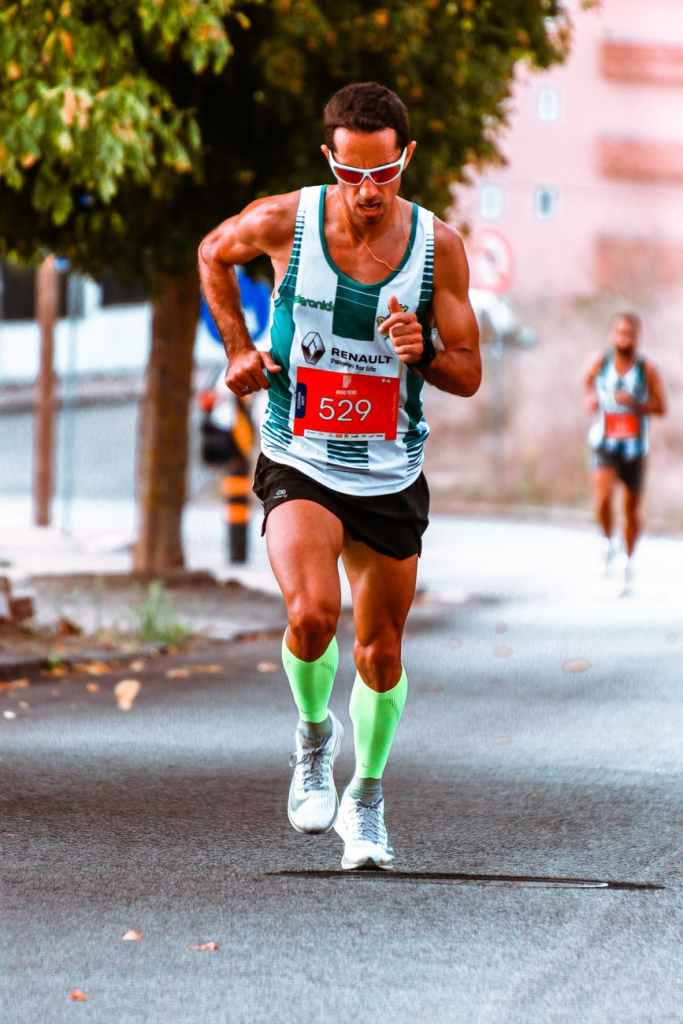
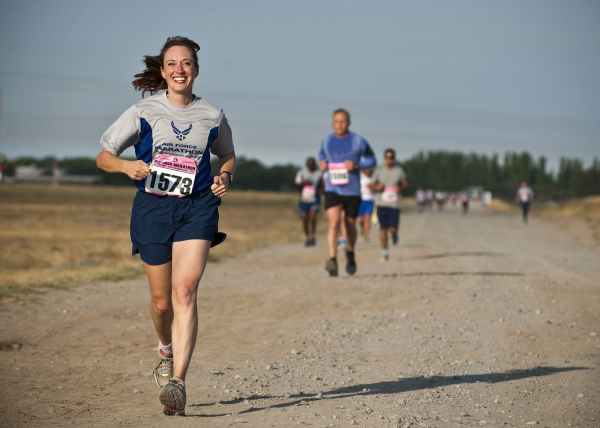
I am NOT a runner. If you ever see me running, I’ve either just encountered a snake, or there’s a wild animal chasing me. So I don’t know a lot about running a marathon, or even a 5-or 10-K race. Even in my daily life as a Christian, I prefer to use the term “Christian Walk!” But the Bible uses the imagery of a race to describe the Christian life. In our pursuit of Christ-likeness, including our pursuit of prayer, we need to think like a runner.

Photo by RUN 4 FFWPU on Pexels.com

For those of us who don’t run, this may pose a bit of a challenge, but the Bible gives us clear principles that provide good guidance.

  • Keep moving forward: “12-14 I’m not saying that I have this all together, that I have it made. But I am well on my way, reaching out for Christ, who has so wondrously reached out for me. Friends, don’t get me wrong: By no means do I count myself an expert in all of this, but I’ve got my eye on the goal, where God is beckoning us onward—to Jesus. I’m off and running, and I’m not turning back.” (Philippians 3:12-14 The Message) Runners don’t worry about what is behind them. They are focused on the goal– reaching the finish line. We need to stop focusing on our past, or the anxieties about the road ahead, and keep our focus on the ultimate goal.
Photo by RUN 4 FFWPU on Pexels.com
  • Travel light/Get rid of the baggage: “Therefore, since we are surrounded by such a great cloud of witnesses, let us throw off everything that hinders and the sin that so easily entangles. And let us run with perseverance the race marked out for us..” (Hebrews 12:1 NIV) What is weighing me down, that I need to let go of, if I want to keep running with endurance? I wrote earlier this month about the expectations attached to the “model” woman in Proverbs 31. Expectations, guilt, unforgiveness, shame, wanting to please other people, even our own self-talk can weigh us down, slow us down, and wear us out. It’s time to let go!
Photo by RUN 4 FFWPU on Pexels.com
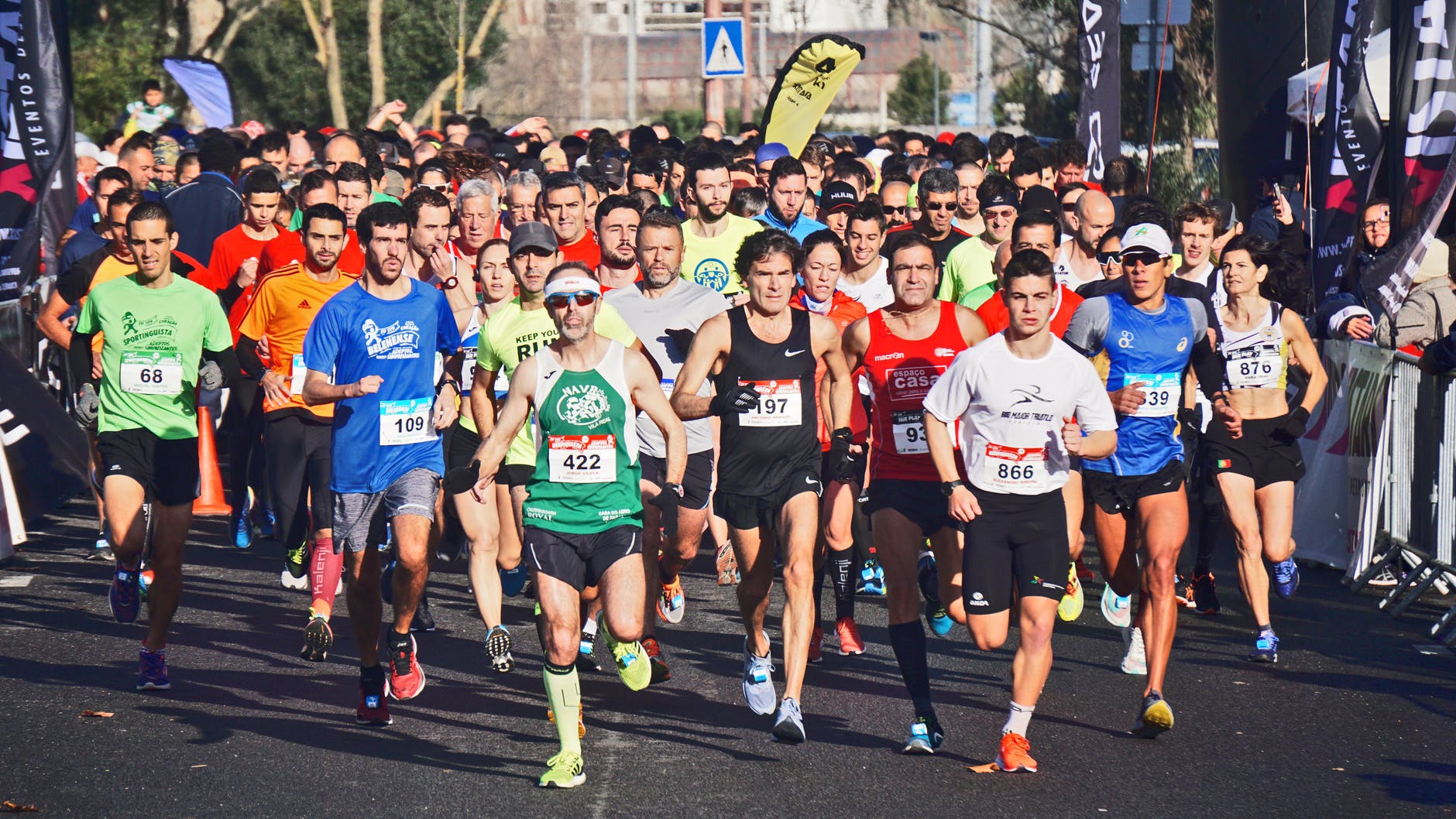
  • Run with the pack: Running alone can be good for meditation, but we need the challenge and the encouragement of others if we want to train and grow stronger. Reconsider the passage I quoted above in its larger context: “Therefore, since we are surrounded by such a great cloud of witnesses, let us throw off everything that hinders and the sin that so easily entangles. And let us run with perseverance the race marked out for us, 2 fixing our eyes on Jesus, the pioneer and perfecter of faith. For the joy set before him he endured the cross, scorning its shame, and sat down at the right hand of the throne of God. 3 Consider him who endured such opposition from sinners, so that you will not grow weary and lose heart. (Hebrews 12:1-3 NIV–emphasis added) We need to surround ourselves with companions, role models, teachers, friends, and others who can encourage, sharpen, comfort, and help us in our pursuit. And we need to remember that NO challenge or opposition we face is unknown to Christ. He is our ultimate role model, and, along with the Holy Spirit, our greatest coach!
  • Run/train with purpose: “25 Everyone who competes in the games goes into strict training. They do it to get a crown that will not last, but we do it to get a crown that will last forever. 26 Therefore I do not run like someone running aimlessly; I do not fight like a boxer beating the air.” (1 Corinthians 9:25-26 NIV) I know many people who “know” a lot about the Bible; they’ve grown up in the church or attended seminary; they’ve memorized scripture or studied theology– only to leave the church and their faith. I know many others who have a “faith” that bears little resemblance to the Bible’s teaching– it is based mostly on their “feelings” about God and a “truth” that is relative to their circumstances and changing emotions. Pursuing the Christian life involves discipline– being a disciple–and that involves all areas of life– studying the Bible, and putting it into practice. It’s not enough to “know” about doctrine or to “feel” like a Christian. We must pursue Christ-likeness in our words, prayers, habits, relationships, etc..
Photo by RUN 4 FFWPU on Pexels.com
  • Don’t run on “no fuel.” “29 He gives power to the weak, And to those who have no might He increases strength. 30 Even the youths shall faint and be weary, And the young men shall utterly fall, 31 But those who wait on the Lord Shall renew their strength; They shall mount up with wings like eagles, They shall run and not be weary, They shall walk and not faint.” (Isaiah 40:29-31 NKJV). It is tempting to run on an empty stomach (see traveling light above), or to start running without stretching or warming up. Anything we do in our own wisdom and power– even “good” things like prayer and Bible study, can leave us empty and worn out. We need to come back to our source of wisdom and power–(See Hebrews 12: 2-3 again!)
Photo by RUN 4 FFWPU on Pexels.com

Running a race isn’t easy. Walking through life is a challenge, too. Pursuing Christ-likeness in our habits, including our prayer life, takes dedication, discipline, guidance, and endurance. But God is faithful to provide all that we need to finish the race and gain the prize!

I Stand At the Door and Knock

I was being pestered by telemarketers the other day, and it struck me that God is the exact opposite of a telemarketer. Telemarketers call, generally when it is inconvenient, to sell you a product you did not know you even wanted! They may ask polite questions, but their goal is not to help you– rather, their goal is to sell you their product. They may have your name from a list (they usually slaughter the pronunciation of mine) , but more often than not, they simply call your number at random. They’ve never met you, nor do they intend to develop a long-term relationship with you. They are not interested in your family, your background, or your most pressing needs.

Photo by MART PRODUCTION on Pexels.com

God is not a telemarketer. He isn’t trying to “sell” you anything. He cares deeply and personally about who you are, and what you need. He knows you– even better than you know yourself! And He says, “Behold, I stand at the door, and knock: if any man hear my voice, and open the door, I will come in to him, and will sup with him, and he with me.” (Revelation 3:20) He doesn’t say that He will make an appointment to come to your door at His convenience. He doesn’t say that He will pound on your door and insist that you answer. He doesn’t say that He is there to make you a “limited-time offer you won’t want to miss…” The image in Revelation is that of a close friend who is always as close as your doorstep and waiting to fellowship with you.

Photo by Jack Sparrow on Pexels.com

The wonder of prayer is just that– God is ALWAYS, ALWAYS available and ready to listen, comfort, protect, encourage, forgive, advise, and just “BE” present. He invites Himself, but waits for our response to His gentle knock. He doesn’t walk away in disgust when we pretend we’re not at home. He doesn’t break in to our house, or peer through the window or blow up our voice mail box with frenzied messages.

Sometimes, WE are like the telemarketer– calling on God, insisting that He come to our rescue, or answer our doubts and questions, only to speed off without so much as a “Thank you.” And God still waits on the doorstep, waiting to come in and “sup” with us. So often, we have an agenda; we believe that God must have one, as well– that He wants a certain phrase or certain action, and then He will “go away” again, satisfied that He has “made a sale.” But God wants us to walk with Him in relationship (see Genesis 5:21-24; Genesis 6:8-9; Micah 6:8; Matthew 9:9; John 8:12; John 10:27; 1 Peter 2:21, etc.) In this sense, prayers is not an activity, but a pursuit and a way of life– an ongoing conversation between companions along their journey.

Photo by Alexavier Rylee Cimafranca on Pexels.com

May we enjoy today’s journey and welcome the company of the One who created us, pursued us, redeemed us, and who loves us best!

Blog at WordPress.com.

Up ↑