Full Disclosure

I like to know things–I like to solve puzzles, figure out mysteries, learn trivial facts.  I want answers.  So when I go before God in prayer, I often ask questions.  Why is this person suffering?  When will their suffering end, and how?  Where were you in this disaster (as though God had stepped out for a minute and wasn’t aware of what happened)?

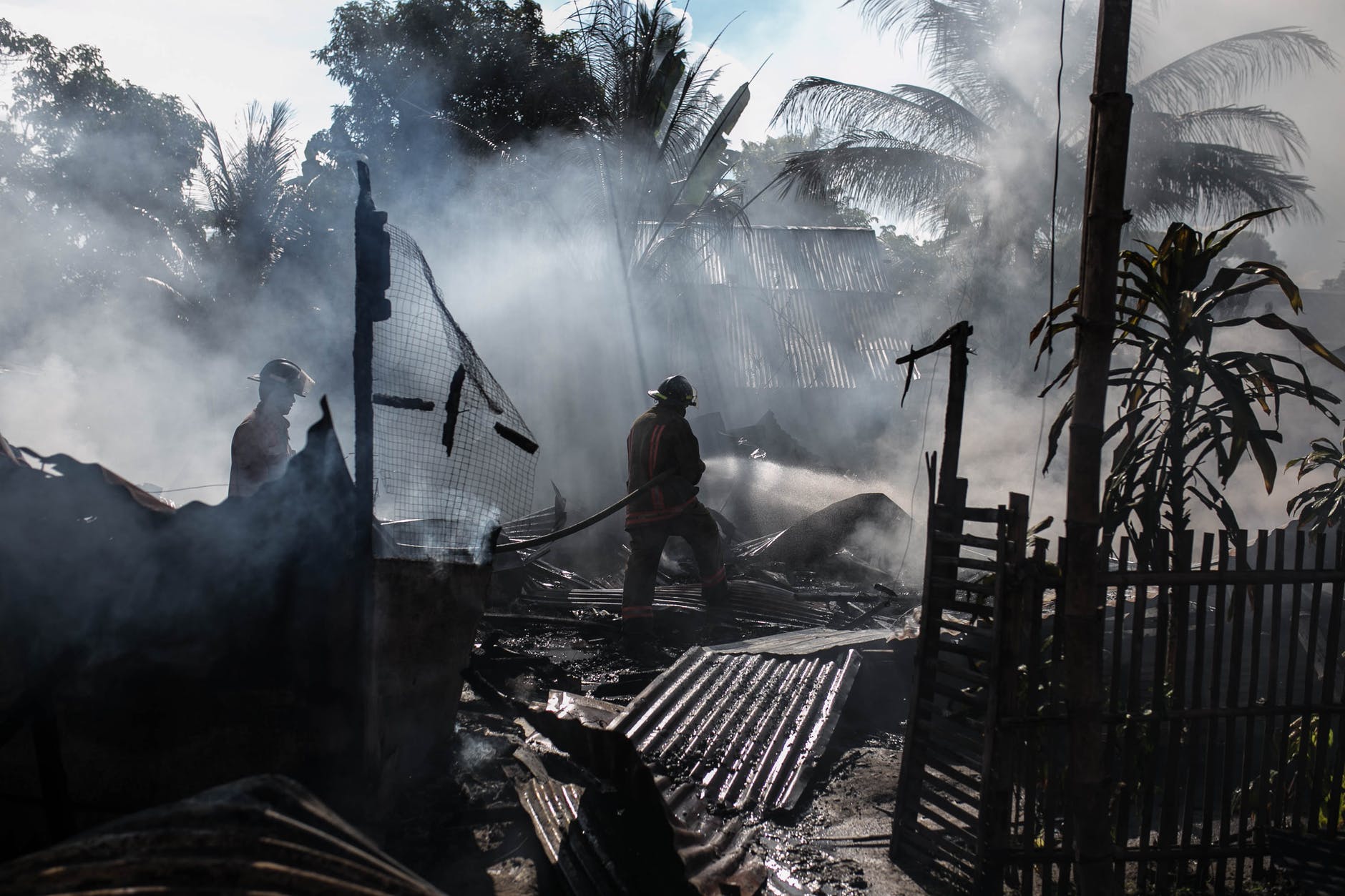
silhouette of fireman holding hose

God stays silent.

I can grow frustrated in the silence or I can learn to trust.  That doesn’t mean that I no longer want answers; just that I am willing to wait on God’s sovereign timing.  It also means that I am need to more about God’s nature–God doesn’t keep secrets or withhold knowledge because He wants to torment me, or frustrate me, or play some cosmic mind game (though some people accuse Him of doing just that).  God withholds full disclosure of His plans, His reasoning, and His nature out of love and compassion.  Suppose I could see into the future, even give out warnings, but had no power to stop disaster from coming.  Not only would I be haunted by the disaster itself, but by the full knowledge of its coming.  Suppose I could see a miracle in advance; know when and how it would unfold.  There would still be joy, but it would be muted by the foreknowledge– of course there would be a happy ending; of course there would be a miracle– I saw it all from afar off.

photo of person holding ball

The Apostle Paul touches on this in 1 Corinthians, chapter 13.  This is commonly known as the “Love Chapter”, and the first half is frequently quoted at weddings and church sermons.  But the end of the chapter is a wonderful message of hope and faith, ending with Paul’s triumphant statement about all three:

1 Corinthians 13:8-13 English Standard Version (ESV)

Love never ends. As for prophecies, they will pass away; as for tongues, they will cease; as for knowledge, it will pass away. For we know in part and we prophesy in part, 10 but when the perfect comes, the partial will pass away. 11 When I was a child, I spoke like a child, I thought like a child, I reasoned like a child. When I became a man, I gave up childish ways. 12 For now we see in a mirror dimly, but then face to face. Now I know in part; then I shall know fully, even as I have been fully known.

13 So now faith, hope, and love abide, these three; but the greatest of these is love.

monochrome photography of a man looking in front of mirror

God loves us with a perfect love.  Because of that, I can trust Him, and have hope in the midst of my questioning.  So when I pray with questions, I can know that God has “filed them away”– He is fully aware of my situation, questions and all, and He is fully faithful to answer them all in His perfect wisdom and timing.  Someday, I will know– not only all that I don’t know now, but why I had to wait.

God will provide full disclosure. with compassion, love, and wisdom that only He can give.

Why Ask Why?

I’ve been asking myself “why?” a lot lately in regards to this blog.  Why am I spending my time writing about prayer?  Wouldn’t I be better served to spend my time productively– making something useful, keeping the apartment cleaner, going to the gym–even spending more time in prayer instead of dissecting it and babbling on to an invisible audience?
But the truth is that I began writing this blog in response to another question, a more basic question thrown at me (not personally, but thrown out to all who believe in the power of prayer)–  “WHY?”  They weren’t asking the question because they really wanted to know my reasons for praying; instead, they wanted to make me feel ashamed and embarrassed, to doubt God’s goodness and my faith.  In fact, they weren’t asking “WHY” so much as asking “HOW”.  How can you continue to believe in God and continue praying in light of random shootings, manifest injustices, rampant corruption, and senseless tragedies?  How can you say that God is good, when people continue to get away with evil?  If God exists, where is he, and how can you just sit back and trust in him?

The fact that I DO continue to trust God doesn’t mean I don’t have questions and concerns, and even righteous anger about the state of the world and the tragedies that fill it.  The questions come pouring out, sometimes keeping me awake at night, sometimes catching me at a raw moment– and they are important questions.  To pretend that I never wrestle or struggle with the questions is to say that good and evil, justice and mercy, that God himself– none of it really matters enough to seek an answer.  God forbid!!

But there is a vast difference in asking “Why?” and challenging God by saying “How? or How come?”

pexels-photo-1027931.jpeg

Consider a small child who asks, “Why is the sky blue?”  (Don’t you just love the inquisitiveness of small children?)  “Well…” I can explain that the sky itself isn’t really blue…I can go on to talk about scientific principals– the property of light, refraction through water molecules and dust particles, and more..I can point out that the sky doesn’t always appear blue, etc.  At the end of my long and factual discourse (assuming the child hasn’t already interrupted), s/he is likely to simply shake their head and ask, “But, why?”  WHY?  Because I haven’t really answered the heart of the question.  I explained HOW, not WHY.

Now suppose I don’t feel like being pedantic, and I simply answer “Because.”  You can guess what comes next.  The child will ask, “Because WHY?”  Because “Because” isn’t a sufficiently satisfactory answer.  The child wants more; he/she yearns for more comprehension; more understanding.

As an adult, we find this kind of questioning frustrating and annoying.  I think it is because we have been conditioned to think that questions either have a “How come” explanation that sweeps away much of the wonder and mystery, or a “because” answer that leaves us unsatisfied. We are frustrated by questions to which we already have a pat answer, and we are frustrated by questions to which we have never received a satisfactory answer.

As an adult, I may well ask, “Why is there evil in the world?”  This is an important question; one I should be asking.  Experts can and will give me all kinds of “how” answers– how the brain is wired, how emotions work, how society has failed various groups of people, how political structures create oppression, how religion teaches intolerance, how poor diet or lack of sunny days … there are a million explanation of “how” evil exists or why it persists.  And many of these explanations contradict each other, so they can’t even give a conclusive answer.  But just throwing up my hands, and saying, “just because” does nothing to answer my question OR provide understanding that could help alleviate the effects of evil in the world.  “Because” communicates my powerlessness to comprehend.

BUT

Something amazing happens when I stop merely asking people for answers to these questions and start asking God.  I don’t get a magical, comprehensive, incontrovertible answer to life’s thorny questions.  God doesn’t send me a “cheat sheet” with all the “right” answers.  I’m not suddenly an expert on good and evil or what should be done to eliminate crime and disease and poverty.  I still have to wade through the “how come” explanations and use my limited judgment to decide what course of action I can take to try to make a positive difference.  And I will make some mistakes along the way.  But when GOD says, “Because”, there is an authority, a majesty, and a wisdom that can never be present in my answer.  I say “because,” because I have no more to say; no better answer.  God says, “Because,” because HE IS the answer! And the cause!  And he gives explanations in his word for many of my questions– even if I don’t like the answers!  He doesn’t explain “how come” the sky is blue–even though science can tell me the “how come.” God doesn’t have to explain the blue sky –He causes it to be blue.  “Why is the sky blue?”  God makes it so.  “But why?”  Because He is God and I am not.  God explains “how come” there is evil in the world– it’s called SIN–but he doesn’t leave it there.  “Why?”  Because we have the free will to choose good or evil.  “Why?”  Because God wants willing obedience and loving companionship with us.  “Why?” Because God is love!  “So why does he allow evil to continue?”  Because he has a plan that involves redemption and restoration and renewal.  He is the cause of this plan, he is its author and finisher.  Moreover, he is the cause of my desire to ask “why?”, to seek for a more fulfilling answer, to yearn for a solution to the very evil that prompts my questions.

pexels-photo-490411.jpeg


I won’t stop asking “why.”  Not because I don’t have any answer, or because I don’t know the answer.  It’s just that the answer is so much bigger, so much better, so much MORE than I can handle in the shortness of this lifetime. And it’s important that I not only keep asking the question, but that I keep defending the answer. Because perhaps today, or tomorrow, or every day next week, someone may ask me WHY?


1 Peter 3:14-16 English Standard Version (ESV)

14 But even if you should suffer for righteousness’ sake, you will be blessed. Have no fear of them, nor be troubled, 15 but in your hearts honor Christ the Lord as holy, always being prepared to make a defense to anyone who asks you for a reason for the hope that is in you; yet do it with gentleness and respect, 16 having a good conscience, so that, when you are slandered, those who revile your good behavior in Christ may be put to shame.


Words Are Not Enough

When tragedy happens, words are not enough to bring justice, resolution, and immediate peace to the situation. “I’m so sorry,” or “I’m here for you,” or “I’m praying for you…” In themselves, the words have no power to change circumstances. Words cannot bring back a lost loved one or undo a fire or earthquake or violent attack.

Yet, when we say that we are sorry, or that we are “here,” or that we are praying, we are offering more than just the words we speak. We are offering to share someone’s grief; to help in practical ways that can ease even some of the suffering; to call attention to God’s presence in every situation, no matter how dire.

Prayers are more than just the words we speak. In Romans 8:26, the Apostle Paul says, “We do not know what we ought to pray for, but the Spirit himself intercedes for us through wordless groans.” Prayer often involves our entire being– body, soul, mind, and spirit–as we bow our heads or lift our hands, sweat, groan, go through a range of emotions from grief to praise, and try to express our heart cry in muddled words.

But prayer is not about US. It is not about our words or our emotions or even our desires. Prayer is about staying connected to God. In ourselves, we will always be insufficient. We may be able to take actions that will help others (or ourselves) achieve some measure of relief or understanding when things go terribly wrong. But we cannot bring complete justice; we cannot reverse what has already happened; we cannot guarantee outcomes. In prayer, we give outcomes and justice to the Only One who can bring true healing, justice, and peace out of our tragedies. We give up on the idea that our own thoughts and actions can overcome all the things that are beyond our control. And we lift up our questions, our fears, and our deepest hurts, with whatever measure of Faith we have, to the one we trust to make all things right. And we relinquish the idea that God MUST give us what we desire in the moment to believe that He gives us what is best according to His eternal plan.

Prayer isn’t simple. It isn’t a “cop-out.” It is a sacrifice. God may never answer our desire for an explanation, or for revenge in this life, or for a re-instatement of all that we think we deserve. But prayer connects us to the Sovereign Heart of God. Prayer doesn’t change our circumstances. It changes the way we respond to them. It changes the way we see ourselves and our own limited power. It changes the way we see others– even those who would harm (or have harmed) us.

Words are not enough– but Prayer taps into the all-sufficiency of God. That is more than enough. And the more we pursue and practice Prayer, the more we will understand its power and sufficiency.

Cowardly Prayer

But when you pray, go into your room and shut the door and pray to your Father who is in secret. And your Father who sees in secret will reward you. Matthew 6:6 (ESV)

Prayer can sometimes seem like a cowardly action. It seems passive; it relies on faith and, often, patience. We connect courage to action– courageous people DO something; cowards sit on the sidelines or hide in their closets. Yet Jesus told His disciples to go into their rooms or closets, close the door, and pray in secret. Jesus himself often went out into the desert to pray alone. Jesus’s ministry was filled with passive moments. He spoke, or he walked along from town to town. He stopped to heal people by touching them or speaking to them. He rarely raised his voice or let his temper show. He allowed himself to be arrested, tried, sentenced, beaten, and crucified, without making a vigorous defense or protesting his horrific and unjust treatment. On the cross, his one impassioned outburst was a prayer to His Father–“My God, My God, why have you forsaken me?” (Mark 15:34)

We don’t think of Jesus as a coward. Yet, we often sneer at Christians who spend more time praying and less time “doing.” Being active is not a bad thing. Jesus commanded His disciples with many active words– “GO,” “teach,” “feed My sheep.” And there are busy people who are courageous in their own way. They go into dangerous places to preach the Gospel. They risk their health and safety to reach the lost with the Good News that Jesus Saves! They stand firm for the truth, and they defend it with vigor and passion. But Jesus also commanded His disciples to “Follow Me.” That means that we need to look at and model our lives after the ways that Jesus responded to various situations, and how He lived. The question we often ask is “what would Jesus do?” But the real question we should ask is “what did Jesus DO?”

Jesus prayed. He prayed for people; He prayed with people; and He prayed alone for hours and even days. And Jesus prayed courageous prayers. He didn’t pray “safe” prayers. Even His anguished prayer in the garden ended with courageous and humble resignation– “Father, if you are willing, remove this cup from me. Nevertheless, not my will, but yours, be done.” (Luke 22:42) Jesus also engaged lovingly and personally with the kinds of people that others ignored or wrote off or dismissed as broken, damaged, or irredeemable.

Just this week, a young Christian apologist and conservative speaker, Charlie Kirk, was assassinated. He was well-known and admired (or detested) for speaking up about family values, and Christian principles on American college campuses. He often faced hostile critics and smug detractors– atheists, anarchists, and those who called him a racist, a homophobe/transphobe, a bigot, and a “hater.” I never met Mr. Kirk. I watched some of the videos his group posted of him patiently and passionately arguing for marriage, faith, morality, hard work, ethical behavior, and national issues like immigration reform, tariffs, and foreign policy matters. I respected much of what he said, and some of how he said it. One of the things I most respected was his commitment to listening and asking questions, instead of merely attacking. But the most amazing thing about Mr. Kirk was his passionate and outspoken commitment to Jesus Christ. His faith was the center of everything he said, and in the way he interacted with supporters and detractors alike. He did not shy away from difficult questions, and he rarely resorted to easy answers, but he always pointed others to the example and the words of Jesus.

In the wake of his death, many people are asking, “What now?” Mr. Kirk was articulate, passionate, and willing to put himself in danger in order to defend the truth and his personal views. He trusted God to use him, and he was willing to pay a horrible price– being hated, threatened, and ultimately shot to death–to do what he saw as God’s work. He left behind a family (wife and two children), several close friends, and a host of people who followed him on social media and looked to him as a Godly example. Fellow Christians, while we may grieve his loss here, rejoice that he is Home with his Savior for eternity. But many people are wondering what will happen if no one steps forward to take his place and carry on his mission. While I believe that many young people will be inspired to speak out and engage in discussions, I don’t think most of us are meant to step into a spotlight. I think we NEED more people who will commit to going into their closets and pray. While Mr. Kirk put himself in the public arena, there have been hundreds and thousands of people praying for him. They continue to pray for his family, his outreach organization, “Turning Point”, and they even pray for those who instigated and committed this violence.

Prayer is NOT cowardly. Prayer warriors are needed to intercede, to call on Heaven’s Armies to continue in the age-old battle. We should be willing to have the difficult conversations when they arise. Some of us will be called to initiate such conversations openly and with fierce determination. And we should all be ready to “give a reason for the hope that is in you” (1 Peter 3:15) even when it is with “trembling and fear.” And we should always remember to be humble and show kindness, even to those who despise us. But some of us need to be lifting up those who are being attacked. Some of us need to pray more boldly, more often, and more confidently in light of the violence that has exploded in our world. We need to pray, not just for the Charlie Kirks of the world, but for the salvation of all the would-be assassins. We need to pray for the hearts and minds of those who want to argue and “cancel” all those who stand for God’s Word. And for all those who do not know the truth, who are confused, befuddled, or deceived.

We need those who can be courageous– whether in the public square or in a private room.

That Voice in Your Head

Most days, I post about Pursuing Prayer from the “praying” end…how do I pray, what attitude do I have about praying, why do I pray, etc.

Today, I want to explore the “responding” end…how do I know when God is answering my prayer, or what he’s asking me to do in response to his will?  While I don’t have a complete answer, I do want to share some wisdom– some from experience and some from Biblical principles and others’ testimony.

Isaiah 55:8-9 English Standard Version (ESV)

For my thoughts are not your thoughts,
    neither are your ways my ways, declares the Lord.
For as the heavens are higher than the earth,
    so are my ways higher than your ways
    and my thoughts than your thoughts.

God moves in a mysterious way, His wonders to perform. He plants his footsteps in the sea, and rides upon the storm. William Cowper

It often surprises people to learn that “God works in mysterious ways” is not actually in the Bible.  God’s ways are NOT our ways, and his thoughts are not our thoughts, but his answers to prayer are not always obscure and unknowable.  God does not delight in vexing us and making us guess and second-guess his will.  It would be easy if God always answered our prayers with a flashing neon sign that gave a simple, one-sentence directive– “Take two aspirin and call me in the morning.”  “Click your heels together and say, ‘There’s no place like home.'” “Hakuna Matata.”  But pithy platitudes and easy answers are not God’s way, either.  God created each of us as a unique reflection of his divine image– his answers will be uniquely designed to fulfill his will and meet our deepest needs, not always in ways we expect or understand.

pexels-photo-942317.jpeg

So how do we discern God’s will when there is no neon sign or simple answer to our prayers?  Here are a few guiding principles:

  • God will NEVER answer your prayer by contradicting himself or compromising his holiness.
    • God will not answer your prayer for money by giving you an opportunity to cheat or steal.  He will not answer your prayer for a husband by throwing you into the arms of someone else’s.
    • Just because God doesn’t send a lightning bolt or physically stop you from doing something doesn’t mean that he has given his OK.  If he ALLOWS you to sin, that doesn’t mean that he APPROVES of your sin or that it is his answer to your prayer.
    • God will never ask you to do harm to yourself or others as an answer to your prayer.  Vengeance, sacrifice, atonement, and retribution are the province of God alone.  I believe that God asks us to be vigilant in defense, and allows us to take up arms in defense, but to initiate a feud, to seek personal vengeance, or to act out vigilante justice is to flout both God’s authority and the authority of the powers God has set in place over us.
  • God MAY use circumstances or people to answer your prayer.  But the same principle above applies– circumstances that lead to sinful actions are NOT God’s answer to your prayer; people who advise you to do what you know is contrary to God’s holiness are not sent from God– no matter how appealing the prospect, no matter how powerful the person or persons.  That being said, God may choose to use the most unlikely of persons or events to bring about a resolution to your need–LET HIM!  Don’t judge a gift by the size, the shape, or the wrapping paper!

gift-made-surprise-loop-39006.jpeg

  • God may use time to answer your prayer.  I prayed for a husband from the time I was a young girl– I married at age 46.  Waiting doesn’t mean that God has forgotten about you; it doesn’t mean that you aren’t worthy of an answer or ready for an answer– sometimes your answer isn’t ready for you!  There are two caveats I want to share from my own experience of waiting for an answer:
    • Don’t give up!  God knows the desires of your heart– but keep praying anyway.  Well-meaning people will say awful, hurtful things– that you aren’t praying enough, or praying the “right” way; that you must be hiding un-confessed sin; that you need to try some other way to get what you want, or to hurry God along.  In my case, I had people trying to fix me up, suggest dating services, remind me that my “clock” was ticking (it was broken, but they didn’t know that), or suggest that it just wasn’t God’s will that I marry, and I should pray for him to take away the desire for a husband.  Listen to folks like this (if you must) with half an ear and less than 10% of your heart– let them cause you to re-examine your heart and your desires, but don’t let them cause you to give up or doubt God.  That was not their intention, but it can often be the result of their ill-considered words.
    • Do the next right thing.  Doing nothing while you wait for the perfect answer gets you nowhere.  Wringing your hands and pacing gets you nowhere.  God wants our trust and our obedience.  As we wait for more specific direction, we need to trust that doing the next right thing IS the RIGHT thing to do.  This was the hardest lesson for me, but the one I most needed to learn.  So while I waited, I moved ahead step-by-step.  I made a lot of friends, gained a lot of experiences, and learned about marriage by watching the examples of others (both good and bad).  I got involved working with children, first as a secondary teacher, and then as a librarian.  I got to spend nearly thirty years of my working life surrounded by young people.  I got to laugh with them, love on them, mentor them, dream with them, discipline them, and cry over them (and send them home).  I didn’t just “settle for” a single lifestyle– I learned to embrace it.  I learned to be grateful for the wonderful opportunities I had as a single woman, and to anticipate the changes that marriage would bring, should it come along.  I learned that marriage should be a means to an end, not the end itself– that marriage done right is not about my growth and fulfillment; not even about his growth and fulfillment; but about OUR growth together and toward Godliness.
  • Trust “that voice in your head”– (not the one that speaks out loud and gets you strange looks!) –but your God-given conscience, and the guidance of the Holy Spirit.  “That still, small voice” is often the most personal way God speaks to us.  In my own life, it was taking the risk to leave a career I loved (teaching) to reach for a deeper dependence on God.  I left the security of my teaching position for three part-time jobs (at one point), no health insurance, and a move to a new community where I knew virtually no one.  I had other choices, other more appealing options, chances to reconsider.  I wasn’t being pushed out of teaching–in fact, I left just as my options at the school were opening up for bigger and better things.  Yet I felt compelled to leave.  I had no safety net waiting– I ended up in libraries, but that wasn’t my original plan.  There were many people counseling me to reconsider– and their reasons were compelling.  But as I stood firm, other voices came along to encourage me.  I believe they were sent by God to confirm that this risk was from him and for my good.
  • Don’t trust “that voice in your head”–No, I’m not trying to confuse you or contradict what I just said.  But this is another caveat (see above).  We are told to “test the spirits”, and sometimes, that voice in your head is NOT the Holy Spirit.  In the case I mentioned above, I had to follow all the other principles of discerning God’s will.  In my case, leaving teaching did not violate God’s holiness or come about because I wasn’t willing to follow God’s leading–I wasn’t leaving teaching to try my hand at a get-rich-quick scheme, or because I had lost my desire to work with students, or had lost faith in God’s sovereignty in my life.  God DID use circumstances and people to confirm my decision and help me grow through the experiences that followed.  God used time to help me transition from schools to libraries, and prepare me for other opportunities, including short-term missions trips and marriage.  I can’t even begin to list all the ways I tested and examined what I felt God was leading me to do before I made the leap.  That much testing may not always be necessary, but we need to be careful not to rely on our own understanding (Proverbs 3:5-6), but to Trust in the Lord with all our hearts.  He WILL direct our paths when we do that.

pexels-photo-618955.jpeg

  • Finally, Pray for it– pray for discernment, for wisdom, for strength to do the right thing!  Won’t God DO IT!

When God says, “Wait!”

I hate waiting. Most people do. I hate waiting rooms at the doctor’s office or the waiting area at the garage or the DMV. They try to make it a bit more pleasant with music, or a TV, or magazines lying around to keep you occupied. But usually, I spend the whole time thinking of “useful” things I could be doing if I wasn’t sitting around waiting. Recently, I published my first book, and I had to wait for freshly printed copies to be sent to my door. Every day, I waited for the delivery van to pull up– and every day, I missed it. Finally, I had to pick them up at the post office. Those few days seemed to take forever.

But I have learned over the years that waiting is necessary, and even good sometimes.

I was thinking about my first “real” teaching job–not student teaching or getting called in as a substitute, but a permanent position. I applied for a teaching job in my hometown. They needed an English teacher for middle and high school– perfect! I felt the interview went well, and I was a “known quantity”– many of the staff knew me from my time as a student just a few years before. Nevertheless, I waited and waited and finally got bad news. The job had gone to another applicant with more teaching experience. I was disappointed. I had prayed so hard, and it seemed like the perfect “fit.” I knew I should trust that God knew about my situation, and had everything in hand, but I just felt the outcome wasn’t “right.” What would I do now? I looked for other teaching positions, but could find nothing. I ended up doing substitute teaching. It was sporadic and unpredictable. I wasn’t really teaching as much as babysitting– especially in classes like elementary music!

Still, I learned a lot about classroom discipline; something I hadn’t really experienced much of before. My student teaching had been done with master teachers who were amazing examples of quiet but stern management. Even when they “turned their class over” to me in the final weeks, the students knew that their other teachers would back me up in a classroom situation.

Not so with substitute teaching! Not only was I “on my own” in the classroom, I frequently traveled to schools where I knew no one on staff and no one knew me. I had no idea what kind of discipline was practiced by either the teacher or the administration at some of the schools. Most were ok, and staff were friendly and supportive. Most of the students were typically a bit naughty, but not out of reason. But not all! There was one class of over thirty-five fourth- and fifth-graders whose teacher had left no lesson plans, and another day at a high school where the entire staff was intimidated by the football team– most of whom were in the same third hour class. The lesson plan called for them to do research in the library– the librarian hid– and I was trying to stop them from literally throwing the pumpkins that were meant to be decorations at each other!

All this to say that after several months, I got a phone call. It was my old school, wanting to know if I would be interested in finishing out the school year in the position I had applied for the previous fall. It turns out the teacher they had hired had serious health issues and had missed over 60 days! They had been trying to fill in with substitutes, but wanted someone who could bring stability and order to the classes for the last marking periods of the year.

My first week in the new position was a nightmare. Every class had fallen behind. The succession of substitutes had given up. The classes lacked discipline and focus. In fact, the other regular teacher had written off all the students as irredeemable hooligans, and she was glad to give up the position. My first day, one of the high school students attempted to sneak out of the window at the back of the classroom, while another classmate tried to sneak out the door! And I found out that my last hour class was to be held in the middle school band room– it was a computer class! I had to commute from the high school to the middle school, which took up part of my preparation period, so I had little time for planning or grading paperwork.

In spite of all the challenges, that first “trial by fire” proved that I really was a “fit” for the position after all. I spent another seven years teaching in my hometown. Eventually, my schedule was changed and I no longer had to commute. I loved my students (most of them), and I am still in touch with some of them to this day! Even the ones from that first disastrous partial year.

God did not answer those first eager prayers that I should get the teaching position right away. And even when I finally “got” it, it was filled with challenges and obstacles. But in the waiting, God was there. Even in the difficult substitute assignments, and the adjustments, and the questions about why I didn’t get the job when I first interviewed.

God may not tell us audibly why He wants us to wait. He won’t tell us how long we must wait. And He generally doesn’t put us in a “waiting room”, filled with soothing music or distracting TV ads or old magazines. But we can trust that God has good reasons for us to wait– whether it’s for a job, or a spouse, a chronic illness, loss of income, or change in circumstances. What He asks is that we trust Him, and that we continue walking a praying in faith. Because I will be worth the wait.

Where is God When…?

A priest, a Baptist minister and a rabbit go to a pub for lunch. The hostess meets them at the door with a message. “Today, we are helping a local blood bank. Your lunch is free if you donate a pint of blood.” All three agree to donate blood in exchange for a free lunch. The hostess asks each one in turn for his blood type. The priest says, “I believe my blood type is A negative. The minister says, “It’s been a long time, but I seem to remember that I am AB positive.” Finally, she turns to the rabbit. “I was supposed to be a Rabbi, so I must be a Type O!”

I love puns, and like many puns, the humor in this one comes from a grammatical or spelling error. Something in the story is almost, but not quite, as it should be. It is a good thing to be able to laugh at small mistakes. But what happens when things are terribly wrong? It’s not funny at all. It’s devastating, confusing, and frightening. We want answers. We want the situation “fixed.” We want to find out what went wrong, why it went wrong, and who is responsible.

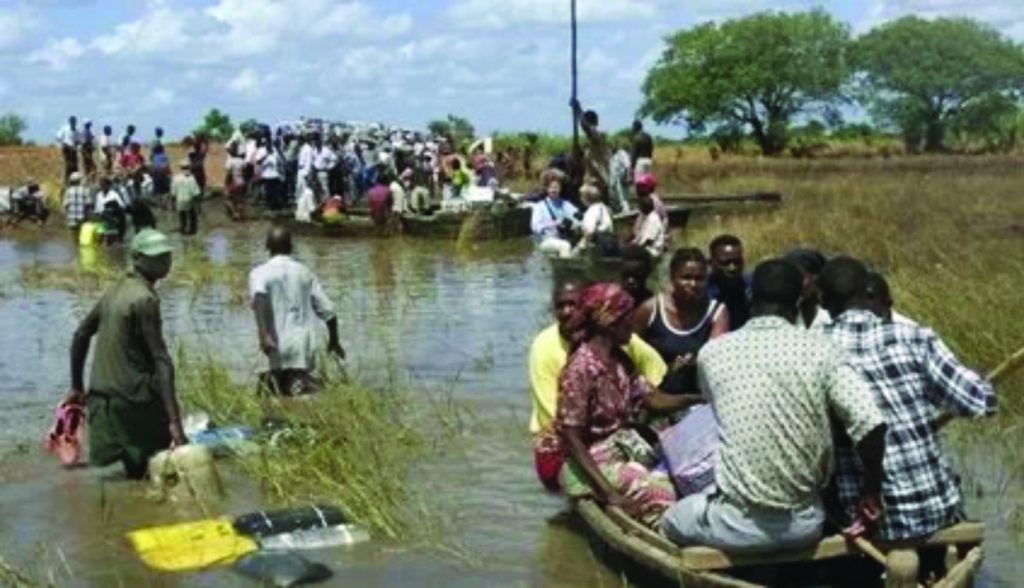
California is burning as I write this. Thousands of acres destroyed; hundreds of homes and businesses reduced to ashes; thousands of people left homeless. Where is God in these fires? When an innocent child is abducted, raped, mutilated and left for dead, where is God? Where is God amid the unrest in Mozambique, where typhoons and political unrest have caused so much havoc? Where was God when the hurricane and storm surge displaced tens of thousands of people in North Carolina, Tennessee, and Georgia less than six months ago? Where is God in the war-torn regions of the world, where innocent families are being terrorized by bombing raids and invading armies? Where was God when millions were dying of COVID just a few short years ago?

I’d love to say that I have an answer. One that is comfortable, unassailable, logical and easy to understand. But I don’t. The “glib” answer is that God is on His Throne, omnipotent and all-wise. And He is. He is not to “blame” for personal tragedies or for sweeping disasters. Sometimes, God intervenes in miraculous ways to “save” us from certain death, “accidents,” or even attacks. But often, He chooses not to do so. And I have no explanation, no all-encompassing, deeply soothing answer for those who are left suffering.

What I do know is this: God is a redeeming God. He is a God who can and often will turn tragedy into triumph. And even if, in such cases, the triumph is often bitter-sweet. This is a God who created mankind, knowing we would reject His goodness and go our own way. This is a God who took a single faithful man (Abraham) and made him the father of many nations– some of whom are still at war to this very day. This is a God who did not spare His Only Begotten Son, but allowed Him to go through a sham trial, be falsely convicted, and die a painful, publicly humiliating death. And then, Christ arose!

What does that mean for someone whose son or daughter is still dead after five (or 25) years of grieving? For someone who lives every day with the trauma of having been raped or abused as a child. It does not give immediate comfort. It does not take away the sting of injustice, pain, and questioning. But it is the promise of redemption– that just as Christ rose victorious, He will cause the pain and grief of the past to disappear in the Joy and Wonder of Eternity with Him. He WILL bring ultimate and complete justice, and it will be perfectly overwhelmed with mercy, grace, and freedom from the past.

It may seem slow and painful, but it WILL happen. Those who have suffered; they will laugh again. Those who are drowning in the senselessness of their own sorrow will experience healing and have answers to their questions. Those areas of the world where suffering is so great in the present– they will recover. Trees and gardens will grow again. Houses will be rebuilt. And yes, there will still be disasters and devastation in our lifetime, and in the years to come– UNTIL THAT DAY. That day when Christ returns to make all things new. Whatever hurts and griefs we carry now, they will be overtaken by joy and healing. No more fires, no more floods, no more war, no more disease, no more “mistakes.”

I don’t know why God allows us to suffer now. I’ve heard some philosophers try to explain, and they have many “good” reasons:

Suffering often leads to growth and necessary change.
Suffering produces resilience and develops character.
Suffering teaches us that there are consequences to our selfish and sinful actions.
Suffering often brings people closer together and brings out the best in us as we offer help and hope and encouragement.
Suffering teaches us to be compassionate toward others in their suffering and grief.
Suffering contrasts with joy, helping us to appreciate what is truly good in our lives.

These are not bad answers. But they are not complete. They are not “enough.” And I think that’s part of God’s plan. God doesn’t want us to live life on autopilot. He doesn’t give us “easy” answers– just like He doesn’t give us a life without any purpose or challenge. He doesn’t want us to focus on having all the answers. He wants us to learn from each other, depend on one another, and ultimately to trust that He knows best. It’s not an easy lesson to learn. But if we stay in pursuit of Prayer, and closeness to God, it’s a lesson well worth struggling through.

And sometimes, we can learn to laugh at life’s “typos” and other little mistakes as we travel this life.

I Wonder…

Advent is a time of waiting. It is a time of wonder. But it is also a time to wonder–to ponder and reflect on the meaning of Jesus Christ. Why did He come? Why did He choose to be born where and when and how He did? The Bible gives us some of the “big” answers– He came to give His life as a ransom for many (Matthew 20:28, Mark 10:45); He came to “bear witness to the truth” (John 18:37); He came to fulfill the law and the prophets (Matthew 5:17); He came to give salvation and everlasting life (John 3:16)–and more. But there are still many things to ponder.

I wonder why Jesus came as a helpless infant. He could have taken on flesh and appeared as a full-grown man, and a king at that. He chose to come in weakness and in need– the Lord of all Creation needing to be fed and clothed and carried from place to place.

I wonder about His early life. Jesus had to learn how to crawl, to walk, to talk, to run, to write. Imagine, the eternal Word of God having to learn to speak! The One who would one day walk on water had to learn to take His first steps on land. He was once toothless! Did He lisp when He was first learning to talk? Did He fall down as He learned to walk? Did He run too fast, and skin His knees? Were there foods He didn’t like, or others He preferred? Did the other kids tease Him and hurt His feelings? Did He suffer from headaches or toothaches or upset stomach (or even diarrhea)? Did He get splinters working with Joseph in the carpenter’s shop? Did He have a favorite teacher? When did Joseph die, and how did this change Jesus’s family situation?

Jesus was fully human, and He lived as a baby, and a child, and as a man. His ministry spanned only a short three years– less than a tenth of His earthly life. What did He see in those years? What did He learn? What did He “wonder?”

I wonder.

What if part of the process of Jesus’s earthly life was to remind us that God is with us from our earliest, neediest, and most vulnerable moments to our last breath? What if it was to remind us that even Jesus had “bad hair days” and skinned knees? That He came to experience ALL that is part of being human, including the long wait to grow to maturity and to fulfill His mission, and the hundred little obstacles of everyday life? Or maybe it was to remind us that there is awesome wonder in the ordinary–that even God found it worth marveling over those little moments with family or friends, or watching a glorious sunset, or catching a firefly.

It’s so easy for us to lose the wonder of the Christmas season. But it’s also easy to lose the wonder of those ordinary moments–a shared smile or tear, the excitement of someone else’s birthday, the taste of fresh-baked bread, the way the sun sparkles on the lake. Jesus came to redeem us. And in the process, He came to redeem our sense of Wonder, too.

The Sweetest Frame…

I have several friends who are really great at photography– some have made it their profession. One of the hallmarks of a great photograph is “framing.” I’m not talking about choosing a frame for a printed photograph, but choosing natural elements that draw the eye to a focal point. It include perspective, focus, lighting, and even composition– which elements make it into the picture, and which ones are excluded. After all, photos, by their very nature, only show part of the whole reality. Even a panoramic picture cannot show everything at once, and the photographer chooses where s/he wants to place the focus and framing.

We have a tendency to “frame” our lives in a similar way. We focus on only part of the whole reality of life. We choose to “frame” our present situations, our past memories, and our future hopes– even when they are out of focus! We can do this in both positive and negative ways. At one point in my life, I felt I had found “the perfect job” as a youth services librarian at a local public library. It was pleasant work that made use of my skills, talents, and interests. It included a mixture of social interaction and self-directed projects. I loved the job, my co-workers, our patrons, the work environment–it was a pleasure and an honor to work there.

Library Story Time

But I was viewing my job (and myself in that job) through a frame. There was more happening in the wider picture of my life and development. After more than a dozen years there, things had changed. I still loved the work, and while some co-workers retired or moved, and the staff changed a bit, the work environment was still mostly peaceful and friendly. I still found the job challenging and rewarding, and I had gotten to know people in the community over the years who truly felt like family. But, as my role changed, so did some of the relationships. As new leadership came, so did new directions and new priorities. And I had become “comfortable”– and somewhat complacent as well.

In time, it became clear that my “perfect” job was not only not perfect, but becoming a source of frustration, stress, and unhappiness. And there were other things happening that demanded my focus. I was preparing to become a wife and move to a new community. My mother’s health was deteriorating, demanding more of my time and energy. My future husband wanted to open a shop– someone would have to work there, and we couldn’t afford to hire anyone, even part-time. That meant working a second job at the shop while trying to maintain my efforts at the library.

As the “frame” of my life shifted, I felt confused, even angry, with God. Why would He allow something so good to turn sour? Why did I feel like I was losing myself? Didn’t He want me to be happy and fulfilled? Didn’t He want me to use my talents to help others?

Now, after a few years’ perspective, I can see some of the “rest” of the picture. I had begun to see myself through the lens of my job, and I was depending on that vision, rather than focusing on what God was doing in, around, and through my life. There was nothing “wrong” with my job, per se, but God needed me to be willing to let go and move in new directions. Now I am preparing for another change, as we have decided to close our shop, and I will look for the next step– a new job, new opportunities, new challenges.

My nation just went through a contentious election. Many people are upset at the outcome, while others are relieved. But just as it happened with my job, I need to be careful NOT to depend on politics and governments to be “saviors.” No political party or platform or policy can “fix” sin and brokenness. The “system” isn’t the root of the problem. As individuals, we need to submit ourselves to the authority of those in government, but only AFTER we submit to the authority of God. HE is the King of Kings, the Lord of Lords, and His power exceeds that of Presidents, Cabinets, Congresses. Our nation must prepare for new challenges, as well as new opportunities.

I write all this, knowing that there are people going through much more traumatic “shifts” in their lives– the changing of a government administration, with its unknown power and potential can be worrying; the loss of a job, and a change of career is a disappointment. But it is not the same as the loss of a spouse or child, the sudden loss of a home to fire, or an unexpected diagnosis of cancer or other health issue. But the principle is not so different. God’s ways are eternal. Sometimes, we see the uncertainty and trauma in front of us, or surrounding us, and it becomes a frame for all of our thinking and emotions. But the “picture” is much bigger than just our immediate situation. God calls us to trust Him in all circumstances, knowing that His love for us is not just for this life, but for all eternity. Whatever we (or our loved ones) go through here is but a snapshot– one of millions that God will put together in a Glorious and Perfect collage.

Moreover, God gives us the privilege of listening to us when we call out to Him. We need not be afraid to ask, “Why this?” or “Why now?” or even “Why me?” But when we ask, we need to be willing to shift our focus, and remember where our Hope is Built– On Christ the Solid Rock. Even the sweetest “frame”– our career, our relationships, our identity, our politics, our happiness in this life– cannot compare with His faithfulness and eternal Sovereignty.

Why, O Lord?

We are a curious race, humans–we ask a lot of questions of ourselves, each other, and even of God. How did He make the universe? When will Jesus return? Who can we trust in this world? Where is Heaven? What must we do to be saved? But the majority of our questions are “Why” questions. Why did Jesus come? Why did He have to die? Why did God make snakes and mosquitoes and platypuses? Why are men and women so different? Why am I… (short/tall, fat/thin, clumsy, “odd,” misunderstood, etc.)? Why are You so mysterious? Why do bad things happen to “good” people?

I was thinking about this last question this week. I don’t have any definitive answer to that– no one I know has any better answer. God has not given us a definitive answer, either. We are to trust that His ways are wise and best and perfect, but faith and trust require–well, Faith and Trust! We know God has done good things in the past. We know He has redeemed what seemed like hopeless situations. We know His promises, and we have seen some of them fulfilled. Still, such a question can often leave us blindsided and tongue-tied.

There are many learned thinkers, philosophers, and apologists who have written whole books on this subject, but I want to just pose a couple of ideas to help us, not ANSWER the question, but understand the question a little better.

First, the question, “Why do bad things happen to good people?” is really two questions: “Why do ‘bad’ things happen?” AND “Why do they happen to ‘good’ people?” So let’s look at the questions separately.

“Why do ‘bad’ things happen?” What do we mean when we say “bad things?” There are many circumstances, events, diagnoses, and occurrences that may be called “bad.” Death is “bad.” Indigestion is “bad.” Stubbing one’s toe is “bad.” Being diagnosed with Alzheimer’s Disease is “bad.” Divorce is “bad.” Slavery and abuse are “bad.” House fires, job losses, being mugged, being stranded without heat in a blizzard, an outbreak of acne, being laughed at– all these are “bad.” But they are all different. Many “bad” things are the direct result of sin–we suffer the consequences of our own sin; we are the victims of the sins of others. The consequences of addiction can be horrific, but we often lack compassion for those who are suffering, because “they brought it upon themselves.” But what about the innocent victim of rape or child sex trafficking? Such acts leave victims traumatized and broken. Both are “bad,” but we are angered and frustrated even more when “bad” consequences also seem unjust and unfair. And what about natural disasters? Are they the result of sin, as well? The Bible suggests that they are. When God placed Adam and Eve in the Garden of Eden, they lived naked, carefree, and unafraid. Only after their sin did God place a curse on the land– Adam would now have to cultivate the land in order to get food. There would be enmity between the woman and the serpent. Eve (and all women after her) would have pains in childbirth. (see https://www.biblegateway.com/passage/?search=genesis+3%3A+14-20&version=NIV) There is no mention of hurricanes, blizzards, or earthquakes prior to the Fall of mankind, though it is speculation on my part, to say that there were none.

God has promised to make all things new. There will be a time when the consequences of Sin will be eradicated. We will not even remember the suffering we endured in life, in light of the blessings of eternity. So, though God doesn’t answer our question of why “bad” things happen, He does give us the assurance that such “bad” things do not determine our destiny, nor do they happen without His knowledge or outside of His will! We cannot understand God’s purposes in allowing us to suffer, though sometimes we may see a hint of good even in the midst of tragedy.

And God is loving and gracious in the face of our confusion and pain. We CAN ask God “Why?!” “Why me?” “Why this?” “Why now?” “Why them?” Why, O Lord!?” Many of the Psalms speak to this very question. But in the middle of his anguish, the psalmist often finds comfort and renewed strength to face the struggle, when he turns to God. Asking why is not always a sign of weak or failed Faith. Instead, it is acknowledging before God that we ache. We grieve. And we NEED HIM!”

And what about the second part of the question: “Why do (bad things) happen to ‘good’ people?” What makes a person “good?” Jesus was “Good,” And yet He questioned the rich young ruler, “Why do you call me good? No one is Good– except God alone.” (see https://www.biblegateway.com/passage/?search=Luke+18%3A18-27&version=MSG) We tend to think of the people we know and like as “good.” And we have a natural expectation that their lives should be “good” also– free of pain or struggle. But that is not realistic in this world. The actor, Michael J. Fox has been suffering for years with Parkinson’s Disease. This seems unfair and cruel. How could God let him suffer like this? But there are many thousands of people suffering from Parkinson’s Disease. Some of them are homeless addicts; some are in prison for rape or embezzlement. Is their suffering any less than that of Mr. Fox? Is it somehow less tragic or unjust?

The sad and shocking truth is that none of us “deserves” a pain-free, struggle-free life. Bad things DO happen. And they happen to people we like, and people we hate; people we judge to be “good” and people we judge to be “bad.” God does not “play favorites.” Yes, God can, and often does intervene on someone’s behalf through prayer, or for His own bigger purposes. But He does not “dish out” suffering to those He dislikes out of spite or revenge. Nor does He cause His faithful to float through life without ever tasting bitterness and grief. Jesus made many promises, but one of them was this: “in this world you will have trouble; but be of good cheer, I have overcome the world.” (John 16:33) He didn’t promise that you might have a little spot of trouble, or that you might look around and see others in trouble– He promised that we would have trouble. Not because we are “bad” or “good” but because that’s the way this world is.

I find it odd that atheists often pose this question as a way of trying to “prove” that God doesn’t exist. They pose the question as an accusation. “If there is a kind and loving God, why do bad things happen to good people?” But if they believe that there ISN’T a kind and loving God, how do THEY explain why bad things happen to good people? How do they define “good” people and “bad” things? Without a Good God, where is the expectation of good things happening to good people? Without God, there are no objectively “good” things or “bad” things happening– only random events without divine cause or purpose. You can’t blame a non-existent God for things He either caused or didn’t prevent. Such questions are meant to plant doubt in the mind of a believer, but they fail to answer the greater question– Why do Good things happen to undeserving people? Why do we sometimes find joy and peace and strength in the midst of our suffering? Why do human beings continue to Hope?

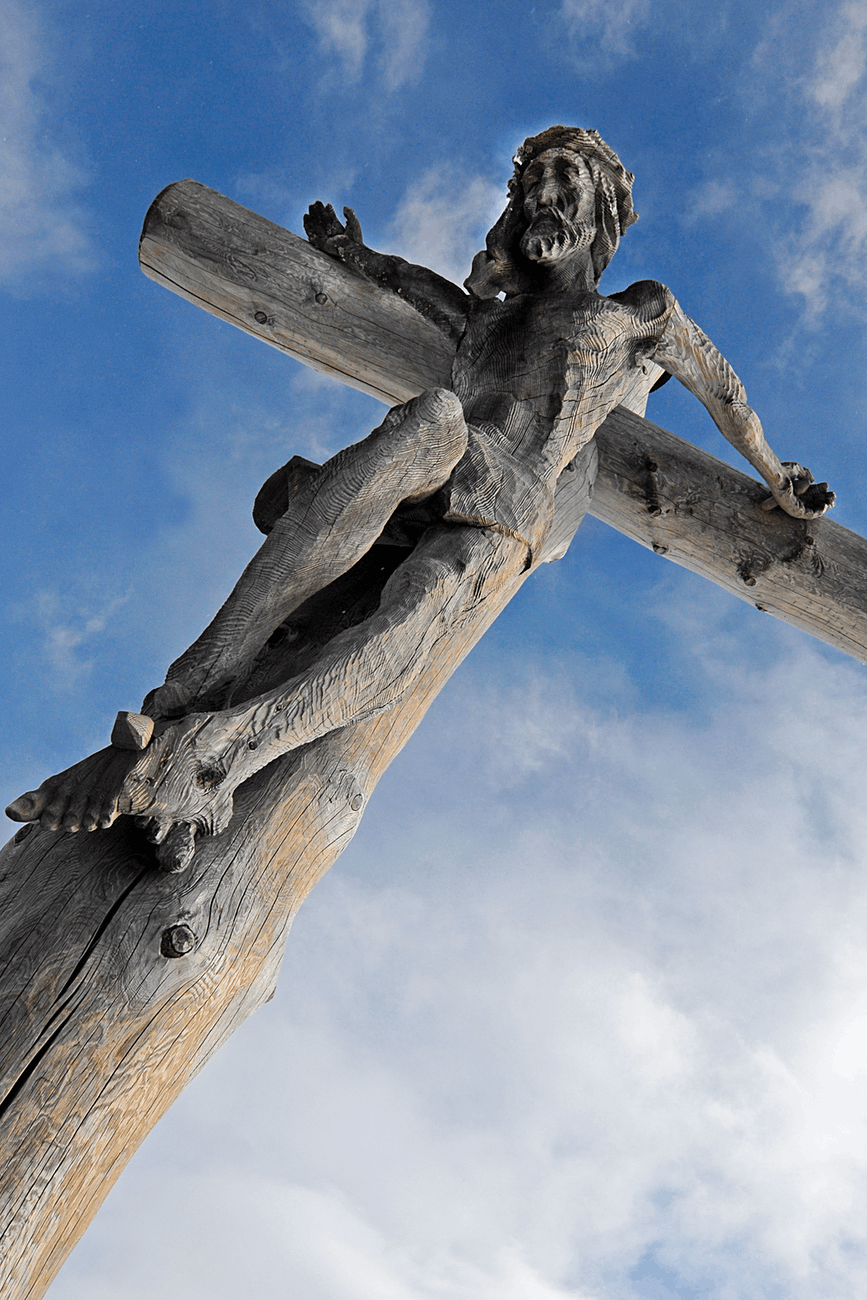
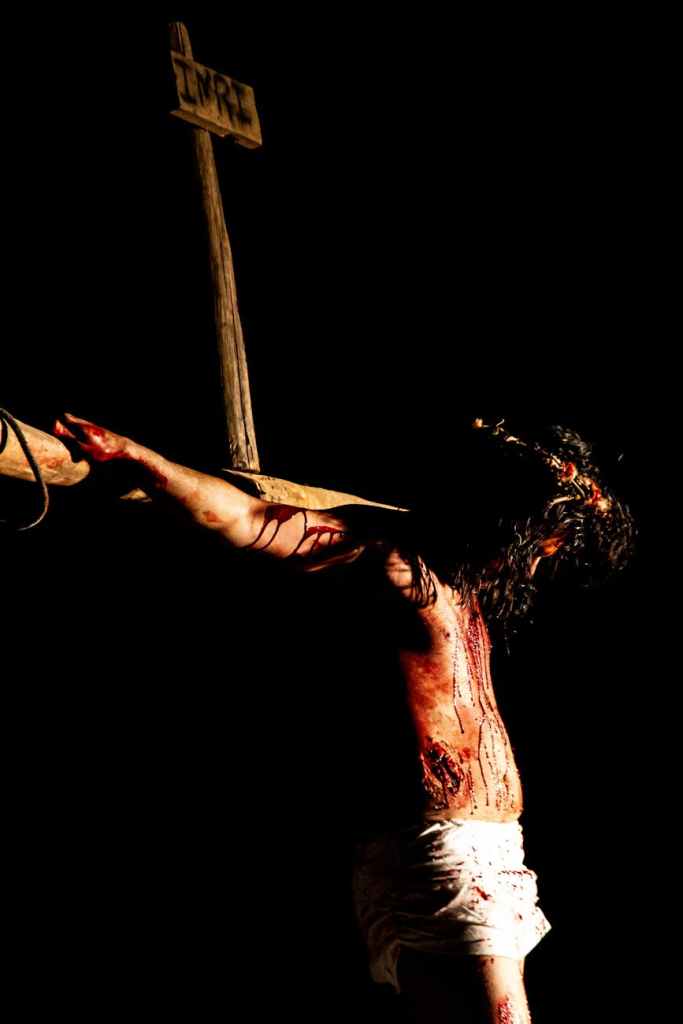
Finally– the ultimate example of God letting something “bad” happen to someone “good” can be seen in the central image of our Faith– the crucifixion of Jesus Christ. Jesus was sentenced unjustly to a torturous death and public humiliation. He was separated from God the Father, and carried the punishment for OUR sins so that WE could be reconciled to God. Even though the purpose of Christ’s suffering has been revealed to us, it doesn’t negate the agony and trauma He faced. And even HE cried out from the Cross– “My God, My God, WHY have YOU forsaken ME?!” (Matthew 27:46)

God does not answer the question of why “bad” things happen in this world. But in the crucifixion, Jesus proves to us that He shares and understands our suffering; that He has the power to overcome and redeem our traumas; and that He will hear our sincere cries of “WHY?!” He will hear when we turn toward Him, instead of turning our back on Him. He will hear our broken heart. He will heal our broken heart.

WHY?– Because He loves us!

Blog at WordPress.com.

Up ↑