
Objects In the Mirror…

“Objects in the mirror are closer than they appear…” This notice is on the side rear-view mirror of my car. It serves to remind me that I cannot judge distances by what I see– that my mirror is meant to show a wide-range view, rather than one that is precise and in-scale.

Many things in life are similarly distorted. The actual objects in my rear-view mirror don’t appear distorted, but if I back up without considering the warning, I am likely to run into an object and “distort” my back bumper!

The Bible also warns us about distortion and mirrors. In James, chapter 1, the Apostle writes:

22 Do not merely listen to the word, and so deceive yourselves. Do what it says. 23 Anyone who listens to the word but does not do what it says is like someone who looks at his face in a mirror 24 and, after looking at himself, goes away and immediately forgets what he looks like. 25 But whoever looks intently into the perfect law that gives freedom, and continues in it—not forgetting what they have heard, but doing it—they will be blessed in what they do.
26 Those who consider themselves religious and yet do not keep a tight rein on their tongues deceive themselves, and their religion is worthless. 27 Religion that God our Father accepts as pure and faultless is this: to look after orphans and widows in their distress and to keep oneself from being polluted by the world.

James 1:22-27 (NIV)

We can easily read what the Bible says; we can easily hear the truth; we can even recite Scripture– and still be deceived and following a distorted version of God’s Word. As I write this, I can quote James, or another passage of Scripture, and walk away from the keyboard only to spread gossip, or snap at my husband, or in some other way distort what I know to be true about myself and about God.

The Apostle Paul also references mirrors in 1 Corinthians:

Love never fails. But where there are prophecies, they will cease; where there are tongues, they will be stilled; where there is knowledge, it will pass away. For we know in part and we prophesy in part, 10 but when completeness comes, what is in part disappears. 11 When I was a child, I talked like a child, I thought like a child, I reasoned like a child. When I became a man, I put the ways of childhood behind me. 12 For now we see only a reflection as in a mirror; then we shall see face to face. Now I know in part; then I shall know fully, even as I am fully known.

1 Corinthians 13: 8-12

Even though this chapter is famously known as the “Love” chapter, it also addresses our need to be alert, humble, and committed to acting on what we know to be true. We can speak of love, even perform acts of self-sacrifice, yet distort what it actually means to practice Love. If we glance at our lives in the distorted mirrors of pride or worldly comparison, we will lose our perspective and our proper focus– and end up damaging more than just a bumper!

This distortion can also infect our prayer life. We can pray on “auto-pilot”– looking at things in a distorted mirror, instead of focusing on God and putting things in their proper perspective. How many times have I prayed that God would help those in need, without ever considering how He might want me to DO something? Have I asked locally if there is a need I can help meet? Not just with money, but in time or service? Do I pray “globally” but ignore those right in my own back yard? Sadly, I must answer than I have been guilty of such distortion. Or how many times have I been in the one in need, praying for a miracle, while refusing the practical help that someone has offered? Have I prayed that God would “change” someone else’s attitude, without seeing that mine needs to change as well (or instead!)? Have I confessed a sin, without really repenting? There is temptation, waiting in my rear-view mirror– and much closer than it appears!–but I want absolution without discipline. I want help without humility. I want to love others– when it is convenient.

Thankfully, God WANTS us to see clearly. He gives us warnings about the mirrors we tend to use, and His Word helps us correct our focus.

God wants us to see things as they really are– both the horror of our sin and rebellion, and the wonder of His Grace. And sometimes, that means grappling with the distortions in the mirrors of our own making.

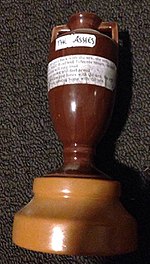
Praying For the Ashes

“Playing for the Ashes” may not be a familiar term to many. It refers to a Cricket Rivalry between England and Australia, dating back over 125 years. The term “the Ashes” was first used by a sports writer lamenting the loss of a Cricket match. The team from Australia had defeated the English team on its home soil, and the writer wrote a tongue-in-cheek “obituary.” Over the years, the two teams now play for a trophy shaped like an urn, which supposedly contains ashes of something related to the famous game. The rivalry is real, and the teams give their all to win each match “for the ashes.” But the trophy itself is little more than a joke. The phrase has come to mean playing all out for something that is already (figuratively) dead or worthless.

“Playing for the Ashes” is also the title of a mystery novel, in which a cricket player is murdered. I am not a Cricket fan, but I am a fan of mysteries, and in reading the book, I learned a little bit about a sport I have never followed. But the book builds on rivalry and the theme of investing one’s energy and dreams for “Ashes.” The main characters of the book have wasted their money, energy, and life force in the pursuit of power, revenge, fame, and status, only to find themselves losing everything they ever worked for. The book is very well written, and it made me think. But it also left me sad and somewhat empty at the end.

I began thinking about how various life pursuits might compared to playing for the ashes. I write about pursuing prayer, but what is my goal and aim? Am I pursuing prayer with the right goals? I may answer that it is part of my pursuit of living like Christ; that I want to grow closer to God; that I want to grow in my walk with Christ…any number of “Spiritual” answers. But is that always true?

How often do I spend my time playing for, and even PRAYING for “the ashes?” How many times do I try to “fix” things first, and only pray as a last resort? How many prayers are spent asking for things I “want” to happen, instead of seeking God’s will first? What dreams am I holding on to when I pray– unwilling to lay them on the altar? Am I praying in line with God’s will, or do I feel like prayer is a rivalry (either with God or with my circumstances)? Prayer IS a pursuit, but it is not a game or a rivalry. The “prize” of prayer is not getting the answers I want, or getting God’s “approval” of my desires. The “prize” is eternal, abundant life from– and with– the Father! It is not getting God “on my side”, but growing closer to the heart of God!

God wants to hear our requests and our desires– but He also wants to hear our desire to follow Him above all. We should be running for the true prize, not playing (or praying) for the ashes!

Tips for Praying Scripture

At least once each month, I want to give some practical tips I have learned that have improved my pursuit of prayer over the years. Today, I want to talk about praying scripture.

On its surface, praying scripture just means reading or saying Bible verses back to God. Of course, some Bible verses or passages lend themselves to this practice, while others do not. (Lists of genealogies in the Chronicles come to mind…) Sometimes, it requires that we change a pronoun or verb tense, or otherwise personalize the scripture, but we are echoing God’s “Word” back to Him in an act of worship. We may be echoing God’s literal words, or repeating words of worship spoken centuries earlier. Some examples:

“Lord, in the beginning YOU created the heavens and the earth”…(from Genesis 1:1)
“Give praise to the Lord, proclaim his name;
    make known among the nations what he has done.
Sing to him, sing praise to him;
    tell of all his wonderful acts.
Glory in his holy name;
    let the hearts of those who seek the Lord rejoice.
Look to the Lord and his strength;
    seek his face always.” 1 Chronicles 16:8-11

Create in me a pure heart, O God,
    and renew a steadfast spirit within me.
Do not cast me from your presence
    or take your Holy Spirit from me.
Restore to me the joy of your salvation
    and grant me a willing spirit, to sustain me.
(Psalm 51:10-12)

“On my bed I remember you; I think of you through the watches of the night” (Psalm 63:6)

“Search me, God, and know my heart; test me and know my anxious thoughts. See if there is any offensive way in me and lead me in the way everlasting” (Psalm 139: 23-24)

Now to YOU who are able to do immeasurably more than all we ask or imagine, according to Your power that is at work within us, to You be glory in the church and in Christ Jesus throughout all generations, for ever and ever! Amen. (taken from Ephesians 3:20-21)

There are some benefits of doing this, but also some pitfalls. First the benefits:

  • Praying scripture can help us when we just don’t know what to say. Sometimes, we are so burdened or so exasperated, or so overwhelmed with emotion, that our words are swallowed up. But a remembered passage of scripture may allow us to speak our emotions in a way that our own words cannot. Sometimes, scripture will give us a focus that we lack, allowing us to put aside distracting thoughts, as well.
  • Praying scripture can help us memorize or review scripture. It can be helpful to read scripture aloud as a prayer, or even repeat key verses as prayer. Sometimes, we will be studying scripture and it speaks to us in a way that causes us to stop and pray it back.
  • Praying scripture can keep our prayers grounded. When we are tempted to pray selfish, momentary requests, scripture reminds us of God’s majesty, sovereignty, and timeless nature. Scripture magnified God and puts our petty worries and desires in their proper perspective.
  • In a group setting, praying scripture can help others focus better, or inspire them to remember another scripture passage that relates to what you have just prayed!

There are many other benefits of praying scripture, but there are also a few pitfalls:

  • Beware of using scripture as a substitute for your own thoughts and concerns. It is powerful to pray the Bible as it relates to your own worship and emotions, but God doesn’t want to hear only the echo of His words– He wants to hear them coming from your heart, as well as your lips. The ancient prophets warned against those who used a form of worship that lacked conviction and submission to His will.
  • Don’t feel bad when you say a prayer that does not contain a direct scriptural quotation– praying scripture is a tool and a guide, not a ritual or requirement. Don’t feel arrogant or superior when you DO pray scripture– it is a tool and a guide, but it does not make your prayer more effective or more Godly than an earnest prayer without a scripture reference.
  • Don’t “cherry-pick” scripture to pray in a way that is out of context or goes against the overall flow of scripture. Two of the most overused and misused scripture passages are Romans 8:28 and Jeremiah 29:11. They are both verses of promise and encouragement, and certainly can be used in prayer. But in context, they are meant to encourage those who are in the midst of anguish and despair, NOT promises to make life carefree or answer a selfish desire for an immediate good outcome.

If you have never (or rarely) tried praying scripture, I hope you will incorporate this tool into your pursuit of prayer. Whether you use a print Bible, scroll through a list of verses on line, or draw upon memory, you will find God’s words to be uplifting, convicting, encouraging, and wholly sufficient as you pour out your heart to your Maker. And if you already use this practice, I hope these tips will help you remember to use scripture wisely and appropriately as you pursue and practice a closer walk with God.

Blog at WordPress.com.

Up ↑