We lost a family member a couple of weeks ago. We were shocked and heartbroken to hear of his loss. To know that we will never get to hear his laughter or watch his eyes crinkle up over a good joke; never hear him enthuse over history or a great movie; never enjoy the fellowship of being in the same room together again. He never got to retire from his job; never got to walk his daughters down the aisle; never got to enjoy the house he and my sister-in-law planned to build.
BUT
Chris had a wonderful life in many ways. He and his wife have three amazing adult children. He got to enjoy plenty of days loving nature and enjoying a good sunset over Lake Michigan. He harvested many morels each spring. He made music. He helped hundreds of people in hundreds of little ways. He was blessed.
We went to Chris’s funeral last weekend. We helped celebrate his life– his accomplishments and achievements, his vivid personality, his sense of humor– and we celebrated his Faith. Yes, there were tears at the funeral. We will miss Chris in the years to come. But we share his faith and his great hope. We will miss him temporarily. We will grieve for a few years. And then, we will experience a joy that will make us forget the grief! Not only will we see Chris again– to laugh together and share stories and songs– we will be in the presence of our source of Life, and Hope, Joy and Peace! We will be surrounded by the great cloud of witnesses as we live eternally with the One who loves us best!
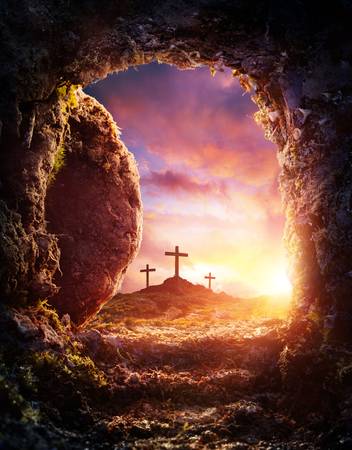
Many years ago, another man died. There was grief, stunned disbelief, and terror. The family, friends, and followers of Jesus Christ mourned. They hid. Their world was dark with despair and anguish. All these years later, we look at paintings and sculptures of Jesus suffering on the cross. But, while we shudder at the horror of all He suffered, we do not look on such pictures with fear or despair. The Cross is not a symbol of Death’s ultimate victory, but rather its ultimate defeat. Jesus didn’t stay dead. His body was buried, but He did not stay there. We celebrate, not the horrors of the Cross, but the limits of its power to steal our joy.
This is where grief meets hope. It is where the past is overwhelmed by the promise of Eternity. Christians grieve– of course we do. We love life, and we grieve to see it end. We love being with friends and family– we feel an emptiness and an ache when someone we love is “missing.” But we do NOT grieve without hope. We acknowledge the brief sting of loss. But Death loses its sting in the light of Christ’s victory. There is no lasting victory in the grave. Our time is short; we are powerless to stop death from taking us; from taking our loved ones. But Eternity beckons! Even our time on earth gives us daily reminders– the sun rises each morning; spring comes after each winter; children grow into parents, and we get to love another generation.
Even when life is hard; when grief looms large and hope seems dim– hope does not disappoint! Because Christ LIVES!
Chris was buried earlier this week– his body was buried– but he LIVES. He is healed and freed of all the pains and frustrations of this earthly life, and because of Christ’s gift of Grace and Redemption, Chris is living all that he once hoped for. Because of Christ’s great gift, many of us will someday join him in singing God’s praises, in laughter, delight, and endless joy!
We are a curious race, humans–we ask a lot of questions of ourselves, each other, and even of God. How did He make the universe? When will Jesus return? Who can we trust in this world? Where is Heaven? What must we do to be saved? But the majority of our questions are “Why” questions. Why did Jesus come? Why did He have to die? Why did God make snakes and mosquitoes and platypuses? Why are men and women so different? Why am I… (short/tall, fat/thin, clumsy, “odd,” misunderstood, etc.)? Why are You so mysterious? Why do bad things happen to “good” people?
I was thinking about this last question this week. I don’t have any definitive answer to that– no one I know has any better answer. God has not given us a definitive answer, either. We are to trust that His ways are wise and best and perfect, but faith and trust require–well, Faith and Trust! We know God has done good things in the past. We know He has redeemed what seemed like hopeless situations. We know His promises, and we have seen some of them fulfilled. Still, such a question can often leave us blindsided and tongue-tied.
There are many learned thinkers, philosophers, and apologists who have written whole books on this subject, but I want to just pose a couple of ideas to help us, not ANSWER the question, but understand the question a little better.
First, the question, “Why do bad things happen to good people?” is really two questions: “Why do ‘bad’ things happen?” AND “Why do they happen to ‘good’ people?” So let’s look at the questions separately.
“Why do ‘bad’ things happen?” What do we mean when we say “bad things?” There are many circumstances, events, diagnoses, and occurrences that may be called “bad.” Death is “bad.” Indigestion is “bad.” Stubbing one’s toe is “bad.” Being diagnosed with Alzheimer’s Disease is “bad.” Divorce is “bad.” Slavery and abuse are “bad.” House fires, job losses, being mugged, being stranded without heat in a blizzard, an outbreak of acne, being laughed at– all these are “bad.” But they are all different. Many “bad” things are the direct result of sin–we suffer the consequences of our own sin; we are the victims of the sins of others. The consequences of addiction can be horrific, but we often lack compassion for those who are suffering, because “they brought it upon themselves.” But what about the innocent victim of rape or child sex trafficking? Such acts leave victims traumatized and broken. Both are “bad,” but we are angered and frustrated even more when “bad” consequences also seem unjust and unfair. And what about natural disasters? Are they the result of sin, as well? The Bible suggests that they are. When God placed Adam and Eve in the Garden of Eden, they lived naked, carefree, and unafraid. Only after their sin did God place a curse on the land– Adam would now have to cultivate the land in order to get food. There would be enmity between the woman and the serpent. Eve (and all women after her) would have pains in childbirth. (see https://www.biblegateway.com/passage/?search=genesis+3%3A+14-20&version=NIV) There is no mention of hurricanes, blizzards, or earthquakes prior to the Fall of mankind, though it is speculation on my part, to say that there were none.
God has promised to make all things new. There will be a time when the consequences of Sin will be eradicated. We will not even remember the suffering we endured in life, in light of the blessings of eternity. So, though God doesn’t answer our question of why “bad” things happen, He does give us the assurance that such “bad” things do not determine our destiny, nor do they happen without His knowledge or outside of His will! We cannot understand God’s purposes in allowing us to suffer, though sometimes we may see a hint of good even in the midst of tragedy.
And God is loving and gracious in the face of our confusion and pain. We CAN ask God “Why?!” “Why me?” “Why this?” “Why now?” “Why them?” Why, O Lord!?” Many of the Psalms speak to this very question. But in the middle of his anguish, the psalmist often finds comfort and renewed strength to face the struggle, when he turns to God. Asking why is not always a sign of weak or failed Faith. Instead, it is acknowledging before God that we ache. We grieve. And we NEED HIM!”
And what about the second part of the question: “Why do (bad things) happen to ‘good’ people?” What makes a person “good?” Jesus was “Good,” And yet He questioned the rich young ruler, “Why do you call me good? No one is Good– except God alone.” (see https://www.biblegateway.com/passage/?search=Luke+18%3A18-27&version=MSG) We tend to think of the people we know and like as “good.” And we have a natural expectation that their lives should be “good” also– free of pain or struggle. But that is not realistic in this world. The actor, Michael J. Fox has been suffering for years with Parkinson’s Disease. This seems unfair and cruel. How could God let him suffer like this? But there are many thousands of people suffering from Parkinson’s Disease. Some of them are homeless addicts; some are in prison for rape or embezzlement. Is their suffering any less than that of Mr. Fox? Is it somehow less tragic or unjust?
The sad and shocking truth is that none of us “deserves” a pain-free, struggle-free life. Bad things DO happen. And they happen to people we like, and people we hate; people we judge to be “good” and people we judge to be “bad.” God does not “play favorites.” Yes, God can, and often does intervene on someone’s behalf through prayer, or for His own bigger purposes. But He does not “dish out” suffering to those He dislikes out of spite or revenge. Nor does He cause His faithful to float through life without ever tasting bitterness and grief. Jesus made many promises, but one of them was this: “in this world you will have trouble; but be of good cheer, I have overcome the world.” (John 16:33) He didn’t promise that you might have a little spot of trouble, or that you might look around and see others in trouble– He promised that we would have trouble. Not because we are “bad” or “good” but because that’s the way this world is.
I find it odd that atheists often pose this question as a way of trying to “prove” that God doesn’t exist. They pose the question as an accusation. “If there is a kind and loving God, why do bad things happen to good people?” But if they believe that there ISN’T a kind and loving God, how do THEY explain why bad things happen to good people? How do they define “good” people and “bad” things? Without a Good God, where is the expectation of good things happening to good people? Without God, there are no objectively “good” things or “bad” things happening– only random events without divine cause or purpose. You can’t blame a non-existent God for things He either caused or didn’t prevent. Such questions are meant to plant doubt in the mind of a believer, but they fail to answer the greater question– Why do Good things happen to undeserving people? Why do we sometimes find joy and peace and strength in the midst of our suffering? Why do human beings continue to Hope?
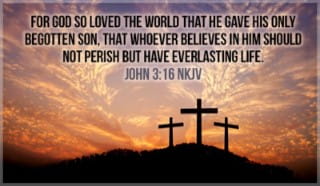
Finally– the ultimate example of God letting something “bad” happen to someone “good” can be seen in the central image of our Faith– the crucifixion of Jesus Christ. Jesus was sentenced unjustly to a torturous death and public humiliation. He was separated from God the Father, and carried the punishment for OUR sins so that WE could be reconciled to God. Even though the purpose of Christ’s suffering has been revealed to us, it doesn’t negate the agony and trauma He faced. And even HE cried out from the Cross– “My God, My God, WHY have YOU forsaken ME?!” (Matthew 27:46)
God does not answer the question of why “bad” things happen in this world. But in the crucifixion, Jesus proves to us that He shares and understands our suffering; that He has the power to overcome and redeem our traumas; and that He will hear our sincere cries of “WHY?!” He will hear when we turn toward Him, instead of turning our back on Him. He will hear our broken heart. He will heal our broken heart.
I love solving things–puzzles, mysteries, codes–I love finding the answer. It’s very satisfying. And I love reading mystery stories–Agatha Christie, Georges Simenon, Dorothy Sayers… But I have very mixed feelings about Sherlock Holmes. Always have had. I loved the intricacy of the mysteries themselves. They seemed impossible; unsolvable. Yet somehow, Holmes always knew the answer. And then, as he calmly explained how “elementary” it was, he would throw out details that no one else could possibly know without three doctorate degrees and a photographic memory.
I recently watched a series of TV episodes about Sherlock Holmes, and it struck me again. However, in our modern age, it is not so very impossible to become an expert on esoteric topics in almost no time. We have the internet, where vast amounts of information is available at the tip of our fingers. We can find facts about nearly everything, everywhere, at any point in history. We can virtually track people, visit places, experience adventures, and yes, even solve mysteries– all without leaving our couch. And while there are numerous dangers of relying on information found in cyberspace, there is no denying the easy availability of it.
One of the things I like about most mysteries is that they show the triumph of good over evil. Mysteries tend to show us, not only the impact of evil in the loss of life or property, the suffering of victims, and the need for vigilance, but the longing for order and knowledge and safety that we hope someone can “solve.” A good mystery story ties up all the “loose ends” and answers all the burning questions– “Who did it?” “How?” “Why?” By the end of the story, we feel victorious and safe and satisfied.
But reading mysteries or solving puzzles can give us a false sense of safety and knowledge. In real life, there are many unsolved puzzles, unanwered questions, and “cold” case crimes with no resolution. We are left asking “Why?” and “How?” about many of the things that have happened in our lives. And the answers are not “elementary”– even for the most intelligent among us.
As an adult, I read (and watch) the Sherlock Holmes mysteries with a different mindset. I know, from past experience, that Sherlock Holmes will always outwit the criminal. And I will probably learn some little-known fact– likely one that I never needed to know–that may be astonishing. But I am more interested in the character of Sherlock Holmes himself, now. Likewise with many of the other detectives I enjoy reading about. Because mysteries involve the triumph of good over evil, they attract writers who study the ongoing fight between the two. Mysteries often involve complex machinations, intricate plots, many-layered characters, and misleading information.
And the detectives are often equally complex and many-layered. Their startling intellect and deductive skills leave us in awe. Yet, they also have human frailties that lead them to overlook key clues or lead them to take risks beyond what we would consider wise. And many of them wrestle with the concept of good and evil–they are often tempted to take the law into their own hands, or to do something illegal in order to bring a criminal to justice. Thus, the reader is left with another mysterious question– just what is “Good” or “Evil?” Are there times when, in order to do “right” we may need to do something that others consider “wrong?” Can two “wrongs” make a “right?”
Some of the best detective characters are almost god-like in their ability to ferret out evil. But they are constrained in their ability to defeat evil. They are, in the end, human. Even Sherlock Holmes, with his arrogant assumptions and dizzying deductions, cannot wipe out evil; cannot keep it from touching and even ruining lives. In fact, as Sherlock Holmes (and others) discovers, intelligence is often a key ingredient of evil. “Stupid” criminals are easy to catch. The great detectives are needed to find the brilliant masterminds of evil; the ones who would otherwise go undetected and unstopped.
The man who created Sherlock Holmes, Sir Arthur Conan Doyle, was an agnostic and, in later life, became a spiritualist. He wrestled with the concepts of good and evil and particularly with the concept of how a “good” God could allow evil to exist. He was skeptical of the existence of the Biblical God, but instead believed in the continuing existence of the human spirit after death. He believed that the battle between good and evil was left to mankind to solve. He, like his famous character’s sidekick, Watson, was a medical doctor. He was a man who worshipped science– a man who valued facts above all. In fact, the stories of Sherlock Holmes offer us what seems to be a triumph, not just of good over evil, but of facts over faith.
Today, we celebrate the triumph of faith and facts over skepticism and arrogance. Jesus, unlike Sherlock Holmes, did not come to the earth to “solve the puzzle of evil” by bringing individual human criminals to justice. He did not brag about His great intellect, though He dazzled the Jewish Priests of His day with His knowledge and understanding of Scripture. Jesus had no fixed address. He did not write treatises or analyze dust samples– He created nature; He had no need for further study! His disciples did not write about Jesus merely because He did miracles. They did not write about Him in order to become rich or famous. Instead, they were martyred and exiled. Jesus did not put an end to the corruption of the priesthood under the Pharisees and Sadducees. He did not break the yoke of the powerful Roman Empire. He died on a wooden cross, hung between two criminals, after being convicted in an illegal trial, and a farce of an appeal to Pilate. He was flogged, taunted, pierced, and buried in a borrowed tomb. He was, by all appearances, defeated by evil and death. He lost– by human standards and appearances.
But faith tells us that God is Good; that Jesus is God; that Good triumphs over evil. And the facts bear out our faith. Yes, Jesus died. It was recorded, affirmed, and witnessed. But that wasn’t the end of the story. He rose again. There is no body in the tomb. There are witnesses to His post-crucifixion appearances. There were witnesses of his ascent into Heaven. His disciples died for their testimony and continued faith in the face of persecution, torture, and threats. And believers over the past two millennia have lived and died in the faith. We are witnesses of His power to redeem, to restore, and renew lives.
The events of Good Friday and Easter present the ultimate mystery. Jesus, Son of God, Messiah– eternal, all-powerful, all-Good– became a sacrifice for us. He allowed Himself to be an innocent victim of Evil for our Good. And in doing so, He didn’t just “solve” a puzzle– He defeated the power of Evil once for all! We don’t have to know more than the enemy. We don’t have to chase down and outwit death. We don’t have to be terrorized by the threat of evil, the weight of our guilt, or the power of the grave. All we have to do to defeat the evil in our lives is to trust in the work of the Risen Savior and follow Him.
I learned a “lot” studying the character of Abraham’s nephew, Lot. (Read Genesis 13, 14, and 19) Today, I want to summarize…
Our lives depend on choices, rather than chances…Lot experienced many opportunities and some tragedies beyond his control. But even when God gave Lot some amazing opportunities– even when He offered miraculous rescue–Lot continued to make bad decisions or no decision at all. When have I done the same? Do I wait for chance and circumstance to find me? Do I drift along without making wise choices, allowing life to carry me to my next destination? Or do I seek God–His wisdom, His Word, His provision–and choose to obey Him?
Not making a choice IS making a choice…Lot chose to live outside of Sodom– but he ended up in the city. Lot spent much of his time NOT making decisions or plans. He chose inactivity, chose to be vulnerable to attack, chose to live in a city so wicked it was doomed to destruction, chose to compromise and bargain with his wicked neighbors, chose to drag his feet (literally) about leaving, chose to let his daughters control his destiny and legacy. How often do I pray for God to direct my steps and guide my life, and then sit on the couch doing nothing? Lot’s story doesn’t include a single instance of Lot taking initiative. He simple reacts to, takes advantage of, or accepts whatever opportunities or misfortunes befall him. And he doesn’t see his inactivity as a sin or rebellion against God. But he never CHOOSES to follow God; to seek Him or obey him. He assumes that not choosing active rebellion and evil is enough. Have I done the same? Do I think that because I am not actively involved in wickedness that I am honoring God with my inaction and apathy?
You cannot live surrounded by evil and not be hurt by it. Ignoring the warning signs, tolerating evil because it becomes familiar, turning a blind eye to the ways others are being hurt–if we are not part of a solution, we are part of the problem. Lot had options– he could have moved away from Sodom; he could have stayed outside the city; he could have spoken up about the evil all around him–he did none of those things. He lived a compromised life; a life in denial. What have I done to flee evil? To speak out against injustice and oppression? To stand up for what is right? When have I winked at evil, or turned a blind eye to wickedness? How often have I sat in uncomfortable silence while someone else suffered? Because “it’s not my problem.” “One voice won’t make a difference.” “It’s just the way they are.” “I don’t want to offend anyone by getting involved. It’s none of my business, anyway.” Lot and his family suffered greatly, even as they tried to “coexist” with their wicked neighbors.
That’s a lot to consider in the life of one man. But more importantly, there are a “lot” of things to learn about the character of God in this story:
God sees us. God included Lot in the larger story of Abraham– He gave an orphaned boy a family, a fortune, and a future. Lot had done nothing to “earn” God’s protection or favor. He certainly did nothing to deserve being rescued– twice– and he did nothing to show gratitude for either rescue. But God didn’t make a mistake in showing Lot mercy. God wasn’t surprised by Lot’s life choices– He didn’t “fail” Lot, and He didn’t forget about Him– even after generations.
God is a judge. We like to concentrate on God’s mercy and blessings, but God’s goodness requires that sin, wickedness, and evil be punished. God doesn’t delight in punishment, but He will not forget the cries of the oppressed. Those who practice evil and seem to “get away with it” will face judgment. If they do not seek God’s forgiveness, they will be destroyed. The cities of Sodom and Gomorrah were destroyed by supernatural fire; Lot was destroyed by his own fears and compromises.
God is merciful. God destroyed Sodom and Gomorrah, but He was willing to save the cities for the sake of as few as ten “righteous” people. We know that “There is no one righteous, not even one..” (Romans 3:10), but God thoughtfully listened to Abraham, and promised to seek for anyone who could be considered worthy of saving. That He saved only Lot and his small family was for Abraham’s sake, not Lot’s– yet save them He did. God doesn’t save the “deserving”– He saves the lost!
God’s plans are perfect, detailed, and eternal. God saved the unworthy Lot, and even when his family repaid God’s mercy with incest, violence, and wickedness against Israel, God orchestrated the story of Ruth– a story of love, faithfulness, and redemption pulled from the ashes of this tragic story in Genesis. God has a plan for each of us– He already knows if we will participate eagerly in a story of beauty and blessing, or be dragged through a story of compromise and tragedy. But ultimately, our story will be woven into a tapestry of God’s faithfulness, righteousness, and restoration. How we respond will change our life, and potentially, the lives of generations to come. And God will give us opportunities to choose lives of obedience, wisdom, and faith. No matter if we live in Sodom, or wasted earlier chances, we can choose rescue and redemption because of God’s great love and mercy!
The Bible never records a prayer by Lot– whether he DID pray is a matter of speculation. But it seems clear that Lot did not seek God in any meaningful way– he didn’t obey God, he didn’t honor God, he didn’t walk with God as his uncle did. Abraham’s life wasn’t perfect– he lied about his wife, became impatient for God’s promised son and took matters into his own hands– but Abraham learned from his mistakes. He humbled himself, looked to God for wisdom, and trusted Him for the next step. He honored God, built altars, and called on the Name of the Lord. May we call out to the same God of Abraham for guidance and wisdom today.
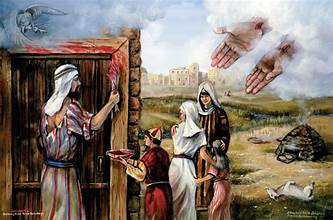
Candlemas, the celebration on which Groundhog Day is founded, is actually the day of the Baby Jesus’ presentation in the Temple (see Luke 2:22-40). Forty days after his birth, every first-born male child in Israel was to be presented at the temple, and a sacrifice was to be made for his redemption. This traces back to the Passover tradition, when the angel of death passed over the houses of the Jewish families who had painted their door frames with blood. Meanwhile, the first born sons (and animals) throughout Egypt were slaughtered. In this way, God showed His Power and His Mercy, leading Israel out of Egypt in triumph, while showing judgment on the Egyptians. (See Exodus 12).
History and tradition cast long shadows. The Jews had been slaves in Egypt for nearly 400 years. A new tradition helped them remember where they had come from and celebrate the promise that God would lead them to their own land. The Jewish people had kept this sacrificial tradition for centuries, reminding them of God’s mercy in saving their sons, and in redeeming them as a people from slavery in Egypt. Christians, realizing that this tradition “foreshadowed” the coming of Christ, adapted it into a new celebration. Christians celebrated Candlemas for centuries, remembering that Jesus was presented as OUR sacrifice, OUR redemption from Death into eternal Life Jesus came to be our Sacrifice, and also our Light.
But somewhere along the way, pagan beliefs and rituals were woven into the story of this day, until it has become “Groundhog Day.” Instead of the Lamb of God, we celebrate a common rodent. Somewhere in Pennsylvania (Punxsutawney), a small crowd gathers as someone lifts up a frightened groundhog and pronounces a weather prediction (one that is less than 50% accurate!) And everyone is looking for a shadow, instead of celebrating the Light.
The thing about shadows is that you cannot see them when you are looking INTO the light. You have to look away, turn around, look back, to see a shadow. Shadows are cast when something gets between the source of light and a flat surface. History casts shadows. Memories cast shadows. Sin casts a huge shadow. But Jesus is pure light. The Word of Life came to be a “lamp unto (our) feet and a light unto (our) path” (Psalm 119:105 KJV). We are meant to learn from the shadows of the past, but not to walk in them. We are to walk in the light, looking forward to the fulfillment of God’s promises, even as we celebrate the faithfulness of His past actions in the lives of others.
Light casts no shadow. But it banishes the darkness where shadows live. Our choices have consequences. We can turn away from the light, or step in opposition to the light, and cast shadows that may follow for generations–cycles of abuse, isolation, hatred, anger, or regrets. Or we can choose to follow the light, and banish the shadows of the past– bringing peace, repentance, reconciliation, and hope.
Heavenly Father, today, I pray that I will be a reflection of Your light in the world; that my actions would help banish shadows of doubt and despair, and shine with Your truth and hope for others to see. Where there are shadows in my life from the past, may I learn from them and leave them behind as I follow you more closely. Where I have cast shadows in the lives of others, help me to bring light and healing in Your name. Amen.
Christmas is so much bigger than just us. That struck me afresh as I was listening to Christmas Carols earlier this week. It is more than just preparing our individual hearts, as crucial as that is, to accept the wonder and miracle that the God of the Universe would empty Himself of all His Royal Prerogative; all His Glory, to become, not just a human being, but a baby! To grow up among His flawed and rebellious creation; to know hunger and exhaustion; to wait in lines, to obey His “elders.”
His coming was not just a quiet birth in the night– though it was that, too. Such a paradox. His birth split the heavens, and divided all time into “before” and “after.” And yet, it went unnoticed by so many people crowded into Bethlehem that night. People living outside of Judea had no idea (other than some wise men from the East) that their King and Savior; their Creator and Redeemer, had just burst into history and humanity with a tiny mewling cry and covered in placenta.
But the Heavens knew! Angels marveled and shouted His Praise! Rocks and hills thrummed with the joy of it. The oceans may have danced, mountains skipped, trees cheered, frosty air molecules jumped up and down, and the stars– the suns of millions of galaxies– laughed in delight! For this was Their Savior, too! Jesus came to redeem all of creation–to fulfill God’s perfect plan!
How can this be? After all, we still have earthquakes and tidal waves; we still have forest fires and smog. Nature is still unpredictable and untamed. And yet, Christ’s coming was the sign that the “groaning” of all creation would certainly come to an end. The promise was true! The Hope of Heaven, the Light of the World, the Word of God, was HERE. Living ON the earth. Able to climb a tree, step into (or walk on top of) the water, breathe the scent of flowers, and look up at all the stars He Himself had placed in the reaches of space. Able to enjoy– as He meant for US to enjoy– all the bounty of the Earth.
And this same Savior has prepared another place– one that is already perfect and needs no redemption, no taming or saving or reclaiming–for those who put their Trust in Him. This tiny Babe, held in the arms of an ordinary girl in a grubby little stable in a tiny corner of the world He holds in His own arms. He is Lord of ALL Nature– that we can see on the Earth, and that which awaits us in a New Heaven and a New Earth!
Christmas is bigger than you and I. It is bigger than our lights and traditions. It is bigger than all of history. Bigger than the night sky; bigger than all we can imagine or dream. Because Christmas is the Advent of Christ– the one who encompasses everything. Let ALL Heaven and Nature Sing! Let the Angels announce His Glory! And let us Repeat the sounding JOY!
Father, I marvel at your Creation. I marvel at your desire to enter into it; to teach us how to have Joy in our journey through it. And I bow in Awe that You would include me in the bigger picture of eternity. Help me to carry this marvel into each moment, as I seek to Honor You and Enjoy the Wonder of Your Nature– both Your Creation, and Your Character! Amen!
A strange image popped into my head the other day while praying with our Wednesday morning prayer group from church. I was trying to express the amazing paradox that we are being pursued by a God who is omnipresent, while seeking the same omnipresent God. And the image God gave me was one of playing a game– “Peek-a-boo” or “Hide and Seek.” Of course, prayer is not just a game– it is nothing less than communicating with the Sovereign Lord of the Universe! But God delights in our prayers, and He delights in delighting us as we learn and experience new aspects of His Character.
I love to play “Peek-a-Boo” with babies and toddlers. They love the idea of being “discovered” and “finding” someone. There is a moment of supreme joy in finally seeing oneself in the eyes of the beholder– that moment of recognition and reaction to being the focus of someone’s attention–the joy of intimate connection, “I SEE YOU!” But the game only brings joy if both of us are present and interacting. It brings no joy to a baby to see me staring off into space, or glued to my cell phone. The baby might be intrigued, or even comforted by my nearness, but there is a deeper thrill when she knows that my eyes will shine as they are revealed– looking directly at her! And I get great joy from seeing the baby’s delight.
The same is true of “Hide and Seek.” Yes, the idea is to hide from sight–for awhile. But what fun is it to hide and never be found? What fun to search for someone who has gone away and has no desire to be discovered again? The joy of the game is in that moment of discovery and being discovered– even though we know the other person is somewhere close by, there is that moment of re-connection that brings a jolt of delight. AHA!! I have found you! AHA! You searched for me and found me!
This is the great tragedy of Sin. Sin causes us to want to hide and NOT be found. (See Genesis 3:8-10). We live in shame and fear, dreading the thought of God finding the “real” us, the secrets we carry, and the ugliness of our hearts. We are frightened by the thought that God is omnipresent– that He sees us; that He sees THROUGH us! We do not want to “Face” God’s justice, and see disappointment and anger in His face. Instead, we want to run away, to cover our eyes, if He will not cover His.
Conversely, this is the great joy of being a Christian. We don’t hide from God’s presence; instead, we turn to Him in delight and recognition. We pray to BE found and to be seen! Finding God, and being found BY Him, involves no fear, no condemnation (Romans 8:1), and no shame. God sees us– all our secrets and shame– through the blood of Christ’s redemption. We are “Born” again– like babies, we can revel in the connection with Our Loving Father. Like a child waiting for the “boo” in Peek-a-Boo, we anticipate the day when we will see Him face-to-face in all His Glory; in the meantime, each glimpse of His Grace, each revelation of His Faithfulness, builds our Hope and our Joy, excites our anticipation, and makes our Heart yearn for the future.
God is omnipresent. His spirit is all around us all the time. As Christians, His Spirit is indwelling– He is not just all around us, but He lives and works IN us and THROUGH us! And yet, God delights in those moments when we turn away from the world around us to focus on just Him. In the same way, even though God is everywhere, He seeks after us and pursues us with a passion and devotion that knows no limits– “Here I am!” “I SEE YOU!” “You are the one who makes my eyes shine!” “I LOVE YOU!”
Today, as you turn away from the world to focus on the Lover of Your Soul, may you find that incredible delight in recognizing His Presence for what it is– Divine, Eternal, Limitless, and Loving.
Several years ago, there was a popular song lamenting that, “all we are is dust in the wind.” The song evokes a feeling of hopelessness– we are weak, small, and helpless as dust in the wind. It speaks of impermanence, brevity, sadness, and despair in the face of forces greater than ourselves, and offers a warning not to “hang on” to earthly vanities.
The Bible speaks to this –God told Adam in the Garden of Eden that he would die and return to the dust from which he was formed (Genesis 2:7 and 3:19). Abraham was told that his seed would be “like the dust of the earth;” spread out across the earth and unable to be counted. The book of Job is filled with images of dust and ashes, as Job, homeless and afflicted, sits covered in them, talking of his life and death, and the emptiness of loss.
But there are surprisingly few references to dust in the New Testament. Jesus tells his disciples to visit cities, and where the people will not listen, the disciples are to leave and “shake the dust from (their) feet” as a testimony against them (Matthew 10:14; Mark 6:11; Luke 9:5)
There are two aspects of dust I want to look at today. First, as the song suggests, dust is carried along by the wind. It has no permanence, no weight, no importance, no resistance, and is swept away by a chance wind, or by design with a broom or dust cloth. Dust is not cherished, but discarded. But dust is not destroyed by the wind– it is carried, lifted, moved, and dispersed, but not destroyed. The dust of today will be somewhere else many generations from now, and the dust that settles on our floors, tables, and under the bed may have been blown there from thousands of miles and centuries away! In just such a way, our lives– fragile and brief, leave traces of words spoken, kindnesses shared, and sacrifices made, that live long after our bodies return to ashes and dust. There is an amazing glory in a mote of dust carried by the stillness into a beam of sunlight. It sparkles and dances and drifts in a graceful spiral, suspended in light and air. And there is glory in a life lived in the light, seeking stillness and grace, being carried by the slightest whisper of God’s eternal love.
Secondly, dust that is not in motion, not in the light, IS discarded, unwanted, corrosive, and dead. There is no glory in layers of accumulated dust covering the beauty of an antique dresser or building up in the corner of a room. Dust that is NOT carried on the wind sits, worthless and destructive. It gets absorbed into an unsightly pile of sad, dead matter, and it sits– going nowhere, doing nothing. We shake it off, brush it off, wash it off, sweep it away, and get rid of it.
Dust comes from death– dead skin cells, dead plant and animal matter–and I think there is a very real reason it is mentioned so often in connection with sin, sickness, unbelief, judgment, and death (though not in all cases). God does not want to leave us unmoved and dead– He wants to bring us to glory and give us new life in Him. We are dust in the wind– but that is not all we are. Instead, it is what we are for a brief moment in time– being carried to a new destination, or sinking and settling into despair.
I pray that we will be lifted up in prayer and faith today, to dance in the light of God’s glorious grace, and carry our mote of glory and grace to wherever God my send us.
There is no way I can give a definitive answer to the above question. In a thousand blog posts or three volumes of analysis, I could never cover all the issues this question brings up. I offer the question today for two reasons:
This question is raised in the Bible. Asaph raised it in Psalm 73 https://www.biblegateway.com/passage/?search=Psalm+73&version=ASV; Habakkuk and other prophets also asked it. Solomon pondered it in Ecclesiastes, and Job cried out against it. God is not afraid of such questions, but He doesn’t give glib answers, either. The psalmist received no immediate answer directly from God, but when he entered the sanctuary of the Most High, and considered the eternal destination of the wicked, his attitude changed. His envy, anger, and bitterness melted in a flood of awe and worship. God does not want us to be bitter, angry, or envious of the wicked; nor does He want us to be apathetic toward injustice, abuse, and inequality. There is something profoundly disturbing when we see the wicked prospering at the expense of the righteous and innocent. It should cause us to turn to God and seek His help.
That brings me to the second reason I want to grapple with this topic today. I need to! I have the tendency to want an immediate answer, and to see the wicked suffer– until I am in the presence of a Holy God. There is no wickedness that is outside of God’s justice, or of His grace. God WILL bring complete justice– in HIS time. But His primary goal is to bring redemption, restoration, healing, hope, and salvation– even to the wicked; even to ME. God’s justice is not just reserved for those I deem to be wicked and prosperous. God’s ways are not my ways. What if, in my eagerness to condemn the wicked, I miss God’s plan to change the heart of a Zacchaeus, or an Ebenezer Scrooge, or a sinful King David or arrogant King Nebuchadnezzar? No amount of wickedness can overwhelm God’s love and mercy, or His ability to make “all things work together for good” (Romans 8:28) for those who love Him and are called to serve Him.
Lord God, today I pray for eyes that see Your face, even in this broken and fallen world. May I look to see Your patience, Your mercy and Your grace, as well as Your Holiness and Justice. May I be an instrument of all these aspects of Your character as I live in Your grace today. Thank You for Your great mercy toward me, and to the promise of Eternal Life with You. Amen.
whose sin the Lord will never count against them.”
Romans 4:7-8 (NIV) via biblegateway.com (See also Psalm 32:1-2)
Ask me about my most embarrassing moment, or my greatest failure..better yet, ask one of my friends or relatives! We tend to hang on to our past, especially our mistakes, our hurts, our missed opportunities, and our shortcomings. When I taught public speaking in a local high school, I heard horror stories about why “I can’t get in front of people and talk.” The fear of public speaking rates higher in some studies than the fear of Death! And often, the fear is based on an incident from early childhood of people laughing at a small, but very public mistake. Such moments haunt us.
As we grow older, we let our regrets live large– those things we “would have, should have, could have” done, or the things we shouldn’t have said, but can never un-say. And even if we try to move on or forget the past, there always seems to be someone who cannot let go, cannot forgive, or cannot forgive. Lives have been stunted and ruined by the ghosts of “what happened” when…
God is all-knowing. There is nothing we’ve ever done, said, or even thought, that He “missed,” ignored, or “lost track of.” God has total recall over all the centuries and eons of time– past, present, and even future! And yet, God offers to forgive ALL our sins, and to “remember them no more.” God will never bring up “that time when you disappointed me…” God will never look at you with condemnation over anything you have confessed and repented over. It’s not that God will never be able to recall what happened; but He will no longer “charge it to your account.” He has chosen to pay the consequences in His own Blood, so that you can be debt free.
Imagine if you had no bills. If all your mortgages, utility payments, credit card debt, medical bills–everything that you were responsible to pay– all were stamped “Paid in full.” You never had to worry about interest payments, late fees, repossession, evening phone calls from bill collectors, credit scores, etc. What a weight off your shoulders! Imagine if you had no reason to fear getting in front of a room full of people to speak or sing or give a presentation– no fear that others would judge your every hesitation, or whether your tie was straight, or your hair was mussed, or you stumbled over a word or phrase or tripped on the steps leading up to the podium. Imagine being accepted and embraced by the very one who, by rights, should be your most severe critic.
Sometimes, when we see God as our critic, our judge, or our opponent, we’re not seeing God as He really is– we’re seeing a reflection of ourselves– harsh, judgmental, unwilling to forgive others; unwilling to forgive ourselves. The very first deception of the Enemy was to distort God’s image from Creator and Sustainer to Judge and Tyrant. Yet Satan is called “The Accuser,” not God. God’s Holy Spirit may convict us of Sin– causing us to see that we have done wrong– but His purpose is always to correct and restore us, not to haunt and condemn us. Even the “worst” sins are not beyond God’s ability or willingness to forgive. Jesus forgave His accusers, His betrayers, and His executioners from the Cross!
Forgiveness is not easy. Sin is real; it has real and terrible consequences. Sin hurts, humiliates, victimizes, and traumatizes. And its effects do not simply vanish if we say, “I forgive.” But hanging on to the pain and anger keeps us from finding and experiencing the healing and wholeness that Jesus offers. Forgiveness does not mean that the sin, or the pain, never happened– God will not “forget” injustice just because we forgive the unjust. Forgiveness means that we no longer need to try to collect the debt from someone else– because God has already promised to pay it back with interest! And forgiving yourself doesn’t mean that your past actions didn’t happen or didn’t cause pain. In fact, whenever there are opportunities to atone for past actions, or ask forgiveness from those we have wronged, we should take them. But where such opportunities are impossible for us, even when we cannot see how such pain could be redeemed or relationships restored, God has promised that we can move beyond our past mistakes and live a new , blessed, and debt-free life.
When we approach God in prayer, we come as we are– people with past mistakes, very human emotions, including doubt and fear, and unworthy to stand on our own before a perfect God. But it is God who invites us to come to Him– debt free and embraced by His limitless Grace!
































 Pursuing Prayer