The Lion’s Share

Because of the Lord’s great love we are not consumed,
for His compassions never fail.
They are new every morning;
Great is Your faithfulness.
I say to myself, “The Lord is my portion;
Therefore I will wait for Him.”

Lamentations 3:22-24
Photo by Jonathan Petersson on Pexels.com

We live in a world of seemingly finite resources. We work hard to save money, save time, protect our joints, take care of our teeth, maintain our house or yard, repair our vehicle, conserve water, protect our air quality, etc.. And we work hard to ensure that we get our “fair share”–vacation time, wages, tax breaks, sale prices, the best return on our investments, the lot with the best view, the window seat on the plane or bus, credit for our hard work, and more.

Photo by Charles Parker on Pexels.com

God’s resources are unlimited and bountiful. Through Christ, we are joint heirs to all the riches of God. God is our “portion.” And no one who trusts in Him will be left with less than a cup filled to overflowing (Psalm 23:5). We may not fully comprehend or receive our great good fortune in this life, but we will enjoy it the next for eternity! And there is no need to scramble and scrimp, worry, or wrangle trying to get it– it’s our promised “portion” and our inheritance.

Photo by Bri Schneiter on Pexels.com

What a world of worry, stress, desperation, and trouble we might avoid if we carried this promise in our memory and LIVED it out. The prophet Jeremiah wrote these words– Jeremiah, the weeping prophet; Jeremiah, whose life was in constant danger as he watched his homeland being invaded, conquered, and exiled. Jeremiah, in the midst of his anguish, took time to write some of the most hopeful and joyful words of prophecy. Jeremiah knew that, even if the nation of Judah was conquered and destroyed, the LION of Judah would still bring ultimate victory. And to the victor belong the “spoils!” Jesus is our victor and our victory. His are the spoils of war to lavish upon those He chooses.

Photo by Alexas Fotos on Pexels.com

Jesus (called the Lion of Judah, an image found in both Genesis and Revelation) has already given us victory over Sin and Death. And the “Lion’s Share” of the spoils– abundant life, restoration, redemption, and the Righteousness of God– are for all those who call on His name and worship Him in Spirit and in Truth! He’s reserved a “Lion’s Share” for each of us.

Photo by Liza Summer on Pexels.com

“The Lord is my portion; Therefore, I will wait for Him.” ” I will trust and not be afraid.” (Isaiah 12:2) “You too be patient; strengthen your hearts, for the coming of the Lord is near.” (James 5:8) https://bible.knowing-jesus.com/topics/Waiting-On-The-Lord (See also Psalm 37)

Instead of scrambling for a “lion’s share” today, let’s call on the Lion, and allow Him to give us our “daily bread,” knowing that His portion is more than sufficient today and forever!

Be Reconciled

23 So if you are offering your gift at the altar and there remember that your brother has something against you, 24 leave your gift there before the altar and go. First be reconciled to your brother, and then come and offer your gift.

Matthew 5:23-24 (ESV)
Photo by RF._.studio on Pexels.com

Why do we find it so difficult to be reconciled? We crave God’s forgiveness, but we withhold our own toward our neighbors, or family members. We let anger and bitterness keep us apart. We let pride keep us from doing what we know is right in God’s eyes.

I speak from conviction. I have been estranged from a cousin of mine. Years have passed since we’ve spoken. We argued about something, and simply stopped talking. I tell myself that I have nothing for which to apologize–that’s just the way things ended. And my life is far less stressful since we’ve stopped talking. I do not “hate” my cousin, or feel bitter toward her. In fact, I tell myself that I only wish her the best– I just don’t want to be involved in her life, or have her involved in mine.

Photo by Josh Sorenson on Pexels.com

I know this is not what God wants. I know I should get in touch, and reassure her that “we’re okay”. Yet I am afraid to reach out and re-establish contact. Not because she poses any sort of physical threat, but she threatens my pride and my comfort. I find her difficult to talk to; difficult to understand. We have different ideas about boundaries and expectations–I find her “needy,” and she finds me “aloof.” I don’t think time will have made our relationship “easier.”

Photo by Liza Summer on Pexels.com

But God finds her precious in His sight– and worthy of my effort to reconcile our relationship. That doesn’t mean that I must allow her to manipulate me or abuse my emotions, or that I must demand that she be someone she is not to make me more comfortable. But it does mean that I may be embarrassed or inconvenienced at times. I need to be willing to listen, even when it is difficult, and so speak, even when it seems like I’ve said the same thing before. And it means that I must learn to set healthy boundaries and insist on them– not to shut her out as I have been doing, but to keep our relationship balanced and safe for both of us.

God puts a great premium on our willingness to be reconciled to one another. So much so, that Jesus told His listeners in the Sermon on the Mount, that if they were ready to bring an offering, and they remembered that someone had something against them, that they should leave their offering– unoffered– and go be reconciled first. Being at odds with others puts us at odds with their Creator and the One who loves them. Whenever possible, we should seek to reconcile. Broken relationships are sometimes a reflection of our relationship with Him. It hinders our prayer life, as well as our witness to the Power of God to redeem and reconcile the world around us.

Photo by Timur Weber on Pexels.com

God is aware that we are sinful people. And there are some relationships that are absolutely toxic. Reconciliation and forgiveness are NEVER about allowing another person to continue to abuse or manipulate you. Especially if this involves physical or sexual abuse. Forgiveness is not the same as accepting someone else’s manipulation or abuse. God, and only God, can redeem us and make us a new creation. Some relationships cannot be fully “reconciled” in this life. But “letting go” is not the same as “locking out” or “running away.” We must let others know that God can do what we cannot–He can restore broken relationships. He can make all things new.

Blessed Are the Pure in Heart..

“Blessed are the pure in heart, for they shall see God.” (Matthew 5:8)

“Create in me a pure heart, O God, and renew a steadfast spirit within me.” (Psalm 51:10)

Photo by Min An on Pexels.com

I’ve been looking through the Beatitudes and how they relate to prayer. Jesus said that the pure in heart are blessed, for they shall “see God.” Have you ever spoken to someone who wasn’t looking at you? They looked past you, or around you, or down at their device, but they didn’t attempt to make or maintain eye contact. It can be disconcerting, and even rude. And yet, there are times when, with our divided hearts, we come into prayer without really looking for, or at, God.

Photo by RODNAE Productions on Pexels.com

At other times, our hearts cloud our vision, giving us a distorted view of God. We harbor sin or guilt, and we see God as unforgiving or unfair. We are holding on to our own will, and we see God as restrictive or demanding.

Photo by Andrea Piacquadio on Pexels.com

The pure in heart see God as He really is– Glorious, Merciful, Wise, and Just. They see evidence of His lovingkindness and faithfulness all around them. They see themselves through His eyes– beloved and forgiven–and they see others through the eyes of Grace.

This is not our natural state. We are NOT pure in heart. We are self-centered, self-absorbed, and self-conscious. King David recognized this profoundly when he was caught in his great sin of adultery and murder. In his own lust and selfishness, he had seduced the wife of another man, and when she became pregnant, David arranged to cover up the first sin–by having the man murdered. David was not a notorious scoundrel. He was even called, “a man after God’s own heart.” But when he was confronted with his guilt, David “saw” himself as he really was– not a victim of circumstance, or a martyr to passion, or a king who was above the law, but a man who had committed evil against others, and against a Holy and Sovereign God.

Photo by Nicola Barts on Pexels.com

David’s prayer was in line with his vision. Not only did he see himself as he really was; he saw God as HE really is: Holy and Just, but willing and able to restore David’s purity of heart. David’s God is the same today as He ever was. He longs to make us clean; to restore to us the joy of our salvation (see Psalm 51:12), and give us the power to pursue our purpose and leave our past sins behind.

Photo by Edu Carvalho on Pexels.com

When we desire to “see God,” we must desire this cleansing and restoration of purity. We can pray without it, but we cannot look at a Holy God with an unclean spirit. All we can do is look elsewhere– talking to the wall or the floor. God still hears us, but he wants to have a real conversation; one full of intimacy and understanding.

So, today, will I make “eye contact” during my prayer time?

Praying For the Past

I was thinking earlier this week about a past friendship– one that involved pain, abuse, and struggle. While we have moved on, and I hope we have both found peace and closure, there are still memories, both good and bad. The past has a way of popping up at odd moments, and sometimes, it pops up in pain.

Photo by RF._.studio on Pexels.com

Prayer isn’t really about the past. What’s past is gone– but it can be redeemed. That is the Good News of the Bible. God is about redeeming our past, and transforming our present and future. When Jesus prayed, and when He taught His disciples to pray, He never mentioned the past. So what do we do with the past when it comes to prayer?

While I don’t have any complete or definitive answer to that, I do have a few thoughts:

  • Don’t wallow in the past. If Jesus has redeemed you, He has redeemed your past as well. Rejoice and be thankful for this incredible gift! We can’t erase the past, but we don’t have to keep living there.
  • Focus on the present, and give both your past and your future into His hands. It’s easy to say, and to write, but it takes time and effort and the work of the Holy Spirit to continue to do this. It’s a daily task!
Photo by Teona Swift on Pexels.com

If you are still bothered by aspects of your past, ask for wisdom to do the following:

  • Pray for wisdom to learn from the past–both your mistakes, and situations you have had to face.
  • Pray for courage to face the past– to apologize, to make atonement, or to rebuild relationships where possible, and the courage to let go of situations you cannot “fix.”
  • Pray for those people and situations that were part of your past–acknowledge them, and lift them up before God’s Throne of Grace.
  • Pray for release from lingering feelings of guilt, and lingering temptations to return to past behaviors and/or toxic relationships.
Photo by Min An on Pexels.com

The past can be powerful in shaping our present and future. God knows this, but He wants to remind us that He is MORE powerful! That doesn’t mean that we will sail through the present, or that we won’t carry scars from our past. But those scars are not the whole of our story, any more than the grave is the end of it.

He who was seated on the throne said, “I am making everything new!” Then he said, “Write this down, for these words are trustworthy and true.”

Revelation 21:5 (NIV)

Peace Like a River…

When peace, like a river, attendeth my way,
When sorrows like sea-billows roll;
Whatever my lot, Thou hast taught me to say,
It is well, it is well with my Soul.
(It Is Well with My Soul–Horatio Spafford)

…He leadeth me beside the still waters. He restoreth my Soul–Psalm 23:2b-3a)

Photo by Pixabay on Pexels.com

When Horatio Spafford wrote the poem that later became this famous hymn, he was not writing from a place of peaceful circumstances. He had suffered a series of financial and heartbreaking personal losses (https://www.christianity.com/church/church-history/timeline/1801-1900/horatio-spafford-it-is-well-with-my-soul-11633070.html). He knew very well that our lives will be blessed by pleasant and peaceful times, and tossed about during storms and waves of loss and despair. But through it all, God’s presence is the source of our strength and hope.

Photo by Collis on Pexels.com

Our Shepherd leads us where we need to go. He gives us everything we need. But He doesn’t give us only ease and pleasure and rest. Such a life leads to complacency, apathy, and spiritual atrophy. He makes me to lie down in green pastures; He leads me beside the still waters– He restores my soul. Even though these thoughts come in two separate verses, I think there is a close link between the phrases. We need rest; we need restoration. And we find it when we are drinking deeply from the “still waters”– cool and clear and life-giving waters–the “living water” that only Jesus provides. We are often attracted to swift water– white water rafting, ocean surfing, waterfalls, sailing, etc. Moving water is exciting and full of energy. But it can be overwhelming to fight against the current or the power of falling, churning, running, or raging water. Without being anchored to something stronger than the waves; without help to overcome the pull of the current or a way to get to shore safely– we would be lost.

Photo by Guy Kawasaki on Pexels.com

Storms and tides will be a part of our life– there will be dangers, and toils, loss, and unexpected heartaches. Sometimes, they come from our own foolish choices; often, they come because we live in a broken and fallen world filled with diseases and disasters beyond our control. God doesn’t lead us into storms just to leave us there, flailing and treading water with no end in sight. His goal is to lead us to the still waters and to restore our souls. The same river that contains white water will reach a peaceful valley, where it will run deep and wide and slow– perfect for restoring our souls and reviving our hearts.

Photo by Kaique Rocha on Pexels.com

It is a comforting thought that God, our Shepherd, will lead us beside still waters. But that is not always our lot. God’s promise is not that we will always have quiet, calm waters in life. God’s promise is that He will lead us safely through even the raging storm– and that His presence will provide a peace that defies our temporary surroundings and our trying circumstances.

Of Flotsam and Jetsam

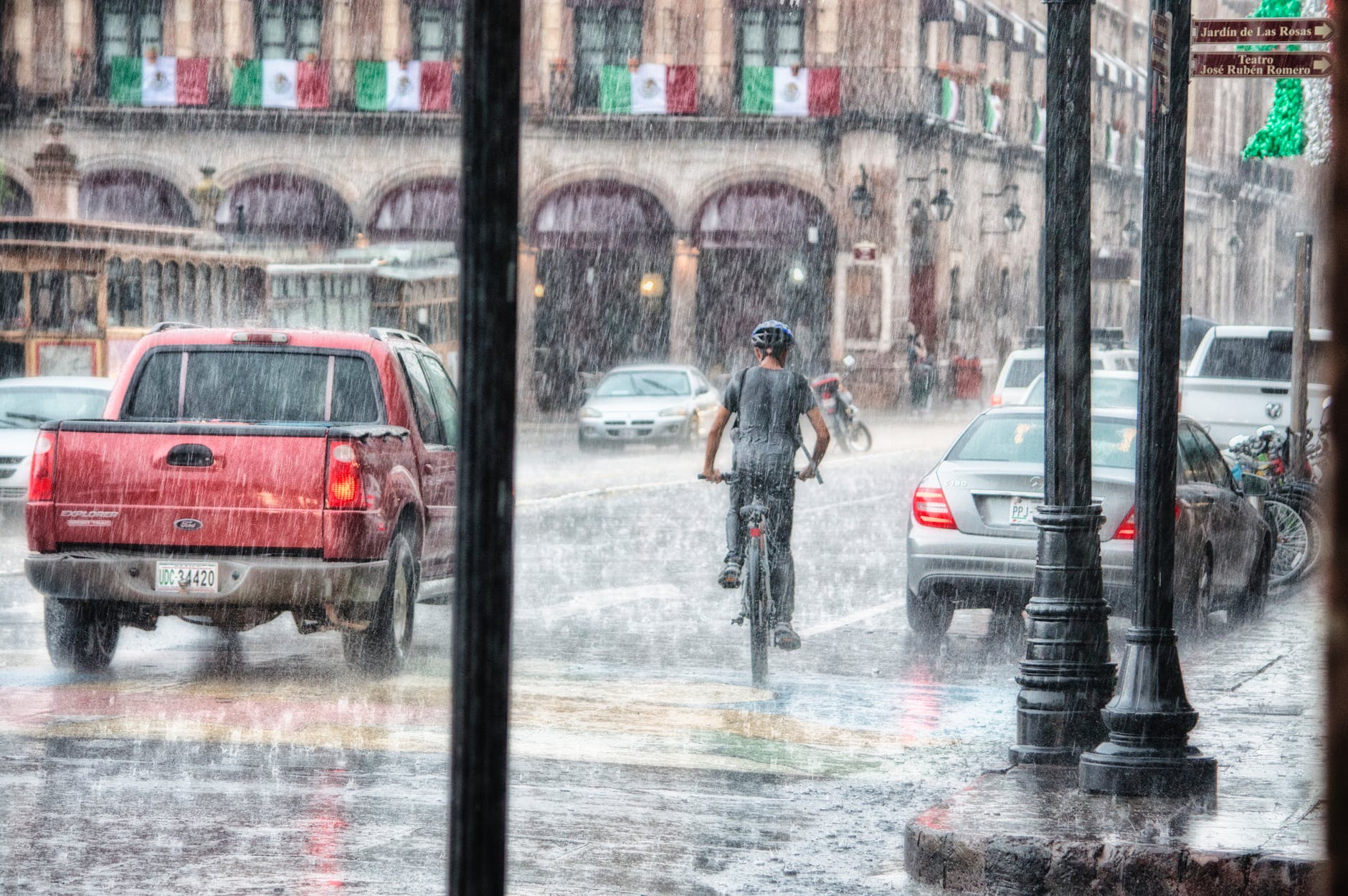
We’ve had a lot of rain lately– torrential bursts that turn our street into a river for a few minutes, before running into the sewer drains.  In that time, many small objects come floating by our apartment– fallen leaves, pebbles, cigarette butts, discarded plastic spoons, candy wrappers, etc.  The swift waters propel them from wherever they had been– someone’s drive, the alley, the parking lot–past houses and stores and toward the drains.  Some of them end up clogging a drain, forming a small pile of trash where there was none before.

person riding a bicycle during rainy day
Photo by Genaro Servín on Pexels.com

The opposite scenario is happening along several coastal areas, where debris is washing up from the ocean and landing on beaches, clogging up deltas and salt marches and having a terrible impact on the environment.

time lapse photo of brown grass on body of water
Photo by Darwis Alwan on Pexels.com

Flotsam and jetsam–the terms come up occasionally in literature or movies.  There are characters in Disney’s “The Little Mermaid” with those names.  There is a chapter in Tolkein’s “Lord of the Rings” Trilogy (the ninth chapter of the first book of The Two Towers, for purists)  titled “Flotsam and Jetsam”.  There is even a band by that name.  They are almost always used in tandem, and most people use them interchangeably.

But there is a difference.  Flotsam is considered debris that ends up in the water by accident, as in the case of a shipwreck.  Jetsam is something deliberately thrown overboard or “jettisoned”.  Legally, flotsam can be reclaimed by its original owner, while jetsam can by claimed by anyone who finds it.  more about flotsam and jetsam from NOAA.

person holding plastic bottles and hose
Photo by Daria Shevtsova on Pexels.com

Most of what I’ve seen floating by this week is neither flotsam nor jetsam– it’s merely garbage.  And that is what is causing so many problems along the coastlines, as well.  Our lands and oceans (and our lives, too) can easily get overrun by waste and packaging and excess.  We fill our lives with things that do not have any good purpose, and even if we dispose of them, they can come back to haunt us or hurt others down the road (or on another coast).

Today, I want to pray that God would continue to teach me to find my satisfaction in Him, and to watch out for spiritual flotsam and jetsam:

  • Flotsam– those things, people, habits, beliefs, promises, warnings, etc.  that get washed overboard or lost along the way.  May God reclaim relationships, help me relearn good habits, and restore joy in my salvation (Psalm 51:12)
  • Jetsam– those things I need to jettison–bad relationships, bad habits, faulty thinking, pride, clutter, etc.  In His power, and with His help, I need to cast such things aside, or better yet, put them to death and bury them, never again to be reclaimed.

sunset ship boat sea
Photo by Pixabay on Pexels.com


Broken Prayers

In “Pursuing Prayer”, I want to explore ways to develop my prayers; to become “better” at praying– more confident, more Christlike.  But along the way, I have found that “better” doesn’t always mean what I think it ought to mean.  Sometimes, becoming “better” requires becoming broken.

food healthy yellow broken
Photo by Pixabay on Pexels.com

I don’t like being broken.  I don’t want to be shattered, ruined, like a broken vase.  I don’t want to pray like a broken record– sending up the same failures, the same weaknesses, the same painful memories.  I don’t want to be pinched, and cracked, and mangled.  I don’t want to be stretched and molded and squeezed.  I want to have comforting chats with God, not drawn-out confessions, or rebukes, or unanswered questions.

broken clay close up crack
Photo by Martins Krastins on Pexels.com

It is tempting to avoid brokenness–cover it up, pretend, deny, ignore its existence.  I don’t want to bring God my questions, my fears, my hurts.  I don’t want to open up the dark places of my soul.  I want to wear a smile and make small talk with God–“How are you today?”  “Just lovely, Father, and how are you?”  “Fine weather we’re having.”  “Yes, thank you for the breezes yesterday.  And could I just put in a plug for my neighbor’s gall bladder surgery?  I told her I would pray for her, so could you just give her a speedy healing?  That’d be great.  Well, gotta run. Talk to you soon…Oh, and I’m sorry for the way I blew up at the kids the other day.  I don’t know WHAT got into me.  You know I’m just not that way, right?  So I’m just asking for grace to kinda cover that up and make it ok again.  Thanks.”

blur broken ceramic clay
Photo by Fancycrave.com on Pexels.com

God is not fooled.  God is not impressed or amused at our shallow righteousness.  He’s not impressed or overcome by our brokenness, either.  But He wants it, anyway.  He wants all of it.  Because He wants to build honesty, intimacy, and most of all, restoration.  God doesn’t want us to wallow in our failures, any more than He wants us to gloat in our false perfection.  He wants to break the bondage they have over us.  He doesn’t get tired of hearing our voices, even in guilt or shame, rage or despair…if they are raised to Him.  He doesn’t want us to stay shattered and ruined.  But He needs us to be redirected, refreshed, rebuilt, rekindled, and renewed.

farm against sky
Photo by Sebastian Voortman on Pexels.com

There are many things that need to be “broken” to become better– we “break” in shoes, we “break” ground to create a new field or prepare for a new building.  We “break bread” to eat it and share it with others.  We “break” horses in order to prepare them to run or work more effectively.  We “break” bad habits.  We even “break” the ice in a new friendship.  The point is not to stay broken, but to “break through” whatever is keeping us oppressed and held down.

petaled flower drawing on white egg shell
Photo by Netaly Reshef on Pexels.com

When I am feeling broken, and I cry out to God, He doesn’t deny my brokenness; He doesn’t turn away in disgust; He doesn’t stick a hasty bandage on my wounds.  God acknowledges my pain, He listens to my questions.  He loves me enough to come and stay with me through the worst moments–even when others have gone; even when I deny His presence and turn my face to the wall–and He begins the process of turning even those scars and cracks and tears into treasures.

Brokenness is inevitable in our fallen and broken world– God is not out to break us; people and time, circumstances, and even our own good intentions will cause us to fall and fail–am I willing to uncover my brokenness and need, and allow God to reshape my shattered dreams?

yellow and pink flowers view behind broken glass
Photo by Pixabay on Pexels.com


Blog at WordPress.com.

Up ↑