Too Much of a Good Thing

My late uncle came to know Christ– really know Christ– later in his life.  He and my aunt spent their final years doing advanced Bible studies by correspondence course– hour after hour studying Hebrew and Greek, filling out paperwork, sending it in, and waiting for the next lesson (this was before the explosion of online classes and internet shortcuts).

When Uncle Fred was diagnosed with ALS (Lou Gehrig’s disease), and he knew his time on earth was drawing to a close, he planned his funeral service, and it was incredible– uplifting, encouraging, hopeful!  This from a man who, earlier in life, had had anger issues, numerous issues with money, and serious doubts about God.  One of his favorite scripture passages came from Proverbs, and it surprised me a bit.  It wasn’t about promise or hope or power or expectation.  Instead, it was about discipline and correction and balance.

Proverbs 30:7-9 New International Version (NIV)

“Two things I ask of you, Lord;
    do not refuse me before I die:
Keep falsehood and lies far from me;
    give me neither poverty nor riches,
    but give me only my daily bread.
Otherwise, I may have too much and disown you
    and say, ‘Who is the Lord?’
Or I may become poor and steal,
    and so dishonor the name of my God.

The first request is one we might expect– keep me from lies and falsehood. Not just the lies of others, but keep ME from lying. After all, this is in keeping with the ninth commandment. And we need God’s help to keep away from all sins, including self-deception!

walk human trafficking

The second phrase is a little harder to swallow– “Give me neither poverty nor riches”– OK, I don’t want to be poor, and it’s probably not good for me to be super wealthy.  I’ll just be a comfortable middle-class sort of person. 

It’s the last phrase that catches us– “But give me ONLY my daily bread.”  Excuse me?  I don’t know about some of you who may be reading this, but I don’t want ONLY my daily bread.  What about all those verses that say we can ask for ANYTHING in Jesus’ name and he will do it!?  What about being prepared in and out of season–what about savings accounts and retirement plans and having extra to give to those in need?  What about a cozy lake cottage or a really nice vacation?  Don’t I deserve to treat myself?  Haven’t I earned a few creature comforts?  I give to charity, and I volunteer at church. I don’t need to be rich, but “only my daily bread” sounds a bit like poverty…

The next verse gives the reason, and also the test.  “Otherwise, I may have too much and disown you and say, ‘Who is the Lord?’ Or I may become poor and steal, and so dishonor the name of my God.”  It’s tempting at this point to brush off the warning.  After all, I haven’t disowned God, have I?  I still go to church and write about prayer.  What more does God want of me…Who is God to ask more of me?  Who is the Lord to tell me what I can’t have…We don’t start out denying or disowning God, but we begin to question his ways, and our own obedience.  Similarly, we don’t think we are stealing or dishonoring God’s name, but how many of us have tried to “beat the system” to get ahead instead of turning to God or the church for help?  Tax breaks that are questionable, lying (see verse 8a again…) about our income to qualify for federal programs or grants, “borrowing” from family or friends with little or no plan for how to repay them…  I wish I could say I didn’t know anyone who had ever bragged to me about they had “cheated” just a little, or that I had a perfect track record in this area.

view of tourist resort

This passage is filled with wisdom, but it is not wisdom we teach in many of our churches today.  Yet it is exactly what God teaches by example and what he expects of us.  Did not Jesus pray for God to “Give us this day our Daily Bread?”  He didn’t ask God to pour out the storehouses of Heaven so we could add a pool in the back yard, or afford a new car, or get that extra pair of shoes or the latest new gadget.  Yet he prayed with the complete confidence that God would not withhold any of his needs or cause him to live in shame or starvation.

man holding sheep statuette

It’s not as though God has commanded us to live as paupers and beggars– look at the way he provided for the Israelites in the wilderness.  He provided, quite literally, their daily bread/manna.  Just enough for each day, with a double portion for the Sabbath.  Just enough– just a sufficient amount.  No one had to worry about losing their food supply to theft, packing it up to travel, using it up before the expiration date, or comparing one brand to another to check for gluten or preservatives or recall notices.

No one had to worry about whether their shoes were the right color to match their favorite outfit, or if they had enough gas in the tank for their next move.  God provided all their needs when they absolutely COULD NOT.  And he provided more than just their basic needs– they had herds and flocks; he provided water and grazing for them, too.  He had caused the Egyptians to give them gold and jewels as they left Egypt, so they would have enough (and far more than enough) to make all the tools and objects for the tabernacle, and still have a medium of exchange when they reached their new homes in the Promised Land.

But God did not encourage His people to seek after riches–even for His sake. When David wanted to build an elaborate temple, God sent word that, while David’s intention was good, He (God) did not need a Temple; nor did He want David to build one. And David listened and humbly thanked God for the blessings he already had, and the opportunities God had provided for him. Solomon DID build the temple, but he allowed the riches flooding into his kingdom (among other things) to turn his heart away from God.   He built an elaborate Temple, but then he spent even more time and money to build his own palace and throne! He collected horses from Egypt and many foreign wives (expressly forbidden for the kings of Israel– see Deuteronomy 17:14-17). And he fell into cynicism and idol worship.

Our current culture (at least in the U.S. and in much of the rest of the world) tends to be consumed by…consumption.  Having the newest and latest and best of everything.  Seeing to our own comfort and self-esteem and satisfaction– often at the expense of our devotion to Christ and our service to others.

adult beautiful elegant eyewear

There’s nothing wrong with nice things– helpful tools, comforts, pleasures– God doesn’t want us to be miserable or full of a false humility that throws away opportunities and rewards.  But he needs us to see that not every “good” thing is the “best” thing for us.  We CAN be too rich, too thin, too smart, too proud…you get the idea.  Too much of a good thing can blind us to the BEST thing!

God’s Economy

“Times are tough!” I hear many people complaining about the economy lately. And they have good reason– gas prices, food prices, housing prices, taxes– everything is getting more expensive, and wages or other sources of income just aren’t keeping up.

While we may worry about the current economic conditions, we need to step back and look at a different economy– God’s economy.

This weekend, I wrote out checks and paid bills. I even put some money in the offering at church. But God doesn’t look at the amount of money I paid or gave away, how much I spent or saved, earned or invested. He’s aware, of course, of such things, but God looks at a different “bottom line.” God cares how I spend or save money, whether it’s pennies or thousands of dollars. But He also cares how I spend my time and energy. And my life is “richer” than just the money in my bank account or the things in my house.

God doesn’t give us everything we want– He loves us too much for that. Life isn’t about having the most “toys;” it isn’t about having the easiest or most entertaining experiences. It isn’t about “winning” and having “more.”

I have noticed that the happiest people are often those who have had to struggle the hardest. In God’s economy, it is His pleasure to give more than we can ask or imagine– but often in ways we would never expect. (see Ephesians 3:20-21) In God’s economy, I am rich. Not because of anything that I have done, or earned, or because I was born to a wealthy family or because I won the lottery. I am rich because of what God has done. And if I am tempted to doubt that, I can begin listing all the blessings of God– and I will run out of space and time!

God has given me life. I didn’t choose to be born. I did not have the power to create myself. But God made me unique among all the people who have ever lived. He gave me a body, a mind, a soul, and a spirit. He gave me thoughts and dreams and opportunities to grow and enjoy life.

God gives me hope and purpose and a reason to live. Life can be difficult. It can be painful. It can be tempting to see only the darkness, the grief, the regrets. But it can be beautiful. It can be almost painfully beautiful, sometimes. What a gift. And what a gift God offers in each new day. A new chance to hope. A new chance to strive. A new chance to make a difference.

God has given me family and friends. And sometimes, that can be a struggle! We aren’t perfect, and we don’t always see eye to eye. We step on the toes or we step on the feelings of others. But we also make each other laugh. We make each other stronger. We help each other grow. We enrich the lives of others, and others enrich our lives in return.

God has given me His word– His promises; His love-letter; His wisdom; His counsel; His power to shape my story. And yours! The Bible is not just a collection of stories or words. It is Truth. It is Grace. It is how we can KNOW the riches God has for each of us.

God has given me His Salvation. No matter what today brings; no matter what has happened in my past– whether things I have done, or things that have been done to me–God sees me as His child. And if I believe in Him; if I trust Him to be who He says He is– my Father, my Savior, my Lord–He will throw my past and my guilt “as far as the east is from the west”(see Psalm 103:12). I am debt-free! And I will inherit all that God will share with His children throughout eternity!

And God has given my His Presence. I am never alone. I am never forsaken or forgotten. NEVER. (Hebrews 13:5) If I am sitting in despair on an ash heap, seeing no hope and no future, God is sitting there with me, waiting for me to see Him, and accept that He is more than “enough” to get me through.

And with such riches, I can follow God’s lead and be generous in return. I don’t have the power to give life, but I can celebrate it, advocate for it, protect it, and remind others of its beauty and promise.

I can encourage others– with acts of service, with a smile, by faithfully lifting them up in prayer. What if we thought about hugs as endowments? What if, in God’s economy, every hug you give is worth $2,000? What if every prayer is like investing in a bank account? What if your smile is worth a fortune to someone today? I can be a friend to someone who feels unseen or unheard. I can share a conversation with someone who feels lonely. I can share a burden for someone who just needs a helping hand.

I can share God’s promises. I can share His wisdom. I can share His compassion. I can share His Mercy and Grace with those who least expect or “deserve” it. I can share my hope and my joy. I can help someone look up and look beyond a bad day. And where there is suffering and pain– I can share that, too, knowing it is part of God’s good economy. And maybe, as I offer my presence, I can help someone else see the presence of God sitting there with us both!

You may not feel very rich today. And in this world’s economy, you may be in great need. God may not shower you with cash or assets in the present moment. But God has promised to give you everything you truly need for life and Godliness (2 Peter 1:3-4)

The Lion’s Share

Because of the Lord’s great love we are not consumed,
for His compassions never fail.
They are new every morning;
Great is Your faithfulness.
I say to myself, “The Lord is my portion;
Therefore I will wait for Him.”

Lamentations 3:22-24
Photo by Jonathan Petersson on Pexels.com

We live in a world of seemingly finite resources. We work hard to save money, save time, protect our joints, take care of our teeth, maintain our house or yard, repair our vehicle, conserve water, protect our air quality, etc.. And we work hard to ensure that we get our “fair share”–vacation time, wages, tax breaks, sale prices, the best return on our investments, the lot with the best view, the window seat on the plane or bus, credit for our hard work, and more.

Photo by Charles Parker on Pexels.com

God’s resources are unlimited and bountiful. Through Christ, we are joint heirs to all the riches of God. God is our “portion.” And no one who trusts in Him will be left with less than a cup filled to overflowing (Psalm 23:5). We may not fully comprehend or receive our great good fortune in this life, but we will enjoy it the next for eternity! And there is no need to scramble and scrimp, worry, or wrangle trying to get it– it’s our promised “portion” and our inheritance.

Photo by Bri Schneiter on Pexels.com

What a world of worry, stress, desperation, and trouble we might avoid if we carried this promise in our memory and LIVED it out. The prophet Jeremiah wrote these words– Jeremiah, the weeping prophet; Jeremiah, whose life was in constant danger as he watched his homeland being invaded, conquered, and exiled. Jeremiah, in the midst of his anguish, took time to write some of the most hopeful and joyful words of prophecy. Jeremiah knew that, even if the nation of Judah was conquered and destroyed, the LION of Judah would still bring ultimate victory. And to the victor belong the “spoils!” Jesus is our victor and our victory. His are the spoils of war to lavish upon those He chooses.

Photo by Alexas Fotos on Pexels.com

Jesus (called the Lion of Judah, an image found in both Genesis and Revelation) has already given us victory over Sin and Death. And the “Lion’s Share” of the spoils– abundant life, restoration, redemption, and the Righteousness of God– are for all those who call on His name and worship Him in Spirit and in Truth! He’s reserved a “Lion’s Share” for each of us.

Photo by Liza Summer on Pexels.com

“The Lord is my portion; Therefore, I will wait for Him.” ” I will trust and not be afraid.” (Isaiah 12:2) “You too be patient; strengthen your hearts, for the coming of the Lord is near.” (James 5:8) https://bible.knowing-jesus.com/topics/Waiting-On-The-Lord (See also Psalm 37)

Instead of scrambling for a “lion’s share” today, let’s call on the Lion, and allow Him to give us our “daily bread,” knowing that His portion is more than sufficient today and forever!

“What Must I Do?”

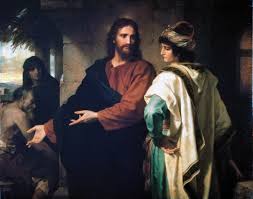
18 And a ruler asked him, “Good Teacher, what must I do to inherit eternal life?” 19 And Jesus said to him, “Why do you call me good? No one is good except God alone. 20 You know the commandments: ‘Do not commit adultery, Do not murder, Do not steal, Do not bear false witness, Honor your father and mother.’” 21 And he said, “All these I have kept from my youth.” 22 When Jesus heard this, he said to him, “One thing you still lack. Sell all that you have and distribute to the poor, and you will have treasure in heaven; and come, follow me.” 23 But when he heard these things, he became very sad, for he was extremely rich. 24 Jesus, seeing that he had become sad, said, “How difficult it is for those who have wealth to enter the kingdom of God! 25 For it is easier for a camel to go through the eye of a needle than for a rich person to enter the kingdom of God.” 26 Those who heard it said, “Then who can be saved?” 27 But he said, “What is impossible with man is possible with God.” 

Luke 18:18-27 ESV via biblegateway.com

I love that Jesus didn’t just give pithy answers to questions, but often went in roundabout ways to explore the motives behind them. I also love how He would use others’ questions, mixed with parables, metaphors, or other figurative language to stimulate further thought. And His parables and word pictures, while short and simple, have layers of meaning that cause us to ponder deeper issues.

The “Rich Young Ruler” in the above story came to Jesus with a question. “What must I do to inherit eternal life?” Instead of answering the question, Jesus seems to get distracted by the young man’s greeting. “Why do you call me ‘Good?'” Did the young man really think that Jesus was better, or wiser, or more righteous than the religious leaders of the day? Or was he trying to flatter Jesus? Or did he think that Jesus would see him as an equal (or even superior) when he found out how righteous the ruler was? Jesus got to the heart of the greeting– “No one is good except God alone.” And therein lies the true answer to the ruler’s question, as well. There is nothing anyone can do to be “Good” enough to inherit eternal life.

Photo by Anna Tarazevich on Pexels.com

Jesus could have said this, but would the young ruler have accepted this answer? Probably not. His question betrays an assumption that he WAS good enough– that he had already done all that was required and that Jesus would surely be impressed and announce to the crowd that here was an example of someone who was worthy of eternal life. Instead, Jesus led the man through his pride by naming a few of the commandments– the very ones the ruler was so sure of. Indeed, this seemed to be exactly what the ruler was hoping to hear– proof that he had “passed the test.” Ironically, he was addressing Jesus as “Good teacher, ” but seemed to miss that fact that he was also addressing the only One who is truly Good! Jesus–God in the flesh — the very one whose death would guarantee that anyone would “inherit” eternal life. This young ruler doesn’t want Jesus to be his “Lord” and “Savior,” he just wants Jesus’s opinion.

Photo by Bryan Catota on Pexels.com

But then, Jesus pulled the rug out from under this man’s assumptions. “One thing you still lack.” One thing…I’m sure the young ruler thought it would be a fine point in the laws or traditions he know so well– some minor point that could be cleared up with a gift or a small offering. I find this a fascinating statement, because it is followed by “sell all you have and distribute to the poor…” It seems like such an oxymoronic statement. You lack one thing, therefore, you must give away all that you have. How is that possible? Because the “one thing” the rich man lacked was not an object; not something he could check off a list of “things I can do to impress the religious leaders.” This man lacked humility; he lacked a self-awareness of his own need. And he lacked the understanding of what it means to “inherit” eternal life. No one “earns” an inheritance. Even someone who is rewarded with an inheritance must trust in the goodwill of the person writing the will, and will only inherit under the terms of the will. Jesus’s “terms” were not that the man had to become destitute or spend the rest of this life as a beggar. But faced with the choice of his comfortable life in the here and now, or eternal and abundant life in heaven on God’s terms, this man chose earthly wealth and spiritual poverty.

Photo by HASSAN YAR JANJUA on Pexels.com

Almost lost at the end of Jesus’s surprising answer are the last two phrases, “and you will have treasure in heaven; and come, follow me.” This man wanted eternal life as an extension of his comfortable life on earth. He did NOT want eternal life enough to sacrifice his present comforts or his preconceived notions of “goodness.” He did not want to follow Christ– he only wanted to consult with Him.

Photo by Anna Shvets on Pexels.com

I find it uncomfortable to hear about the young ruler’s rejection of Christ. I understand the initial shock of the disciples as Jesus uses the illustration of a camel going through the eye of a needle to compare with a “rich” person coming into the kingdom of God. Wasn’t Abraham wealthy? Wasn’t Solomon rich? What about King David? If riches make it impossible to follow Christ, who can gain eternal life? Thankfully, Jesus redirects the focus– it’s not about the riches; and it’s not about what we “do”– it is God’s “Good” pleasure to give eternal life to those who choose to “follow” Him.

Photo by Tima Miroshnichenko on Pexels.com

“Good Teacher and Lord, help me to remember this lesson as I come before you in prayer. You have not asked me to ‘earn’ my inheritance. It is your gift to answer my prayers as you see fit; to be the Lord of my life; to be merciful and gracious to me; to prepare a place for me to live with You for eternity. What you ask of me is that I ‘follow’ you– that I listen to your call; that I accept Your “terms” of inheritance; that I share Your Grace and Mercy with those around me.”

A Miss is as Good as a Mile

I heard a phrase, an idiom, recently..one I hadn’t heard in many years: “I’m as good as dead.” It is an odd phrase, but English is filled with similarly odd sayings, like, “good as gold”, “good as finished”, or “a miss is as good as a mile.” “As good” in each case signifies being close to, or similar too, without being the same; nearly or akin to being. A child who is “good as gold” is one whose behavior is nearly faultless, whose actions and demeanor shine like gold. Someone who is “as good as dead” is someone who is either in very poor health or in dire trouble, and expects to die soon. “A miss is as good as a mile” refers to the idea that a miss, whether narrow or wide, is still a miss..an inch or a mile makes no difference. A puzzle of 1000 pieces, minus one, is still incomplete; missing one’s train by a minute or an hour still leaves one at the depot.

Photo by Pixabay on Pexels.com

In hearing this phrase, “as good as dead,” I was arrested by the juxtaposition of “good” and “dead.” There is nothing good about death or dying, yet we don’t say, “I’m as bad as dead.” We compare being close to anything as being “good as..”

I think there is an important spiritual and psychological reason. Deep in our soul, we have a desire to be “good.” To be whole, and righteous, and complete. And we also know that we are not whole; not really “good” as we now are. We long to be “as good as” our aspirations; as good as…God. We spend our lives comparing and measuring and striving to be better, and closer to His perfection. And sometimes, we feel comparatively “good.” Other times, our goodness only seems to measure up to failure and death. https://www.theidioms.com/a-miss-is-as-good-as-a-mile/

Photo by sergio souza on Pexels.com

But we cannot be “as good as dead” any more than we can be “as good as gold” or as good as God. Because “a miss is a good as a mile.” Being almost as good as God will never be enough to save us from the wages of sin, which is death. Being “almost dead” cannot separate us from God’s love, or His gift of everlasting life.

In the Gospels (Matthew, Mark and Luke), there is a short story of a young man who struggles with this concept. https://www.biblegateway.com/passage/?search=Mark+10%3A17-27&version=NASB The young man asks Jesus, “Good teacher, what shall I do to inherit eternal life?” In asking the question, the young man already reveals a certain lack of understanding. An inheritance is not something that can be earned; it is a gift that can only be received by an heir after someone’s death. It can be accepted or rejected, or divided between many heirs. There may be stipulations or conditions– and this may be what the young man meant to find out–but inheritance is determined by the giver, not the conditions of the person or persons expecting to receive an inheritance. Secondly, the man assumes that whatever is required, he can accomplish it easily. He expects, in fact, the beginning of the answer Jesus gives him. But Jesus doesn’t begin with the answer. He cuts directly to the heart of the question: “Why do you call me ‘Good?’ No one is good except God alone.” (Mark 10:18) At the heart of this man’s question is the desire to become “Good” like God– to earn eternal life– to be complete and whole through his own actions. This young man doesn’t want to be challenged. He wants to be justified, lauded, and congratulated on his own wisdom and performance. And Jesus starts by giving him the answer he expects. He lists several commandments– five things NOT to do, and one general principle (honor your parents). One can almost hear the sigh of relief from the young man. “I’m as good as guaranteed to get into heaven!”

But that’s when Jesus speaks again. He doesn’t offer a lengthy list of impossible feats; no pilgrimages or vows of silence, no special diets (not even a reminder to follow the Jewish dietary restrictions), no pledge to give more money to the Temple, or lead a rebellion against the Romans. Instead, He gives a single challenge– sell what you own and give it to the poor, and you will have treasure in Heaven– followed by an offer to follow Him.

Jesus did not offer this challenge as a kind of “gotcha” to the man’s initial question. In fact, the Gospel of Mark says that Jesus felt a love for him as He responded, and a great sadness when the man walked away. But “a miss is a good as a mile.” The young man wanted to know what he could do to be (or if what he had already done was) “good enough” to inherit eternal life. He had done all the things he expected would be enough. He had compared his life and actions with others around him. But he had missed the heart of the matter– inheritance. When he walked away, he was depressed and discouraged– “as good as dead.” Not because there was no way for him to have eternal life, but because he could not hit the target; he could not do the one thing Jesus asked of him, and he could not trust Jesus enough to “follow” the “good” teacher.

Photo by Jigar Maru on Pexels.com

The disciples, too, missed the point at first. Jesus had not given the young ruler a simple task in earthly terms. But it wasn’t the action that was difficult; it was the heart attitude. The young man wanted– he wanted the respect of the “good” teacher (not a relationship with Him), the acclaim of all those surrounding him, the honor and prestige his wealth had brought him, AND eternal life– because he was “as good as perfect” in his own eyes. He did not want eternal life more than any of these other things, but in addition to all of them, and by his own efforts.

Photo by Jonas Ferlin on Pexels.com

Lord, forgive me for the times that I have wanted to earn eternal life for myself. Help me to seek you with all my heart, so that I may not miss the blessings you have for me by even the narrowest margin. And thank you, thank you(!) that in those times when I do stray and miss the point, I am not “as good as dead”, but you are always gracious and loving in showing me how to “follow you” and live!

Blog at WordPress.com.

Up ↑