I was at worship yesterday. We sang some wonderful songs of worship. Still, I miss some of the “old” hymns we used to sing in the small country church of my youth. This was one of them:
In case the video does not show up, here are the words: Jesus calls us: o’er the tumult of our life’s wild, restless sea, Day by day His sweet voice soundeth, saying, “Christian, follow Me.” Jesus calls us from the worship of the vain world’s golden store, From each idol that would keep us, saying, “Christian, love Me more.” In our joys and in our sorrows, days of toil and hours of ease, Still He calls, in cares and pleasures, “Christian, love Me more than these.” Jesus calls us: by Thy mercies, Saviour, may we hear Thy call, Give our hearts to Thine obedience, serve and love Thee best of all. Amen.
Prayer is never just a one-way communication. We may not “hear” from God in an audible voice, but He calls us into communion with Him daily. He wants to hear from us; He wants to speak to us–through His word, through our experiences, through friends and neighbors and even chance encounters. We may not have a deep spiritual burden to bring before the throne of grace– does that keep us from needing to share a quiet moment with the lover of our soul?
Suppose the only time you ever spoke to your spouse was when you desperately needed her/his help? What would that say about your relationship? The same holds with our spiritual walk. God wants to speak to us; to have us notice the beauty of the sunrise, or the grace of moonlight in the mist. He wants to bring us hope and comfort in the stories and psalms of scripture. He wants us to share our nagging worries and our minor triumphs– not because He doesn’t know or cannot see–because He wants to share in our struggles and our joys, our deep grieving and our small amusements.
He wants all of this because of His great love for each of us. If we could just see His eyes light up with love when we walk into a room…and if we could hear the love in His voice– we would be undone. Someday, we will be– undone, and remade, and able to catch His eye without shattering in the light of that love.
It is a great reminder that, as followers of Christ, we always have a reason to be happy and to sing his praises, even when circumstances are confusing or situations are trying.
I love this old song, but sometimes, even though I have reason to be happy, I don’t feel like singing. The same happens with prayer. Some days, I’m just not feelin’ it. It’s not necessarily that I’m miserable or angry. Sometimes, I’m distracted, or even happy doing self-centered things.
I find it easier to pray when I’m sad or needy– my brokenness brings me closer to God. When things are going along just fine, I sometimes forget the true source of my joy and strength. I take for granted that God and I are close, not realizing that I haven’t spoken to him lately, or that I have whispered a quick, shallow prayer, but I haven’t spent much quality time with the lover of my soul.
There is an old Chinese proverb that says: “I don’t sing because I am Happy– I am happy because I sing.”
At first, it may sound like this is a contradiction of the beloved hymn, but really it is a complement. I sing because I’m happy, but if I sing no matter how I start out feeling, I find myself happier! I pray because I want to be close to God, but I stay closer to God because I pray. When I was younger, I used to base my prayer life on how I felt. It’s yet another reason I now use a prayer journal. Read more about keeping a Prayer Journal It keeps me disciplined and helps me maintain a stronger prayer life. We all know that prayer is a key element in building a strong relationship with God and others, but it has to be practiced to be effective. Other key elements are:
Reading the Bible/doing a Bible study
Fellowship with other believers
Obedience– Actively following God’s example
Confession/Forgiveness
Any of these elements can become lackluster and difficult, especially if we aren’t practicing them daily. And all of the elements will become stronger through practice. Not only that, but they will blend together better, and the end result is a stronger, healthier, happier you.
There are at least two great songs and one movie with the title, “P.S. I Love You.” The idea comes from a letter– one in which the writer wants to make sure that “I Love You” are the last three words on the page– the lasting impression for the letter’s recipient.
The Bible is many things– a history, a book of laws, a narrative of God’s dealings with humankind–but it is also a love letter. Scattered throughout the lists of generations, the poetry, the prophecies, the gospels, and yes, the letters to churches, are expressions of love. God begins by creating a beautiful garden, creating Adam in his own likeness, and creating a suitable helper from Adam’s side. He gives them everything they need to live and enjoy everything around them–He even comes to walk and talk with them!
God rescues the nation of Israel from slavery and cruelty in Egypt, and guides them in the wilderness for 40 years–providing food and water, even preserving their clothing and shoes, so they have no lack!
God punishes the rebellious nation, sending them into exile– but He gives them promises, and even in the worst of their punishment, He speaks words of love and healing and reconciliation.
God sends the ultimate Word of Love in His Son– who loves, heals, forgives, and serves, even to the point of dying! And in the death and resurrection of Jesus, this love is extended to everyone who will accept Him.
Finally, God promises an end to death and rebellion–eternal reconciliation and life with Him who loves us best. His love letter ends with a glorious P.S.:
22 Then the angel showed me the river of the water of life, as clear as crystal, flowing from the throne of God and of the Lamb 2 down the middle of the great street of the city. On each side of the river stood the tree of life, bearing twelve crops of fruit, yielding its fruit every month. And the leaves of the tree are for the healing of the nations. 3 No longer will there be any curse. The throne of God and of the Lamb will be in the city, and his servants will serve him. 4 They will see his face, and his name will be on their foreheads. 5 There will be no more night. They will not need the light of a lamp or the light of the sun, for the Lord God will give them light. And they will reign for ever and ever… 16 “I, Jesus, have sent my angel to give you this testimony for the churches. I am the Root and the Offspring of David, and the bright Morning Star.” 17 The Spirit and the bride say, “Come!” And let the one who hears say, “Come!” Let the one who is thirsty come; and let the one who wishes take the free gift of the water of life… 20 He who testifies to these things says, “Yes, I am coming soon.” Amen. Come, Lord Jesus. 21 The grace of the Lord Jesus be with God’s people. Amen. (Revelation 22:1-5; 16-17; 20-21.)
Even when God sends punishment, or stays silent in the face of our immediate questions, He never stops saying “I Love You.” I. LOVE. YOU!
Lord, may I take time today to read your love letter. May I savor Your words and may I take the time to read Your Post Script– and respond to Your Eternal and Fathomless Love! Amen!
1 I love you, Lord, my strength. 2 The Lord is my rock, my fortress and my deliverer; my God is my rock, in whom I take refuge, my shield and the horn of my salvation, my stronghold. 3 I called to the Lord, who is worthy of praise, and I have been saved from my enemies. 4 The cords of death entangled me; the torrents of destruction overwhelmed me. 5 The cords of the grave coiled around me; the snares of death confronted me. 6 In my distress I called to the Lord; I cried to my God for help. From his temple he heard my voice; my cry came before him, into his ears. 7 The earth trembled and quaked, and the foundations of the mountains shook; they trembled because he was angry. 8 Smoke rose from his nostrils; consuming fire came from his mouth, burning coals blazed out of it. 9 He parted the heavens and came down; dark clouds were under his feet. 10 He mounted the cherubim and flew; he soared on the wings of the wind. 11 He made darkness his covering, his canopy around him— the dark rain clouds of the sky. 12 Out of the brightness of his presence clouds advanced, with hailstones and bolts of lightning. 13 The Lord thundered from heaven; the voice of the Most High resounded. 14 He shot his arrows and scattered the enemy, with great bolts of lightning he routed them. 15 The valleys of the sea were exposed and the foundations of the earth laid bare at your rebuke, Lord, at the blast of breath from your nostrils. 16He reached down from on high and took hold of me; he drew me out of deep waters. 17 He rescued me from my powerful enemy, from my foes, who were too strong for me. 18 They confronted me in the day of my disaster, but the Lord was my support. 19 He brought me out into a spacious place; he rescued me because he delighted in me.
Psalm 18:1-19 NIV (taken from biblegateway.com)
I grew up hearing hymns– lots of them. My mother and grandmother and aunt all played the piano or organ for church and often practiced during the week. My father led the congregational singing sometimes, and my grandfather taught himself to play many musical instruments, and used hymns to become familiar with the chords, notes, and fingerings of the instrument du jour. The congregation at our small church sang with more gusto than musical talent, but we sang during the Sunday morning service, the Sunday evening service, the Wednesday evening service, and at any special occasion.
Two things happened as a result of this: one not-so-good, and one very good thing. The not-so-good thing was that I became somewhat inured to the songs and lyrics– I knew what the songs said, but I didn’t really understand or internalize the truths they contained. However, the very good thing was that the hymns stuck in my memory– years later they came back like the best of friends to comfort me, challenge me, and remind me of sacred realities in the midst of mundane frustrations and worldly confusions.
This old hymn, neglected, out-dated, and seldom sung in our current services, was my lullaby growing up. My mother would sing it over and over as she rocked me to sleep, often running out of verses and words and just humming or filling in with “la, la la, la,” until she reached the chorus. “Love lifted me. Love lifted me. When nothing else could help, Love lifted me.”
As a young child, I experienced the loving arms of my dear mother lifting me to her lap and rocking me for what seemed like hours until I drifted off to sleep. As a teen, I scoffed at the lyrics a bit–what need had I to be lifted and helped, when I was invincible and young and ready to conquer the world? As an adult, this old hymn came back with power and comfort when my own efforts and life’s stormy circumstances left me with little hope and lots of confusion, doubt, and regret. It reminds me that help and hope can be found even in the raging storms of grief, depression, oppression, and pain. “When nothing else could help…” God could and did! He can and will!
“Love lifted me”–such a simple phrase, and by itself not a solid foundation for hope and victory. In fact, there are many popular songs that speak of love lifting a person up, making one feel buoyant and hopeful, joyful or young. But this song speaks of a different and everlasting, all-powerful love– the Love of Christ. And it doesn’t just lift us up from one pleasant place to another. It reaches down into the depths of sin, despair, and even death to lift us up beyond all hope, beyond any strength or effort we could generate or receive from any other source. And this great Love reaches down to lift me–even me! It does not belong only to the elite, the wealthy, the beautiful people, the gifted or the powerful. In fact, this love is especially close and available to those who have done nothing to deserve it; those who have been bypassed and ignored and left to drown in their own shame and sorrow.
Love. Lifted. Me! My prayer is that this same Love will surround you today, lifting you up, and helping you, just as it helps me and brings me life and hope, to the Glory of Christ our Savior.
Prayer is often about burdens– the burden of need; the burden of sin and guilt; the burden of worry and distress. We bring our burdens to God, to the “throne of Grace;” we bring them “in Jesus’ Name,”, and we bring them to “Our Father.” But how often do we bring them to “Calvary?”
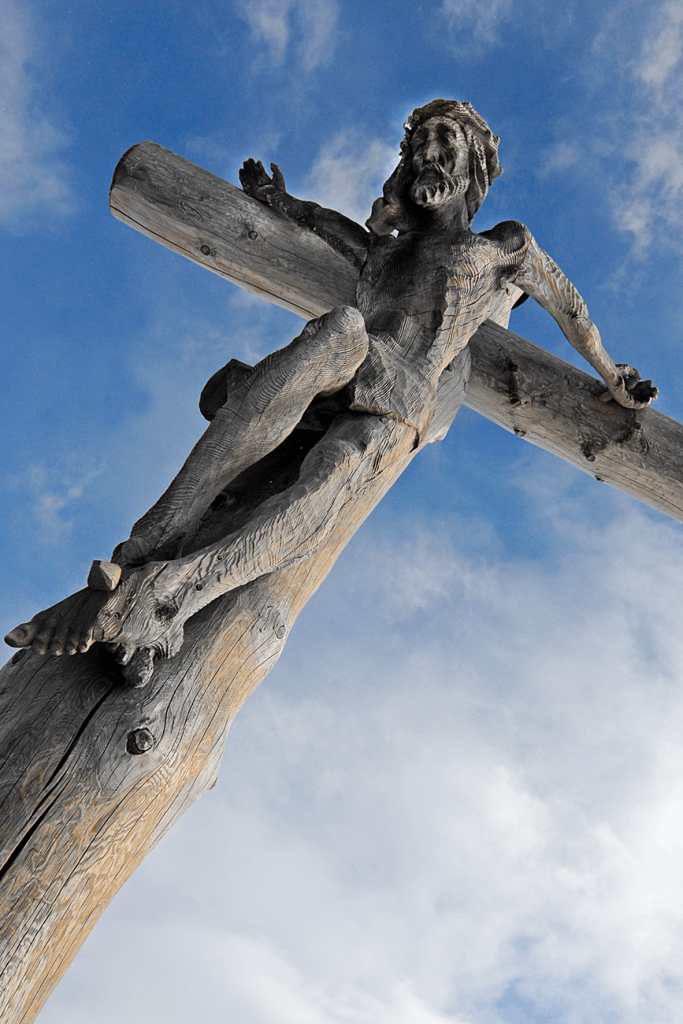
Not the victorious empty cross on the hillside with a beautiful sunset in the background, but the bloody, hot, dry and dreadful Calvary of the crucifixion? How often do we make the pilgrimage to that rocky outcropping with the smell of blood and sweat and death and agony? How often do we cry out to the one who was lifted up, struggling to breathe, pierced, wounded, broken and humiliated? When do we reach out to touch the scars and bruises he received in our place?
It is at Calvary that we get the real story of Grace, Mercy, and forgiveness–the real cost of victory and peace. It is at Calvary that we see the full extent of God’s Holiness married to the full extent of His Love. Holiness demands justice; Love demands intimacy– together, they require sacrifice.
And it is at Calvary that we find, in the darkest and most hopeless of moments– God forsaking Himself, giving all He IS to bring justice and reconciliation for all we’ve done–that we trade our burdened souls, our worries, our despair for God’s embrace. Arms stretched so wide they are pulled from their sockets; blood spilled from head to toe; breathless and exposed in His passion for your soul and mine–that’s what God offers at Calvary.
Why do I pray? I am ambushed and overwhelmed and enraptured by such a love. God had no need to suffer even a moment’s discomfort. He owed nothing to His rebellious creation; no mercy, no explanation, no hints as to His character (or ours). The creator of galaxies had no need to lift a finger to save one puny planet or any of its inhabitants from His own right to un-create them and blot out even their memory. Instead, He showed the greatest act of Love across all of space and time–to me!– At Calvary!
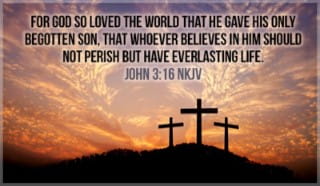
Today is March 16. In my area of the world, we abbreviate it as 3/16/26, or just 3/16. So it reminds me of the most quoted verse in the Bible– John 3:16– “For God so loved the world, that he gave his only Son, that whoever believes in him should not perish but have eternal life.” (ESV) This verse is so famous and so quoted, that many times, people just skip the actual verse and just use the reference. In fact, if you just see a poster or sign of reference that says 3:16, it almost always means this verse.
Recently, I saw a short video of a person complaining about seeing such a reference on their soft-drink cup at the fast food chain In-N-Out Burger. The chain prints “John 3:16” on the inside of the bottom of their cups. They’re known for it. They don’t print out the entire verse, just the reference. It’s not blatant or over-bearing– just a modest note on the bottom of their cups. But this person wanted none of it. They started out by liking the food, but they were offended by this tiny reference to a Bible verse. “Keep your John 3:16,” they sneered. “I don’t want your John 3:16.” Apparently, it left a bad taste in their mouth just to see any reference to the Bible. They felt judged and oppressed, I guess.
But John 3:16 is not about judgment. It’s all about Love! For God SO LOVED the WORLD–take a minute to reflect on that. God, the Holy One, who created the world, only to have mankind reject Him over and over again, didn’t destroy it. He didn’t turn His back on the world. He didn’t leave us as a footnote and move on. Instead, He GAVE His ONLY begotten SON. He didn’t come up with a cheap plan for salvation that was just adequate to cover our worst sins and leave us enslaved to our old guilt and shame. He didn’t send a half-hearted emissary to show us what Heaven and Holiness were like. He sent His SON– the heir of the Universe–to live among us, show us how to love and live and worship. And that Son GAVE all of Himself as a sacrifice– not for a select few, but for WHOSOEVER would trust in Him and submit to His Lordship!
WHOSOEVER believes in Him will not perish, but have ETERNAL LIFE! How does that offend and oppress? The message of John 3:16 sums up the whole Gospel of Christ. It is NOT judgment, but Salvation. It is not oppression, but freedom from Sin and Death!
So today, I am thrilled to celebrate 3:16! It is a message of hope, joy, renewal, abundance, purpose, power, and LOVE!
I heard a phrase, an idiom, recently..one I hadn’t heard in many years: “I’m as good as dead.” It is an odd phrase, but English is filled with similarly odd sayings, like, “good as gold”, “good as finished”, or “a miss is as good as a mile.” “As good as” in each case signifies being close to, or similar too, without being the same; nearly or akin to being. A child who is “good as gold” is one whose behavior is nearly faultless, whose actions and demeanor shine like gold. Someone who is “as good as dead” is someone who is either in very poor health or in dire trouble and expects to die soon. “A miss is as good as a mile” refers to the idea that a miss, whether narrow or wide, is still a miss–an inch or a mile makes no difference. A puzzle of 1000 pieces, minus one, is still incomplete; missing one’s train by a minute or an hour still leaves one at the depot.
In hearing this phrase, “as good as dead,” I was arrested by the juxtaposition of “good” and “dead.” There is nothing good about death or dying, yet we don’t say, “I’m as bad as dead.” We compare being close to anything as being “good as..”
I think there is an important spiritual and psychological reason. Deep in our soul, we have a desire to be “good.” To be whole, and righteous, and complete. And we also know that we are not whole; not really “good” as we now are. We long to be “as good as” our aspirations; as good as…God. We long to be close to God, and to His Goodness. We spend our lives comparing and measuring and striving to be better, and closer to His perfection. And sometimes, we feel comparatively “good.” Other times, our goodness only seems to measure up to failure and death. https://www.theidioms.com/a-miss-is-as-good-as-a-mile/
But we cannot be “as good as dead” any more than we can be “as good as gold” or as good as God. Because “a miss is a good as a mile.” Being almost as good as God (even if such a thing were possible) will never be enough to save us from the wages of sin, which is death. By the same token, being “almost dead” cannot separate us from God’s love, or His gift of everlasting life!
In the Gospels (Matthew, Mark and Luke), there is a short story of a young man who struggles with this concept. https://www.biblegateway.com/passage/?search=Mark+10%3A17-27&version=NASB The young man asks Jesus, “Good teacher, what shall I do to inherit eternal life?” In asking the question, the young man already reveals a certain lack of understanding. An inheritance is not something that can be earned; it is a gift that can only be received by an heir after someone’s death. It can be accepted or rejected or divided between many heirs. There may be stipulations or conditions– and this may be what the young man meant to find out–but inheritance is determined by the giver, not the conditions of the person or persons expecting to receive an inheritance. Secondly, the man assumes that whatever is required, he can accomplish it easily. He expects, in fact, the beginning of the answer Jesus gives him. But Jesus doesn’t begin with the answer. He cuts directly to the heart of the question: “Why do you call me ‘Good?’ No one is good except God alone.” (Mark 10:18) At the heart of this man’s question is the desire to become “Good” like God– to earn eternal life– to be complete and whole through his own actions. This young man doesn’t want to be challenged. He wants to be justified, lauded, and congratulated on his own wisdom and performance. And Jesus starts by giving him the answer he expects. He lists several commandments– five things NOT to do, and one general principle (honor your parents). One can almost hear the sigh of relief from the young man. “I’m ‘as good as’ guaranteed to get into heaven!”
But that’s when Jesus speaks again. He doesn’t offer a lengthy list of impossible feats; no pilgrimages or vows of silence, no special diets (not even a reminder to follow the Jewish dietary restrictions), no pledge to give more money to the Temple, or lead a rebellion against the Romans. Instead, He gives a single challenge– sell what you own and give it to the poor, and you will have treasure in Heaven– followed by an offer to follow Him.
Jesus did not offer this challenge as a kind of “gotcha” to the man’s initial question. In fact, the Gospel of Mark says that Jesus felt a love for him as He responded, and a great sadness when the man walked away. But “a miss is a good as a mile.” The young man wanted to know what he could do to be (or if what he had already done was) “good enough” to achieve eternal life. He had done all the things he expected would be enough. He had compared his life and actions with others around him. But he had missed the heart of the matter– inheritance. Heaven isn’t “achieved;” it is a gift of inheritance. It can only be given, not earned. And as an “inheritance,” it can only be given because someone else has died (Jesus!). When the young man walked away, he was depressed and discouraged– “as good as dead.” Not because there was no way for him to have eternal life, but because he had not “hit” the target; he would not do the one thing Jesus asked of him– he could not trust Jesus enough to “follow” the “good” teacher.
The disciples, too, missed the point at first. Jesus had not given the young ruler a simple task in earthly terms. But it wasn’t the action that was difficult; it was the heart attitude. The young man wanted something– he wanted the respect of the “good” teacher (not a relationship with Him), the acclaim of all those surrounding him, the honor and prestige his wealth had brought him, AND eternal life– because he was “as good as perfect” in his own eyes. He did not want eternal life more than any of these other things, but in addition to all of them, and by his own efforts.
Lord, forgive me for the times that I have wanted to earn eternal life for myself. Help me to seek you with all my heart, so that I may not miss the blessings you have for me by even the narrowest margin. And thank you, thank you(!) that in those times when I do stray and miss the point, I am not “as good as dead”, but you are always gracious and loving in showing me how to “follow you” and live!
Joy to the world, the Lord is come! Let earth receive her King; Let every heart prepare Him room, And heav’n and nature sing, And heav’n and nature sing, And heav’n, and heav’n, and nature sing. Joy to the earth, the Savior reigns! Let men their songs employ; While fields and floods, rocks, hills, and plains Repeat the sounding joy, Repeat the sounding joy, Repeat, repeat, the sounding joy. No more let sins and sorrows grow, Nor thorns infest the ground; He comes to make His blessings flow Far as the curse is found, Far as the curse is found, Far as, far as, the curse is found. He rules the world with truth and grace, And makes the nations prove The glories of His righteousness, And wonders of His love, And wonders of His love, And wonders, wonders, of His love.
Joy to the World– words by Isaac Watts
Advent is a time of preparation– joyful preparation. It is an oxymoron to say it, but it is a time when we remember with anticipation. It is a time once again to prepare our hearts for the arrival of an event that happened over two thousand years ago. Each year, we look backward to look forward! And we prepare as though it were all happening anew– the announcement of the angels, the travels of Mary and Joseph and their arrival in Bethlehem, the wise men following a star..
And we prepare for this year’s festivities– the gifts, the food, the decorations, the invitations and greeting cards, programs and parties, caroling and shopping…But in the midst of it all, hopefully, we prepare our hearts to be rekindled, reawakened to the wonder– beyond the star and angels and virgin birth–the wonder that God would ransom the lost, break the chains of sin and death, redeem the fallen and weary world, and pour all of his Glory into the frail cries of a newborn baby. All the rest of the preparation is meaningless if we don’t prepare to be overwhelmed again by the “glories of His righteousness, and wonders of His love.”
“Lord, may our hearts be prepared to accept the wonder and joy of this season. May we have new hearts for the wonders of your great Love for us– that you would humble yourself to live among fallen men and women, and die to set them free. That you would rise triumphant, so that we need not fear death. Thank you for this indescribable gift. Once again, let Earth receive her King with joy as all of heaven and nature sing!”
1 In the bleak midwinter, frosty wind made moan, earth stood hard as iron, water like a stone; snow had fallen, snow on snow, snow on snow, in the bleak midwinter, long ago.
2 Our God, heaven cannot hold him, nor earth sustain; heaven and earth shall flee away when he comes to reign. In the bleak midwinter a stable place sufficed the Lord God Almighty, Jesus Christ.
3 Angels and archangels may have gathered there, cherubim and seraphim thronged the air; but his mother only, in her maiden bliss, worshiped the beloved with a kiss.
4 What can I give him, poor as I am? If I were a shepherd, I would bring a lamb; if I were a Wise Man, I would do my part; yet what I can I give him: give my heart.
United Methodist Hymnal, 1989
I love this Christmas Hymn, though it creates a picture that is likely very false. Historically, we have no reason to believe that Jesus’ birth occurred on the 25th of December, or even in the winter at all. And even if it was December, it is very unlikely that the Middle-Eastern countryside was experiencing frosty moaning winds or icy waters on the night of Christ’s birth. In addition to Mary, the Bible tells us of others who came to worship that night– the shepherds in the nearby hills. The wise men likely came days, weeks, or even months later to bring their gifts. And Joseph would certainly have been there, as well.
The song is still lovely, and the last verse is the key. Christ poured out all that He was; taking on the form of a helpless baby, He lived among those who rejected and mocked Him. He served those whom He had created, healing their wounds, forgiving their sins, providing for their eternal redemption. He died, betrayed and despised by His own chosen people, and dismissed by the rulers and authorities of the day. He never owned a home, built monuments, carved his name in stone, or wrote books to preserve his legacy. He had no dynasty or even children to carry on his name; at the time of his death, all his friends and followers had abandoned him– all but one disciple and his mother. Yet his birth (the actual date of which has been obscured by history) is synonymous with generous gifting, rejoicing, singing, worship, and renewed hope. So what could any of us possibly give that could even begin to match what His life, death, and resurrection gave us?
He asks for only one thing– everything we have: all the failures, mistakes, good intentions, bad choices, selfish desires, and hurts of the past–and in return, He gives us everything beyond our wildest imaginations: eternity with Him; all the riches of His Glory; all His holiness and majesty imputed to us; peace with Him; rest and restoration in Him; and His Spirit to guide and sustain us!
The bleakness of midwinter may not have been the physical setting of Christ’s birth, but it represents the spiritual setting of our lives without Him. In that sense, Christ comes in the bleak midwinter of our rebellion, our despair, and our isolation, and offers to give us everlasting light, hope, peace, and joy!
That’s worth celebrating every day throughout eternity!
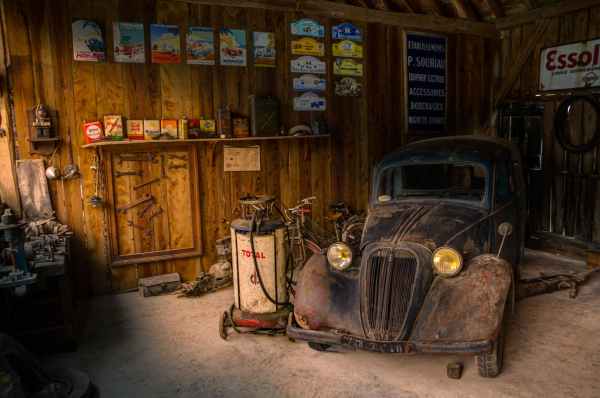
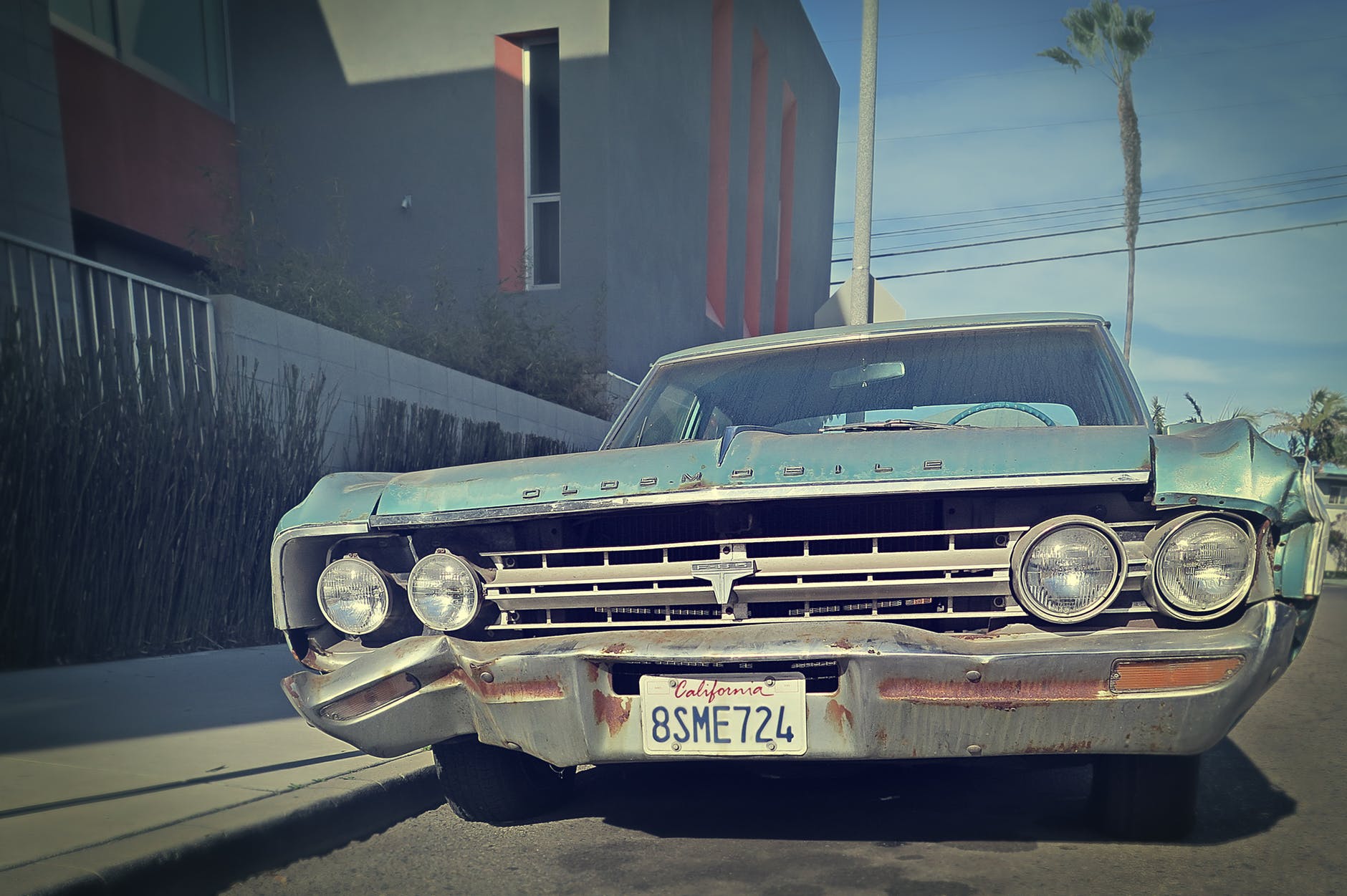
A widow contacted a local church to come pick up an old rusty car that belonged to her late husband. He had one request– that the car be kept in the old garage at the church parsonage and that anyone who wanted to could stop by and work on it. He had purchased it years before with the intention of restoring it to drive around in during his retirement. But time and ill-health had robbed him of his dream. His hope was that someone might enjoy working on it, and if no one came to work on the car, perhaps the church could sell it to scrappers and at least get some money for it. An ad was placed in the bulletin, and another in the local paper. Hours were set up, when people could stop by to work on the car.
Soon, there was a great stir– several members of the congregation came forward to protest. Some were concerned about the safety and liability involved in having the car in the garage where anyone could get to it. Surely, it would be in the church’s best interest to have the car locked away, so only members of the congregation could get to it. Others were arguing about how to restore the car properly– what was the original color of the chassis and the interior? Could they find the exact parts for that make and model? Who would work on the engine? The interior? The frame? Surely the old man didn’t mean for just anyone to come in and work wherever s/he felt like working…how would the job get done? Detailed schedules were posted and discussed; re-posted and opposed.
Weeks, and even months went by. The church was divided; some threatened to leave. And none of the church members had even visited the old car in the garage– it sat forgotten. Except…
A young man in town had seen the notice in the newspaper. He wrote down the original work schedule and followed it, quietly coming every Tuesday and Friday night after work, and patiently working to restore the car. He cleaned and oiled parts, “tinkered” with others, sanded off rust, fixed hose lines and checked all the panels. He patched upholstery and polished up the old tires. He painted the chassis and found matching window wipers to replace the old ones. He worked on the motor and the exhaust, and even the old AM radio. He made sure the mirrors and windows were not cracked or chipped. He even hunted around to find the right hood ornament to replace the one that was lost. Only the pastor knew of his work, and even he had never joined the man or asked about his progress– he merely opened the garage door every time the young man arrived, and closed it when the young man left.
After eight months, the division in the church had reached a fevered pitch. One group demanded that the car be removed to a secure location and that the labor should be divided based on an elaborate chart that focused on how long someone had attended the church, their skill base, what time they were available to work, and whether they were currently an elder or deacon (or had ever served as an elder or deacon).
When the group arrived at the garage, they were shocked to discover that the car was completely restored, polished and glorious in its restoration. Shocked and angry, they attacked the pastor– How could he have allowed this to happen “behind their backs?” When the pastor admitted that he was as surprised as they were, their attention turned to the young man. They hunted him down and demanded an explanation. How dare he come and work on the church’s car without their knowledge or approval! Who did he think he was?!
The young man’s answer left them stunned. He said, “I read an invitation that said anyone who wished could come and help restore an old car. I came every week, and no one else ever showed up to help. No one from your church did any work on this car. No one ever came to check on it or see if any work had been done. No one from your church gave me a word of encouragement, no one had a helpful suggestion or even constructive criticism. No one offered me a word of gratitude. No one helped hold a lamp or flashlight so I could see the hidden damage as I made repairs. No one helped when I had to hoist the motor or clean off the grease and grime or polish the chrome. The invitation was clear– whosoever will, may come. I came. I followed the directions I was given– I came on Tuesdays and Fridays, and I cleaned up each time before I left. I put a lot of work into this car, and now I’m done. I hope your church can decide on a good use for it; she’s a beauty, and I think she’ll run really well– I didn’t take her for a spin, but I hope someone will be able to enjoy her for many years to come.”
The crowd from the church still had one question– Why had the young man come in the first place, and why did he keep working on the car all those months? Did he want the car for himself?
“No,” the man said; “when I first read the ad in the paper and I saw the word ‘restoration’, I was deeply moved. Not too many years ago, I was living a very wild and dangerous life. I felt alone and abandoned and I was filled with anger. I was restless and destructive. But one man in town took me under his wing. He gave me a part-time job, and made me promise to stay in school. But much more than that, he and his wife invited me over for dinner several times. They made time out of their busy schedule to come and watch me play basketball after I finally made the team in my senior year. When I joined the army, they sent letters and care packages. The old man used to tell me that I reminded him of an old car he bought and kept in his garage. He said it was an amazing machine that just needed restoration– he said I was an amazing person who just needed some restoration. He told me that Jesus came to bring restoration to anyone who wanted to come to Him.”
“I finished my time in the army; I came back and started my own business. I got busy and moved on with life. I never came back to thank that man for his kindness, and he never asked for anything from me. I guess I expected to thank him some day, but I found out that he had died. I went to see his widow. She was so gracious, asking about my family and wishing me the best, and then she mentioned her husband’s last request. And when I saw the ad in the paper, I knew this was a way for me to thank the old man, but also to experience what restoration really means. When I came to God, I was rusty, filthy, and broken. God has sanded off the rust in my life, mended broken relationships, and given me new life. It’s an honor to be able to bring restoration, no matter the circumstances. God has done so much to restore my life, it’s the least I can do to help restore an old car. I hope that somehow, this car can inspire renewal in someone else’s life the way its owner helped bring restoration to my life.”
I wish I could say that the young man’s story changed the hearts of the angry deacons and elders. A few of them were touched; some even convicted of their pride and selfishness. But most were simply put out.
What have I done with the precious gift of restoration in my life? God, lead me to someone today who needs to hear, and SEE, the miracle of restoration and Grace.