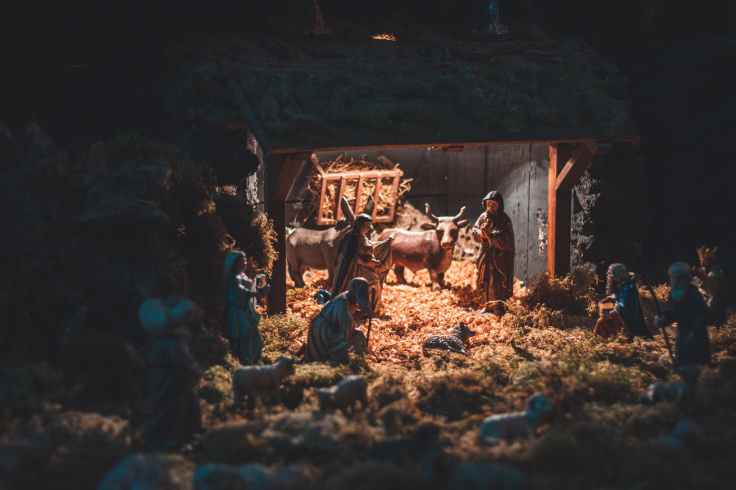
On a Cold Winter’s Night…

One of the great classic Christmas carols, “The First Noel,” describes the night of Christ’s birth as a “cold winter’s night, that was so deep.”

It is dreamy and dramatic to think of Jesus coming into a cold, dark, dreary (and even snowy) world, bringing angels, glorious stars, kings bearing expensive gifts, and joyous songs.

We tend to look at Advent as a time of darkness and silence, in anticipation of the coming light and the Gospel. The idea that the world before the Birth of the Savior was cold continues the pattern of absence. Darkness does not exist independently. Neither does silence or cold. Each is the absence of something else– Light, sound, warmth–and it can only be known by the degree to which its opposite is reduced, distant, or absent.
In contrast, the light, sound, or warmth is made more evident in contrast with its opposite–we may not notice a slight difference in lighting on a sunny day, or a slight difference in temperature; but a candle in a dark room, or a whisper in a silent auditorium has a dramatic effect.

We don’t actually know the exact date of Jesus’ birth, and while December falls during winter, that doesn’t always mean a cold night in every part of the world. If shepherds were watching their flocks in fields just outside of Bethlehem, it is not likely that the temperatures were below freezing, or that there was snow and ice all around. The Middle East is not known for icy winters, after all. Nighttime generally brings colder temperatures, and it may be close to freezing by the middle of the night if you have no fire or protection from the wind, but a “cold winter’s night” is more likely to be found in Minnesota or Finland, not in Bethlehem, and usually in the middle of winter– January– rather than the beginning of the season.

However, just like the darkness and silence, the cold of that first Christmas was spiritual in nature. (https://www.biblegateway.com/passage/?search=John+1%3A9-12&version=ESV). Jesus entered a frigid world– a world of closed-off people, suspicious, oppressed, angry, sick, and world-weary. Hatred can be cold, but colder still is apathy and disdain and hopelessness. The world of Advent is a world desperate for the light and heat and sound of God’s love– not because God is absent, but because people have moved so far away from Him. The light becomes dimmer, the songs become a series of indistinct noises, and the cold and damp of night creep into our souls. Today, even with the hope and light of the Gospel story, we take our focus off of the true light of the world, and the true source of warmth and love, and too often focus on the lesser warmth of a new jacket, or the glittering lights of a shopping center, or the strident sounds of greed and envy.

Jesus may not have come in the cold of midwinter. But He came into a world of cold hearts as a helpless baby in a strange and unwelcoming land. And he was wrapped in rags and placed in a feeding trough– the warmest place that could be found. But even in this tiny, shivering baby, there was the warmth of Pure Love. And it was felt by all who came in contact with Him– shepherds rejoiced, Mary pondered, Wise Men knelt in adoration.

I love seeing candles and firesides at Christmas time– I love coming into a warm house, full of laughter and love, or singing carols on a cold night, and being invited inside to share the warmth. I love fellowship at church, and sharing a hug and a smile with those I meet. Imagine the warmth of God with us–All of the warmth and life of being wrapped in the arms of Grace, and held by the nail-scarred hands, never to be cold or alone ever again. Can you feel it? Can you anticipate it? Imagine passing that on to someone who has never known such warmth…on a cold winter’s night…


O Little Town of Bethlehem

O Little Town of Bethlehem


1. O little town of Bethlehem, 
how still we see thee lie; 
above thy deep and dreamless sleep 
the silent stars go by. 
Yet in thy dark streets shineth 
the everlasting light; 
the hopes and fears of all the years 
are met in thee tonight. 

2. For Christ is born of Mary, 
and gathered all above, 
while mortals sleep, the angels keep 
their watch of wondering love. 
O morning stars together, 
proclaim the holy birth, 
and praises sing to God the king, 
and peace to all on earth! 

3. How silently, how silently, 
the wondrous gift is given; 
so God imparts to human hearts 
the blessings of his heaven. 
No ear may hear his coming, 
but in this world of sin, 
where meek souls will receive him, still 
the dear Christ enters in. 

4. O holy Child of Bethlehem, 
descend to us, we pray; 
cast out our sin, and enter in, 
be born in us today. 
We hear the Christmas angels 
the great glad tidings tell; 
o come to us, abide with us, 
our Lord Emmanuel! 

Words by Phillips Brooks


Micah 5:2 English Standard Version (ESV)
2 But you, O Bethlehem Ephrathah,
    who are too little to be among the clans of Judah,
from you shall come forth for me
    one who is to be ruler in Israel,
whose coming forth is from of old,
    from ancient days.

God’s ways are not our ways.
I grew up in a tiny village in Michigan, and when we used to sing “O Little Town of Bethlehem,” I always imagined a similarly tiny town, draped in silence in the dead of night, sleeping right through the most glorious and stunning event in history.  It wasn’t difficult to imagine the same thing happening in my sleepy village– Christ could have come to any of a dozen sway-backed sheds or garages around town without fanfare as hundreds of strangers crammed into local houses and public buildings, eager to be done with a bizarre census that led them back to where their ancestors once lived.  There is nothing special about my hometown to anyone but those of us who grew up there.

Bethlehem was just such a small town.  Prophecy that a king would arise from such a backwater village was mostly ignored.  Four hundred years had passed since the last mention of Bethlehem by God or any of His prophets.  No one expected a miracle there, just as no one would expect a miracle in our little town today.

We expect big things to happen in big cities– bustling, surging, modern, energy-filled cities.  This is where grand events are held– political rallies, sold-out concerts, championship sporting events, groundbreaking new developments in business and medicine, coronations and ceremonies.  But God often works in the quiet spaces and unexpected places of our world and in our lives.  He comes softly and silently into the dark corners and forgotten nooks filling them with His glory.

And He gives us the privilege of sharing in this miracle– wherever we are, whoever we are, whatever our circumstances.  Christ did not spend most of His life on earth in the halls of power or the centers of commerce.  He didn’t “tour” the university circuit giving lectures, or fill great auditoriums while His image was splashed across a Jumbo-tron.  He walked humbly from small village to small town, spreading truth and love and drawing people to Himself, that they might believe and find true life.  He modeled how we can extend His grace– starting with those in our own small towns or neighborhoods–with simple acts and earnest prayers like the ones in this song:
“Cast out our sin, and enter in, be born in us today.”
“Oh, come to us, abide with us, our Lord Emmanuel.”

Do You Hear What I Hear?

high angle view of train on railroad tracks

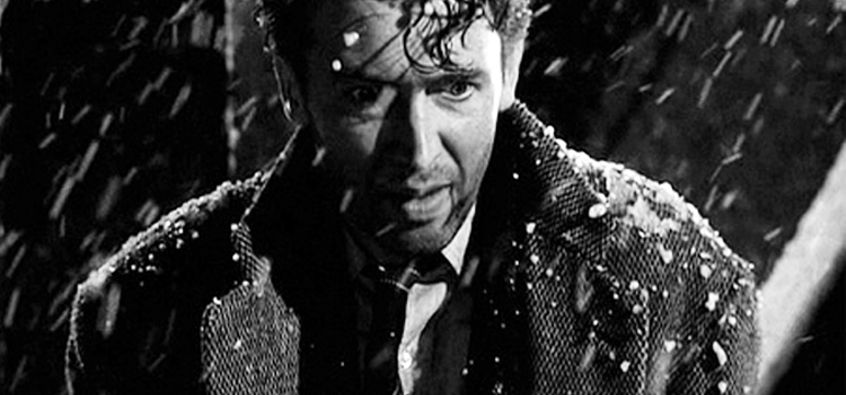
George: You know what the three most exciting sounds in the world are?
Billy: Uh-huh. Breakfast is served; lunch is served, dinner…
George: No, no, no, no! Anchor chains, plane motors, and train whistles.

James Stewart (as George Bailey) in “It’s a Wonderful Life”

I’ve mentioned before that I love the old movie, “It’s a Wonderful Life.”  In it, the protagonist, George Bailey, is in despair and considers taking his life.  As his family and friends pray, God responds by sending “an angel, second class” named Clarence, who shows George what life would be like if he had never been born (and how much impact his life has had on those around him).

ItsAWonderfulLife4

One of the key events in George’s life happens when he is 12 years old.  He dives into a freezing river to save his brother from drowning, but in the process, he loses the hearing in his left ear.  This hearing loss weaves its way through the rest of the movie.  As a young man, George designs an indoor swimming pool under the gym floor for his high school (the movie makes no direct link to the earlier event, but it might be presumed that his experience caused him to think of ways to keep active kids indoors during winter months…)  His bad ear (and his need to help his dad at the Bailey Building and Loan) keeps him from playing football in high school.  It later keeps him from fighting in the war but leaves him stuck at home coordinating scrap drives and air-raid drills–“safe” but less-than-honorable positions for a young man of his day.

There are many things George cannot hear, but three things he listens for– Anchor chains, plane motors, and train whistles!  George spends much of the first part of his life longing to leave Bedford Falls (his home town), to travel the globe.  While his friends travel to exotic places and build successful careers in big cities, George gets tangled up in financing small houses for ordinary people in his small town.  All around him are bitter reminders of the life he dreamed of leading.  His brother becomes a pilot– a fate denied to him.  His best friend makes a fortune selling plastic parts for fighter planes, and takes cruises and fancy vacations that George cannot afford.

jimmy_stewart_in_its_a_wonderful_life

There is a dramatic change, however, when Clarence turns George’s life upside-down.  One of the first things George notices after Clarence declares that George has gotten his wish (and never been born) is that the hearing has “returned” to his left ear.  He marvels at this simple but profound change, but attributes it to his recent encounter with more freezing cold river water.  Soon other changes capture George’s attention–his brother is dead because George wasn’t there to save him; his mother is destitute and care-worn because George wasn’t there to save the Building and Loan after his father’s death; none of the houses he helped finance were ever built, and dozens of families are living in squalor and being over-charged for rent by the evil Mr. Potter.  And the peaceful town of Bedford Falls has been transformed into a noisy hotbed of crime and filth, anger and greed.

Its-A-Wonderful-Lifeb

After George has a change of heart and is “returned” to his wonderful life, the hearing loss is back– this time, George laughs in gratitude as his “disability” confirms that all is back to normal.  He no longer listens for plane motors or trains whistles– instead, he eagerly listens for the sound of his kids as he returns home, and the breathless call of his wife as she returns home with help and hope in the form of neighbors and friends.  The sirens and screaming of his earlier nightmare are replaced with joyous music and laughter.

One of the last shots of the movie shows a tiny, tinkling bell on the Christmas Tree.  Zuzu says that her teacher has told the class that every time a bell rings, an angel gets his wings, and George, hearing the bell ring, simply says, “Atta boy, Clarence.”

pexels-photo-788567.jpeg

What are we listening for in life?  Are we consumed with the sounds of excitement and adventure?  Or are we listening for the important sounds of lonely people softly crying, children giggling, birds singing their morning worship song, or raindrops dancing on the sidewalk?  Are we listening for the Spirit’s whisper in the wind, or God’s voice in the thunder?  Exciting sounds can sometimes deafen us to important sounds.  God calls for us to “be still” and know that He is God (see Psalm 46:10)–what we hear in the stillness and silence is rest and peace for our souls.  And that is one of the best sounds of all!

Full Disclosure

I like to know things–I like to solve puzzles, figure out mysteries, learn trivial facts.  I want answers.  So when I go before God in prayer, I often ask questions.  Why is this person suffering?  When will their suffering end, and how?  Where were you in this disaster (as though God had stepped out for a minute and wasn’t aware of what happened)?

silhouette of fireman holding hose

God stays silent.

I can grow frustrated in the silence or I can learn to trust.  That doesn’t mean that I no longer want answers; just that I am willing to wait on God’s sovereign timing.  It also means that I am need to more about God’s nature–God doesn’t keep secrets or withhold knowledge because He wants to torment me, or frustrate me, or play some cosmic mind game (though some people accuse Him of doing just that).  God withholds full disclosure of His plans, His reasoning, and His nature out of love and compassion.  Suppose I could see into the future, even give out warnings, but had no power to stop disaster from coming.  Not only would I be haunted by the disaster itself, but by the full knowledge of its coming.  Suppose I could see a miracle in advance; know when and how it would unfold.  There would still be joy, but it would be muted by the foreknowledge– of course there would be a happy ending; of course there would be a miracle– I saw it all from afar off.

photo of person holding ball

The Apostle Paul touches on this in 1 Corinthians, chapter 13.  This is commonly known as the “Love Chapter”, and the first half is frequently quoted at weddings and church sermons.  But the end of the chapter is a wonderful message of hope and faith, ending with Paul’s triumphant statement about all three:

1 Corinthians 13:8-13 English Standard Version (ESV)

Love never ends. As for prophecies, they will pass away; as for tongues, they will cease; as for knowledge, it will pass away. For we know in part and we prophesy in part, 10 but when the perfect comes, the partial will pass away. 11 When I was a child, I spoke like a child, I thought like a child, I reasoned like a child. When I became a man, I gave up childish ways. 12 For now we see in a mirror dimly, but then face to face. Now I know in part; then I shall know fully, even as I have been fully known.

13 So now faith, hope, and love abide, these three; but the greatest of these is love.

monochrome photography of a man looking in front of mirror

God loves us with a perfect love.  Because of that, I can trust Him, and have hope in the midst of my questioning.  So when I pray with questions, I can know that God has “filed them away”– He is fully aware of my situation, questions and all, and He is fully faithful to answer them all in His perfect wisdom and timing.  Someday, I will know– not only all that I don’t know now, but why I had to wait.

God will provide full disclosure. with compassion, love, and wisdom that only He can give.

Let No Tongue On Earth Be Silent..

“O ye heights of Heav’n, adore Him,
Angel hosts His praises sing.
Pow’rs, dominions, bow before Him,
And extol our God and King.
Let no tongue on earth be silent,
Ev’ry voice in concert ring,
Evermore and Evermore!”

“Silent night, Holy night…” Tradition has it that Christ was born on a cold and silent night. The Bible doesn’t exactly say when he was born. It does say that the angels appeared to shepherds who were keeping watch over their flocks by night; and that the wise men of the East followed a star to find the newborn King. But the Bible doesn’t talk about the night being unnaturally silent or cold– these are details we’ve added to the story that may or may not be accurate.

But one thing is certain– whatever silence may have settled over Bethlehem near the time of Christ’s arrival; whatever lull in the hustle and bustle of the busy city’s streets–there was no silence among those who heard the good news of His birth. From the singing hosts of Heaven’s angels, to the excited voices of the shepherds, the inquiring whispers among the wise men, and the nervous recitations of the prophecies among Herod’s advisors, Christ’s birth was met with a symphony of reaction.

And so it continues–as Christmas Eve and Christmas Day approach, hymns will be sung, rich with words like “Hallelujah,” “Joy, ” “Blessed,” “Adore,” “Savior,” “Lord,” “Wonder,” “Glory,” “In Excelsis Deo,” “Redeemer,” “King,” and “Emmanuel!” From every nation, and in every language, praise and worship will erupt from homes and churches. And this is in addition to prayer and worship that rises in an unbroken stream around the globe each day, every day.

Even during this time of Advent, when we spend some time in silent reflection, we await the music and joyful sounds of Christmas. And we have songs for this season, too. Songs and prayers as we think abou the glory to come.

It fills me with wonder to think that at any given moment, someone, somewhere, is praying and praising our Wonderful God. But millions of tongues are silent– even on Christmas–in response to God’s Everlasting Love and Grace. There are millions, even billions of tongues that will greet Christmas Day without wonder, without hope, without joy. Billions who will grumble about the weather, or the outcome of a sporting match, or their family relationships. Tongues that might be singing will be mumbling, boasting, yelling, or complaining this season.

Someday, “no tongue on earth” will be able to keep silent in response to the Messiah. “Every knee shall bow, in Heaven and on earth and under the earth, and every tongue confess that Jesus Christ is Lord, to the glory of God the Father.” (Philippians 2:10b-11 NIV)

Can you imagine a choir made up of every single human being–“every voice in concert”– declaring the worth and majesty of God’s Holy Lamb?! This babe born to be the Prince of Peace; this Only Begotten of the Father; our Emmanuel– He is worthy of such a concert! Let NO TONGUE on Earth be silent! Let us Extol Him! How Great Our Joy!!

How Long?

We are preparing for Advent season. We celebrate the coming of our Savior, and His humble birth in Bethlehem over 2000 years ago. We count down the days with advent calendars, candles, and other traditions. And it can be difficult to wait for Christmas Eve and Christmas Day to come.

But imagine those people who lived BEFORE the Advent…those who held the promise, but had not seen it fulfilled. Imagine waiting an entire lifetime without ever hearing the Good News– He is Here! The Messiah has come!

There are promises and hints and prophecies throughout the Bible in what we call the “Old Testament.” And the New Testament is filled with the story of Jesus’ life, death, resurrection, and rule, as well as the outcome of His mission to bring Salvation and Hope to a darkened world. But in between the two testaments there stretches a period of nearly 400 years when God was silent.

I get frustrated when I have to wait 45 minutes at the doctor’s office! Imagine listening to stories from grandparents and elders about promises made a thousand years before, knowing that there was no word, no glimmer of fulfillment for over a dozen generations or more!

And yet, we celebrate the glory of the fulfillment. And on the strength of that glory, and Jesus’ teachings, we are waiting for His triumphant return. A return that hasn’t come in nearly 2000 years.

The difference for us is that we live in the aftermath of the Advent. He HAS already come. He HAS Risen! He has assured us of His return– with His own mouth, in His own words. How long will we have to wait? Will He return within our lifetime? Christians have been asking this question for almost 100 generations now, but we ask with wonder and hope.

The mystery of Advent has become the mystery of the Revelation. We don’t just celebrate the promise given to Abraham or Moses– we celebrate the ongoing promise of Eternity– past and present and future.

I’m reminded of the classic tale by Charles DIckens– A Christmas Carol– where Ebenezer Scrooge is visited by three spirits. He is transported to his own past, sees the present through a different lens, and gets a terrifying glimpse into the future he can expect if he does not repent of his ways. So much of the tale is dark and foreboding, but the ending is rapturous– almost literally. Scrooge’s life has been a narrow life, filled with bitterness, greed, and fear. He spends much of his Christmas Eve adventure wondering about time– how long has Marley been dead? Why appear to Scrooge now? How long before the next spirit will appear? How long will Tiny Tim live? How long has he been haunted– has he missed Christmas Day? Does he still have time to change?

How Long? Ebenezer Scrooge never gets a clear answer about his own future– how long does he have to live? How long will Tiny Tim survive? At first, he is not even sure he HAS survived the night. But he DOES get a clear picture of the glory of hope; the value of time; the joy of promises made and kept; and the true riches of redemption.

We have just under four weeks before we celebrate Christmas Day. In this season of Advent, may we use our time to reflect and rejoice in the promise that was fulfilled so long ago, and in the promise that awaits us for all eternity!

The Silence of God

I am just finishing the book of Job in my daily Bible studies. Job is an interesting book. It begins with a discussion between God and Satan, in which God seems to “set up” Job. God points out Job and his righteous life. Satan (The Accuser) fires back that Job is only enjoying God’s favor; that, given hardship and pain, Job will turn his back on God and embrace evil. God allows Satan to ruin Job’s life– taking away his property, his status, and even all his children. (Ironically, Satan doesn’t cause any harm to Job’s wife, who acts as “devil’s advocate” later, telling her husband to “Curse God and die!”)

Job passes the first test. Satan asks for a “second chance,” saying that Job is still enjoying God’s physical protection. So God allows Satan to cause a painful, wasting disease to attack Job.

But the narrative shifts dramatically at this point. The next several chapters focus on Job’s confusion; his suffering; his bitter quest for answers to the age-old question– Why does God allow bad things to happen to good people? Job’s friends, who start out sharing his sorrow, end up being of very little help and no comfort at all. They insist that God wouldn’t– couldn’t– allow bad things to happen to an innocent man. Therefore, they conclude that Job “deserves” his pain and misfortune. Job insists that God is Righteous, but he wants God to answer his questions– WHY? WHY ME? WHY THIS? WHAT HAVE I DONE TO DESERVE THIS?

And God is silent. Through several rounds of discussion and argument, God is nowhere to be found or heard. Job’s complaints and questions anger his friends, but God remains silent and seemingly unmoved. The central question is not so much about God’s righteousness, but about His Goodness. Is God Good? Can a loving God allow people to suffer– especially if it is unjust– and still be called “Good”?

Reading through the book of Job, we are aroused to the same kind of anger that Job expresses. There are times when I have questions; times when I am suffering; times when I just don’t understand– “What have I done to deserve this?”

And yet.

The Bible is full of “and yet” moments. God finally speaks, but He never answers Job’s questions directly. Job did nothing to “deserve” his suffering. And yet, God allows him to be tested, tormented, and stretched to his breaking point. Not because Job has done something wrong, but because he has been faithful! God never answers Job’s complaints– and yet, God does not leave Job without any answer. In fact, God restores Job’s fortunes and gives him more children, so that his final condition is even better than before! God justifies Job in front of his friends, restoring his status, as well. Job complains about not having a mediator to defend him before the Almighty. And yet, Job trusts that such a mediator– such a redeemer– exists. He cannot see Jesus– and yet He puts his faith in the promise of His coming!

The book of Job ends with Job praising God–BEFORE his restoration– acknowledging that God is not just Good, but that He is Great! He is Great beyond our understanding. He is Holy, and His ways are higher and greater than our ways. Job’s suffering, while painful and undeserved, allowed him to understand God in a new and deeply personal way. God allowed Job to be crushed but not destroyed; tested, but not terminated. God was silent, but never absent.

In fact, the one character who is conspicuously absent at the end of the story is Satan! He has “lost” his challenge to make Job repudiate his right living and his love of God. He has been given two chances to strike at the authority and character of God– and he has left the battlefield in contempt and defeat. He has caused Job pain and suffering, but he has not caused Job to quit.

Job’s questions throughout the book which bears his name are really prayers. He is talking about God, and talking TO God, even as he addresses his friends. He is bitter and angry and confused– AND YET– he prays!

May that be said of me today, as I face questions, trials, and suffering. I can “Take it to the Lord in Prayer.” Not just when things are going well, and I am praising God, but when life seems bitter and I am questioning God’s justice. He IS Sovereign. He IS Good. He IS listening. He DOES Love me.

I Know That God Lives

13-20 “God alienated my family from me;
    everyone who knows me avoids me.
My relatives and friends have all left;
    houseguests forget I ever existed.
The servant girls treat me like a deadbeat off the street,
    look at me like they’ve never seen me before.
I call my attendant and he ignores me,
    ignores me even though I plead with him.
My wife can’t stand to be around me anymore.
    I’m repulsive to my family.
Even street urchins despise me;
    when I come out, they taunt and jeer.
Everyone I’ve ever been close to abhors me;
    my dearest loved ones reject me.
I’m nothing but a bag of bones;
    my life hangs by a thread.
21-22 “Oh, friends, dear friends, take pity on me.
    God has come down hard on me!
Do you have to be hard on me, too?
    Don’t you ever tire of abusing me?
23-27 “If only my words were written in a book—
    better yet, chiseled in stone!
Still, I know that God lives—the One who gives me back my life—
    and eventually he’ll take his stand on earth.
And I’ll see him—even though I get skinned alive!—
    see God myself, with my very own eyes.
    Oh, how I long for that day! (Job 19:13-27 The Message)

When God Doesn’t (Seem to) Answer…

Prayer is a conversation with God. But sometimes it can seem like a one-sided conversation. We have pressing needs for healing, or strength to bear up under stress or oppression. Sometimes, we pray for our loved ones’ struggles against addiction or wrong choices. And God seems silent.

Sometimes, it’s better to get an answer we don’t like than no answer at all. When I was younger, I prayed for a family– a dream family with a handsome husband (preferably wealthy), three adorable and well-behaved children (I already had names picked out..), and maybe a beloved family pet, all living in a beautiful house with a big back yard, and maybe a small woods. I waited and prayed; prayed and waited. When I was in my thirties, still waiting and praying, I found out that I have several health problems– none of them life-threatening, but they mean that the chances that I would ever have had children are slim to none. I would never have the pleasure of watching my own children grow up; never know the joy of having a little voice calling me “mommy.”

But God had not abandoned me. In my careers as a teacher and a children’s librarian (careers I had begun before I knew I couldn’t have children of my own), I had the joy of working with hundreds of children across a spectrum of ages, from nearly newborn through college! My memories are filled with a choir of voices calling me Miss Toney or Miss Lila (as I was known then). God had not closed the door on my dream– he had opened a window.

It wasn’t the answer I had hoped for, but it was an answer. However, I was still single. I didn’t want to be single. I didn’t feel it was what God wanted for my life, yet He didn’t seem to be listening or giving me any sign that He heard or understood. There was only silence. No promising relationships– only a few scattered dates over the long years–a few budding friendships, and many lonely days and nights.

There were many helpful friends and family with suggestions, ideas, advice, comforting thoughts, or “explanations.” “God is waiting for you to become more mature in your walk with Him.” “God is saving the best for last.” “You’re too picky (I was never quite sure what that meant in light of the scarcity of dates, but…)” “You need to ‘get out there’ more–have you tried on-line dating? (I did. It was ‘meh’..).” “You should change jobs– single men are not hanging out at the library.” “You should change churches– find one with more single men.” But God stayed silent through my thirties and into my forties.

I did take some of the very good advice I received. I signed up to do short term missions trips. I traveled when I could, with family and friends, and even on my own. I read and went back to college. I spent time in the woods and at the beach, meditating, singing, or just enjoying God’s nature. I got “involved” in various volunteer opportunities. I joined the church choir. And I continued to pray.

By the time I was squarely in my forties, I had decided to stop praying for a husband, to stop hoping, and praying, and seeking, and dreaming. And God said nothing. But I began getting phone calls from an old friend– someone I had known in childhood–in fact, the very first boy I had ever dated, nearly 30 years before! At first, I listened to his voice-mail messages, but didn’t return his calls. I was annoyed, and even a bit angry. After all this time, was God laughing at me? Did He really expect me to go all the way back to the very beginning and start over?

David and I on our wedding day.

Finally, I let go of my pride, and my ancient dream– I decided to give David a chance. Maybe it would lead to another (renewed) friendship. Maybe it would be another disappointment. But it led to a new dream. It led to marriage, and a huge extended family, including David’s wonderful children, and three adorable (and mostly well-behaved) grandchildren. My husband is kind, and honorable, and Godly. He is a treasure. And God’s timing is perfect, even as it is mysterious. God didn’t withhold marriage as a bargaining chip to get me to “grow up,” or grant it as a “reward” for going on a couple of mission trips. God was silent–but He wasn’t absent. He saw every teardrop, rejoiced in every busy child-filled day at work, smiled at every snapshot of every natural wonder, every Teddy Bear picnic, every Bible School. He want along on every date, kept track of all the hundreds of books I read over the years, and hovered over the dinner table set for one every night. I committed my life to serving Him– whether I was single or married, alone, or surrounded by children. His ways are higher, and better, and wiser than mine.

I may never understand why God allowed me to travel the roads that have been set before me. And my roads could have looked much different. I could have married young, unaware of my barrenness, and ended up bitter and feeling guilty about my body for years before I was diagnosed. I might have had a child (or children), and become proud and controlling and fearful. I might have made idols of my “dream” husband and family.

I know many dozens of people who are praying into the “silence” and waiting for God’s answer. Some are praying for healing. They may pray for days in the hospital, only to lose their loved one. They may pray for weeks or months, as their child battles chronic illness. They may pray for years as they battle depression and loneliness. God may seem silent. But He is never absent. His ways sometimes lead to a happy ending in this life. Sometimes, they lead us to have greater understanding and compassion for others. Sometimes, they lead us to unexpected purposes and goals– adventures beyond what we have ever dreamed of. Sometimes, they lead to a legacy that we cannot see this side of death. He does not promise us the answer we want, when or how we want it. He doesn’t promise us an easy or “happy” answer on the road ahead of us in this life. What He does promise is that He will never forsake us. Long after we have been tempted to give up, to doubt, to turn away, God will still be waiting– sometimes in the silence– for the perfect moment, the perfect justice, the perfect word, the perfect solution.

Let All Mortal Flesh Keep Silence

Christmas is a time of joy and light. But the time of Advent is often a time of somber reflection. We remember a time we have never known– a time before the coming of Christ the Messiah– a time before the mysteries of Heaven were revealed and before the victory of Salvation was accomplished. Advent reminds us of the spiritual darkness that existed before God, in human form, in humble obedience, and in sacrificial love, became the Light of the World, and the Hope of All Nations.

Before the bells rang, and the angels sang; before the kings brought gold and the shepherds ran to tell the news; before there were Christmas Carols, Christmas decorations, or Christmas pageants– there was solemn silence, fear, dread, and waiting. God had been silent. The prophets had been silent. The world had grown hard and cold.

Jesus stepped out of the unfathomable glory of the Highest Heaven– surrounded by armies of angels all worshiping Him and ready to do His bidding. In an instant, He became a helpless fetus inside a helpless young woman, a subject of the Roman Empire, and at the mercy of her culture. Her fiance could have repudiated her; her parents could have disowned her; her community could have had her stoned to death, along with her unborn child. No one, even those who were anticipating the arrival of a Christ, was expecting this tiny baby growing inside the womb to change the course of history.

He was born in obscurity, in ignominious squalor. He was the Lord of All Creation, wrapped in rags and laid in a feeding trough in an overcrowded city at tax time. There were no bells or carolers, no glittering trees or festivals of lights, no sounds of joy and celebration– not in that manger in Bethlehem. Instead, there were strangers pushing and shoving, shouting, and snoring in the inns and houses and streets, being watched by soldiers and pickpockets alike, as they made their way through narrow, unfamiliar streets and tried to lock out the worry and danger and dread. There may have been silence in the fields and valleys outside of town, but not near the stable where Jesus was born. No. The “silence” we sing about during Advent is the silence inside our own hearts– a call to “be still,” and know that this baby we celebrate is God Incarnate. He is the One to whom every knee will one day bow, and every tongue confess that He is LORD.

In the stillness and silence of Advent, in the darkness lit only by candles and faint hope, we being to understand the contrast. We re-imagine what came before the joy and hope and eternal clouds of witnesses shouting, “Holy, Holy, Holy!” We remember the days and years before the angels sang, and the star danced across the night sky– before the shocking crucifixion and the glorious resurrection of this still unborn Savior.

Let us spend these days of Advent preparing our hearts for the true wonder of Christmas. It doesn’t come in the wrapped packages under a festive tree, or in the feasting with friends or family. It doesn’t come with sirens and parades, or speakers at the mall blaring out favorite tunes. It doesn’t come in the majesty of a Cathedral ringing with the voices of a choir and organ. It comes when the silence and darkness of our sin and dread are pierced with the overwhelming glory of God With Us– Emmanuel is coming! But for now, for these moments, Let All Mortal Flesh Keep Silence.

When Half-Spent Was the Night

‘Tis the season for Christmas Music– hymns and carols, ancient songs and modern tunes celebrating the Advent and Birth of the Lord Jesus. Joyful, passionate, somber, or even a bit silly, such music can lighten our spirits, and remind us of the incredible gift of God– Emmanuel–His very presence among mankind.

Christmas lyrics often use wonderful imagery to retell this amazing story. The Bible accounts tell of shepherds, angels, wise men, and stars– the songs give us the immediacy of a dark night– “silent”, “still”, “earth as hard as iron; water like a stone”, “a midnight clear”, “half-spent was the night”…

Most of us live in a world that rarely gets so dark. If we live in a town or city, we are surrounded by street lights, security lights, even night-lights in the hallway. Even so, we have a feeling for how the midnight and early morning hours seem darker, colder, quieter, and more dreary than any other time. And there is a significance in remembering that Jesus came to earth in the midst of literal and metaphorical darkness, “when half-spent was the night.”

Photo by Alex Fu on Pexels.com

God is Omnipresent– it is not as though God leaves us when all is merry and bright– but His presence is often most keenly sought, and unexpectedly found, in darkness and distress. When all seems bleak, cold, and hopeless, Jesus comes silently, small and fragile as a baby, bringing light, hope, joy, and peace. He comes when the night is “half-spent”– when the darkness is deepest, the silence weighs heaviest, and the cold is most bitter; when hope and light seem lost.

Jesus’ Advent came after four hundred hears of silence. Prophets, such as Isaiah, Zechariah, and Micah, had spoken of Messiah rescuing Israel from captivity. But the years had passed, and Rome ruled the Jewish people with an iron fist. God had stayed silent, and hope seemed remote. Rome would continue to rule the world for another four hundred years. But when Messiah arrived, He didn’t come to break the power of Rome. He didn’t come at the end of that particular “night”; rather, He came when the night was “half-spent.” He came gently, quietly, and humbly. He came to deliver Israel from something much darker, colder, and deadlier than a foreign occupation. Jesus, through His life and death and resurrection, came to deliver Israel, and the rest of the world, from the power of sin and death.

All the promise of deliverance and salvation that came in the middle of that bleak night so long ago, remains for us to celebrate– even in the middle of our “half-spent” nights.

We may not see the dawn in the middle of our struggles. We may not hear the angels singing or feel the warmth of the new day coming. But because of this “Rose e’er Blooming”, we can rejoice. We can find hope and peace in the present night, knowing that Emmanuel is with us! Like a lamp in the night, He will stay with us as we travel through the present darkness. After all, “Thy WORD is a lamp unto my feet and a light unto my path.” (Psalm 119:105) Jesus is the Living Word of God, and thus, our living light!

Blog at WordPress.com.

Up ↑