One of my very favorite bedtime stories when I was growing up was about a little bear cub. ( “Why do you love me?” by Mabel Watts) He and his mother were on a walk, and the little bear kept watching other little bears. Some were getting in trouble–running away to play in the brier patch, or climbing trees to get honey–and meeting up with bees! Little bear knew that sometimes he was like that. Other bear cubs were kind and helpful. He knew that sometimes he was like those bears. At one point, the cub was confused and asked his mother, “WHY do you love ME?” After all, he realized that he was helpless and accident-prone. Without his mother, he would be lost, hungry, and in danger. Yet his mother was always there when he needed her– even when he said he didn’t! His mother’s answer provided solid assurance– “Because you’re MY little bear!” The story book is almost impossible to find now. It is long out of print, and has been crowded out by newer books with similar titles. But for 50 years, I have cherished this story of unconditional love, because it echoes the Biblical story of God’s love for each of us.
We find many reasons to question God’s love. We find ourselves in trouble, and we are afraid to ask for help or forgiveness. After all, we have done nothing to earn it. We don’t deserve it. Even our good behavior cannot save us from our own limitations. And our bad decisions can hurt others in ways we cannot “fix.” We may have walked away from God or sneered at His care of us. We may be lost and hopeless without God’s intervention on our behalf. Why would He help? Why should He look kindly toward us?
But God’s answer is the same as that Mother Bear–You are MINE! I Love you with an everlasting love!
Even when we wander and try to do things we shouldn’t or can’t, God is near, and ready to help. He wants us to walk with Him and follow Him; He wants us to turn to Him in our need. Why? Because we belong together; we belong to HIM. And when we see others behaving badly–even when their actions hurt us–God still loves them, too. He created each one of us to walk with Him, trust Him, learn from Him, and experience His loving care.
In fact, as children of God, we should be showing the same kind of unconditional love to others. That does not mean that we condone wicked or dangerous behaviors. But we should love in such a way that people may even question it– “Why do you love me?” Instead of sharing our anger, or our own self-righteousness, what if we shared compassion and held to the truth without arrogance or disdain? What a great opportunity to share the reassurance and hope we know in Our Father’s great love!
We are a curious race, humans–we ask a lot of questions of ourselves, each other, and even of God. How did He make the universe? When will Jesus return? Who can we trust in this world? Where is Heaven? What must we do to be saved? But the majority of our questions are “Why” questions. Why did Jesus come? Why did He have to die? Why did God make snakes and mosquitoes and platypuses? Why are men and women so different? Why am I… (short/tall, fat/thin, clumsy, “odd,” misunderstood, etc.)? Why are You so mysterious? Why do bad things happen to “good” people?
I was thinking about this last question this week. I don’t have any definitive answer to that– no one I know has any better answer. God has not given us a definitive answer, either. We are to trust that His ways are wise and best and perfect, but faith and trust require–well, Faith and Trust! We know God has done good things in the past. We know He has redeemed what seemed like hopeless situations. We know His promises, and we have seen some of them fulfilled. Still, such a question can often leave us blindsided and tongue-tied.
There are many learned thinkers, philosophers, and apologists who have written whole books on this subject, but I want to just pose a couple of ideas to help us, not ANSWER the question, but understand the question a little better.
First, the question, “Why do bad things happen to good people?” is really two questions: “Why do ‘bad’ things happen?” AND “Why do they happen to ‘good’ people?” So let’s look at the questions separately.
“Why do ‘bad’ things happen?” What do we mean when we say “bad things?” There are many circumstances, events, diagnoses, and occurrences that may be called “bad.” Death is “bad.” Indigestion is “bad.” Stubbing one’s toe is “bad.” Being diagnosed with Alzheimer’s Disease is “bad.” Divorce is “bad.” Slavery and abuse are “bad.” House fires, job losses, being mugged, being stranded without heat in a blizzard, an outbreak of acne, being laughed at– all these are “bad.” But they are all different. Many “bad” things are the direct result of sin–we suffer the consequences of our own sin; we are the victims of the sins of others. The consequences of addiction can be horrific, but we often lack compassion for those who are suffering, because “they brought it upon themselves.” But what about the innocent victim of rape or child sex trafficking? Such acts leave victims traumatized and broken. Both are “bad,” but we are angered and frustrated even more when “bad” consequences also seem unjust and unfair. And what about natural disasters? Are they the result of sin, as well? The Bible suggests that they are. When God placed Adam and Eve in the Garden of Eden, they lived naked, carefree, and unafraid. Only after their sin did God place a curse on the land– Adam would now have to cultivate the land in order to get food. There would be enmity between the woman and the serpent. Eve (and all women after her) would have pains in childbirth. (see https://www.biblegateway.com/passage/?search=genesis+3%3A+14-20&version=NIV) There is no mention of hurricanes, blizzards, or earthquakes prior to the Fall of mankind, though it is speculation on my part, to say that there were none.
God has promised to make all things new. There will be a time when the consequences of Sin will be eradicated. We will not even remember the suffering we endured in life, in light of the blessings of eternity. So, though God doesn’t answer our question of why “bad” things happen, He does give us the assurance that such “bad” things do not determine our destiny, nor do they happen without His knowledge or outside of His will! We cannot understand God’s purposes in allowing us to suffer, though sometimes we may see a hint of good even in the midst of tragedy.
And God is loving and gracious in the face of our confusion and pain. We CAN ask God “Why?!” “Why me?” “Why this?” “Why now?” “Why them?” Why, O Lord!?” Many of the Psalms speak to this very question. But in the middle of his anguish, the psalmist often finds comfort and renewed strength to face the struggle, when he turns to God. Asking why is not always a sign of weak or failed Faith. Instead, it is acknowledging before God that we ache. We grieve. And we NEED HIM!”
And what about the second part of the question: “Why do (bad things) happen to ‘good’ people?” What makes a person “good?” Jesus was “Good,” And yet He questioned the rich young ruler, “Why do you call me good? No one is Good– except God alone.” (see https://www.biblegateway.com/passage/?search=Luke+18%3A18-27&version=MSG) We tend to think of the people we know and like as “good.” And we have a natural expectation that their lives should be “good” also– free of pain or struggle. But that is not realistic in this world. The actor, Michael J. Fox has been suffering for years with Parkinson’s Disease. This seems unfair and cruel. How could God let him suffer like this? But there are many thousands of people suffering from Parkinson’s Disease. Some of them are homeless addicts; some are in prison for rape or embezzlement. Is their suffering any less than that of Mr. Fox? Is it somehow less tragic or unjust?
The sad and shocking truth is that none of us “deserves” a pain-free, struggle-free life. Bad things DO happen. And they happen to people we like, and people we hate; people we judge to be “good” and people we judge to be “bad.” God does not “play favorites.” Yes, God can, and often does intervene on someone’s behalf through prayer, or for His own bigger purposes. But He does not “dish out” suffering to those He dislikes out of spite or revenge. Nor does He cause His faithful to float through life without ever tasting bitterness and grief. Jesus made many promises, but one of them was this: “in this world you will have trouble; but be of good cheer, I have overcome the world.” (John 16:33) He didn’t promise that you might have a little spot of trouble, or that you might look around and see others in trouble– He promised that we would have trouble. Not because we are “bad” or “good” but because that’s the way this world is.
I find it odd that atheists often pose this question as a way of trying to “prove” that God doesn’t exist. They pose the question as an accusation. “If there is a kind and loving God, why do bad things happen to good people?” But if they believe that there ISN’T a kind and loving God, how do THEY explain why bad things happen to good people? How do they define “good” people and “bad” things? Without a Good God, where is the expectation of good things happening to good people? Without God, there are no objectively “good” things or “bad” things happening– only random events without divine cause or purpose. You can’t blame a non-existent God for things He either caused or didn’t prevent. Such questions are meant to plant doubt in the mind of a believer, but they fail to answer the greater question– Why do Good things happen to undeserving people? Why do we sometimes find joy and peace and strength in the midst of our suffering? Why do human beings continue to Hope?
Finally– the ultimate example of God letting something “bad” happen to someone “good” can be seen in the central image of our Faith– the crucifixion of Jesus Christ. Jesus was sentenced unjustly to a torturous death and public humiliation. He was separated from God the Father, and carried the punishment for OUR sins so that WE could be reconciled to God. Even though the purpose of Christ’s suffering has been revealed to us, it doesn’t negate the agony and trauma He faced. And even HE cried out from the Cross– “My God, My God, WHY have YOU forsaken ME?!” (Matthew 27:46)
God does not answer the question of why “bad” things happen in this world. But in the crucifixion, Jesus proves to us that He shares and understands our suffering; that He has the power to overcome and redeem our traumas; and that He will hear our sincere cries of “WHY?!” He will hear when we turn toward Him, instead of turning our back on Him. He will hear our broken heart. He will heal our broken heart.
We don’t like to talk about (or write about!) prayers of confession and repentance. And yet, the Bible is full of such prayers. In fact, even the Lord’s Prayer contains the phrase “forgive us..” Even if we pray eloquent prayers of praise and petition, our prayers will be lacking without first evaluating our relationship with Christ and seeking His forgiveness and continued cleansing.
I know there are those who will challenge this statement– after all, once we have “accepted Christ,” aren’t we considered to have His righteousness? Haven’t we BEEN forgiven? If we must keep asking for forgiveness, does that mean that Christ’s death and resurrection are not sufficient to “save” us?
I do not mean to suggest anything of the sort. We ARE forgiven– past, present, and future– our names entered in the Lamb’s Book of Life. God isn’t holding on to a grudge over every future fib, flub, or fall. And nor should we. Confession in the prayer of a Christian shouldn’t be wallowing in guilt and shame, or confessing the same sins over and over, doubting that Christ’s finished work isn’t actually finished. But just as in all close friendships, we sometimes ask, “Are we ok?”, to clear the air and maintain closeness, it is appropriate to “fess up” with God– to clear the air– precisely so that shame and guilt DO NOT build up or slowly seep into our relationship.
God will not withhold His promised salvation from us if we are trusting in Him. We are justified, and our advocate, Jesus Christ, mediates for us constantly, just as the Holy Spirit indwells us to be able to overcome temptation and do what we cannot do on our own. But WE are still living in our fallen world and fallen bodies. We will find it difficult to trust; we will find it tempting to judge others; we will doubt our own decisions– did we really do “right”? And while God is eternally faithful– we are not; nor have we reached perfection in all our daily actions and thoughts. We are “okay” with God– but confession reminds us of that!
In the story of the prodigal son (Luke 15:11-32), the son rehearses a speech of confession. And even as he begins saying his rehearsed words, His father interrupts with complete reassurance of his love. How much more does God delight in reassuring us of His eternal, unfailing love!?
Two thoughts I’d like to add here:
One– It can be very easy for us to fall into confession as a works-based ritual. Confession adds nothing to Christ’s finished work on the Cross. We are saved by God’s Grace– period. Ten thousand prayers of confession will not make us “more” saved.
Two– It can be just as easy to avoid self-evaluation and discipline as we grow “comfortable” with our Christian Walk. Confession is not about “right” and “wrong” as much as it is about humility. The Apostle Paul says, “And I am sure that God who began the good work within you will keep right on helping you grow in his grace until his task within you is finally finished on that day when Jesus Christ returns.” (Philippians 1:6 The Living Bible)
We don’t need to be hampered by guilt, fear, or shame– but we should want to keep our relationship with God pure above all other relationships. And that means being willing to submit to God’s will and God’s discipline on a daily basis. Confession is not an admission of God’s failure to save us; nor of our commitment to follow Him. Rather, it is an admission of how important that relationship is, and how much we need to keep our commitment fresh, pure, and vibrant. God HAS forgiven us; He will continue to forgive– freely, and fully!– as we follow Him.
I spent last week helping out at Vacation Bible School. But most of the kids didn’t see me “working.” I was behind a curtain, helping with the puppet show. My puppet was a little boy named “JJ.” He was a hand puppet. Hand puppets are pretty simple to operate– you stick your hand inside the puppet, and move its mouth as you talk. There are also “hands” you can operate with your fingers to make the puppet clap or wave, etc. During the course of the week, “JJ” also had one “costume change”– he wore a simple plastic bag poncho, but he put it on backwards. “JJ” was the comic relief of the puppetry team! But his purpose was to expand on the Biblical principles we were teaching throughout the week. “JJ” learned about sin and its effects– often by example– and about God’s forgiveness. And he helped the younger kids review their daily Bible verse.
I have worked with puppets off and on over the years, especially during my time as a youth services librarian. Puppets help tell stories in an entertaining and engaging way. But puppets are merely tools. The same stories can be told using flannel cut-outs, or videos, or illustrated comic books. In fact, everything that “JJ” did was scripted. If he nodded, it was because the script said to nod. If he sang, the song was in the script. And when the puppet show was done for the day, “JJ” rode around in a canvas bag, lifeless and unused.
We use puppets at VBS to teach about Christian principles– but pursuing a Christian life is NOT about being a puppet. Many people reject Christ, because they believe that God is asking them to become puppets. They learn about concepts like the indwelling of the Holy Spirit, and it sounds to them as though God will “possess” them, and take away their free will and their ability to live life on “their” terms. But that is not what Jesus taught. Jesus was perfect in Righteousness– yet he clearly CHOSE to follow His Father’s instructions, and he did it using His own unique personality and style. Jesus did not parrot the words of God when He taught. He told stories– parables– that brought God’s laws and commands to life, and helped people understand them better. Jesus was no puppet. And He doesn’t ask us to be puppets, either. Instead, we are witnesses– telling our own stories, living our own lives–SHOWing others how Christ lives THROUGH us. God doesn’t want “tools” or mindless puppets. He wants a relationship with us that gives our unique experiences an eternal and sacred purpose.
Yes, in Christ, we become a “new creation.” (see 2 Corinthians 5:17) We see the world through a different lens; our minds are renewed (see Romans 12:2); we follow Christ’s example and walk in obedience to God. But we do so out of our desire to be closer to God– our desire to pursue the relationship that only God can offer us. The Holy Spirit indwells us; He doesn’t coerce us or take over our mind– rather, He helps us continue in our newness and progress toward greater Godliness!
It was fun to spend a week using “JJ” to help teach the daily lessons. But we had dozens of amazing volunteers who also made VBS memorable, fun, and, hopefully a life-changing week for the kids who came. There were the actors who did a daily skit; the singers who taught the kids vibrant songs and dance moves; the Bible teachers who explained deep issues with wonderful skill; the volunteers who taught science lessons and crafts that tied in with our daily themes; the food staff, who created treats that told a story; the sports team that provided games (and plenty of water on hot days!) and the group leaders, greeters, and security staff that ensured that the kids were welcomed, introduced to others, and kept safe. Each of us lived out the message of the Gospel– God’s love for each of His children!– in our unique ways.
One of the ways we served last week was in prayer. We prayed together as a team. We prayed in our small groups and areas, and we prayed with the kids. And each person’s prayer was unique. Some people get nervous about praying aloud in a group– others are eloquent speakers. But each person’s prayer shows their heart for God and others. In our puppet skit, JJ talked about wanting to pray with his “granny” after the skit. But the puppets never prayed. And I think that is appropriate. Prayer is not about a “script.” Prayer is not about someone else putting words in your mouth. Prayer doesn’t come from a hand or a finger moving us to speak. Prayer comes from the heart. And I hope the kids (and adults) last week were moved more by our prayers than by our puppets!
Are you ever afraid to pray? Afraid that God will not hear, or worse yet, that God will hear but reject your prayers?
The Bible has much to say about fear and our worship of God and in our conduct before God. We are supposed to have a healthy “fear of the Lord.” After all, God is Sovereign. He holds absolute power over life and death, both in this life and throughout eternity! We should have the kind of awe and respect we have for one whose power is so great. We fear forces of nature, such as fire, floods, earthquakes and tornados. We should be afraid of God’s power in relation to our own. But what does this mean in relation to prayer? Does fear have any place in our pursuit of prayer?
So we have come to know and to believe the love that God has for us. God is love, and whoever abides in love abides in God, and God abides in him. By this is love perfected with us, so that we may have confidence for the day of judgment, because as he is so also are we in this world. There is no fear in love, but perfect love casts out fear. For fear has to do with punishment, and whoever fears has not been perfected in love. We love because he first loved us.
1 John 4:16-19 (ESV)
The “fear of the Lord” has to do with God’s power and authority to punish sin. We live in a fallen, sinful world, and we are fallen, sinful people. Our natural response is that of Adam and Eve in the Garden of Eden– to hide from God, and try to avoid His righteous judgment against us. Those whose consciences have been seared will lose this healthy and natural fear– they will be proud in their defiance against God. They will say that God is not sovereign or Holy; that He does not have the power to judge them; that they can “bargain” with God about their eternal destiny– they will even deny His very existence. Others will claim that God is Holy, but not “Good.” They claim that He is disposed to judge harshly; that He is vindictive and without mercy; that He demands too much of us. On the other end of the spectrum, Christians and others can become so disposed to seeing God as their friend and advocate that they forget His awesome Holiness and Power. Christians have no reason to be afraid of God, but we have every reason to stand in AWE of Him!
The Truth of God, as revealed in Jesus Christ is that God is LOVE– perfect and everlasting Love! While He has the power and the authority to judge, it is His desire to lavish mercy on us! Such love should compel us to run TO God, rather than run away from Him! We fall on our knees in worship and adoration, not in abject terror.
So what could still cause us to be afraid to pray?
Perhaps we are still in sin, or we have strayed back into sin. Christ has already paid the penalty for Sin– it has no real power over the believer who “abides in God.” But it still has the power to draw us away from God and damage our relationship so long as we hide it, refuse to confess it, or repent of it. Even as we know that Christ has paid the price for our Sin, we also know that we need to abide in His Love to grow into a more perfect relationship with Him.
Perhaps we are holding on to old patterns of thinking and old guilt. Satan is an accuser. Even after we have confessed our sin and received God’s forgiveness, Satan will try to keep us enslaved to our guilt and shame. He will try to bring it to mind, or have others treat us with condemnation or condescension, so that we feel unforgiven or unlovable. We need to follow the advice of the Apostle Paul:
So here’s what I want you to do, God helping you: Take your everyday, ordinary life—your sleeping, eating, going-to-work, and walking-around life—and place it before God as an offering. Embracing what God does for you is the best thing you can do for him. Don’t become so well-adjusted to your culture that you fit into it without even thinking. Instead, fix your attention on God. You’ll be changed from the inside out. Readily recognize what he wants from you, and quickly respond to it. Unlike the culture around you, always dragging you down to its level of immaturity, God brings the best out of you, develops well-formed maturity in you.
God’s love is PERFECT. But our love is not. Sometimes we are praying, not out of love, but out of duty or even selfish motives. We pray for God to give a green light to our wants and desires and plans, rather than listening for His wisdom and grace in our situation. We pray for God to “change” that person who annoys us or persecutes us, rather than praying for God’s blessing on them, and listening to the ways He may want to “change” us! Sometimes we cannot see the wisdom of an outcome we don’t like, and we are afraid of the unknown path we must take– even with God’s continued presence by our side.
We don’t have to be afraid to pray. But when we feel apprehensive, it may be a sign that we NEED to pray–honestly telling God what He already knows and asking for the grace and wisdom to listen to what He so lovingly wants to tell us.
Therefore, since we have a great high priest who has passed through the heavens—Jesus the Son of God—let us hold fast to our confession. For we do not have a high priest who is unable to sympathize with our weaknesses, but one who has been tempted in every way as we are, yet without sin.Therefore, let us approach the throne of grace with boldness, so that we may receive mercy and find grace to help us in time of need.
One of the prayer models I like to use often is based on the acronym ACTS. ACTS stands for Adoration, Confession, Thanksgiving, and Supplication. I like this model because it is well-rounded. It works like this:
ADORATION–I love to begin prayer by remembering and acknowledging God’s worth, His supremacy, His Holiness, and His majesty. It sharpens my focus on the WHO of prayer, rather than the WHAT of my worries or doubts. And it puts everything in the proper perspective. Sometimes, I come to God by praying a Hymn, or praying a Psalm, or remembering the many names of God.
CONFESSION–Confession is important in prayer, and since I want to concentrate on it, I’ll come back to this element below.
THANKSGIVING– Thanksgiving returns me to remembering what God has already done– for me, for others, throughout history, and just yesterday in my life. Instead of prayer being all about my needs, wants, or concerns, prayer should be an honest conversation with God. And that must include gratitude, because God is truly GOOD! If you ever doubt that, think about the first five minutes of your morning. If you awoke, you are alive (thank you, God!). If you heard your alarm, opened your eyes and saw anything, if you were lying on a bed, in a shelter with a roof, if you were able to sleep through the night without the terrors of war, slavery, starvation, torture, or chronic agonizing pain, you have much for which to be grateful. If you were able to get out of bed on your own, able to eat breakfast, get dressed, and you have a job to go to or a purpose to fulfill in this day, you are among the blessed. To withhold praise and thanksgiving is to miss one of the privileges of life.
SUPPLICATION–Yes, we bring requests to God. And He already knows what we need, what we desire, and what He has planned for us. So supplication is not about making God aware of our needs. But it is another act of acknowledging that God hears and responds to us. Because that’s the kind of God He IS! And because we have spent time Adoring, Confessing (to), and Thanking God, we know that we can present our requests without fear or doubt.
Most of us are fine with Adoring, Thanking, and Saying our requests, but Confession can be tricky– especially in our culture. What are the elements of Confession that trip us up? Mostly, I think, it’s a misunderstanding of what confession is (within the element of prayer) and what it is NOT.
Confession is defined as admitting to guilt, or to a crime or sin or wrongful act. But, even more basically, confession is an admission that we are not the ultimate authority over our lives or the lives of others. As such, we must confess before we can accept God’s atonement for our Sin. If we do not confess our need for God, we cannot accept, understand, or appreciate the depth and nature of His sacrificial Love for us. So when we pray, we must confess, not only God’s Glory in the heavens and the Earth, but His Sovereignty in our lives; His authority over our emotions, our thoughts, and our actions. King David gave us many great examples of confession in his Psalms– and they can be terrific models to use in our own prayers. (See Psalm 6, Psalm 32, Psalm 38, Psalm 51, and others.)
Confession in prayer is not primarily a list of our petty missteps– though we should be willing and able to name them, rather than denying what we’ve said and done–but a daily admission of God’s right to determine how we conduct our thoughts, our habits, our priorities, and our relationships, and acknowledging that God is Merciful, Gracious and Loving– beyond all our failures, mistakes, and even past rebellion. Confession shouldn’t focus so much on what we’ve done, as on how God is able to free us from guilt and shame, and how we intend to move on away from the past. We confess that our ways are not Holy, and in doing so, we underscore that God’s ways ARE Holy, perfect, wise, and good. God already knows our thoughts and actions, but WE need to be reminded of our goal– to run the good race (see Hebrews 12:1, and 1 Timothy 6:12) to follow Christ; to become more like God each day!
Confession is primary to the Christian Life– we confess that ONLY by the work of Jesus (the cross and resurrection) can we be reconciled to God. We cannot pray openly to God if we don’t believe–and confess– that this is true. God is not fooled by sweet talk or glib arguments. We cannot believe that Jesus’ atoning death and resurrection saved us if we don’t believe that it was necessary and good for Him to do so. And besides, confession is good for the soul!
“If we confess our sins, he is faithful and just to forgive us our sins and to cleanse us from all unrighteousness.”
1 John 1:9 (KJV)
Confession has a negative reputation in many Christian circles, and it is misunderstood in others. Just listing our sins or admitting we did something wrong doesn’t have any value without the positive confession that Jesus is “the way, the truth, and the life.” (see John 14:6) In fact, a better definition of Christian confession is this– agreeing with God about who I am (a sinner/imperfect/unable to attain Holiness on my own), and who HE is (perfect/Holy/Sovereign/the One who Loves me absolutely)
When we pray today, I hope we will confess– positively, profoundly, willingly, and whole-heartedly. I hope we will humbly and honestly confess any actions or habits that are interfering with our Christian walk. And I hope we will joyfully confess that Jesus is LORD; that we are trusting in Him to guide us, intercede for us, and give us the power to live more abundantly in this life, and throughout eternity. What a great way to pray!
“Look at the proud! They trust in themselves, and their lives are crooked, but the righteous will live by their faith.”
Habakkuk 2:4
Is it rational to believe in God? About three and a half centuries ago, the French philosopher, Blaise Pascal, drew up what is now known as “Pascal’s Wager.” In it, he gives a “rational” justification for belief in God (theism). In it, he posits that if God doesn’t exist, it doesn’t matter whether or not we believe that He does. But if God is real, the consequences of our belief or denial are crucial. If the God of the Bible exists (along with heaven and hell, sin and salvation), the failure to believe will lead us to lose everything; the decision to believe will lead us to gain everything…there is no in between.
I’m not a big fan of Pascal’s Wager. Not because it’s bad logic, per se, but because it depends on belief, but not faith.
What’s the difference? Belief says that God exists–that He is supreme, that He controls our destiny, and that He must be obeyed. It will produce a life of theistic obedience to God’s Law, including a life of “good” works, moral conduct, and “right” thinking. But it will not produce a Godly character. It will not be a life of righteousness.
Faith, on the other hand, believes that God not only exists, but that He rewards those who earnestly seek Him (Hebrews 11:6) and that He so loved the world, that He gave His only Son (John 3:16) to save us from Sin and Death (1 Corinthians 15:56-7). It is not our belief in God’s existence that saves us and gives us life; rather it is Faith by His Grace! (Ephesians 2:8-9) in the nature and character of God– in the atoning work of Jesus as revelation and proof of His character– that saves us from Sin and Death.
Pascal’s Wager is a way of thinking about God. It can lead someone to believe, which can produce a life of Faith. But it can also produce a kind of life that is ruled by grudging obedience, resentment, and pride in one’s own powers of self-control and understanding. Faith lives in dependence and humility, and joyous gratitude for God’s gifts.
The prophet Habakkuk, who first wrote the phrase, “the righteous will live by faith,” learned this lesson in dramatic fashion. He “believed” in God– in His righteousness and justice. He spoke to God about the wickedness he saw all around him, among his own people. God gave him a difficult answer: Justice was coming in the form of an invasion by the Babylonians– a group known for their wickedness and cruelty and lack of justice! God’s answer was shocking and counter-intuitive. But Habakkuk chose to believe and put his faith in God’s Eternal Character, as God revealed the “rest of the story.” Israel would suffer; justice would be cruel–but God’s glory and His salvation would triumph. Habakkuk’s response was a song of praise. Regardless of his circumstances, Habakkuk would wait and rejoice, knowing that God’s ways are perfect.
It’s not difficult to say we believe in God. But are we living in Faith? I find it easy to let circumstances–especially injustice and wickedness–overwhelm me and rob me of peace and joy. But I find it comforting to know that my momentary doubts cannot stop God’s promises, His Mercy, or His power to help me live by Faith. That’s due to His righteousness, not mine, but through Christ, I can trust in it, walk in it, and live in it!
There once was a distinguished scholar and lecturer who was invited to be part of a symposium at a prestigious university. But during his time on stage, the professor realized that he was having a gas attack. Not wanting to embarrass himself by passing gas in front of the rest of the panel (and indeed the entire auditorium full of students) he politely asked to be excused to take a short break as the rest of the panel discussed a minor issue. He proudly excused himself, making it seem as though he was merely bored and wanted to stretch his legs a bit. Exiting the auditorium, he raced to the nearest bathroom and “let it rip,” not realizing that his portable microphone was still “hot.” The entire audience could hear, not only the gas he passed, but the other noises he made– of pain as the gas was passing, and of relief at the end of the attack. As he returned to his seat on stage, he was stunned to see people grinning and pointing, and hear stifled giggles as he rejoined the panel. Even his colleagues were finding it difficult to meet him with a straight face. Finally, the moderator asked, somewhat sarcastically, if the professor felt better after his break, and could be please be sure that his microphone was “turned back on…” As he finally realized what had happened, the professor was mortified, and barely spoke during the rest of the symposium. He left in a hurry, and it was many years before he agreed to visit that university again.
We may laugh at the downfall of the proud professor, but how often do we try to “pass gas” discreetly, pretending that we are “above” petty embarrassments and minor setbacks. As Christians, it is especially tempting to pretend that we “have it all together;” that because we follow Christ, we never struggle with pain, or niggling doubts, or unanswered questions. We sit in judgment on our neighbors because we do not stumble over the same sins that we see in them.
The world is watching. They pay close attention, not only to the sins we avoid, but to the sins we push aside or try to explain away. Sins like pride and gossip; sins like “bending the rules” and “fibbing.” It’s not that they don’t know about their own sins. In many cases, they are trapped in a cycle of guilt about their own sins, and their inability to escape the cycle on their own. Or they live in a web of lies about their lifestyles and habits– “I’m no worse than Him!” “God understands my weakness. He can’t condemn me for being the way He made me!” “God and I have a bargain. I don’t do X, and he’s ok that I do Y instead…”
But are we any “better?” “I don’t gossip. I ‘share’ prayer concerns.” “I’m a work in progress. God isn’t finished with me yet!” “King David told lies, and he was a ‘man after God’s own heart’!” “I’m not cheating on my taxes. You should hear my neighbor talk about what he’s done!” “I know I need to lose weight, but, well, there’s just more of me to love!” We are just as ready to find excuses for doing things we know to be wrong, unhealthy, unloving, and sinful, as our neighbor or our “enemy.”
Even more, we are tempted to pretend that we “have all the answers.” After all, if we trust God, how can we still have questions about pain or suffering or grief? We feel that admitting our weaknesses will expose us to ridicule, and that it may hurt our testimony.
That doesn’t mean that we should condone the sins of others, or that we should carry a load of shame over our own lapses. The point is that Jesus calls us to walk humbly and bring ALL our burdens to Him in prayer. Do I still struggle with my tongue–am I still spouting sarcastic retorts make me look smart, while putting others down? I need to submit that habit to the Lord. Does it bother me that my brother smokes or looks at porn? I should not condone such behavior, but it’s not my place to “make him” change his behavior. I should pray about it, and let him know I care about what these habits may be doing to his health and relationships. God doesn’t “hate” my neighbor who can’t seem to hold down a job, nags her husband and kids, and uses foul language– and neither should I! I shouldn’t encourage her bad behavior, but I should be willing to listen to her, show her compassion as someone Christ died to save, and offer her the same friendly helping hand I would be willing to give my other neighbors.
And I should be honest about my own limitations. God has saved me. I am His. But he didn’t save me because I had “cleaned up my act.” And he doesn’t reject me because I still don’t know all the answers or do all the “right” things. Instead, He guides me to be more like Him as I faithfully follow His ways, including confessing when I mess up. God is big enough to save me and re-shape my future in ways I can’t even imagine. I didn’t “win” my salvation. It is a gift– one that keeps on giving!
Being a Christian isn’t about acting “better” than those around us– though we should be walking in Jesus’ footsteps and living more like Him each day. It can be difficult, as the rest of the world may hold us to a higher standard. We will be judged more harshly than our neighbors who do not attempt to follow Christ. We will be accused of holding judgmental attitudes, even when we don’t display them. And we will find our standards and morals being maligned as “old-fashioned” or “snobbish” or even “hateful.” Not because they are any of those things, but because God’s standards (and anyone who agrees with them) offend those who rebel against them. And we still live in a fallen world, just like everyone else. We still wrestle with temptations, we still experience the consequences of sin– our own and others’–that make us sick, or weak, or poor, or otherwise look like “failure” to those around us. And it does no good to pretend that life isn’t sometimes difficult and painful–we’re not fooling anybody!
Instead, being a Christian is about “becoming” better than we can be without God’s Spirit living, moving, and acting THROUGH us. And a big part of that process involves “passing gas.” We need to let go of the sin and the “bad gas” that still builds up inside of us– pride, shame, stubbornness, laziness, envy, criticism, apathy, anger, bitterness, hatred, and so much more. And we need to acknowledge that our Salvation– now and through eternity– only comes through the finished work of Jesus Christ, not our own efforts. This process is called “Sanctification.” We are “saved” by Grace through Faith (see Ephesians 2:8-9). We cannot boast about having been saved. But we testify about our salvation by a changed nature, led by God’s spirit– a “new” compassion for those around us; a new delight in following God’s standards; a new humility about our own limitations, and a new joy for the way God can work through even our weaknesses to give us victory!
Ironically, passing gas is a necessary part of our bodily processes. If we don’t get rid of the “bad” gas, it will lead to bloating and actually poison us! Similarly, if we don’t acknowledge areas where we need to confess, continue in obedience, and submit our will to the Holy Spirit’s promptings, we will become bloated with our own self-importance, and poisoned by our self-deceptions.
So today, as I pass gas– as I surely will at some point– I hope that I will be convicted, and even amused, at how God uses the lowly things of this world for our benefit, and His Glory!
Across from our shop, there is a mural that tells the story of the first “Orphan Train.” In October of 1854, 45 children– some orphaned, others abandoned–arrived in southwest Michigan from New York City. Conditions for such children in the large cities were dangerous. Floods of immigrants included children who had lost their parents on the voyage to America, or who had been separated from their families upon arrival. There were very few orphanages, and almost no resources dedicated to child welfare. Hunger, disease, crime, and exposure to the elements meant that many children never lived to maturity. Most of them lived on the streets; ignored, preyed upon, or simply forgotten. A group called the Children’s Aid Society, founded in 1853, had tried helping children– especially boys–but their limited resources were overwhelmed within the first year.
Section of the Orphan Train Mural, Dowagiac, Michigan (Ruth Andrews)
It was the idea of a man named Charles Loring Brace that large numbers of these children could escape the dangerous environs of the city and find safety and hope in the expanding “West.” With the help of the new railroads, groups of children could travel west, where kind-hearted families could adopt them. Food, shelter, education, fresh air, opportunity, and a loving family- this was the promise of the orphan train. For some children, it was the start of a wonderful new life. For some, it was trading a hard life in the city for a hard life on the frontier.
I can only imagine how frightening it must have been for the first train-load of orphans to travel here. Few people had ever traveled by train in those days. Some of the children had never traveled more than a few blocks from where they had been born– had never seen a farm or a forest. Part of their journey was on a steamboat. The journey would not have been comfortable, but it would have been exciting and even terrifying at times. They had no guarantee of finding homes or families who would be willing to take care of them– only the hope that someone might.
What does this have to do with prayer? Well, the obvious connection would be that everyone involved with this venture must have prayed diligently. All 45 children were placed with local families in that first journey. And the success of this first placement encouraged future endeavors. The “orphan trains” ran for 75 years, and carried nearly a quarter of a million children to new homes throughout the growing United States. And while not every child found a “happy ending” with their new family, most of them survived to create a new life as adults–an opportunity many other orphans had been denied.
But it struck me today, as I was looking at the mural and thinking about the fate of these children, that we are or were all in a similar situation. I am so thankful to be able to pray to my Loving Father– but there was a time when I was lost and without hope. There was a time when Sin had made me an orphan. I was alone and frightened and helpless to save myself. Like the orphans in first part of the mural, I was sick and sad, my best intentions were no more than tattered rags. Even as they line up to board the train, their faces show fear and pain.
It can be frightening to call out to God– frightening to leave the life we know, even when it is dangerous and unhealthy. God’s way takes us to uncomfortable and unfamiliar places–we can’t see the road ahead, and we don’t know what our “new” life will be like.
As I gaze once again at the mural, the last section shows an idealized version of the “new life” experienced by the riders of the “Orphan Train.” It shows a groups of children in a circle, holding hands and playing in the sunshine among grass and trees, while a bird flutters nearby. It is a heavenly place– the children’s clothes are clean, and they look healthy and happy. And while this is an ideal, rather than the reality for some of the children, it is a reminder of the contrast with the life they left behind.
Thanks be to God for His Grace that rescues us from the ravages of Sin. He offers us an escape to a new life– complete with a new family and a glorious hope of Heaven. He offers full adoption– guaranteed by the blood of His own Son– for those who will choose to leave their old life of Sin behind and travel as an orphan on His own “Orphan Train.”
4 I mean that the heir, as long as he is a child, is no different from a slave, though he is the owner of everything, 2 but he is under guardians and managers until the date set by his father. 3 In the same way we also, when we were children, were enslaved to the elementary principles of the world. 4 But when the fullness of time had come, God sent forth his Son, born of woman, born under the law, 5 to redeem those who were under the law, so that we might receive adoption as sons. 6 And because you are sons, God has sent the Spirit of his Son into our hearts, crying, “Abba! Father!”
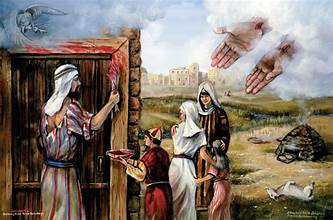
Candlemas, the celebration on which Groundhog Day is founded, is actually the day of the Baby Jesus’ presentation in the Temple (see Luke 2:22-40). Forty days after his birth, every first-born male child in Israel was to be presented at the temple, and a sacrifice was to be made for his redemption. This traces back to the Passover tradition, when the angel of death passed over the houses of the Jewish families who had painted their door frames with blood. Meanwhile, the first born sons (and animals) throughout Egypt were slaughtered. In this way, God showed His Power and His Mercy, leading Israel out of Egypt in triumph, while showing judgment on the Egyptians. (See Exodus 12).
History and tradition cast long shadows. The Jews had been slaves in Egypt for nearly 400 years. A new tradition helped them remember where they had come from and celebrate the promise that God would lead them to their own land. The Jewish people had kept this sacrificial tradition for centuries, reminding them of God’s mercy in saving their sons, and in redeeming them as a people from slavery in Egypt. Christians, realizing that this tradition “foreshadowed” the coming of Christ, adapted it into a new celebration. Christians celebrated Candlemas for centuries, remembering that Jesus was presented as OUR sacrifice, OUR redemption from Death into eternal Life Jesus came to be our Sacrifice, and also our Light.
But somewhere along the way, pagan beliefs and rituals were woven into the story of this day, until it has become “Groundhog Day.” Instead of the Lamb of God, we celebrate a common rodent. Somewhere in Pennsylvania (Punxsutawney), a small crowd gathers as someone lifts up a frightened groundhog and pronounces a weather prediction (one that is less than 50% accurate!) And everyone is looking for a shadow, instead of celebrating the Light.
The thing about shadows is that you cannot see them when you are looking INTO the light. You have to look away, turn around, look back, to see a shadow. Shadows are cast when something gets between the source of light and a flat surface. History casts shadows. Memories cast shadows. Sin casts a huge shadow. But Jesus is pure light. The Word of Life came to be a “lamp unto (our) feet and a light unto (our) path” (Psalm 119:105 KJV). We are meant to learn from the shadows of the past, but not to walk in them. We are to walk in the light, looking forward to the fulfillment of God’s promises, even as we celebrate the faithfulness of His past actions in the lives of others.
Light casts no shadow. But it banishes the darkness where shadows live. Our choices have consequences. We can turn away from the light, or step in opposition to the light, and cast shadows that may follow for generations–cycles of abuse, isolation, hatred, anger, or regrets. Or we can choose to follow the light, and banish the shadows of the past– bringing peace, repentance, reconciliation, and hope.
Heavenly Father, today, I pray that I will be a reflection of Your light in the world; that my actions would help banish shadows of doubt and despair, and shine with Your truth and hope for others to see. Where there are shadows in my life from the past, may I learn from them and leave them behind as I follow you more closely. Where I have cast shadows in the lives of others, help me to bring light and healing in Your name. Amen.





































 Pursuing Prayer