
The Right Side of History

My nation– and even my community–is divided right now. People argue, accuse, blame, and reject their neighbors because of political beliefs. And they defend the “rightness” and righteousness of their own beliefs–even when they must compromise on other beliefs and teachings of the Bible. Some people use the phrase “I’m on the right side of history..” or “History will prove us right.” And they cross their arms, jut out their chin, and stand smugly convinced that they have won the argument.

Photo by Vera Arsic on Pexels.com

But history books are written by human beings– and usually those human beings who are in power. “History” is constantly in flux– some things that were deemed “virtuous” or “necessary” in the past are looked on with horror today. Times change; societies change; customs and morals change.

Photo by Wallace Chuck on Pexels.com

When we justify our politics, or our actions to others in this way, we are really saying, “whatever I am doing, saying, or supporting today will be judged “righteous” by future generations. And that may be so. Those who advocated for the abolition of slavery in America over a century ago should surely qualify as people who were on the “right side of history.” Yet, in the past year of rioting across my country, many of the statues that were toppled, and spray-painted, and chiseled, and marred were of abolitionists. Their moral prowess notwithstanding, they were seen as “old, white men” in old-fashioned clothing, whose lives and legacies were long forgotten, or confused with other “old, white men” who had supported slavery during the same time period. We delight in “debunking” cherished histories, toppling our heroes, and rewriting traditions. And we often compare our “struggles” to those of previous generations, even if the comparisons are skewed or largely non-existent. And in our fight to push forward a particular narrative or policy; in order to “take back” a certain position or tradition, we often lose our moral compass, believing the lie that “the end justifies the means” or that “might makes right.”

Photo by RF._.studio on Pexels.com

In order to be on the “right side of history” today, people tend to make certain compromises– regardless of what “side” they choose. Political parties tend to support diverse causes and groups. Whatever good policies they promote, chances are they also promote policies and beliefs that are in direct conflict with scripture. Words like “compassionate,” “wholesome.” “traditional,” “patriotic”, “liberal,”and “progressive” may sound noble, but they often mask actions and policies that are corrupt, wicked, and destructive.

As Christians, we must be careful not to make “comfortable compromises” and to avoid righteous-sounding justifications. Just as importantly, we must be careful when confronted with labels and accusations, not to over-react or respond with bitterness or arrogance. If someone accuses me of being “hateful” or “gullible” because of my political beliefs, it is tempting to puff up and respond in kind. No one likes being judged. In fact, we are told in scripture NOT to judge, lest we be judged in kind. (Matthew 7:1-6) Jesus was often misunderstood, hated, falsely accused. He went to the cross after being found innocent by Pilate– who compromised by offering the Jewish people a choice of the innocent Jesus or the condemned Barabbas, instead of commanding that Jesus be released. In spite of his compromise, Pilate is not considered to be on the “right side of history” for his political masterpiece.
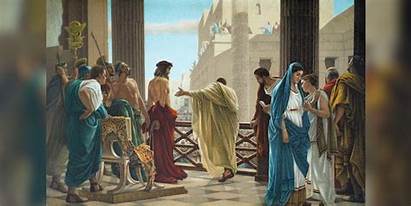
In fact– we are ALL on the WRONG side of of history! No matter how righteous our beliefs, ALL have sinned and fall short of the glory of God (Romans 3:23). Our allegiances, our morality, our political affiliations– none of them will save us from the just judgment of God, or the wavering judgments of future generations. We need, more than ever, to hold fast to the truth, and to seek God’s wisdom. When the final “history” is written, I want to be on God’s side!

Photo by Ray Bilcliff on Pexels.com

Daring to Dream

I’ve been reading about Joseph in Genesis. He was the favored son of Jacob (Israel), and he was a dreamer. His dreams were spectacularly unpopular with his older brothers, and got him into a world (or a well) of trouble. (See Genesis 37)

Joseph’s dreams were sent to him from God…they weren’t just wishes or imaginings. But they were grand. Joseph had a dream that all his brothers (represented by bales of wheat) bowed down to him. Later, he dreamed that his entire family would bow down to him. He was just 17, and full of the arrogance of youth. His jealous brothers were so outraged, they plotted to kill him. When an easier opportunity arose, they sold him into slavery, instead. (See Genesis 39-45)

Joseph’s dreams seemed to mock him when he arrived in Egypt as a slave. And after spending years building up a sterling reputation with his master, his dreams were dashed again. Falsely accused and unable to defend himself, Joseph ended up in prison. Who would ever bow down before a convict and a slave?

Photo by Jimmy Chan on Pexels.com

Joseph could have become bitter and angry. He could have given in to the frustration of serving those who were willing to let him do all the work and take on all the responsibility, while they got all the credit. But Joseph dared to dream– not the dreams of an arrogant 17-year-old, but the dreams of an honest and God-fearing man. He dreamed that his actions and attitudes mattered– even as a slave; even as a prisoner. He dreamed that God could and would rescue him and vindicate him. He dreamed that God had a purpose for his life– one that depended on Joseph being the best man he could be.

The Bible never records Joseph having visions and dreams in Egypt. But because Joseph had experienced grand dreams as a youth, he was sensitive to the dreams of others. He could have ignored the dreams of Pharaoh’s cup bearer and baker in prison. He could have sneered and laughed at their dreams. He could have told them all about his much grander dreams of old. Instead, he was ready to ask for God’s wisdom to help others interpret THEIR dreams. And in doing so, God gave Joseph the miracle of a dream fulfilled. Along the way, Joseph received life lessons in patience, humility, responsibility, management, integrity, and leadership. Joseph’s brothers–coming to seek grain!– bowed down to him, just as he had once dreamed they would. But they didn’t bow to him as a kid brother; they bowed before Pharaoh’s agent and the second-most powerful man in the entire known world. They bowed before a men who held the kind of power none of them had ever dreamed of. They bowed before a man they might have killed– except for God’s plan. Joseph was sent ahead, trained in the art of management, and perfectly placed to save thousands of lives.

Photo by The Lazy Artist Gallery on Pexels.com

Sometimes our lives seem like a waste– all our dreams have been shattered, either by circumstances or by our own bad choices. But God can take our most cherished dreams and redirect them into something amazing. He has a purpose for your life. It may not seem grand, like Joseph’s youthful dreams, but in God’s hands, it may have an enormous impact. Some days, it may seem like we’re living through a nightmare, but God writes the ending– and He’s already there!

Photo by Andrea Piacquadio on Pexels.com

El-Roi–The God Who Sees…

Do you ever feel invisible? One of the common complaints among depressed people is that they feel as if no one sees them. “No one would notice if I just disappeared..” “No one really notices me…I just fade into the background.” “I always get passed over; pushed aside; ignored…” “Everyone just seems to look right through me. It’s like I don’t even exist.”

Photo by Engin Akyurt on Pexels.com

In a world of 7.8 billion people, https://en.wikipedia.org/wiki/World_population#:~:text=In%20demographics%2C%20the%20world%20population,more%20to%20reach%207%20billion. it’s easy to see why someone might be tempted to feel that way. But it isn’t true. No one exists in a vacuum. Even when it feels like we are being ignored or dismissed or forgotten, someone is always watching.

Photo by Mike Chai on Pexels.com

Hundreds of years ago, Hagar, the slave girl of Abraham’s wife, Sarah, believed herself to be abandoned and alone. She had been used by her mistress as a pawn in a scheme to give Abraham a son. Hagar was able to do what Sarah could not (get pregnant by Abraham), and she let it go to her head. But she was still a slave. When Sarah complained to her husband, Abraham reminded her that she still had power over Hagar. Sarah used that power to mistreat Hagar, causing her to run away into the wilderness. But God was watching. The “angel of the Lord” not only saw Hagar– he found her beside a spring and called out to her by name. He asked why she was in the wilderness, and then gave her a promise– that her descendants would become too numerous to count! In response, she gave God a name– El-Roi– “the god who sees me.”

Photo by Pixabay on Pexels.com

The Bible is filled with stories of people–sometimes warriors and kings, but often ordinary, even lowly, people: slaves, younger siblings, nameless servants–who are seen and chosen by God for His Glory, to play a special role in history. God sees them all; He knows them all by name (even if their names are not recorded in the Bible!) He knows each person’s strengths and weaknesses; He knows everyone who will cross their path, how their story began, and how their story will end.

Photo by Ivandrei Pretorius on Pexels.com

We can take great comfort in knowing that God sees us. There is nothing hidden from Him– when we are slighted or mistreated; when we are the ones wronging others…He knows our thoughts and emotions. He knows our strengths and weaknesses (better than we know ourselves!) He understands– even when we don’t–what’s happening in and around us. God sees us exactly as we are– and He already knows all that we can become! Hagar could see that she was a pawn. She could see herself giving Abraham a child when Sarah had not. But God didn’t see her as “just” a slave girl or “just” a pregnant woman. He saw her her as a young woman in distress; as a woman with unique hopes and dreams, aches and disappointments; and as the ancestress of millions upon millions of people– unique people, each one loved and seen and known intimately by their creator. He saw her as someone worthy of being found and called and reassured. And even though God sent her back into a difficult situation, He kept His eyes on her, and came to her rescue again years later.

Photo by Pixabay on Pexels.com

On days when you feel invisible, or forgotten– when it seems that no one would notice your absence– remember Hagar’s experience with El-Roi– “The God who Sees.”

Blog at WordPress.com.

Up ↑