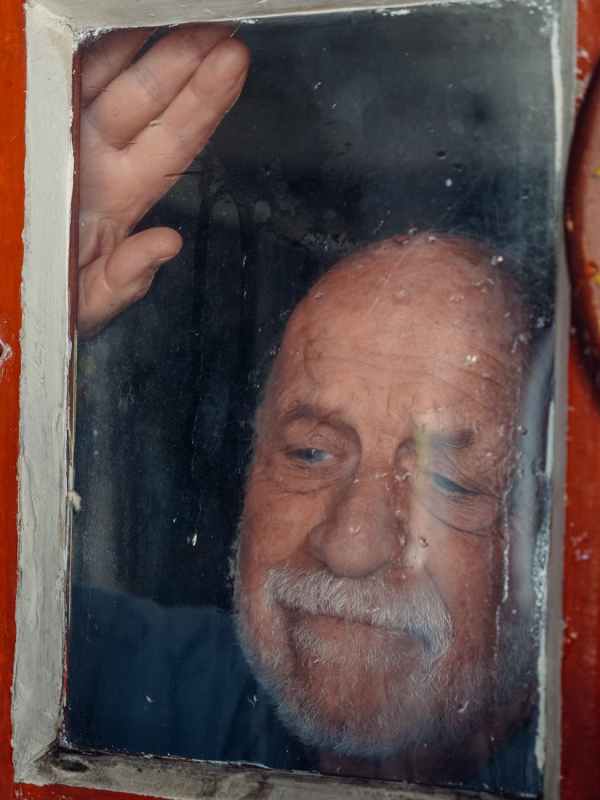
Look Up!


My faith looks up to Thee,
Thou Lamb of Calvary,
Savior divine!
Now hear me while I pray,
Take all my guilt away,
Oh, let me from this day
Be wholly Thine!
May Thy rich grace impart
Strength to my fainting heart,
My zeal inspire!
As Thou hast died for me,
Oh, may my love to Thee
Pure, warm, and changeless be,
A living fire!
While life’s dark maze I tread,
And griefs around me spread,
Be Thou my guide;
Bid darkness turn to day,
Wipe sorrow’s tears away,
Nor let me ever stray
From Thee aside.
When ends life’s transient dream,
When death’s cold, sullen stream
Shall o’er me roll;
Blest Savior, then in love,
Fear and distrust remove;
Oh, bear me safe above,
A ransomed soul!

Hymn lyrics by Ray Palmer 1830


 Therefore, since we are surrounded by such a great cloud of witnesses, let us throw off everything that hinders and the sin that so easily entangles. And let us run with perseverance the race marked out for us, fixing our eyes on Jesus, the pioneer and perfecter of faith. For the joy set before him he endured the cross, scorning its shame, and sat down at the right hand of the throne of God. Consider him who endured such opposition from sinners, so that you will not grow weary and lose heart.

Hebrews 12:1-3 New International Version (NIV)

When was the last time you spent a little time sky-gazing?  Looking up at the stars?  Or even looking up at ceiling tiles or roof lines?

Photo by rawpixel.com on Pexels.com

It turns out that the very act of looking up is good for your body, mind, and soul.  Looking down, on the other hand, can, over time, lead to neck and back problems, and contribute to depression.  (for more info, use a search engine to look up “health benefits of looking up” or click here: https://www.spine-health.com/blog/modern-spine-ailment-text-neck )

The author of Hebrews reminds us that we should be “fixing our eyes on Jesus” as we run the “race marked out for us”. This is more than just watching the road ahead or looking up at the sky.  We look up at Jesus because:

  • He is the Author and Finisher (the pioneer and perfecter) of our Faith.  Faith must be anchored…we will believe in something, or we’ll fall for anything, someone has said, and if we don’t make a choice to fix our eyes on Jesus, we will end up looking around or down for something else.
  • He is our guide.  Like a highway sign keeping us on the right road and keeping us from taking a wrong turn, we look to Him to stay on track.
  • He is our example.  In looking up to him, we are also learning how to live and endure and overcome.
  • He is our advocate and encouragement!  How much better will we run when we look up to see Him cheering us on!
  • He is our goal.  We run to Him, so we look up to see how close we are to running into His loving arms.

How Must I Pray for My Enemies?

We are commanded to pray for our enemies. This is not an easy command to understand, let alone follow. Should I pray for the destruction of my enemies? Or should I pray for their success? Surely, God doesn’t want me to pray that they will continue in evil or succeed in corruption and destruction. So where is the balance? What does God want from me?

I wish I had a simple answer, but I don’t. The Bible, however, gives us several examples and guidelines. There are things we should pray for, and things that we need to give over to God.

DO pray for the following:

  • Pray for the protection of your enemies– protection from their own folly, protection from the temptations and wiles of the enemy, etc.
  • Pray for them to choose repentance and accept God’s salvation through Jesus Christ.
  • Pray for their physical, emotional, and spiritual needs. Is your enemy hungry? Suffering from grief or loneliness? Do they have cancer? Are they blind to God’s Grace because they have followed false teachers or doctrines? Pray for their health in all areas and be willing to offer practical help when possible.
  • Pray for their families.
  • Forgive them–pray for the strength to forgive and to let go of any bitterness or resentment against them for past wrongs or current actions.
  • Pray that God will bring peaceful resolution–and be willing to do whatever you can within God’s will to help bring that about.
  • Pray that God will bring Justice–not personal revenge for you. Pray that God will, in His way and His timing, uphold what is righteous and wholly just.

DO NOT pray for:

  • Their destruction. If they are not following Christ, they are already on the road to destruction! Praying for their death, or physical harm is not Biblical. This does NOT mean that we cannot pray that their deception should be exposed, or their power over others for evil should not be stripped away. Remember, our “enemy” is not the person or persons involved, but the EVIL they represent. If you are tempted to pray for someone’s death or wishing them to get cancer or cheering on those who would hurt them, YOU are just as guilty of grieving the Holy Spirit as they are!
  • Their triumph. “Praying for your enemy” is not the same as cheering them on. Forgiving them is not the same as praying that they get a “free pass” on past behavior.
  • God to “make” them change. God desires that we choose to follow Him. Pray instead that God will bring opportunities for others to want to seek Him, and to choose repentance.
  • Them to apologize, grovel, or be humiliated so that you can feel better. God MAY cause any of those things to happen, but we should not demand our own importance over God’s Grace.

Along with these guidelines, we should remember that we must treat everyone with respect and love. But that doesn’t mean that we compromise on the truth. Many of “our” enemies are really in rebellion against God and His Word. We can continue to love and respect their humanity and their need for compassion without condoning their behavior or accepting as valid their false narratives.

David spares Saul’s life in the cave (1 Samuel 24)

King David often prayed about his enemies. And some of his prayers may seem like the ones on the DO NOT list above. David often prayed that his enemies would be vanquished; that their names would be blotted out, or that they would fall victim to their own traps. But David also refused to harm his arch-enemy King Saul. Though God had promised that the kingdom would be taken from Saul and given to him, David refused to kill one who had been anointed as king of Israel (see 1 Samuel chapters 24 and 26). David killed many men in battle, and he committed murder in ordering the death of Uriah, but he showed kindness to Saul’s family, rather than punishing them (2 Samuel 9). God punished David for murder, but He blessed David for showing compassion to his enemies.

Jesus prayed for His disciples– that they would grow in Love and Grace. He instructed them to pray for those who have hurt them (Matthew 5:43-48). He never prayed for the destruction of the Pharisees or the Roman oppressors who caused so much suffering in Judea. Instead, he healed the son of the Roman official (see John 4:46-54) who asked for help. Even when the mob came to arrest Jesus in the garden before His crucifixion, He healed the ear of the soldier, after Peter cut it off trying to defend Him. And on the Cross, Jesus prayed that the father would “forgive them, for they know not what they do” (Luke 23:34)

Stephen, as he was being stoned, prayed for the forgiveness of his killers. Saul, who became the Apostle Paul, would have heard this prayer as he stood guarding the coats of the assassins. Throughout the epistles, we are reminded to pray for our enemies, AND to do our best to live in peace with them. (Romans 12:18; 1 Timothy 2:1-3; see also 2 Peter 3:9)

It is very tempting to want God to step in and do what we want– bring instant justice and punishment to those who harm us. But that is NOT God’s will. It IS His will that we should trust HIM to bring about true justice and to bring others to repentance. Including our “enemies.”

Full Disclosure

I like to know things–I like to solve puzzles, figure out mysteries, learn trivial facts.  I want answers.  So when I go before God in prayer, I often ask questions.  Why is this person suffering?  When will their suffering end, and how?  Where were you in this disaster (as though God had stepped out for a minute and wasn’t aware of what happened)?

silhouette of fireman holding hose

God stays silent.

I can grow frustrated in the silence or I can learn to trust.  That doesn’t mean that I no longer want answers; just that I am willing to wait on God’s sovereign timing.  It also means that I am need to more about God’s nature–God doesn’t keep secrets or withhold knowledge because He wants to torment me, or frustrate me, or play some cosmic mind game (though some people accuse Him of doing just that).  God withholds full disclosure of His plans, His reasoning, and His nature out of love and compassion.  Suppose I could see into the future, even give out warnings, but had no power to stop disaster from coming.  Not only would I be haunted by the disaster itself, but by the full knowledge of its coming.  Suppose I could see a miracle in advance; know when and how it would unfold.  There would still be joy, but it would be muted by the foreknowledge– of course there would be a happy ending; of course there would be a miracle– I saw it all from afar off.

photo of person holding ball

The Apostle Paul touches on this in 1 Corinthians, chapter 13.  This is commonly known as the “Love Chapter”, and the first half is frequently quoted at weddings and church sermons.  But the end of the chapter is a wonderful message of hope and faith, ending with Paul’s triumphant statement about all three:

1 Corinthians 13:8-13 English Standard Version (ESV)

Love never ends. As for prophecies, they will pass away; as for tongues, they will cease; as for knowledge, it will pass away. For we know in part and we prophesy in part, 10 but when the perfect comes, the partial will pass away. 11 When I was a child, I spoke like a child, I thought like a child, I reasoned like a child. When I became a man, I gave up childish ways. 12 For now we see in a mirror dimly, but then face to face. Now I know in part; then I shall know fully, even as I have been fully known.

13 So now faith, hope, and love abide, these three; but the greatest of these is love.

monochrome photography of a man looking in front of mirror

God loves us with a perfect love.  Because of that, I can trust Him, and have hope in the midst of my questioning.  So when I pray with questions, I can know that God has “filed them away”– He is fully aware of my situation, questions and all, and He is fully faithful to answer them all in His perfect wisdom and timing.  Someday, I will know– not only all that I don’t know now, but why I had to wait.

God will provide full disclosure. with compassion, love, and wisdom that only He can give.

What if?

What if–
I say the wrong thing, and ruin someone’s day?
Or perhaps I get lost and lose my way?

What if–
I get bad news about my health
Or suddenly lose all my worldly wealth?

What if–
Friends turn to foes this week?
What if I can’t find the peace that I seek?

But

What if–
I take it to the Lord in prayer?
Bring Him every question and care?

What if–
God prevented that unseen wreck;
Stopped me from falling and breaking my neck?

What if–
God saw the looming temptation
And removed me from the situation?

How many times had God stepped in
And quietly saved me from the effects of Sin?

And when He hasn’t–do I really know
If my life would be better if God never said, “No!”

What if–
I trusted and always gave praise
When God’s answers reveal His mysterious ways?

What if–
I ask and seek and knock,
Knowing my God is the Eternal Rock?
Knowing that God hears, and cares, and sees
Much more than I do when I’m down on my knees.

“..casting all your anxieties on him, because he cares for you.” 1 Peter 5:7 (ESV)

“Seeing” Answered Prayer

God always hears our prayers. He always has an answer. But it isn’t always the answer we expect. Sometimes, God answers, “No,” or “Not yet.” Sometimes, He answers in ways that seem confusing and mysterious, and even ironic.

I remember as a young teen praying for a woman in the community who had lymphoma. In treating her condition, the doctors, trying a new experimental treatment, did permanent damage to certain muscles, leading to a progressively debilitating condition. She died a slow and painful death, unrelated to her original condition. Where was God? How could He listen to our prayers and give such a cold, cruel answer?

But God sees a bigger picture than we do. This precious woman had incredible faith and grit. She had spent years working diligently to help others and teach God’s Word. She continued her work, even in the midst of her health struggles almost to the end of her life. What might have caused some people to turn their backs on God made her more dependent on His Grace. She faced her pain and weakness with grit, strength, and hope in God’s eternal healing. God’s answer wasn’t to rescue her from the suffering, but to be present in it with her. And her example lives on to this day.

Some people would read about this and be dismissive. What a cop-out! What a delusion! But there is much more to her story than her own condition or even her response. One of the men in our church really struggled with God’s seeming indifference. He wrestled with his own faith for many months while watching her get weaker and weaker. But through his struggle, he grew in his conviction that God was present in every situation. He was inspired to do short-term mission work, partly as a result of this growth. Knowing that God would be with him, he threw himself into loving people from a different culture–different climate, different language, different work ethic– and helped build churches and other facilities for those in need. Many people were helped, inspired, and encouraged because of his dependence on God– a dependence enhanced by facing his own questions and doubts.

Family members and community members, watching her struggles, were inspired to pick up where she left off– working and teaching and reaching out to others with zeal and joy–following her marvelous example. Today, some of her family members are leaders in their churches, raising the next generations of witnesses to God’s mercy and power. Doctors, having failed in her treatment, learned from it– a difficult lesson for all, but a lesson, nonetheless. Her joyful attitude (before and during her struggles) inspired me to direct the Vacation Bible School program at our church for a few years, and to teach Sunday School when I moved to a new location. And those are just a few of the ways I have “seen” God’s answers to our prayers. God did not give our friend the physical healing we wanted. But her struggles– and her response of faith and perseverance–inspired a ripple effect far beyond her own pain and disappointment. And she has received the ultimate healing! Her pain, intense and unjust as it was, was only temporary. Her life, her legacy, her joy– they all live on!

How often do we look at a situation and think we know what is “best?” How often do we feel that God’s answers are “wrong?” Wrong timing, wrong outcome, full of hardship or pain– how can this be God’s “perfect” will for us? There was nothing about this woman’s situation that was comfortable; no reason to see a good outcome for her or her immediate family. She died. She experienced pain, with no earthly justice. Her suffering was undeserved and unmitigated. She refused to sue the hospital or the doctors– she wanted them to be able to continue to learn from her experience so they could help others NOT to suffer in the future. But her life was shortened and made grueling in the process, and she received no payout, no financial compensation, no symbolic reparation for her sacrifice. We received no “miraculous” answer to our prayers. It seemed at the time that the more we prayed for healing, the worse her condition became. We continued to pray anyway, knowing that God DID hear us, and God’s ways were not our ways– they are always better. Even when His ways seem like silence.

This all happened several decades ago, and many of the “answers” from our urgent prayers are still hidden from our eyes. Many of our questions remain unanswered. But God’s will is still active, even in these tragic circumstances. Someday in Heaven, it may be revealed to us exactly how God used this woman’s life and struggles to bring about blessings to hundreds of other people– causing them to grow strong through her weakness, drawing them to His healing and wisdom in a world of pain and confusion.

I have lost many friends to cancer. I pray for each one, and the outcomes are never exactly the same. Some go into remission, only to have the cancer return three or four years later. Others get amazing healing– surgeons are astonished and perplexed by the rapid or miraculous disappearance of cancer cells. Some go into fast decline and die almost immediately after their diagnoses. And each situation impacts people in different ways, showing God’s power and presence for those who are willing to look for them. Prayer isn’t a magic formula for immediate and total healing. Prayer is lifting up a situation that is beyond our control or understanding and trusting that God has a perfect plan beyond what we can see or understand. Cancer cannot take God by surprise. Death cannot outwit or overpower God. We live in a world where Evil can overwhelm us; our bodies can betray us; our future can be lost in the fog of uncertainty and suffering. But God is present– not only IN our suffering, but ABOVE and BEYOND our suffering.

We don’t pray for our friends and loved ones to suffer. We want them to be healed, to be free of pain and grief; to be at ease and blessed with abundance. This is normal; it is good. God wants to bless us. It doesn’t bring Him joy to watch us suffer. But He also wants us to see the blessing of His presence, His wisdom, and His power. Sometimes, we can’t see that as we look around. Sometimes, we need to look up! Even from a hospital bed (see John, chapter 9). Even from the flames of suffering (see Daniel, chapter 3). Or from the belly of a whale (see Jonah, chapter 2). And we will find that God is there.

Too Proud to Pray About It

I had a small habit.
Not a horrible addiction,
Or a life-threatening compulsion.
Just a little thing.
No need to pray about it…

I had a toothache.
Just a small one.
I made a dental appointment.
No need to pray about it…

My boss was giving me a hard time–
She “had it out for me.”
She was wrong, of course.
Everyone else said so.
No need to pray about it…

Finances were tight last month.
We were just a few dollars short.
No big deal.
Some bills were paid a little late.
No need to pray about it…

My son is having a hard time at school.
There’s a bully in his class.
I spoke to the teacher.
I gave him advice.
I told him all about the bullies I had faced.
Bullies I had dealt with and overcome.
No need to pray about it…

“Pray without ceasing.” (1 Thessalonians 5:17)
“Cast all your anxiety on him because he cares for you.” (1 Peter 5:7)
 “Do not be anxious about anything, but in every situation, by prayer and petition, with thanksgiving, present your requests to God.” (Philippians 4:6)
“Look to the Lord and His strength: seek His face always.” (1 Chronicles 16:11)
“May my prayer be set before you like incense; may the lifting up of my hands be like the evening sacrifice.” (Psalm 141:2)

God is not so far away
That He does not know my every need.
The “small” things I keep from Him
Keep me from seeing
Just how close He really is…

“For though the Lord is high, he regards the lowly,
    but the haughty he knows from afar.” (Psalm 138:6)

Prayers From the Cockpit

Years ago, a decorated fighter pilot, Robert Scott, wrote a book with the title, “God is My Co-Pilot.”  It was made into a movie, and the title became a  popular phrase for bumper stickers, posters, and more.

Theatrical trailer for “God Is My Co-Pilot” –youtube

More recently, there have been several people who have spoken out against the catch-phrase, by saying something to the effect of ,”If God is your co-pilot, someone is sitting in the wrong seat!”  I mean no disrespect to Mr. Scott, the book, the movie, the bumper stickers or even the critics, but I think both sentiments kind of miss the point.

There is a much better analogy in the title of an lesser-known book by another pilot.  Pilot and high school basketball coach Floyd Eby wrote a book called “Calling God’s Tower– Come In, Please.”

51pdlJsYI0L._SX325_BO1,204,203,200_

I’m not a pilot or a coach, and I’m not claiming that Scott’s title is bad, or that Eby’s book is “better.”  Certainly, when I pray, I believe that God is always right beside me, that he hears me, and that he knows my thoughts and my heart intimately.  I think that is the intent of the co-pilot analogy, and as such, it rings true.  But God is much more than a partner, a co-pilot, or a colleague.  The danger of this thinking is that we take God for granted.  If God is my co-pilot, I won’t turn to him for help unless something is going wrong and “my way” isn’t working.

“I am the vine; you are the branches. The one who remains in me and I in him produces much fruit, because you can do nothing without me.” (John 15:5 CSB)

So what about “switching seats?”  Shouldn’t God be my pilot?  He is God and I’m not.  It is true that this represents a better view of God’s authority and sovereignty.   It is also true that God is greater, stronger, and wiser than I am.  But I think this view, though more accurate in portraying our position, gives rise to another dangerous idea– that I can sit back and be little more than a passenger, while God does all the flying.  One of the valid criticisms of modern Christianity (especially in America), is that we know about Christ, and talk about Christ, but we don’t always live for Christ.  We see the finished work of Christ as an excuse to sit back, smug and complacent about morality, evangelism, obedience, and good works.  We shout, “Jesus Paid it All!” and mumble “All to Him I Owe.”  We want to sit in the cockpit for the pretty view, but we don’t want to learn how to fly the plane.

 I know how to be brought low, and I know how to abound. In any and every circumstance, I have learned the secret of facing plenty and hunger, abundance and need. I can do all things through him who strengthens me.” Philippians 4:12-13

God has given us the privilege and the responsibility to be the pilots (or drivers, or captains) of our lives–He gives us the free will to make choices and steer our behavior or actions.  We are not helpless passengers on a fatalistic trip through this life.  He has equipped us to know the thrill of soaring and banking and flying through the clouds.  But God doesn’t leave us to fly blindly through the haze and clouds and glare.  He gives us his word, which, like a map, chart, instrument panel, or GPS system, shows us where and how we should go.  And, like the air control tower, he gives extra guidance, listens to our needs, and provides assurance as we stay tuned to him.

God also sees and knows more than we do in our cockpit.  When I’m “calling God’s Tower”, he knows all that goes on above and below, ahead and behind– he knows about the storms in the distance or the other planes scheduled to arrive or take off from the airport.  I can trust his advice, his commands, and his presence more than my own judgment or eyesight.

I want to learn how to fly; I want to soar like an eagle, and I want to come in for a safe landing at the end of my journey.  I need to keep in constant contact with God’s tower and follow His wise flight plan.

landscape-aircraft-clouds-storm-38574.jpeg


“Little” Prayers

I was challenged the other day by someone who suggested that my prayers are “too little.” Well, not precisely “my” prayers– I head up a small prayer group at church, and we pray for people in our congregation and our community. We keep a running list of people who are suffering from various health issues or housing issues, relationship issues, etc. We also pray for our church staff, for missionaries that our church supports, for upcoming ministry opportunities and programs, and other seemingly “small” requests. These are posted on a list and shared with some of our church members who are shut in or who want to lift up their neighbors in very specific ways.

I don’t think this person meant to be insulting but I see our prayer group quite differently. These “little” prayers are heartfelt, and I believe they reflect the heart of our Savior. Yes, Jesus offered salvation through His death and resurrection to “whosoever believeth” (John 3:16) throughout all the ages, but in His ministry, Jesus was extremely personal and intimate. Among His disciples, Jesus taught them to ask for “our daily bread” and for simple forgiveness as “we forgive” those who have hurt us. (Matthew 6:9-13) And I think our prayer group reflects that aspect of prayer. So, even though our list may seem “small” as we pray for Ned’s pneumonia, or Clarice’s upcoming CAT scan, next week’s teen outing, or Chris’s continuing housing issue, it is also showing compassion and worth to each individual, sharing in their “burdens” (Galatians 6:2) because God loves each of us without condition or limit!

On the other hand, I think I know what this individual was trying to convey. We are also called to pray “big” prayers. Jesus encouraged His disciples to have “big” faith– the kind that moves mountains (see Matthew 17:20– although Jesus says that even faith as small as a mustard seed can result in this kind of answer!) “Little” prayers can be the result of “little” faith. We pray for God to intervene in ordinary things without asking Him to unleash His power and majesty. God is able to do infinitely more than we ask or imagine (Ephesians 3:19-20) through the power of Christ in us! So are we tapping into that promise, or limiting our prayers to what we think God might do on a small scale?

I don’t think our prayer group is doing this at all. We often pray for peace in the Middle East and in other war-torn regions. We pray that the spirits of Anger, Lust, Deception, and Rebellion will be bound and that the eyes of the lost will be opened; that hearts will be softened toward the Gospel, and that our brothers and sisters facing persecution will be, strengthened, emboldened, and protected/rescued. We pray for Revival and renewal across nations and continents. And we pray that in these “little” situations, God’s love, wisdom, and power will be shown clearly– even to those who deny His existence.

Prayer is a huge topic, and a lifelong pursuit. I was challenged by this comment the other day to look closely at how our group functions; at how I present prayer each week; at how we perceive the calling and responsibility of prayer. In the Proverbs, we are told that “As iron sharpens iron, so one person sharpens another.” (Proverbs 27:17) Comments like the one that challenged me the other day are golden opportunities to learn, review, and grow in our daily pursuit. The Church is strengthened when we allow for each member to speak– especially if it stretches our view of things we take for granted!

I don’t believe there are any prayers that are “too little” to bring to God– He delights in our smallest steps of Faith; in our complete and simple dependence on Him. But I also don’t believe that our prayers can or should be limited by the mundane and ordinary. We should come boldly to the throne of Grace– not because of who we are or what we’ve done, but because of the Awesomeness and perfect Sufficiency of the God we serve!

“Praying” Favorites

There is a very dangerous mindset that many Christians fall into– that somehow, God has “favorites” among His children. That He listens to and answers prayer for certain people “better” or more often than others. As someone who has pursued a lifestyle of prayer for more than fifty years, I can categorically state that this is false. Time after time, the Bible teaches us that God does NOT play favorites. He listens to each of us and loves each of us with a boundless and eternal Love!

Yet, I often hear people say, “Please pray for me. You are a prayer warrior. God will listen to you.” Is this wrong? Is it wrong to ask others to pray for us?

Of course not. And it is good to find other Christians who are devoted to praying for others. We ARE “prayer warriors!” But that doesn’t mean that God listens to any of us more than anyone else, or that some prayers are somehow better or more powerful than others.

There are three aspects of this mindset that I think are particularly dangerous:

First– we can feel that our prayers are not important; that they are not “good enough.” Satan loves to have us wallow in our inadequacies and focus on our faults and shortcomings. Maybe I have trouble finding the “right” words when I pray. Maybe I don’t feel comfortable praying aloud in a group. And I hear someone else who sounds eloquent and polished. While that may impress or intimidate me, it cannot make a difference to God! NONE of us is “good enough” to impress God! He loves to hear from each unique and precious child! If we believe that God somehow has “favorites” in prayer, we will believe that He has favorites in other areas, too. That our gifts aren’t as “holy” as someone else’s, or that our faith depends on us working harder or doing “more.” And this is idolatry–saying that God’s grace is not sufficient for Him to accept us and bless us without some extra effort on our part.

Secondly– we can feel that prayer is for “other” people. If there are special people whose prayer lives are strong, then we can let them do the “heavy lifting” of praying, while we concentrate on giving or preaching, etc.. We SHOULD develop the particular gifts that God has given us– that is true– but prayer, just like spending time in worship, studying God’s word, practicing fellowship, and showing grace, is something everyone should be practicing. The Apostle Paul compared the Christian life to being an athlete or a soldier. We are ALL in training and part of a team. Prayer is not specialized training– it is basic and fundamental to the Christian Walk.

Finally–“Prayer Warriors” are fellow workers, not specialized saints. Some people practice prayer because they have more time to do so. Many of those who are considered “prayer warriors” are widows or widowers, retired, or even bedridden. Many of us are prayer warriors for a season. When we believe that God has “favorites” in prayer, we may elevate them beyond what we should. Once again, Satan loves to have us compare ourselves with others, rather than focus on how we can each serve God.

There are some Bible verses that speak to this, and many of them, taken out of context, can reinforce the wrong mindset. For example: James 5:16 says that the “fervent effectual prayer of a righteous man availeth much.” But the context is that of people praying for one another, not a single man doing the praying. It says more about passionate and persistent prayer than any identity as a prayer warrior among other “lesser” pray-ers.

First John 5:14 says, “This is the confidence we have in approaching God: that if we ask anything according to his will, he hears us.” That applies to any of us!

“The Lord is near to all who call on him,
to all who call on him in truth.” Psalm 145:18

“Call to me and I will answer you and tell you great and unsearchable things you do not know.” Jeremiah 33:3

“Let us then approach God’s throne of grace with confidence, so that we may receive mercy and find grace to help us in our time of need.” Hebrews 4:16

“But when you ask, you must believe and not doubt, because the one who doubts is like a wave of the sea, blown and tossed by the wind.” James 1:6

“If you believe, you will receive whatever you ask for in prayer.” Matthew 21:22

There are only two things that the Bible says about “better” or more effective prayers. We must pray in FAITH, and in OBEDIENCE, (or praying within the will of God). NOTHING else is required for God to listen and respond. We are all “prayer warriors.” Prayer is part of our warfare against the enemy. And while it is wonderful to come together and know that others are praying for you, it is also important to remember that God has no favorites. His Grace, Power, Protection, and Love are equally available to anyone who asks in faith! There may be millions of pray-ers, but only one Sovereign, All-Powerful, Majestic and Loving God!

The Weight of Prayer

Have you ever carried a burden that just got heavier each minute? Some pressing need, or a load of guilt and shame, or an unresolved issue that has been hanging over you for years with no relief. Sometimes, prayer is very heavy. It is a sacrifice, and a burden to keep praying for an unsaved loved one, or to fully confess the shame you have carried for years. Your needs (or the needs of loved ones) can push down on your spirit and make it difficult to even want to pray. Pain, grief, or persecution can cause you to shrivel up inside and even though you want to pray, you just can’t seem to find the words.

But oh! The relief of carrying our burdens to the throne of Grace! God may not give us immediate relief from the burdens of pain and suffering, but He will come alongside and shoulder a God-sized portion of our load. He has promised this. Jesus Himself said, “Come to me, all you who are weary and burdened, and I will give you rest. Take my yoke upon you and learn from me, for I am gentle and humble in heart, and you will find rest for your souls.  For my yoke is easy and my burden is light.” (Matthew 11:28-30 NIV)

Not only will God come alongside us as a result of prayer, His Spirit will help us in our weakness and inability to express our deepest emotions. “Likewise the Spirit helps us in our weakness. For we do not know what to pray for as we ought, but the Spirit himself intercedes for us with groanings too deep for words. And he who searches hearts knows what is the mind of the Spirit, because the Spirit intercedes for the saints according to the will of God.” (Romans 8: 26-7 ESV)

I have found this to be true through experience. And I have also found great relief when I can share my burdens with other Christians and know that they are praying for me and for my loved ones. One of the greatest burdens we can bear is that of isolation and hopelessness. Finding a trusted group of fellow believers can ease the pain of bearing such burdens alone. Often, Christian friends can offer limited practical help for immediate needs or provide counseling and wisdom in our next steps. Two words of warning– no group of friends, even Christian friends, can substitute for God. Friendship should not substitute for prayer and Godly wisdom. And true friends will always point you to God rather than trying to fix everything in their own power and time frame. A true friend will not only share the “weight” of your burden, but also the “wait” for God’s answer! Secondly, “sharing” is not the same as rehearsing the same guilty secrets over and over for attention, shock value, or entertainment. It is not gossiping about the same horrible boss or nosy neighbor you can’t seem to forgive or lamenting over all the things you might have done differently as a parent (or spouse or co-worker) last week.

Prayer is deep. It is heavy. And it is powerful. But it can also be freeing, removing the burden of worry, shame, guilt, and isolation. We may enter prayer with groaning and exit with praise! God inhabits our prayers! He is with us in the groaning and in the struggle. He sends us friends and “angels unaware.” And He remains with us in victorious celebration. He provides comfort, strength, and peace as we lay our burdens down. He provides companionship, help, and hope as He shares the weight of whatever we bring to Him.

Don’t “wait” to share your burdens. Let God do the heavy lifting!

Blog at WordPress.com.

Up ↑