Snow has been falling in earnest lately in our area– sometimes wet and heavy blobs, unsure of their status as liquid or solid; other times cold and wispy flakes, hovering and swirling in the frosty air, shimmering as they catch the light of street lamps, headlights, and even moonlight. Snow has coated limbs and branches of trees, and painted iron fences and rooftops white against the leaden skies.
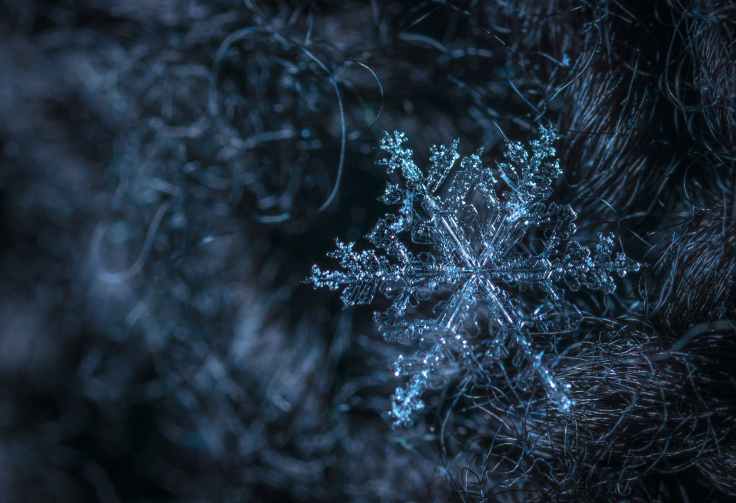
We learn as children that each flake of snow is unique– no two are alike among all the hundreds of millions of flakes that fall. And just so, we are also taught, no two people are exactly alike. Each of us is unique.
God himself underscores this analogy in the book of Job, when He describes rain, dew, frost, and ice:
28 “Has the rain a father, or who has begotten the drops of dew? 29 From whose womb did the ice come forth, and who has given birth to the frost of heaven? 30 The waters become hard like stone, and the face of the deep is frozen.
Job 38:28-30 (ESV)
Just as each drop of water, each snow flake, each bit of frost is unique, so are we. And so should be our prayers–millions of voices and hearts raised to our Father in praise, petition, repentance, supplication, worship, adoration–trembling or triumphant– each as unique in our needs and utterances as the beautiful snowflakes dancing and skittering around in the moonlight. No two of us are alike, yet together we fill the empty night with wonder and give honor to our creator by being who we were created to be.
As we pray today, let us remember to be grateful for our uniqueness– celebrate God’s artistry by being fully ourselves and celebrating the uniqueness of the others around us.
My father was color-blind. He could distinguish the color red, but all other colors registered as shades of gray. Certain forms of colorblindness are treatable today, but Dad went through his whole life not seeing most colors. He knew the sky as light or dark, not piercing blue or deep blue or sunset indigo. He even told people his eyes were brown, because he couldn’t see how startlingly, wonderfully blue they were. He was cautious about getting dressed for events and such, worried that he would “clash.” He generally preferred neutrals. He liked that his company provided uniforms– it was much easier that way.
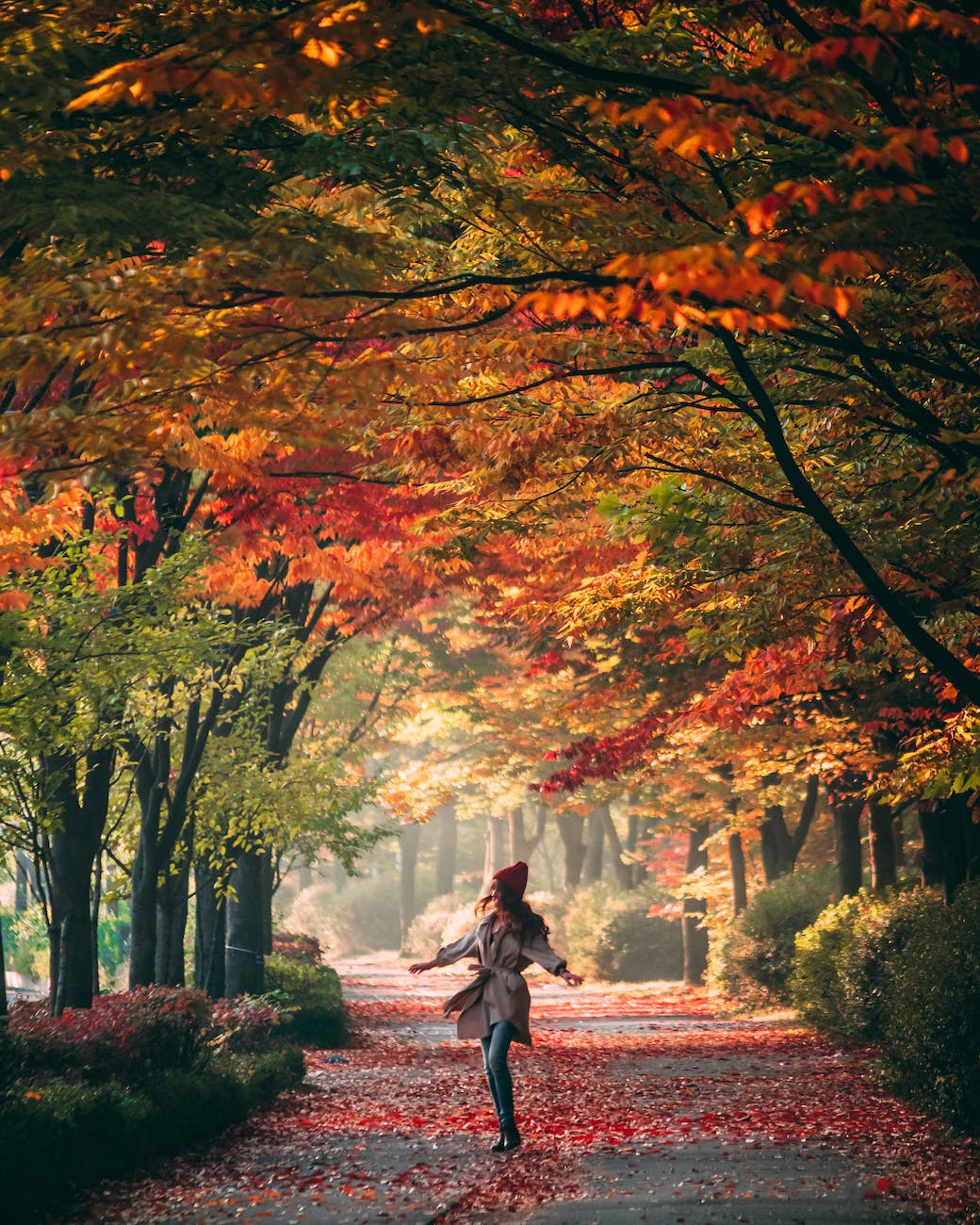
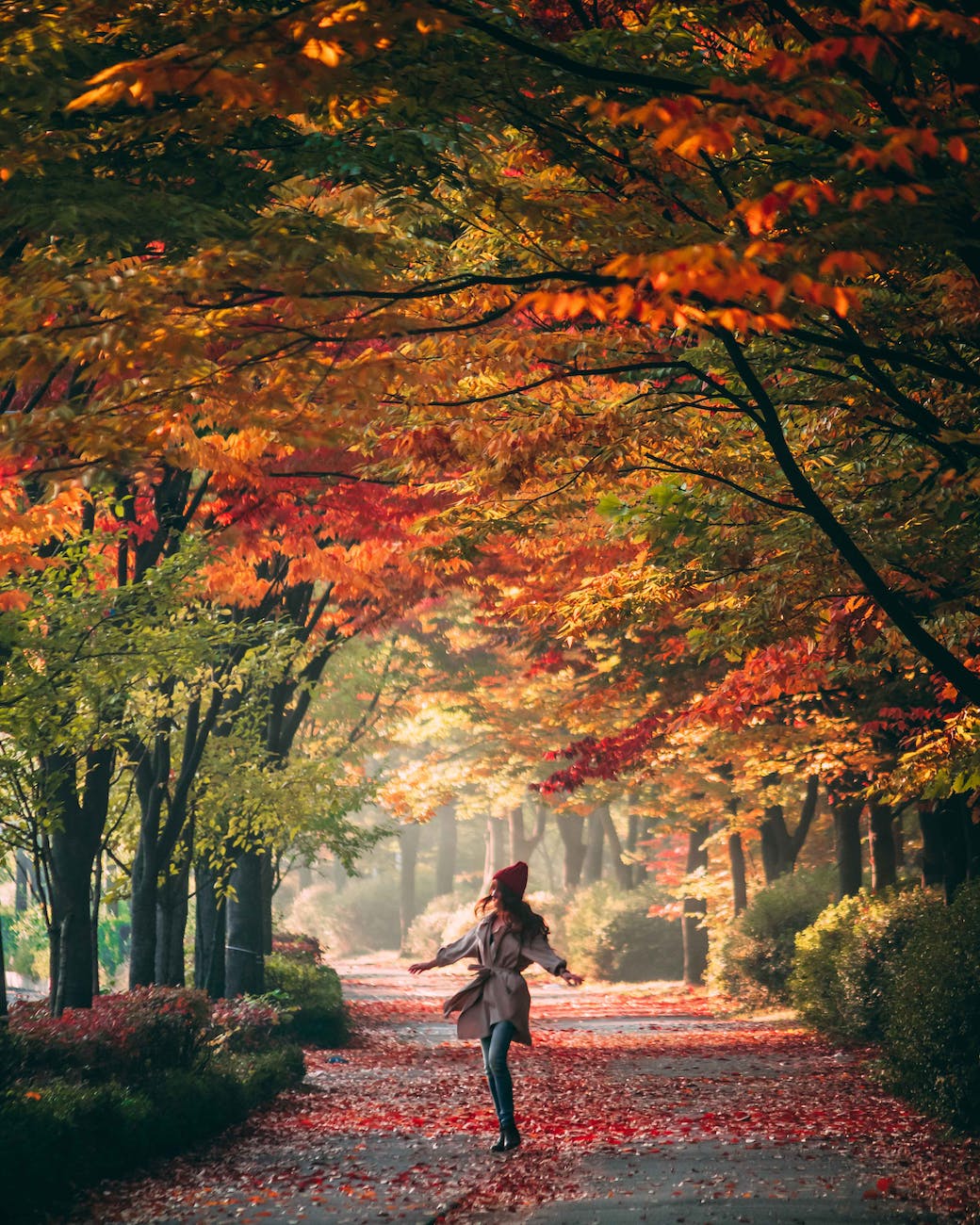
As I write this, I am looking out the window at a cornucopia of colors on the autumn trees– glowing shades of orange, deep reds, bright yellows, a few dark browns, and even some leaves still vibrant green. Autumn has come late this year, and the cold weather will bleed all the colors and cause the leaves to fall into a single great carpet (except where rakes gather them up into piles). It is marvelous to see so much variety in the individual trees; so much color and life, and beauty. God loves color! He loves to dazzle with surprising touches of unique shades, designs, and combinations. Towering trees with golden leaves, shorter, squat bushes with fiery reds, evergreens providing contrast. And in a few weeks, it will all be a memory, as leaves give way to snow-covered branches, and ice-trimmed bushes.
It made me think of the marvelous variety of people in our world. Each one unique, beautiful, and precious in God’s eyes. We tend to waste so much of our time comparing ourselves to others. Sometimes we wish we were like “them”– taller or darker, blue-eyed, or thinner, with hair that is curlier or blonder or just different from what God created. We feel that our bodies are “not good enough,” or not “right.” We long to be something else; someone else. At other times, we judge others by similarly narrow standards. “They” don’t look like us; they are “not good enough,” or “inferior” in some way. Of course, we don’t like to admit to any hint of bigotry or prejudice. We like to say that we are “color-blind” when it comes to people.
But God is not color-blind. He is deeply away of all the genetic differences in our skin and eyes and hair; all the high cheekbones and stubby fingers and freckles that are passed from generation to generation in some of our families. And God approves! God loves us all the same– lavishly, intimately, eternally! Just like the colors on the trees, God delights in our variety and differences– our “crooked” teeth; our “large” noses, our “mousey” brown hair, our “wide” hips. After all– He planned each one! He designed each of us to be who we are–from our bodies to our talents to our personalities. And someday, in Heaven, we will all be as one–not divided or obsessed with our “deficiencies” or differences, but united in our love and worship as never before– a great carpet of redeemed souls, spread around the Throne of God!
God isn’t color-blind; and neither should we be. We should celebrate each other, encourage each other, and love each other for who God made us to be. Sometimes, that can be difficult in our fallen world. Hurting people, fearful people, angry people– they may not be easy to love. They may judge us, reject us, even persecute us unfairly. But that’s not God’s original intention or purpose. We were meant to add our own unique beauty to an equally beautiful world.
Let’s pray that God would teach us how to show our “true colors” to the world, and reflect the beauty He planted in each one of us today!
My first name, Lila, is not unique, but it is uncommon. Last week, when my husband and I got away for a few days for our anniversary, we visited a gift shop. I was excited to see a magnet with my name on it, so I bought it (though we don’t need any more kitchen magnets, and it was more than I would normally spend on such a trinket). My husband, David, on the other hand, has the opposite experience. He can be in a room with 20 people, and if someone calls out, “Hey, Dave,” sometimes three people will answer! He can find trinkets that say, “David,” “Dave,” and “Davey” almost anywhere.
Names can be funny that way. Almost everyone knows how to pronounce my husband’s name. And spell it. It’s a good name, a strong name– that’s one reason it’s so popular. My name is shorter by one letter, but almost no one spells it correctly– I’ve seen it spelled Lyla, Lilah, Laila, Leila, and Lily; and I’ve heard it pronounced Lee-la, Lay-la, Lill-a, as well as just misread completely as Lisa, Lilian, Lina, Lenore, Delilah, Lora, Mila…
Both David and I were named after other members of our families, and we have nieces, nephews, and cousins named David or Lila, as well. Our names have personal and family importance beyond just the normal meanings. Still, somewhere in the world, there are dozens of people who bear the same name (first, middle, and last) as my husband, while there may be one other who bears my same name.
God knows my name. He never misspells it, never mangles the pronunciation or gets me confused with someone else. And he knows “my” David, and never gets him confused with someone else or lumps him in with a group of other “Davids”. God knows why David and I were named as we were, and He knew the family members after whom we were named. He knows the names of our yet-unborn great-great-great grandchildren!
Jesus had twelve disciples. The Bible records that two of them were named James, two were named Simon, and two others were possibly named Judas. Jesus gave one of the “Simons” the new name of Peter’ the other was also known as “Simon the Zealot”. The two James were distinguished as “the elder” and “the younger” or “James the brother of John, and son of Zebedee” and “James the son of Alpheus.” Judas Iscariot was the disciple who betrayed Jesus to the authorities; there was another disciple, who went by the name Jude, or Thaddeus, or Judas the brother of James. Historians know little about “the other Judas”, and even the authors of the Gospels give different lists of names for the twelve disciples, given that some of them went by more than one name. However, Jesus knew each one from before they were even born.
Of course, God knows far more than just our names. He knows our every thought– before we even think it! God “gets” us–for better or worse. He knows our quirks and our capabilities. He knows our deepest shame, and our deepest fear; our greatest accomplishment and our most secret desire. Even more, God knows our future; He knows all that we could be and all that we will become (or fail to become). He knows “what might have been” if we had been born in a different time or place. He knows exactly how our decisions have affected us for good or ill, and how others’ actions have impacted our character.
There are nearly 8 billion people alive on this planet at the current time (7.9 billion estimated as of September 2021). God knows the name and dreams and histories of each and every one! And when we pray, we are not praying to someone whose knowledge of us is limited or determined by our relation to someone He knows “better.” Imagine God having 8 billion kitchen magnets with names on each one–even if there were 100,000,000 of them with the name “David,” God would know exactly which one belonged to “my” David. And God would not confuse mine with any of the millions of similar magnets saying Lily, Lisa, Lylah, Lola, Laura, or even “Lila.”
What an amazing God! What a privilege to call on HIS Name, knowing that He knows us so intimately and loves us so thoroughly!
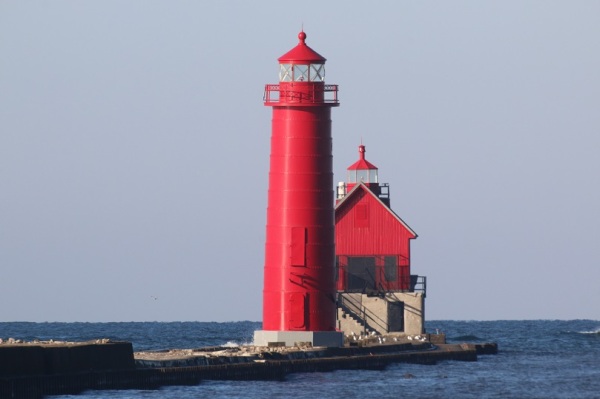
I live in an area not too far from Lake Michigan. All along the shores of this Great Lake are lighthouses. Some are small; some are tall; some are old and some use the latest technology Some are red; some are white; some are striped. Most are designed to warn ships of rocks, but others warn of shoals and hidden sand bars, as well.
Big Sable Point Lighthouse, Ludington
We think of lighthouses shining their light in the darkness, but lighthouses also shine in the daytime, through cloudy days, foggy mornings, and stormy afternoons. Most lighthouses also have fog horns, to warn ships when even the light won’t penetrate a thick fog.
This past week, a faithful lady at our church reminded us of a favorite song from childhood– “This Little Light of Mine.” We are called to be like Jesus, the “light of the world.” But what does it mean to “let our light shine”? And what does it mean to “hide it under a bushel?” (See Matthew 5:14-16)
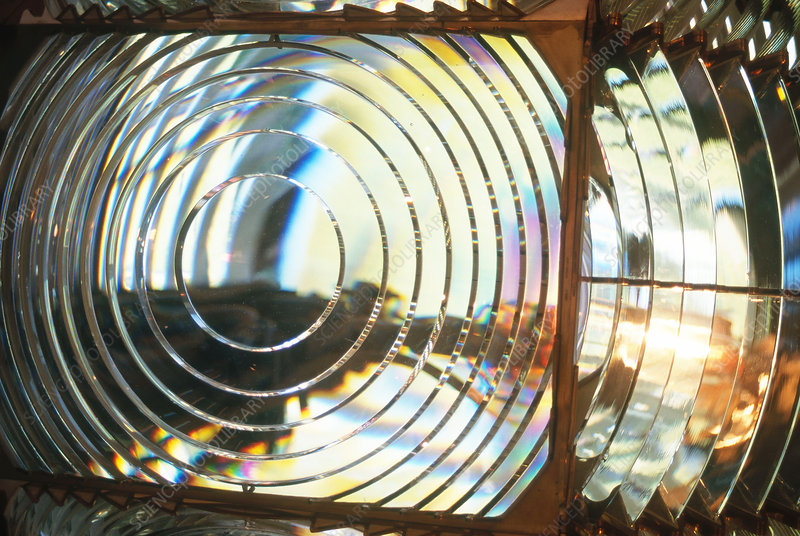
Fresnel lens at Ponce Inlet Lighthouse, Daytona Beach, FL. Invented by French physicist Augustin-Jean Fresnel, the lens is much thinner than a conventional lens, which allows for a large aperture and short focal length at a lower weight.
Lighthouses use special lenses, called Fresnel lenses, to magnify the effect of refracted and reflected light. The resulting beam of light is stronger and can be seen for miles. Our own “little light”– our weak and imperfect faith; our limited talents and resources; our clumsy attempts– would not be enough to “save” anyone. But God magnifies our efforts as we reflect HIS radiance; His Love and Mercy. And many will be saved as we allow God to shine through us.
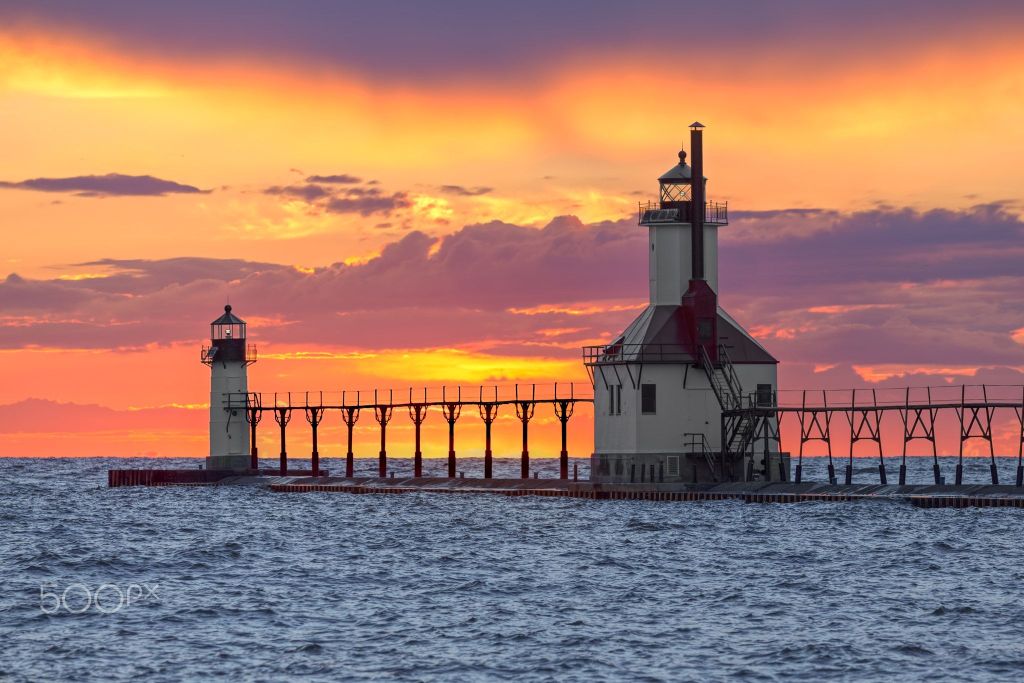
St. Joseph Lighthouse at sunset
Lighthouses are consistent– they don’t “turn the light off” when the weather is perfect, waiting only until someone spots a ship in danger. They don’t “dim” the light, or add extra strobe lights for the holidays or special occasions. Each lighthouse sends a consistent signal–steady and sure. But each lighthouse is unique– both in its outward appearance, and in it’s light pattern. This helps sailors tell them apart, and provides further help in navigation. As Christians, our light should also be consistent and unique. God created us with unique talents and opportunities–and we can “shine” the light of Christ in such a consistent and unique way as to help others “navigate” the trials of life. I am so thankful for the many faithful and uniquely gifted Christians who have inspired and guided me throughout my journey–and I want to be that kind of light for others!
Lighthouses are solid. They are normally built close to the shore, but not on the sandy beaches– rather on a rocky outcropping or a solid concrete and steel-reinforced foundation. As Christians, we have a solid foundation in Christ. We need to “shine our light” from that foundation– living out the Gospel of Christ– His life, death, resurrection, and imminent return. Building a bonfire on the beach may produce light, but it won’t stand out in a storm. Building our lives on any other foundation or religious “fad” may produce outward “success,” but it will not withstand storms.
Finally, and this may sound ridiculously obvious, but Lighthouses shine with purpose. They don’t twinkle or glitter; they don’t scream from the shore– “Look at ME! Look at ME!” They don’t shoot off fireworks to captivate onlookers from the shore. But they shine. They send a consistent warning, and provide consistent security to those who need it– and those who are seeking it! “This little light” may not be a blazing comet on the horizon, but without its steady pattern, there is darkness, confusion, and danger for those at sea (on lake in our case!) “No one lights a lamp and puts it in a place where it will be hidden, or under a bowl. Instead they put it on its stand, so that those who come in may see the light.” (Luke 11:33 NIV) We are commanded to shine– to Love others, to reach out with light, and hope, and yes, even a warning. To hide that light is to deny our purpose. To shine only for our own glory is to miss our purpose.
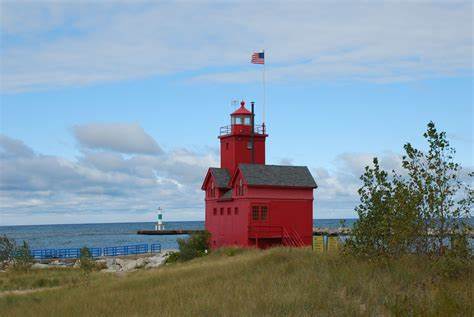
Holland (Michigan) Lighthouse
Father, help me to be a light in the darkness today. Help me to shine with Your Love, Your Mercy, and Your Goodness. Help me to be consistent, and to shine in the strength of Your Righteousness and Grace. Help me to use the unique gifts and opportunities You provide to show Your Character and Love to others.
As I look out my window today, I see a wonderful palette of fall colors waving in the wind. There are trees still filled with dark green; others with variegated shades of red and orange and yellow; some have brown leaves– so brown, they are tinged with purple! Back in the spring, the trees had so many subtle shades of green– bright green, yellow-green, and un-nameable greens in between. The colors of nature are astounding in their variety and their ability to change throughout the seasons.
God loves variety– not just in colors, but in all of life. Giraffes and gerbils; elephants and eels; ladybugs and llamas; koalas and kingfishers; swans and sloths; trees and termites; roses and raccoons…different shapes and sizes, with different lifespans and different habitats. Nature is a kaleidoscope. And precious people, too. Skin tones that span a vast spectrum; different hair; different eyes; different noses; different heights. But also different speech; different ways of thinking and doing; different ways of life–people living in city apartments, isolated huts, houseboats, underground houses–infinite variety.
Our prayers are also uniquely different from those of other people. And God LOVES to hear the differences as we lift up our unique praises and petitions. God created us to be uniquely ourselves– and uniquely His!
Just think– at this very moment, someone is praying in a language you’ve never spoken, in a place you’ve never visited. Someone else is praying for needs you have never even imagined, and thanking God for blessings you’ve never dreamed of.
It is a wonderful exercise to pray in a group– dozens, even hundreds of God’s people speaking the same thing in agreement; raising united hearts in praise or even in pain. But there is also something wonderful about listening to others as they express their hearts, knowing that God values each of us for the unique person He made us to be. We can be just as awed by the variety of amazing people we meet as we are by the amazing colors of the autumn leaves. The same God loves to fill the world with infinite variety and beauty.
Today, let’s try to see people for who God made them to be–infinitely precious and unique. And don’t forget that person in the mirror! God loves you. He loves to hear from you. He loves to lavish His love on you and through you, in ways that only He and You can experience.
Today, I am choosing to be thankful for snow. I don’t really like driving in it, or shoveling it, but there are some wonderful things about snow. God made it– in fact, the Bible says He has storehouses full of it (Job 38:22)! So what are some of the wonders of snow?
Snow acts as a natural insulator of soil, roots, and underground bulbs and plants. When temperatures plummet, the snow acts as a blanket, protecting all that lies below ground.
Snow– especially new-fallen, clean snow, reflects light and brightens the landscape. With less natural sunlight, this is very important, not just for plants, but for people. Physical and mental health is enhanced when we get adequate amounts of light. Visibility is also enhanced– even at night!– when there is a snowy ground-cover.
Snow is a better way to add moisture to the air and ground in winter–when winter rainfall freezes, it is much heavier and more dangerous than snowfall.
Snow can be fun! Skiing, sledding, making snowmen, and snow forts– it’s not just fun for children.
Snow can be good for business! Ski resorts, plowing services, parks with cross-country ski trails, and many others depend on snow.
Snow accumulates– especially in mountainous regions– and refreshes rivers and lakes as it melts in the spring. Running water from snowmelts feed brooks and streams, and replenishes underground springs and wells as it seeps in. In this way, God gently wakes up mountainside forests and glens, turning them from white (or gray) to vibrant green.
Snow is beautiful! (Especially if I don’t have to drive in it or shovel it.) It glistens on the bare tree branches and settles in mounds on the fields. It sparkles in the moonlight and glories in the sunrise. It delights us as it dances on the air, swirling and hovering and settling on our eyelashes or fingertips, only to melt away like a dream. We hear often about the marvel of snowflakes– each one is completely unique in its design and makeup. We may even take it for granted– especially after a particularly large snowstorm! But God chooses to lavishly pour out His creativity and love into each tiny flake that falls to the ground and melts with a mere breath. How much more does He pour out His love on each one of us!
God uses snow as a metaphor for His forgiveness. See Psalm 51:7, Isaiah 1:18. “Snow” white is considered pure, radiant, and refreshing. In just such a way, God can take our failures and mistakes, and replace them with His righteousness, making us pure, radiant, and able to be refreshed and to offer refreshment to others!
In the movie, The Sound of Music, a young woman named Maria is asked to leave her life in a convent to become a governess of seven children belonging to a widowed Navy Captain. After a hectic first day, she settles in for her evening prayers. She lists by name all the people she wants God to bless; but as she goes through the unfamiliar names of the seven children, she realizes she has forgotten the name of the younger, “incorrigible” boy. After a short struggle, she simply asks God to “bless what’s his name.” That evening, a storm comes up and soon three frightened girls come running to Maria’s room, and happen to mention the boy’s name– Kurt. “That’s it. Kurt. God Bless Kurt!” A short time later, Kurt, his brother, Freidrich, and the other girls show up, and they all end up bonding and singing through the storm. It’s a nice movie scene, but it also teaches us a lesson about prayer.
Maria’s lapse reminds us that even when we try to include everyone, we often forget a person’s name, or forget one member of a larger group. Sometimes, we forget that we already mentioned someone else, and count them twice. It happens. When I was a teacher, even with my roll call list, sometimes I would make mistakes as I hurried through the task to get to a lesson. As I get older, I find it’s common for me to see a person’s face, and not be able to remember their name. And, disconcertingly, I often see a name and cannot remember the face! (“God bless Kurt…whoever he is.”)
God knows the weaknesses and limitations of our minds. While it would be irresponsible to pray “God bless what’s his name” every night, and never try to call Kurt by name, it is important to lift up the “what’s his/her names” in our lives, trusting that God knows their names, their needs, their hearts, and their unique place in His plans. The very fact that we remember some essence of their personality or presence is enough to make them worth lifting up to the one who knows them far better. And perhaps someone else, who has forgotten your name, but not your value to the Father, is lifting you up in this very moment!
Maria’s prayer also reminds us that it is important to pray for individuals BY name (when we remember). We can pray for nations, groups, civil and corporate bodies, and churches, but when we pray for individuals, calling them to mind and heart, we are continuing a prayer that stretches through time and around the globe. This prayer– this list of names and remembrance of faces and spirits– began with Jesus and His disciples, and continues unbroken over centuries. It is a single prayer, tying together brothers and sisters in Christ who are otherwise divided by language and distance, time, and tide. Children saying their bedtime prayers; aged saints at their morning devotions; mothers lifting up their precious children; fathers lifting up their neighbors; missionaries lifting up their persecutors–throughout generations–this prayer is a continuous offering, like incense, rising to the throne of grace.


















 Pursuing Prayer