Smack-dab in the center of Sin and Pride; You could find me in Peril, Intrigue and Rebellion– Guilt surrounded me, pain and despair held me fast. But I was not in Repentance, Mercy, or Grace.
I had to die to “I”– let it go and let the Son redeem the Sin Trade Pride for Prayer, and Hype for Hope.
But I am no longer lost or dead– and no longer a slave to sin or pride. I can now be found in Faith, and Charity; I thrive in Fellowship, I have a Friend in Jesus, A Spirit to guide me, and a vision for Eternity. It is not “I” who lives, but “I AM” who lives in me. Salvation, forgiveness, life, and victory are all mine; Alive in Him, I am found in Christ– sanctified, And never alone.
Romans 8:1-5King James Version (KJV)
8 There is therefore now no condemnation to them which are in Christ Jesus, who walk not after the flesh, but after the Spirit.2 For the law of the Spirit of life in Christ Jesus hath made me free from the law of sin and death.3 For what the law could not do, in that it was weak through the flesh, God sending his own Son in the likeness of sinful flesh, and for sin, condemned sin in the flesh:4 That the righteousness of the law might be fulfilled in us, who walk not after the flesh, but after the Spirit.5 For they that are after the flesh do mind the things of the flesh; but they that are after the Spirit the things of the Spirit.
1 Corinthians 15:57New International Version (NIV)
57 But thanks be to God! He gives us the victory through our Lord Jesus Christ.
A brief note about Scripture references and quotes: I try to give scripture references and quotes in various translations, though I give most in the New International Version (NIV), the English Standard Version (ESV) or the King James or New King James versions (KJV or NKJV). I don’t intend to cause confusion by doing this. There are several excellent translations/versions available, and for a good comparison, there are several wonderful Bible study websites (two of my favorites are Bible Gateway and Bible Hub ). I simply find that there are some nuances that make for easier reading or use in the blog. Often, one translation will have notes and cross references that are wonderful for further study, but confusing to include as part of the blog quote. I encourage anyone to read the verses in whatever translation they have available, feel most comfortable using, or feel is most trustworthy. I also welcome comments or corrections.
Have you ever watched a sporting event–a real nail-biter–and prayed for your team to win? Do you wonder if God is concerned about Little League or High School Basketball, or which team wins the Superbowl? And what about the parents and coaches on both teams praying to him–one side has to “lose”–how does God answer such prayers? DOES he answer such prayers?
While the Bible doesn’t give us a specific answer, I think there are some general principles that apply. When teams prepare for a big game, they may talk about their desire to win, they may study their opponents, assess their own strengths and weaknesses, and give themselves pep-talks about winning, but they don’t practice winning– they practice playing their best, improving those areas where they are weakest, and working to bring their best on game day. They don’t pray to win by default or by bad sportsmanship.
The apostle Paul uses athletic analogies for the Christian life– he talks about running the good race, fighting the good fight, and working to be worthy of the prize. But he doesn’t direct Christians to pray that God gives us a victory. Instead, he points out that the greatest victory– that over sin and death– has already been won! We don’t fight the battles wondering if our victory or loss will turn the tide of the war. We fight in the hope of strengthening our fellow warriors and bringing our victorious Savior more glory and honor.
This holds true in other areas as well. In politics, we fight to win, but not in desperation or despair, knowing that if we lose this battle, God is not defeated or even surprised by the outcome. Even in situations of corruption, despotism, and chaos, God can raise up leaders, topple evil powers, and bring renewal and revival. In war, we fight to win, we fight to defend what we know to be right; but even if we lose the battles, we don’t lose faith.
God doesn’t always give us “wins.” He doesn’t guarantee that we will never face setbacks or disappointments. In fact, sometimes we need to “lose.” We need to lose our selfish ambition, our pride, our drive to compare ourselves with others, our envy and greed, and our failure to submit to God’s best plan.
We pray for victory, but more than victory at any cost, we pray for God’s will to be victorious– for his strength to be shown even in and through our own weakness. We pray for victory on God’s terms– which may mean a painful loss today, and grieving for the night, but joy that comes in the morning. Great teams, great nations, great leaders– are not forged in continuous expectation of easy victory. Sometimes we learn more and become greater by learning from our failures.
Let’s not just pray to win– let’s pray to be more than conquerors (Romans 8:37)!
“Your right hand, O Lord, glorious in power, your right hand, O Lord, shatters the enemy.” – Exodus 15:6
“You give me your shield of victory, and your right hand sustains me; you stoop down to make me great.” – Psalm 18:35
“So do not fear, for I am with you; do not be dismayed, for I am your God. I will strengthen you and help you; I will uphold you with my righteous right hand.” – Isaiah 41:10
There are many verses in the Bible about the mighty right hand of God. God’s might and power, His authority and sovereignty are all represented by his “right hand.” It is His right hand that protects us, upholds us, and gives us victory over the Enemy. God’s right hand spread out the heavens, and rules over the stars.
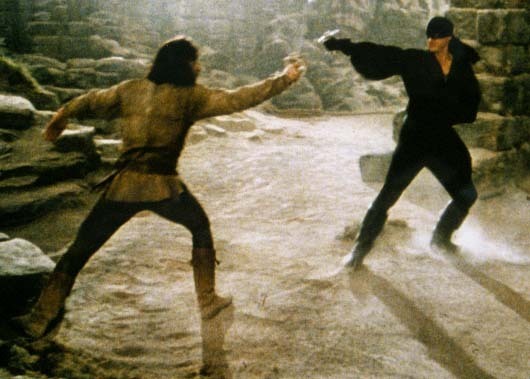
Today, I was thinking about one of my favorite movies– The Princess Bride. In one scene, two mighty swordsmen are fighting a duel. They are fighting with all their might, but they are evenly matched, and neither one is winning. Then, with a flourish, the challenger moves the sword from his left hand (which he had been using) and confesses that he is really right-handed. To his surprise, his opponent does the same! Each man has been fighting with his “lesser” hand, giving his opponent a (supposed) advantage. The fight continues with a similar ferocity. The two opponents later become allies in finding and saving the Princess.
So what if God fought for us with His left hand? What if (and I suppose He is) God is ambidextrous? God could defeat the enemy blindfolded and with one arm tied behind His back! Yet God assures us that His protection and provision are never second-best. If we suffer the attacks of the enemy, it is NEVER because God just didn’t fight hard enough, or that He didn’t have the means to win that battle. He doesn’t send in a junior varsity team of Angels to fight on our behalf. He doesn’t call a “time out” in the middle of fighting to catch His breath or re-evaluate His strategy.
God’s “Mighty Right Hand” isn’t just a metaphor for super-human physical power. He isn’t a muscle-bound hero in a comic book or legend. His mighty right hand is not an eternal fist. God is the One who holds the entire universe in His Hand. It is open. He doesn’t hold us in a choking grip; He holds us in the same gentle hands that hold a newborn chick or a delicate snowflake. God’s mighty right hand is also our safe haven. God’s hand guides and directs, as well.
God IS powerful and sovereign. He could choose to use His mighty right hand to squash us, or pound us into dust. He could hold us in a suffocating grip. But God’s mighty right hand is always directed by His LOVE. His Love cradles us, defends us, lifts us up, encourages us, works alongside us, and welcomes us into His arms!
A mighty fortress is our God, a bulwark never failing; Our helper He, amid the flood of mortal ills prevailing: For still our ancient foe doth seek to work us woe; His craft and pow’r are great, and, armed with cruel hate, On earth is not his equal.
Did we in our own strength confide, our striving would be losing, Were not the right Man on our side, the Man of God’s own choosing: Dost ask who that may be? Christ Jesus, it is He; Lord Sabaoth, His Name, from age to age the same, And He must win the battle.
And though this world, with devils filled, should threaten to undo us, We will not fear, for God hath willed His truth to triumph through us; The Prince of Darkness grim, we tremble not for him; His rage we can endure, for lo, his doom is sure, One little word shall fell him.
That word above all earthly pow’rs, no thanks to them, abideth; The Spirit and the gifts are ours through Him Who with us sideth; Let goods and kindred go, this mortal life also; The body they may kill: God’s truth abideth still, His kingdom is forever.
I love old hymns– I love music in general, but there is something powerful and “grounding” about old hymns and ancient praises that stick with us through thick and thin.
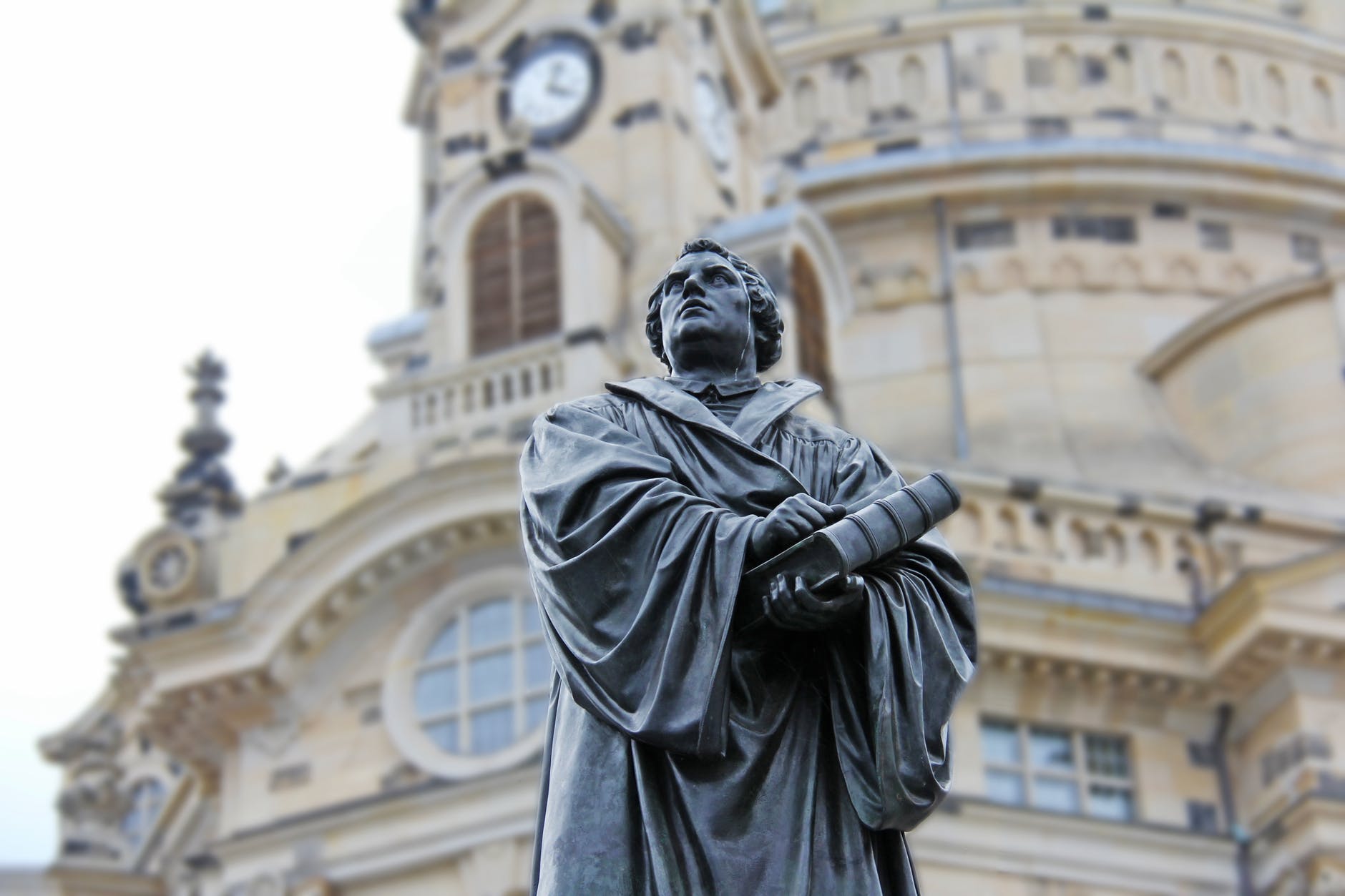
Martin Luther, author of “A Mighty Fortress”
This ancient (nearly 500 years old!) hymn has been attacked often. I saw an article recently that said it should be kicked out of hymnals and never sung. The author’s reasons: It had “old” words and it was gloomy and aggressive in its tone. True, it has words like “abideth”, “grim”, “kindred”, “battle”, and “doom”. (Although the song has been “rewritten”– not only translated into English, but “modernized” to take out the “old-fashioned words”–it’s not like you have to put up with the archaic words you don’t like or understand.) And it isn’t an upbeat anthem about dancing and lifting our hands in celebration. It’s not about daisies and unicorns and good vibes. It was written in a time when worship wasn’t about luxurious auditoriums and customized T-shirts with your church’s logo. Worship wasn’t “cool”–it was deadly serious.
And this hymn doesn’t celebrate the kindness and gentleness of God. It celebrates His Strength and Power; it celebrates Him as a warrior and a conqueror. It also reminds us that we have an Enemy; that we are involved in a pitched battle between Good and Evil– a battle we cannot win in our own power and with our limited resources.
Good hymns are not just there to help us celebrate the good times; they are there to remind us to keep going during the struggles and bad times that are sure to come in life. It doesn’t help that many times this hymn gets shortened. If you only read or sing the first and last verses, it can be confusing. It sounds grim. It assaults the ears and its words pound into our seemingly safe and comfortable worship.
In its entirety, however, the hymn reminds us of a very real spiritual battle being waged for our souls, and the victory that is already ours through Jesus (“that little word!”). Jesus is not just a “crutch” for weak sinners. He is a mighty fortress for battle-scarred and wounded warriors. He is a refuge in the middle of a field of war between good and evil, and the garrison for the army of Goodness. He is the battlefield hospital, providing healing; he is the supply station, offering armor and weapons of war.
The outcome of war is already decided– the victory is sure–but the battles are still raging. Innocent people are dying today in the Middle East and Eastern Europe. History has left us with few illusions about lasting peace in this world. That doesn’t mean that we should not work to pursue peace in our time. But it does mean that our real peace comes from seeking shelter within the “never failing” bulwark that is Christ Jesus, and drawing power from Him to go back out and fight the battle before us.
God is our Fortress and our Deliverer (2 Samuel 22:2). He is an ever-present help in times of trouble (Psalm 46:1) and His Name is our strong tower (Proverbs 18:10). Today, I will take shelter in the Hope and Promise of God as I pray. I need not fear or be depressed about the evil in this world. God still Reigns!
We lost a family member a couple of weeks ago. We were shocked and heartbroken to hear of his loss. To know that we will never get to hear his laughter or watch his eyes crinkle up over a good joke; never hear him enthuse over history or a great movie; never enjoy the fellowship of being in the same room together again. He never got to retire from his job; never got to walk his daughters down the aisle; never got to enjoy the house he and my sister-in-law planned to build.
BUT
Chris had a wonderful life in many ways. He and his wife have three amazing adult children. He got to enjoy plenty of days loving nature and enjoying a good sunset over Lake Michigan. He harvested many morels each spring. He made music. He helped hundreds of people in hundreds of little ways. He was blessed.
We went to Chris’s funeral last weekend. We helped celebrate his life– his accomplishments and achievements, his vivid personality, his sense of humor– and we celebrated his Faith. Yes, there were tears at the funeral. We will miss Chris in the years to come. But we share his faith and his great hope. We will miss him temporarily. We will grieve for a few years. And then, we will experience a joy that will make us forget the grief! Not only will we see Chris again– to laugh together and share stories and songs– we will be in the presence of our source of Life, and Hope, Joy and Peace! We will be surrounded by the great cloud of witnesses as we live eternally with the One who loves us best!
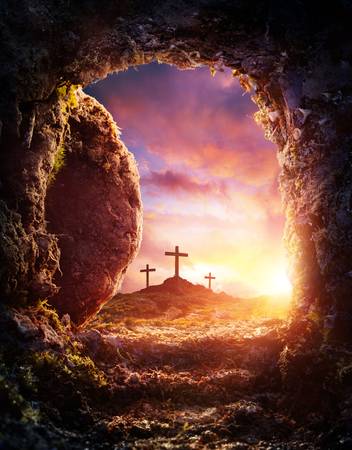
Many years ago, another man died. There was grief, stunned disbelief, and terror. The family, friends, and followers of Jesus Christ mourned. They hid. Their world was dark with despair and anguish. All these years later, we look at paintings and sculptures of Jesus suffering on the cross. But, while we shudder at the horror of all He suffered, we do not look on such pictures with fear or despair. The Cross is not a symbol of Death’s ultimate victory, but rather its ultimate defeat. Jesus didn’t stay dead. His body was buried, but He did not stay there. We celebrate, not the horrors of the Cross, but the limits of its power to steal our joy.
This is where grief meets hope. It is where the past is overwhelmed by the promise of Eternity. Christians grieve– of course we do. We love life, and we grieve to see it end. We love being with friends and family– we feel an emptiness and an ache when someone we love is “missing.” But we do NOT grieve without hope. We acknowledge the brief sting of loss. But Death loses its sting in the light of Christ’s victory. There is no lasting victory in the grave. Our time is short; we are powerless to stop death from taking us; from taking our loved ones. But Eternity beckons! Even our time on earth gives us daily reminders– the sun rises each morning; spring comes after each winter; children grow into parents, and we get to love another generation.
Even when life is hard; when grief looms large and hope seems dim– hope does not disappoint! Because Christ LIVES!
Chris was buried earlier this week– his body was buried– but he LIVES. He is healed and freed of all the pains and frustrations of this earthly life, and because of Christ’s gift of Grace and Redemption, Chris is living all that he once hoped for. Because of Christ’s great gift, many of us will someday join him in singing God’s praises, in laughter, delight, and endless joy!
My husband and I recently sat in the comfort of our apartment, and watched the movie trilogy of The Lord of the Rings. I’ve read the books several times, and enjoyed the movie several times, as well. The story is a classic tale of good v. evil, where it looks almost impossible for good to triumph. But, through the courageous acts of a few unlikely heroes (with the help of many others), evil is destroyed at last, and peace–eventually– returns to Middle Earth. It is one of my favorite stories, but it is not always “comfortable.”
The books and movies can be almost torture to watch, sometimes. There are battles, and betrayals, tragedies, and frustrations galore. From the midges that attack the party near the beginning of their journey, to the Ring Wraiths who relentlessly haunt Frodo as he carries the ring of power to its final end; from the unnatural armies of the Uruk-Hai, created by the betrayer Saruman, to the betrayal of Boromir from within their own fellowship; from the fall of Gandalf in the mines of Moria to the madness of Denethor in Gondor–there are plenty of times that the reader/viewer is tempted to turn away from such agony and despair. How could there be a “happy” ending? How could Frodo and Sam possibly survive long enough to finish the task, let alone return from it?
And yet, Sam himself provides an answer:
Yes, that’s so,’ said Sam. ‘And we shouldn’t be here at all, if we’d known more about it before we started. But I suppose it’s often that way. The brave things in the oldtales and songs, Mr. Frodo: adventures, as I used to call them. I used to think that they were things the wonderful folk of the stories went out and looked for, because they wanted them, because they were exciting and life was a bit dull, a kind of a sport, as you might say. But that’s not the way of it with the tales that really mattered, or the ones that stay in the mind. Folk seem to have been just landed in them, usually – their paths were laid that way, as you put it. But I expect they had lots of chances, like us, of turning back, only they didn’t. And if they had, we shouldn’t know, because they’d have been forgotten. We hear about those as just went on – and not all to a good end, mind you; at least not to what folk inside a story and not outside it call a good end. You know, coming home, and finding things all right, though not quite the same – like old Mr Bilbo. But those aren’t always the best tales to hear, though they may be the best tales to get landed in! I wonder what sort of a tale we’ve fallen into?’ ‘I wonder,’ said Frodo. ‘But I don’t know. And that’s the way of a real tale. Take any one that you’re fond of. You may know, or guess, what kind of a tale it is, happy-ending or sad-ending, but the people in it don’t know. And you don’t want them to.’ https://thetolkien.forum/wiki/Sams-Speech
Movie version:
Often, when I am facing “an adventure,” I am praying for God to take away the circumstances; to change the world around me, so I can be comfortable. I love to read stories, but I don’t want to live through what it might take to make a great one! And yet, God calls us to “be strong and courageous” (Joshua 1:9). Jesus calls us to be courageous as well, “In the world you have tribulation, but take courage; I have overcome the world” (John 16:33b). And Paul reminds his protege, Timothy, that “God has not given us a spirit of timidity, but of power and love and discipline.” (2 Timothy 1:7)
In the movie version of Lord of the Rings, the four courageous hobbits return to the Shire after all the fighting to find things almost exactly as they had left them– hobbits comfortably going about their business, oblivious to the grand and terrible adventures of their neighbors and the rest of the world. Hobbits, we are told early on, do not concern themselves with the “adventures” of the wider world. They like comfort. And the Shire, in some ways, represents a haven from the evils of the world of men and orcs and other creatures. In the books, however, evil spills over into the Shire, and the hobbits must face battles even when they expect to return to comfort.
Comfort is a wonderful feeling– ease and peace, no reason to worry or fret. Everything is familiar and good, expected, and desired. But comfort doesn’t build character. Courage does. Frodo and Sam, Merry and Pippin, all return to the Shire changed by their adventures. They are no longer “comfortable” living in ignorance of the wider world, no longer afraid of what might happen if they step beyond the borders of the Shire.
The same is true for us as Christ followers. Jesus commands us to Go into all the world. He does not promise comfort, in fact, He promises that we WILL have trouble. But He also promises that we will not face danger alone; and that we will see victory– His final victory. We DO know the end of the story! We do not know what tomorrow may bring, but we DO know that it won’t end in futility. Even our disasters will be redeemed! Even if tomorrow brings tragedy, grief, pain, or torture, we know it is not the way our story ends. But we must face tomorrow with courage. We must continue on THROUGH the story, even when it looks like we can’t go on. Courage, not comfort, will lead us to the victory.
Today, I pray that God will forgive me for the times I have asked for comfort and not for courage. For the times I have stayed in the Shire, instead of going forth to face the battles beyond. For the times I have been too afraid, or just too lazy, to obey His call to GO and be a light in this dark world.
I love flipping through old photo albums. I’m reminded of special times and special people. Sometimes, the memories make me a little sad, as I see familiar faces of those who have passed away, or times of struggle or stress. But most of the time, memories fill my heart with gladness and comfort, strength and resolve.
I’ve been reading through the Psalms lately, and many of them speak of remembering. When God’s people faced struggles, they were told to remember the great stories of the past– the plagues of Egypt, the parting of the Red Sea, the conquest of the Promised Land, and many other times when God gave miraculous provision, restoration, and victory. These songs were not just a matter of recapturing the “glory days” of old– they were part of God’s command to remember and pass along God’s deeds and His laws to each new generation.
In the Psalms, we are also encouraged to remember our own past actions– both righteous and rebellious– and God’s faithfulness in spite of our failures. We are to remember God’s correction and discipline; God’s forgiveness, and His Mercy– not just in our own lives, but over many generations and throughout the years.
God instituted festivals, and rites, and Holy Days of remembrance– special times set aside for remembrance and meditation, because it is important to Him that we never lose our focus. We can get so wrapped up in the present (or worrying about the future) that we forget God’s timeless and eternal nature.
Even Jesus, before He went to Calvary, instituted a new rite of remembrance– Communion– in which He called His disciples to “do this in remembrance of me.”
Today, I want to pray a prayer of remembrance. I want to spend time in worship and gratitude for who God IS, but also for who He always HAS BEEN. Thank you for your eternal faithfulness, and for your eternal plan of Salvation. Thank you for the ways you have provided in my life, in the lives of those who came before, and in the lives of generations of faithful saints. May I remember your Great Love and Power as I face uncertainties in the day ahead. May the remembrance of you lead me to trust you completely, follow you boldly, and share you with those I meet.
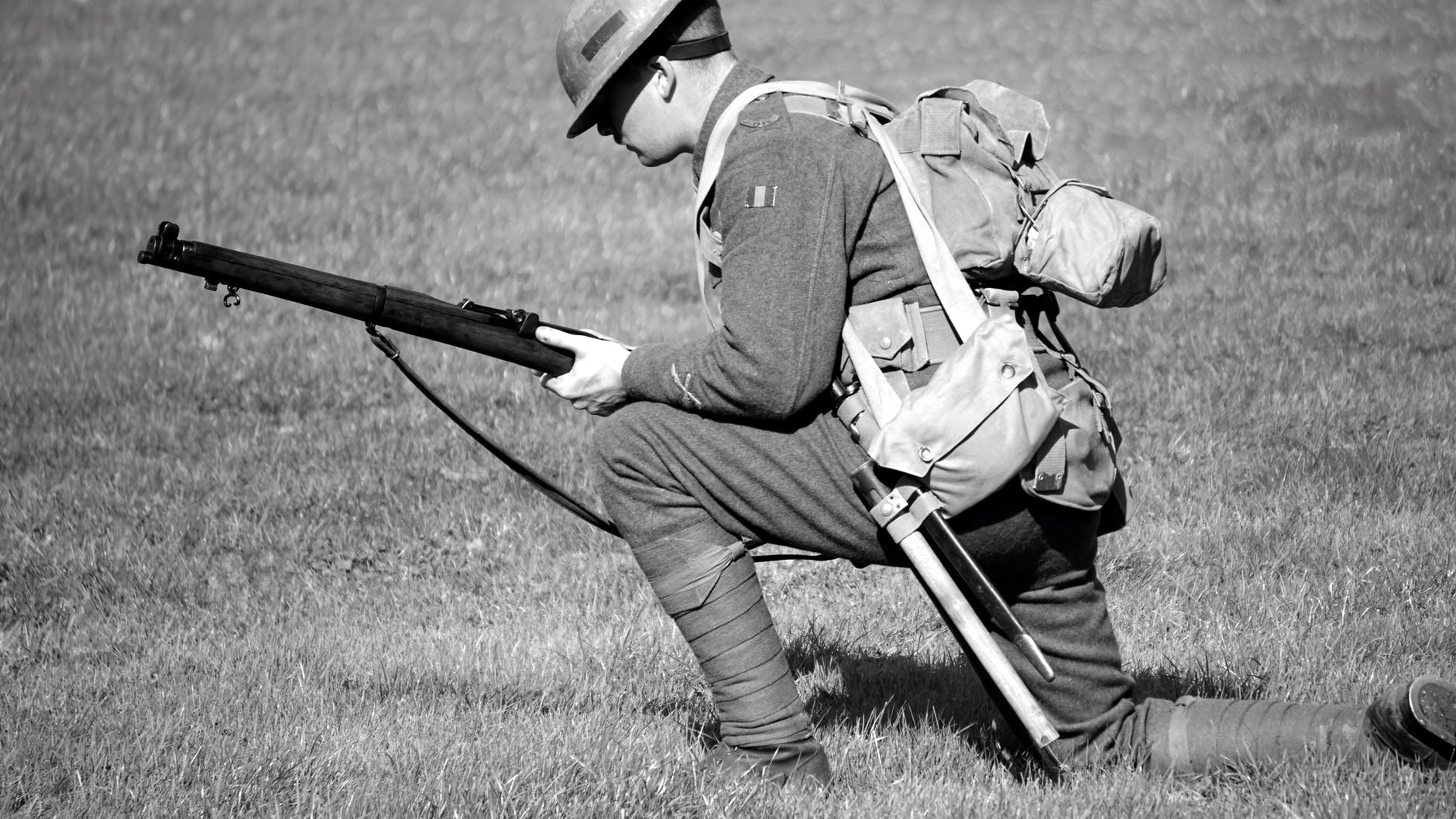
Today is May 8th. Historically, this is known as V-E Day, or Victory in Europe Day. On this day, in 1945, the German forces surrendered, ending World War 2 in Europe. Parades and parties broke out in several cities. People celebrated the end of war and the promise of peace. But the war was NOT over– not for everyone. War continued to rage in the Pacific for several months. Prisoners in concentration camps were still being liberated, many of whom had lost their homes and families. And the devastation across Europe and North Africa would take decades to clean up. Millions were still facing food rationing and homelessness; there were unexploded bombs and land mines, craters and ruins–all was not suddenly peaceful and prosperous.
The events of V-E Day happened years before I was born. But my parents and grandparents remembered it well. And as someone who loves history, I look back on events of the past and ask, “What can I learn from this day?”
Today, I want to look at what “victory” looks like. Not the thrilling victory of winning a race, or the victory of one army over another in a past century, but true “victory”–an end to all war and struggle and pain and uncertainty. What will that look like?!
In my life, I have experienced small victories, and victories that seem large in the moment. Graduation ceremonies, job promotions, signing the papers on a new car or house, saying “yes!” when David proposed, and later celebrating our marriage with friends and relatives at our reception…These were all moments of celebration and victory. But like the victory of V-E Day, there was still work to do, challenges to face, and even difficulties and set-backs that clouded each victory. Even my greatest Victory– coming to faith and knowing my name is written in the Lamb’s Book of Life– is in the “here and now.” I still face trials and temptations in this life, even though I can claim victory over Sin and Death through the work of Jesus Christ. But true “Victory” is in the “not yet.”
It can be tempting, when celebrating our earthly victories, to get caught up in the momentary feelings of success and happiness. But what happens on May 9? What happens after the parade? What happens when we face the next challenge? I find myself too often disappointed with the fleeting nature of my victories in life. And in the disappointment, I lose not only the joy of the victory, but the strength of the promise of victories yet to come!
There is a day coming– one that will make V-E Day pale in comparison! Some day, the forces of Evil will be utterly crushed. It will be total surrender. No occupying forces, no rationing or homelessness, and no more death or destruction for those who have trusted in Christ. Just sweet Victory. In a moment; in the blink of an eye, God will say, “ENOUGH!” The war will end. The suffering will end. The waiting will end. The dead will rise and the living will be changed.
I can only imagine what that day will truly be like. But I can live with the certainty of a coming day of “Victory.” I can know the hope and the joy of each small victory today, as it reminds me that there is much more to come!
Thank you, Jesus, for each small victory today. Thank you for the ultimate Victory that I find in You!
I love solving things–puzzles, mysteries, codes–I love finding the answer. It’s very satisfying. And I love reading mystery stories–Agatha Christie, Georges Simenon, Dorothy Sayers… But I have very mixed feelings about Sherlock Holmes. Always have had. I loved the intricacy of the mysteries themselves. They seemed impossible; unsolvable. Yet somehow, Holmes always knew the answer. And then, as he calmly explained how “elementary” it was, he would throw out details that no one else could possibly know without three doctorate degrees and a photographic memory.
I recently watched a series of TV episodes about Sherlock Holmes, and it struck me again. However, in our modern age, it is not so very impossible to become an expert on esoteric topics in almost no time. We have the internet, where vast amounts of information is available at the tip of our fingers. We can find facts about nearly everything, everywhere, at any point in history. We can virtually track people, visit places, experience adventures, and yes, even solve mysteries– all without leaving our couch. And while there are numerous dangers of relying on information found in cyberspace, there is no denying the easy availability of it.
One of the things I like about most mysteries is that they show the triumph of good over evil. Mysteries tend to show us, not only the impact of evil in the loss of life or property, the suffering of victims, and the need for vigilance, but the longing for order and knowledge and safety that we hope someone can “solve.” A good mystery story ties up all the “loose ends” and answers all the burning questions– “Who did it?” “How?” “Why?” By the end of the story, we feel victorious and safe and satisfied.
But reading mysteries or solving puzzles can give us a false sense of safety and knowledge. In real life, there are many unsolved puzzles, unanwered questions, and “cold” case crimes with no resolution. We are left asking “Why?” and “How?” about many of the things that have happened in our lives. And the answers are not “elementary”– even for the most intelligent among us.
As an adult, I read (and watch) the Sherlock Holmes mysteries with a different mindset. I know, from past experience, that Sherlock Holmes will always outwit the criminal. And I will probably learn some little-known fact– likely one that I never needed to know–that may be astonishing. But I am more interested in the character of Sherlock Holmes himself, now. Likewise with many of the other detectives I enjoy reading about. Because mysteries involve the triumph of good over evil, they attract writers who study the ongoing fight between the two. Mysteries often involve complex machinations, intricate plots, many-layered characters, and misleading information.
And the detectives are often equally complex and many-layered. Their startling intellect and deductive skills leave us in awe. Yet, they also have human frailties that lead them to overlook key clues or lead them to take risks beyond what we would consider wise. And many of them wrestle with the concept of good and evil–they are often tempted to take the law into their own hands, or to do something illegal in order to bring a criminal to justice. Thus, the reader is left with another mysterious question– just what is “Good” or “Evil?” Are there times when, in order to do “right” we may need to do something that others consider “wrong?” Can two “wrongs” make a “right?”
Some of the best detective characters are almost god-like in their ability to ferret out evil. But they are constrained in their ability to defeat evil. They are, in the end, human. Even Sherlock Holmes, with his arrogant assumptions and dizzying deductions, cannot wipe out evil; cannot keep it from touching and even ruining lives. In fact, as Sherlock Holmes (and others) discovers, intelligence is often a key ingredient of evil. “Stupid” criminals are easy to catch. The great detectives are needed to find the brilliant masterminds of evil; the ones who would otherwise go undetected and unstopped.
The man who created Sherlock Holmes, Sir Arthur Conan Doyle, was an agnostic and, in later life, became a spiritualist. He wrestled with the concepts of good and evil and particularly with the concept of how a “good” God could allow evil to exist. He was skeptical of the existence of the Biblical God, but instead believed in the continuing existence of the human spirit after death. He believed that the battle between good and evil was left to mankind to solve. He, like his famous character’s sidekick, Watson, was a medical doctor. He was a man who worshipped science– a man who valued facts above all. In fact, the stories of Sherlock Holmes offer us what seems to be a triumph, not just of good over evil, but of facts over faith.
Today, we celebrate the triumph of faith and facts over skepticism and arrogance. Jesus, unlike Sherlock Holmes, did not come to the earth to “solve the puzzle of evil” by bringing individual human criminals to justice. He did not brag about His great intellect, though He dazzled the Jewish Priests of His day with His knowledge and understanding of Scripture. Jesus had no fixed address. He did not write treatises or analyze dust samples– He created nature; He had no need for further study! His disciples did not write about Jesus merely because He did miracles. They did not write about Him in order to become rich or famous. Instead, they were martyred and exiled. Jesus did not put an end to the corruption of the priesthood under the Pharisees and Sadducees. He did not break the yoke of the powerful Roman Empire. He died on a wooden cross, hung between two criminals, after being convicted in an illegal trial, and a farce of an appeal to Pilate. He was flogged, taunted, pierced, and buried in a borrowed tomb. He was, by all appearances, defeated by evil and death. He lost– by human standards and appearances.
But faith tells us that God is Good; that Jesus is God; that Good triumphs over evil. And the facts bear out our faith. Yes, Jesus died. It was recorded, affirmed, and witnessed. But that wasn’t the end of the story. He rose again. There is no body in the tomb. There are witnesses to His post-crucifixion appearances. There were witnesses of his ascent into Heaven. His disciples died for their testimony and continued faith in the face of persecution, torture, and threats. And believers over the past two millennia have lived and died in the faith. We are witnesses of His power to redeem, to restore, and renew lives.
The events of Good Friday and Easter present the ultimate mystery. Jesus, Son of God, Messiah– eternal, all-powerful, all-Good– became a sacrifice for us. He allowed Himself to be an innocent victim of Evil for our Good. And in doing so, He didn’t just “solve” a puzzle– He defeated the power of Evil once for all! We don’t have to know more than the enemy. We don’t have to chase down and outwit death. We don’t have to be terrorized by the threat of evil, the weight of our guilt, or the power of the grave. All we have to do to defeat the evil in our lives is to trust in the work of the Risen Savior and follow Him.
It was almost 160 years ago, during the darkest days of America’s Civil War, that Henry Wadsworth Longfellow wrote a poem “Christmas Bells” that would become the Christmas Hymn, “I Heard the Bells on Christmas Day.” His son had been badly wounded in battle; his wife had died just a few years earlier, and the nation was in ruins and chaos. No one knew how much longer the war would continue or what the final outcome would be; Longfellow did not know if his son would live, or if he would be paralyzed for life. As he listened to the bells of Christmas ringing from church towers, he poured out all his doubts and fears in verse. Yet he concluded, “The Wrong shall fail, the Right prevail, with peace on earth, good-will to men.”
Christmas is not just a celebration of “comfort and joy” that comes from tinsel and lights, cozy fires, or gifts under brightly lit trees. Christmas is about Hope in times of darkness. It is about promises kept; prophesies fulfilled, victory assured, even when it looks as though the Enemy has the upper hand.
It is horribly tempting in troubled times to wonder and question God’s ways– does He hear? Does He see? Is He asleep? Does He exist? How can a “good” God allow such suffering and pain? And like Longfellow, we listen to our circumstances, and they seem to drown out the message of Christmas– “For Hate is strong, and mocks the song of peace on earth, good-will to men.” The cannons of yesteryear may have been replaced with 24-hour news cycles or Facebook news feeds, with protests and terrorist attacks; war and political corruption; social tensions and economic turmoil, but the noise is still the same. There is hatred, deceit, destruction, and doubt in our world–it was present during the Civil War; it was present during the Roman occupation at the time of Christ’s birth. But that birth brought a singular hope– one that has become so familiar, and so casual as to be almost forgotten amidst the immediate urgent noises of the day.
The trappings of Christmas sometimes hide the very Glory of Christ’s Advent. God CAME. He LIVED AMONG US. He was humble. He felt the cold and heat of long days and nights; his feet got dirty from walking. He laughed and cried. And, He DIED. He felt agony and shame and fear as he gasped for breath, naked and bloody and facing sneers and anger from the crowd. But God IS NOT DEAD–He conquered death; He rose again victorious. And He did it so that our suffering is not in vain– our suffering is not the end of our story.
GOD IS NOT DEAD. Hope is not in vain. Nor does He sleep–even in the silence of our lonely nights, even in the noisy chaos of life in 2023–God has not stepped off His throne; He has not turned His back on mankind. “The Wrong shall fail–” though it may seem strong and strut arrogantly through the streets, shouting and threatening–God is the final authority. Nothing is hidden from Him. He sees every injustice, every secret sin; He hears every lie, every twisted truth, every deceit. And He has no favorites– there is no excuse, no “religious” exemption– ALL have sinned, and all will be held to account.
EXCEPT– because of that one birth and death and resurrection–the debt is already paid. “The Right (shall) prevail with peace on earth, good-will to men.” For those who listen beyond the noise of battle, the bells of Christmas ring “more loud and deep” with the hope and joy and strength that overcome our pain and struggle. Longfellow found that truth– and I’m so glad he shared it. I hope his words will continue to remind us to listen through this season for the true message of Christmas.



































 Pursuing Prayer