Prayer and Marriage

As a young girl, I prayed about being married. Most of my prayers were pretty shallow– more about the wedding than the marriage. I dreamed of dresses and decorations, flowers and a shadowy “prince charming” type of groom, whisking me off into the sunset and living happily, dreamily ever after.

The years went by…MANY years! I prayed and dreamed through my twenties; I prayed and hoped through my thirties; and I prayed with less hope and more desperation in my early forties! But my prayers changed as I saw marriages around me. I saw many marriages that were solid, even through tough times. And I saw many “fairy tale” marriages crumble. I saw a lot of heartbreak, anger, and tears, as people who had once vowed to love one another “’til death us do part” fought over furniture and who got the kids over minor holiday weekends. I heard from frustrated wives who felt like they had made a huge mistake, marrying the “man of their dreams.” Some of them compounded the mistake by looking around for a replacement “Mr. Right.”

Instead of praying about a wedding, I began praying about marriage. Instead of praying for “Mr. Right,” I started praying that God would help me become “Mrs. Right.” And I prayed that God would show me what I should do for others during the time that I was single, as well as what I could do for him in a marriage relationship.
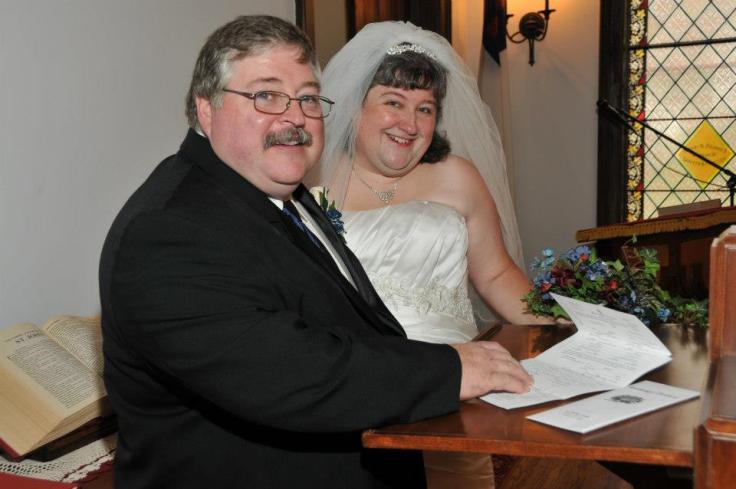
Thirteen years ago, I married my husband, David. He isn’t “Prince Charming,” though he can be charming and noble at times. He is, as I am, a flawed human being. David was married before, and he carries the hurt of betrayal and loss of trust from the past. I carry the hurt of being rejected and passed over for so many years. Marriage doesn’t make the past disappear. Marriage is not a “cure” for such hurts.

But marriage is more. God instituted marriage from the beginning for a man and woman to come together in a mysteriously intimate relationship that models what God’s love is like. (See Genesis 2:24; Matthew 19:5; Ephesians 5:31 and others.) David and I don’t exist to “complete” each other. We don’t cease to be our own individual selves. And yet, we are not the same as we were before our marriage. We are more than the sum of our parts– we are ourselves, yet we are one– the Fairs. He is David Fair, and I am Lila Fair, but WE are THE Fairs. And spiritually, we are also one WITH Christ– as individuals and as a couple. We walk forward as One. We make decisions together. We share hopes and dreams, as well as struggles and disappointments. We fight sometimes– not against each other, but against differences or misunderstandings that could weaken US as a couple and weaken our relationship with Christ.

I don’t pray any less often or less fervently now that I am married, but I pray daily about my marriage. I thank God that He was with me through all the “single” years. I thank God that He continues to work in our marriage– that David and I know more about love and faith, hope and fulfillment than we did 13 years ago! I pray that David and I will grow together for many years to come. I pray that we will impact our family as we live out what a Godly marriage is supposed to be. I pray that our marriage will inspire young men and women who are looking (as I once was) to see what a solid marriage involves– that the way we talk to each other, and behave, and work, and live will give hope to future couples, and glory to God.

Marriage and prayer go hand in hand. Prayer cannot guarantee that marriage will be easy–or even than it will survive. Marriage takes two people praying and walking in the same direction! But marriage–and life– without prayer will never be all that God intends it to be.
Where Are the Altars?

In the Biblical books of the prophets (Isaiah, Jeremiah, Ezekiel, etc.), there are many references to altars and sacrifices–both the ones built to honor Jehovah God, and those designed for idols.

Israel and Judah were guilty of building thousands of altars and shrines to false gods. Some of them were found even inside the Holy area of God’s own temple! As part of God’s judgment, He repeated that He would no longer accept the empty sacrifices of His people–He would no longer hear their prayers, unless they repented.

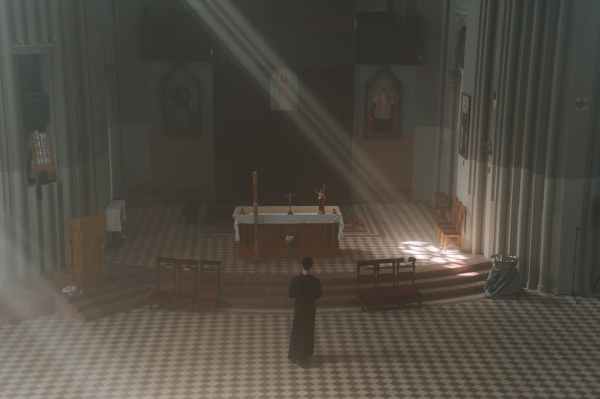
I read these words and wondered– Where are our altars today? When I was a child, many of the older churches had what we called an Altar. It was usually a raised platform, with a podium for the minister, and possibly a “host table” for communion. My childhood church also had a small table that held a large Bible. Sometimes, the platform would have a railing around the edge, with a couple of stairs on either side. And, while many churches “passed the plate” for offerings, some had a special plate on the railing of the altar, where people would march up and place their offerings for the week. There it would sit for the rest of the service–random dollar bills of random denominations in random states of being crumpled, folded, and worn, along with checks, and, sometimes even coins. All of them brought forward and placed on the altar.

In many churches, the altar was where congregants would come to receive communion. The most important church events happened “at the altar.” Weddings, baby dedications, Bible readings and sermons, even funerals– all happened at the altar.

And often, we would have an “altar call.” The pastor, or a guest evangelist would urge people from the congregation to meet at the altar– to repent, to receive forgiveness, to be renewed and refreshed as we offered ourselves to God. There we were– random denominations of people, in random stages of obedience or rebellion, all answering the call to follow Christ as Lord. Some stayed there for a few minutes, praying silently. Others might be there for an hour, crying out, trying to find the words to express pain, guilt, or gratitude and awe, that GOD would meet with US there! Sometimes, we would form small groups to pray and give encouragement; sometimes we would disperse, too moved to speak at all. The Altar was the focus of the service– the place where God met with us; where He received our worship and our offerings; where we were challenged and made ready for spiritual battle.

Today, many churches have stages, like any large theater or event center. There is no railing, but there are hundreds of spotlights and fog machines. There is no podium for the pastor–just a headset and maybe a small stand for notes. Sometimes, the pastor reads from a teleprompter. Often, he or she is joined by a full band or orchestra, and dozens of singers, actors, or other assistants. No one from the congregation approaches the stage– why would they get up from their comfortable reclining padded seat? No one even “needs” to bring a Bible– the sermon text is printed out on the giant screens hanging above the stage. Our worship is comfortable, and entertaining. Many of us don’t even go to a church building, anymore. We can livestream worship services, or watch from a satellite location. We don’t even have to change out of our pajamas! And we feel blessed, and filled with excitement to be part of something dynamic and spiritually uplifting.

But we have no altars. There is no place for someone to lay their offering before God; no place to meet with Him in repentance or revival. There is no place to remind us of sacrifice and atonement. Oh, to be sure, many churches have a large cross on display somewhere. Some even have the “host table” for communion– somewhere in the wings, just in case–but the concept of an “altar” has all but disappeared from churches in the West. It is an anachronism–something ancient and uncomfortably part of the distant mists of tradition.

I miss the altar. I believe God misses it, too.

Blog at WordPress.com.

Up ↑