“God isn’t Fair!” I hear this often from angry and bitter people who have suffered losses or disappointments in life. Some of their losses are heavy and come with great pain– loss of a child, loss of a home, loss of health…these are legitimate losses, and there are no conclusive, comprehensive or comforting answers. In fact, in many ways, God is NOT “fair”– as we usually define “fair.” God sends life, health, happiness, sunshine and rain to both the “just” and the “unjust”; to both rich and poor, tall and short, ugly and good looking, gracious and annoying, kind and cruel… Tragedy strikes at random, some are touched by it, others seem to be plagued by it, and still others skate through life unscathed.
God may not seem “fair”, but let’s look at it from another angle. God sends rain and sunshine on the just and the unjust. He sends gifts, and we use, abuse, accept, or reject them. Circumstances and outcomes are not always pleasant, but does this mean they are “bad?” And when they are easy, and comfortable, does this always make them “good?” Good people have to endure tragedy– this is usually what we focus on when we talk about God being “unfair.” And we generally put ourselves in the “good” category. Why should we have hardship and pain, while “bad” people seem to get a “pass?” Shouldn’t bad things only happen to bad people, while good people enjoy only good things? Sounds “fair”, doesn’t it?
But what happens when the world operates on that principle? If “bad” people are the only ones who get sick, then they deserve to be sick– not healed. If “bad” people are the only ones to experience poverty, then we don’t need to help the poor or the needy. Good people should be rich and healthy. But what if we are sometimes good, and sometimes selfish? Do we deserve to keep all that’s good if we misuse it, or lose all that’s good if we go astray and then repent? Is that fair?! Where is the motivation to cure diseases, share resources, or enforce laws? Who decides whether your “good” idea is “good” for everyone around you? Who can ascend to heaven and tell God what is “fair?”
God created us in His image, and that means that we have a spirit that longs for justice and fairness. It’s how we recognize evil and injustice. But sin clouds our eyes, and poisons our world–pollution doesn’t just hurt the people who pollute; arson doesn’t just burn the arsonist; drunk drivers don’t just hurt themselves; and so on. We don’t look at the evil or thoughtless or “unfair” things we have done or said that went unpunished or unnoticed. And we discount all the unmerited blessings that have come our way– God is often “unfair” in our favor! We don’t complain about that.
God is not the author of “unfairness”, though He allows it. And, while I can’t explain away pain and suffering when they occur, I know two things:
God is Gracious– If God’s justice were not tempered by mercy, every mistake, every sin, would be unforgivable and eternally ours to bear. Every random thoughtless action, and all its consequences, would weigh us down forever.
God is Just–Jesus’s death was about redemption and restoration– He didn’t just die to “save” you from hell– He died to restore you to the person and position for which you were created– whole, pure, unstained and uncorrupted. This wasn’t “Plan B”– this was His eternal plan, and it includes perfect justice and perfect restoration.
Knowing these things does not take away the pain of the present. It does not make suffering easy; it does not erase the loss. But it can allow us to take the next step, and the next, on our journey. Rain or shine.
I’ve been asking myself “why?” a lot lately in regards to this blog. Why am I spending my time writing about prayer? Wouldn’t I be better served to spend my time productively– making something useful, keeping the apartment cleaner, going to the gym–even spending more time in prayer instead of dissecting it and babbling on to an invisible audience?
But the truth is that I began writing this blog in response to another question, a more basic question thrown at me (not personally, but thrown out to all who believe in the power of prayer)– “WHY?” They weren’t asking the question because they really wanted to know my reasons for praying; instead, they wanted to make me feel ashamed and embarrassed, to doubt God’s goodness and my faith. In fact, they weren’t asking “WHY” so much as asking “HOW”. How can you continue to believe in God and continue praying in light of random shootings, manifest injustices, rampant corruption, and senseless tragedies? How can you say that God is good, when people continue to get away with evil? If God exists, where is he, and how can you just sit back and trust in him?
The fact that I DO continue to trust God doesn’t mean I don’t have questions and concerns, and even righteous anger about the state of the world and the tragedies that fill it. The questions come pouring out, sometimes keeping me awake at night, sometimes catching me at a raw moment– and they are important questions. To pretend that I never wrestle or struggle with the questions is to say that good and evil, justice and mercy, that God himself– none of it really matters enough to seek an answer. God forbid!!
But there is a vast difference in asking “Why?” and challenging God by saying “How? or How come?”
Consider a small child who asks, “Why is the sky blue?” (Don’t you just love the inquisitiveness of small children?) “Well…” I can explain that the sky itself isn’t really blue…I can go on to talk about scientific principals– the property of light, refraction through water molecules and dust particles, and more..I can point out that the sky doesn’t always appear blue, etc. At the end of my long and factual discourse (assuming the child hasn’t already interrupted), s/he is likely to simply shake their head and ask, “But, why?” WHY? Because I haven’t really answered the heart of the question. I explained HOW, not WHY.
Now suppose I don’t feel like being pedantic, and I simply answer “Because.” You can guess what comes next. The child will ask, “Because WHY?” Because “Because” isn’t a sufficiently satisfactory answer. The child wants more; he/she yearns for more comprehension; more understanding.
As an adult, we find this kind of questioning frustrating and annoying. I think it is because we have been conditioned to think that questions either have a “How come” explanation that sweeps away much of the wonder and mystery, or a “because” answer that leaves us unsatisfied. We are frustrated by questions to which we already have a pat answer, and we are frustrated by questions to which we have never received a satisfactory answer.
As an adult, I may well ask, “Why is there evil in the world?” This is an important question; one I should be asking. Experts can and will give me all kinds of “how” answers– how the brain is wired, how emotions work, how society has failed various groups of people, how political structures create oppression, how religion teaches intolerance, how poor diet or lack of sunny days … there are a million explanation of “how” evil exists or why it persists. And many of these explanations contradict each other, so they can’t even give a conclusive answer. But just throwing up my hands, and saying, “just because” does nothing to answer my question OR provide understanding that could help alleviate the effects of evil in the world. “Because” communicates my powerlessness to comprehend.
BUT
Something amazing happens when I stop merely asking people for answers to these questions and start asking God. I don’t get a magical, comprehensive, incontrovertible answer to life’s thorny questions. God doesn’t send me a “cheat sheet” with all the “right” answers. I’m not suddenly an expert on good and evil or what should be done to eliminate crime and disease and poverty. I still have to wade through the “how come” explanations and use my limited judgment to decide what course of action I can take to try to make a positive difference. And I will make some mistakes along the way. But when GOD says, “Because”, there is an authority, a majesty, and a wisdom that can never be present in my answer. I say “because,” because I have no more to say; no better answer. God says, “Because,” because HE IS the answer! And the cause! And he gives explanations in his word for many of my questions– even if I don’t like the answers! He doesn’t explain “how come” the sky is blue–even though science can tell me the “how come.” God doesn’t have to explain the blue sky –He causes it to be blue. “Why is the sky blue?” God makes it so. “But why?” Because He is God and I am not. God explains “how come” there is evil in the world– it’s called SIN–but he doesn’t leave it there. “Why?” Because we have the free will to choose good or evil. “Why?” Because God wants willing obedience and loving companionship with us. “Why?” Because God is love! “So why does he allow evil to continue?” Because he has a plan that involves redemption and restoration and renewal. He is the cause of this plan, he is its author and finisher. Moreover, he is the cause of my desire to ask “why?”, to seek for a more fulfilling answer, to yearn for a solution to the very evil that prompts my questions.
I won’t stop asking “why.” Not because I don’t have any answer, or because I don’t know the answer. It’s just that the answer is so much bigger, so much better, so much MORE than I can handle in the shortness of this lifetime. And it’s important that I not only keep asking the question, but that I keep defending the answer. Because perhaps today, or tomorrow, or every day next week, someone may ask me WHY?
1 Peter 3:14-16English Standard Version (ESV)
14 But even if you should suffer for righteousness’ sake, you will be blessed. Have no fear of them, nor be troubled,15 but in your hearts honor Christ the Lord as holy, always being prepared to make a defense to anyone who asks you for a reason for the hope that is in you; yet do it with gentleness and respect,16 having a good conscience, so that, when you are slandered, those who revile your good behavior in Christ may be put to shame.
We are a curious race, humans–we ask a lot of questions of ourselves, each other, and even of God. How did He make the universe? When will Jesus return? Who can we trust in this world? Where is Heaven? What must we do to be saved? But the majority of our questions are “Why” questions. Why did Jesus come? Why did He have to die? Why did God make snakes and mosquitoes and platypuses? Why are men and women so different? Why am I… (short/tall, fat/thin, clumsy, “odd,” misunderstood, etc.)? Why are You so mysterious? Why do bad things happen to “good” people?
I was thinking about this last question this week. I don’t have any definitive answer to that– no one I know has any better answer. God has not given us a definitive answer, either. We are to trust that His ways are wise and best and perfect, but faith and trust require–well, Faith and Trust! We know God has done good things in the past. We know He has redeemed what seemed like hopeless situations. We know His promises, and we have seen some of them fulfilled. Still, such a question can often leave us blindsided and tongue-tied.
There are many learned thinkers, philosophers, and apologists who have written whole books on this subject, but I want to just pose a couple of ideas to help us, not ANSWER the question, but understand the question a little better.
First, the question, “Why do bad things happen to good people?” is really two questions: “Why do ‘bad’ things happen?” AND “Why do they happen to ‘good’ people?” So let’s look at the questions separately.
“Why do ‘bad’ things happen?” What do we mean when we say “bad things?” There are many circumstances, events, diagnoses, and occurrences that may be called “bad.” Death is “bad.” Indigestion is “bad.” Stubbing one’s toe is “bad.” Being diagnosed with Alzheimer’s Disease is “bad.” Divorce is “bad.” Slavery and abuse are “bad.” House fires, job losses, being mugged, being stranded without heat in a blizzard, an outbreak of acne, being laughed at– all these are “bad.” But they are all different. Many “bad” things are the direct result of sin–we suffer the consequences of our own sin; we are the victims of the sins of others. The consequences of addiction can be horrific, but we often lack compassion for those who are suffering, because “they brought it upon themselves.” But what about the innocent victim of rape or child sex trafficking? Such acts leave victims traumatized and broken. Both are “bad,” but we are angered and frustrated even more when “bad” consequences also seem unjust and unfair. And what about natural disasters? Are they the result of sin, as well? The Bible suggests that they are. When God placed Adam and Eve in the Garden of Eden, they lived naked, carefree, and unafraid. Only after their sin did God place a curse on the land– Adam would now have to cultivate the land in order to get food. There would be enmity between the woman and the serpent. Eve (and all women after her) would have pains in childbirth. (see https://www.biblegateway.com/passage/?search=genesis+3%3A+14-20&version=NIV) There is no mention of hurricanes, blizzards, or earthquakes prior to the Fall of mankind, though it is speculation on my part, to say that there were none.
God has promised to make all things new. There will be a time when the consequences of Sin will be eradicated. We will not even remember the suffering we endured in life, in light of the blessings of eternity. So, though God doesn’t answer our question of why “bad” things happen, He does give us the assurance that such “bad” things do not determine our destiny, nor do they happen without His knowledge or outside of His will! We cannot understand God’s purposes in allowing us to suffer, though sometimes we may see a hint of good even in the midst of tragedy.
And God is loving and gracious in the face of our confusion and pain. We CAN ask God “Why?!” “Why me?” “Why this?” “Why now?” “Why them?” Why, O Lord!?” Many of the Psalms speak to this very question. But in the middle of his anguish, the psalmist often finds comfort and renewed strength to face the struggle, when he turns to God. Asking why is not always a sign of weak or failed Faith. Instead, it is acknowledging before God that we ache. We grieve. And we NEED HIM!”
And what about the second part of the question: “Why do (bad things) happen to ‘good’ people?” What makes a person “good?” Jesus was “Good,” And yet He questioned the rich young ruler, “Why do you call me good? No one is Good– except God alone.” (see https://www.biblegateway.com/passage/?search=Luke+18%3A18-27&version=MSG) We tend to think of the people we know and like as “good.” And we have a natural expectation that their lives should be “good” also– free of pain or struggle. But that is not realistic in this world. The actor, Michael J. Fox has been suffering for years with Parkinson’s Disease. This seems unfair and cruel. How could God let him suffer like this? But there are many thousands of people suffering from Parkinson’s Disease. Some of them are homeless addicts; some are in prison for rape or embezzlement. Is their suffering any less than that of Mr. Fox? Is it somehow less tragic or unjust?
The sad and shocking truth is that none of us “deserves” a pain-free, struggle-free life. Bad things DO happen. And they happen to people we like, and people we hate; people we judge to be “good” and people we judge to be “bad.” God does not “play favorites.” Yes, God can, and often does intervene on someone’s behalf through prayer, or for His own bigger purposes. But He does not “dish out” suffering to those He dislikes out of spite or revenge. Nor does He cause His faithful to float through life without ever tasting bitterness and grief. Jesus made many promises, but one of them was this: “in this world you will have trouble; but be of good cheer, I have overcome the world.” (John 16:33) He didn’t promise that you might have a little spot of trouble, or that you might look around and see others in trouble– He promised that we would have trouble. Not because we are “bad” or “good” but because that’s the way this world is.
I find it odd that atheists often pose this question as a way of trying to “prove” that God doesn’t exist. They pose the question as an accusation. “If there is a kind and loving God, why do bad things happen to good people?” But if they believe that there ISN’T a kind and loving God, how do THEY explain why bad things happen to good people? How do they define “good” people and “bad” things? Without a Good God, where is the expectation of good things happening to good people? Without God, there are no objectively “good” things or “bad” things happening– only random events without divine cause or purpose. You can’t blame a non-existent God for things He either caused or didn’t prevent. Such questions are meant to plant doubt in the mind of a believer, but they fail to answer the greater question– Why do Good things happen to undeserving people? Why do we sometimes find joy and peace and strength in the midst of our suffering? Why do human beings continue to Hope?
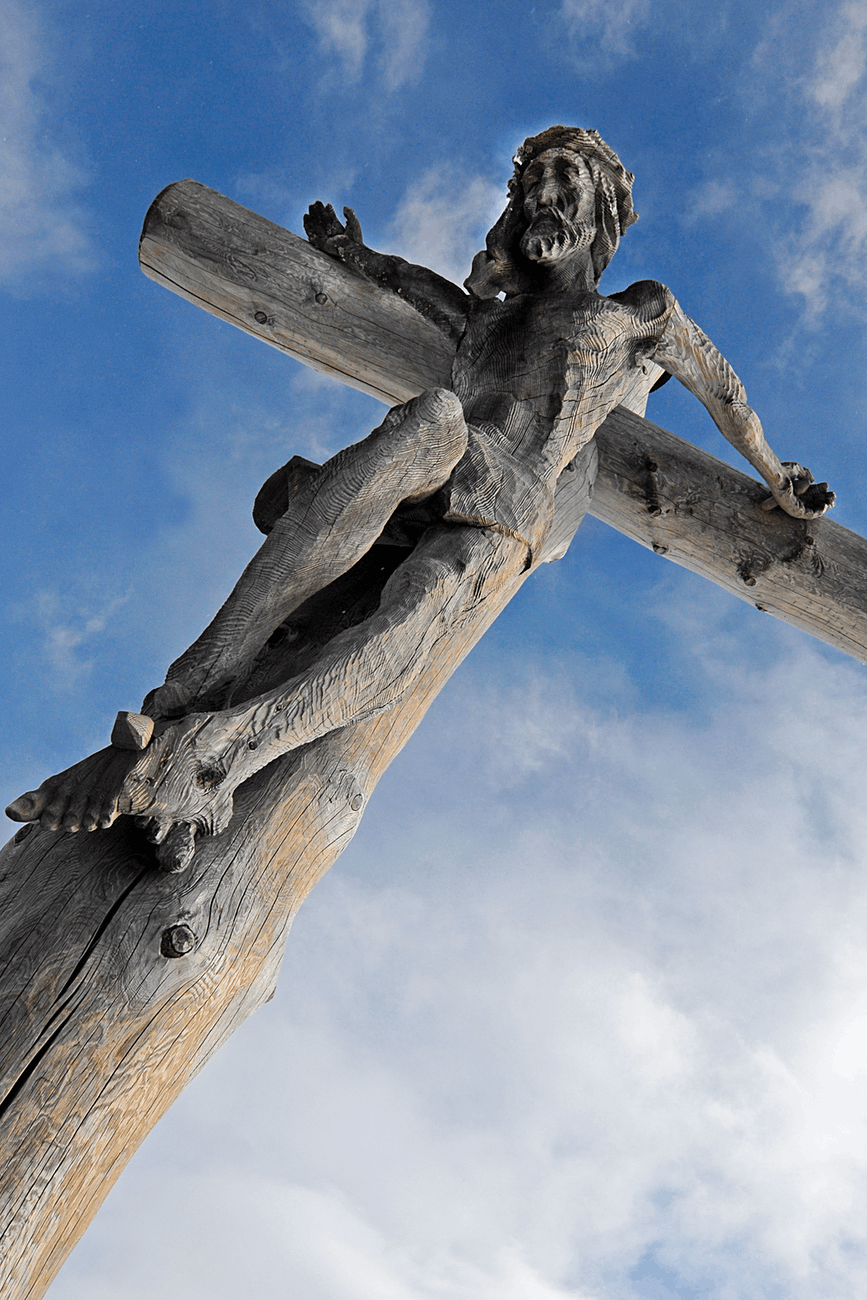
Finally– the ultimate example of God letting something “bad” happen to someone “good” can be seen in the central image of our Faith– the crucifixion of Jesus Christ. Jesus was sentenced unjustly to a torturous death and public humiliation. He was separated from God the Father, and carried the punishment for OUR sins so that WE could be reconciled to God. Even though the purpose of Christ’s suffering has been revealed to us, it doesn’t negate the agony and trauma He faced. And even HE cried out from the Cross– “My God, My God, WHY have YOU forsaken ME?!” (Matthew 27:46)
God does not answer the question of why “bad” things happen in this world. But in the crucifixion, Jesus proves to us that He shares and understands our suffering; that He has the power to overcome and redeem our traumas; and that He will hear our sincere cries of “WHY?!” He will hear when we turn toward Him, instead of turning our back on Him. He will hear our broken heart. He will heal our broken heart.














 Pursuing Prayer