One of my favorite old hymns is the ancient Irish tune, “Be Thou My Vision.” I have heard it jokingly referred to as “the optometrist’s hymn.” But there’s a lot more to unpack in the title than just a plug for good eye care.
God’s word is full of references to sight, seeing, blindness, light, lamps, darkness, night, day, visions and dreams, foresight and prophecy, images and reflections, and much more. God is both the source of our sight, and of our insight. God sheds light on our deepest secrets of the past, and provides a lamp allowing us to see the obstacles ahead more clearly. Jesus came to be the Light of the World, and bring sight to the blind, both physically blind and spiritually blind.
Many times, we pray for answers– we want a quick solution to our circumstances, or a definitive direction for our next step. But God sometimes wants to show us a bigger picture. Sometimes, he wants to show us more intricate details. Instead of asking for what we want God to give us, we need to ask for God to give us the vision HE has for our future. He may not reveal every detail– or he may only reveal the next detailed step. But God’s vision is clearer and bigger, and more glorious than we will ever know if we aren’t willing to look with His eyes to see.
We also need to ask God to BE our vision– that we would see him more clearly for Who He Is! Whatever is in our focus will appear bigger and clearer than things in the periphery. When we allow Him to be our vision, we start to see things from His perspective, which makes all the difference. What we see on our own is often an optical illusion– problems look bigger than they really are, hurts and grievances grow larger, and people become distorted by the lenses or mirrors we use to view them. And we lose sight of God’s glory, wisdom, majesty, power, and everlasting love. But God restores our focus and our perspective, so that we see problems in the light of His power to overcome; we see people who are made in His likeness and image– people who are loved by God, even if they are in rebellion against Him. We see the glory of God’s creation as it was meant to be, even as we see the wreckage of pollution, corruption, disease and disaster. We see God’s mercy as lives are transformed and families are mended and justice is finally achieved. And we see the rays of hope in God’s promises fulfilled and those yet to be fulfilled.
I know several people (myself included) who are facing stressful situations on a daily basis– some are fighting cancer, some are caring for aging parents, some have rebellious teens, some have lost jobs or are in danger of losing their home, some are fighting depression or addiction, others have lost close family members–some are facing multiple stressors every day.
Stress is a killer and a thief. It robs us of energy, time, and focus. And it isolates us– as we focus on our stressful surroundings, they begin to close in on us, hemming us in and keeping others out. We long to be stress-free–sitting on a beach or lying in a hammock or on a chaise without a care in the world– no worries, just peace. And we pray for it.
But peace isn’t the absence of stressful circumstances. I once met a man who was, in fact, lying on a chaise by a poolside, a sandy beach less than 100 feet away– palm trees and gentle breezes relieving the searing heat, icy drinks available at a whim. He had nothing to do but soak in the heat and sea air, relax, and enjoy his day. He had all the time and money he needed to find perfect peace– but he didn’t have it. He was bored, and restless, and dissatisfied with life. He couldn’t lie still, and he found no wonder in all the beauty and peace all around him.
Peace doesn’t come by denying stressful circumstances, or running away from them, either. Ask the next three people you meet how they are doing, and they will likely answer, “I’m fine.” We know they’re not really “fine”– they know that we know they’re not “fine,” yet neither of us tells or demands to know the truth. Stress isn’t contagious, but we avoid sharing it. I don’t want to hear about your stress, in case it reminds me of my own; you don’t want to share your stress in case I judge you as being weak or whiny. We learn from others around us that “success sells.” “Fake it until you make it,” as some would say.
We can’t get peace by any means in our own power– we can’t manufacture it, legislate it, demand it, buy it, trade for it, or wish it into being. In fact, the more we try to chase after it, the more elusive it becomes. Peace is a by-product of faith and trust– the result of a relationship in which circumstances are not borne or understood only by us but shared with someone all-wise and all-powerful. Our circumstances don’t need to disappear, but we must believe that they are not insurmountable or permanent, and that we are not forgotten in the midst of them.
You will keep in perfect peace those whose minds are steadfast, because they trust in you. (Isaiah 26:3 NIV)
Peace comes from knowing and sharing with the Prince of Peace. He doesn’t take away our circumstances (though he can, and sometimes will remove some of our stressors–even against our will). Most of the time, Jesus will take away our blinders, instead. He will turn our focus away from our own pain, loss, frustration, or confusion, and allow us to see Him working around us, in us, through us, in ways that put things back in perspective.
The peaceful scene I described above– the beach, the pool, the gentle breezes– I was in the same location and enjoying every minute of it. This in spite of numerous bug bites, an almost certain case of sunburn, and a very short time before I had to return to the snowy Midwest, and the normal stresses of my ordinary life. But, while I knew they were waiting for me, I wasn’t concentrating on them. And even while I enjoyed the beauty of the beach, I wasn’t focused on the sun or the sand, or my tan/burn progress. I was enjoying the memory of working with rescued children, of meeting amazing foster parents and missionaries, and of seeing what God was doing to heal and bring peace to lives that had been ravaged. I was seeing in the beauty of my short stay at the resort the promise of what God has in store for me throughout eternity. THAT will be perfect peace– not shortened by time, not diminished by restlessness or dissatisfaction, or denial.
The story in the Bible about Hannah is about prayer; it is also about depression, anguish, misunderstanding, marriage, rivalry, infertility, trust, and obedience.
Yesterday, I talked a bit about the priest, Eli, and his wicked sons. It is that same Eli who becomes a surrogate parent for Hannah’s precious, promised son, Samuel.
Think about that. In all my years reading through this story, it never occurred to me that Hannah had already known about Eli’s sons and their wickedness. Hannah knew that Eli was not the best role model for her small son. She knew that she was sending her child into an environment that included corruption, injustice, and perversion. This child she had promised to “give back” to God would grow up in a family more dysfunctional and dangerous than if he had stayed with Hannah, Elkanah, and even Peninnah and his half-siblings.
The Bible does not give us all the details of either family, (https://www.biblegateway.com/passage/?search=1+Samuel+2%3A11-26&version=ESV ) but there is evidence that Elkanah was a good provider, an honest and worthy man, and a good father. Eli, on the other hand, was told of his sons’ wickedness, and, other than giving one mild rebuke, he turned a blind eye to their practices and grew fat and lazy in his service. There is no mention of a mother or motherly influence at all in Samuel’s new “foster” family. Why would Hannah surrender her maternal rights (and why would Elkanah agree to forfeit his paternal rights) to send Samuel into this hornet’s nest?
Perhaps the answer can be found just before the account of Eli’s wicked sons. At the end of Hannah’s Song (which we will examine in more detail later), we have a profound statement of faith:
1 Samuel 2:9-10 English Standard Version (ESV) 9 “He will guard the feet of his faithful ones, but the wicked shall be cut off in darkness, for not by might shall a man prevail. 10 The adversaries of the Lord shall be broken to pieces; against them he will thunder in heaven. The Lord will judge the ends of the earth; he will give strength to his king and exalt the horn of his anointed.”
Hannah was not giving Samuel to Eli to raise; she was giving Samuel to God to raise and guide and protect.
I am writing this today, not to encourage parents to absolve themselves of responsibility for training and caring for their own family, but to encourage those parents who may not be in a position to guide and protect their children. Some of us have children, grandchildren, siblings, or other young and vulnerable family members living away from our care or influence. Some are living in dysfunctional and even dangerous environments. God KNOWS. He SEES. He HEARS. We do not know, nor do we understand, why God allows innocent people to suffer. We do not know what fears or concerns Hannah and Elkanah may have had about Samuel’s upbringing. We do not know what Samuel endured under Eli’s care, or what he saw or heard in the presence of Eli’s sons. As a child, he may have been spared some of the worst of their behavior.
We do know two things, however. Hannah and Elkanah may or may not have had reason to trust Eli. He did allow them to visit each year, and he seems to have been fond of young Samuel; certainly the Bible stories I used to read in Sunday School made Eli seem like a kindly uncle. But the reality was that Samuel’s life was not in Eli’s hands–it was in God’s! Hannah and Elkanah trusted God to guide their son, even as they relished every moment they were able to spend with him. They certainly prayed for his safety and growth in wisdom as he served in the Tabernacle of the Almighty.
Secondly, we know that God can bring good out of even bad circumstances. Eli was weak and indulgent with his sons; he was warned and did nothing. He sat down on the job and faced judgment without repentance. When Samuel was grown, this pattern could have been repeated. Samuel’s own sons began taking bribes and perverting justice. Samuel was still serving faithfully, even as an old man, but his sons were not following his good example. However, when the people came to Samuel with reports of his sons’ activities and asked him to step aside and appoint a king, Samuel sought the Lord. God reassured him, and Samuel was faithful to appoint and advise Israel’s first king, Saul. God was faithful to guide Samuel’s footsteps, and to bring justice against the wicked sons of Eli.
Eli’s flawed examples of fatherhood and leadership still served as models for Samuel. Even as a child, he showed wisdom, respect, and love for his “foster father” and mentor. Hannah and Elkanah never wavered in their trust that God could and would guide their son and provide for him. Their faith wasn’t based on the knowledge that Samuel would one day become the chief priest and anoint both Saul and his successor, David. They only knew that God could be trusted.
That is not a promise that every child in a bad environment will be “safe” and rise above their circumstances to become famous or powerful. But it is reason to keep hope and faith when we feel powerless. None of Hannah and Elkanah’s (or Peninnah’s) other children are mentioned in the Biblical narrative. They may have been honest, upright citizens, successful in business or esteemed in their hometown of Ramah. Samuel’s story is not a parable–there is no promise about “giving a child back” to God and being able to expect success and fame and blessing. There is, however, a lesson here about recognizing that every child is a gift– not a reward, not a burden–our children belong to God. We should do our best to guide them, nurture them, protect them, and above all, to love them. But their destiny– including tragic circumstances and glorious opportunities–is not ours to control.
Next time, we explore another important relationship– that of Hannah and her Son.
We are commanded to pray for our enemies. This is not an easy command to understand, let alone follow. Should I pray for the destruction of my enemies? Or should I pray for their success? Surely, God doesn’t want me to pray that they will continue in evil or succeed in corruption and destruction. So where is the balance? What does God want from me?
I wish I had a simple answer, but I don’t. The Bible, however, gives us several examples and guidelines. There are things we should pray for, and things that we need to give over to God.
DO pray for the following:
Pray for the protection of your enemies– protection from their own folly, protection from the temptations and wiles of the enemy, etc.
Pray for them to choose repentance and accept God’s salvation through Jesus Christ.
Pray for their physical, emotional, and spiritual needs. Is your enemy hungry? Suffering from grief or loneliness? Do they have cancer? Are they blind to God’s Grace because they have followed false teachers or doctrines? Pray for their health in all areas and be willing to offer practical help when possible.
Pray for their families.
Forgive them–pray for the strength to forgive and to let go of any bitterness or resentment against them for past wrongs or current actions.
Pray that God will bring peaceful resolution–and be willing to do whatever you can within God’s will to help bring that about.
Pray that God will bring Justice–not personal revenge for you. Pray that God will, in His way and His timing, uphold what is righteous and wholly just.
DO NOT pray for:
Their destruction. If they are not following Christ, they are already on the road to destruction! Praying for their death, or physical harm is not Biblical. This does NOT mean that we cannot pray that their deception should be exposed, or their power over others for evil should not be stripped away. Remember, our “enemy” is not the person or persons involved, but the EVIL they represent. If you are tempted to pray for someone’s death or wishing them to get cancer or cheering on those who would hurt them, YOU are just as guilty of grieving the Holy Spirit as they are!
Their triumph. “Praying for your enemy” is not the same as cheering them on. Forgiving them is not the same as praying that they get a “free pass” on past behavior.
God to “make” them change. God desires that we choose to follow Him. Pray instead that God will bring opportunities for others to want to seek Him, and to choose repentance.
Them to apologize, grovel, or be humiliated so that you can feel better. God MAY cause any of those things to happen, but we should not demand our own importance over God’s Grace.
Along with these guidelines, we should remember that we must treat everyone with respect and love. But that doesn’t mean that we compromise on the truth. Many of “our” enemies are really in rebellion against God and His Word. We can continue to love and respect their humanity and their need for compassion without condoning their behavior or accepting as valid their false narratives.
David spares Saul’s life in the cave (1 Samuel 24)
King David often prayed about his enemies. And some of his prayers may seem like the ones on the DO NOT list above. David often prayed that his enemies would be vanquished; that their names would be blotted out, or that they would fall victim to their own traps. But David also refused to harm his arch-enemy King Saul. Though God had promised that the kingdom would be taken from Saul and given to him, David refused to kill one who had been anointed as king of Israel (see 1 Samuel chapters 24 and 26). David killed many men in battle, and he committed murder in ordering the death of Uriah, but he showed kindness to Saul’s family, rather than punishing them (2 Samuel 9). God punished David for murder, but He blessed David for showing compassion to his enemies.
Jesus prayed for His disciples– that they would grow in Love and Grace. He instructed them to pray for those who have hurt them (Matthew 5:43-48). He never prayed for the destruction of the Pharisees or the Roman oppressors who caused so much suffering in Judea. Instead, he healed the son of the Roman official (see John 4:46-54) who asked for help. Even when the mob came to arrest Jesus in the garden before His crucifixion, He healed the ear of the soldier, after Peter cut it off trying to defend Him. And on the Cross, Jesus prayed that the father would “forgive them, for they know not what they do” (Luke 23:34)
Stephen, as he was being stoned, prayed for the forgiveness of his killers. Saul, who became the Apostle Paul, would have heard this prayer as he stood guarding the coats of the assassins. Throughout the epistles, we are reminded to pray for our enemies, AND to do our best to live in peace with them. (Romans 12:18; 1 Timothy 2:1-3; see also 2 Peter 3:9)
It is very tempting to want God to step in and do what we want– bring instant justice and punishment to those who harm us. But that is NOT God’s will. It IS His will that we should trust HIM to bring about true justice and to bring others to repentance. Including our “enemies.”
Several years ago, it became incredibly fashionable (literally) to wear t-shirts, necklaces, and especially bracelets with the four letters, WWJD– which stood for “What Would Jesus Do?” This was supposed to serve as a reminder that the wearer was an ambassador of the Kingdom of God, and was supposed to be a follower of Jesus, and thus should act in accordance with what Jesus would do in any given situation. Stuck in traffic–What would Jesus do? Presumably, we would not lose his temper, honk and scream obscenities, or rudely try to cut or push others off the road. Tempted by the scantily clad actors and actresses in a new R-rated movie– What would Jesus do? Presumably, he would not attend R-rated movies filled with sexual situations in the first place, or, finding himself tempted, he would leave the movie.
I think the intention was good in the beginning– even scriptural in a sense. The Children of Israel were commanded, in Deuteronomy 6: 8 to “tie them (God’s commandments, laws, and decrees) as symbols on your hands and bind them on your foreheads. Write them on the door frames of your houses and on your gates.” Throughout the Bible, the patriarchs, prophets, Jesus, and the apostles, often spoke of keeping God’s Word in our hearts and on our minds as we go through our daily routines. This short reminder should help us do just that– redirect our thoughts to the One we are to follow. As far as it achieved that goal, it was a good thing.
The problem is that it didn’t work that way for most people. The jewelry or the t-shirt didn’t serve as a reminder to the wearer, but as a symbol to everyone else. “Hey, look at me! I’m wearing a fashionable accessory with a cryptic message that lets you know that my thoughts and actions represent Jesus here on earth!” Ironically, Jesus would have been the last person to wear such an item– not only because he wouldn’t have to ask the question (BEING Jesus, and all), but because his focus was on others–Jesus didn’t wear his heart on his sleeve, or his wrist, and he didn’t call attention to his own righteousness. Instead, he spoke to outcasts, and touched lepers. He acted in accordance with God’s wishes, not because he had decided what he thought God would want him to do, but because he knew who God wanted him to become.
One of the worst casualties of the WWJD craze is that many people substituted their own wisdom for a study of God’s word– in other words, they imagined what Jesus would (or might) have done, instead of learning and following what he DID. Of course, Jesus was never stuck in a traffic jam. But he did face demands on his time, and stressful situations. He was never tempted by movies or internet porn, but he was surrounded by a culture that had “religious” “temple” prostitutes, along with sexual immorality not that different from what we see today. The Bible doesn’t give us a picture of Jesus planning and executing a strategy for specific temptations– it DOES give us specific examples of people over a long period of time who failed or triumphed over temptations, big and small, and of people who turned to God for strength to overcome temptation and grace when they had fallen. It also gives us a picture of Jesus living a life that was perfectly pleasing to God– including a life of prayer.
What would Jesus pray? Look at John 17. Look at Luke 11:1-4 or Luke 22: 39-48. Look at Mark 14: 32-42. There are many examples of Jesus’ prayers– prayers that pour out his heart to his Father– in faith, in pain, in grief, and in hope. In fact, it would be appropriate to say in answer to the question, “What would Jesus do?”– Jesus would take it to God in Prayer! Look at the way He taught His disciples to pray:
“And when you pray, do not be like the hypocrites, for they love to pray standing in the synagogues and on the street corners to be seen by others. Truly I tell you, they have received their reward in full. But when you pray, go into your room, close the door and pray to your Father, who is unseen. Then your Father, who sees what is done in secret, will reward you. And when you pray, do not keep on babbling like pagans, for they think they will be heard because of their many words. Do not be like them, for your Father knows what you need before you ask him. “This, then, is how you should pray:
“‘Our Father in heaven, hallowed be your name, your kingdom come, your will be done, on earth as it is in heaven. Give us today our daily bread. And forgive us our debts, as we also have forgiven our debtors. And lead us not into temptation, but deliver us from the evil one. For if you forgive other people when they sin against you, your heavenly Father will also forgive you. But if you do not forgive others their sins, your Father will not forgive your sins. (Matthew 6:5-15 NIV)
Jesus did not ask the Father to give His disciples a blueprint of “Holy” activities or attitudes. He asked for fundamentals– that God’s Kingdom would come; that God would meet our daily needs; that God would forgive us as we forgive others; and that God would steer us away from temptations and evil. For everything else, Jesus directed His disciples to DO what He did, not ask what He would do. Reach out to those who are needy and hurting with love and practical help. Forgive. Tell the Truth. Worship God above all else, and go to Him in prayer.
Jesus didn’t come to earth and live his life to make us great, or successful, powerful or popular by the world’s standards. He came to seek and to save those who were lost. He asks us to do the same– not in our own strength or success, but in the overflow of the grace and power he has poured into us. T-shirts and jewelry are nice, but Jesus used his life–his time, his love, his talents, his words and his actions in accordance with God’s will and God’s wise commands to bring people to himself. Then he did what none of us could do– he fulfilled God’s law, becoming the perfect sacrifice for our sins, and conquering Sin and death. What would Jesus do? He DID IT! It is FINISHED! Our part is not to do what only God can do, but to what he has asked of us and trust him to do the rest.
This is also true in our pursuit of prayer. I often get side-tracked in wondering if my prayers match up to what Jesus might have prayed in the same situation– and that shouldn’t be my immediate focus. Prayer is, as I have to keep reminding myself, a pursuit. It is a process and a journey, and an ongoing, deepening conversation with the one who loves me best. And it is not a one-sided conversation– God answers my prayers, not just by meeting immediate needs or changing circumstances. He speaks through his law, through the Psalms and prophets, through the Gospels and the Epistles, and through the godly wisdom of friends and counselors and ministers of his Grace. And in doing so, he teaches me to pray.
May I stop worrying so much about the length or the style or the “worthiness” of my prayers. May I instead listen, and learn, and continue the pursuit.
I’ve been asking myself “why?” a lot lately in regards to this blog. Why am I spending my time writing about prayer? Wouldn’t I be better served to spend my time productively– making something useful, keeping the apartment cleaner, going to the gym–even spending more time in prayer instead of dissecting it and babbling on to an invisible audience?
But the truth is that I began writing this blog in response to another question, a more basic question thrown at me (not personally, but thrown out to all who believe in the power of prayer)– “WHY?” They weren’t asking the question because they really wanted to know my reasons for praying; instead, they wanted to make me feel ashamed and embarrassed, to doubt God’s goodness and my faith. In fact, they weren’t asking “WHY” so much as asking “HOW”. How can you continue to believe in God and continue praying in light of random shootings, manifest injustices, rampant corruption, and senseless tragedies? How can you say that God is good, when people continue to get away with evil? If God exists, where is he, and how can you just sit back and trust in him?
The fact that I DO continue to trust God doesn’t mean I don’t have questions and concerns, and even righteous anger about the state of the world and the tragedies that fill it. The questions come pouring out, sometimes keeping me awake at night, sometimes catching me at a raw moment– and they are important questions. To pretend that I never wrestle or struggle with the questions is to say that good and evil, justice and mercy, that God himself– none of it really matters enough to seek an answer. God forbid!!
But there is a vast difference in asking “Why?” and challenging God by saying “How? or How come?”
Consider a small child who asks, “Why is the sky blue?” (Don’t you just love the inquisitiveness of small children?) “Well…” I can explain that the sky itself isn’t really blue…I can go on to talk about scientific principals– the property of light, refraction through water molecules and dust particles, and more..I can point out that the sky doesn’t always appear blue, etc. At the end of my long and factual discourse (assuming the child hasn’t already interrupted), s/he is likely to simply shake their head and ask, “But, why?” WHY? Because I haven’t really answered the heart of the question. I explained HOW, not WHY.
Now suppose I don’t feel like being pedantic, and I simply answer “Because.” You can guess what comes next. The child will ask, “Because WHY?” Because “Because” isn’t a sufficiently satisfactory answer. The child wants more; he/she yearns for more comprehension; more understanding.
As an adult, we find this kind of questioning frustrating and annoying. I think it is because we have been conditioned to think that questions either have a “How come” explanation that sweeps away much of the wonder and mystery, or a “because” answer that leaves us unsatisfied. We are frustrated by questions to which we already have a pat answer, and we are frustrated by questions to which we have never received a satisfactory answer.
As an adult, I may well ask, “Why is there evil in the world?” This is an important question; one I should be asking. Experts can and will give me all kinds of “how” answers– how the brain is wired, how emotions work, how society has failed various groups of people, how political structures create oppression, how religion teaches intolerance, how poor diet or lack of sunny days … there are a million explanation of “how” evil exists or why it persists. And many of these explanations contradict each other, so they can’t even give a conclusive answer. But just throwing up my hands, and saying, “just because” does nothing to answer my question OR provide understanding that could help alleviate the effects of evil in the world. “Because” communicates my powerlessness to comprehend.
BUT
Something amazing happens when I stop merely asking people for answers to these questions and start asking God. I don’t get a magical, comprehensive, incontrovertible answer to life’s thorny questions. God doesn’t send me a “cheat sheet” with all the “right” answers. I’m not suddenly an expert on good and evil or what should be done to eliminate crime and disease and poverty. I still have to wade through the “how come” explanations and use my limited judgment to decide what course of action I can take to try to make a positive difference. And I will make some mistakes along the way. But when GOD says, “Because”, there is an authority, a majesty, and a wisdom that can never be present in my answer. I say “because,” because I have no more to say; no better answer. God says, “Because,” because HE IS the answer! And the cause! And he gives explanations in his word for many of my questions– even if I don’t like the answers! He doesn’t explain “how come” the sky is blue–even though science can tell me the “how come.” God doesn’t have to explain the blue sky –He causes it to be blue. “Why is the sky blue?” God makes it so. “But why?” Because He is God and I am not. God explains “how come” there is evil in the world– it’s called SIN–but he doesn’t leave it there. “Why?” Because we have the free will to choose good or evil. “Why?” Because God wants willing obedience and loving companionship with us. “Why?” Because God is love! “So why does he allow evil to continue?” Because he has a plan that involves redemption and restoration and renewal. He is the cause of this plan, he is its author and finisher. Moreover, he is the cause of my desire to ask “why?”, to seek for a more fulfilling answer, to yearn for a solution to the very evil that prompts my questions.
I won’t stop asking “why.” Not because I don’t have any answer, or because I don’t know the answer. It’s just that the answer is so much bigger, so much better, so much MORE than I can handle in the shortness of this lifetime. And it’s important that I not only keep asking the question, but that I keep defending the answer. Because perhaps today, or tomorrow, or every day next week, someone may ask me WHY?
1 Peter 3:14-16English Standard Version (ESV)
14 But even if you should suffer for righteousness’ sake, you will be blessed. Have no fear of them, nor be troubled,15 but in your hearts honor Christ the Lord as holy, always being prepared to make a defense to anyone who asks you for a reason for the hope that is in you; yet do it with gentleness and respect,16 having a good conscience, so that, when you are slandered, those who revile your good behavior in Christ may be put to shame.
Two women, so alike in some ways– Both attractive and energetic, Both young and vivacious.
But
One has prepared a table; the other has prepared her bed, One talks of virtue and honor; the other whispers secrets. One requires commitment; the other promises no strings. To enter either door is to be changed.
A man entered the door of the wise woman. He was simple, uncomplicated, straightforward; A man of few words, but noble heart. He ate at her table, put his boots outside the door– Carried her over the threshold. Time passed, children came. They added on to the house. Put in a garden; got a dog. Others took note. There were gatherings– Holidays, barbecues, reunions. The house was a home. He never looked back.
Years later, the man died. His neighbors and family all spoke Of his honesty, integrity, and wisdom. His wife mourned and was comforted. He was the father of three, The grandfather of seventeen.
Another man entered the door of the foolish woman. He was simple, uncomplicated, straightforward. A man of few words, but a yearning heart. He ate her food and drank her wine; slept in her bed– Wallowed in her perfumed sheets. He laughed at her coarse jokes, Reveled in her catfights with the other girls, And the stares of other men.
He bought her jewelry. She bought him a car. They lived the dream: parties and vacations; Dancing ’til dawn and no responsibilities. They forgot to pay the bills; they wrecked the car. Others took note and shook their heads. Time passed.
She moved in with someone else. He moved into a hotel. There were other women And other hotels. There were neighbors, friends– Cars, jobs, bright lights and Stolen pleasures. But he was never the same.
Years later, the man died. His neighbors and friends Spoke of the loss In passing, over a beer. The woman had almost forgotten him. When someone brought up his name, She said, “Such a simple, stupid man. I wonder what ever happened to him.”
Last time, we looked at the story from Daniel Chapter 2 (see text here:https://www.biblegateway.com/passage/?search=Daniel+2&version=ESV ) Daniel, his friends, and the entire court of magicians, sorcerers, wise men, and counselors of Babylon are under threat of death if they cannot tell the mighty Nebudchadnezzar the meaning of his dreams– dreams he refuses to disclose to them! The power and wrath of the king of Babylon is imposing. The threat is real and very dire.
But today, I want to focus a little more on the larger picture, just as Daniel was able to do so long ago.
Nebuchadnezzar looms large across all his empire– he is the supreme ruler, a despot, and a madman. But he is not God. Even as he strikes fear in the hearts of his counselors, he causes Daniel and his friends to seek help from a higher power. Already, the other learned men, sorcerers and astrologers have come to Daniel for help. Even though he is young, and a foreign captive, there is something about his character that has earned the respect of others in authority. Daniel could easily have become arrogant and proud. Or he could have folded under the pressure, knowing that he had no answers to give the king.
Instead, he did two key things– first, he asked for help from his friends. He asked for their support in prayer. Never discount the power of prayer– especially the prayers of others on your behalf. So often, we worry and wallow in our problems, waiting for God to work, praying in isolation and silent anguish. God wants us to seek His face; He wants to hear our prayers. But He also wants us to seek help and prayer support from those who are close to us. Even Jesus, in the Garden of Gethsemane, asked for support from His three closest friends. (https://www.biblegateway.com/passage/?search=mark+14%3A32-42&version=ESV) He went off alone to pray and pour out His deepest anguish, but He took His closest friends to “keep watch”. Daniel would face Nebuchadnezzar one-on-one, but he would not be “alone.” Not only would he know that God was with him, he would know that his caring friends were “keeping watch,” and providing faithful support. We should do the same.
In weight training, there is a practice called “spotting”, in which another person stands ready to help a weight lifter as s/he attempts to lift a heavier weight than normal. (https://en.wikipedia.org/wiki/Spotting_(weight_training)) Daniel is preparing to shoulder a big weight. He expects to face Nebuchadnezzar, and, while he doesn’t know (yet) the content of the king’s dreams, he knows that they are disturbing and mysterious. Whatever he says to the king, however tactfully he says it, his life (and the lives of many others) may be at stake. Spotters “keep watch”, and offer to step in and help if the weight is too great to bear. In this instance, Daniel’s friends were there, ready to help. They were not required to step up and face Nebuchadnezzar’s wrath. But their time will come soon enough! As Christians, we need to be prepared to be a Daniel– but we also need to be prepared to be a “spotter” for our brothers and sisters in the faith. We need to “keep watch,” ready to step in with prayer, action, and faithful support.
Secondly, Daniel waited with hope and expectation. The Bible does not tell us what Daniel prayed before God sent His answer, but it does record Daniel’s response to God’s vision. And his prayer is not one of selfish relief– “Thank you, God for giving me what I need to save me from the mighty Nebuchadnezzar…”–instead, Daniel rejoices in God Almighty; the one who causes kings to rise and fall, the one who gives wisdom and who knows the future. It is this God Daniel has trusted, and this God Daniel will honor when he goes in to meet with Nebuchadnezzar. It is this God who will deal with Nebuchadnezzar personally, proving once for all that He is the Almighty and Sovereign LORD. It is also this God who will rescue Daniel’s people from their exile and oppression– though Daniel himself will never return home–and restore their relationship with their TRUE king: God Himself.
Today, may we follow the good example of Daniel. Let’s share our concerns with others, and gladly offer to pray for each other, pray with each other, and “keep watch” for each other. And let us expect great things from our great and faithful God– even if we are living –and praying–under pressure!
In Chapter 2 of the Book of Daniel, there is an interesting story. Most often, students of the Bible focus on the prophetic meaning of Nebuchadnezzar’s dream. But I want to look at the context, and see what this story tells us of Daniel, his friends, his boss, and his God. (see text here: https://www.biblegateway.com/passage/?search=Daniel+2&version=NIV )
First, let’s look at the extraordinary presumption of Nebuchadnezzar. (God will deal with him severely a few chapters later!) The ruler of the vast Babylonian empire, Nebuchadnezzar’s word is absolute. His whims and moods control the destinies of all his courtiers, as well as all the people under his domain. Princes, satraps, governors, advisers, military leaders, and common citizens all live in fear of his absolute power, even as they try to curry favor and rise among the ranks.
Nebuchadnezzar is not (at this point) crazy; he is not a foolish man. He has led campaigns to destroy several strong enemies, and has wisely appointed a number of officials to administer his sprawling empire. Daniel (and his friends, Shadrach, Meshach, and Abednego) are among several captured youth who are being assimilated into this administration. But this story shows the beginning of Nebuchadnezzar’s descent into madness and humiliation. He has had a dream (some translations suggest it was a recurring nightmare) that disturbs him greatly. It has him agitated. It causes him to act in an irrational manner. He calls in all the magicians, enchanters, astrologers and sorcerers of the kingdom. He is desperate for answers.
We don’t know how many various men (or even women) were called in, but they represent all the best minds of the entire Babylonian empire. And Nebuchadnezzar wants the impossible–not only are they to correctly interpret his strange dream; they are to do it without any clue about what happened in it! As they try to reason with their king, he accuses them of wanting to mislead him, and threatens them with death and the destruction of their homes and families! This is a very real threat– the king’s word is absolute, and his wrath inescapable. Nebuchadnezzar’s bizarre actions and irrational fear are signs of much worse to come. As powerful as he is, the king is plagued by insecurities throughout his reign. Pleasing, or even appeasing such a man must be like constantly walking a tightrope.
The story seems to suggest that Daniel and his friends were not included in the first summons before Nebuchadnezzar. Perhaps they were still too young to be included; perhaps they were still in training. But it is clear that they will be included in the execution orders if they cannot please this tyrant. This marks the second trial faced by Daniel in his captivity, but it is the first time he comes to the forefront of Nebuchadnezzar’s notice. While the king raves and threatens his other counselors, he listens to Daniel’s plea for more time. In the end, he is awed by Daniel’s interpretation, by Daniel’s courage– and by the God Daniel serves.
It is not only Daniel’s wisdom and courage that are highlighted in this story. Daniel has a confidence and peace that Nebuchadnezzar lacks. Daniel calmly asks for more time. He asks for help from his friends before he proceeds. And when he recognizes the importance (and the danger) of the dream, he doesn’t respond with panic or theatrics. He very calmy presents God’s answer to the king and gives God the credit for everything. It wasn’t just Daniel’s amazing gift of prophecy and interpretation that saved the lives of all the other wise men, magicians, and counselors. It was his absolute trust that God was in control of the situation– both the current situation with Nebuchadnezzar, and the ongoing situation of Daniel’s captivity.
No matter what irrational situation we may face today, no matter what impossible task we are given; no matter who threatens us or makes ridiculous demands– God is more powerful. He causes kingdoms to rise and fall. He knows the future, and nothing is outside his control. Even the direst circumstances and most impossible situations can lead to opportunities …opportunities that showcase God’s omnipotence and sovereignty.
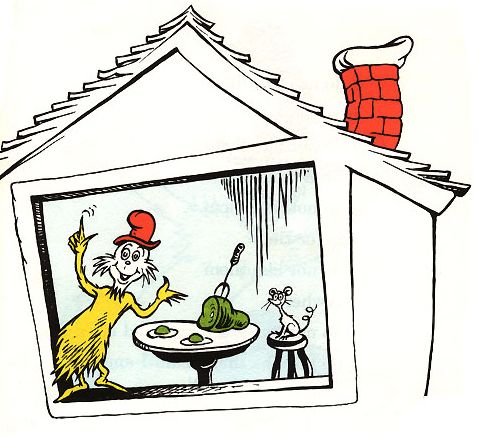
Have you ever read the Dr. Seuss classic, “Green Eggs and Ham”? In this early childhood reader, the narrator (nameless) is accosted by an enthusiastic character named Sam (Sam I Am), who wants him to try a dish called green eggs and ham. But the narrator refuses. Sam keeps offering, but the narrator continues to refuse, saying he does not like green eggs and ham, and will not try them under a variety of circumstances (in a box, with a fox, on a train, in the rain, etc..) offered by the optimistic Sam.
Finally, Sam’s persistence wears down the narrator’s resistance, and he agrees to try the dish. To his surprise, he LOVES them. In his newfound enthusiasm, he declares he WILL eat them in a box, with a fox, in a tree, in a boat, with a goat, on a train, in the rain, here or there…in fact, he WILL eat them anywhere! He ends by thanking Sam.
So what does a children’s book have to do with prayer?
Well, I believe that the pursuit of prayer as an integral part of living a Christ-like lifestyle is kind of like green eggs and ham. Most people who dismiss the power of prayer have never really pursued it. They have seen it, heard about it– maybe even gotten a whiff of it. They may have “sampled” prayer many years ago as a child or in a single moment of desperation. And the result was disappointment or confusion. Prayer didn’t solve all their problems in an instant. They didn’t get the miracle they hoped for. They didn’t get the bike for Christmas. Their neighbor’s leukemia wasn’t cured. Their situation at work got even worse. Their wife still left and filed for divorce. “Prayer” left a bad taste in their mouth. And they have heard others dismiss prayer and faith as obsolete, ignorant practices, designed for backward and unenlightened people. Like the slightly nauseating color of green eggs and ham, prayer has been deemed unappetizing and best avoided.
And now, when someone mentions a lifestyle of prayer– when someone talks about praying as a daily habit, or a natural part of their worship–the reaction is scorn and suspicion. Prayer doesn’t look powerful. It doesn’t look appetizing. How can something so simple and tame have any effect? Why is the world still suffering so much injustice and evil if there are people out there praying every day? And why do Christians (and others with a prayer tradition) cling to prayer as though it will solve life’s problems?
But prayer, like eggs, can have a bad reputation. For years, we were told that eggs were awful for you– high in protein, yes, but also high in cholesterol, and likely to contribute to diabetes and colon cancer. Recent studies contradict each other, but many now say that eggs are actually good for you. Similarly, during times of crises or disasters, prayer is often derided as inactive and ineffective, and we get mixed messages about people who offer to pray for victims and their families.
Recently, I was challenged about my pursuit of prayer. What good does my prayer do in the face of injustice and disease, death and suffering that people experience? Why do I pray to a God that allows bad things to happen? I have been challenged before, and my answer remains the same. I pray because I have known the peace that comes from trusting God’s wisdom, HIS timing, and His Love for each of us. I don’t have answers for all the “what-ifs” or the “whys.” But I continue to trust that God DOES! And daily prayer is not about “me,” or my questions or what I wish for. It’s about communing with the God who has been faithful all my life and continues to be faithful in every season. The God I love, and the God who knows the end from the beginning.
So what if more of us prayed daily– not just as a reaction to disasters– but pro-actively? What if we prayed, not in anger or bitterness, not transactionally, expecting a particular outcome, but with gratitude for who God is, what He has already done, and what He will choose to do in His loving sovereignty? What if we prayed with open minds and hearts, trusting that we are talking to a God who loves us and knows what is best, not just in the temporary, but in the eternal scope of our lives? We would still see evil in this fallen world, but what if our prayers DO make a difference– we just don’t see the whole scope of what God has provided, or the evil He has NOT allowed to touch us?
I speak as one who has pursued prayer for more than half a century. I’m not perfect. Sometimes, I get frustrated when my desires don’t align with God’s answers. But that’s not the fault of Prayer. Prayer DOES change things– maybe not instantly, and maybe not in the ways I imagine in the short term– but I have seen and experienced the power of prayer. I have felt it in my own life, and I have seen in in studying history and talking to people whose lives were radically transformed by their prayers and the prayers of others.
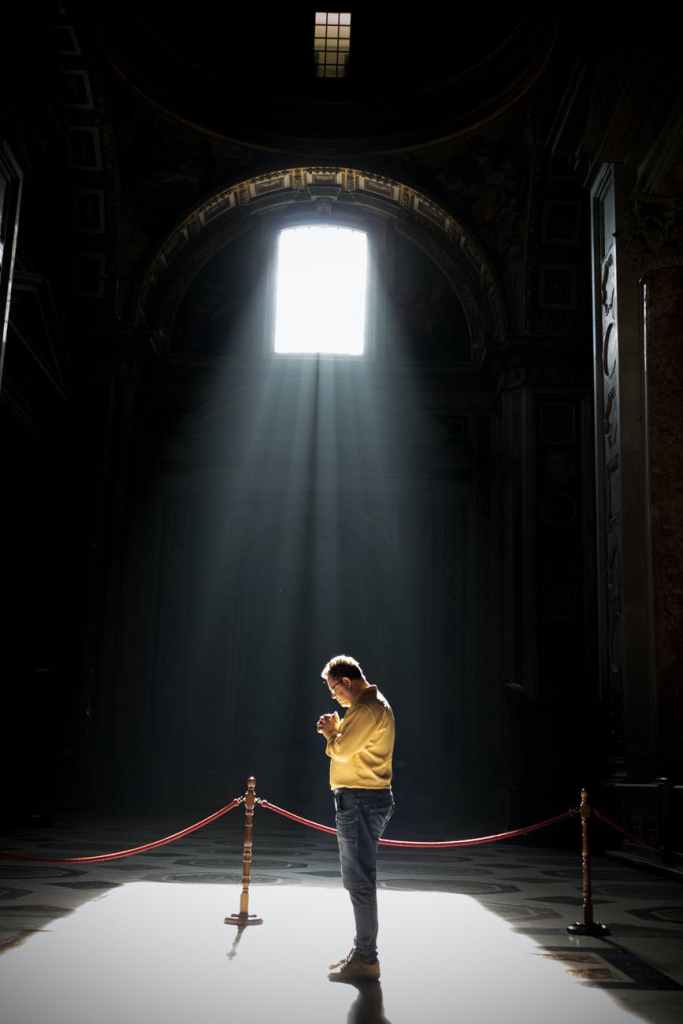
In every situation, we can pray. So, to paraphrase Sam I Am, I WILL pray here and there! I will pray most anywhere (except I won’t close my eyes if I am driving!) So to end:
“I’ll be praying in a boat, I could be praying with a goat. I may be praying in the rain. Or in the dark. Or on a train.
And in a car (eyes open of course). And in a tree. Because Prayer, it is so good, you see!
So I would still pray in a box. And I would still pray with a fox. I will pray inside my house. And I will pray beside a mouse.
And I will write “Pursuing Prayer” Because I serve a Lord who Cares!
What if we all had the same enthusiasm for prayer as Sam had about Green Eggs and Ham? What if we keep praying “without ceasing” (1 Thessalonians 5:17) and with confidence (1 John 5:14-15) each day?


































 Pursuing Prayer