Why Ask Why?

I’ve been asking myself “why?” a lot lately in regards to this blog.  Why am I spending my time writing about prayer?  Wouldn’t I be better served to spend my time productively– making something useful, keeping the apartment cleaner, going to the gym–even spending more time in prayer instead of dissecting it and babbling on to an invisible audience?

But the truth is that I began writing this blog in response to another question, a more basic question thrown at me (not personally, but thrown out to all who believe in the power of prayer)–  “WHY?”  They weren’t asking the question because they really wanted to know my reasons for praying; instead, they wanted to make me feel ashamed and embarrassed, to doubt God’s goodness and my faith.  In fact, they weren’t asking “WHY” so much as asking “HOW”.  How can you continue to believe in God and continue praying in light of random shootings, manifest injustices, rampant corruption, and senseless tragedies?  How can you say that God is good, when people continue to get away with evil?  If God exists, where is he, and how can you just sit back and trust in him?

The fact that I DO continue to trust God doesn’t mean I don’t have questions and concerns, and even righteous anger about the state of the world and the tragedies that fill it.  The questions come pouring out, sometimes keeping me awake at night, sometimes catching me at a raw moment– and they are important questions.  To pretend that I never wrestle or struggle with the questions is to say that good and evil, justice and mercy, that God himself– none of it really matters enough to seek an answer.  God forbid!!

But there is a vast difference in asking “Why?” and challenging God by saying “How? or How come?”

pexels-photo-1027931.jpeg

Consider a small child who asks, “Why is the sky blue?”  (Don’t you just love the inquisitiveness of small children?)  “Well…” I can explain that the sky itself isn’t really blue…I can go on to talk about scientific principals– the property of light, refraction through water molecules and dust particles, and more..I can point out that the sky doesn’t always appear blue, etc.  At the end of my long and factual discourse (assuming the child hasn’t already interrupted), s/he is likely to simply shake their head and ask, “But, why?”  WHY?  Because I haven’t really answered the heart of the question.  I explained HOW, not WHY.

Now suppose I don’t feel like being pedantic, and I simply answer “Because.”  You can guess what comes next.  The child will ask, “Because WHY?”  Because “Because” isn’t a sufficiently satisfactory answer.  The child wants more; he/she yearns for more comprehension; more understanding.

As an adult, we find this kind of questioning frustrating and annoying.  I think it is because we have been conditioned to think that questions either have a “How come” explanation that sweeps away much of the wonder and mystery, or a “because” answer that leaves us unsatisfied. We are frustrated by questions to which we already have a pat answer, and we are frustrated by questions to which we have never received a satisfactory answer.

As an adult, I may well ask, “Why is there evil in the world?”  This is an important question; one I should be asking.  Experts can and will give me all kinds of “how” answers– how the brain is wired, how emotions work, how society has failed various groups of people, how political structures create oppression, how religion teaches intolerance, how poor diet or lack of sunny days … there are a million explanation of “how” evil exists or why it persists.  And many of these explanations contradict each other, so they can’t even give a conclusive answer.  But just throwing up my hands, and saying, “just because” does nothing to answer my question OR provide understanding that could help alleviate the effects of evil in the world.  “Because” communicates my powerlessness to comprehend.

BUT

Something amazing happens when I stop merely asking people for answers to these questions and start asking God.  I don’t get a magical, comprehensive, incontrovertible answer to life’s thorny questions.  God doesn’t send me a “cheat sheet” with all the “right” answers.  I’m not suddenly an expert on good and evil or what should be done to eliminate crime and disease and poverty.  I still have to wade through the “how come” explanations and use my limited judgment to decide what course of action I can take to try to make a positive difference.  And I will make some mistakes along the way.  But when GOD says, “Because”, there is an authority, a majesty, and a wisdom that can never be present in my answer.  I say “because,” because I have no more to say; no better answer.  God says, “Because,” because HE IS the answer! And the cause!  And he gives explanations in his word for many of my questions– even if I don’t like the answers!  He doesn’t explain “how come” the sky is blue–even though science can tell me the “how come.” God doesn’t have to explain the blue sky –He causes it to be blue.  “Why is the sky blue?”  God makes it so.  “But why?”  Because He is God and I am not.  God explains “how come” there is evil in the world– it’s called SIN–but he doesn’t leave it there.  “Why?”  Because we have the free will to choose good or evil.  “Why?”  Because God wants willing obedience and loving companionship with us.  “Why?” Because God is love!  “So why does he allow evil to continue?”  Because he has a plan that involves redemption and restoration and renewal.  He is the cause of this plan, he is its author and finisher.  Moreover, he is the cause of my desire to ask “why?”, to seek for a more fulfilling answer, to yearn for a solution to the very evil that prompts my questions.

pexels-photo-490411.jpeg


I won’t stop asking “why.”  Not because I don’t have any answer, or because I don’t know the answer.  It’s just that the answer is so much bigger, so much better, so much MORE than I can handle in the shortness of this lifetime. And it’s important that I not only keep asking the question, but that I keep defending the answer. Because perhaps today, or tomorrow, or every day next week, someone may ask me WHY?

 

1 Peter 3:14-16 English Standard Version (ESV)

14 But even if you should suffer for righteousness’ sake, you will be blessed. Have no fear of them, nor be troubled, 15 but in your hearts honor Christ the Lord as holy, always being prepared to make a defense to anyone who asks you for a reason for the hope that is in you; yet do it with gentleness and respect, 16 having a good conscience, so that, when you are slandered, those who revile your good behavior in Christ may be put to shame.


Finding the Lost

The other day, God answered a prayer I had been praying for about a month. I had lost a letter. Such a small thing, and yet it was priceless to me. It was old, yellowed, and crumbling. I was a letter from a law office, sent in 1933, informing my great-grandmother that her long-lost great-granduncle had died in California. He had not made a will, so his fortune was to be divided between any of his surviving relatives. The law office had found 36 such relatives, one of whom was Lila Green, for whom I am named. The “fortune” had been greatly reduced by the Great Depression– his stocks were worthless, and his properties greatly reduced in value. Still, the share that came to my great-grandparents allowed them to pay off debts, keep their farm, and even invest at a time when others were destitute.

I had intended to scan the letter and include it in a book I am writing about the lives, times, and families of my great-grandparents. But I had put it aside and misplaced it.

Such a dingy, yellowed, fragile letter– just a single sheet in an equally yellowed and fragile envelope with a three-cent stamp still clinging to one corner. I could not remember where I had placed it for “later.” I looked everywhere, or so I thought. And I had prayed that God would show me where it was. It seemed as though God might be telling me to “just let go” of the letter. That it wasn’t necessary for the book, and I was wasting my time looking for it. Still, it hurt to think that my great-grandmother, grandmother, and mother had preserved the letter, just to have me lose it when it could be useful again.

And then, my husband asked me to look for some paperwork to finish our taxes. Oh NO! Surely I could find important papers from the past year– I was pretty certain I knew where they would be. Still, I prayed that God would help me find them quickly. And I did! But as I was putting the financial papers away in the aftermath, I found a book bag behind the box of receipts and tax papers. It looked empty– no books inside– but it wasn’t. There, waiting patiently, was the letter, along with some other old papers I wanted to keep in my family history files!

I was so thrilled! I danced around, thanking God for His answer to my prayer. I was far more thrilled, in fact, over finding that letter, than I was about finding the tax papers!

But what about the “lost” people I encounter each day? When was the last time I put aside my other tasks and spent time “searching” for ways to share the gospel? How much time have I spent reaching out to “find” the hurting, the needy, the hopeless? Have I done more than just say a quick prayer, or shed a couple of tears? Have I even prayed consistently for weeks or even years?

Of course I pray for family members I know and love; for old friends and classmates who are struggling; even for people groups or nations where Christians are being persecuted, and the Gospel is being hindered. But that’s not the same.

This letter reminds me that there are people– many of whom “look” rather worn or worthless– people for whom Christ gave His life to save. People who need someone to listen, and offer hope. They need to be “found.” Even so, not all of them will accept the Gospel message. I can’t force them to see God for who He really is; I can’t make them choose to follow Christ. But I can do a better job of letting them know how very much God loves them, and wants a relationship with them. Yes, even those who feel yellowed and used; even those who have been sitting, forgotten, lost in the shuffle.

15 1-3 By this time a lot of men and women of questionable reputation were hanging around Jesus, listening intently. The Pharisees and religion scholars were not pleased, not at all pleased. They growled, “He takes in sinners and eats meals with them, treating them like old friends.” Their grumbling triggered this story. 4-7 “Suppose one of you had a hundred sheep and lost one. Wouldn’t you leave the ninety-nine in the wilderness and go after the lost one until you found it? When found, you can be sure you would put it across your shoulders, rejoicing, and when you got home call in your friends and neighbors, saying, ‘Celebrate with me! I’ve found my lost sheep!’ Count on it—there’s more joy in heaven over one sinner’s rescued life than over ninety-nine good people in no need of rescue. 8-10 “Or imagine a woman who has ten coins and loses one. Won’t she light a lamp and scour the house, looking in every nook and cranny until she finds it? And when she finds it you can be sure she’ll call her friends and neighbors: ‘Celebrate with me! I found my lost coin!’ Count on it—that’s the kind of party God’s angels throw every time one lost soul turns to God.”

Luke 15:1-10 (The Message)

I thank God that He helped me find the old letter. But I am eternally grateful that He seeks out and saves people like me, and like you. I pray that today, I will have eyes that see, and a heart that reaches out to the “lost.”

“Idol” Thoughts…

I was in an odd mood the other day, and I started thinking about “Christian” Book Stores. There used to be several bookstores in the area that were “Christian” book stores. They sold Bibles, Bible study guides, devotional guides, prayer journals, hymnals and song books, contemporary Christian CDs, Christian DVDs, and all sorts of “Christian” gift items– tee shirts, wall hangings, jewelry, even candles! If it looked, sounded, felt, or even tasted “Christian” you could probably find it there.

Photo by Pixabay on Pexels.com

Many of these stores are now out of business. And it made me sad at first, but I think it’s worth a little analysis:

Photo by Tim Douglas on Pexels.com
  • Maybe the most obvious reason why any store or set of stores goes out of business is the law of supply and demand. As more and more Christian book stores popped up, they filled the market with more and more “stuff.” Every store had Bibles and books, but the demand was for “stuff.” Bracelets and CDs, Mother’s Day gifts, Christmas- and Easter-themes decorations…Bibles were relegated to the back of the store on a couple of shelves. And most of the stores ended up with the same “stuff” as the other stores– the same candles and t-shirts and throw-pillows and coffee mugs with the same “Christian” sayings. Other store chains caught on– you could buy the same coffee mug or DVD at Hobby Lobby, or Walmart– at half the price! And, of course, with e-publishing, streaming services and Spotify, etc., books, DVDs and CDs are almost a thing of the past, anyway. Years of buying “stuff” has resulted in families who can’t even give away all their “precious” used art and decorative items from 20 years ago. The demand just isn’t there.
  • More subtle is the psychology of the “Christian” Book store patron. Buying mugs and key chains and bracelets at a “Christian” book store is a form of virtue signaling. Buying a t-shirt with a provocative Christian message can make you feel like you’re witnessing for Christ– without actually having to engage in conversation or develop a relationship with anyone! That feels great for awhile, but the reality is that feelings and virtue signals change. It’s not trendy to wear WWJD bracelets anymore– it’s not even trendy to be a “Christian” anymore–much better to be an open-minded, accepting, and loving “Christ follower.” “Christian” has a bad connotation these days– judgmental, narrow-minded, and hateful. People who used to proudly stroll the aisles of Christian book stores are now full of disclaimers about their church affiliations.
  • More subtle still is the psychology of the “Christian” Book Store itself. There really is no such thing as a “Christian” book. There are books written by Christians, and about Christians, and for Christians, but a book is an inanimate object. It cannot be a “Christian” or a “Christ Follower,” or a “Believer.” The same is true about any of the other products sold at any store. There are no “Christian” pot holders or hand lotion sets or wall art. A store catering to a “Christian” audience must not expect to be wildly popular in a secular world. We don’t see a trending wave of Buddhist book stores or Muslim book stores, or book stores specializing in Wiccan coffee mugs– though we may see such trends come and go in the future.
Photo by Inna Lesyk on Pexels.com

What makes me saddest about the disappearance of the “Christian” Book stores is not that there are fewer cool t-shirts to consider buying, or that I have to travel farther to find a bookstore with a great “Christian” Sci-fi section, or a larger selection of devotionals. It is that, on some level, my “Faith” became an idol. I filled my bookshelf with “good” books, while neglecting to read the most important book of all. I spent time browsing aisles of great music, but less time singing from my own heart. I spent money on items that proclaimed my Faith, but spent less time and energy living it out.

There is nothing “wrong” or sinful about “Christian” Book Stores. I am very grateful to live in a country where I can freely shop for Bibles, and even a couple of throw pillows that remind me how much God loves me. I love that I can wear cross necklaces, or listen to wonderful songs about Christ without facing imprisonment or torture. But I want to be careful not to take for granted a culture that makes following Christ easy. I don’t want to worship the “Christian” culture and not the Christ it claims to love.

Photo by Tara Winstead on Pexels.com

One of the first items I remember not being able to find in the “Christian” Book Stores was a prayer journal. Oh, they had several leather-bound journals where you could write notes, or ones that had “prayer prompts” written on gilt-edged pages. But I wanted one like the one I had found years before– it had pages with information on various people groups around the world as prayer prompts, and space to list names and even answers to prayer. I have since created my own notebook-style prayer journal that tries to replicate that older one.

Photo by Pavel Danilyuk on Pexels.com

And perhaps that is a good thing. “Christian” books promise a lot–journals that prompt us to pray; devotionals that basically do the “worship” for us; even Bibles that speak to us in comfortable language, so we don’t struggle with unfamiliar words. But ease and comfort do not produce growth. “Christian” book stores do not necessarily produce strong Christians, either. Only Christ, through the work of the Holy Spirit, can do that. Christian Book Stores can be a valuable tool, or an idol.

God Doesn’t Vote

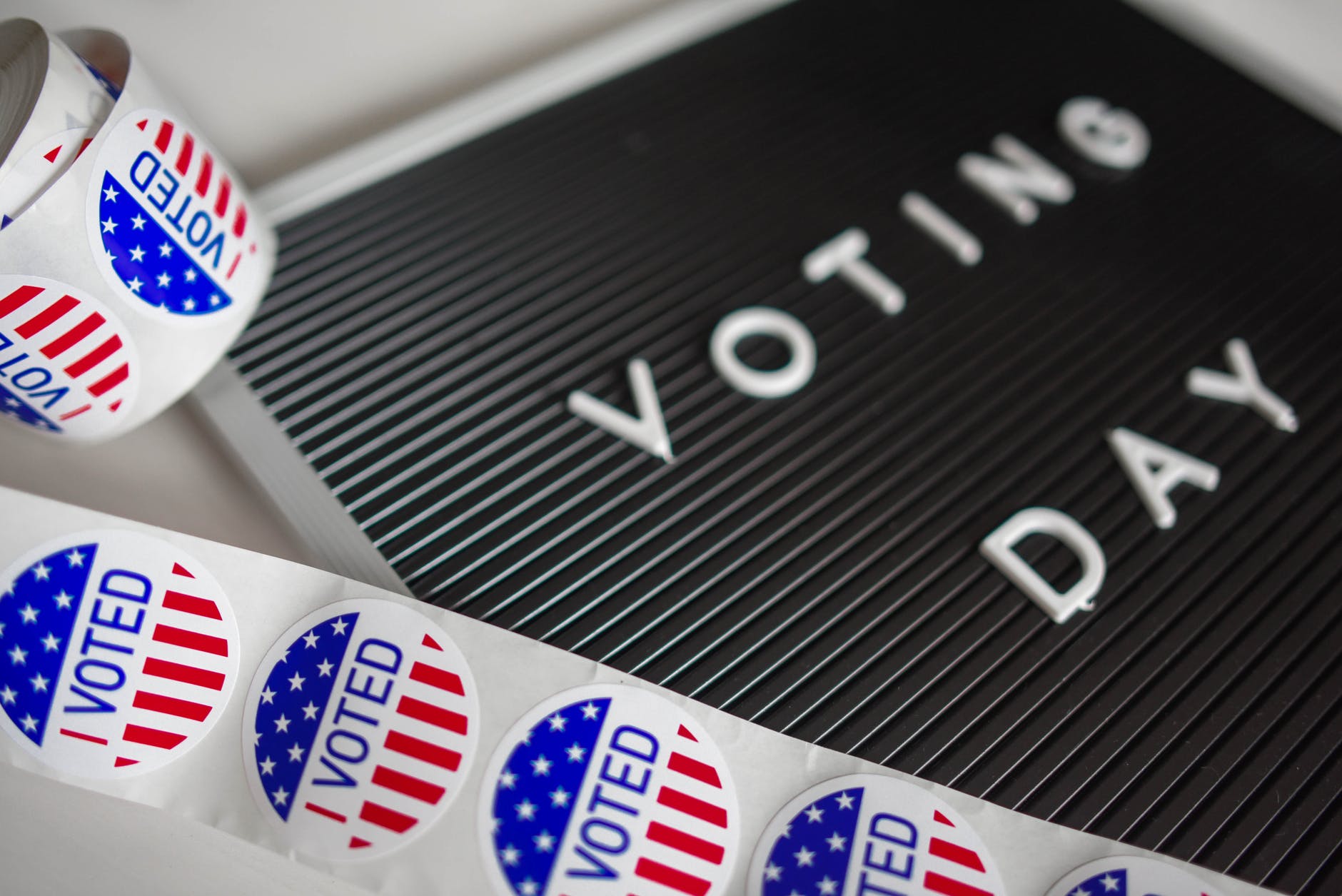
Tomorrow is election day in America. People have been “early” voting for weeks; many will be voting tomorrow, myself included. And then we will watch and wait.

Photo by Element5 Digital on Pexels.com

Pundits and professional pollsters have been trying to predict the outcome for months. They will go at it for the next several days (if not longer), trying to analyze, synthesize, and dissect the voting patterns in various regions to explain why this candidate won, that one lost, or why this race is “too close to call.”

Photo by Element5 Digital on Pexels.com

Meanwhile, many Christians will be doing the same thing in their living rooms, Bible study groups, and neighborhoods. Is America under God’s blessing or His curse? Is this election God’s judgment, or a second chance?

Photo by Markus Spiske on Pexels.com

But God doesn’t “vote.” God is sovereign; He can direct the outcome of elections. He can raise up rulers and bring them down again. He can raise up a nation from nothing or tear down empires. But God doesn’t act on our whims or even on our fervent beliefs about politics, economics, social action, or social issues. He acts on HIS plans and in His wisdom. He asks us not to vote for Him, but to trust and obey Him!

Photo by Magda Ehlers on Pexels.com

I will vote for candidates and issues based on prayer, research, and hopefully, with God’s wisdom. But my vote is not the same as my everyday witness of how God is working in His world. I can vote for the “right” candidates or principles and still disobey God’s commandment to “love my neighbor as myself.” I can vote for the “wrong” candidate, because I am focused on what she says, and not how she treats the people around her, or how she honors God by her actions. I can not vote at all, and still work to spread the good news of the Gospel.

Photo by Toni ph on Pexels.com

God wants His people to live “in the world.” He wants us to be good citizens, interacting with those around us, even getting involved in causes, movements and social issues. But He also wants us to seek His Kingdom first and foremost (Matthew 6:33). Whether we live in a nation that has free elections; whether we vote red or blue (or purple or green); whether we take an active role in politics or sit on the sidelines– we should act in a manner that honors Him above our own ambitions or preferences. And if our candidate(s) should lose; if our nation adopts policies that continue to devalue life, denigrate families, and dishonor God– that does not give us the right to seek violence, retribution, endless recounts, or haughty isolation. We must continue to DO the right thing, in the right way, for the right reasons. We must continue to pray for our enemies, and bless those who curse us. We must continue to tell the truth– IN LOVE–and be ready to joyfully explain the hope that is in us (1 Peter 3:15).

Photo by cottonbro on Pexels.com

God doesn’t vote. He does love ALL those who do!

On The Witness Stand

Last week, I was called upon to give testimony in court as a witness to a crime.  The crime itself occurred months ago, so I was very nervous, trying to remember the sequence of events, and trying to make sure I didn’t add or leave out important details.

There is a reason the judge asks for “the truth, the whole truth, and nothing but the truth.”  It is very easy to exaggerate, to leave out details that may reflect poorly on us or on those we know, or to add commentary or opinion.  Even the way a lawyer asks a question can evoke a certain memory or reaction that is more or less than the original event warrants.

close up court courthouse hammer
Photo by Pixabay on Pexels.com

As hard as I tried, I couldn’t tell the entire “truth”–not because I lied or withheld evidence, but because I only witnessed a portion of the crime, and because I don’t have total and perfect recall.  No one does.  Three witnesses may testify and get certain details “wrong” or mix up the sequence of events, or be confused or hazy months after the event.  Even seeing the same event from a different perspective can alter one’s testimony.  One person hears a conversation clearly, but cannot see one speaker’s facial expressions or gestures.  Another sees the event close up, but cannot see what is happening “behind the scene.”  One person’s personal biases may come out in the way they give testimony, even if they are unaware of it. While I hope and believe that I told the truth as I witnessed it, my witness alone is not enough to determine the defendant’s guilt or innocence–nor should it be.

The ninth Commandment (in Exodus 20) warns about giving or “bearing” false witness.  We usually equate this with lying, but it is more than telling “a whopper.”  Bearing false witness includes spreading rumors, “sharing” questionable posts, omitting facts, and even “faking it” until you make it– pretending to be what we are not; hypocrisy, and false appearances.

man person woman face
Photo by Gratisography on Pexels.com

As a follower of Jesus, I am a full-time witness.  This is far more important even than being a witness in a court case.  I should always speak and behave as if I am “under oath.”  Not just when I know all eyes may be watching; not just when I’m with other “witnesses.”  Always.  This doesn’t mean that I aggressively volunteer my opinion and beat people over the head with commentary everywhere I go.  It doesn’t mean that I smile and say only what I think others want to hear.  It means that I speak less than I listen, but when I speak, it is truth–loving, sometimes harsh, spoken with the intent to help, heal, encourage, challenge, and bring justice.

black women casual daylight eyeglasses
Photo by Christina Morillo on Pexels.com

In prayer, it means that I repent of falsehood, pride, envy, anger, and bitterness.  It means that I acknowledge God for who He is, and myself for who I am in Him.  It means that I ask for wisdom to seek and see truth, and to see through deception and falsehood–even in my own heart and mind.  And it means that I thank God for His Truth, which is perfect and victorious.  I pray that the Truth will shine in, around, and through my life and my words, and in the lives of others.

abstract beach bright clouds
Photo by Pixabay on Pexels.com

man and woman wearing brown leather jackets
Photo by Vera Arsic on Pexels.com

Many people will point out when I get it “wrong.”  They will point to other Christ-followers, other “witnesses” whose lives may look different from mine, who speak differently, act differently, vote differently, even worship differently than me.  And I need to trust that the “whole” truth will come from each of us bearing honest and full witness to what we know and experience of God’s goodness, His power, and His love.  I don’t have the “whole” truth– but I am a witness of the one who IS the whole Truth!

Blog at WordPress.com.

Up ↑