As Far as the East is From the West..

In blogging about prayer and in keeping a prayer journal, there is one type of prayer I don’t dwell on very often.  Prayers of confession and repentance are very important, but I don’t  include them in my journal and I don’t spend much time analyzing them.  It’s not that I want to ignore them or that I want to give a false impression that I don’t say them.

arrogant

I’m a saint–but only in the sense that Christ’s blood is my atonement and my only hope of salvation.  He who started the work is still working, and there’s a lot of work yet to be done.  So, while I include prayers of confession and repentance in my practice of pursuing prayer, I don’t write them down or share them publicly.

Photo by Mikhail Nilov on Pexels.com

Here are some of the reasons I don’t spend more time talking about confession:

trueconfessions
  • Confession is not meant to be a public spectacle.  It is generally private and very personal between an individual and God.  Apologies may be public, and repentance may include public atonement or recompense, but those are not prayer; rather they are the actions taken in conjunction with  and as a result of prayer and confession.
  • Confession is fundamental– it’s not a prayer option, or a stylistic preference–every one of us has sinned, and we all need to admit to our sins, bring them before the throne of God’s grace, and ask for his forgiveness.  Hiding sins, denying sins, or lying about them will get in the way of all our other prayers.
  • Writing about past sins keeps them alive and keeps the focus on me and on my faults, rather than on God and on His Grace.
  • Making confession public has a tendency to devolve into gossip and self-justification.  Descriptions of my sinful actions will necessarily be from my incomplete and very biased point of view.  Other people can be misrepresented and hurt.
  • But the last reason is my favorite– I don’t waste time writing down and discussing past sins because GOD HAS FORGOTTEN THEM!  Writing them down, rehearsing them, analyzing them–even analyzing how I might approach confession won’t change God’s response:

10 he does not treat us as our sins deserve
    or repay us according to our iniquities.
11 For as high as the heavens are above the earth,
    so great is his love for those who fear him;
12 as far as the east is from the west,
    so far has he removed our transgressions from us.

Psalm 103:10-12 New International Version (NIV)
  • The key is that we DO confess– humbly, consistently, and with a heart of true repentance.  What follows is a free and forgiven conscience, no longer weighted down or pulled off focus by guilt and doubt.
pexels-photo-941693.jpeg

Cautious or Courageous?

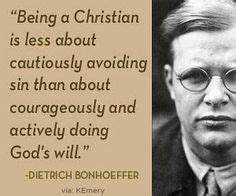
Being a Christian is less about cautiously avoiding sin than about courageously and actively doing God’s will.

Dietrich Bonhoeffer

Dietrich Bonhoeffer was a German pastor and writer who ended up sacrificing his life as he protested the Nazi regime in his homeland. Many of the things he wrote are uncomfortable for modern Christians to read. Sometimes, we want to coast along, joyfully celebrating our own Salvation, and ignoring the evil around us. After all, the ultimate victory is already won in Christ, isn’t it?

I write a lot about the power of prayer. And I stand behind what I write. But a life of prayer and Bible Study that doesn’t result in actively living out and spreading the Gospel is a life of lukewarm and selective obedience. This is not to say that we should skitter around trying to earn our Salvation with random acts and self-righteous crusades. But we must have the courage to “come out of the closet” as Christians in a dark and unfriendly world.

Photo by Pavel Danilyuk on Pexels.com

What does this look like? Does it mean wearing a badge or getting in people’s faces with “the Truth.” Perhaps. But mostly, it means every day living out the kind of love and truth that Jesus demonstrated. Jesus didn’t march in protests, hand out pamphlets with convicting messages, or start arguments to humiliate atheists in front of crowds. But He didn’t back down in the face of arguments and tough questions asked by His opponents. He ate with sinners– but He didn’t wink at their sin, or send them away reassured that they were “good enough” to please God. He went where God sent, spoke God’s Truth, and DID God’s work.

Jesus wasn’t a writer; He wasn’t a professor of Theology, or an elected official. The Pharisees were constantly frustrated with His lack of “credentials.” But their frustration came because Jesus spoke with the kind of authority they could never achieve– Jesus was authentic. He spoke, not from cold and lofty intelligence, but from wisdom and love. And Jesus didn’t just speak. He served. He listened. He lived out all that He spoke. He “courageously and actively” DID the will of the Father.

Jesus prayed and studied scripture. Jesus spent time alone communing with the Father. He spent time in rest. He spent time being social with His family and friends. But in every activity, He wove in the Truth of God’s word. And crowds followed Him. They wanted to listen, even as He spoke uncomfortable truths. And some of them came to love Him. Others came to hate Him, and even kill him.

We can’t be true followers of Christ and not risk being mocked, and hated. We WILL be misunderstood, laughed at, persecuted, ignored, and inconvenienced. We should not invite this with obnoxious or arrogant behavior. But we must not shrink away from it when it comes at us, or try to avoid it by being silent in the face of evil and injustice.

One of the recent charges leveled against Christians is that we meet evil with “thoughts and prayers” but little action. We must be wise and careful with such charges. Often, the taunt is thrown at us in an effort to get us to take a specific, ungodly “action” INSTEAD of praying. But we must honestly examine ourselves and ask what Godly actions SHOULD I be taking to make a difference? What actions should I be denouncing as ungodly, even if they are popular and seem to be “right?” And what must I do to defend the power of prayer in the face of ridicule?

Photo by Mikhail Nilov on Pexels.com

One of the other charges leveled against Christians is that we are “intolerant.” Again, we need to be wise and careful in answering this charge. Are we quick to judge others, while giving ourselves a “pat on the back” for merely avoiding a particular sin or sinful lifestyle? What is if about our life and work that makes others see us as “intolerant?” Are we exclusive and prejudiced in our interactions? Or are we humble in presenting the truth of God’s word? Do we speak from a need to defend our own actions or from a desire to help others? Are others offended by our words and actions, or by the truth of God as it convicts them?

Photo by Ketut Subiyanto on Pexels.com

I pray today that I would be courageous and active in LIVING the Christian life, and not merely writing about it.

How Will You Be Remembered?

Today would have been my paternal grandmother’s 118th birthday. I have many memories of my grandmother, and I wish more of them were pleasant.

I remember dreading time spent at Grandma’s house. She wasn’t a horrible woman, but she was not peaceful or kind or warm. Her house was small and dark, with cobwebs and dust bunnies in the corners and under furniture. There were very few toys, and most of them broken. Grandma always wanted my sister and I to be still and silent, and I always had the feeling that she dreaded our visits as much as we did. I had a cousin who loved it when we came over, because she was just a bit older and an only child. If the weather was nice, Grandma would send us all outside, and my cousin would dare us to climb trees, or jump over a pit or some other physical (usually dirty and dangerous, too) activity. When we came in, Grandma would frown and comment on how dirty and sweaty and noisy and un-ladylike we all were.

Photo by Anna Shvets on Pexels.com

Growing up, I didn’t think of Grandma as someone who had ever been young, and noisy, or happy and excitable, or awkward and easily hurt. She seemed to have been perpetually old and cranky and bitter. In hindsight, I can see how circumstances– being the middle child of seven living on a farm; starting her married life living in with a bossy sister-in-law and verbally abusive father-in-law; losing her husband when he was only 50–had been allowed to shape her character in negative ways.

Photo by Karolina Grabowska on Pexels.com

There are some pleasant memories, and I cherish them. Grandma was a good cook. She made wonderful chicken dinners, and a strange candy out of mashed potatoes and peanut butter. She always had cold tea on a hot day. I knew that she loved my dad, and that she could be proud of us, in her own way. I was sorry when she died. Sorry that I hadn’t made more of an effort to know her better. Sorry that she had chosen bitterness, and that I had chosen to stay distant from her.

I write all this, difficult as it is, to say that Grandma–both her good and bad qualities–lives on in my memory as someone I would not choose to be. I don’t want to grow old like her. I don’t want my family members to dread spending time with me while I live, and dig deep to remember something good about me when I’m gone, or justify my bitterness and negativity.

Photo by Nishant Aneja on Pexels.com

My grandmother claimed to be a woman of faith. And it is not my place to be her judge. But I saw very little evidence of faith in her daily life. I cannot remember ever hearing her pray. She did not attend church. She had a Bible, but I never saw her reading it. Her better qualities, and her walk with Christ were overshadowed by rancor, bitterness, anger, hurt, and pettiness. I do not want that to be my legacy. I want people to know, not just from my words, but in my actions and choices, that God’s love lives in me, brighter and stronger than memories of Grandma.

Photo by Andrea Piacquadio on Pexels.com

Shortly before her death, I ended up spending an afternoon with Grandma– just the two of us. She had moved into a small apartment in town, and somehow, it transpired that I had to be in town on Saturday morning for a school event, and no one could pick me up until that evening. We were forced to keep company. It began awkwardly, but as we talked, Grandma opened up about her childhood, her love of music, and more; she asked about my time at school and my love of history. It is the single most pleasant memory I have of her, and I wish there had been more afternoons like it; more afternoons to bond; more afternoons to cherish, rather than dread.

After her death, I learned a couple of things about my grandmother– things I wish I had known earlier. I found an old copy of her high school yearbook, which contained a story she had written. Grandma’s story was full of wonderful details and imaginative characters. She was a writer– and I never knew! I also found out that Grandma not only loved music, she was a singer– an alto, just like me. At some point in her life, she stopped writing, and she stopped singing. I hope that, even if I never saw it or heard it, that she never stopped praying. And I hope that when I’m gone, those who remember me will never have to wonder if I sang, or wrote, or prayed.

Photo by Edu Carvalho on Pexels.com

Show, Don’t Tell..

A fundamental piece of advice for writing fiction is “Show, don’t tell.” A good writer will use words to paint a picture or set a mood. Poets and songwriters are masters of this advice. Metaphors, analogies, figurative language, even alliteration– all create memorable images with very few words.

Photo by Akshar Dave on Pexels.com

Jesus (hardly surprising, as He is the Word of God) was a master storyteller, using parables that we still recognize and identify with today–mustard seeds and prodigal sons, good Samaritans and lilies of the field– Jesus didn’t “lecture” about forgiveness or holiness or love; He provided word pictures, even as He demonstrated each concept in His actions.

Photo by Cindy Gustafson on Pexels.com

When Jesus was getting ready to return to Heaven, He commanded His disciples to “Go and make disciples of all nations.. (Matthew 28:19 NIV) He also said to “Go into all the world and preach the gospel to every creature..(Mark 16:15 NKJV). And as I review Jesus’ methods and actions, I see that I need to make some changes.

Photo by Ketut Subiyanto on Pexels.com

I need to listen more and lecture less. I need to spend more time with those who are shunned by the “righteous,” but cherished by God. I need to spend less time defending myself and more time testifying about Jesus. And I need to spend less time “telling” and more time “showing” love, obedience, joy, mercy, peace, and hope.

Photo by ThisIsEngineering on Pexels.com

This doesn’t eliminate the need to talk and write and “tell” about God– but I want to learn more about doing it God’s way!

Time Flies

Yesterday had 24 hours, the same as every other day. Yet it seemed to zoom past, leaving me “behind” in getting my blog ready for today. So here I am, writing “under the gun” so that I can publish today.

Photo by Ivan Samkov on Pexels.com

Blogs like this don’t have “deadlines” in the sense of print publications or broadcasts. I don’t have advertisers or managers demanding that I have content by a certain time or date. There are no editors to determine the length of any particular blog post. This one is likely to be shorter than most, in fact. And God isn’t standing by waiting to scold me for being late today. It is my own sense of expectation that gives me grief.

But God has placed all of us in time and space with a purpose. We do not have the power to “stretch” time, to reclaim it, or to bargain for more of it. Time “flies”–and what we do in the time we have flies, too. And He wants us to give our time to Him first of all.

Photo by Rakicevic Nenad on Pexels.com

Falling behind on a blog entry is not a life-or-death matter. Falling behind in life is another matter.

I pray that today will be a productive day, a restful day, even a challenging day– and that, as it flies by, we will fulfill God’s purpose in it. And He’ll take care of the timing!

I Can Do All Things..

I know many Christians who cite Philippians 4:13 as their favorite verse: “I can do all things through Christ who gives me strength.” And while this is a powerful verse, and holds great promise, I think it has been misused and taken out of context too often in recent years.

The Apostle Paul wrote this– from a prison cell as he awaited trial and a likely sentence of death! And this thought is a summary statement. It follows a list of circumstances in which Paul had experienced needs, and questions, and setbacks, and lack of provision.

Photo by Nandhu Kumar on Pexels.com

In this season of “sheltering in place,” I have a new appreciation for Paul’s letter. I am not in jail, but there are many restrictions (temporary, but seemingly endless) on where I can go and what activities I can pursue in light of the COVID-19 pandemic. I cannot “do all things” in any normal sense. My family could not gather for Mother’s Day this year. We cannot have friends over for a meal, or take our grandchildren to the movies, or meet together for a traditional church service on Sundays. I cannot open my little shop to customers. I can’t go and get a haircut or hang out at the bakery or coffee shop.

Photo by Cliff Booth on Pexels.com

And there are others who are struggling, not just with restrictions, but with increased expectations. They cannot “do all things” to help a dying patient, or stop the spread of infection in their nursing home or hospital ward. They cannot answer frenzied questions about timelines and protocols. They cannot work effectively from home and still be available to their children as both parent and surrogate teacher. Or, they cannot meet the needs of their students without face-to-face interaction.

But Paul is not talking about the mere completion of a worldly task, or achieving a personal goal. Paul isn’t suggesting that he (or anyone else) can do anything and everything he might want to do or that others might wish him to do. He has just finished talking about times of lack, of wants and needs and facing uncertainties. Paul did not (even with Christ’s help) skip lightly around Asia Minor, making friends and influencing people.

Photo by Ylanite Koppens on Pexels.com

So what DID he do? What did he mean by “all things?”

Paul speaks often throughout his letter of “running a race.” Paul learned that in all circumstances, with whatever resources, whatever restrictions, and whatever obstacles, he could “run” his race. Under persecution or in times of great success; in times of plenty, or in times of hunger; in prison or on the road (or seas); in Jewish synagogues or Greek amphitheaters; alone or in crowds– Paul could worship God. He could proclaim the Gospel. He could spread the love and grace of Christ Jesus. If he couldn’t travel, he could still speak. If he couldn’t speak, he could write. If he couldn’t write, he could pray. He could do “all things” that were necessary to accomplish his one goal– to run the race; to finish strong; to live a life of purpose and worship.

Photo by Pixabay on Pexels.com

May we do the same today, through Christ, who gives us strength. I may not be able to gather with friends, but I have the blessing of being able to call, or e-mail, or IM, or send encouragement. I can still write this blog. I can still pray– in fact I have more time to do so! I can do “all things” that will fulfill my purpose and bring honor to God. And so can you. What a privilege–no matter where we are or what our circumstances!

Photo by Porapak Apichodilok on Pexels.com

Writing the Next Chapter

Welcome to the year 2020! The next 366 days stretch before us– new, unknown, and ready to be discovered, experienced, LIVED!

Photo by nappy on Pexels.com

It is tempting to make bold plans, resolutions, or vague wishes for all the days at once– trying to fold the entire year into a single goal or set of goals. But is this consistent with Biblical principles?

Today, I want to pray, as Jesus did, that God would “give us THIS DAY our daily bread”– that I would walk and talk with my Savior each day, each moment as it comes. That doesn’t mean that I make no plans or goals for the future; rather, I keep things in a proper perspective. God knows the future much better than I do. I know where I am and where I’ve been (hopefully!), but only God knows everything that lies ahead. My job is not to dream about the finish line, but to continue running the race– step by step and moving forward, my eyes fixed on Jesus:

Photo by Pixabay on Pexels.com

Therefore, since we are surrounded by such a great cloud of witnesses, let us throw off everything that hinders and the sin that so easily entangles. And let us run with perseverance the race marked out for us, fixing our eyes on Jesus, the pioneer and perfecter of faith. For the joy set before him he endured the cross, scorning its shame, and sat down at the right hand of the throne of God. Consider him who endured such opposition from sinners, so that you will not grow weary and lose heart.

Hebrews 12:1-3 (NIV) taken from http://www.biblegateway.com

Life is like a long race; it’s also like a story. As we enter a new year, we can look around and see where the story has brought us. Some of us are in crisis. Some of us have just defeated a giant, or survived a trip down the raging rapids. Some of us are headed for disaster, or about to head into battle. Some of us are caught in a trap and we can’t see any hope of rescue.

Photo by bruce mars on Pexels.com

I can’t change the race course I must face in the coming year. Nor can I change the story I’ve lived so far– I can’t change anyone else’s. But I know this– the next unwritten chapter is in God’s expert hands. God, the author of miracles and second chances. God, who turns shepherd boys into heroic kings; God, who transforms prostitutes into saints; God, who sends Himself naked and shivering into His rebellious creation knowing He will suffer and die at the hands of those He loved into being, and knowing that this death is not the end, but a glorious beginning! This God has a triumphant and joyous ending in store for me– for you!

Photo by Vlad Cheu021ban on Pexels.com

God has given us the amazing story of our lives–and the next chapter is here. God also gives us the amazing opportunity to write the next chapter. He will guide us through the process– bring in new characters and plot twists, or send us to new places through unexpected channels–but we have the power to choose the next step. Today and every day.

My prayer for this new year is a prayer for this new day. Tomorrow, I get the gift of taking the next step; of writing the next sentence!

Photo by Pixabay on Pexels.com

Why Journal?

In this blog, I try to focus on three basic aspects of prayer:

  • The purpose of prayer
  • The power of prayer and
  • The practical pursuit of prayer.

Today, I’d like to just put in a plug for journals as a very practical way to pursue a better prayer life.  For a more detailed list of ideas to get started, please see this page:  Prayer Journal

Journals are as individual as the people who create them, but the very practice of writing and keeping a journal has certain universal benefits.

  1. It develops discipline.  Prayer should be a daily practice, but having a journal can provide structure, accountability, and motivation.  Writing down requests, answers to prayer, questions I want to bring before God, even feelings or events of the day, can help establish a routine and a reason to come back to the same place (physically, emotionally, and spiritually) each day.
  2. It serves as a focus for each day’s prayers.  There are times when prayer is difficult–maybe the stresses of the day are distracting; maybe I just can’t think how to begin because there are so many thoughts running through my head or needs that I want to bring up.  If I begin with items in my journal, and add others to a list, it can be easier to bring order, focus, and steadiness.
  3. It serves as a witness and testimony.  One of the values of writing things down is that it gives me a chance to look back and review.  Sitting down every few weeks or months can reveal how many times God has answered prayers that I’ve already forgotten about.  It can also show how my ongoing prayers for certain situations may reveal changes God has made in my own heart and my own thinking, which sometimes helps me see why God didn’t “answer” my prayer when or how I imagined.

    abstract black and white blur book
    Photo by Pixabay on Pexels.com
  4. It serves as a reminder of God’s general faithfulness.  In times of doubt or pain, it can be encouraging to see and remember how God has helped or healed so many others around me.  Even if it brings up questions, like “Why did you heal that person, and not me”, in the end, there are mountains of examples of God’s care and faithfulness that allow me to see that He works “All things” together for good.  All of which can be written in and added to the journal as a further reminder!
  5. It serves as a reminder of God’s specific faithfulness.  If I look at the list of people and situations in the past and present, I am often overwhelmed at the amount of love that God has showered on me in the form of friends, family, opportunities to meet and be inspired, or share and give kindness.  In big ways and small ways, God has brought in and through my life miracles, amazement, and blessings– so very many.  It is tragic that I can so easily dismiss such blessings, or be distracted by the same worries and fears that God has brought me through in the past.  The journal sparks powerful memories of God’s enduring love for each one of us.
  6. It convicts.  As I mentioned above, it is tragic to think that I can so easily be dissuaded and discouraged by present troubles, when there is so much clear evidence of God’s faithfulness in the past.  But the journal can also show times when I have been unfaithful or lacking in faith.  This is important, not to beat myself up or become despondent, but to turn me back from such behavior and help me get back on track.

    analysis blackboard board bubble
    Photo by Pixabay on Pexels.com
  7. It inspires.  As mentioned above, each person’s journal is unique and personal.  God has given each of us passions and interests that can be brought into our prayer journal.  If I have a heart for missions, I can include prayer requests from missionaries of my acquaintance, or from web sites.  I can research cities and nations and people groups being reached by missions organizations.  If I have a passion for art, I can include drawings and sketches that flow out of my worship time.  My journal (and yours) can be filled with unique expressions of our heart for God– our deepest questions, hopes, worries, aspirations, and worship.

If you don’t already keep a prayer journal, I hope you will consider starting one.  It’s never too late or “the wrong time” to start one, and it can be as personalized as you wish– keep a notebook, a sketch pad, index cards, a electronic journal, a calendar– whatever works best for your resources, your personality, and your needs.


I-Bug

It started out small– a glItch, really.
Every tIme I began to type, the same thIng would happen.
At fIrst, I barely notIced.

After all, It wasn’t lIke I couldn’t read my own wrItIng.
It wasn’t In every lIne or word;
It was a sIngle letter.

But then It began to spread.
As tIME passed, It becaME more dIffIcult.
I notIced a theME.  I could stIll read the words,
But theIr MEaning was gettIng lost In
SoME way I couldn’t quIte deterMINE.

It was begInnIng to spIll Into MY speech;
IMpossIble to MEnd; MEldIng Into MY mInd’s
NIches, MErgIng wIth MEdIocre comMEnts
And MYsterIous MEltdowns.

I I I I I,

ME ME ME ME ME.

As I and ME took over, yo_ went mIssIng.
ThIngs were s_ddenly less peacef_l…
Even Jes_s seemed sIlent In the dIn of ME and MINE.
SIn and prIde– I co_ld always be fo_nd there.

It was a fast-spreadIng vIr_s– s_rely leadIng to MY r_In:
_ntIl I lIstened to a stIll, small whIsper…
A Holy breath of fresh, clean, wholesome change.

AAAHHH!

Exhaling the I’s and ME’s, and breathing in YOU–
Brought hope and healing; renewal,
Perspective and life.

Where Your Treasure Is…

Our church held a hymn-sing and ice cream social last Sunday.  It was an informal evening service, but we heard testimony of the power of hymns to shape our worship, and to help us remember scripture’s promises.  We also had the chance to just “call out” a favorite hymn to sing together.  We probably sang 15 or 20 hymns that night, and each one had special meaning to many in the congregation.  We treasure certain songs, certain verses, certain stories– they feed our soul, encourage our heart, steel our thoughts, and pour balm on our wounds.

church-bank-wood-benches-161060.jpeg

One hymn we didn’t sing the other night, though it is a favorite of many, was “Sweet Hour of Prayer.”  Sweet Hour of Prayer– lyrics and much more here  In getting ready to post for today, I thought about this hymn.  We treasure the thought of prayer being sweet and bringing relief, but do we treasure prayer enough to spend an hour or more at it?  If I add up the time spent in morning prayers of devotion, grace at mealtime, evening prayers, and “quick thoughts to heaven” throughout the day, it probably adds up to an hour…but I spend more time writing about prayer each day than I actually spend practicing it.  And when was the last time I got so caught up in prayer that I lost track of time and spent over an hour at it in one sitting?

pexels-photo-707676.jpeg

In the Sermon on the Mount, Jesus warned that we should not lay up treasures for ourselves on earth, but to store up treasures in heaven, “For where your treasure is, there will your heart be also.” (Matthew 6:21 KJV)  This is true of our material treasures, but also our spiritual treasures, our thought treasures, and our time.  When I hear “Sweet Hour of Prayer,” one of my first thoughts is always, “That would be nice, but I don’t have an hour to spend praying– I’d never get anything done!”  But would I have said that about watching my favorite TV show?  Spending an hour on Facebook or shopping at my favorite store?

God is beyond time– he’s not counting the hours, minutes or moments we spend with Him.  But he feels our absence and our distraction just the same.  He isn’t trying to pull us away from important things to waste our time– he wants to pull us away from the things that weigh us down, worry us, haunt us, and eat up the precious time He has given us.

grayscale photography of people walking in train station
Photo by Skitterphoto on Pexels.com

I have found that when I feel “too busy” to spend time with Jesus, it’s a good time to pause and make time for prayer.  When I do (and it’s not as often as I should), three things happen:

  • I want more!  That time refreshes me, calms my spirit, and removes the burden of  worries, failures, and frustrations.
  • I accomplish more–maybe it’s a case of God re-ordering my other priorities; maybe he just gives me the power to work more efficiently; maybe it’s a miracle–but I find that the “time crunch” I worried about seems to melt away.
  • Jesus becomes “more” to me– I grow closer to Him, and closer to the person He created me to be.

Blog at WordPress.com.

Up ↑