I worked for many years at a public library doing pre-school story time programs. One of the favorite songs among the children was “Head and Shoulders, Knees and Toes.” Children love rhymes, music, and movement, and this song involved all three. Children stood, ready to stretch and bend, point, and sing: “Head and shoulders, knees and toes, knees and toes.” Their hands flew from one body part to another as we sang, faster and faster. “Eyes and ears and mouth and nose; head and shoulders, knees and toes, knees and toes.” Faster and faster, louder and louder, the excitement growing, until the song ended in a breathless shout, “Knees and toes”!
Another favorite was the “Hokey Pokey”, in which we formed a circle and took turns “putting in” and “putting out” various limbs and body parts, “turning (ourselves) about” and clapping. We “put in” our right arms, our left legs, our heads, and “our whole selves.” From the earliest of ages, we become aware of the various parts of our bodies, their names and functions, and how they work together.
As God’s people, we are to be the “Body of Christ” (1 Corinthians 12:12-14) and our bodies are to be His temple(1 Corinthians 6:19). It is important that we recognize how every part of our body needs to be consecrated and ready to serve, to worship, and to reflect God’s Glory.
This is not a new concept. In fact, much of the book of Leviticus is given over to consecrating every aspect of the worship of God by His children. There are detailed instructions for the priests– how and when to enter the Tabernacle; what to wear, what kind of offerings to bring and how to prepare for service. One set of details involves the installation ceremony for the priests. They were to wash from head to toe, before putting on the sacred garments. They were to offer a blood sacrifice, and some of the blood was to be placed or smeared in three places– the lobe of the right ear, the thumb of the right hand, and the big toe of the right foot (Leviticus 14:28).
Scholars through the years have given us many reasons for these detailed instructions (see this link for a terrific overview) https://www.myjewishlearning.com/article/ears-thumbs-and-toes/, and most of them bring out the idea that God wants us to worship and be consecrated “from head to toe.” God has authority over how we choose to use our ears, hands, and feet– He wants purity in our words and deeds. He wants us to listen to Him, obey Him, and follow Him.
The smearing of blood in these three areas also demonstrates a need for atonement– only blood can cover or atone for our lack of attentiveness, our lack of obedience, and our open rebellion against God’s authority. The blood of the ritual sacrifices in Leviticus are a foreshadowing of the ultimate atonement we receive from the sacrifice of the Only True Lamb, Jesus Christ. Christ takes away our sin, and consecrates us to His service and worship– from head to toe!
And, unlike the Hokey Pokey, THAT’S what it’s all about! God gives us His life and purity, His Grace and forgiveness, His divine purpose and eternal Glory when we “put our whole selves” in His hands, and He “turns us all about,” to become more than conquerors (Romans 8:37), a royal priesthood (1 Peter 2:9), and the sheep of His pasture. (Psalm 100:3)
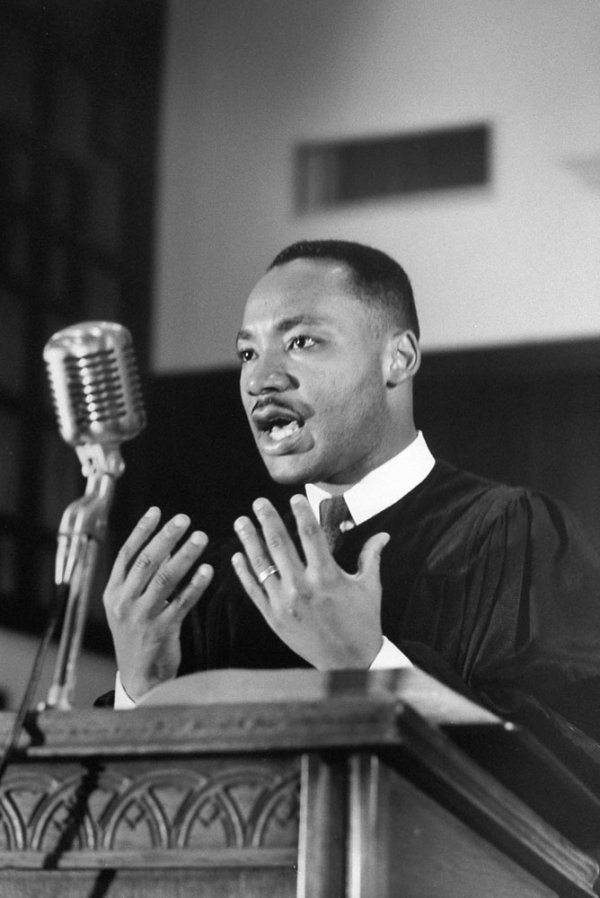
Last week in America, we marked two important dates. We celebrated the birth of a great hero, patriot, and statesman, Martin Luther King, Jr. And we marked the 47th anniversary of the Supreme Court decision, Roe v. Wade, which effectively legalized abortion across the land.
The life of Dr. King was marked by hardship, oppression, violence, and assassination at the age of 39. Dr. King was a brilliant student and gifted speaker. He led peaceful protests and civil rights marches calling for justice and equality under the law for all people. More than 50 years after his death, there are still issues of racial discrimination and racial tensions in this country. The disproportionate loss of life and liberty among blacks in urban areas has led to a new round of protests, some of which go under the name of “Black Lives Matter.” There is a feeling that, especially with the police and government officials, black lives don’t matter– that black lives are devalued and dismissed as less deserving of respect and protection.
In light of this, there has been “push back” from those who argue that “ALL Lives Matter”, or that “Blue Lives Matter” (blue for police who have become victims of mob violence and angry crowds who feel that the police are responsible for racism and corruption). The argument is that groups like “Black Lives Matter” are not so much about bringing awareness or promoting justice, but are meant to divide us as a nation and exact revenge for past offenses, slights, and perceived slights.
There is speculation about what might have happened if Dr. King had not died when he did. Would he have continued leading non-violent protests? Would the Civil Rights movement of the sixties gained more momentum under Dr. King’s leadership? Would our nation have achieved a new dawn of equality, freedom, and unity, greater and stronger than what we have seen in the last five decades? Would Dr. King be pleased with the progress we have made, or ashamed? Did his life make a difference? Yes. But was it “enough” of a difference? Does it matter to a young person of color growing up in Baltimore or Chicago that Dr. King spoke out, marched, and died for a dream that seems frozen in time and unfulfilled?
Just two days after our nation wrestled with that uncomfortable memory, we marked one even more controversial. In 1973, our Supreme Court ruled that no state could prohibit abortion. The decision also limited the ability of states to restrict abortion. Since that decision, an estimated 60 million Americans http://www.numberofabortions.com/ (not to mention infants around the world) have been denied the right by legal practice to be born. This is roughly equal to the number of people killed in World War II, though estimates of both numbers vary by source (https://www.nationalww2museum.org/students-teachers/student-resources/research-starters/research-starters-worldwide-deaths-world-war)
In looking at abortion, we see millions of lives who were determined NOT to matter. They didn’t deserve respect, protection, liberty, education, dreams, food, shelter…not even breath and a heartbeat!
Oh God– let us see life as YOU see it. Every life matters infinitely to You. You have created all life–unique, precious, priceless, glorious, fragile, and yet eternal. You walked among people, healed the sick and broken, reached out to the outcast and isolated, welcomed children, and brought the dead back to life. In Christ, you took on human life– breathed the air, knew joy and pain, weariness, hunger, and strife.
One life– every life– matters. It matters, not because we are important to the world, but because we are precious in the eyes of our creator. We celebrate the life of Dr. King, because we was considered important in the history of our nation. But God celebrated Dr. King’s life from the moment of his conception. God knit him together in his mother’s womb, just as He does for each of us. God knew the moment of Dr. King’s birth. He saw every tear, heard every laugh, felt every bruise that Dr. King experienced. And God knew the moment of Dr. King’s assassination. He knew the shock and horror it would be for his family. He knew that years later, we would quote Dr. King’s words and even argue about his relevance and impact. But Dr. King’s life mattered to God even if it had been a life of obscurity or failure.
Similarly, and incredibly, every one of those 60 million lives that have been lost to abortion “mattered” to God. He knew and loved them from the moment of conception. And He knew– He KNEW– that they would be aborted; thrown away and discarded by those who should have loved and protected them. And He LOVES those who killed them– their lives “matter” to God as well. Dr. King’s dream was that his children would be judged by the content of their character. God will judge us one day on that basis; but He offers to judge us by the content of HIS character, if we will trust Him to forgive us for the past, and transform us as we live for Him.
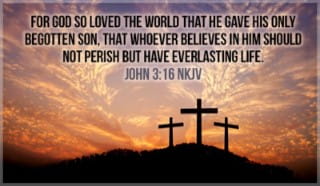
Your life matters to God. It has worth and meaning. You are infinitely precious– so much so that God sent His only son to live and to die for your sake. What an incredible love He has for you! What an incredible love He has for every person you will encounter today!
30 Lot and his two daughters left Zoar and settled in the mountains, for he was afraid to stay in Zoar. He and his two daughters lived in a cave. 31 One day the older daughter said to the younger, “Our father is old, and there is no man around here to give us children—as is the custom all over the earth. 32 Let’s get our father to drink wine and then sleep with him and preserve our family line through our father.” 33 That night they got their father to drink wine, and the older daughter went in and slept with him. He was not aware of it when she lay down or when she got up. 34 The next day the older daughter said to the younger, “Last night I slept with my father. Let’s get him to drink wine again tonight, and you go in and sleep with him so we can preserve our family line through our father.” 35 So they got their father to drink wine that night also, and the younger daughter went in and slept with him. Again he was not aware of it when she lay down or when she got up. 36 So both of Lot’s daughters became pregnant by their father. 37 The older daughter had a son, and she named him Moab; he is the father of the Moabites of today. 38 The younger daughter also had a son, and she named him Ben-Ammi; he is the father of the Ammonitesof today.
I’ve been studying the life of Lot, the nephew of Abraham in the Biblical book of Genesis. The last we hear of Lot is a story of incest with his two daughters, after they have been rescued from the destruction of Sodom and Gomorrah.
Lot’s rescue is filled with its own drama and scandal. First Lot begs the rescuing angels to let him flee to the small town of Zoar, instead of the mountains. The angels reluctantly agree to his request. But here we see that Lot ends up fearing for his life and fleeing again– to a cave in the mountains! As his family is fleeing, Lot’s wife turns back to see what is happening (against the explicit instructions of the angel), and is turned into a pillar of salt. Only Lot and his daughters are left from the wicked but prosperous city of Sodom and its sister-city, Gomorrah.
But the stench of evil and rebellion lingers. Lot is now just an empty shell of his former self–a spineless hermit, isolating himself from what is left of his life. His daughters take control and hatch a ruthless plot to get what their father has denied them– families of their own. Instead of talking to their father, who seems distant and unwilling to help, or pleading their case for justice, they take matters into their own hands. They take turns getting their father drunk– so drunk he is unaware that his daughters are using him for sex–and getting pregnant by him.
The product of this wickedness is the rise of two violent nations who will plague the region for centuries to come. The names of Lot’s daughters are lost to time, but their sons become the ancestors of the Moabites and Ammonites– ruthless tribes who raid and plunder the nation of Israel (among others) over the course of many generations, even though they are distantly related. Time and again, the Israelites will have dealings– mostly bad–with these two people groups.
The Bible doesn’t give us a reason why Lot did not make provision for his daughters. He seems to have made initial provision for them to be married to men from Sodom– he even tries to warn these men to flee the coming destruction. But afterward, he seems to have lost all interest in the future. Even in the small town of Zoar, there should have been some men who wanted to marry. Lot no longer had wealth and power to settle on them, but they were still related to Abraham, and to Nahor– why didn’t he appeal to his family to help with his daughters? We don’t know the reasons. Maybe he was ashamed that Abraham had to rescue him years before; that he had to be rescued again from Sodom’s destruction. Maybe he was too proud to ask for help. Maybe he was too broken to reach out. He had options open to him– he could have reached out– he could have called on the God of his uncle Abraham. But he didn’t. He could have stirred himself to do something on behalf of his two daughters, but he didn’t. He could have freed them to leave and try to find husbands on their own. But he didn’t. Instead, he became a pawn, yet again, in the wickedness of others– this time within his own household. He became the father of two mighty nations– without even knowing it!
And his daughters, having done this wickedness, did nothing to hide it or repent of it. The names of their sons reek of arrogance. Moab sounds like the words meaning “son of my father,” while Ben-ammi means “son of my people.” If Lot’s beginnings/parentage had been somewhat obscure (see https://pursuingprayer.blog/2020/01/13/a-lot-to-discover/), these boys were clearly labeled as the products of incest and intrigue. The Bible never reveals what kind of father Lot was to his sons/grandsons, but their legacy is one filled with bouts of antagonism, conquest, raids, and bitterness. Prophecies against Moab and Ammon are recorded in Amos, Jeremiah, and Ezekiel, among others.
In the middle of all this history, we have a bright spark of hope. In a sweet story of redemption and faith, we meet a young woman named Ruth (to read more, visit https://thebibleproject.com/explore/ruth/), from Moab. Her devotion to her mother-in-law, Naomi, and her gentle spirit catch the eye of Boaz, who marries her and rescues her from poverty and disgrace after the loss of her first husband. Boaz and Ruth become the parents of Obed, and the great-grandparents of King David. Ultimately, Ruth, the descendant of Lot, the scandalous descendant of incest and shame, is listed in the ancestry of Jesus Christ!
Nothing– no act of defiance, no shameful event in your past or your family’s past– is beyond God’s gaze; nor his power to redeem and turn to good. Incredibly, Lot, with all his failures and bad choices; Lot’s daughters, unnamed and guilty of depravity; Moab, father of raiders and betrayers– all of them are in the earthly genealogy of the Savior who would come to die and pay the penalty for their sins. And for our sins. Lot’s descendants may have been ruthless, but thankfully, they weren’t “Ruth-“less! God– though He has the right to reject and despise those who are rebellious, defiant, or just unwilling to follow him– is not ruthless, either. Instead, He watches over us– whether we are living in a wicked sprawling city or a remote cave or fleeing famine, destruction, or poverty–and gives us opportunities to trust His plan for our future and for our good!
I’m continuing to explore the life of Lot in the Biblical story of Genesis. Lot, the nephew of the Biblical patriarch, Abraham, chose to live near, and then in, the wicked city of Sodom. His circumstances have made him wealthy, but they have also made him a pawn and a victim of greed and war all around.
When we left Lot (see Friday’s entry), he had been rescued by his uncle Abram (later renamed Abraham), along with all his possessions, after being kidnapped from Sodom. This might have been a good time for him to move on with his life, make a fresh start, and get away from the wars and wickedness surrounding him. But he didn’t. Nor does he seem to have had any kind of positive impact on his neighbors and friends. The Bible doesn’t mention whether or not Lot joined in any of the wicked behavior of his fellow Sodomites, but he seems to have turned a (mostly) blind eye to it.
The Biblical narrative leaves Lot for a few chapters, to concentrate on the life of Abraham, the changing of Abram’s name to Abraham, the birth of his son, Ishmael, and the promised coming of Isaac. But at the end of chapter 18, the LORD speaks to Abraham about the impending destruction of the cities of Sodom and Gomorrah:
17 The LORD said, shall I hide from Abraham what I am about to do, 18 seeing that Abraham shall surely become a great and mighty nation, and all the nations of the earth shall be blessed in him? 19 For I have chosen him, that he may command his children and his household after him to keep the way of the LORD by doing righteousness and justice, so that the LORD may bring to Abraham what he has promised him.” 20 Then the LORD said, “Because the outcry against Sodom and Gomorrah is great and their sin is very grave, 21 I will go down to see whether they have done altogether according to the outcry that has come to me. And if not, I will know.” 22 So the men turned from there and went toward Sodom, but Abraham still stood before the LORD. 23 Then Abraham drew near and said, “Will you indeed sweep away the righteous with the wicked? 24 Suppose there are fifty righteous within the city. Will you then sweep away the place and not spare it for the fifty righteous who are in it? 25 Far be it from you to do such a thing, to put the righteous to death with the wicked, so that the righteous fare as the wicked! Far be that from you! Shall not the Judge of all the earth do what is just?” 26 And the LORD said, “If I find at Sodom fifty righteous in the city, I will spare the whole place for their sake.” 27 Abraham answered and said, “Behold, I have undertaken to speak to the Lord, I who am but dust and ashes. 28 Suppose five of the fifty righteous are lacking. Will you destroy the whole city for lack of five?” And he said, “I will not destroy it if I find forty-five there.” 29 Again he spoke to him and said, “Suppose forty are found there.” He answered, “For the sake of forty I will not do it.” 30 Then he said, “Oh let not the Lord be angry, and I will speak. Suppose thirty are found there.” He answered, “I will not do it, if I find ththirty there.” 31 He said, “Behold, I have undertaken to speak to the Lord. Suppose twenty are found there.” He answered, “For the sake of twenty I will not destroy it.” 32 Then he said, “Oh let not the Lord be angry, and I will speak again but this once. Suppose ten are found there.” He answered, “For the sake of ten I will not destroy it.” 33 And the LORD went his way, when he had finished speaking to Abraham, and Abraham returned to his place.
The Bible is not explicit in describing the evil that occurred in Sodom and Gomorrah. But two things stand out in this passage. The LORD speaks of “the outcry” against these two cities and the gravity of their “sin.” Some people have suggested that there is a single egregious sin– “sodomy”– that roused God’s especial judgment. Certainly, in chapter 19 (https://www.biblegateway.com/passage/?search=Genesis+19&version=NIV) the men of the city demand that Lot’s “guests” be brought out so they can have sex with them. Lot offers his virgin daughters, but the men refuse and become so violent that the “guests” have to intervene. However, a parallel story is reported later in the Old Testament, this time in the city of Gibeah in the region of Benjamin. (https://www.biblegateway.com/passage/?search=Judges+19&version=NIV) And, while judgment is delivered to the city, it is not singled out for especial judgment by fire from heaven.
Whatever the evil in Sodom, it included rape, sodomy, and likely human trafficking and human sacrifice (see the end of Genesis 14, where the king of Sodom offers Abram all the material spoils of war, in exchange for all the people). It was not just the evil of sexual promiscuity or occasional violent practices, but something that caused an enormous “outcry” from victims, and possibly even angelic messengers reporting on the level of depravity, destruction, and oppression involved. Yet Lot lived there for years, raising his family, going about his business, and ignoring or excusing the evil all around him. There is no record of him making any positive difference, any positive contribution; no record of Lot doing anything to stand out from among his neighbors.
And when judgment comes, it is swift and terrible. The Angelic messengers must drag Lot and his family away from their home and possessions. They urge him to flee into the mountains, but he balks and asks to be allowed to flee to the small town at the edge of the destruction. (More about this at a later time…) Lot has lost almost everything of value– he ends up bankrupt; materially, and spiritually. Lot is a vacant shell of a man–fearful and snivelling, weak and empty.
What evil occurs in our neighborhoods today? What are we doing to alleviate it? Combat it? Excuse it? Enable it? If God were to bring judgment to our city or country, would He have to send angels to drag us out of the fire? Would he find even 10 righteous people on our block? In our apartment complex? God didn’t find 10 righteous people in Sodom…In fact, the Bible doesn’t say that he found ANY! Lot and his daughters were spared, but the stench of Sodom and Gomorrah lingered in this family to their ruin.
Lot’s legacy is one of emptiness, loss, and depravity. But there is one bright spot, which we’ll look at next time. God is slow to anger, and rich in mercy. His redemptive plan will include even Lot with all his flaws and weakness. And it extends to each of us, regardless of where we’ve lived, or what we’ve experienced. God didn’t find any righteous people in Sodom; He knew He wouldn’t! More than once the Bible tells us “there is no one righteous; not even one; there is no one who understands; there is no one who seeks God. All have turned away, they have together become worthless; there is no one who does good, not even one.” (Romans 3:10-12; Psalms 14:1-3, others…) God’s plan is not to find people who are already righteous– His plan is to rescue people like Lot; people like US! And His plan is to include us in the rescue effort, too.
I’ve been following the story of Lot– a Biblical character in the book of Genesis, and the nephew of Abram/Abraham. I left off in Genesis 13, where Abram and Lot had to separate their flocks and herds. Abram offered Lot the opportunity to choose the best of the land– and Lot jumped at his opportunity. He chose the well-watered valley along the Jordan river, near the thriving cities of Sodom and Gomorrah, and moved his tents just outside of Sodom.
But the author of Genesis (likely Moses, writing generations later) adds a single sentence that foreshadows events to come: “But the people of this area were extremely wicked and constantly sinned against the Lord.” (Genesis 13:13 NLT via http://www.biblegateway.com). It doesn’t take very long for this small detail to add up to a “lot” of trouble. The fertile Jordan valley may look like a paradise, but there are perils and pitfalls all around. In Genesis 14, we hear of a great war– five regional kings against four– with Sodom and Gomorrah caught in the middle. (https://www.biblegateway.com/passage/?search=Genesis+14%3A1-16&version=NLT) The armies and kings of Sodom and Gomorrah flee the battlefield, and straight into a series of tar pits. The opposing armies loot the cities, taking all the food and supplies. They also kidnap Lot and take all his possessions, because he was “living in Sodom.”
Notice two important details here– Lot is no longer pitching his tents outside the city; he has moved into Sodom. When we make the choice to live “on the outskirts” of evil, thinking we will remain separate and untouched, we are asking for trouble. Lot cannot live in paradise and avoid the evil and war all around him. And he isn’t prepared for the consequences. The war is happening all around him, yet he has made no plan to escape or to fortify his home or property.
Secondly, Lot wasn’t among the army or fighting with the kings– on either side! Lot stood for nothing; fought for nothing; defended nothing. Lot placed all of his hope and faith in blind chance– thinking somehow he would be spared the violence and war happening all around. He seems to have had no concern about his neighbors or their fate. He seems indifferent to their losses, and uncaring of their needs. One might argue that if the neighbors were so wicked, Lot had no obligation to help them, but his level of apathy and inactivity suggest that Lot was both self-centered and inept.
One of Lot’s men manages to escape and bring word of this disaster to Abram, who mobilizes his men, makes a daring night raid on the army of the five kings, rescues Lot and restores all of the stolen property and other kidnapped people. The king/priest of the city of Salem (meaning peace) blesses Abram. The rescued King of Sodom offers Abram all the captured loot in exchange for the people, but Abram refuses. Unlike his nephew, who is enticed by lands and goods and wealth, Abram seeks only peace and goodwill.
This might have been the end of Lot’s troubles; he might have learned a valuable lesson. But he didn’t.
The character of Lot in the Biblical book of Genesis is one that often gets overlooked in favor of his uncle, Abram/Abraham. Yet Lot lingers in the background, following Abram to Canaan, and later to the area between Bethel and Ai. (See the end of Genesis 11 and the beginning Genesis 13.) Curiously, we don’t hear anything of Lot when Abram and Sarai travel to Egypt during a period of famine. He isn’t there to support his uncle, or share his burden. He isn’t there to alleviate any of Abram’s fears relating to Sarai (See Genesis 12). Abram resorts to lying about his relationship, and causing difficulties with Pharaoh, but there is no mention of Lot until Abram and Sarai return from Egypt. Lot rejoins his uncle and they move into a fertile region– so fertile, in fact, that their flocks and herds soon grow too big for the area.
At the beginning of Genesis 13, things have come to a crisis point. Abram, as the elder, could have used his age and position to demand the best grazing land and force Lot to fend for himself elsewhere. But he doesn’t. God has already promised that Abram and he will become a great nation and own the land of Canaan. Abram, in faith, tells Lot that he can have his choice of the land– anywhere he goes, Abram will pull back and take the leftovers.
It must have felt like winning a prize–being given carte blanche– first dibs on the best land in the region, while your elder agrees to give you even more space to expand. And Lot makes the most of this golden opportunity. He chooses the best land in the area– well watered, green, and near wealthy centers of commerce and culture–what could go wrong?
Before we explore the answer to that question, let’s stop and consider Lot’s character and choice in comparison to his uncle’s character and offer.
Abram reveals much of his character in a pattern of “calling on the Lord.” He does it in Genesis 12:7, 13:4, and again after the separation from Lot in Genesis 13:18, where he built an altar. There is no mention of Lot ever calling on the Lord for anything. Not to seek His face, or give Him praise, or memorialize an event. Lot is not a giver– he is a taker. He takes advantage of his uncle’s wealth and standing time after time, but we never see him thanking his uncle or showing deference to him as an elder. This is not to say that Lot never showed gratitude or deference, but he seems not to have made a habit of it. In taking the best land for himself, Lot acted with supreme self-interest. He could have sought out good land elsewhere, leaving his older uncle in possession of good land close by. He could have taken time to consider more than just the obvious good points of the land he chose. But he didn’t. He jumped at what looked like an amazing stroke of luck. But in the end it turned out to be more of a curse than a blessing.
How often am I like Lot? When have I jumped at the chance to take the “easy” path, never bothering to consider how it impacts others? Have I developed the bad habit of taking “good fortune” for granted? Do I thank God, and those who have poured into my life, for their care and help? Am I dependable– am I “there” for my friends and family in good times and in times of famine, hardship, or pain?
Lord, help me to learn these lessons from your word. Help me to be more like Abram, and less like Lot as I go through the day and week ahead. And Thank You for Your character of faithfulness and grace, that chose to rescue Lot (twice!) in spite of his selfish choices. Help me to show the same grace to others I encounter.
I spent part of last year taking a closer look at some of the figures of the Old Testament. This week, I’d like to take a closer look at one of the lesser figures of Genesis: Abraham’s nephew, Lot.
We tend to focus on the teachings of Jesus, and the writings of the apostles in the New Testament. We should. But we should not neglect the lessons to be found in these ancient stories. They have a “lot” to teach us about human nature, and about God’s response to it. They are rich with characters, patterns, metaphors, and foreshadowing.
We first meet the character of Lot, along with his family, at the end of Genesis 11: 27 This is the account of Terah’s family line. Terah became the father of Abram, Nahor and Haran. And Haran became the father of Lot. 28 While his father Terah was still alive, Haran died in Ur of the Chaldeans, in the land of his birth. 29 Abram and Nahor both married. The name of Abram’s wife was Sarai, and the name of Nahor’s wife was Milkah; she was the daughter of Haran, the father of both Milkah and Iskah. 30 Now Sarai was childless because she was not able to conceive. 31 Terah took his son Abram, his grandson Lot son of Haran, and his daughter-in-law Sarai, the wife of his son Abram, and together they set out from Ur of the Chaldeans to go to Canaan. But when they came to Harran, they settled there. 32 Terah lived 205 years, and he died in Harran. (Genesis 11:27-32 NIV, taken from http://www.biblegateway.com)
When I was reading this passage the other day, I was struck by something I never noticed before, and have never heard in any sermon or Bible study–Lot’s mother is never mentioned, and there is a strong implication that Lot’s parents were never married. The text merely says that Haran became the father of Lot, and that he died. The next sentence, however, says that both his uncles married– and it names their wives. The Bible does not state explicitly that Lot was illegitimate, or that he never knew his mother, but if that is the case, it makes certain things about his life stand in sharp contrast. And, though it says Haran died while his father was still alive, we don’t know how long he was a part of his son’s life. Lot is part of a family, but his position is not well-defined. He is a grandson, and a nephew, but he has no parents or siblings, and he is not adopted or named as an heir by either of his uncles. (Even before Abraham becomes a father, his “heir” is a servant named Eliezer of Damascus, not his nephew– see Genesis 15:1-3) He travels with his grandfather, and then “moves about” with Abraham (Genesis 13), but doesn’t seem to be a part of Abraham’s household. Instead, he is raised by his grandfather, who seems to have given him his father’s portion of the inheritance. Lot isn’t abandoned by his father’s family, but he is not embraced, either.
Lot seems almost to be included in this family history by chance. And, indeed, his name connotes chance and happenstance. People cast lots, play the lottery, and talk about their “lot in life.” Lot, much like his name, seems to depend on chance as he travels through life. His birth is mysterious and obscure, but he has connections to a great and wealthy family. He has great success in building his flocks and herds, enough that the “land could not not support (he and Abraham) while they stayed together” (Genesis 13:6a), but he doesn’t seem to be able to stay out of trouble. He gets used as a pawn in a territorial war (Genesis 14), and must be rescued by his uncle, only to return to the wicked city of Sodom. Angels must drag him out of the city to rescue him again, when God decides to destroy both Sodom and Gomorrah for their wickedness. Bitter and pouting, Lot becomes a pawn for his own daughters in the aftermath of his rescue, ending his days as a footnote in history, as the ancestor of two of Israel’s fiercest enemies– the Moabites and Ammonites.
Why is the story of Lot woven into the chronicles of Abraham? What can we learn from his character and life story? How does Lot play a part in the genealogy of Jesus?
I’ve challenged myself to learn more–may I pray that you might do the same? Nothing about Lot’s story is written without some purpose–let’s search out what a “lot” God has to share with us in the life of this one man.
I see a lot of articles, posts, and religious sites as I wander around the internet. And there has been a lot written and shared lately about the word Christian getting a “bad rap.” Many writers and church goers are no longer comfortable calling themselves Christians. They don’t want to be identified with “bad” Christians– hypocrites, political extremists, etc., who loudly and proudly use the label while treating others with contempt, and generally acting like bullies and/or clowns. The growing trend is to use the term “Christ-follower” to describe a lifestyle that seeks to mirror that of Jesus Christ during His life on earth.
Proponents of this practice point out that Jesus never called His followers “Christians.” Instead, He consistently invited people to “Follow me.” The term “Christian” is associated with the earliest Gentile churches and with the scattering of the persecuted church across Judea, Samaria, and Asia Minor. The term originated in Antioch a few years after Jesus’ resurrection:
19 Now those who were scattered after the persecution that arose over Stephen traveled as far as Phoenicia, Cyprus, and Antioch, preaching the word to no one but the Jews only. 20 But some of them were men from Cyprus and Cyrene, who, when they had come to Antioch, spoke to the Hellenists, preaching the Lord Jesus. 21 And the hand of the Lord was with them, and a great number believed and turned to the Lord. 22 Then news of these things came to the ears of the church in Jerusalem, and they sent out Barnabas to go as far as Antioch. 23 When he came and had seen the grace of God, he was glad, and encouraged them all that with purpose of heart they should continue with the Lord. 24 For he was a good man, full of the Holy Spirit and of faith. And a great many people were added to the Lord. 25 Then Barnabas departed for Tarsus to seek Saul. 26 And when he had found him, he brought him to Antioch. So it was that for a whole year they assembled with the church and taught a great many people. And the disciples were first called Christians in Antioch. (emphasis added)
Christian was not a positive or honorable label for the early followers of Jesus Christ. There are still many places in the world where the label “Christian” invites arrests, beatings, and death threats. There are places where the name “Christian” invites scorn and derision. What has changed (or seems to have changed) in the intervening years is that we see and hear of more and more places in the world where the label “Christian” brings up images of sneering protesters condemning gays or smug white faces spouting self-righteous phrases to justify greed, racism, and/or injustice. “Christians” are not just unwanted or misunderstood by others–Christians are unwanted by their own; misunderstood and misrepresented, at odds and at war with one another.
So what can be gained by followers of Jesus Christ in re-branding themselves as “Christ-followers?” After all, it’s just a name. In the 1960s, many Christians were condescendingly labeled “Jesus Freaks.” Jesus Freaks were viewed much like Hippies. They spoke of Peace and Love and Acceptance. They taught about kindness and unity. They were often young, and generally disillusioned with the older generation and its way of life. They acted a lot like Hippies; they just didn’t do as much experimenting with drugs and free sex. Much like the early Christians, they were labeled by those who dismissed their message and their way of life. They rejected traditional or mainstream Christianity, and were dismissed by many who called themselves Christians. Some were openly critical of previous generations of Christians. Many of those who wish to be called “Christ-followers” now are the descendants (or remnants) of the Jesus Freaks of the 60s. The mind set is very similar– disillusionment with others who have misused or abused the name of Christ, and a desire to “rescue” the reputation of the church.
There have been other groups across the centuries who have tried to re-brand and re-label their devotion to Jesus– God-fearers, Disciples, Reformers, Witnesses, Saints, Fellowships, etc.. And there is no command in Scripture that we must all call ourselves by a particular label.
But is seems odd to me that the very label, “Christian,” that came about because of persecution, that came about as a derisive, sneering, condescending term, was embraced by those it sought to shame and intimidate. Why didn’t the original “Christians” re-brand themselves to make their cause less offensive? Why has this term, “Christian,” endured over the centuries?
“Christians” bear the name of Christ, whatever other name they give themselves. When I say I am a Christian, I know that there are people who will compare me to others who make this claim. But I am not just a member of a group that likes the idea of Christ; I’m not just a Facebook follower of Christ, or a fan of Christ, or a student of Christ. Christ is my Lord; my life; my identity. Christ– Jesus the Christ, the Messiah. Not Joe Smith down the road who also attends my church, or a famous evangelist or Bible teacher, or even one of the Apostles, or Saints. Jesus– son of Mary and Joseph; Son of God and Son of Man. This same Christ was arrested, given a sham trial, condemned to be crucified like a common criminal, and hung, naked and tortured before a mocking crowd. He was humiliated, misunderstood, and abandoned by those who claimed to care the most. THAT is the name I willingly bear.
“Christian” is a label. I can label myself in any number of different ways– “Woman,” “American,” “Caucasian,” “College graduate.” But there are many others who can use those same labels. They may define what I am, but they don’t define who I am. I may be appalled (and I am, sometimes) at things other women do, at things other Americans say, at the history of Caucasians and their interactions with indigenous peoples in other parts of the world, at the snobbery of other college graduates…But I don’t say, “I’m no longer going be an American; I want to be known as a resident of the United States, but I have my own system of government and culture and language independent of those living in Missouri or Idaho or Chicago– they don’t represent who I am.” Of course they don’t represent who I am–they never did. We all, collectively, are Americans AND residents of the United States. I can’t decline to be a woman because I don’t like the way other women behave or speak. And I can’t choose to be “other than” a Christian…all I can do is give it another label.
Finally, who I am is not found in a name or title or label. It is the sum total of my character and the way I live my life. Jesus didn’t tell His disciples that they would be known by any particular name, but He did say they would be known and identified by their love: 34 A new commandment I give to you, that you love one another; as I have loved you, that you also love one another. 35 By this all will know that you are My disciples, if you have love for one another.” (John 13:34-35 NKJV). That doesn’t mean I have to approve of everything other “Christians” do– in fact, if they use the name Christian and do not have love for others, they prove they are liars– but it means that I must do everything in the name of Christ. I am a Christian first, before I am a woman or an American or any other label. That means that I am the co-heir and sister to a young man in India who has been rejected by his family and expelled from his school for being a Christian. I am an ambassador of Christ to the woman I meet in the grocery store whose children are taxing her patience and whose cart is blocking the aisle I want to enter. I am an example of Christ’s love to the young couple who have been victimized by other “Christians” because they are “different.” And I am a Christian in a world of “fake” Christians, and confused Christians, and faulty and very human Christians just like me, who need correction, mercy, justice, and wisdom to follow Christ, to die to self, and to bear the honor of His name. Ultimately, I can call myself a Christian, a Christ-follower, a Jesus Freak–any other label I want. Whether I AM a Christian or not will be determined by how I live, not what I call myself.
34 “A new command I give you: Love one another. As I have loved you, so you must love one another. 35 By this everyone will know that you are my disciples, if you love one another.”
Jesus was about to be tried and condemned to die. He was giving His disciples last instructions and reminders. But in the midst of it all, He gave this “new” command. I’ve read this passage dozens of times, and yet it struck me, possibly because we have just started a new year, that Jesus calls this a new command. Love one another. As if this was a revolutionary concept; as if it had never been spoken before.
So I began to search. ” You shall love the LORD your God with all your heart and with all your soul and with all your might. ” (Deuteronomy 6:5 ESV) “Do not take revenge on others or continue to hate them, but love your neighbors as you love yourself. I am the Lord.” (Leviticus 19:18) “So show your love for the alien, for you were aliens in the land of Egypt. ” (Deuteronomy 10:19)
Throughout the Old Testament, the Israelites are commanded to love God and to love their neighbors, especially to those who might otherwise know only hatred or injustice– enemies, conquered peoples, resident aliens, widows, orphans, etc.. Most often, the commands are given in negative terms– how NOT to treat others. “Thou shalt not steal; thou shalt not kill; thou shalt not commit adultery; thou shalt not bear false witness…”
There is nothing completely new about Jesus’ command in John 13, but it IS new– it is a positive command to show love for one another. And Jesus goes further– “As I have loved you, so you must love one another.” This goes beyond simply seeing that others are treated fairly within the broader society. Jesus washed feet. He went out of his way to speak to those who were despised and marginalized– tax collectors, prostitutes, lepers. He didn’t write a check to a non-profit charity and pat himself on the back. He didn’t share a political cartoon about Pharisees or the Roman Emperor with his followers or join the Jerusalem March for Jewish Rights–he challenged the Pharisees face-to-face about their unjust practices and healed the family members of Roman officials. He gave His life– not just on the cross, but in serving others’ needs throughout His earthly life.
Love One Another. It isn’t a suggestion. It is a command–one Jesus gave directly to His disciples. It is not a new command to the Church; but it is one we have not obeyed fully. We love those Christians in our small group at church, or those who share our politics, or those who look and talk just like us. Or we “love” those Christians who are struggling thousands of miles away– from our safe and comfortable lives thousands of miles away.
I find myself often reading this command, but trying to obey it the same way I look at the Ten Commandments– obedience by omission; obedience in the negative. “Thou shalt not offend. Thou shalt not intrude. Thou shalt not condescend.” But that’s where I stop. I don’t wash feet. I don’t visit the sick or disgraced. Sometimes I send a check or donate a box of unwanted items.
What would this new year look like if I followed this command more fully? What if, instead of just showing love to those I already like, or when it’s convenient, I reached out across town or across the globe to share my time, my heart, my resources, my skills, with those who need them most? What if I obeyed Jesus’ command to love those around me as Jesus has already loved me?
What if I dared to pray that God would bless others through me, instead of just asking that everyone would “be blessed.”
It is tempting to make bold plans, resolutions, or vague wishes for all the days at once– trying to fold the entire year into a single goal or set of goals. But is this consistent with Biblical principles?
Today, I want to pray, as Jesus did, that God would “give us THIS DAY our daily bread”– that I would walk and talk with my Savior each day, each moment as it comes. That doesn’t mean that I make no plans or goals for the future; rather, I keep things in a proper perspective. God knows the future much better than I do. I know where I am and where I’ve been (hopefully!), but only God knows everything that lies ahead. My job is not to dream about the finish line, but to continue running the race– step by step and moving forward, my eyes fixed on Jesus:
Therefore, since we are surrounded by such a great cloud of witnesses, let us throw off everything that hinders and the sin that so easily entangles. And let us run with perseverance the race marked out for us, 2 fixing our eyes on Jesus, the pioneer and perfecter of faith. For the joy set before him he endured the cross, scorning its shame, and sat down at the right hand of the throne of God. 3 Consider him who endured such opposition from sinners, so that you will not grow weary and lose heart.
Life is like a long race; it’s also like a story. As we enter a new year, we can look around and see where the story has brought us. Some of us are in crisis. Some of us have just defeated a giant, or survived a trip down the raging rapids. Some of us are headed for disaster, or about to head into battle. Some of us are caught in a trap and we can’t see any hope of rescue.
I can’t change the race course I must face in the coming year. Nor can I change the story I’ve lived so far– I can’t change anyone else’s. But I know this– the next unwritten chapter is in God’s expert hands. God, the author of miracles and second chances. God, who turns shepherd boys into heroic kings; God, who transforms prostitutes into saints; God, who sends Himself naked and shivering into His rebellious creation knowing He will suffer and die at the hands of those He loved into being, and knowing that this death is not the end, but a glorious beginning! This God has a triumphant and joyous ending in store for me– for you!
God has given us the amazing story of our lives–and the next chapter is here. God also gives us the amazing opportunity to write the next chapter. He will guide us through the process– bring in new characters and plot twists, or send us to new places through unexpected channels–but we have the power to choose the next step. Today and every day.
My prayer for this new year is a prayer for this new day. Tomorrow, I get the gift of taking the next step; of writing the next sentence!









































 Pursuing Prayer