While Shepherds Watched Their Flocks


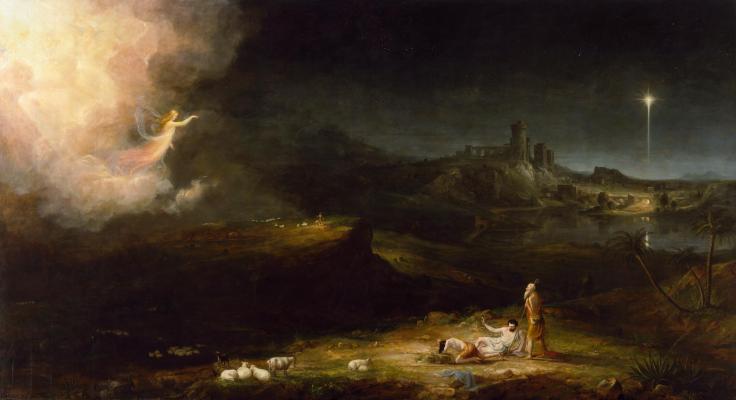
While shepherds watched their flocks by night,
All seated on the ground,
The angel of the Lord came down,
And glory shone around.
“Fear not!” said he, for mighty dread
Had seized their troubled mind;
“Glad tidings of great joy I bring
To you and all mankind.
“To you, in David’s town, this day
Is born of David’s line
A Savior, who is Christ the Lord,
And this shall be the sign:
“The heav’nly Babe you there shall find
To human view displayed,
All meanly wrapped in swathing bands,
And in a manger laid.”
Thus spake the seraph and forthwith
Appeared a shining throng
Of angels praising God on high,
Who thus addressed their song:
“All glory be to God on high,
And to the Earth be peace;
Good will henceforth from heav’n to men
Begin and never cease!”

Words by Nahum Tate

Why the shepherds? Angels might have appeared to the rulers and priests of Israel, announcing the birth of their long-awaited Messiah, but they did not.  Nor did they appear to the common citizens (and other visitors) in Bethlehem.  We make much of the shepherds being lowly and humble, and that is true enough.  But there were other poor and humble people throughout the land.  And there were “important” people who waited to hear the news.  

Photo by Magda Ehlers on Pexels.com

There is something about shepherds that is close to the heart of God.  All the way back in Genesis– Abel was a shepherd.  The early patriarchs– Abraham, Isaac, Jacob– were all shepherds.  Moses, when God called him, was working as a shepherd.  King David started as a shepherd, tending his father’s sheep, while his older brothers were serving in the army.  The prophet Amos was a shepherd.  Jesus used several parables about and allusions to shepherds and sheep as well.  (See Matthew 18:10-14; John 10 among others.)

Shepherds are humble, yes, but there are other traits that I think are at work in the story of the Nativity– some important, and others incidental:

  • Shepherds watch.  That seems pretty self-evident from songs and passages, but it’s also important.  The shepherds weren’t watching for angels that night, but they were alert, combing the area for dangers, pitfalls, straying sheep, wandering predators…There is nothing in the Bible that says that the angels were invisible to anyone else in the neighborhood; only that the angel appeared to the shepherds and was joined by the hosts of heaven.
  • Shepherds must focus on others.  Much is made of the “lowly” station of shepherds.  But that is the nature of the job.  A “Good” shepherd is one whose focus and efforts are directed at the sheep.  He doesn’t “climb the ladder of success”, “toot his own horn”, “keep banker’s hours”– in fact the shepherds of the Nativity story were the “night shift”, tending the flocks when it was cold, dark, dangerous, and thankless!

  • Shepherds were familiar with “unconventional” birth.  An announcement that Messiah was born in a stable and could be found wrapped in strips of cloth would come as a surprise to shepherds, but not as an impossibility or a cruel joke.  Shepherds (anyone whose livelihood depends on the safe delivery of livestock) would understand and rejoice over new life, even in unexpectedly humble or unconventional circumstances.
  • Shepherds were often “left out” of ceremonies and celebrations, because of their frequent contact with blood and death.  The angel’s announcement had special meaning in the inclusion of shepherds, which was to show that even those who had been deemed ritually unclean were to be included in the “Good news of Great Joy!”
  • The shepherds were “abiding” in the fields.  These were not the temporary visitors thronging to Bethlehem for the census.  They were not the patriarchs of great families living in walled compounds or great estates; neither were they awake in the middle of the night plotting, scheming, or creating havoc.  They were humble, but they were faithfully doing their work.
Photo by Chama on Pexels.com

This Advent season, may we consider the shepherds and learn to be watchful, other-focused, joyful, ready to accept the Good News, and faithful in all that we do and say in response to our Good Shepherd!

Photo by Pixabay on Pexels.com

I Heard the Bells on Christmas Day


I heard the bells on Christmas day
Their old familiar carols play;
In music sweet the tones repeat,
“There’s peace on earth, good will to men.”
I thought how, as the day had come,
The belfries of all Christendom
Had rolled along th’ unbroken song
Of peace on earth, good will to men.
And in despair I bowed my head:
“There is no peace on earth,” I said,
“For hate is strong, and mocks the song
Of peace on earth, good will to men.”
Then pealed the bells more loud and deep:
“God is not dead, nor does He sleep,
For Christ is here; His Spirit near
Brings peace on earth, good will to men.”
*When men repent and turn from sin
The Prince of Peace then enters in,
And grace imparts within their hearts
His peace on earth, good will to men.
O souls amid earth’s busy strife,
The Word of God is light and life;
Oh, hear His voice, make Him your choice,
Hail peace on earth, good will to men.
Then happy, singing on your way,
Your world will change from night to day;
Your heart will feel the message real,
Of peace on earth, good will to men.

Words by Henry Wadsworth Longfellow, with alterations and *additional text by Harlan D. Sorrell.

Some Christmas Carols are the joyous outpouring of Christmas cheer, filled with the laughter of wonder of the season.  Others are forged in pain and doubt that has been turned to the light of hope and renewal.  Such is the story behind this hymn. http://suvcw.org/mollus/art005.ht

Photo by Pixabay on Pexels.com

The famous American poet, H. W. Longfellow had lost his wife in a tragic fire just three years before he nearly lost his son in the horrors of the Civil War.  When his son was severely wounded in battle, Longfellow went to the military hospital, and, when he could, he transported his son home, knowing the journey would be painful and the outcome might not be a happy one.  (His son lived, but never recovered fully– see the article above.)
As he sat with his wounded son over the Christmas season, he could hear the bustle and chatter, and the bells ringing from the church steeples, announcing the good news of Christmas.  As his pain and bitterness churned, he wrote about it, and about how his heart was turned from bitterness to hope. (See the original poem here:   https://www.hymnsandcarolsofchristmas.com/Poetry/christmas_bells.htm

Photo of C. A. Longfellow

Christmas is a time of warmth and good cheer for many–the ringing of bells, the singing of merry tunes, the tinsel and glitter of decorations–but for others, it is a time of deep soul-searching.  “My life is a mess.  I have suffered greatly.  There is no Peace On Earth!”  Yet, the hope and promise of Christmas rings out greater than the darkness and the blast of gunfire, the angry outcries and the weeping of those in grief.

How can this be?

Christmas reminds us that our circumstances, though very real and very painful, are confined to this time and space.  They are temporary– not in the sense that we will forget our pain or loss– but that we can still experience hope and joy  and healing in their midst.  “The Wrong shall fail”–there will still be evil in the world, injustice, hunger, abuse, sickness–wrong will still exist, but it does not have the power to define us, to enslave us and take away our ability to do good.  “The Right, prevail”–God’s promise of Messiah (among several hundred other prophetic promises!) has been fulfilled.  God is Faithful.  God’s word endures.  God’s Justice Will Be Done, and there will be “Peace on Earth, Good Will to Men.”

Photo by Magda Ehlers on Pexels.com

Christmas also reminds us that it is just in those very small things– the tolling of bells, being able to hug your child,  to share memories of loved ones who are no longer here, being grateful for small gifts, giving a word of encouragement–that hope and joy are spread like ripples of water and echoes of sound.  Christ’s birth was humble, but it was heralded with the hosts of angels from the highest heavens. 

Photo by Oleg Magni on Pexels.com

My prayer today is that we would listen for the true message of Christmas, and that we would echo and repeat the message– even if it seems that we are being drowned out by sirens and protests, or silenced by those who are hurting and cannot hear the sweetness in the music of the season.

Go, Tell It on the Mountain


Go, Tell It On The Mountain

While shepherds kept their watching
O’er silent flocks by night,
Behold throughout the heavens
There shone a holy light


Go, tell it on the mountain
Over the hills and everywhere
Go, tell it on the mountain
That Jesus Christ is born.


The shepherds feared and trembled
When lo above the earth
Rang out the angel chorus
That hailed our Savior’s birth;


Go, tell it on the mountain
Over the hills and everywhere
Go, tell it on the mountain
That Jesus Christ is born.


Down in a lowly manger
The humble Christ was born;
And God sent out salvation
That blessed Christmas morn.


When I was a seeker
I sought both night and day
I sought the Lord to help me
And He showed me the way.


He made me a watchman
Upon the city wall
And If I am a Christian
I am the least of all.


Go, tell it on the mountain
Over the hills and everywhere
Go, tell it on the mountain
That Jesus Christ is born.

Photo by Gratisography on Pexels.com

During the Christmas season, we often focus on giving.  And it’s certainly appropriate.  But there is another aspect of Christmas that sometimes gets overlooked– Telling.

Photo by James Wheeler on Pexels.com

Christ came to earth humbly, but he didn’t come secretly.  Angels announced his arrival to the shepherds; stars aligned and shone brightly as a signal to the wise men.  Prophets had foretold his coming for centuries.  John the Baptist even went ahead of Jesus, baptizing and preparing his hearers for the good news yet to come.  The earliest followers of Christ were eager to tell of his words, his deeds, and his glorious resurrection.  Many lost their lives doing so.

Photo by Julian Jagtenberg on Pexels.com

If the birth of Christ was reason to fill the night sky with songs and wonders,  reason enough to send angels and stars, prophets and messengers; what about the news of his life, death, resurrection, and ascension?  Why do we allow this amazing news to sit on a dusty shelf, unopened and unshared?  Or treat it like a secret, good news for only the few, the righteous?

We have the greatest news in all of history– more important than any political scandal, more amazing than the latest technology, more joyous than any other announcement imaginable.  Emmanuel– God WITH US–He came, he lived, worked, spoke, laughed, shared, loved, cried, ate, slept, and died, WITH US.  And he died and rose so that we could continue to live WITH HIM!

Photo by Pixabay on Pexels.com

God didn’t send all the signs and wonders– he didn’t come into the world to be a guilty secret.  And though there is still a risk involved in proclaiming the gospel, it is no less good, and no less NEWS now than it was nearly 2000 years ago.  Let’s TELL it!  SHOW it!  POST it!  SING it out!– Everywhere!

Photo by Janez Podnar on Pexels.com

Father, Thank you for this wonderful news. Thank you for the Greatest Gift–Yourself.  Give us hearts filled with joy and courage, and lips eager to share your grace and love with those we meet.  Help us to be faithful messengers of that grace and love; transparent and true in word and deed.  May every mountain and valley, forest, meadow, desert and ocean ring with the hope and glory of your nativity, your ministry, and your death and resurrection.

Gloria in Excelsis Deo


Angels we have heard on high
Sweetly singing o’er the plains,
And the mountains in reply
Echoing their joyous strains.Refrain:
Gloria, in excelsis Deo!
Shepherds, why this jubilee?
Why your joyous strains prolong?
What the gladsome tidings be
Which inspire your heav’nly song?
Come to Bethlehem and see
Him Whose birth the angels sing;
Come, adore on bended knee,
Christ the Lord, the newborn King.
See Him in a manger laid,
Whom the choirs of angels praise;
Mary, Joseph, lend your aid,
While our hearts in love we raise.
Photo by Anthony on Pexels.com

This has always been one of my favorite Christmas carols to sing.  I love the movement of the melodic line and the harmonies, especially when singing the angels’ chorus:  “Gloria, in excelsis Deo!  Gloria, in excelsis Deo!”
(Glory to God in the Highest Heavens!)

Yet, if we think about it, the angels seem almost to be having a joke.  There is something ironic about hosts of angels praising the glory of God in His highest Heaven, when they are announcing that He is, at that moment, a wailing, helpless infant, wrapped in rags and borrowing a feeding trough for his bed, miles from the warmth and comfort of a home of any kind, let alone the glory of His rightful throne.

Photo by Pixabay on Pexels.com


And there were shepherds living out in the fields nearby, keeping watch over their flocks at night. An angel of the Lord appeared to them, and the glory of the Lord shone around them, and they were terrified. 10 But the angel said to them, “Do not be afraid. I bring you good news that will cause great joy for all the people. 11 Today in the town of David a Savior has been born to you; he is the Messiah, the Lord. 12 This will be a sign to you: You will find a baby wrapped in cloths and lying in a manger.”
13 Suddenly a great company of the heavenly host appeared with the angel, praising God and saying,
14 “Glory to God in the highest heaven,
    and on earth peace to those on whom his favor rests.”
15 When the angels had left them and gone into heaven, the shepherds said to one another, “Let’s go to Bethlehem and see this thing that has happened, which the Lord has told us about.”
16 So they hurried off and found Mary and Joseph, and the baby, who was lying in the manger. 17 When they had seen him, they spread the word concerning what had been told them about this child, 18 and all who heard it were amazed at what the shepherds said to them. 

Luke 2:8-18 (NIV)
Photo by Bich Tran on Pexels.com

And this is how God chose to appear, and chooses to work– confounding the power of the powerful, the wisdom of the wise, and the goodness of the self-righteous.  God does not glorify that which is already a spectacle.  Instead he glorifies the lowly and unqualified things of the world by coming into them, working through them, and reshaping them for His use.

Photo by David Dibert on Pexels.com

And so, may we have eyes, ears, and hands to work in the same way–to raise up, encourage, bless, and honor those who cannot yet see the Glory around them, the Glory God offers to share freely.  May we be the host of God’s messengers to spread the Glorious news of Christ’s gift of life and salvation.  May we be like the shepherds, jubilant in our acceptance of His great news.  And may we be, like the babe himself–humble and kind–bringing Glory to the world around us, no matter how dark or unwelcoming it may appear.  Remember, God himself is with us!

Photo by James Wheeler on Pexels.com

Gloria!  Gloria, in excelsis Deo!

Small Gestures

My mother is famous (in our corner of the world, at least) for sending greeting cards–hundreds each year for birthdays and anniversaries.  Nearly every day, she sits down and chooses birthday cards, signs them, puts them in envelopes, addresses them, stamps them, and dates them to put in the mail box.  She has learned over many decades just how long it takes for cards and letters to travel to various parts of the country and world, and times each card to arrive as close to the actual date of the event as possible.

Photo by Bich Tran on Pexels.com

As a girl growing up, I found this ritual time-consuming, wasteful, and bizarre.  The calendar was a crowded mass of names, copied faithfully from last year’s calendar and crammed full of new births and recent marriages.  Once the card had been chosen and signed, Mom would have to look up addresses in an ancient address book crammed with scraps of paper and index cards with changes, notes, and other esoteric information.   Mom sent cards to people I had never heard of or met– old friends she knew from school, people my father knew from his army days, distant cousins, people who used to live in the neighborhood from before I was born.  Each year, there would be cards returned to sender as people we barely knew moved and mom lost contact with them, often for good.

Photo by Element5 Digital on Pexels.com

When I was old enough and sassy enough, I asked her why she bothered.  What value did she see in doing something so simple, yet so complicated– who cared whether someone they had never met (or barely remembered) sent them a 2-cent greeting card?  She patiently answered that perhaps no one cared (though she hoped it meant something), but she did it because one year, when she was young and times were very tough, she had received a beautiful birthday card from an unlikely source– the only card she received that year.  It came from her “uncle” Ralph, who was not actually her uncle, but a dear friend of the family.  “Uncle” Ralph had grown up in an abusive home, and had lost two sisters in childbirth.  He knew the pain of being forgotten on his own birthday, and wanted to make sure it didn’t happen to his “niece.”  Mom’s birthday wasn’t “forgotten” that year, but there was no money for fancy cards that year– just enough for a small, unfrosted cake and many good wishes.  Mom faced other “tough” years as a young wife and mother, when she couldn’t afford gifts or cards for birthdays.  This one small gesture so impressed my mother that she made it her mission, when she could afford to do so, to send as many greeting cards as she could to as many people as she could.  As a follower of Christ, moreover, she does it from a heart that wants constantly to show love to just one more person for whom Christ died.

Photo by John-Mark Smith on Pexels.com

In the many years since my impertinent question, I have seen the incredible ministry my mother has had, and have heard from some of the many lives she has touched with her cards and her kind thoughts.  Time after time, I have heard of people who were strengthened and encouraged by her example and her thoughtfulness.  She is the living extension of God’s heart as she lovingly signs each card, walks it out to the mail box, and sends it on its way.

Many people have stopped sending greeting cards– we are more likely to send a text message or tweet a birthday greeting– if we think about it, or if it pops up in our news feed and we can just click a button. Yesterday was my birthday…I received three actual paper greeting cards (and yes, one was from my mother, one from my mother-in-law, and one from the ladies’ group at church).  I was blessed and touched by each one– and by the dozens of on-line greetings and random birthday wishes in the days before (and probably after), as well as the hugs and special time spent with my husband and other family members.

Photo by Pixabay on Pexels.com

I don’t send cards through the mail as my mother does, but I find myself typing Happy Birthday greetings on all my friends’ news feeds– sending happy thoughts to them,  their children and grandchildren; their spouses and cousins (though I’ve never met them)–and each time, I am reminded that even a seemingly small gesture can make an enormous difference in someone’s life.  And, because of Mom’s example, I write every name in my prayer journal.  As I turn the pages each day, I see the names of two, three, or even ten precious souls– all infinitely and passionately cherished by the creator of the universe–and I have the honor to lift each one up in prayer to the One who knows and loves them best.

The Rocks Cry Out

A couple of days ago, while the weather was still cold, but clear, my husband and I visited one of the many beaches along the eastern coast of Lake Michigan.  The beaches are popular throughout the summer months, especially those with lots of dunes and smooth sand for sunbathing and picnics and beach volleyball.  We’re the sort of odd ducks who like to visit in the off-season, bundled in parkas and combing the rocky shores looking for unique stones and beach glass.

I was reminded of Jesus’ parable of the two men– one who built his house upon the rock, and the other who built his on sand.  https://www.biblegateway.com/passage/?search=Matthew+7%3A24-27&version=ESV.   Sandy beaches are wonderful to visit in the summer, when the weather is perfect, the sun is shining, and the lake is calm.  But over the winter months, people avoid sandy beaches (as we did) because the wind and waves can erode great patches of sand, moving it about and changing the shoreline considerably.  On the bigger public beaches, crews put up fences to keep the winter gales from blowing sand away from the shore and into the parking lots and streets.  The fences also trap the sand and snow on the shore.  Snow banks that form on the beach can melt and carry the sand back into the lake, forming new sand bars that can cause damage to small boats.  Even in the summer, large waves can produce undertows and dangerous currents for the unwary. 

Photo by Miro Alt on Pexels.com

In many ways, sand is like sin.  Sand is attractive– smooth and glistening in the sun.  It is warm and seems to yield to the touch.  But sand shifts; it blows and drifts easily, but it sticks in place where we least want it, tiny grains getting into hair and clothes, shoes, and beach towels.  It slips away, slides from under our feet, fails to hold its shape, unless we wet it down and pack it, and then it crumbles under the action of the waves.

Photo by Pixabay on Pexels.com

Rock, on the other hand, is secure.  It takes centuries to erode; it doesn’t shift or fall away.  A rocky coast may not seem as inviting for pleasure, but it makes a far better foundation for a home or a lighthouse.  Even the smaller stones along the beach do not blow around in a strong wind, nor do they melt away with the snow.

Photo by Pixabay on Pexels.com

Beach stones can offer further illustrate how God works in our lives.  Stones on the beach start out with sharp edges.  They are cold and hard and uneven.  But over time, the rocks are slowly churned by the waves and the movement of smaller rocks and sand, and they are smoothed and polished by their environment.  Among the sharp rocks are beautiful agates and quartz, their varied colors seeming to absorb sunlight and heat.  Just so, we are transformed from hard and cold isolated individuals as we absorb the Son’s character.  And, as we are churned up against others, and the hard edges get smoothed away, His beautiful character is revealed in us, and we shine.  With further polishing, the stones reveal the kind of strength and beauty that make them worthy of being displayed or set in jewelry.  Not every rock along the beach will go through this transformation..some will remain hard and sharp; others will be ground into sand.  But some will cry out in their beauty and strength as testimonies of  God’s eternal process of redemption.

God Gave…


For God So Loved the World
16 “For God so loved the world, that he gave his only Son, that whoever believes in him should not perish but have eternal life.


John 3:16 English Standard Version (ESV)
Photo by Sharefaith on Pexels.com

From the very beginning, God has been a giver of good gifts.  He created a beautiful world, teeming with life and joy.  He gave mankind dominion over this beautiful creation, and even when we rebelled and fell short of our calling, God gave us promises of restoration and renewal.  He gave His words and demonstrations of His character and goodness as He interacted with His chosen people.  He took a childless man and promised to make him the father of many nations.  He took His people through the wilderness and provided for their every need– from their heads to their sandal-shod toes.

God’s greatest gift was himself– and He gave everything He had to give.

Photo by Francesco Paggiaro on Pexels.com


14 The Word became flesh and made his dwelling among us. We have seen his glory, the glory of the one and only Son, who came from the Father, full of grace and truth.


John 1:14 New International Version (NIV)


In your relationships with one another, have the same mindset as Christ Jesus:
Who, being in very nature God,
    did not consider equality with God something to be used to his own advantage;
rather, he made himself nothing
    by taking the very nature of a servant,
    being made in human likeness.
And being found in appearance as a man,
    he humbled himself
    by becoming obedient to death—
        even death on a cross!

Philippians 2:5-8
Photo by Pixabay on Pexels.com

Many of us are celebrating Thanksgiving today– but there is great reason to give thanks every day for this indescribable gift!

Photo by Element5 Digital on Pexels.com

Thanksgiving is so much more than turkey dinners or football on TV or shopping.  It is a lifestyle and an attitude that recognizes the God who gives lavishly, lovingly, eternally, and to the very last measure.

God Promised..

When we look around at all the beauty God created (see yesterday’s post:https://pursuingprayerblog.wordpress.com/wp-admin/post.php?post=1206&action=edit  ), we also see the ugliness of a fallen world.  What God created, he proclaimed “Good.”  That goodness still exists, but it is tainted and polluted by sin.  God has the authority and the right to destroy it all (and us along with it!); instead, he chose to redeem it.  God’s promise to do this has been playing out from the very beginning.

Photo by Pixabay on Pexels.com

God did not strike Adam and Eve– He allowed them to age, and reproduce, and live out their lifespan–but He did keep his promise that they would have to die (see Genesis 3).  God kept his promise to Noah, to save his family from a worldwide flood (Gensis 6-9).  He kept his promise to Abraham, to bring him to a new land and give it to his descendants– though the promise was made when Abraham as childless and wandering in the wilderness (Genesis 12-25).  God kept his promise to Abraham’s descendants, to bring them back to the land he had promised them (Exodus–Joshua). 

Photo by Brett Sayles on Pexels.com

God kept his promises to Israel– promises of blessings and of curses, of retribution and revival.  God chose King David, and kept many promises to him about his dynasty, the building of the temple, and the coming of a kingly redeemer in David’s line of ancestry (2 Samuel-1 Kings).  He kept his promises given through the prophets concerning the exile and return to Jerusalem.

Photo by Pixabay on Pexels.com

In this season, we celebrate all the many promises God made and kept regarding the coming of our Savior (Matthew-John). Just as God’s creation is “good,” so too are His promises– they are sure and true.  God’s promises reveal His nature–He is Just, He is Kind, and He is Omnipotent.  What He says, He can and will accomplish.

Photo by Pixabay on Pexels.com

Today, I am grateful for God’s promises– for all the ones He has already fulfilled, and for all He will bring to pass!

God Created…


For the Beauty of the Earth
The United Methodist Hymnal Number 092
Text: Folliot S. Pierpoint 
Music: Conrad Kocher; Arr. by W.H. Monk 
Tune: DIX, Meter: 77.77.77

1. For the beauty of the earth, 
for the glory of the skies, 
for the love which from our birth 
over and around us lies; 
Lord of all, to thee we raise 
this our hymn of grateful praise. 

Photo by Studio 7042 on Pexels.com


2. For the beauty of each hour 
of the day and of the night, 
hill and vale, and tree and flower, 
sun and moon, and stars of light; 
Lord of all, to thee we raise 
this our hymn of grateful praise. 


3. For the joy of ear and eye, 
for the heart and mind’s delight, 
for the mystic harmony, 
linking sense to sound and sight; 
Lord of all, to thee we raise 
this our hymn of grateful praise. 

\Photo by Pixabay on Pexels.com


4. For the joy of human love, 
brother, sister, parent, child, 
friends on earth and friends above, 
for all gentle thoughts and mild; 
Lord of all, to thee we raise 
this our hymn of grateful praise. 

Photo by Edward Eyer on Pexels.com


5. For thy church, that evermore 
lifteth holy hands above, 
offering up on every shore 
her pure sacrifice of love; 
Lord of all, to thee we raise 
this our hymn of grateful praise. 

Photo by Pixabay on Pexels.com


6. For thyself, best Gift Divine, 
to the world so freely given, 
for that great, great love of thine, 
peace on earth, and joy in heaven: 
Lord of all, to thee we raise 
this our hymn of grateful praise. 

Photo by David Dibert on Pexels.com

This week, may we raise hymns of grateful praise to the creator of all the beauty of the earth.

For by him all things were created: things in heaven and on earth, visible and invisible, whether thrones or powers or rulers or authorities; all tings were created by him and for him. 

Colossians 1:16


In the beginning was the Word, and the Word was with God, and the Word was God. He was in the beginning with God. All things were made through him, and without him was not any thing made that was made. In him was life, and the life was the light of men. The light shines in the darkness, and the darkness has not overcome it.

St. John 1:1-5 (ESV)

Hello, My Name Is…

Have you ever been to a conference for work, or a large meeting or convention, where you were required to wear a temporary name badge?  It might be a simple sticker with a space to write your name, or it might be a pre-printed card set inside a clear plastic pouch attached to a lanyard or a safety pin.  It may have a stripe or box in a bright color, and/or an introductory word or phrase, such as “Hello..” or “My name is…”
Perhaps you’ve had to wear a name tag for work on a daily basis, or you have to carry an ID tag pinned to your shirt, lapel, or around your neck or waist.

Photo by rawpixel.com on Pexels.com

Such tags serve a purpose; they are functional, if boring, and even if they are also annoying, they are temporary.  Some of them give a little more information, such as where you are from or what company, or plant, or building you represent.  Name tags make it easy to identify someone and put a name to a face.  But a name tag cannot reveal much beyond a person’s name.  Sometimes, a name tag doesn’t even meet that simple criterion.  I have a simple name, Lila, that is commonly misspelled and misspoken.  I have had people look right at my name tag and call me, “Lisa,” “Lily,” or “Leah.” Wearing my name on my shirt or hanging from my neck may (or may not) make me identifiable.  It does not make me knowable or known.

Photo by Edward Eyer on Pexels.com

When we come before the Throne of God, we need no name tag.  God not only knows our name, He knows us intimately– our thoughts, our attitude, our fears, our hopes, our weaknesses and strengths. He has numbered the hairs on our heads, and knows the words we will say before they reach our tongues.

Photo by Public Domain Pictures on Pexels.com

This knowledge might cause us apprehension– there can be no hiding from God–even if we can lie to ourselves about our actions, motivations, and feelings, we can’t lie to Him.  But this intimate knowledge should also ease our every fear– God knows all about us, and loves us unconditionally.

Prayer can be many things– joyful, contrite, needy– but it never needs to be small talk!

Blog at WordPress.com.

Up ↑