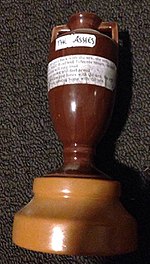
“Playing for the Ashes” may not be a familiar term to many. It refers to a Cricket Rivalry between England and Australia, dating back over 125 years. The term “the Ashes” was first used by a sports writer lamenting the loss of a Cricket match. The team from Australia had defeated the English team on its home soil, and the writer wrote a tongue-in-cheek “obituary.” Over the years, the two teams now play for a trophy shaped like an urn, which supposedly contains ashes of something related to the famous game. The rivalry is real, and the teams give their all to win each match “for the ashes.” But the trophy itself is little more than a joke. The phrase has come to mean playing all out for something that is already (figuratively) dead or worthless.
“Playing for the Ashes” is also the title of a mystery novel, in which a cricket player is murdered. I am not a Cricket fan, but I am a fan of mysteries, and in reading the book, I learned a little bit about a sport I have never followed. But the book builds on rivalry and the theme of investing one’s energy and dreams for “Ashes.” The main characters of the book have wasted their money, energy, and life force in the pursuit of power, revenge, fame, and status, only to find themselves losing everything they ever worked for. The book is very well written, and it made me think. But it also left me sad and somewhat empty at the end.
I began thinking about how various life pursuits might compared to playing for the ashes. I write about pursuing prayer, but what is my goal and aim? Am I pursuing prayer with the right goals? I may answer that it is part of my pursuit of living like Christ; that I want to grow closer to God; that I want to grow in my walk with Christ…any number of “Spiritual” answers. But is that always true?
How often do I spend my time playing for, and even PRAYING for “the ashes?” How many times do I try to “fix” things first, and only pray as a last resort? How many prayers are spent asking for things I “want” to happen, instead of seeking God’s will first? What dreams am I holding on to when I pray– unwilling to lay them on the altar? Am I praying in line with God’s will, or do I feel like prayer is a rivalry (either with God or with my circumstances)? Prayer IS a pursuit, but it is not a game or a rivalry. The “prize” of prayer is not getting the answers I want, or getting God’s “approval” of my desires. The “prize” is eternal, abundant life from– and with– the Father! It is not getting God “on my side”, but growing closer to the heart of God!
God wants to hear our requests and our desires– but He also wants to hear our desire to follow Him above all. We should be running for the true prize, not playing (or praying) for the ashes!
I had a surprise last week. Something I had prayed for– arrived early! Why was I shocked? Hadn’t I prayed about this very thing? Did I think God was too busy to hear my prayer? Or not powerful enough to answer?
Sometimes, when we pray for things, we have a high expectation that God will answer our prayers exactly as we wish. But other times, we pray hesitantly, as though we are asking too much, or asking for the wrong thing. You see, I wanted a certain book order to be delivered in time for us to take the books to a Ham-fest, where we could resell them. But I had waited to order them until nearly the last minute. So my prayers were made with the fear that God’s will might not align with my own. I was surprised and delighted when the books came a day earlier than I expected!
Not only was I surprised by the early arrival of the books, I was surprised to realize that I had been praying without the confidence that God would answer. I knew He COULD answer my prayer. But I wasn’t sure that He SHOULD answer my prayer. After all, if only I had ordered sooner, I should have expected the books to come in time. I didn’t “deserve” to have God answer the prayer above and beyond my expectation…
And this is a horrible way to think. God doesn’t give us what we “deserve.” And, to be clear, He won’t give us what goes AGAINST His will. If I were to steal books in order to resell them, that would NOT be an answer to prayer. But God WANTS to bless us! His ways are not our ways, so sometimes, He “blesses” us in ways we don’t see or understand. But God is a good, good Father.
We don’t have to pray in fear. We don’t have to worry that we are asking for “too much.” We can pray in confidence– even knowing that God may not answer in the way we hope or expect. And we shouldn’t be surprised when God answers in good, and even miraculous ways that go beyond our hopes and expectations!.
“Father, thank you for being so Good and so Faithful in answering prayer. Whether little concerns or big problems, I can trust You to do what is best and to meet my needs. Help me to trust you even more in every area of my life.”
Years ago, our high school class read a classic short story by the American author, Herman Melville. Bartleby the Scrivener tells the story of an unusual clerk– one who begins as a good worker, efficient and conscientious, but ends up dying in prison, hopeless, ruined, and broken. His tragic downward spiral begins one day when the lawyer for whom he works asks him to examine a short document. This is a commonplace request, much like asking a writer to proofread her final draft before submitting it to the editor. However, Bartleby responds by saying “I would prefer not to.” The startled lawyer decides not to force the issue, and gives the task to someone else.
Bartleby’s refusal to do what is expected of him escalates until he no longer does ANY work. He refuses to work, refuses to leave the office, and refuses to eat. He isn’t angry or violent, but he remains defiant until the very end.
So it is with us when we are living in sin and rebellion against God. It may start out small– some little habit or attitude. We know it is wrong, but instead of obeying God’s word, we calmly say, “I would prefer not to…” not to tell the truth, not to turn away from porn, not to help my neighbor, not to agree with God about my behavior.
8 The Lord is merciful and gracious, slow to anger and abounding in steadfast love. 9 He will not always chide, nor will he keep his anger forever. 10 He does not deal with us according to our sins, nor repay us according to our iniquities. 11 For as high as the heavens are above the earth, so great is his steadfast love toward those who fear him; 12 as far as the east is from the west, so far does he remove our transgressions from us.
Psalm 103:6-12 (ESV)
God is patient. He is gracious and kind. He does not treat us as our offenses deserve. He gives us the chance to repent. He offers forgiveness. But every time we say to God, “I would prefer not to,” we get a little more like Bartleby– isolating ourselves, wasting our potential to be all that God created us to be, growing more defiant and more rebellious, until we waste away into a prison of our own making, and, finally, death.
One of the things that makes Melville’s story so disturbing is that the narrator keeps trying to explain away Bartleby’s defiance–perhaps he is having trouble with his eyesight and doesn’t want to admit it; perhaps he was traumatized at a previous job; maybe there is a reason for his passive aggression. But in all of his attempts to understand, the narrator cannot save Bartleby from prison and death.
Understanding sin cannot change us. Excusing sin does nothing to stop its consequences (see Romans 6:23). No one killed Bartleby, yet he died because he “would prefer not to” do the things he needed to do to live. His small act of defiance, which starts out singular and almost heroic (after all, who wouldn’t like to tell the boss, “I would prefer not to,” every once in awhile?), sounds innocuous. Such a little thing to refuse. Surely God would not punish us for so small a thing…until one small thing leads to another…and another; a bigger rebellion; a numbing complacency; loss of perspective; a heart of stone; isolation; starvation; imprisonment; death.
What am I refusing to do for God today? What am I refusing to give up? Refusing to admit? Refusing to listen to? Am I excusing myself? Do I tell myself I am not in rebellion because I have been polite in my refusal to obey? Do I comfort myself that my rebellion is really just a matter of “preference,” and will not be consequential? That God’s Holiness is less important than my comfort or convenience?
Many people coast through life in the belief that God is SO merciful and SO loving that He can’t also be Holy and Just– that His commands are really suggestions; that His wrath is mythical; that our own wisdom is sufficient for living a “good” life and pleasing Him. But God isn’t concerned about whether we live a “good” life– He wants us to have an abundant life– filled with joy and peace, love and relationship, both now and forevermore. In fact, He would “prefer not to” punish us. He is not “willing” (i.e. desirous) that any should perish (2 Peter 3:9), but that everyone would some to repentance. That doesn’t mean that He won’t punish those who refuse to obey Him, or those who refuse to turn from their rebellion and trust Him; only that He will continue to give us the opportunity to recognize our need for forgiveness.
10 If you keep my commandments, you will abide in my love, just as I have kept my Father’s commandments and abide in his love. 11 These things I have spoken to you, that my joy may be in you, and that your joy may be full.12 “This is my commandment, that you love one another as I have loved you. 13 Greater love has no one than this, that someone lay down his life for his friends. 14 You are my friends if you do what I command you. 15 No longer do I call you servants, for the servant does not know what his master is doing; but I have called you friends, for all that I have heard from my Father I have made known to you.
John 15:10-15 ESV– taken from biblegateway.com
God has made it possible for us to be more than servants. We don’t have to respond to God as Bartleby responded to his boss– though God has the ultimate authority to demand our loyalty and obedience. Through Jesus, we are sons and daughters and friends! When God gives us commands, like “Love one another,” they are still commands. But His heart is that we should trust that all of His commands are righteous, life-giving, and in our eternal best interest. But some of us are still saying, “I would prefer not to.”
I write about prayer as a pursuit. Prayer is, at once, both simple and mysteriously complex.
It is a simple thing to pray–to direct one’s thoughts and words toward God. It is no more difficult than having a conversation with another person.
And yet it is not the same as talking to another person. God’s ways are not our ways. He is Holy, Sovereign, and Almighty. We come to God in need, but God has no “needs.” He has no need to confide in us, or ask for our help, or plead with us. Instead, He chooses to share with us His promises and His plans. He allows us to be part of His great work, and asks us to be His hands and feet and voice in this world. He pleads with us to come and spend time with Him and walk in relationship with Him.
I spent some time recently reviewing the life of George Muller. https://www.georgemuller.org/ George Muller was born over 200 years ago. He was, by his own admission, a liar and a thief in his early years. But when we came to Christ, his life changed dramatically. His life was a series of miracles that attested to his great faith and active practice of prayer. Muller founded several orphanages in England, and he did all of it through prayer. He never did traditional fund-raising: he never asked anyone for money or donations, he didn’t take out loans, he didn’t find “partners” or “sponsors” to pay for any of the needs. He simply prayed. He prayed for money to buy buildings. He prayed that God would send workers. He prayed for food and clothing and furniture that the children would need. And he vowed to take in any (and as many) children who came.
The stories of George Muller’s faith are legendary. He prayed for money to start one orphanage– he ended up with enough for several! He prayed for supplies– people came and gave furniture. Milk wagons broke down and the milk was donated to the orphanage. One story states that there was no food one morning. Muller prayed. Shortly afterward, he went to the door, and there, on the doorstep, lay a 50-lb. bag of rice. No one knows who left it or how it got there. God showed up in miracle after miracle in Muller’s life. And that doesn’t mean that his life was without struggle or heartache. He agonized over friends who were unsaved; he prayed for them over a period of years. One close friend remained unsaved until after Muller’s death. He experienced the heartbreak of losing his wife. But he was consistent in his witness about the power of prayer.
Muller prayed about everything– as we all should, all the time. (Philippians 4:6, 1Thessalonians 5:17) Little, seemingly unimportant things; huge, seemingly impossible things. God cares about them all. He is the Almighty– there is nothing so big (or so tiny) that He cannot do it! There is no heartache or struggle that He doesn’t want to hear about! Nothing can separate us from His Love (Romans 8:38). No matter what we’re going through, we can bring it to God.
But God’s ways– powerful, compassionate, miraculous– remain mysterious. We can trust that God will hear our prayers. But we cannot predict how, or when, or if He will let us see the answers we seek. Nor can we predict how God will use our simple prayers to impact the world around us! George Muller’s orphanages helped more than 2,000 homeless children survive, grow, and in many cases thrive and contribute to the lives of countless others. And the stories of his faith and the hundreds of small but significant miracles he experienced have inspired generations of people for more than a century and a half! And his story is not unique–we have an amazing “cloud of witnesses” (Hebrews 12:1) throughout history testifying to the power of God to hear and answer prayer in mysterious, miraculous, even mischievous ways! From finding lost keys to feeding multitudes; from protecting kittens to rescuing captives; from stretching budgets to saving souls– God’s ways are mysterious, Holy, and wholly good.
Prayer can be such a simple thing– and it can have eternal impact!
Earlier this week, we celebrated Constitution Day in the United States. It went largely unheralded. The United States Constitution– the document on which all other laws are supposed to be based in this country– is relatively small. It takes about a half-hour to read it through, including all 27 amendments. It takes much longer to understand and make sense of it. One document that helps define and explain the Constitution is the Declaration of Independence.
One of the key phrases in the Declaration is this: “We hold these truths to be self-evident, that all men are created equal, that they are endowed by their Creator with certain unalienable Rights, that among these are Life, Liberty and the pursuit of Happiness.–That to secure these rights, Governments are instituted among Men, deriving their just powers from the consent of the governed, –That whenever any Form of Government becomes destructive of these ends, it is the Right of the People to alter or to abolish it, and to institute new Government, laying its foundation on such principles and organizing its powers in such form, as to them shall seem most likely to effect their Safety and Happiness.”
But looking around today, it seems that not all American hold ANY truths to be self-evident– indeed, many people don’t hold any truths to be true! We like to pay lip-service to one phrase– “All men are created equal…” but even here, we cringe and rephrase it. “It’s not just ‘men’ who are equal– all genders are equal” “Everybody is equal.” But what do we mean by this new phrase? It is self-evident (I would argue) that everyone is NOT equal in all ways. Some of us are taller than others, or healthier or wealthier than others; some of us live longer than others. Some of us work in offices; others work in the wind and rain and snow. Some of us live in large mansions, while others live in motor homes, apartments, hospital rooms, or even homeless shelters. The “Truth” is that we are CREATED equal– we are equally valued by our Creator, and equally entitled to dignity, life, liberty, and the “pursuit of happiness” under the laws of the land. Our laws are not supposed to create an artificial “equality” of outcome or circumstance, but provide for equal protection and opportunities for everyone to live, experience freedom, and pursue their individual purpose and dignity.
And we are losing the self-evident truth that Government should derive its just powers from the consent of the governed– not the arbitrary will of unelected bureaucrats appointed without public consent and answerable to no one.
We have lost the self-evident Truth, and replaced it with clever and complicated ideals.
None of this is new, however. All the way back in the days of ancient Israel, the people lost the self-evident Truth about their nation and its unique covenant with God. The Covenant was simple. It did not take a long time to read through. There were Ten Commandments and several “amendments” of ceremonial and social rules. God gave Moses a list of promises– blessings and curses–if the nation of Israel would (or would not) uphold their portion of the covenant. God would be their ruler, and they would be His People.
But after the death of Moses and his successor, Joshua, the people abandoned the law and the covenant, until chaos reigned, and God invoked many of the curses against His own people. By the end of the book of Judges, we learn that, “..in those days there was no king in Israel; every man did that which was right in his own sight.” (Judges 21:25)
Such conduct led to Israel being invaded, defeated, and oppressed. Worse, they approached their religious leader, Samuel the Priest/Prophet, and asked for a human king in order to be just like the other nations– nations God had called out for being wicked, violent, and unjust. The reign of kings failed, too, and the nation was again invaded, dragged off to exile, and oppressed.
“We hold these truths..” is more than just a phrase in a national document. It is a guideline for justice, peace, and prosperity.
WE– It doesn’t work for the people of any nation to be divided about what constitutes Truth. “My truth,” “Your truth,” and “their truth” can’t live together in harmony.
HOLD– We must be firm in our commitment to the Truth, or we will be swept away by the latest philosophy, moral standard, or faddish practices of the world around us. That doesn’t mean that we can never admit a need for change– that’s what the amendment process is for– but when we keep letting go of standards which have preserved safety and guaranteed opportunity, replacing them with temporary power grabs and loosely defined concessions to the loudest complainers, we are headed for nationwide injustice, violence, and oppression
THESE– There are other “truths” we could have adopted back at the founding of our nation. We could have set up another monarchy. We could have developed an oligarchy, made up of a ruling class. We could have argued that only land-owners were “equal.” That life was not an “unalienable” right. That representative government was inefficient, and therefore not necessary.
TRUTHS– Not suggestions. Not prevailing opinions of the day. TRUTHS. Immutable, unchanging, solid, objective.
And what goes for the United States should be a warning for Christians everywhere. We are citizens of Heaven. There are truths that we should hold to– truths that should be self-evident in the life of every Christian. Jesus is LORD– not just a pal; not just a guru or a good teacher. He is the LORD. God doesn’t change– What He said a thousand years ago about loving God and loving your neighbor still applies today. He hasn’t changed His mind about life, or liberty, or the pursuit of righteousness… He hasn’t become less powerful or less Holy, that we should just do “whatever is right in our own eyes..” God’s Word hasn’t changed–His promises still hold; His warnings are still meant to be heeded; His will is still evident. God’s grace is sufficient! God is HOLY and JUST. And He is full of Mercy and Love. He will forgive; He will empower us to do His will; He will continue to transform us as we follow Him. God is Greater than Government. Whatever system of Government we live under in this life, God’s Kingdom is greater, more just, and everlasting.
These are truths worth holding! No matter what happens to the United States or its Constitution, I will continue to hold to the Truth of the Bible above all. May God in His Grace give us the strength, wisdom, and will to hold fast to what is true, and not just what is “American.”
Have you ever ordered nachos at a restaurant? I’m not talking about just tortilla chips with sauce– I mean the loaded, deluxe, supreme nachos that some with everything but the kitchen sink. There are several layers of goodness: crispy tortilla chips, smothered in rich, gooey nacho cheese sauce, and piled with spiced meat, tomatoes, green onion, black olives, salsa, chilies, beans, more cheese (shredded), maybe even some mango or avocado, and sour cream. Each flavor is distinct– different textures, different temperatures–yet they come together as they land on your taste buds. And each bite is just a little different– a different ratio of cheese to meat to veggies to chips in each taste.
And that means that my nacho is “not ‘cho” nacho. Even with all the same ingredients, my nacho experience will never be exactly the same as yours.
In a strange way, prayers are kind of like nachos. Prayers have many distinct “ingredients”– confession, praise, anguish, supplication, thankfulness, even questions. And many people can pray with the same ingredients and still offer up unique prayers. My prayer is “nacho” prayer– and your prayer is not mine; even when we are praying together about the same thing.
God loves the variety and uniqueness of our individual prayers. He never tires of “nacho” prayers. And He never compares my “nacho” prayers with yours, or your prayers with mine. Indeed, He loves tasting the individual ingredients in their unique ratio of flavors and elements. He loves hearing our gooey, cheesy emotions, as well as our crisp list of needs; He appreciates the savory outpouring of our praise, as well as the spicy and even bitter tang of our grief.
Can you imagine the tantalizing aroma of our prayers as they rise to Heaven? What satisfaction it brings to God as we pour out our thoughts and concerns to the One who loves us best? God isn’t looking for gourmet prayers. Our prayers may be neatly arranged or completely sloppy. They may contain lumps of worry, or be soggy with emotion; they may be spiced with urgency, or smothered in majestic outpourings of praise. God is still hungry to hear from us!
The fool says in his heart, “There is no God.” They are corrupt, they do abominable deeds; there is none who does good.
Psalm 14:1 (ESV)
Only fools say in their hearts, “There is no God.” They are corrupt, and their actions are evil; not one of them does good!
Psalm 53:1 (NLT)
One thing that seems to surprise many intellectuals is the discovery that other intellectuals are Christians! There is a certain class of thinkers who believe that only ignorant people “need” to believe in God. Many of them posit that the concept of “god” is outdated and primitive, steeped in superstition, and unnecessary for anyone. Others claim that any belief in a supreme deity, a Sovereign God who has authority over all humankind, and all of nature, is actually dangerous
If God could be discovered by intellect alone, this might be disturbing for those of us who are not certified “geniuses.” If mere knowledge about God could save us, we could trust intellectuals to be our “saviors” and spiritual guides. But just because someone is intelligent and learned doesn’t mean that they have attained wisdom. Wisdom is a gift of God, and it begins with acknowledging a simple fact– God exists. This does not come automatically with knowledge about God–such knowledge can be dismissed, twisted, and even lost. If God exists– not just as a concept or a long-lost myth–certain other truths must be acknowledged. Chief among these is the truth that I am NOT God.
Fools come in all shapes, sizes, colors, and intellects. There are people of limited intellectual capacity who are very wise. There are intelligent people who live as fools. Foolishness comes when we deny God– whether we deny His very existence, or His authority over our lives– and live as though we are the supreme authority in our own lives.
“The Fool says in his HEART, ‘There is no God.'” Foolishness doesn’t begin in the brain. It begins in the heart. The more I believe that I KNOW better than others–including God–the less I will listen to instruction, advice, and wisdom. The more I will do what I want– and justify it, even if others get hurt. The Apostle Paul–no intellectual slouch himself– warns us in 1 Corinthians 8:1 that “Knowledge puffs up..” Not all intellectuals are snobs, but it is easy to become hardened to others if they believe they know more or better than everyone they meet. And Paul’s warning is to believers! Just because we believe that God exists, we can be foolishly puffed up by our very knowledge of scripture, and ignore God’s sovereign call to love our neighbors! We can be foolish “Christians” who acknowledge that Christ exists, but deny His Lordship in our lives.
There are many intelligent Atheists. Some of them lead moral lives, and do many things that we might see as “good.” They give to charities, advocate for healthful living, a clean environment, and world peace. So why does the Bible use such strong language to denounce them as fools, who are corrupt and even abominable? Doesn’t God see their good works? Doesn’t God give them “credit” for doing the “right” things (sometimes more than their Christian neighbors!)?
God sees us from a different perspective– He looks on the heart. The heart of someone who denies God is the heart of someone in rebellion. It may be a quiet rebellion; it may be vocal and even violent. But once a person denies the very one who created her/him, their heart is corrupted and opposed to giving God His proper place. Even “good” deeds done in defiance of the God of all goodness will become twisted by the selfishness and pride of the doers. The smartest among us may have many great ideas for achieving world peace, but they do not have the power to control all of humanity, nor the authority to force others to accept their “brilliant” ideas. In the end, they will either face disillusionment and despair, or they will become tyrannical in their efforts to “fix” the world’s problems according to their own plans.
God asks us, first and foremost, to trust Him. Second, we are to obey Him. Third, we are to live with, and love, others– to share the love and wisdom He gives! Fools may know about God, but they stop short of trusting Him, obeying Him, and learning to serve others. They deny His wisdom; they deny His Grace, and their need for it. They deny themselves the joy of relationship with the God of Love. There is nothing wrong with learning and intelligence– they, too, are gifts from God–but when we depend on them ahead of leaning on God’s wisdom, we become fools.
Father, I don’t want to be a fool. Help me to acknowledge You in everything I say and do. Help me to recognize Your wisdom, and cling to it. And help me to appreciate the wisdom of Your Word in guiding my intellect and learning.
Beware of false prophets, which come to you in sheep’s clothing, but inwardly they are ravening wolves. (Matthew 7:15 KJV) Behold, I am sending you out like sheep in the midst of wolves; be wary and wiseas serpents, and be innocent (harmless, guileless, and without falsity) as doves. (Matthew 10:16) Beloved, do not believe every spirit, but test the spirits, whether they are of God; because many false prophets have gone out into the world.By this you know the Spirit of God: Every spirit that confesses that Jesus Christ has come in the flesh is of God, and every spirit that does not confess that Jesus Christ has come in the flesh is not of God. And this is the spirit of the Antichrist, which you have heard was coming, and is now already in the world. You are of God, little children, and have overcome them, because He who is in you is greater than he who is in the world. They are of the world. Therefore they speak as of the world, and the world hears them. We are of God. He who knows God hears us; he who is not of God does not hear us. By this we know the spirit of truth and the spirit of error. (1 John 4:1-6 NKJV)
Hucksters, charlatans, con-artists, false prophets– we’ve all seen or heard them. Some are easy to spot; while others seem sincere. They “talk the talk”–they “Praise the Lord,” they pray, they quote scripture. They speak about Love and compassion; about joy and peace; about caring and service to others. How can we tell if they are “wolves in sheep’s clothing?”
In the Old Testament book of Judges, two tribal groups had a battle. Afterwards, the victors set up a “test” for soldiers trying to cross the Jordan River. The Ephraimites spoke a dialect that did not contain the “sh” sound. When asked to say the word, Shibboleth, they could not pronounce it correctly, and so were unable to hide their identity as enemy soldiers, even though they looked just like the others waiting to cross.
There is an old Irish prayer that says, “May those who love us, love us; and those who don’t love us, may God turn their hearts; and if He doesn’t turn their hearts, may he turn their ankles so we’ll know them by their limping.” God doesn’t always “turn their ankles,” but He will give us the wisdom to discern false prophets– If we ask and listen. Even those who “talk the talk” will speak with a worldly “accent” that gives them away. They will fail the test of “Shibboleth.” Their talk will be filled with spiritual-sounding words and phrases, but it will deflect honor away from the only One truly worthy of our worship. Their teaching is described in 2 Timothy as “having a form of godliness but denying its power. Have nothing to do with such people.” (2 Timothy 3:5 NIV) Beware of teaching that proclaims the power of the Human Spirit over that of God’s Spirit; or speaks of God’s power being demonstrated only in terms of worldly success. They may not “limp,” but they will “lisp.”
When the Gileadites used the “Shibboleth” test, they were looking for a specific mistake in pronunciation to identify their enemies. When we are testing Christian teachers, we should also look for specific “mis-pronouncements.” And just as important, we should look for words that don’t match actions and attitudes. For example, anyone who wants to call themselves a Christian or Christ-follower, but won’t proclaim Jesus Christ– His ministry, life, death, and resurrection– should be suspect. Many people want to proclaim a Jesus who will appeal to the masses– a Jesus who will be your pal, your guru, your cheerleader, or your “life coach,” but NOT your Lord. Others will present Him as a Savior who is distant, whose love is conditional on abject obedience and blind trust. Neither of these are accurate pictures of the biblical Jesus Christ. We must also beware the teachers who present a Jesus whose lifestyle is nothing like the one they practice. None of us is perfect, but we should be living a life that testifies to God’s faithfulness, not our own popularity or power or purse.
The best way to learn to detect imposters and false teachers is to spend time each day with “the real thing.” When I spend time reading scripture each day, it become easier for me to detect a “lisp” when someone misquotes it or takes it out of context. When I spend time asking God to reveal more of his character, I will learn to spot His character (or absence!) in those around me.
Father, may I have ears to discern Your voice and Your power today. May I be wise as I listen to those who speak of You. And may all that I do and say reflect Your Truth and Your Glory. Thank You for Your wise counsel, Your examples throughout Scripture and in those who desire to follow You faithfully, and for Your Spirit, who reveals Truth.
One of my favorite characters from “The Princess Bride” is Inigo Montoya. He has a few redeeming qualities– he is a loyal friend; he is intensely (obsessively) loyal to his father’s memory; he is basically honest; and he has a soft spot for lost causes, including a tender-hearted giant and a (mostly) dead pirate/rival/would-be hero.
But Inigo has many failings, as well. He is a drunkard, he lacks the skills to plan great achievements, and he has an over-developed sense of revenge that gets him in a lot of trouble. Also, he hates waiting. And he has done a lot of it– he’s waited over 20 years to track down his father’s killer and challenge him to a duel (the above-mentioned revenge).
When he first meets Westley (the above-mentioned pirate/rival/would-be hero), Westley is climbing a treacherous cliff. Inigo waits at the top as Westley struggles up the rocky crag, trying not to fall to his death. Inigo, ever concerned, calls down to ask how it’s going. He wants to know if Westley can “a-speed things up.” He REALLY hates waiting. Later, as he seeks to rescue Westley, he is told that he must wait at least 15 minutes for the magic potion to work and for Westley to regain consciousness. Inigo is delighted when Westley can talk and move his head a little, but he cannot wait for Westley to regain the use of his arms or legs before “storming the castle!”

Not many of us enjoy waiting. Some of us are better at it than others. And it is a character quality that God asks us to develop. Several times in the Bible, God asks us to “wait” or “wait on the LORD.”

When we pray, it is tempting to expect or even demand an immediate, clear answer. If we don’t get it, we fall into two temptations. The first is to despair and/or lose faith. If God doesn’t “show up” right away, we are tempted to believe that He just isn’t listening or doesn’t care about our situation. As time goes by, we may become bitter, angry, sullen, and depressed. We stop calling out to God; we turn away and seek answers (or escape) elsewhere.
The second temptation, the one I believe Inigo falls into, is to stop depending on God and carry the burden of our pain, our grief, or our situation all by ourselves. Inigo’s father was killed when he was eleven years old–his entire adult life has been wasted on a quest to avenge his father’s death. He hasn’t developed a life of his own– he has no career (he does odd jobs for crooks like Vizzini), no family, no plans for a sustained future– only his anger and bitterness over a twenty-year-old tragedy. And only when, in desperation, Inigo pauses for a moment and prays, does he find any real help in achieving his goals. In fact, at the end of the story, when Inigo finally achieves his revenge on Count Rugen, he is left with a dilemma. He admits to Westley that he has no idea what to do with the rest of his life! He has allowed the past to consume both his present and his future.
Another story that illustrates this temptation is the story of King Saul. In 1 Samuel 13, Saul has begun to attack the enemies surrounding Israel. He and his troops are hiding in caves and waiting for the prophet Samuel to offer a sacrifice and seek God’s counsel. The enemy is camped nearby with thousands of troops and chariots, and Saul’s men are beginning to panic and desert him. When Samuel doesn’t come at the appointed time, Saul disobeys God’s law by offering the sacrifices himself, even though he is not of the priestly line. Instead of standing firm, and encouraging his men, Saul gives in to the general panic and takes matters into his own hands. He takes a visible action — offering the sacrifice– without taking the right attitude of seeking God’s counsel.
Waiting can be difficult– especially when we are faced with fear, anxiety, danger, and lack of plan or purpose. But learning to wait for God’s ways and timing will teach us how to grow in Faith and confidence. Today, instead of asking God to “a-speed things up,” may we thank Him for all the times He has been faithful in the past, and trust that He will “arrive” at just the right time!
(SPOILER ALERT)– this post is about The Lord of the Rings and contains many references to plot devices. If you have not read the books or seen the movies, you will be confused and the narrative will be spoiled..
It’s no secret that I am a big fan of the Lord of the Rings by J.R.R.Tolkein. I’ve read through the trilogy several times, and I love to watch the movie version, as well. Even though it is a fantasy story, many of the situations and lessons are “true.” We may not face orcs or dragons or undead ring-wraiths, but we do face difficult challenges, such as war, grief, confusion, and oppression. We WILL face difficulties in life; we need to face them with resolve, courage, wisdom, and action. We may not have to destroy the Ring of Power, but we may have to battle addictions, habits, and relationships that threaten to destroy us.
One of the elements of the Lord of the Rings that captured my imagination from the very first readings was the “fall” of the wizards, Gandalf and Saruman. Saruman, who is introduced as one of the council of “good” wizards, and a mentor/friend of Gandalf, seems like someone who will be able to help the Fellowship in their quest to destroy the Ring of Power. But Saruman has “fallen” under the thrall of the evil Sauron. Using one of the “seeing stones,” Saruman has seen into the Dark Lord’s plans, and has decided that his own wisdom and power are enough to equal those of Sauron. His “fall” is one of self-delusion and arrogance. And his fall is described in terms of color. Where once he was called Saruman the White (the color of light when all the colors come together), Saruman becomes a prism, reflecting all the colors, but broken up, diffused, and no longer giving a true light.
Gandalf’s “fall” in the chasm as he battles the demonic Balrog is both dramatic and unexpected. Coming on the heels of Saruman’s betrayal, it sends shockwaves through all of Middle Earth. It left me devastated. After all, Gandalf is wise, good, and powerful. Having read The Hobbit, it was comforting to have a familiar guiding force to lead this new “adventure.” It is his knowledge and encouragement that has provided leadership and stability for the Fellowship of the Ring. His sudden and tragic absence leaves a gaping hole and many questions. His is a literal “fall.” He falls into blackness– fire and shadow and utter silence.
It strikes me that the wizards of The Lord of the Rings are not unlike the gods and heroes we make for ourselves. We imagine God (and often human heroes, including pastors and other religious figures) as being benign old men, walking among us, offering just enough wisdom, power, and “magic” to entertain, enlighten, and encourage us. We listen for good advice (whether or not we actually take it!), and we take comfort in the fact that they seem to know all that is going to happen. Of course, the wizards in the books are not REALLY gods–they know many things, but they cannot see all ends; they have great power, but they cannot defeat Sauron on their own (nor successfully challenge him, as Saruman learns); they are not always where they say they will be when they said they would be there.
“You’re late, Gandalf!” “A wizards is never late, Frodo Baggins. Nor is he early. He arrives precisely when he means to.” (From the Fellowship of the Ring)
Not only is Gandalf “late” for Bilbo’s special party (according to Frodo), but he completely misses his meeting with Frodo and the other hobbits in Bree, due to circumstances beyond his control. And, when the company seems to need him most, he falls into the great chasm and they must flee to the Elves at Imladris. Galadriel offers some encouragement, but it is tinged with dire warnings. Saruman’s “fall” highlights his shortcomings– he can only “see” victory through compromise, deception, and the machinery of war. Everything about him becomes twisted and sullied. In the books, he ends up being a two-bit tyrant, defeated in his attempt to take over the Shire. In the movies, he “falls” from his tower of Orthanc and sinks into the stinking pools festering around his ruined ambitions.
What about our visions and expectations of God? Sometimes, it seems as though He is “late” or “absent” in the midst of our difficulties. We want Him to come in and save the day– tell us exactly what to do next, or make an obstacle disappear, or bring a host of warriors to fight our battles. Other times, it seems as though our vision of God is seen through a prism…if God is really good, how could He let _______ happen? If God is really just, why is there still so much injustice around us? And what about others who follow a different “God.” Which one is real? Which one is “Right?” How can we know? In fact, those who follow Christ are following a God who faced betrayal and death– and He seemed to be defeated. And sometimes, it seems as though He has left us to the mercy of the evil that surrounds us.
God sometimes seems to be “fallen into shadow.” He seems to be absent. Or at least distant and silent. Just as in The Lord of the Rings, we can be left like the Fellowship– shocked, dismayed, left feeling lost and hopeless. Where is God in those moments?
But when I re-read the books, or when I sit down to binge-watch the movies –again– I find myself seeing things from a different perspective. Gandalf and Saruman both “fall” before even the middle of the story. Saruman’s betrayal seems not just tragic, but nearly insurmountable. Gandalf’s absence leads (indirectly) to the breaking up of the Fellowship into smaller, leaderless factions. But here’s what I see clearly in reflection– the Shadows that seem to swirl around the wizards are just that. They are shadows. There is darkness in the Land of Mordor. But Frodo and the rest of the Fellowship carry their own light. (Frodo, in fact, carries a literal light in his gift from Galadriel). They stay true to one another and true to their quest. As Sam points out at Osgiliath, they have had many chances of turning back and giving up, but they hold on to the hope that Good will win over Darkness, and Truth will defeat oppression and deceit, and yes, even the Ring of Power. Gandalf’s absence, while shocking and discouraging, is not permanent, nor is it devastating. It only seems so in the shadow of uncertainty and the chaos of war and suffering. The other members of the Fellowship actually develop their character, their strengths, and their gifts when Gandalf isn’t there to make things easier. He has already given them the wisdom they need– even if they don’t realize it. Gimli and Legolas become a team as their unlikely friendship develops. Merry and Pippin mature into warriors and diplomats. Aragorn becomes the King he was always destined to be. Frodo and Sam–unaware of Gandalf’s victory until the very end, still face all their dangers, including betrayal by Gollum, and save all of Middle Earth!
And so it is with our difficulties. We are looking around for help, wondering how we will continue if God is in the shadows; if God remains silent. We want to see His hand moving the chess pieces, or hear His voice calling out our next step. When we don’t hear it, we can make bad choices– we can give up hope, compromise with the enemy, or trust in our own power to see us through–or we can stay true to His Word and keep running the good race (see 2 Timothy 4:7-8) God does not abandon us– unlike the wizards, He is omniscient and omnipresent– but sometimes He stays in the shadows, knowing that it is for our development and maturity. I don’t have certainty about my choices and my actions, but I have the Bible and I have the Holy Spirit.. I have prayer. And I have the people God sends into my life to give advice and encouragement. I may not know if I can trust even the advice of religious leaders, but I can compare their advice with what I read in God’s Word and what I see in their actions. When I read the Bible, I read about promises God made to the nation of Israel– promises He kept. I read in Ezekiel, and Daniel, and again in Matthew and Revelation about His promises for the end of the ages.
It may look dark for the characters in The Lord of the Rings as they battle their way through Middle Earth. But I DO know how the story ends! I know that Gandalf does not stay in the shadows– he comes back more powerful than ever! And Saruman’s army of orcs is defeated; Saruman’s poisonous plot to usurp the mind and will of King Theoden is discovered and the king restored to health. And the Fellowship (excepting Boromir) is reunited after Frodo and Sam are successful in destroying the Ring. And I may not know the next step in my own story, but I know how my story will end! God may seem to be AWOL or “in the shadows” during my current circumstances– in my grieving, struggling, and pain. I may not see justice and peace in my near future– I may not see them in my lifetime– but I can KNOW that God is never late. He is never too early. He will arrive precisely when He means to. No shadow will be able to hide Him; no darkness will be able to comprehend Him. He will come in the blazing light of His Glory– and He will come to make all things new!