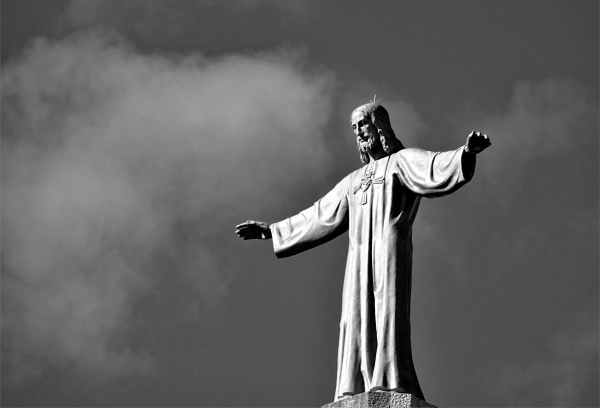
“Discovering” Jesus

Some places in America are observing Columbus Day today. This has become a controversial subject. For many years, schoolchildren were taught that Christopher Columbus, an Italian explorer working for the Spanish, “discovered” America when he landed on the island of Hispaniola in 1492.

Modern scholars are offended by this for a variety of reasons. First, there were already people in the Americas– Columbus didn’t “discover” a new-found continent devoid of people or culture. Just because the Spanish court, and most of Europe, didn’t recognize the existence of North and South America and the Caribbean, doesn’t mean they were undiscovered. It only means they were undiscovered by the major European powers. Scholars go on to argue that Columbus and the Spanish (and the French and English and Portuguese who followed) did not so much “discover” the “New World;” they invaded and stole it from those who were living here “in peace.”

Photo by kat wilcox on Pexels.com

I disagree with the way scholars have “revised” the history of Western culture. But it causes me to think of how, over the years, we have also revised the message of the Gospel, and our concept of Christianity.

Much like the modern scholars’ version of Columbus “Discovering” America, many people like to talk about “discovering” Christianity. We “encounter” the Gospel. Maybe we join a local congregation of believers, or a Bible study group. It’s exciting– at first. It is new and amazing in its message of hope and love and grace.

Photo by Luis Quintero on Pexels.com

But then we hear ugly stories of Christians who are hateful, judgmental, condemning, greedy, hypocritical, and hurtful. “That can’t be true; that can’t be what Christianity is about,” we say. And so we vow that “our” Christianity will be different. We adapt our message to the current trends in our society. We tailor our message to our friends and neighbors, even when the it’s no longer true. We wipe out and “conquer” and reshape those verses that cause offense. We recreate Jesus into a “great teacher,” a pal or a guru, rather than a Sovereign Savior. We end up following our own gospel, rather than the Gospel of Jesus Christ.

Photo by Andrea Piacquadio on Pexels.com

Or, we double down on legalism, making our walk with Christ more like a walk with His accusers, the Pharisees. We scream and argue about the “right” way to worship, or dress, or manage money. And we seek to wipe out those who don’t follow our traditions. We remove the promise of Grace from our Christianity, and replace it with judgment.

Except it isn’t “our” Christianity. We haven’t “discovered” the Gospel to make it into a “new” and better religion. We haven’t “discovered” a Jesus who is kinder or more accepting or less judgmental than He ever was. And We don’t follow a Jesus who refuses to love those who are not perfect or forgive those who have “fallen short of the glory of God.” (Romans 3:23)

Photo by Pixabay on Pexels.com

Our “discovery” of Jesus should be a lifelong discovery– a lifelong journey of becoming who He wants us to be; becoming more like who He really is. Part of that is living out our faith in a world that refuses to understand or accept the Gospel. Part of it is living our lives according to the Bible’s principles, and not our culture’s trends. Part of it is trusting that God’s word never changes, even when the world around it does. And part of it is a consistent pursuit and practice of humble and earnest prayer. Otherwise, we may well be guilty of the same conquest and colonization as those we are condemning who came before us.

“I Never Knew You”

21 “Not everyone who says to me, ‘Lord, Lord,’ will enter the kingdom of heaven, but only the one who does the will of my Father who is in heaven. 22 Many will say to me on that day, ‘Lord, Lord, did we not prophesy in your name and in your name drive out demons and in your name perform many miracles?’ 23 Then I will tell them plainly, ‘I never knew you. Away from me, you evildoers!’ Matthew 7:21-23 (NIV)

Photo by Raphael Brasileiro on Pexels.com

In my life I have met “important”people– people with money, or power, or fame, (or all three!) And I have met “forgotten” people, “ordinary” people, “special” people, flamboyant people, even repugnant people.

I know hundreds of people’s names; recognize their faces; carry memories of laughter created, or goals accomplished, or griefs shared. As I get older, I sometimes meet up with people I should remember or know, but I can’t place their name, or their face has changed out of recognition since we last met. And of course, the same thing sometimes happens in reverse– I expect to be recognized, but the other person has no memory of me. It can be distressing; this feeling of not remembering or not being acknowledged.

Photo by omar alnahi on Pexels.com

I know many families who have journeyed through Alzheimer’s or other forms of dementia. Loving someone who no longer remembers looking into your eyes, no longer reacts to the tone of your voice, no longer knows your intimate secrets…who searches your face and sees only a stranger. Hoping for even a glimmer of recognition; a moment of memory–it’s heart-breaking and harrowing and exhausting.

Photo by burak kostak on Pexels.com

But imagine hearing those words from your creator– “I never knew you.” In all your life, never having made time to create memories with the God who formed you in the womb, who counts the very hairs of your head; hearing HIM say, “I never knew you. I made you; I was as close as your next breath through every moment of your life. I heard every laugh; I saw every tear– yet I never KNEW you. You never let me in; you never reached out or looked in my direction. You pretended to others that you knew me. You ‘name-dropped.’ You told others that we were friends. That you spoke with me every day. I heard you. I wept. But I never knew you. And you never knew me. Oh, you learned about me. You knew enough to convince some others that you knew me. You even said elaborate prayers and quoted many of my words. You put on a good show. But you lived your life as though you never met me; as though I were no more than a myth or a shadow. And now, now that you see me for who I AM; now that your eternal life depends on it–you have to hear the most frightening words I will ever speak: ‘I never knew you.'”

Photo by Andrea Piacquadio on Pexels.com

10 I want to know Christ—yes, to know the power of his resurrection and participation in his sufferings, becoming like him in his death, 11 and so, somehow, attaining to the resurrection from the dead.
12 Not that I have already obtained all this, or have already arrived at my goal, but I press on to take hold of that for which Christ Jesus took hold of me.
Philippians 3:10-12

Of all the people I have met; of all the people I know– Lord Jesus, let me recognize Your voice above all. Let me cherish your presence in every moment of my life, and in every relationship. Grant me grace and wisdom to follow you and live in joyful obedience. And let me invite others into your presence. Let me know you and be known by you. Let me be eternally yours as you are mine.

Photo by Munmun Singh on Pexels.com

Fishers of Men

My husband and I had the opportunity recently to go fishing on Lake Michigan. Lake Michigan is huge– the fifth largest lake in the world– and is home to many species of freshwater fish, including bass, catfish, trout, salmon, walleye and whitefish.

Photo by Brett Schaberg on Pexels.com

Our daughter had chartered a boat for the day. The captain and first mate did most of the “work” involved– they piloted the boat, set up the fishing reels, put on the lures, and dropped them to the desired depths. Then, they trolled; they slowly ran the boat back and forth along a stretch of water where the fish were feeding, hoping for a bite. Once a fish was on the line, they would hand us the reel, and it was our job to “land” the fish. Mostly, this involved a lot of reeling and making sure to “hold the line” so the fish would not escape or drag the line. With lures at depths up to 200 feet and several yards away from the boat, this could take up to 10 minutes, fighting against the fish and the drag of the boat’s motion. But eventually, we could see the fish rise to the surface and soon enough, it was in the net and on the boat.

We had a fantastic day, and reached our “limit” of fish to take home– several lake trout and a few salmon.

Our day of fishing reminds me that Jesus’s first disciples were fishermen https://www.biblegateway.com/passage/?search=Matthew+4%3A18-22&version=NIV. Jesus told them to leave their nets and follow Him, and He would make them fishers of men. Jesus used a lot of parables and imagery in His teaching. And He never wasted an analogy. So what is it about fishing that can teach me about how Jesus wants me to share the good news and/or help disciple others?

  • Go where the fish are! This seems kind of obvious for our trip the other day, but how often do I go looking for those who need to hear good news? Am I willing to go out into deep waters, willing to take risks, willing to leave the comfort of the shore?
  • Listen to your captain! Our captain really knew the waters and the fish who lived there. He knew how the different kinds of fish would respond to being hooked. Some fish needed to be reeled in with a steady, even pull. Others would try to jerk and “run”– they needed to be given some slack, but kept on the line. People react differently to the Gospel. Some respond eagerly; some resist; some seem indifferent. God wants us to listen to Him– and also to each other. My goal should not be to force someone into a relationship with Jesus– to trick them or frighten them into a confession of a faith they don’t really have. I want people to come to KNOW Jesus and experience His grace and immeasurable love. I want them to be drawn to Him—even if that means answering their questions, listening to their doubts and fears, and waiting.
  • Be patient; but be prepared. Our first couple of fish were caught within just a few minutes of reaching our first “spot.” But then we waited. And waited. Our captain took us to another spot. And we waited…and waited. But then, there was a small frenzy– at one point there were three of us reeling in fish at the same time! And then, we waited… and waited. One last fish– our largest of the day! Sometimes, we think nothing is happening. No one is listening. No one notices our Christian walk– or they mock and steer clear of us because of it. Don’t give up, and don’t give in.
  • Pray! We prayed for safety, for good weather, and that we would enjoy our day, regardless of the results. And God gave us an abundance. God will not always give us the results we imagine or hope for. And sometimes, He will give us more than what we ask for–more work, more strength, more patience, more obstacles– but He will be there in the rain, or fog, or sun. Whether we have fished all day without success or we bring in our limit before 10 a.m., the most important thing is to have followed Him.
Photo by Public Domain Pictures on Pexels.com

A Legacy of Faith

Psalm 112 English Standard Version (ESV)

The Righteous Will Never Be Moved

112  Praise the Lord!
Blessed is the man who fears the Lord,
    who greatly delights in his commandments!
His offspring will be mighty in the land;
    the generation of the upright will be blessed.
Wealth and riches are in his house,
    and his righteousness endures forever.
Light dawns in the darkness for the upright;
    he is gracious, merciful, and righteous.
It is well with the man who deals generously and lends;
    who conducts his affairs with justice.
For the righteous will never be moved;
    he will be remembered forever.
He is not afraid of bad news;
    his heart is firm, trusting in the Lord.
His heart is steady; he will not be afraid,
    until he looks in triumph on his adversaries.
He has distributed freely; he has given to the poor;
    his righteousness endures forever;
    his horn is exalted in honor.
10 The wicked man sees it and is angry;
    he gnashes his teeth and melts away;
    the desire of the wicked will perish!

My grandmother would have celebrated her 108th birthday today. I’m confident that she IS celebrating today– but she no longer has to count birthdays, or worry that this one might be her “last.” She passed into eternity more than 25 years ago. But she and my grandfather left a legacy of faith, hope, integrity, and prayer that lives on. It is a quiet legacy– my grandparents were not “important” people–they worked hard, lived a simple lifestyle, and never made a showy practice of their faith. But they lived it in such a way as to leave others with a glimpse of what steadfast faith looks like.

Grandma was born just a few short weeks after the sinking of the Titanic. She lived through two World Wars (one of which kept her separated from her husband, working in a factory, and raising two young girls). She lived through times of war, times of riots and uncertainty, and times of disease and pain. She knew what it was to struggle and lose. She was born before women could vote. She and my grandfather lived through the “Great Depression,” picking up whatever odd jobs they could, and sometimes not having enough for rent or food. But she also knew incredible joy and satisfaction. She knew what it was to be loved and to give love. She knew the joy of seeing a job to completion, and of using her talents and skills to help others. Most of all, she and grandad shared an incredible faith– one that had been tested many times– in God’s goodness, His provision, and His faithful protection. They lived in circumstances that would cause many to fear. But I never remember Gram being frightened–she wasn’t oblivious to bad news and difficult circumstances–but she faced them with confidence and resolve, the kind that gave hope and courage to everyone around.

My grandparents moved a lot. I mean, A LOT! They probably moved 50 times (at least) during their 62 years of marriage. Sometimes, they moved because Grandad had “itchy feet.” He liked change; he liked to have new projects to tackle; he liked to feel “free.” He loved moving into a “fixer-upper,” or renting a place with a run-down yard. But sometimes, they moved because they had to. They moved a lot– but they were never “moved” from each other, from their family, or their faith. They didn’t lose hope; they didn’t shift opinions based on their circumstances; they didn’t break promises or end friendships.

Photo by Ketut Subiyanto on Pexels.com

Psalm 112 gives a wonderful description of a “righteous” person. Not a self-righteous person, and not a perfect person (as none of us are perfect). But it is a great picture of the kind of legacy my grandparents left behind. They were generous– not just with money, but with gifts, work, time, hospitality, and words of encouragement and hope. They were rock-solid in their integrity– they went above and beyond not to cheat or lie or complain or shirk duties. In all their struggles (and in their good times) they never lost sight of God’s Goodness and Sovereignty.

My prayer today is that I would pass along such a legacy; such a witness. God is faithful, He is good, loving, and kind. He is never far from those who call on His Name, and He is able to deliver us from all our struggles. I am so grateful that, in addition to all the other blessings I take for granted, God gave me amazing grandparents. I hope He brings such people into your life today, and equips you to be such a legacy-builder, as well!

Sticks and Stones

Last time Any One Who Is Without Sin…, I looked at a few verses in the gospel of John (8: 1-11), and wrote on four insights. Today, I’d like to look at some practical implications.

Photo by Harrison Haines on Pexels.com
  • If I am “part of the crowd” following Jesus, how easily do I get distracted by the “Pharisees” and critics? How often do I wander off track, looking at fine points in the scriptures that fit a particular argument? How often do I get caught up in senseless debates, allowing myself to be offended or riled up? Over the past several weeks, I have seen arguments via FB , e-mail, or other social media sites where Christians are using Bible verses, Church traditions, the U.S. Constitution, and other teachings and documents to defend such things as wearing a face mask, defying executive orders, practicing (or not practicing) social distancing, and condemning family, friends, and neighbors for taking a different view. We live in a society that reacts– often instantly and with confidence in our own morality– instead of listening and contemplating. We like building strong arguments to defend…scripture? tradition? interpretation? Jesus did none of these things when confronted by this mob. He didn’t dismantle their argument with more argument– he simply got to the heart of the matter– how to deal with Sin.
  • How often do I come to Jesus “knowing” the answer before I ask the question? The Pharisees in the story were not really interested in Jesus’ thoughts or wisdom concerning the situation at hand. They assumed that Jesus would have to answer in only one of two ways, and that either way, he would look bad. I may not be trying to “trap” Jesus with my prayers, but often, I AM trying to seek his confirmation, rather than his wisdom and teaching. The Apostle Paul wrote to the Corinthians, “Knowledge puffs up, but love builds up. Anyone who claims to know something does not yet have the necessary knowledge; but anyone who loves God is known by him.” (1 Corinthians 8:1b-3 NRSV) Many times, I am busier “loving” how much I know than learning how much God loves!
Photo by Engin Akyurt on Pexels.com
  • For me, one of the most amazing new insights about this passage is that once Jesus introduces the phrase, “Any one who is without sin…” everyone leaves– everyone except the one who has been caught in the act of sinning, and the One who has always been without sin. Dealing with Sin is a very personal thing– both confronting our own sinfulness, and acknowledging God’s perfect righteousness. Everyone in the original crowd came to hear Jesus teach. And they were comfortable letting someone else be humiliated and condemned for her sin. But when their own unrighteousness was introduced into the situation–secret sins, unconfessed sins, pride, prejudice, and more–they melted away. How often do I slink away, unwilling or ungrateful to see Jesus show mercy to someone I find “unworthy,” knowing that I am equally undeserving, knowing that I am not “without sin?” Yet the sinful woman in question is the only one who receives the full light of Jesus’ love and mercy. Dozens of others, eager to hear Jesus’ teaching, missed the greatest lesson of all. In the very next verse, at the very next opportunity to speak, Jesus makes one of the most amazing statements in the Gospels, “12 Again Jesus spoke to them, saying, “I am the light of the world. Whoever follows me will not walk in darkness, but will have the light of life.”(John 8:12 ESV) It’s not just showing up to hear him speak; it’s not just knowing the law–it’s following him that leads to light and life.
  • Finally, Jesus grants mercy. He doesn’t split hairs about the Law of Moses. He doesn’t dismiss the reality of Sin or guilt. He doesn’t give the woman a long list of do’s and don’ts for the future or a proscribed plan of atonement. He doesn’t give her a blank check to keep sinning. The Bible doesn’t give us an epilogue to the story. We don’t hear whether or not the woman gave up her life of adultery– we assume that she did. But why? Would she have given it up because she had “dodged a bullet” with the mob? Part of the reason she was brought to Jesus in the first place was that Roman law overruled Jewish law. The mob was not likely to stone this woman– especially within the city limits. ( In fact, in the book of Acts, we have the story of Stephen, who was stoned by a mob. He was dragged out of town, after facing trial by the Sanhedrin, and stoned because of his testimony against their unbelief. ) Would the woman’s life have changed because her guilty secret had been exposed, even though she had not been condemned? Or is it more likely that her life changed because she had an encounter with the “One who is without sin,” and found in Him a love greater than condemnation? She hadn’t planned to follow Jesus. She may not have taken his teaching seriously if she had been just “one of the crowd.” She wasn’t singled out because of her beauty or righteousness or knowledge or status. But Jesus poured out on her the fullness of His love and mercy. How would/does such an encounter change my life? Yours?
Photo by Vlad Cheu021ban on Pexels.com

The Pharisees saw this woman as a pawn worthy of stoning; worthy of condemnation. They brought her, intending to throw “sticks and stones,” accusations, and painful, even fatal words. Jesus used words of healing and hope. May we do the same today– as we approach our neighbors and friends, and as we approach the Sinless one who died in our place.

Photo by Pixabay on Pexels.com

WWJD–Coronavirus edition

What Would Jesus Do? This question, shortened to the acronym WWJD, appeared as a fad on bracelets, t-shirts, billboards, etc., a few years ago. The idea was to ask oneself how Jesus Christ would act or react in various situations.

While I don’t disagree with the premise, I have never been a fan of this trend– mostly because it calls for people to speculate or imagine what Jesus would or might have done in their place. There is nothing wrong with wanting to act like Jesus– that’s what we’re supposed to do–to be disciples of Christ, and be His ambassadors. But our minds and hearts are not perfect; in fact they can be deceitful and arrogant, self-righteous and self-justifying. It is more common for us to justify how Jesus would act like us, than for us to adjust our thoughts and actions to those we know Jesus took during His time on earth. Would Jesus be angry about injustice– of course! Would He want us to have empathy for others– undoubtedly! But what would He actually DO? There are some pretty clear examples in the Bible– both examples of what Jesus DID, and what He DID NOT do:

  • Jesus drank wine; He visited and ate with known sinners; healed on the Sabbath (in direct violation of the church leaders of His day); interacted with the Romans (soldiers and leaders, etc.)who were oppressing the Jews– without protesting their rule or joining rebel groups; healed and performed miracles for some, but not for others; forgave sins for some, but not for others; paid His taxes without complaint; challenged religious leaders and spoke harshly against their practices; refused to get drawn into condemning and stoning a guilty adultress….
  • Jesus prayed. He want to temple regularly; read and studied God’s word; He rested, meditated, and spent time alone; He listened to strangers and treated those He met with compassion and respect; He honored His mother, but did not put her above His work; He loved his friends, even those who did not understand Him and the one who betrayed Him; He did not flatter those in power or disdain those in lowly positions; He cared deeply, wept unashamedly, and laughed heartily…
  • Jesus did not own a home. He didn’t have a “regular” job; He had no savings account or retirement fund; He had no donkey or horse for transportation; He wasn’t a member of a particular congregation or church council, like the Pharisees. Jesus didn’t have a university education; He didn’t run for public office; He never got “employee of the month;” He never married or had kids; We have no evidence that He ever gave to a particular charity, or joined any activist group. Jesus never hosted a barbecue, or led an evangelistic gathering, like His cousin, John the Baptist…
  • Jesus never addressed many of the issues we deal with today– civil rights, gay rights, abortion, health care, income inequality, democracy/socialism, smoking, drug use, pornography, violence in the media, global climate change, speed limits on highways, income tax structure, campaign finance reform, gender dysphoria, unisex bathrooms, vegans vs. meat eaters…

But the point of Jesus’ ministry on earth was to preach the coming of the “Kingdom of God,” and to fulfill His promise to go to the cross, die for our sins, and to rise again on the third day. He spent time teaching and discipling twelve very different individuals, who saw and did things very differently from each other, and differently from Jesus himself. Peter was fiery, John was a quiet observer, James was stern and concerned about actions, Matthew was concerned with history and prophecy. And all of them were loved by and commissioned by Jesus to spread the Gospel.

In these days of COVID-19, faced with fear and panic, many Christians (myself included) are struggling with the “right” response–we all want to show the love of God, and honor Him above all. In doing so, however, I find myself spending a lot of time justifying my own actions, and condemning the words and actions of others. And I find myself getting hurt and angry when someone I know and love reacts differently, uses different words or tones, or gets caught up in arguments about what “we must do.”

Photo by Korhan Erdol on Pexels.com

We MUST seek God’s wisdom in these times. And we MUST listen to and obey His word. But beyond that, I believe that God wants us to be very different “parts of the body” (see 1 Corinthians 12) https://www.biblegateway.com/passage/?search=1+Corinthians+12&version=ESV And I believe that God wants us to work together, honoring the various gifts and personalities that we have been given. Some of us are going to be fiery in our defense of health care workers, and advocating for the best and fastest medical care and treatments available. Some of us are going to be spreading small words and acts of encouragement wherever we see the opportunity. Some of us are going to be standing up against threats of corruption and injustice lurking among the actions of those in power. Some of us are going to speak boldly about our Hope in Christ, evangelizing and calling people to repentance. Some are going to be “standing in the gap” in prayer and counseling. Some are going to be providing money, food, PPE (personal protective equipment), and other services. And we must honor the other members of the body– in whatever role they take on– and seek unity, rather than division.

Photo by Pixabay on Pexels.com

Instead of blasting each other on Facebook or angry e-mails, we need to bring our initial reactions– anger, disappointment, hurt, confusion– to God. HE is the one who will judge our actions and motives in the end. Unless we see Christians who are flagrantly violating God’s laws– looting, cheating, spreading malicious lies and causing division, cursing God and/or misrepresenting Him in heretical fashion–we should ask, not just what Jesus would/might do in my situation, but what DID Jesus do in my place.

Photo by Francesco Paggiaro on Pexels.com

Because He died for me when I was still a sinner. He sacrificed His life. Not because I had done anything “right,” or “good enough.” He didn’t keep a list of all the things I got “wrong.” He did not bring condemnation– He brought forgiveness, mercy, and hope! And His mercies are new every morning. If I “get it wrong,” if I do something, or don’t do something–because I am still human and I don’t know everything about COVID-19 or the global economy or what tomorrow will bring–God will still love me. God will forgive me.

My prayer is that I will do the same for others– that I will extend Grace, and true encouragement (rather than flattery or mutual congratulation), and Love, because I know without a shadow of doubt or speculation, that this is What Jesus Would Do.

A Miss is as Good as a Mile

I heard a phrase, an idiom, recently..one I hadn’t heard in many years: “I’m as good as dead.” It is an odd phrase, but English is filled with similarly odd sayings, like, “good as gold”, “good as finished”, or “a miss is as good as a mile.” “As good” in each case signifies being close to, or similar too, without being the same; nearly or akin to being. A child who is “good as gold” is one whose behavior is nearly faultless, whose actions and demeanor shine like gold. Someone who is “as good as dead” is someone who is either in very poor health or in dire trouble, and expects to die soon. “A miss is as good as a mile” refers to the idea that a miss, whether narrow or wide, is still a miss..an inch or a mile makes no difference. A puzzle of 1000 pieces, minus one, is still incomplete; missing one’s train by a minute or an hour still leaves one at the depot.

Photo by Pixabay on Pexels.com

In hearing this phrase, “as good as dead,” I was arrested by the juxtaposition of “good” and “dead.” There is nothing good about death or dying, yet we don’t say, “I’m as bad as dead.” We compare being close to anything as being “good as..”

I think there is an important spiritual and psychological reason. Deep in our soul, we have a desire to be “good.” To be whole, and righteous, and complete. And we also know that we are not whole; not really “good” as we now are. We long to be “as good as” our aspirations; as good as…God. We spend our lives comparing and measuring and striving to be better, and closer to His perfection. And sometimes, we feel comparatively “good.” Other times, our goodness only seems to measure up to failure and death. https://www.theidioms.com/a-miss-is-as-good-as-a-mile/

Photo by sergio souza on Pexels.com

But we cannot be “as good as dead” any more than we can be “as good as gold” or as good as God. Because “a miss is a good as a mile.” Being almost as good as God will never be enough to save us from the wages of sin, which is death. Being “almost dead” cannot separate us from God’s love, or His gift of everlasting life.

In the Gospels (Matthew, Mark and Luke), there is a short story of a young man who struggles with this concept. https://www.biblegateway.com/passage/?search=Mark+10%3A17-27&version=NASB The young man asks Jesus, “Good teacher, what shall I do to inherit eternal life?” In asking the question, the young man already reveals a certain lack of understanding. An inheritance is not something that can be earned; it is a gift that can only be received by an heir after someone’s death. It can be accepted or rejected, or divided between many heirs. There may be stipulations or conditions– and this may be what the young man meant to find out–but inheritance is determined by the giver, not the conditions of the person or persons expecting to receive an inheritance. Secondly, the man assumes that whatever is required, he can accomplish it easily. He expects, in fact, the beginning of the answer Jesus gives him. But Jesus doesn’t begin with the answer. He cuts directly to the heart of the question: “Why do you call me ‘Good?’ No one is good except God alone.” (Mark 10:18) At the heart of this man’s question is the desire to become “Good” like God– to earn eternal life– to be complete and whole through his own actions. This young man doesn’t want to be challenged. He wants to be justified, lauded, and congratulated on his own wisdom and performance. And Jesus starts by giving him the answer he expects. He lists several commandments– five things NOT to do, and one general principle (honor your parents). One can almost hear the sigh of relief from the young man. “I’m as good as guaranteed to get into heaven!”

But that’s when Jesus speaks again. He doesn’t offer a lengthy list of impossible feats; no pilgrimages or vows of silence, no special diets (not even a reminder to follow the Jewish dietary restrictions), no pledge to give more money to the Temple, or lead a rebellion against the Romans. Instead, He gives a single challenge– sell what you own and give it to the poor, and you will have treasure in Heaven– followed by an offer to follow Him.

Jesus did not offer this challenge as a kind of “gotcha” to the man’s initial question. In fact, the Gospel of Mark says that Jesus felt a love for him as He responded, and a great sadness when the man walked away. But “a miss is a good as a mile.” The young man wanted to know what he could do to be (or if what he had already done was) “good enough” to inherit eternal life. He had done all the things he expected would be enough. He had compared his life and actions with others around him. But he had missed the heart of the matter– inheritance. When he walked away, he was depressed and discouraged– “as good as dead.” Not because there was no way for him to have eternal life, but because he could not hit the target; he could not do the one thing Jesus asked of him, and he could not trust Jesus enough to “follow” the “good” teacher.

Photo by Jigar Maru on Pexels.com

The disciples, too, missed the point at first. Jesus had not given the young ruler a simple task in earthly terms. But it wasn’t the action that was difficult; it was the heart attitude. The young man wanted– he wanted the respect of the “good” teacher (not a relationship with Him), the acclaim of all those surrounding him, the honor and prestige his wealth had brought him, AND eternal life– because he was “as good as perfect” in his own eyes. He did not want eternal life more than any of these other things, but in addition to all of them, and by his own efforts.

Photo by Jonas Ferlin on Pexels.com

Lord, forgive me for the times that I have wanted to earn eternal life for myself. Help me to seek you with all my heart, so that I may not miss the blessings you have for me by even the narrowest margin. And thank you, thank you(!) that in those times when I do stray and miss the point, I am not “as good as dead”, but you are always gracious and loving in showing me how to “follow you” and live!

I Love to Tell the Story

I’ve mentioned this before, but many of my childhood memories of church revolve around old hymns, sung with more gusto than musicality– joyful noises, just not always faithful to the notes. But they were faithful to the Word, and the Worship of Christ. I will always be grateful for that heritage.

Photo by Pixabay on Pexels.com

In the more informal services on Sunday nights or Wednesday nights before we settled in for prayer, the worship leader would often ask for members of the congregation to call out the number of any random hymn. We would (attempt) to sing it, often a capella, just the first verse, or maybe the first and last. It gave people a chance to sing an old favorite, or a hymn we hadn’t sung in awhile. Sometimes, a brave soul would find a “new” hymn– one no one (or almost no one) had ever heard. Occasionally, the evening church hour would revolve solely around this worship model– a hymn-sing service. It’s a dying practice, and one that deserves to be preserved. My church has done it a few times over the past years, a local chapel does it once a month, and Bible Study Fellowship in our area begins with hymn-sing every week. It’s a great way to learn old hymns, long-forgotten choruses, and treasured truths of doctrine set to music.

Photo by Luis Quintero on Pexels.com

But I digress. As a child, I liked this spontaneous activity, except for one thing. I knew that if Mr. Teeter opened the hymnal and started to clear his throat, that he would suggest the same hymn he always picked. It never seemed to vary– ever. Mr. Teeter was one of the older men of the church. He was in his seventies, short, with wisps of white hair, wise and twinkling eyes, and a big, red nose like a strawberry, which he often blew–loudly–into his pristine white handkerchief. He always came to church in a suit, complete with a hat, which had its own special spot on the hat rack in the entryway. I could not imagine him any other way. And every time he had the opportunity, he would choose to have us all sing, “I Love to Tell the Story.”

I wasn’t much impressed with the song. It seemed old-fashioned. It was simple. It had no soaring musical passages– sometimes, it even sounded whiny to my young ears. I dreaded the thought that we would sing it (yet) again. I would try to get my hand up and choose another hymn, any other hymn, before Mr. Teeter could clear his throat. I did not understand why he never seemed to want to sing other hymns– I knew he liked “Standing on the Promises,” “Blessed Assurance,” even “Leaning on the Everlasting Arms!” But, while he could be stalled for one or two other numbers, he would eventually call out the dreaded number, and we would sing at least one verse. It’s not that I hated the song, and I certainly had respect for Mr. Teeter, but I just couldn’t figure out why THIS song? Why EVERY time?

Photo by Pixabay on Pexels.com

Just a couple of years before his death, Mr. Teeter gave his salvation story in front of the church. Many of us had never known about his wild early years; his drinking or his rebellion against his family and the church. Many of us assumed he had always lived a quiet, rather pious life. He radiated the peace and wisdom of a man who walked daily with his God. And then, he told of his fascination with this old hymn. He liked the very simplicity of it–his life wasn’t based on some grand theological argument, or a complicated list of heroic actions he had achieved to win his salvation. His life–his born-again, wonderful, eternal life– was because someone had told him an old, old story, he had believed it, and that had made all the difference. That simple old story has been the same since the beginning– God made the world, mankind sinned and fell short of God’s glory, God sent His Son to pay the price of that fall, and Jesus’ death and resurrection allows anyone who believes to be adopted as a son or daughter of God. And though Mr. Teeter knew the old story inside and out, and lived it, he never tired of it. He was “hungering and thirsting” to hear it again!

Whenever I hear this song now (or suggest it), I think of Mr. Teeter singing with saints and angels, his quiet voice full of emotion, his eyes filling with tears of gratitude and worship, as he gets his request–“and when, in scenes of glory, I sing the new, new song, ’twill be the old, old story that I have loved so long. I love to tell the story; ’twill be my theme in glory to tell the old, old story of Jesus and His love!”

Praying it Forward

Have you ever been the recipient of a small act of kindness, and “paid it forward” by doing something nice for others? It doesn’t have to be an extravagant gesture–someone holds a door open for you, so you do the same for someone else when your hands are free; you give someone a compliment, and as you walk on, you hear them complimenting the next person they see. It doesn’t even have to be the same action–you may see someone pick up trash along the sidewalk, and later you make a small donation to a local charity that collects gently used items for needy residents…

Photo by Pixabay on Pexels.com

The idea is that when we see good things happening, we can be inspired to join in and “spread the good.” In a world full of things that are not so “good”– bitterness, greed, hatred, pushing and shoving, name-calling, apathy, sadness, shame, and evil–good deeds stand out. Even the smallest kind word, smile, or simple act can have an exponential impact when it gets passed on.

Photo by mentatdgt on Pexels.com

Have you ever considered “Praying it forward?” Not as a substitute for “paying it forward”, but as a supplement? When you see someone doing a kindness, or when you are the recipient of that kindness, you can pray:

  • Thank–of course, if you have the opportunity, thank the other person first, but then thank God for HIS goodness and kindness; thank Him for the person you’ve seen or interacted with; thank Him for giving you eyes to see (or ears to hear, etc.) the goodness around you; thank him for others who have blessed you in the past
  • Bless–if you have the opportunity, bless the other person with a smile, or a reciprocal act of kindness, but then ask God to bless the other person–and/or someone else who is on your mind.
  • Ask– ask God for opportunities to “pay it forward”, or just to spread more kindness! Ask how you can show kindness, mercy, and love to others throughout the day. Even more, ask God to intervene (or help you intervene) in places and lives that need more than a small act of kindness.
  • Confess/Repent–sometimes a small act or word of kindness will convict us, reminding us of a time when we have withheld mercy, or have been the means of causing harm or destruction. Use this time to confess and seek to make amends (if possible), or seek forgiveness.
Photo by Vlad Chețan on Pexels.com

May today offer you opportunities to “pay it forward”, and then to “Pray if forward!”

Getting Ready…

My husband and I recently celebrated our anniversary. We married late– I became a bride at nearly 47 years of age. I spent most of my childhood and adulthood “preparing” to be a bride–I learned how to cook and sew and keep house with the goal of becoming a wife and mother. I saved items in a “hope” chest– collecting dishes and linens, candles, books–items I thought would help fill our home. After several years, I had quite a collection! Even so, when the time came, I found there were several things I still needed to learn, prepare, collect, and even change as David and I began our life together. And it wasn’t just me– David also made a lot of preparations and sacrifices to ensure that we could begin our lives in safety and relative comfort.

And marriage requires learning, and adjusting, and growing after the wedding, too. So even though we are still happily married after seven years, and even though I spent years before preparing to be a wife, I am still learning and we are still growing in our love for each other and for God.

Jesus compares our eternal life to a marriage. He has paid the “bride price”– redeeming us to belong to Him. He has gone ahead to “prepare a place” for us (John 14: 1-4). Our response should be to prepare for our eternal future with Him! In fact, our marriages should be a reflection and a model of Christ’s relationship with His Bride, the Church.

Photo by Bashir Olawoyin on Pexels.com

As we live out our lives, learning and preparing to spend eternity with God, there are (at least) two things to remember:

  • Don’t “go it alone”– God uses the imagery of weddings and marriages for good reason– He wants us to live in communion, unity, and togetherness for eternity. To try to live independently, grow, learn, and act independently, is to work outside of God’s plan. Insisting on the “perfect” mate– one that will never challenge you to grow–or bailing out at the first sign of conflict may be signs of trouble in our relationship with God. That doesn’t mean that we can’t grow or learn outside of earthly marriage– nor does it mean that marriage alone can teach us all God wants us to learn about relationships. But it does mean that relationships should be more than just superficial interactions, and working through relationship struggles can often teach us about God’s steady and enduring love, and help us develop our own capacity to love wisely and well. Heaven has many “rooms” or “mansions”, but it doesn’t have hideaways and solitary confinement!
  • Preparation must be a priority–imagine getting engaged and doing nothing to prepare for a wedding! No date or time, no venue, no dress, no invitations or guests, no menu, no vows?! And worse– no plan for the marriage–no idea where to live, no furniture, no discussions on how to rear children, pay bills, manage the household expenses, plan for the future?! Yet many of us become Christians and do little or nothing to prepare for our future eternal life with Christ! We spend no time reading His word, seeking His face, or learning about His character. And we spend no time investing in relationships with people who will be our neighbors for eternity– or inviting others to join us for the most important wedding in history!

I have wonderful pictures and memories of a wedding day seven years ago–how much more wonderful to prepare for the ultimate wedding day!

Blog at WordPress.com.

Up ↑