Some time ago, I wrote about the famous Dr. Seuss book, “Green Eggs and Ham.” In it, a character, named Sam (“Sam I am”) encourages the nameless narrator to try a strange dish– ham and eggs that are bright green! After several exchanges in which the narrator insists he will NOT try the dish, Sam’s enthusiasm wears him down and he agrees to try a bite. Surprise– He LOVES green eggs and ham! He spends the rest of the book enthusiastically affirming how much he loves the dish, thanking Sam for insisting that he try them.
We just celebrated Easter. The Resurrection, I would argue, is much more important than trying a new breakfast dish. But how many of us are as enthusiastic as Sam in trying to get our families, friends, and neighbors to “taste” the amazing gift of Eternal Life? Would we witness on a train? In a car? In the rain? Would we witness to a grumpy, resistant person like the narrator of “Green Eggs and Ham?” And if not, why not?
And would we pray for the unsaved? In a tree? On a boat? With a goat? In our house? With a mouse? Here or there? Anywhere? What kind of enthusiasm do we show for making disciples? Do we seek to pray for our neighbors? With our neighbors? With those who are struggling with doubts or fears? For those who resist the message of Christ? Does our confidence in the Gospel of Christ equal the confidence of Sam in ham and eggs? Shouldn’t our joy and commitment exceed Sam’s? After all, our “product” is unending, everlasting, unconditional Love from a God who came to earth and died to save each one of us!
We carry the amazing treasure of God’s Power to save, redeem, and reconcile! Let us not get discouraged as we share the good news and as we pray for God to continue His work in a broken world!
My faith looks up to Thee, Thou Lamb of Calvary, Savior divine! Now hear me while I pray, Take all my guilt away, Oh, let me from this day Be wholly Thine! May Thy rich grace impart Strength to my fainting heart, My zeal inspire! As Thou hast died for me, Oh, may my love to Thee Pure, warm, and changeless be, A living fire! While life’s dark maze I tread, And griefs around me spread, Be Thou my guide; Bid darkness turn to day, Wipe sorrow’s tears away, Nor let me ever stray From Thee aside. When ends life’s transient dream, When death’s cold, sullen stream Shall o’er me roll; Blest Savior, then in love, Fear and distrust remove; Oh, bear me safe above, A ransomed soul!
Hymn lyrics by Ray Palmer 1830
Therefore, since we are surrounded by such a great cloud of witnesses, let us throw off everything that hinders and the sin that so easily entangles. And let us run with perseverance the race marked out for us, 2 fixing our eyes on Jesus, the pioneer and perfecter of faith. For the joy set before him he endured the cross, scorning its shame, and sat down at the right hand of the throne of God. 3 Consider him who endured such opposition from sinners, so that you will not grow weary and lose heart.
Hebrews 12:1-3 New International Version (NIV)
When was the last time you spent a little time sky-gazing? Looking up at the stars? Or even looking up at ceiling tiles or roof lines?
It turns out that the very act of looking up is good for your body, mind, and soul. Looking down, on the other hand, can, over time, lead to neck and back problems, and contribute to depression. (for more info, use a search engine to look up “health benefits of looking up” or click here: https://www.spine-health.com/blog/modern-spine-ailment-text-neck )
The author of Hebrews reminds us that we should be “fixing our eyes on Jesus” as we run the “race marked out for us”. This is more than just watching the road ahead or looking up at the sky. We look up at Jesus because:
He is the Author and Finisher (the pioneer and perfecter) of our Faith. Faith must be anchored…we will believe in something, or we’ll fall for anything, someone has said, and if we don’t make a choice to fix our eyes on Jesus, we will end up looking around or down for something else.
He is our guide. Like a highway sign keeping us on the right road and keeping us from taking a wrong turn, we look to Him to stay on track.
He is our example. In looking up to him, we are also learning how to live and endure and overcome.
He is our advocate and encouragement! How much better will we run when we look up to see Him cheering us on!
He is our goal. We run to Him, so we look up to see how close we are to running into His loving arms.
I like to know things–I like to solve puzzles, figure out mysteries, learn trivial facts. I want answers. So when I go before God in prayer, I often ask questions. Why is this person suffering? When will their suffering end, and how? Where were you in this disaster (as though God had stepped out for a minute and wasn’t aware of what happened)?
God stays silent.
I can grow frustrated in the silence or I can learn to trust. That doesn’t mean that I no longer want answers; just that I am willing to wait on God’s sovereign timing. It also means that I am need to more about God’s nature–God doesn’t keep secrets or withhold knowledge because He wants to torment me, or frustrate me, or play some cosmic mind game (though some people accuse Him of doing just that). God withholds full disclosure of His plans, His reasoning, and His nature out of love and compassion. Suppose I could see into the future, even give out warnings, but had no power to stop disaster from coming. Not only would I be haunted by the disaster itself, but by the full knowledge of its coming. Suppose I could see a miracle in advance; know when and how it would unfold. There would still be joy, but it would be muted by the foreknowledge– of course there would be a happy ending; of course there would be a miracle– I saw it all from afar off.
The Apostle Paul touches on this in 1 Corinthians, chapter 13. This is commonly known as the “Love Chapter”, and the first half is frequently quoted at weddings and church sermons. But the end of the chapter is a wonderful message of hope and faith, ending with Paul’s triumphant statement about all three:
1 Corinthians 13:8-13English Standard Version (ESV)
8 Love never ends. As for prophecies, they will pass away; as for tongues, they will cease; as for knowledge, it will pass away.9 For we know in part and we prophesy in part,10 but when the perfect comes, the partial will pass away.11 When I was a child, I spoke like a child, I thought like a child, I reasoned like a child. When I became a man, I gave up childish ways.12 For now we see in a mirror dimly, but then face to face. Now I know in part; then I shall know fully, even as I have been fully known.
13 So now faith, hope, and love abide, these three; but the greatest of these is love.
God loves us with a perfect love. Because of that, I can trust Him, and have hope in the midst of my questioning. So when I pray with questions, I can know that God has “filed them away”– He is fully aware of my situation, questions and all, and He is fully faithful to answer them all in His perfect wisdom and timing. Someday, I will know– not only all that I don’t know now, but why I had to wait.
God will provide full disclosure. with compassion, love, and wisdom that only He can give.
You’ve got to accentuate the positive Eliminate the negative Latch on to the affirmative Don’t mess with Mister In-Between
You’ve got to spread joy up to the maximum Bring gloom down to the minimum Have faith or pandemonium (is) Liable to walk upon the scene “Accentuate the Positive” by Harold Arlen/Johnny Mercer
This popular song came out in 1944, as thousands of soldiers were dying in World War 2, and millions were facing homelessness and starvation in Europe, Asia, and northern Africa. Its syncopated rhythms and upbeat lyrics helped focus minds and hearts on hope in a world torn apart by war, hatred, and despair. Further lyrics refer to biblical characters Jonah and Noah, and their experiences facing “dark” times.
The Bible gives us similar (and more specific) advice. The Apostle Paul wrote from prison to believers in hard-pressed Philippi:
6 Do not be anxious about anything, but in every situation, by prayer and petition, with thanksgiving, present your requests to God. 7 And the peace of God, which transcends all understanding, will guard your hearts and your minds in Christ Jesus. 8 Finally, brothers and sisters, whatever is true, whatever is noble, whatever is right, whatever is pure, whatever is lovely, whatever is admirable—if anything is excellent or praiseworthy—think about such things. Philippians 4:6-8 (NIV)
In other words– Accentuate the Positive and latch on to the affirmative!
To the Ephesian believers, he says:
The Old Way Has to Go (or, Eliminate the Negative):
And so I insist—and God backs me up on this—that there be no going along with the crowd, the empty-headed, mindless crowd. They’ve refused for so long to deal with God that they’ve lost touch not only with God but with reality itself. They can’t think straight anymore. Feeling no pain, they let themselves go in sexual obsession, addicted to every sort of perversion. But that’s no life for you. You learned Christ! My assumption is that you have paid careful attention to him, been well instructed in the truth precisely as we have it in Jesus. Since, then, we do not have the excuse of ignorance, everything—and I do mean everything—connected with that old way of life has to go. It’s rotten through and through. Get rid of it! And then take on an entirely new way of life—a God-fashioned life, a life renewed from the inside and working itself into your conduct as God accurately reproduces his character in you. What this adds up to, then, is this: no more lies, no more pretense. Tell your neighbor the truth. In Christ’s body we’re all connected to each other, after all. When you lie to others, you end up lying to yourself.Go ahead and be angry. You do well to be angry—but don’t use your anger as fuel for revenge. And don’t stay angry. Don’t go to bed angry. Don’t give the Devil that kind of foothold in your life. Did you use to make ends meet by stealing? Well, no more! Get an honest job so that you can help others who can’t work. Watch the way you talk. Let nothing foul or dirty come out of your mouth. Say only what helps, each word a gift. Don’t grieve God. Don’t break his heart. His Holy Spirit, moving and breathing in you, is the most intimate part of your life, making you fit for himself. Don’t take such a gift for granted. Make a clean break with all cutting, backbiting, profane talk. Be gentle with one another, sensitive. Forgive one another as quickly and thoroughly as God in Christ forgave you. Ephesians 4:17-32 (The Message)
But what does it mean when the song says, “Don’t mess with Mister In Between”? The Bible gives some advice on this as well. The Apostle James has much to say about such a man in the first chapter of his epistle. He talks about being steadfast, not doubting, not double-minded, and not swept up in temptation, blaming others, and justifying his own philosophies:
22 But be doers of the word, and not hearers only, deceiving yourselves. 23 For if anyone is a hearer of the word and not a doer, he is like a man who looks intently at his natural face in a mirror. 24 For he looks at himself and goes away and at once forgets what he was like. 25 But the one who looks into the perfect law, the law of liberty, and perseveres, being no hearer who forgets but a doer who acts, he will be blessed in his doing. James 1:22-25 (ESV)
To James, “Mister In Between” is a shadow man, a person without root or discipline, who will listen to the word of truth, but then turn back to the darkness of the world to justify inaction and/or wrong actions. Mister In Between wants to straddle the fence between sin and obedience, revenge and forgiveness, anger and patience, comfort and compassion. But that doesn’t work. Such a person lives in a false reality– one where his/her “truth” changes with each new experience or emotion, each new encounter with pleasure or grief.
Jesus Himself spoke of the dangers of living “In Between”:
Then he said to them all: “Whoever wants to be my disciple must deny themselves and take up their cross daily and follow me. 24 For whoever wants to save their life will lose it, but whoever loses their life for me will save it. 25 What good is it for someone to gain the whole world, and yet lose or forfeit their very self? 26 Whoever is ashamed of me and my words, the Son of Man will be ashamed of them when he comes in his glory and in the glory of the Father and of the holy angels… 62 Jesus replied, “No one who puts a hand to the plow and looks back is fit for service in the kingdom of God.” Luke 9:23-26;62 (NIV)
13 “You are the salt of the earth. But if the salt loses its saltiness, how can it be made salty again? It is no longer good for anything, except to be thrown out and trampled underfoot.14 “You are the light of the world. A town built on a hill cannot be hidden. 15 Neither do people light a lamp and put it under a bowl. Instead they put it on its stand, and it gives light to everyone in the house. 16 In the same way, let your light shine before others, that they may see your good deeds and glorify your Father in heaven. Matthew 5:13-16 (NIV)
We may not be in the midst of a World War (though some reading this may be experiencing war, persecution, and suffering), but we are all involved in a great Spiritual Battle. There are negative forces and philosophies warring with God’s Truth– Anger, Despair, Hatred and Vengeance, Pride, Envy, Power, Greed, and many more. We need to keep our thoughts positively turned toward “whatever is true”.. and noble and praiseworthy– we need to keep our thoughts, prayers, and actions in tune with the teachings of Jesus. We also need to “eliminate” the negativity in our lives– doubts, regrets, shame, lust, bitterness, jealousy, and empty adherence to things of this world– we need to turn our back on old ways of thinking and doing (or NOT thinking or doing) and focus on Jesus. And we need to avoid “messing” with Mister In Between– stop compromising, stop trying to straddle the fence between loving others and making them feel comfortable or superior in their sin at the cost of our own soul.
It sounds easy and jaunty to “accentuate the positive.” But it involves commitment, and the willingness to let go of the negative and the complacent that creeps into our lives. That’s my prayer for today. I hope it is yours, too.
“Your right hand, O Lord, glorious in power, your right hand, O Lord, shatters the enemy.” – Exodus 15:6
“You give me your shield of victory, and your right hand sustains me; you stoop down to make me great.” – Psalm 18:35
“So do not fear, for I am with you; do not be dismayed, for I am your God. I will strengthen you and help you; I will uphold you with my righteous right hand.” – Isaiah 41:10
There are many verses in the Bible about the mighty right hand of God. God’s might and power, His authority and sovereignty are all represented by his “right hand.” It is His right hand that protects us, upholds us, and gives us victory over the Enemy. God’s right hand spread out the heavens, and rules over the stars.
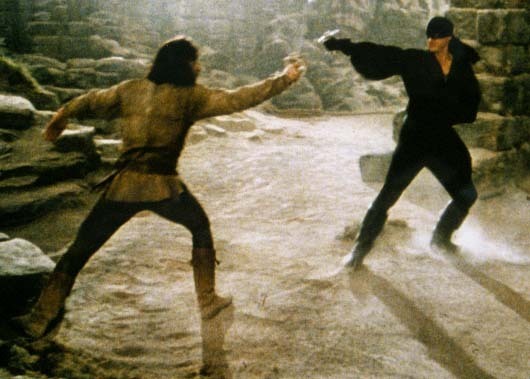
Today, I was thinking about one of my favorite movies– The Princess Bride. In one scene, two mighty swordsmen are fighting a duel. They are fighting with all their might, but they are evenly matched, and neither one is winning. Then, with a flourish, the challenger moves the sword from his left hand (which he had been using) and confesses that he is really right-handed. To his surprise, his opponent does the same! Each man has been fighting with his “lesser” hand, giving his opponent a (supposed) advantage. The fight continues with a similar ferocity. The two opponents later become allies in finding and saving the Princess.
So what if God fought for us with His left hand? What if (and I suppose He is) God is ambidextrous? God could defeat the enemy blindfolded and with one arm tied behind His back! Yet God assures us that His protection and provision are never second-best. If we suffer the attacks of the enemy, it is NEVER because God just didn’t fight hard enough, or that He didn’t have the means to win that battle. He doesn’t send in a junior varsity team of Angels to fight on our behalf. He doesn’t call a “time out” in the middle of fighting to catch His breath or re-evaluate His strategy.
God’s “Mighty Right Hand” isn’t just a metaphor for super-human physical power. He isn’t a muscle-bound hero in a comic book or legend. His mighty right hand is not an eternal fist. God is the One who holds the entire universe in His Hand. It is open. He doesn’t hold us in a choking grip; He holds us in the same gentle hands that hold a newborn chick or a delicate snowflake. God’s mighty right hand is also our safe haven. God’s hand guides and directs, as well.
God IS powerful and sovereign. He could choose to use His mighty right hand to squash us, or pound us into dust. He could hold us in a suffocating grip. But God’s mighty right hand is always directed by His LOVE. His Love cradles us, defends us, lifts us up, encourages us, works alongside us, and welcomes us into His arms!
Note: This is a re-post from seven years ago, but I thought it was worth revisiting…
Have you ever had one of those days where things just don’t seem to make sense? It doesn’t have to be a “bad” day, necessarily–just a day when things don’t seem to “fit.” I had one of those days yesterday.
I journal my prayer life– I have notebooks with names and places for each day of the year. Yesterday, my notebook included the city where my daughter lives and the names of three people celebrating birthdays, among other needs. One of the names was a complete mystery to me. I couldn’t remember who this person was, or how I knew either her or her name…I was drawing a blank and didn’t know how I should pray for her. Was she a former classmate? Was she a daughter or mother or sister of someone I knew better? I ended up praying a very general prayer– for her health, her family, etc., but it bothered me.
Hours later, speaking with someone on the phone, another name came up, along with a prayer request– a man suffering with an illness who happened to have the same surname. Coincidence? Possibly, but the name stood out, and I prayed again– for both. Now I was really curious. I did some digging. The first person WAS the sister of someone I knew, and their father is the one suffering from an illness.
God is amazing, and one way is how he gives us the opportunity for “a-ha!” moments like the one I had yesterday. I have spoken to several Christians who are sometimes separated by several time zones from those they normally call on for help or advice. In crisis moments, they have cried out to God. Thousands of miles away, someone will be awakened from a sound sleep with a sudden urge to pray for their distant friend, or another will be stopped in their tracks and send up a random prayer as their mind wanders. Often, this will be in the exact moment of the crisis, and God will intervene with a miraculous healing or rescue or provision. Days later, the two parties will connect and be astonished at the timing.
What used to puzzle me about such prayers was this– if God already knows the need, and plans to act, why involve the second (or third) party? Because stories like this, while impressive and inspiring for those who believe, rarely cause a skeptic to come to faith, and aren’t necessary for those who already believe.
I think God has many answers, and I know I don’t have all of them, but here are three things I believe God is doing through such puzzling circumstances and outcomes:
While it doesn’t turn a skeptic into a believer, it DOES give the skeptic something to explain away– one such instance might be ignored as coincidence, but five? two hundred? And we have a Biblical precedent in the book of Acts, chapter 12, when Peter is rescued from prison and shows up at the very house where believers are praying for his release! Even they didn’t believe at first, and left Peter out in the cold!
It IS an inspiration and an encouragement as a follower of Christ to know that he not only hears our prayers, but he recruits others to think about us, bear our burdens, and share in our trials.
Last (on my short list; I’m sure God has many other wonderful answers I haven’t imagined yet), I believe that God’s purpose for us involves communion– eternally living, sharing, and loving together with Him and with each other. It is one of the highest honors and greatest privileges to be involved in God’s work through prayer…it is something we all can do, anywhere, anytime, but it requires being humble and willing to stop what we’re doing, commit our moments and our hearts in prayer for others (sometimes without knowing why!), and trust God to do all that we cannot.
Prayer sometimes seems puzzling, but that’s because we don’t see all the answers– yet. Someday, what a marvelous and miraculous picture will unfold– and we have the opportunity to fill in the gap; to be the answer to 34-down; to be the missing piece of the pine tree in the upper right corner– to answer the call and finish the puzzle!
Full disclosure– I’m not any type of expert on either prayer or journal writing. But I do keep a prayer log of sorts, and I want to share how that works for me, and why I think it is helpful.
My prayer “journal” is actually a set of four standard notebooks I picked up on sale about two and a half years ago at an office supply store. Each notebook has 100 pages. I have labeled each page with a day (February 12, for example) at the top– three months to each notebook. Below the date, I list people I know who are celebrating birthdays or anniversaries that day, as well as people who died on that day. Below that, I save space for urgent prayer requests as I become aware of them. To the side, I list a place (a country, city, or community) to pray for that day. In the front cover or each notebook, I have a list of focus areas to pray for each day of the week, as well– things like family, leaders and authority figures, cultural issues, missions, etc. The back side of each page is left to record answers, results, and updates.
The journal/notebook approach is not meant to lock my prayer life into a fixed routine; it is not a checklist of what I must pray for each day (and nothing else or added to everything else). I don’t take the notebook with me everywhere– instead, I have a small notepad in my purse to jot down thoughts or requests. Sometimes, I record these in the larger notebook later, but not always. I review the journal once a day, but I pray throughout the day– sometimes raising the names and places in the journal, other times people or situations as they come to my heart or mind. The point is not to make an unnecessary burden of prayer. The point is to remind me that prayer is a pursuit–an ongoing discipline as well as an intimate pouring out of my heart to God.
I’ve come to delight in turning the pages to see:
who is having a birthday/anniversary today– who might be encouraged with a FB post, a call or card or e-mail message
where in the world can I lift up people I may or may not know? There are enough days in the year to pray for every country in the world, every U.S. state, and several major world cities or local communities–and while my list is in alphabetical order, I could have organized by geographic location, or simply listed random places for each day. Some days, the places are familiar; other days I am inspired to look up information on places like Burkina Faso or find out more about West Virginia…
what was I praying about a year ago? Often, I find that my prayers have fallen into a particular pattern– and maybe I need to redirect my focus. Have I been mostly coming to God with burdens, or do my prayers reflect a heart of worship? Humility? Dependence on Him?
how faithful God has been over the years! Maybe there’s a burden that I’ve been praying about over many months or years, but far more often, I have forgotten the “urgent” need I was praying about just a few months ago–God answered in ways I did not anticipate. And those requests that are still “unanswered?” God HAS an answer. I just don’t know it yet.
Does the journal make me a better person or a better pray-er? Well, prayer isn’t a competition, so while I would hope that it helps me develop perseverance, compassion, faithfulness, hope, trust, and wisdom in the practice and pursuit of prayer, it doesn’t make me or my prayer life “better” than someone else’s. It is, however, a tool that is helping me chart the progress in this pursuit, and so I recommend it based on that experience.
If you feel (like I did for so many years) that your prayer life is haphazard and you want to grow in prayer, I encourage you to start with a simple journal– you don’t have to write out every thought or every request. You don’t have to have a plan for every day. But keep a remembrance of your prayer life –even a single item each day for a week, or a month–to look back on, and to move you forward.
For more detailed information, see my page about prayer journaling. Or do a search for “prayer journals.” You may find a system that works better for you– not because prayer needs to be systematic, but because prayer is a journey, and every journey can benefit from a journal!
We live in an angry world, filled with outrage, entitlement, bitterness, hurt, and arrogance. Everywhere we look, someone is giving someone else (sometimes everyone else) a “piece of their mind.” And those who do are often lauded and celebrated. Pundits, critics, “talking heads,” columnists, “expert” opinion-makers (recognized or self-appointed)– all make careers out of sharing their opinions, their theories, expertise, or knowledge. They may be clever, intelligent, even entertaining; they may be popular, intimidating, or impressive in their range of knowledge. I may agree with their opinions, and share their conclusions or beliefs. But I should be careful not to become “puffed up” with knowledge.
Knowledge puffs up but love builds up. The man who thinks he knows something does not yet know as he ought to know. But the man who loves God is known by God. 1 Corinthians 8:1-3
It is very tempting– VERY tempting– to join in this practice of verbal tongue-lashing. To show off our superior knowledge or our righteous opinions. To win arguments and create “mic-drop” moments.
Meeting anger with anger, sarcasm with sarcasm, and pride with pride is natural. But it is not God’s way. God calls for us to have peace of mind– to have a mind that can see and hear the reality of our fallen world but respond in an unnaturally loving and gracious manner given to us by the Holy Spirit. We are to speak words of peace, to walk in humility, and to love our neighbors as ourselves.
Our words can be powerful– for good or evil. We can speak peace and goodwill, harmony, and love into a world that is drowning in hateful comparisons, disdain, selfishness, malicious gossip, idle chatter, and careless opinions. Words can uplift, encourage, heal, and strengthen. Words–even quiet words– can stem the tide of malice and bring light and hope.
And it is not just what we pass on to others with our words– we become what we speak! When we speak arrogance and self-righteousness, we become (and remain) self-righteous and arrogant. When we speak love and joy, peace and patience, trust and truth, we become more peaceful, joyful, patient and trustworthy.
Jesus– the Word of God– often used a quiet sentence to bring hope, reassurance, and blessing to people in need. Jesus felt anger– and He had every right to speak HIS opinion and HIS omniscience when He was tested and unfairly questioned. But He chose to be patient. His answers were not laced with malice and sarcasm, but they silenced His critics, and served as lessons for others who were listening. What a great example for us!
What might happen if we spent less time giving a “piece of our mind” and more time spreading “peace of mind” in our world?
“Now unto him that is able to do exceeding abundantly above all that we ask or think, according to the power that worketh in us,”
Ephesians 3:20 (KJV)
What do I expect as I pray? What is the outcome that I hope for? Most of the time, it looks like one of the following:
I expect to praise and worship God; I hope that He will hear my heart of gratitude and worship, and that He will be pleased with my words and actions
I expect Him to act on or through a particular circumstance, such as providing healing or guidance to someone in need
I expect to hear from Him, or to gain wisdom or guidance for myself
I expect that He will honor His promise to forgive my sins when I confess them
I expect to grow closer to God as I speak to Him and wait to hear from Him
But Paul reminds us in the book of Ephesians that God is able, through the power of Christ at work in us (emphasis added), to do much more than anything we can imagine or ask! What does that mean in my pursuit of prayer?
Well, it means more than I can explain in any blog entry, but let me attempt to imagine a few outcomes that go beyond my normal expectations:
Prayer is a matter of choice. It is also a matter of obedience and acknowledgement. No matter how short, or faltering, or disorganized it may be, each prayer proclaims that God is GOD–worthy of praise, able to save and forgive, supremely authoritative over my life and the lives of others, and ever present to listen to every voice that calls out to Him. And it proclaims this both to the physical world (if we’re praying aloud or with others) and to an unseen and metaphysical world inhabited by spiritual beings who also owe God their worship and obedience.
Prayer is a partnership. In some mysterious way, God allows us to participate in His ongoing work– whether it is bringing healing, joining the chorus of angels in songs of praise, praying for God’s hand to move in global and historical affairs, or developing our personal relationship with Him–God chooses to let us “have a voice” in what He does. God is still in charge. Our prayers will not cause Him to go against His own will. But as we pray, we grow to understand God’s heart. We begin to want what He wants, and to ask for His will because it is what we want most. As we see and hear about miracles, we can know that we are “part of the team.”
Prayer changes things–often in ways we cannot ever see or measure. Someone may pray for years to see a relative or neighbor come to Christ– seemingly without success. What they may NOT see is how their testimony, though spurned by the object of their prayers, has brought others to Christ over the years. And each one of THOSE people has the potential to witness to others– including the one who rejected the original efforts! A prayer for healing that seems to go unanswered may inspire someone to commit their life to researching a disease of find a cure so that thousands of others may be spared the suffering you prayed to alleviate. Praying for peace or justice may not have immediate effect. But we cannot know or imagine the cumulative effect of such prayers in bringing lasting peace or more perfect justice to our children or future generations.
Prayer changes people– especially us! If I am praying for someone, my thoughts and actions will follow. I will take a more active interest in those for whom I pray. I will (or should!) reach out with practical efforts and partner with others who share my concerns. I will give, share, encourage, work, and advocate– not just pray and move on unchanged.
Prayer has substance. We imagine prayer to be ethereal and mental or spiritual. But the Apostle John, writing in Revelation 8:3-4, describes the prayers of the believers (saints) as incense. Our prayers have a pleasing odor, and they rise like smoke into the presence of God. There is nothing empty or “fake” about prayers lifted to Almighty God. Our prayer is not just an exercise in wishful thinking or the power of group-think or “positive vibes.”
We serve an amazing, limitless, all-powerful, all-wise God! Our prayers may seem like just words–humble, inadequate, or even unintelligible– but in God’s hands, they are mighty tools, bringing Him glory in ways we can’t even begin to explain or imagine!
I love puzzles, puns, mysteries– I love clever plot twists in novels. Most of the time. But there is a type and degree of “cleverness” that is offensive to me. And that is the kind of clever that is meant to sting, hurt, or humiliate.
I love the old movie with Jimmy Stewart called “Harvey.” It is a silly comedy about a man who claims to see, and talk to, a six-foot tall invisible rabbit named Harvey. Jimmy Stewart’s character, Elwood Dowd, is a mostly harmless and genial man, but he is an embarrassment to his socialite sister, and a puzzlement to his neighbors and the staff at the mental institution where his sister wants him committed. The doctors are especially intrigued by Elwood, because he appears to be intelligent, rational, and agreeable– “nice”– except for the rabbit! Meanwhile, the other characters in the film are mostly uptight, stressed, angry, and unpleasant. But Elwood has an explanation. He claims that his mother always told him there were two ways to “go through life.” You could be “oh, so clever,” or you could be “nice.” Elwood has chosen “nice.” And his life– even with its crazy invisible rabbit, is more serene, more fulfilling, than the lives of those who are “smarter” and more powerful.
Such a simple line in a silly film, but that thought resonates with me, and it matches Biblical teaching, too! The Bible has much to say about people who think that they are clever. Those who are proud of their intelligence and acumen; those who are wise in their own eyes. This is not the same as being intelligent, while acknowledging that you don’t know everything. Such “clever” people tend to be cynical, snide, and sarcastic. The Bible calls them “mockers”– people who make fun of and belittle others; those who use their intelligence and quick thinking as a weapon to bludgeon and bully their way through life.
We see and hear it often on television, in government, on talk radio, or comedy routines. We hear it in conversations among groups of peers in the workplace or in social situations. There’s always at least one person who entertains others with jokes or stories that are “wicked” funny– jokes that might make you a bit uncomfortable in certain situations, because you know they are unkind, unjust, or downright offensive–even if they are funny. Jokes that get a laugh at someone else’s expense. Remarks that “burn” people with differing beliefs, opinions, or lifestyles. We sometimes even hear it in the church, with harsh remarks for those who think or worship differently from us.
Just like Elwood Dowd’s mother, God has given us a blueprint for life– we can go through life being “oh, so clever” or “nice.” We can be arrogant; overly certain that we know everything, heaping contempt on those who are struggling or who don’t see things “our way.” Or we can be humble and kind; listening to others, offering loving encouragement and counsel, rather than snide “I told you so’s”, embarrassing comparisons, or pithy quips.
The Apostle Paul, in Galatians 6, outlines how we should not only “bear our own burdens” by taking responsibility for our own strengths, weaknesses, faults, and duties, but also “bear one another’s burdens” by showing compassion and reaching out in love. In the middle of this advice, Paul warns us against deceiving ourselves, and reminds us that “God is not mocked” (v. 7)– We cannot dismiss God’s Holiness in our own life, nor can we dismiss God’s command to love our neighbor. Anyone who does mock God (and those made in His likeness!) are deceived in thinking they are clever and beyond judgment.
Recent world events have reminded me of this truth. The opening ceremony at the Paris Olympics was marred by a “clever” but offensive display. Those who organized it and put it on, “explained away” the offense, claiming it was something entirely different; that their actions were not offensive, and those who were offended were misinterpreting their intentions. Many of them are sneering at Christians, even as they “mythsplain” their mockery. But their actions weren’t just mocking Christians around the world, they were mocking Christ. And many of us Christians responded with our own angry and mocking comments, memes, and posts, calling them names, or worse. But God– and God alone– is Holy and Just. Those actions will be punished, but they will be justly punished by God Himself. In fact, if any of those who participated in that display (and any who have responded hatefully) will repent and turn from their mockery and sin, Christ Himself has already paid the price for their actions!
People can be mocked. Even Christians can be mocked. Christ can be laughed at, spit upon, and even crucified in this fallen world. But God is eternally Holy and Just. He will have “the last laugh.” No one is too clever for God. The same people who laugh at Christ will someday bow before Him in worship, acknowledging that He is the King of Kings. That same King offers His Grace to each of us.
Christ isn’t about being “clever” or smug. Even though He has the perfect right to boast. He chooses to be “nice.” He chooses Grace. He chooses Love. And THAT makes all the difference!





































 Pursuing Prayer