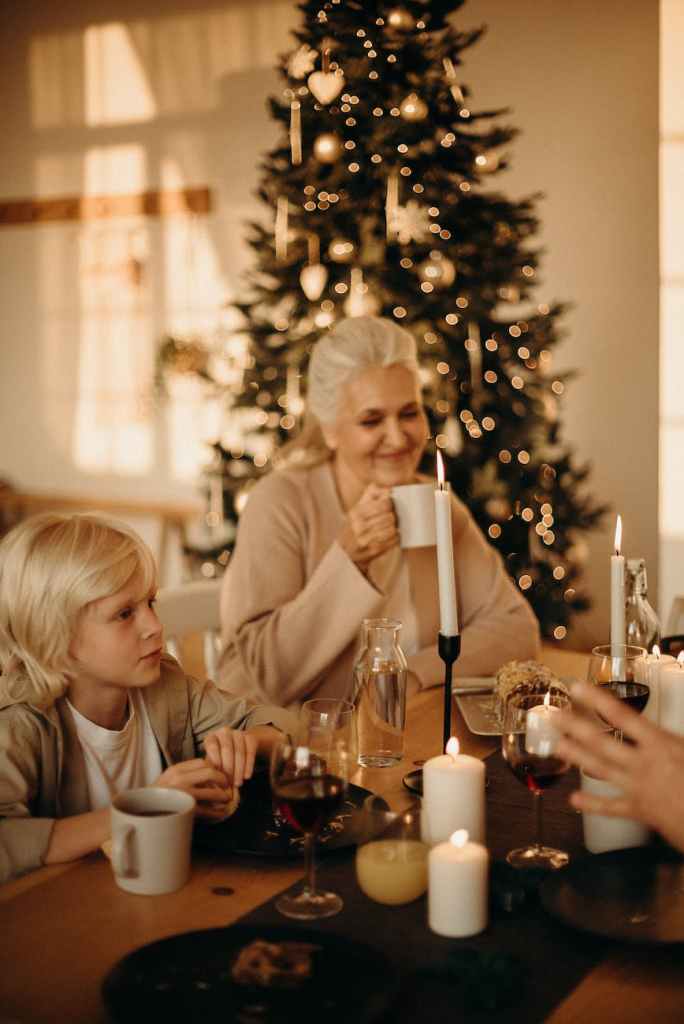
Ugly Christmas Sweaters

It’s that season of the year, when several companies have their annual “Christmas Parties.” Some companies, in an effort not to offend any of their employees, investors, etc., have stopped calling them “Christmas” parties– they are “holiday” parties or “year-end” celebrations. In fact, at one place I worked, they stopped having any parties for the employees, claiming it was a “bad look” to “waste” money on such nonsense! Bah, Humbug!

But company Christmas/Holiday parties have a tendency toward the silliest and least meaningful ways of celebrating what this season and its holidays are all about. Often, the festivities involve a cash (or open) bar, some sort of anonymous gift exchange– white elephant or “secret Santa” with a spending limit of $5 or $10 dollars, and an ugly sweater contest.

And there is an entire industry predicated on the modern tradition of the “ugly” holiday sweater. Garish, loud, often bedecked with pom-poms, tinsel, or even battery-operated flashing lights, such sweaters can cost a minor fortune. They get worn once a year (twice if you have to go to a second party with a spouse, friend, or as a chaperone). And, while I don’t want them banned, I think they represent some of the worst excesses of our modern first world. They serve no higher purpose than to draw attention to bad taste and mock the core values of Christmas, Hanukkah, and other seasonal holidays. They are about tacky and fleeting entertainment, at the expense of higher virtues. 

I’m not trying to be a Scrooge or a Grinch. The holidays should be a time of joy and laughter. But is a tacky sweater really the best we can come up with? Is it in the top ten best ways to enjoy a season of miracles, love, light, giving, and hope? (I feel the same way about the focus on drinking– waking up hungover and sick; not being able to remember the end of the party– how is this “fun?”)

In our effort to have “Christmas” without “Christ” or Hanukkah without miracles; in our efforts to erase God from the celebrations of HIS goodness, we have created a level of fake celebration that echoes the story of “The Emperor’s New Clothes.” We’re walking around with ugly sweaters, each more elaborately ugly than the one before, considering it a triumph to be the biggest fool in a forest of foolishness.

Imagine giving that ugly Christmas sweater to someone who was homeless and had no warm clothes. Would it make you laugh to see someone in those circumstances wearing your once-a-year indulgence? Would your ugly sweater bring hope and healing to those who are refugees this season? Do you wear it when no one else can see it? The sweater isn’t about the season. It really has nothing to do with the meaning of the Holidays. It’s about impressing people with your willingness to stand out; your ingenuity in finding an uglier sweater than anyone else; it’s about YOU.

What would happen if, instead of an ugly sweater contest, seeing who can drink the most before passing out, or a white elephant exchange of worthless gifts, companies celebrated with worthwhile activities– building community ties, honoring achievements, or maybe even reflecting on miracles in our midst? What if our celebrations were less about empty amusements and more about reflecting on what is genuinely worth celebrating–health, friendships, family, hope, and purpose? They might be less amusing, but they might also be more memorable and meaningful.

There’s nothing “wicked” about ugly sweaters or white elephants– but they are becoming symbols of the kind of “Christ-less” Christmas that offers mild entertainment, but no hope for the dark days of a long winter. They are some of the symbols of excessive economic wealth in the midst of emotional and moral poverty. Naked and empty entertainment, pretending to offer light and satisfaction, but settling for glitter and gluttony.

Today, I’m going to wear a sweatshirt to keep warm, and I’m going to spend some time with my family– building memories that will last much longer than last season’s ugly sweater! And I will spend some time thanking God for the sweatshirt, my grandkids, and for the incredible gift of His Son–the real meaning of this season of love, gifts, miracles and hope–our real reason for celebrating Christ-mas!

O, Christmas Tree

As I look out my window today, the sun is shining on hundreds of bare branches. The sky is blue-gray, and the branches are brown and mostly lifeless. Occasionally, a breeze will stir the thin upper branches, or the very last of the dead-looking leaves. When the snows come, the branches and twigs will glisten and stand out against the white-covered ground and slate-gray skies above.

But elsewhere in town, and in the forests and woods just outside of town, there are evergreens! Their green needles and sturdy, squat shapes may go unnoticed in spring and fall, when the other trees show off their glorious changing colors and elegant branches. Soon it will be their time to stand out. Their low branches help break the snow drifts, and increase visibility. Their greenery reminds us that life endures and continues.

I hesitated to write about Christmas Trees. There are no Christmas Trees in the Bible story of the Nativity. Decorated trees have a connection with pagan rituals from long ago. It wasn’t until the first half of the 19th century that Christmas Trees really became a tradition throughout most of Europe and spread to America. What connection do they really have with pursuing a Christian Walk? Only the ones we choose to apply…

  • Evergreen trees are a symbol of eternal faithfulness. They stay green year-round. They do not lose “leaves” like other trees (though they drop needles and cones). This can be a reminder to us of God’s faithfulness and His unchanging nature.
  • Evergreen trees are generally the “newest” trees. After a fire, for instance, pine and fir trees will be the first trees to spring up. Hardwoods take longer to recover and regenerate after a disaster. Just as the birth of Jesus represented the coming of new life and hope, an evergreen tree can symbolize new, fresh growth.
  • While there is no “Christmas” Tree in the birth of Christ, there is a tree in His death on a wooden cross. Hidden in the greenery and lushness of a Christmas Tree is the solid trunk that symbolizes the Cross that Jesus bore, and the Cross that bore Him. Even the needles on the tree call to mind the crown of thorns– sharp, painful, prickly. Jesus came to serve; He came to bear the shame and humiliation, the pain and suffering that WE deserve.
  • Christmas Trees “point” upwards. Unlike many other trees, they get narrower as you look up, and are broad near the bottom. This is a reminder that here on earth, we are to spread out–spread the Gospel, spread the Love of Christ to as many as we can. And our focus should be drawn up to God in Heaven. That is why we traditionally “crown” our trees with stars or angels– to remind us that Heaven should be our “top” focus.

This year, if you are putting up a Christmas Tree, I pray that your focus would not be on the tree itself. It may be real or artificial; green or white or some other metallic color. It may be decorated with glass bulbs, funky home-made crafts, expensive, individualized ornaments, chains of cranberries or popcorn, bright ribbons or twinkle-lights, paper chains, or even photos of loved ones. But all that can be distracting from the true meaning of a Christmas Tree and WHO it represents. And I pray that your focus would not be on the gifts placed in or around the tree, but that those gifts would truly remind us of the greatest Gift of all– Jesus! I pray that the tree would be another wonderful reminder of the one who created trees, knowing He would one day die on one! I pray that you would be encouraged to share new and enduring life and growth to others. I pray that you would be encouraged that God’s plans are eternal, and His Promises faithful and sure.

An Encouraging Word

It can be a dog-eat-dog kind of world out there.  Every day, I hear of people who are facing difficult and trying circumstances– health issues, loss of a job or home, loss of a family member or close friend, depression, oppression, harassment, rebellious or estranged children, abuse, academic failures, exhaustion from being provider, caregiver, etc.– even just daily stress.  It can really take a toll.  But it becomes even more difficult when we isolate ourselves.

When I get stressed, I tend to withdraw.  I don’t want others to think of me as a failure, or to think less of me in my struggles.  But this is one of the worst things I can do.  First, it means more worry and stress because I’m bearing the burden alone!  Second, it forces me to cover up my level of anxiety or depression be pretending that things are fine when they aren’t.  That would all be bad enough, but it gets worse.  Isolating means my focus turns inward– my problems become bigger, not smaller;  I’m so close to the problem, I’m not able to “look outside the box” for solutions, because my box keeps closing in on me.  I can’t see beyond my circumstances to understand if they are temporary, or if they necessitate some life changes on the other side of whatever crisis I’m dealing with.  And, worst of all, the only voice I listen to is my own, rehearsing and reminding me of the difficulties or failures I’m facing. What opportunities do I miss, not only to hear an encouraging word, but to share one with someone else?!

pexels-photo-936048.jpeg

We all need an encouraging word now and then; a voice telling us that we are not alone; that all is not lost; that there is hope.  I have been blessed with wonderful family, friends, and neighbors who are great about encouraging me, even when I try to shut them out or pretend that everything is grand.  Sometimes that encouragement comes through conversation; sometimes a card or text message or a shared piece of scripture; sometimes it comes through prayer.  I may not even know who prayed, or what words they used until days or weeks later, but their faithfulness in praying has become a lifeline when I feel isolated and overwhelmed.

This does not negate my need to pray and ask God for wisdom, healing, or strength for myself, nor does it suggest that God doesn’t answer my prayers.  Instead, it shows a pattern– God often answers our prayers by incorporating and using those around us.  God’s goodness and his love are shown best in teamwork.  We run the race to win, but we race together as teammates, not competitors.  We share sorrows, struggles, and joys. We come alongside; we lift others up, and they lift us up in return.

Encouragement does so much, we sometimes underestimate its power.  In a world of sniping, criticism, name-calling, and finger-pointing, encouragement does the following:

  • It lets someone know that they are seen and heard– that they are being noticed, thought of, and valued.  This shouldn’t be uncommon, but in a world where we are connected to so many be technology, and to so few face-to-face, it is HUGE!
  • It give us perspective to realize that we are not alone in our problems and not unique in facing difficulties.
  • It reminds us that hope and help are gifts to be shared, not something we must earn.
  • It gives us a purpose and a mission to be part of God’s redemptive work– Jesus gave encouragement and hope to those who needed it most, not to those who “deserved” it.

It can be a dog-eat-dog world out there, but we are not dogs.  We are children of the King.  Let’s send out some encouraging words today!

A word fitly spoken is like apples of gold in a setting of silver. (Proverbs 25:11 (ESV)

pexels-photo-416443.jpeg

Also see James 5:13-16 on praying for one another.

Making the Most of Every Opportunity

4-5 Celebrate God all day, every day. I mean, revel in him! Make it as clear as you can to all you meet that you’re on their side, working with them and not against them. Help them see that the Master is about to arrive. He could show up any minute!
6-7 Don’t fret or worry. Instead of worrying, pray. Let petitions and praises shape your worries into prayers, letting God know your concerns. Before you know it, a sense of God’s wholeness, everything coming together for good, will come and settle you down. It’s wonderful what happens when Christ displaces worry at the center of your life.
8-9 Summing it all up, friends, I’d say you’ll do best by filling your minds and meditating on things true, noble, reputable, authentic, compelling, gracious—the best, not the worst; the beautiful, not the ugly; things to praise, not things to curse. Put into practice what you learned from me, what you heard and saw and realized. Do that, and God, who makes everything work together, will work you into his most excellent harmonies.
10-14 I’m glad in God, far happier than you would ever guess—happy that you’re again showing such strong concern for me. Not that you ever quit praying and thinking about me. You just had no chance to show it. Actually, I don’t have a sense of needing anything personally. I’ve learned by now to be quite content whatever my circumstances. I’m just as happy with little as with much, with much as with little. I’ve found the recipe for being happy whether full or hungry, hands full or hands empty. Whatever I have, wherever I am, I can make it through anything in the One who makes me who I am. I don’t mean that your help didn’t mean a lot to me—it did. It was a beautiful thing that you came alongside me in my troubles.

Philippians 4:4-22 (The Message)

I have been blessed with the opportunity to do a couple of short-term mission trips. I am not a “Missionary” in the traditional sense. I have not left friends and family behind to move to a new culture or live among strangers for years to spread the gospel. I basically took some working vacations, met dozens of wonderful new friends, learned about the work they are doing in their community, and joined in helping them with a couple of small projects (painting, sorting donated clothes and shoes, working in the school, helping organize a library, putting together scrapbooks, etc.) I was able to go back and visit five times over a dozen years and watch as the children grew up, the school added on, the staff changed, and the mission work focus became broader and more community-focused.

Two things about visiting the mission field– you meet amazing people and you hear amazing stories. Some people will become life-long friends. Some people teach you and touch you in unexpected ways, even if they cross your path only on a single day. Some stories make you re-evaluate all the things you take for granted. Some stories leave you laughing or crying along with your new friends. Some just leave you speechless.

One such story happened on my first visit. We went on a “field trip” to see a developing community not too far from the border between the Dominican Republic and Haiti. Hundreds of Haitian refugees had flooded into the D.R., and at least two mission groups from the U.S. and Canada were working to provide housing, healthcare, and schooling for homeless families. Several teams of workers had already started building small cinder-block houses, a couple of bath houses/bathroom facilities, etc. in an area that used to be a sugar cane field. The houses were serviceable, and had basic electricity and running water. However, the water was only good for washing, not for drinking. The houses were close together, with very small plots for gardening, but the land was rocky and dusty. There was a centralized “administration” building, with a small clinic and other basic community services, a small elementary school, and a small chapel. Most of the homes had an electric light bulb hanging from the ceiling, but no other appliances. Meals were still cooked over a small open fire in the main room of the house. Cots or bed rolls took up most of the other room. The bathrooms were in the communal bath houses.

Not the actual location, but this is not too different from what the first houses were like– very basic.

I set the scene above so the circumstances are clear. These families were happy to be alive, and to have any shelter at all, but they were not living in luxury, nor were they moping and in despair about their condition. Part of our visit was to bring awareness to what efforts were already underway, and what needs were still outstanding. Medicine was scarce; many of the families had at least one person who was HIV positive, and many of the others had issues resulting from malnutrition and untreated childhood diseases. Jobs were hard to come by– the sugar cane plantations and rum factories had a history of exploiting their workers, and very few other jobs were open to Haitians who either didn’t speak the language or had no work permit/official identification. The mission organizations were not set up to provide jobs, income, or food and water. They were surviving on donations, which were sporadic and usually consisted of non-perishable items like clothes and hygiene items (toothpaste and soap).

Into this scene, the mission had received a princely donation of several hundred pairs of flip-flops. One of the bigger department store chains in the states and an overstock of black and white flip-flops– different sizes, but all the same style and colors. There were enough that everyone in the community could have a new pair of shoes! However, after the shoes were distributed, the administrators noticed that people were still going around barefoot. Very few of the people were wearing the new shoes. Finally someone asked if there was a problem with the shoes.

The answer they received is the heart of the story, and a lesson I have never forgotten. The people were very grateful for the shoes. But their greater need wasn’t for shoes. God had heard their prayers and supplied their need. Several enterprising members of the community had bundled dozens of pairs of flip-flops, carried them nearly eight miles into the nearest beach-front town, and found a spot along the beach where they sold the shoes to foreign tourists. Other groups did the same thing. Using the money from the sale of the flip-flops, they bought bottled water and produce at other roadside stands, carried them back to the community. This way, such items would be readily available while they waited for crops to grow in their gardens or a closer source of drinking water could be found.

On a later trip, we visited this community again. There were flowers, gardens, and two or three “colmados” (Dominican-style corner markets), which had grown out of two or three houses being torn down and reassembled. The community was flourishing. The “administration” center was still used mostly as a clinic and community meeting center, but some of the community members were administrators there. The school and church had grown, and there was now an arts and crafts center; community members were making candles, necklaces, wood carvings, and other items for sale at the beach, where they now had an established booth. God had used hundreds of unwanted, discarded shoes to supply an opportunity for people to work together and build a thriving community. There are still issues– health issues, domestic issues, economic issues– plaguing this settlement. But it is now “home” to hundreds of families who once had nowhere to go, and it is a beacon to surrounding communities, giving hope to hundreds more in the area. And, while some of the community members still go barefoot, most have shoes– shoes they chose and bought and paid for with their own money!

I’ve told this story before, because it is such a strong lesson in looking for and making use of every opportunity. God’s gifts are never wasted on us IF we choose to see them as gifts. Even our abundance– our “leftovers” and “overstocks” can benefit others in ways we might never imagine. And our efforts– even small ones taken in the midst of struggles– will pay dividends when we trust in God to supply our true needs.

What to Throw Away…

19 “Do not store up for yourselves treasures on earth, where moths and vermin destroy, and where thieves break in and steal. 20 But store up for yourselves treasures in heaven, where moths and vermin do not destroy, and where thieves do not break in and steal. 21 For where your treasure is, there your heart will be also

Matthew 6:19-21 (NIV)

When my mom died earlier this year, she left a house filled with “stuff.” Mom saved EVERYTHING! She saved old calendars, expired drivers’ licenses, used peanut butter jars, all her children’s baby clothes and shoes, graduation and wedding invitations, Christmas Cards, broken cameras, and so much more. She owned a seven-bedroom farmhouse, but she lived for many years in just a few square feet in four different rooms. She slept on half a twin mattress; the other half was covered with boxes. She ate on just a patch of her kitchen table; the rest was piled over with papers and “stuff.” There was a narrow path through the dining room to the bathroom and bedroom. Mom was a hoarder.

Mom was also stubbornly independent, and refused to get rid of things or have others help her throw things away. It contributed to her falling and breaking her hip, and later falling and breaking her leg. We eventually persuaded her to move to assisted living and later to a small house that she could navigate safely. But she would not sell the old house or let us throw away her “treasures.”

Shortly before she died, Mom gave us permission to begin the difficult task of “going through” her house. She joked that we would all hate her after she died and we had to finish the task. We joked back that we would never be able to finish in our own lifetimes! Mom knew that she should have thrown things away. But she had chosen to live surrounded by the memories of broken toys and yellowed letters of yesterday.

Well, the house is almost empty. We decided to sell it, and had to clean it out so it could be shown. The bulk of the work fell to my brother and his wife. They are retired, and they live closest to the old house. But even so, it has taken months, and tons of sweat, to find the floors and walls and windows that were covered and blocked by “stuff.” There are still a few pieces of furniture and some items in the basement, but hundreds of boxes, bags, crates, and containers had to be taken to my brother’s house, my house, my sister’s house, donation centers, recycling centers, and, sadly, to the dump.

We had very few “things” left from my father. His family had lived through a house fire when he was a young man, and he learned early that even precious things cannot be saved. He tried to throw things out; Mom would “rescue” some from the trash and bring them back in! He saved a few momentos, mostly photos, and when he died, he was no longer there to advise Mom about what must be put in the trash. But even his “stuff” was hidden among worthless old shoes and dishes and old boxes.

My Mom DID have several treasures– at least to us. She had saved school papers from our childhood, birth and baptism certificates, photos, my dad’s old work uniform, my grandfather’s Navy cap, afghans and doilies my grandmother made, and several worn and tattered Bibles she had so faithfully studied over the years. And Mom was generous in her own way– she sent out thousands of greeting cards and gave wonderful and thoughtful gifts to her many friends and family members. But she kept broken things, rusty and dusty things, used-up things, and things that were useless. And the hardest part of sorting through over 20,000 square feet of “stuff” was finding and determining what to keep and what to throw away.

Life is a lot like that house full of “stuff. It is full of memories, experiences, hopes, dreams, guilt, fears, relationships, emotions, and disappointments. And we have to make choices about what to treasure and what to throw away. Here are some guidelines I’ve learned through my recent experience:

  • Treasure the lesson– throw away the bitterness.
  • Keep the memories– throw away the t-shirt.
  • Save the relationship– throw away the anger.
  • Keep the recipe– throw away the container/magazine it came with.
  • Eat the chocolate–but throw away the fancy box it came in.
  • Throw away the broken dishes, the worn towels, and the pot without a handle.
  • Treasure the stories– trash the dusty, musty books (Yes, that’s coming from a librarian!)
  • Don’t just worth on appearance alone–DON’T throw away an opportunity to show kindness where it is least expected and most needed. There may be treasure among the rubbish!
  • Use the stationery you got for Christmas–throw away the wrapping paper.
  • Throw away last year’s calendar– those days are gone. Make space for this year.
  • Keep your promises–let go of your disappointments.
  • Hold your dreams loosely– be ready to accept what IS as a gift; what WILL BE as a mystery.
  • Treasure the empty spaces in your house and in your life– throw away the extra baggage.
  • Keep space for new blessings–pass the old blessings on to others.
  • Things can never take the place of time spent with the people you love. I appreciate some of the things Mom left behind, but the real treasure was the wisdom she imparted, the laughter and tears we shared over the years, and the faith she lived out as she loved others.

Mom’s joke about us hating her after she was gone– that didn’t happen. And our joking prediction was wrong, too. It was frustrating to go through everything; it was hard work and it might not have been necessary if Mom had chosen differently. But it wasn’t wasted work. We still have dozens of boxes to sort through, but I am finding small miracles and memories (and lessons!) in each one. Mom may not have been able to judge what she should throw away, but she did know what to keep above all!

I hope I am learning what to throw away, as well as what to give away and what to keep. Mostly, I hope I am learning to let go of the things that might prevent me from accepting better things. God will not always take away the things that hold us back, or bury us in the past. But He asks us to store up our treasure, not in a house or a storage barn, or a safe deposit box, but with Him! Things will break, rust, rot, and be lost. Feelings and thoughts can keep us trapped in the past, and blind to the present and future. But God’s gifts– Faith, Hope, Love, Peace, Patience, Discipline, Forgiveness–these last forever, and never lose their value!

Hidden Among the “Baggage”

I am always drawn by the stories in the Bible. Stories of ordinary and extraordinary people used by God– sometimes in spite of themselves–to rescue others, to teach others, to serve as examples, and to show how God wants to interact (or discipline) those He loves.

Photo by Tima Miroshnichenko on Pexels.com

One such person was a man named Saul, son of Kish. Of all the young men of Israel, God chose Saul to be their first king. This was a mixed blessing for the nation. In asking for a human king, they were saying that the did not want to be “ruled” by God or His prophets. God warned Israel through the prophet Samuel that they might come to regret having a human king. They were rejecting the pattern established by God under Moses, and asking for a system of leadership that matched the surrounding nations. This would make it easier to make treaties, do business, and interact with neighboring countries, but it would also bring some of the same problems (succession, power struggles, greed, etc.) that plagued all the other monarchies and empires around them. The choice of Saul reveals not only God’s character, but the character of Israel. God chose a man from one of the least of the families of the least of the tribes of Israel. Saul’s father, Kish, was a man of some power and wealth, but his family line was one of younger sons of younger sons. God often chooses the “least” among us to lead. He is not a respecter of rank or birth, wealth or experience. However, God also chose Saul as a man who “looked” the part. Saul was “head and shoulders” taller than others. He was good-looking and well-educated. Wasn’t this exactly was Israel wanted in a king?

Photo by fabio.tsu on Pexels.com

On the day Samuel called a great assembly to publicly anoint the new king, lots were cast to show God’s choice. Among the 12 tribes of Israel, the tribe of Benjamin was chosen– the youngest of the sons of Jacob, and the smallest of the tribes. A lesser family among the tribe was then selected. Finally, the choice was narrowed down to Saul, son of Kish. But Saul could not be found! A search ensued, and he was eventually found– hiding among the baggage! The tallest man in the kingdom– the one who already had been confirmed as God’s choice– tried to hide from his own coronation! And it was God who revealed Saul’s hiding place and forced him to face his exaltation!

The ongoing story of Saul’s reign as king is filled with both triumph and tragedy. Time and again, Saul tries to “hide” behind excuses. He fails to obey God’s command, but blames his weakness on others. God takes away His favor, and His spirit leaves Saul, who descends into paranoia, anger, and madness.

But today, I want to look at the idea that Saul thought he could hide “among the baggage.” (1 Samuel 10:22) Other translations say he was “among the stuff” or “among the supplies.” Saul did not run away from the assembly altogether; he did not reject his role. Yet he tried to hide from the gravity and responsibility of kingship. In many ways, this shows good qualities of humility and an understanding of his own limitations. Saul’s problem wasn’t that he thought he was “born to be king.” Saul wasn’t born to be king– it was an honor thrust upon him. Saul’s problem was that he wasn’t prepared to let God rule through him. Saul would be the titular King of Israel. But who would be the King over Saul’s own life and heart? Saul, like the nation he ruled, ended up rejecting God’s rule. He tried to follow the letter of the law, and the traditions of his people, but he did not always choose to follow the God who had created them, nor did he humble himself to accept God’s correction.

Photo by Pixabay on Pexels.com

We may not be chosen for a position of leadership. But what responsibilities are we hiding from today? Are we surrounding ourselves with baggage? Do we hide in the busyness of our hobbies or our job? Do we cover ourselves with “obligations” that leave us drained to no real purpose? How many hours do we spend hiding in chit-chat, or watching television, or shopping, or daydreaming? How many times are we volunteering to work with strangers in order to avoid spending time with difficult relatives or neighbors? How often do we offer up the sacrifice of generic worship instead of the sacrifice of a teachable spirit?

Saul had many gifts, which he used to strengthen his nation and expand its territory. He had the opportunity to do even more great things for God and for Israel. But he is mostly remembered for his failures– his defiance of Samuel’s orders and excuses about disobedience; his ongoing murderous pursuit of his anointed successor, David; his consultation in the dead of night with the witch of Endor; his ignoble death in battle… We too, have opportunities to do great things with God’s help and in His power. We cannot hide forever among the “stuff” of life. God will reveal our hiding places– to others, even if we don’t acknowledge them!

Today, I pray that I will come out from behind the baggage of my everyday activities, and be available for God’s good purposes!

Photo by Munmun Singh on Pexels.com

Please see these other links for more commentary:
https://jentezenfranklin.org/daily-devotions/what-are-you-hiding-behind#:~:text=%E2%80%9CHe%20is%20hiding%20among%20the%20baggage.%E2%80%9D%201Sa%2010%3A22,tackling%20the%20job%20God%20appointed%20you%20to%20do.
https://www.thekingdomcollective.com/spurgeon/sermon/3322/

Souvenirs or Baggage?

My Mom died recently, and my brother and sister and I are cleaning out her estate. This is by no means a small task, as my Mother saved EVERYTHING! All of our elementary school report cards, 4-H Awards programs, class play programs, thousands of photos (mostly unidentified), post cards from all of our vacations (including places we re-visited!), ticket stubs from movies and football games and banquets, our old baby shoes, broken toys, recipes clipped from magazines and old boxes, letters we sent from college, and letters sent to her when she was in high school. She even saved such things that her own mother and grandmother had saved! Souvenirs and memories, all tucked away or piled up throughout her house.

Photo by Tina Nord on Pexels.com

My mom was what is known as a “hoarder.” She was pathological in her collecting bits and pieces of everything that went on all around her. She had clothing she had never worn. She had Christmas gifts she had opened and put back in their wrapping, but never enjoyed. She had books she had never read, DVDs she had never watched, and pots and pans she had never used. She had stacks and bags and boxes of memories she always meant to sort through– someday.

Photo by Ricky Esquivel on Pexels.com

As she grew older, she sometimes would lament that we, as her children, would be burdened with the job of sorting through all her “stuff.” Even so, she wouldn’t let us touch any of it until the last months of her life, when it was obvious that she would never be able to do it herself. And we weren’t to throw anything out– only make an attempt to organize it all!

Photo by Ketut Subiyanto on Pexels.com

Of course, now we are throwing out the majority of what she kept. Much of it was damaged by being stacked and stored in the haphazard way it was. Some was damaged by a leaky roof, or mice. Many of the things that are damaged were once useful, and might have been useful yet if they had not been hoarded and held back. Blankets and towels that might have been passed on were left to be chewed up or rotted. Books and photos are warped or stained.

Photo by Wendelin Jacober on Pexels.com

I loved Mom, and she was a great woman of God– a prayer warrior and evangelist. But she was human. In this part of her life, she missed some great opportunities to bless others with the resources she had. She even missed the opportunity to enjoy many of the things she obsessively stored for “someday.” Moreover, she saved many things that weren’t useful. Old boxes and jars of spoiled food, old bills and advertisements, expired credit cards and driver’s licenses.

I have been reminded of many things as I’ve helped go through Mom’s “things.” There are many wonderful memories that still can be found in all of her souvenirs. I found an old storybook– one of my favorites–about a Mama Bear and her naughty, curious little cub. “Why do you love me?,” the cub asks after getting into trouble yet again. “Because you’re my little bear,” she answers as she cleans the wounds and lovingly carries her cub home. Love transcends mischief. It transcends things like lost opportunities and hoarding tendencies, and the frustrations of life.

But sometimes we hang on to things, not out of love, but out of pain or desperation. Mom was a child of the Great Depression. Her family had to move a lot when she was younger. She was forced to give away toys and clothes she wanted to keep; forced to leave old friends and make new ones; forced to make things “last” when new things couldn’t be had. She spent many years having to be frugal and careful to make small memories last a lifetime. She became obsessed with collecting “souvenirs” of even the smallest events, even tragic ones, and holding on to what was “good enough,” even if something better was offered.

Photo by Carlo Ju00fcnemann on Pexels.com

Many of Mom’s “souvenirs” have become baggage for those of us who follow. And many of our “souvenirs” will be baggage for those who follow us. Some of our scars will be passed down to our children. Some of our hopes and dreams will be unrealized–unopened and unused gifts that “might have been.” Others objects and experiences will be pleasant reminders of the love that lasts beyond our own lives and limitations. But objects, in themselves, cannot take the place of the actual experiences of joy, love, and peace they are meant to represent.

Photo by Inna Lesyk on Pexels.com

God wants us to hold fast to certain things. Truth. Hope. Love. Faith. But He calls us to let go of other things. Bitterness, resentment, anger, self-pity. I know that in my final days, I will probably find that I am still carrying some baggage. But I hope that I will find more souvenirs– good memories of a life enjoyed, goals accomplished, and relationships that have stood the test of time. Mom had those in abundance. But some were hidden among the baggage–treasured memories of those who loved her, and those whom she loved, surrounded by the baggage of heartache and longing. I pray that those who follow me won’t have to search among the ruins to find my souvenirs, or hunt through piles of souvenirs to find my treasures.

…And His Own Received Him Not

Today is Boxing Day. Some people will leave their Christmas decorations up for awhile longer; maybe even until after the New Year. Others will box up all the holiday trappings for next year. But the boxes and bags that held gifts yesterday are likely put away– some put aside; others in the trash. We laugh about toddlers and pets being more fascinated with the boxes than with the gifts inside, but most of us tear off the paper and rip open the boxes to get to the “good stuff” hidden inside. The ribbons and bows, the gift card holders and glittery greeting cards, while they delight us in the moment, pale in comparison to the gifts and the thoughts behind them.

Photo by Petri-Caragea Alexandru on Pexels.com

What a shame it would be if all the wonderful gifts under the tree remained unopened– boxed away for another year, just to be placed back under a Christmas tree in 2023. What a useless tradition it would be to give gifts that were never opened or used, or even seen!

Photo by George Dolgikh on Pexels.com
Photo by Burkay Canatar on Pexels.com

And yet…the Greatest gift of all–the very reason for the Christmas season– often remains boxed up and carefully preserved for another year. “Jesus is the reason for the Season,” as some people say. But have we RECEIVED Him? Have we opened up the gift of His coming; of His offer of salvation and reconciliation– or do we just enjoy the idea of the Baby in the Manger and the Wise Men coming from afar and offering gifts; the angels singing in the night sky, and the gentle animals in the stall?

The Gospel writer and Apostle John wrote that Jesus “came unto His own, and His own received Him not.” (John 1:11) God so Loved the world that He gave His son (John 3:16), but the gift remained unopened and ignored by those who should have welcomed Him. He grew up and lived among them– healed their diseases, spoke comfort and truth, laughed and shared sorrows with them– and they cried out, “Crucify Him!” God’s “one-size-fits-all” perfect gift– the “gift that keeps on giving” eternally!–was despised and rejected. And the Gift is still rejected, ignored, scorned, and unopened today.

All the splendor and glitter of the Christmas season will fade away– the decorations will go back in their boxes; the wrappings and trimmings will be forgotten. But the Gift! Let’s bring it out and use it– revel in it; wonder at it. God with Us. God reaching down and out and beyond to bring us Home–forever! And God giving us the privilege and the power to BE His hands and feet and eyes and lips as we minister to those around us! God holding us close as sons and daughters. “But as many as received Him, to them He gave the right to become children of God, to those who believe in His name..”(John 1:12) When we open this gift, we are not just recipients, not merely believers or followers– we are Children of God.

Photo by Porapak Apichodilok on Pexels.com

Lord, help me not make the grave mistake of taking your incredible gift and leaving it in a box, or worse, opening it up and putting it back in a box for later. Help me to live in the “present”– in every way– and to enjoy the privilege of being Your child forever. Amen!

Christmas Wish Lists

When I was a child, we used to write letters to “Santa” with a list of what we wanted to find under the Christmas Tree that year. Sometimes this was a school project– practice in letter-writing etiquette, etc.– and sometimes, it was done spontaneously after poring through the Sears “Wish Book” Christmas catalog, or after watching Saturday morning cartoons with their endless ads for toys, dolls, bikes, and sugary cereals.

As adults, we often do something similar, drafting a Christmas “wish list” in our prayers and Advent dreams. Our adult lists may be as shallow as those of childhood–a new dishwasher, or a shiny piece of jewelry; a new “toy” boat for Dad, etc. Sometimes, they sound more virtuous– world peace, a healthy economy, a cure for cancer…

Photo by Ivan Samkov on Pexels.com

It isn’t “wrong” to have wishes at any time of year. And we should hope for better things in the world around us. But we can get caught up in the idea of Christmas being all about wishes and desires at the expense of the real GIFT of Christmas– Christ Himself! In fact, we can become numb to the fact that Jesus wasn’t just “another” Christmas gift among our “wish list” items.

Photo by Irina Iriser on Pexels.com

The true light that gives light to everyone was coming into the world. 10 He was in the world, and though the world was made through him, the world did not recognize him. 11 He came to that which was his own, but his own did not receive him. 12 Yet to all who did receive him, to those who believed in his name, he gave the right to become children of God— 13 children born not of natural descent, nor of human decision or a husband’s will, but born of God.14 The Word became flesh and made his dwelling among us. We have seen his glory, the glory of the one and only Son, who came from the Father, full of grace and truth.

John 1: 9-14 (NIV)

Christ didn’t come that first Christmas in response to any person’s wish list. In fact, the Bible says that when Jesus came into the very world He created, He was rejected, ignored, even despised by those who should have recognized and welcomed Him. He didn’t come wrapped in shiny paper and waiting for us to enjoy Him. He came wrapped in rags, forced to go into exile under threat of death, and honored only by humble shepherds and strangers from foreign lands. No one sought Him out on their own. Even the shepherds and wise men were led by angels and a guiding star.

This year, instead of concentrating on wish lists and our desires (even noble ones!), let’s reflect on God’s wish list– that we would turn from sin and rebellion, and be reconciled to Him; that we would make His gift our greatest desire!

Photo by Pavel Danilyuk on Pexels.com

Joy(?) to The World

Photo by zeno ferenczi on Pexels.com

I don’t know about you, but I sometimes have problems with Advent Season. On the one hand, it’s a season of joy and wonder; a season of anticipation and expectation. But I find myself contemplating…and as the days get darker, earlier, and the snow falls, then melts, leaving everything brown and gray, I can’t seem to hang on to the joy. It slips through my fingers, leaving me thoughtful and even a little depressed.

I also find myself looking at the glitter and listening to the peppy music of the season and feeling as though all the “Merry” in Christmas is just a soap bubble, waiting to burst. I don’t watch much television, but it seems that every year the “holiday” specials and TV ads get more artificial and shallow. “Buy this!” “Turn up the Tunes!” “Wear THIS to the Holiday party!” “Eat this– Drink that!” “Get away from it all!” It’s more about escaping the ordinary, rather than celebrating the extraordinary gift of God’s Son. The more I try to get “into the Spirit” of the season, the more I seem to miss it…

Photo by Henlynn on Pexels.com

It is important to remember that this extraordinary Joy came INTO and THROUGH the ordinary. The angels didn’t announce to the shepherds that they could escape their duties and run off to a vacation cruise; Mary and Joseph didn’t celebrate their first Christmas surrounded by lights and mugs of hot cocoa. The wise men didn’t have a brand new GPS device to help them find their destination, or tasty cookies and fruit baskets to make the journey more “fun.” This “good news of great joy” was the birth of a child– an ordinary event–except that THIS birth was the fulfillment of God’s Promise and the Way, the Truth, and the Life!

Photo by Levent on Pexels.com

Many millions of people today will not have joyful circumstances to make the season “Merry and Bright.” But they can experience true Joy– the kind that comes from Knowing Jesus–and not just for a day or a season, but forever, in spite of difficulties, pain, and struggle. There IS joy in the journey, but it doesn’t always manifest as mirth and comfort.

Photo by Kampus Production on Pexels.com

This season, it is our privilege as Christians to offer a different level of Joy to the World–the Joy of forgiveness; the joy of belonging; the joy of eternal Hope and Peace. It may not be in laughter or singing. It may be in holding a hand at the side of a hospital bed. It may be in sharing tears with those who are suffering. It may be sharing a crust of bread with real thankfulness, instead of a feast with stress. Joy doesn’t have to be complicated. It doesn’t require wrapping paper sugar sprinkles. The best gifts we can give this season don’t have to be filled with merriment and laughter. They don’t have to be expensive or even filled with thoughtful intent. They should be the spontaneous response of love and compassion for those around us. Let’s give lots of hugs, smiles, and small tokens of respect and appreciation this year. After all, God’s great gift– the greatest of all– began as a tiny, wailing infant, hidden away in a spare stable, wrapped in rags. But “Behold!” It is still bringing great joy all over the world. (Luke 2:10)

Photo by Burkay Canatar on Pexels.com

Let’s not trade certain Joy for temporary mirth this season. Reflect on the Reason, and not just the Season!

Blog at WordPress.com.

Up ↑