What God Didn’t Give Me

I’m very grateful for all the many blessings that God has given me– for Salvation, most of all. But God has blessed me with family, health, freedom, and so many other wonderful things. But there are several things God didn’t give me. Some of them are things I wanted (or thought I needed!) Others are things I never even imagined.

God didn’t give me a pony when I was younger. God didn’t give me blonde hair. God didn’t give me the genetics to be 5’9″ tall, athletic, and thin– I never became a ballerina or a model. God didn’t make it possible for me to study in France my junior year of college like I had wanted. God didn’t see fit to make “Mr. Right” fall in love with me in high school or college. God didn’t give me children to raise. God didn’t let my father live long enough to walk me down the aisle when I finally got married. And I never won the lottery (probably because I don’t play!– but still…)

It’s very human to look around and see what others have that we might desire– things that God did not choose to give us; even things that God has taken from us–and feel resentment, envy, and even anger. But we rarely look at those things others have that we would NOT desire. And we rarely look back and see how things we thought we wanted would not have been good for us, or how God removed things from our lives–even good things–for a better purpose. Sometimes, we cannot know or understand such things this side of heaven. But it might be a good practice once in awhile to look back and see what God DIDN’T give us– and thank Him for His wisdom and provision!

God allowed me to get chicken pox as a child– but He didn’t let me get Polio, or Diphtheria, Scarlet Fever or Whooping Cough. God didn’t give me blue eyes like my dad– but He didn’t give me Dad’s color-blindness, either. God prevented me from going on a date with one cute and popular boy who asked me out in high school. And the one in college. And the one I worked with. But God delivered me to my husband a virgin, and free of the guilt and shame of a string of failed relationships. God took my father at age 68. But He healed my father after a heart attack at age 50 (the reason I never got to study in France). We had and “extra” 18 years with Dad, and while Dad was sick most of the last years of his life, we didn’t have to see him suffer years of pain, misery, and helplessness. And about that semester in France? Some of my friends went that year– and they were plagued by injuries, nationwide strikes, and other issues. God knew what I wanted in each case; He also knew what was best for me.

A couple of years ago, I was diagnosed with Diabetes. God did not “give” me Diabetes. (That’s another mistake we often make.) God gives good gifts. (James 1:17) But we live in a fallen and imperfect world. Disease, injustice, pain, and heartache are part of this world. Someday, God will redeem the world and put an end to all of these, but for now, there is no guarantee that God will keep us in perfect health or happiness. So, I’m Diabetic. I’m not grateful because I have the disease, but I am grateful for so many things related to it. I am grateful that I live in a time when treatments are both available and accessible. I am grateful that I was diagnosed, rather than suffering a coma or dying without help. I am grateful that I have access to healthful foods and the ability to exercise– two things necessary to keep the Diabetes under control. I am grateful that I lived for so many years without the disease. I am grateful for a supportive husband and family members who help keep me motivated. And I am grateful that nothing about having Diabetes changes IN ANY WAY God’s love for me, and His plans to give me eternal life in Him!

Are there things, people, or situations in your life that God DIDN’T give you? Healing that was denied, or blessings withheld? Hurtful things that He allowed to happen in your life? That He took away from your life? God doesn’t want us to pretend that all is perfect in our world. He knows the pain of NOT getting what we wanted, and the agony of losing what we did want. But He also knows the joy that we haven’t yet experienced– the joy of renewal; the joy of restoration; and the joy of completion.

God didn’t give me a pony– nor the hard work of caring for it, or the heartbreak of losing it. God didn’t let me date the popular boy– but He gave me a man of gentleness and integrity. God didn’t give me children to raise, but He gave me grown children, and grandchildren to love. God didn’t “give” me the semester in France, but He did give me opportunities to meet people from France. He gave me opportunities to use the French language I studied– in Florida, Texas, and even the Dominican Republic! God didn’t let my father walk me down the aisle at my wedding. But He allowed Dad and David to meet and even know each other– years before we were married. God didn’t give me perfect health here on Earth– but there will be no disease or death in Heaven.

Thank you, God, for all that you have given me– even Diabetes–and for all that you have allowed to shape my life. Help me see You in every detail of my life– the pleasant, the painful, the difficult, and the mysterious– and to praise You in every circumstance. Thank you for today, and for all the plans you have for it, and for me. Thank You for being You!

Happy New Year!

Today is New Year’s Day. And for most of us, nothing is really that much different than yesterday. Some of us have the day off from work; others don’t. Some of us will begin new ventures this year; others won’t. But we face January first with expectation and hope. Why?

There is something about looking forward. Sometimes, it can fill us with dread– especially if we imagine the worst or have some reason to expect a dire outcome or consequence for one of our past actions. But most of the time, we look forward to a new year with some level of confidence and even eagerness. We make plans, promises, and resolutions. We fill in calendar pages and make appointments in our planners. We dream about goals and accomplishments we hope to fulfill by this time “next” year. And hope makes us happy.

What makes you happy and gives you hope today? Is it your career? Your family? The savings you have in the bank? Is it your ability to make things happen? Or your past success in planning for the future?

What if 2025 brings disaster– to you personally, or to the world around you? What if the economy fails? What if war comes to your town (if it hasn’t already!) What if this is the year you face Cancer? Can you still have hope? Can I still wish you a “Happy New Year?”

We don’t know what this year will bring. But we CAN know the timeless and eternal Hope that is in Jesus Christ. Even if we face uncertainty, grief, struggles, pain, loss, injustice, or misery. We may not find “happiness” in this year, but we can find joy and peace that surpass all understanding (see Philippians 4:7).

How can we do this? The Apostle Paul tells us in the very same passage to “be careful for nothing.” (see v. 6) That doesn’t mean to be careless, but rather not to try to control all the variables and circumstances in our life. Instead, we are to take everything–EVERYTHING– to God in prayer. So every day of 2025, we can offer up the day, the night, and all that happens within them to a loving God who KNOWS our future. He not only knows what will happen TO us; He knows what can happen THROUGH us, AROUND us, FOR us, and WITHIN us! He knows what resources we will need, and how those resources can be made available. He knows what is truly best for our growth, fulfillment, and joy. That doesn’t mean that we won’t have to suffer or that we won’t have questions and even some doubts. And it doesn’t mean that we sit back and do nothing. But we can do our best to step out in Faith, knowing that God can redeem even our mistakes– if we let Him.

There is one other part of the Apostle Paul’s directive–Gratitude. We can be thankful, even in the midst of pain and suffering, frustration and grief. Not because we are suffering, but because we are NEVER alone, and NEVER forgotten. God’s plans may involve suffering, but they never end there. Just as we turned the page on 2024, God will one day make ALL THINGS NEW.

Someday– and it could happen in 2025 for all we know– we will be ushered into something completely new. Not a new year, a new decade, a new millennium, a new epoch, a new age, or a new phase, but a completely new Heaven and Earth.

And THAT’S a Happy New worth hoping for, waiting for, and being thankful for. Right now, and every day of 2025!

All I Want for Christmas…

Children are busily writing letters to Santa and making lists for their parents– “I want…” We’re listening to “Christmas Classics” on the radio– “All I Want for Christmas is My Two Front Teeth.” “All I Want for Christmas is You,” “I’ll be home for Christmas…Please have snow and mistletoe and presents on the tree…” “Christmas, Christmas time is here; time for toys and time for cheer. We’ve been good but we can’t last– Hurry, Christmas. Hurry fast!”

Advent is a time of expectation and hope. But it can also be a time of selfishness and greed. “I want…” “I’m dreaming…” Even if the things we want and wish for are not ‘bad’ things, we can get so caught up in the wanting and wishing, that we forget the deeper meaning and purpose– not just of Christmas, but of life! Life isn’t about getting things– even good or nice things. And Christmas, while it is a season of gifts, is primarily a season of giving.

Turning the radio to a Christian station, I can hear old familiar carols reminding me of the real reason for this season. “O Come, O Come, Emanuel!” “Joy to the World!” “Hark, the Herald Angels Sing–Glory to the Newborn King!” “What Can I Give Him, Poor As I Am?” “Yet In Thy Dark Streets Shineth the Everlasting Light…” “This, this is Christ the King; whom shepherds guard and angels sing.”

Even so, it is tempting to spend time this Advent season thinking and praying about all the things we want– noble things like Peace on Earth, Good Will to Men, and good things like health and happiness for our loved ones, and even selfish things, like a new toaster or a new pair of gloves. But what about what GOD wants this Christmas?

Photo by Wolf Art on Pexels.com

God wants us to enjoy the blessings He sends our way. But He also wants us to be grateful for the blessings we already have; the ones we have enjoyed (and even taken for granted) all year long. He wants us to take time in this busy season to reach out, not just with gifts and cookies and lights and greeting cards, but with compassion, warmth of heart, a willingness to listen, an invitation to share tears as well as joys, and efforts to heal old wounds and make peace right in our own families and neighborhoods. Christmas isn’t just about the baby in the manger– it’s about the Christ of the Cross, and the Return of Christ the Triumphant. And this is Our Advent season– awaiting and preparing for His Return!

There are many good things to “want” this Christmas. But all I really want is to be ready for His Coming– ready to receive His Grace, His Hope, His Joy, and to point others to “Thy Glorious Light!”

Fuzzy Socks

Every year at about this time, people come up with lists of “Things For Which I Am Thankful.” Some lists are elaborate. Some are short. Some are earnest; others are tongue-in-cheek– “Thanks for nothing.”

A few years back, one of my former students started posting on Facebook about her “thanks” list. She started on November first and listed one thing for every day of the month. I liked the idea, so I began doing the same. I’ve done it for a few years now. It’s not really difficult to find things to be thankful for– but it can be frustrating trying to come up with 30 different things that don’t end up overlapping or repeating. I could list individual family members on different days, but if I’ve already listed “Family” or “Grandkids” (as I did this year), it seems repetitive to list them separately. Also, what if I list some family members and leave others out? Won’t someone be hurt?

I began to realize, as well, that posting every day can become somewhat self-indulgent. What about those who are alone in the world? My rhapsodizing about family, good food, good health– isn’t that really just a subtle way of bragging about my blessings? The real goal of Thanksgiving shouldn’t be about WHAT, but about WHO? WHO is the source of all these blessings? WHO deserves to be thanked for any of the wonderful people, things, and situations in my life?

In the middle of all this second-guessing and self-righteous reflection one year, I was suddenly struck with a strange and ridiculous thought. I am really thankful for fuzzy socks! I used to run around barefoot every chance I got. But in the past few years, I’ve developed neuropathy in my feet from diabetes. My feet are often numb and cold. They aren’t so painful that I can’t walk, but sometimes the least little thing on the rug or floor can suddenly feel painful to my bare feet. Fuzzy socks are a treasure to me. They keep my feet warm, and cushion against some of the tiny antagonists– the pile of the carpet, the mote of dust on the floor, or the early morning temperature of the bathroom tile.

And it hit me. Thanksgiving is not just about the “important” things in life– though it’s wonderful to take the time to evaluate how much God has given me, and how many “big” things I often take for granted. But Thanksgiving is also about the little things– like fuzzy socks– that touch our lives. God cares about my neuropathy. He cares about my likes and dislikes, my comforts and my aches and pains.

And Thanksgiving is not just about “fun” or “pleasant” things. I am thankful for the times when God has disciplined me; when I have had to struggle to find the answers, when I have had to ask for help. I am thankful that God is with me in every situation. I am grateful to remember how much He REALLY cares about me. And in remembering all this, I want to share with as many people as I can reach how truly thank-full we ALL can be for the Love, Mercy, and Grace that is showered on us by God every day. Even when we are not aware; even when it involves something as simple as “fuzzy socks.”

So, I still post about 30 things every November. I discuss my thankfulness for family and friends, for vision and mobility, for a roof over my head, and for transportation, and the freedom to come and go. I list “Godly” things like prayer and my Bible or my Church. But I also list “fuzzy socks.” And pizza, and crossword puzzles, bird song, snowflakes, and books. Such things truly make me grateful.

“The Lord Giveth…”

We are approaching Thanksgiving in America. Too often, Thanksgiving is lost amidst the shuffle between Halloween and Christmas. No one dresses up for Thanksgiving; no one passes out treats. There aren’t the same long-standing cultural traditions that we have with Christmas– no trees to decorate, no “Thanksgiving” cookies to make, no “Thanksgiving” elves or Santa Claus. There are turkeys, and sometimes stories about Pilgrims and Natives sharing a peaceful feast, but even that has become a sore topic. In fact, for many people, Thanksgiving is about three things– eating, watching parades on TV, and watching Football (trying to stay awake after all that food!). Some families give a nod to the spirit of Thanksgiving by going around the table and reciting the things for which they are thankful. But we rarely take the opportunity to draw attention to the Giver of all good things. We are more likely to be thankful for things we have as a result (we think) of our own hard work, wise decisions, and “good luck.” Families may travel long distances to be together, but even that is going out of fashion, as young adults often opt to spend the day with their friends or even on their own, and older adults are often “celebrating” without any family present.

I love Thanksgiving. It is one of my favorite holidays. But I think we have lost much of the spirit of Thanksgiving. Thanksgiving is not just about one day with lots of food spent with family or friends. Thanksgiving is really a lifestyle. The Bible is rich with thanksgiving and praise:

 “I will give to the Lord the thanks due to his righteousness, and I will sing praise to the name of the Lord, the Most High.” Psalm 7:17
“I will give thanks to you, LORD, with all my heart; I will tell of all your wonderful deeds.” Psalm 9:1
“Enter his gates with thanksgiving and his courts with praise; give thanks to him and praise his name.” Psalm 100:4
“Give thanks in all circumstances; for this is the will of God in Christ Jesus for you” 1 Thessalonians 5:18
 “Do not be anxious about anything, but in everything by prayer and supplication with thanksgiving let your requests be made known to God.” Philippians 4:6
 “And let the peace of Christ rule in your hearts, to which indeed you were called in one body. And be thankful.” Colossians 3:15
 “Through him then let us continually offer up a sacrifice of praise to God, that is, the fruit of lips that acknowledge his name.” Hebrews 13:15

We have much to be thankful for, but when we look at the Bible verses, Thanksgiving is NOT about WHAT but about WHO. We can be thankful for good health, but we should “give thanks” to the One who gives LIFE– even when we aren’t enjoying perfect health. We can be thankful for our family, but we should really be thankful for the One who created and designed families– including our imperfect, slightly dysfunctional family.

Job learned this lesson well. He was extremely blessed– one of the richest men in all the land. He owned cattle and land, had a large family, and was highly respected. But when he lost it all, he still took time to thank God– not just for the good things He had given Job, but for who He was and is. Job acknowledged that the same God who gives is also the God who takes away– yet He is just, Holy, and awesome. He is sovereign and merciful. And, in the end, Job was restored to health, prosperity, honor, and given a new family.

Jesus was always thanking God– and not for the things we might expect! Jesus arrived in Bethany to find His friend Lazarus dead. Yet He thanked the Father. He did not thank God for “letting” Lazarus die, but He thanked Him for always hearing His prayers, including His prayer to restore Lazarus to life. Jesus thanked God for food– even though He proved that He could turn water into wine and small amounts of food into feasts! Jesus even thanked the Father for hiding His message from those who think they are wise, while revealing it to the lowly and meek. Imagine how much easier His ministry would have been if God had simply opened everyone’s heart and mind to accept that Jesus was the Messiah! But it pleased God to make Jesus’ ministry “fail” on many levels and lead to the Crucifixion. In spite of this, Jesus praised the Father for His wisdom and sovereignty.

We can be thankful to God, not just when things are going well, and we are feeling blessed, but when things are dark and chaotic, or we feel as though we have failed. We don’t ignore the grief of loss, the pain and struggles we face– but we look beyond to the God who sees, hears, heals, and makes all things new in His time. We can thank God in all circumstances, because He is GREATER than all circumstances!

This season, may we take time to contemplate– not just all the good things we have–but to dive deep into who God IS. May we say with Job, “The LORD giveth, and the LORD taketh away; Blessed be the Name of the LORD!”

The Power of “Thank You”

It happened that as he made his way toward Jerusalem, he crossed over the border between Samaria and Galilee. As he entered a village, ten men, all lepers, met him. They kept their distance but raised their voices, calling out, “Jesus, Master, have mercy on us!” Taking a good look at them, he said, “Go, show yourselves to the priests.”They went, and while still on their way, became clean. One of them, when he realized that he was healed, turned around and came back, shouting his gratitude, glorifying God. He kneeled at Jesus’ feet, so grateful. He couldn’t thank him enough—and he was a Samaritan. Jesus said, “Were not ten healed? Where are the nine? Can none be found to come back and give glory to God except this outsider?” Then he said to him, “Get up. On your way. Your faith has healed and saved you.”

Luke 17:11-19 (The Message)

Have you ever been thanked for doing your job? I don’t mean praised or tipped or even promoted…have you ever had someone look you in the eye and thank you for a job you did? Not because they had to, or because it was expected–not because they were trying to flatter you– but because they were genuinely grateful? It is a powerful, humbling, and even startling experience. I can count in the fingers of both hands the number of times I have been genuinely and personally thanked for things I did in the course of various jobs. Such expressions have come from unexpected sources, and have made lasting impressions.

Photo by cottonbro on Pexels.com

Our culture has been one of polite gratitude– I grew up being reminded to thank salespeople, waitresses, bellhops, bank tellers, gas pump attendants (yes, I’m THAT old!), ushers, and anyone who held a door, or provided a small service. We’ve lost a lot of that– we EXPECT good service (some of us expect even more than that) and are more prone to complain if we don’t get it. And, in the age of self-service and entitlement culture, we are less likely to receive the kind of good service I remember as a child. The end result is a lot of complaining and resentment. But even “good manners” is not the same as genuine, heart-felt gratitude. Someone can say all the right words and still leave you feeling drained and even hurt. Someone can leave a huge tip after being beastly–you still remember the abuse. And someone can be grateful but leave you unsure if they even noticed your effort.

The Gospel of Luke tells a story that illustrates this well. Jesus, while traveling through the region between Galilee and Samaria, comes to a village with ten lepers. Keeping their distance, but wanting to catch Jesus’s attention, they shout out and ask for a miraculous and merciful healing. Jesus takes pity on them. He doesn’t shun them, but He doesn’t make a big fuss, either. He simply sends them on their way to show themselves to the local priest and be declared healed. It is after they leave that they realize they are indeed clean! Nine if the men continue on, grateful (we assume) and overjoyed. But one man makes the decision to turn around and thank Jesus face-to-face. He shouts and glorifies God and thanks Jesus repeatedly. And he was a Samaritan–an outsider; a rogue Jew–the type of person who wouldn’t be expected to show “good manners” to a Jewish teacher. Jesus points out to His disciples that there were ten men who were healed, and only one who came back to show his gratitude. He then speaks directly to the healed man, and assures him that his faith has both healed him and saved him.

This story does not go on to tell us whether or not the ten men offered the “appropriate” thank offerings that were set up in the Laws of Moses. It does not mention whether or not these men spoke of their healing or their gratitude among their friends and neighbors. We should not assume that the nine others were ungrateful in any way. Yet Jesus calls attention to the tenth man. Not because he was more important than the others, or felt more gratitude than the others, but because he took the effort to show it in person. It didn’t cost him any money or a lot of extra time, but it made an eternal impression that was recorded for us to learn from centuries later.

What a small thing, to say “thank you” for a helping hand, or friendly advice, or good service. It doesn’t require a costly demonstration, or empty flattery. Just a simple, direct, and heart-felt expression of gratitude. But what a powerful gesture. One so powerful, even Jesus was moved to stop and comment on it. Think how much good we could do if we took the extra moment to say, “thank you” to someone today? Think how much we have to be thankful for!

Photo by cottonbro on Pexels.com

Heavenly Father, THANK YOU for all that You do and have done; for all that You ARE! Thank you for those who do good, who show kindness, and who give their time and effort in service. May we be truly grateful, and quick to show our gratitude today. Amen.

Childlike or Childish?

This is the week of our local County Fair. People around here are pretty excited. The exhibits, the rides, the animals, the events and attractions, the food, the games…there is a little something for everyone. I love watching the faces of the children– their wonder and excitement is contagious as they see the various farm animals, or ride the Merry-Go-Round, or discover the joys of Cotton Candy and Elephant Ears.

I grew up with the County Fair– not just as a visitor, but as a participant. And I am encouraged to see a new generation showing animals, exhibiting craft projects, learning new skills, and having fun. Some of them will return as 4-H parents; some to work as judges or to volunteer at a booth for local churches, clubs or businesses ; some to visit from out of town with their own children and grandchildren. There is something about a County Fair that is simple and pure–something that can inspire childlike wonder, even in adults.

Childlikeness is something we are called to by Christ. He loved children, and He told His disciples that if they wanted to be part of God’s Kingdom, they would have to become like little children (See Matthew 18:2-4). We are to pray to Our Father, having childlike faith in His good will and His promise to hear us. Childlike faith is not “blind” faith. Children are often frightened by the big animals or loud noises at the Fair. And they tend, (especially small children) to want to hold hands or stay close to those they know. But they also want to see and experience “everything”– because they trust that their parents and the Fair organizers will not put them in jeopardy. A childlike attitude and trust in God brings us the kind of joy and peace we see in children as they discover, rejoice, explore, and enjoy life– especially during Fair week.

This is not to be confused with childishness. While Jesus encouraged His disciples to have childlike faith, He reminded them that the “children of Israel” had often behaved with childish disobedience and complaining. God is a loving Father. He wants children who follow Him out of love, and who trust Him completely. But He will also lovingly discipline those who have developed a childish rebellious streak. I didn’t see much childishness at last year’s fair, but when I did, it was not exhibited by children, but by those who consider themselves adults. Tantrums, selfish demands, complaining about the weather or the crowds or the noise… While the children at the fair were gracious “winners” and “losers” at the shows, patient and content (for the most part) as they waited for rides or food, some of the adults were grouchy, whine-y, and difficult to please. I’m sure I missed a couple of epic meltdowns by toddlers, and some tears from a few exhibitors, but most of the children were just thrilled to be able to go to the Fair again.

It is easy to recognize and call out childish behavior in others. Obnoxious, foolish, self-centered, unreasonable– those are just some of the adjectives such behavior warrants. A childlike attitude is also easy to recognize– eager, grateful, joyful, hopeful, teachable, honest and open, loving and caring. Oddly, I know several adults who sneer at childlike behavior, even as they exhibit childish behaviors. They brag about their very “adult” approach– cynical, “realistic,” confident, “tough,” clever, independent, and self-sufficient. But they are stressed, angry, bored, distrustful, lonely, and sad. Our loving Father wants so much better for us! Being with childish people is tiring and depressing; being around childlike people is refreshing, joyful, and encouraging!

I’ve been thinking this week about my own attitude. The County Fair will come and go this year, but each day comes with wonders and struggles, competitions, waiting in lines, and dealing with crowds. Do I face them with an attitude that is childlike or childish? Do I trust God to be with me when I go through new experiences, even if they are a bit daunting? Or do I complain and demand my own way, expecting to “win” every game or competition, dragging myself and others through stress and tears? Father, help me to see Your world through childlike eyes of wonder and gratitude. Help me to see others with the love and joy You alone can inspire.

I’m Too Busy!

Father, I’m too busy today.
I have filled my life with too many urgencies
And obligations.
I can’t take the time to quiet my soul
And just meditate on You.

I have a checkup appointment with the doctor this morning.
(Thank you for my health and wellness, and
Give the doctor insight and wisdom to see
What I need to do to stay healthy.)

And then, I have a busy day at work,
To make up for the time off…
(Thank you, Father, for employment!)
(Thank you for time off!)
(Thank you for travel mercies.)

Tonight, I have to catch up on all the housework…
(Thank you for a home, and clothing, and dishes, and furniture…)
(Thank you for family to share it all with!)
And I promised our neighbor I’d check on their cat while they are on vacation.
(Thank you for good neighbors, and the opportunity to serve them.)

Lord, forgive me… I’m just too busy to pray today.
(Father, thank you for a busy life– a life with purpose and activity.
Thank you for your Presence throughout the day!)

Father, thank you for the truth–
I am NOT too busy to give you praise
I am NEVER too busy to turn my thoughts and my heart
to YOU, even on this busy day!

“Fruit-ful” Prayers

Our church has been presenting a series of sermons on being a BLESSing to our neighbors. BLESS is an acronym for Begin with Prayer; Listen with Care; Eat Together; Serve like Jesus; and Share Stories. We were challenged the first week to choose four close neighbors. We were to pray for them, and if we didn’t know them well, to reach out and make contact. This has been a true challenge for David and I, because we live in an apartment above our shop. Most of our neighbors are not residential, but commercial! Nevertheless, we decided on a couple of commercial “neighbors” and a couple of non-traditional “neighbors.” We started praying– praying for opportunities to get to know our neighbors a little better, and praying for their health, well-being, etc. We’re getting to know some of the workers at the two commercial locations, and getting to know our chosen “families” a little better. We’ve been more intentional about stopping to visit or chat, and making sure we listen and respond sincerely– this is not just a short-term “project” but an opportunity to build closer relationships. And we’ve been praying for opportunities to develop closer friendships.

So this week was the sermon I’ve been dreading– “Eat together.” You might wonder why this is so fearsome–doesn’t everyone like to eat? And I love meeting over a nice meal. I love to cook, as well. The problem? Our apartment is tiny and upstairs– NOT conducive to inviting people over for a warm, comfortable meal shared around a large table. We have two mismatched chairs around a small table in our tiny kitchen, and two more mismatched armchairs in the living room. No couches, no designated dining room, no space to “entertain” guests. I want to serve others. I want to grow friendships. But I’m not a hostess. Not in a cracker-box-sized apartment upstairs. I know this seems petty– I’ve known amazing hostesses who live in shacks and invite guests to sit on a dirt floor. I know. But I still struggle with the idea of entertaining others in my current circumstances.

I knew it was coming– we looked at all the examples in the Bible of good and even sacred things happening around the table and/or involving food– Passover Seders, Communion, the Wedding Feast of the Lamb (among others)… “But Lord,” I prayed, “I can’t invite the entire staff next door to my home for a meal. And some of the “residential” neighbors we are praying for are elderly and can’t manage the stairs to our apartment even if we had the room to host a meal. And it’s too expensive to invite some of the families or staff to a restaurant. How are we going to be able to bless others and “Eat” together?”

But God isn’t bound by conventional ideas– even when it comes to hospitality. At the end of the service, we were surprised by an announcement from our pastor– one of the families in our church owns a fruit farm. Last year, they had a bumper crop of apples, and they donated several bags of the apples to the church. There were enough apples for each family to take several bags to “BLESS” our neighbors! No meal to fix. No apologizing for the smallness and shabbiness of our living space. But a chance to share FOOD with my neighbors and bless them with wonderful apples! Thank you, God!

David and I wasted no time– we delivered most of the apples yesterday afternoon! And we had so many apples, we were able to bless more than just the four locations we had decided on earlier in the series. We were able to bless at least 13 different families/ businesses with at least one full bag of apples! We blessed families with small children, a retired couple; a single person on a fixed income; an extended family of four generations; we blessed people who go to another church; we blessed people who don’t attend church at all. We blessed the staffs at a couple of local businesses, and shared laughter (and concerns) with several friends, old and new.

Not everyone wanted the free apples. One family turned down our offer. Some people are suspicious of free gifts; some are too proud to accept food as a gift; some are simply not interested, or too busy. It is the same with the Good News. Some people do not want what we have to offer in Christ. Some are suspicious; some are too proud or even too ashamed to believe that God has Good News for them. Some are too caught up in their problems or their ambitions. We must not be discouraged, though. God has not given us such a precious gift without also giving us the opportunity share it with others. And we will see how God continues to work in mysterious ways. Some people were surprised and confused by the concept of “apples of blessing.” They wondered what we might ask for in return. We smiled and said there were no strings attached– we just wanted to share our blessing with them! Some people took more apples than we had planned to give them– that’s ok, too. Others wanted to bless us in return– we received over two dozen eggs in gratitude for a couple of bags of apples! Today, I’ll be delivering the last few bags to businesses that were closed yesterday (to share with their staff). I’m excited to share this gift–and I’m reminded of how good it is to share the free gift of the Gospel!

God didn’t change the circumstances of our apartment. I worried that I would be asked to host an elaborate meal, or that I would miss out on blessing others because of our circumstances. But in God’s economy, we can show hospitality, love, generosity, and compassion on the street. We can share food in a way that opens up opportunities to make memories, share stories, communicate prayer requests and concerns, serve others’ needs, and make new friends. There are dozens of ways we can open our hearts and our lives to our neighbors, serve them, and pray for them…

We kept one bag of apples– maybe someone in our neighborhood would like a pan of apple crisp! And now, David and I have a few extra eggs! Anyone interested?

Why Say Grace?

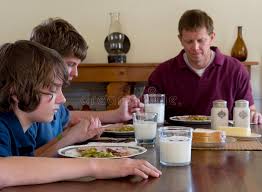
When I was growing up, we always said grace before our meals. It wasn’t an afterthought; it wasn’t an affectation. It was just part of the meal. We sat down, said grace, and started eating. Sometimes, Dad did the honors; sometimes, it was Mom. And sometimes, my sister or I were asked to say it. It was usually something simple, though it wasn’t always the same. We would say grace at home, around our own table, and we would say grace at restaurants– wherever and whenever our family was together for a meal.

Today, my husband and I have the same tradition. We don’t have children in the house, but he and I take turns saying grace, and if one of the grandkids happens to visit, they know they may be asked to take a turn, as well. If David and I are eating out, we still take a quiet moment to hold hands, close our eyes, and say grace. Some times, other diners or wait staff will stare (or glare) or comment, but most of the time, they don’t even notice.

So why do we do it? Is it no more than force of habit? Are we just “holier” than other diners? Do we really think it impresses God if we say grace, or that God will be angry if we don’t say it?

No. But we believe saying grace is important. Here are some reasons why:

  • Grace is about gratitude. In our busy lives, it can be tempting to take things for granted– even things like food and family. We are BLESSED to have food to eat, and family with whom to share it. We are blessed when we go out to eat to have others cook and clean up for us. We are blessed whenever our family or neighbors can share a meal with us. God is a loving and gracious God, and grace is a time to remember our blessings.
  • Grace slows us down for just a minute to REMEMBER who we are, and who God is! All our blessings– including food and family and time to share them– come from God. Grace reminds us to be humble as well as thankful. It reminds us to see God’s hand at work in even the smallest and most mundane happenings in our lives. And it reminds us that God is faithful in all things, big and small.

  • Grace also helps us to remember to thank the people involved in our meals– the ability to buy groceries; the work it takes to prepare our food; friends and family who share our meals; neighbors who have given or traded with us for food; the cooks and wait staff that serve us at restaurants. Saying grace helps us SEE how we are interconnected; how we depend on God and on others in every area of our lives.
  • Grace gives us the opportunity to lift up our immediate worries and give them to God, instead of holding on to them. Grace is more than just a quick word about food. It is a time for us as a couple (or a family) to pray together about worries that are on our minds. Then, instead of being stressed as we eat, we can stay “in the moment” with each other, and enjoy mealtime together! It’s also a great way to share our thoughts, feelings, and concerns in a safe and informal environment. How much better mealtime is when stress and frustration are diminished, and joy and peace are given a seat at the table, instead!

Saying grace is much more than just a quaint habit from a bygone era. It is a vital part of our growth as individual Christians, and as a Christian couple. I believe it is a simple and quiet witness to others. I believe it has benefits for our digestion, our attitudes, and our emotions, as well.

Grace– not just the mealtime prayer, but the concept of Grace– is not loud or showy. It is, however, consistent, lovely, and powerful. May we say grace; may we show grace; may we live in the power of Grace today!

Blog at WordPress.com.

Up ↑