I have been revisiting old hymns lately as I write about my pursuit of prayer. This is partly because I believe that prayer is a form of worship, and is closely tied to other forms of worship– meditation, singing, etc.. Sometimes, it can be helpful to pray songs or to sing prayers– look at the entire book of Psalms!
Our church has recently been involved in revival services– two weeks of time set aside to evaluate our daily walk with Christ. We need periods of revival and refreshment, conviction and confession, repentance and reflection. Without them, we will wander; without them we will wither and grow cold, and lose sight of our first love.
One of the first nights, we explored the idea of surrender. We say that we trust God; that Jesus is Lord, that we are followers of Christ…but do we really demonstrate those truths by the way we live? Have we really surrendered our will, our lives, our futures to God? We claim that He is sovereign over big things– all of creation, world affairs, and such–but is He Lord over the little things? Do I trust Him with my reputation when someone misrepresents me to others? Do I trust Him with my diet when I am tempted to overeat? Do I trust Him with my time when someone asks me to help them on my day off?
One of the keys to this hymn (and to prayer) is in the first verse– “..in His presence daily live.” There are times when I feel the need to surrender; times when I feel wholly surrendered and devoted. But there will be other days when the feeling just isn’t there. My surrender needs to happen daily– in the “good” times and in the “difficult” times. Sometimes, I just need to pray that the Holy Spirit will guide and empower me to recognize and surrender those areas that I have tried to “take back” from Him.
And then, I need to be intentional about letting go–one piece at a time, if necessary–each day saying, “Yes” to God instead of “Yes” to those things that pull me away. It’s not always easy to say, “I surrender all.” It’s even harder to actually follow through. We want to hang on to things that are comfortable, familiar, even “good.” We want to hang on to things that seem to promise safety, success, or fulfillment– even when God offers more.
I’m not writing this because I have mastered the discipline of surrender– I need to learn to let go, to trust God more, to risk what I cannot keep to gain what I cannot lose (paraphrasing from Jim Elliot–https://www.brainyquote.com/quotes/jim_elliot_189244. That is my prayer today, for myself, and for others.
One of the reasons I began a blog about prayer over eighteen months ago was in reaction to a scathing op-ed article about prayer written in the wake of a mass shooting. Well, here we are again. Two highly publicized (and several “smaller”) mass shootings occurred over the last week in the U.S., and the outrage and anguish is overwhelming and completely understandable. The senseless violence and subsequent loss of life stops us in our tracks. Why? Why would anyone do this? How? How could this happen? In the wake of such evil, millions of people rush to distance themselves from such evil; many of them resort to angry protests and calls for action. Many point their fingers at this leader, that group of people, that philosophy, that industry–any entity (other than oneself) that can be held responsible and made to “pay.” Many offer earnest condolences for the families of the victims– often with the phrase “thoughts and prayers.”
But what good are any of these responses? Nothing we say or do can turn back time and undo the events of the past week. No amount of protesting, legislating, avenging, or moralizing will guarantee that everyone lives in peace and safety as long as evil lurks in human hearts– whether by vigilante gun violence, war, terror attacks, economic and political unrest, rioting, looting, domestic violence, brutality, assault, murder, or suicide. “Banning” guns (or “assault weapons”, “military-style” weapons, etc.) sounds like a sensible action to take, but it is not practical in the face of evil people who will not follow the law, and corrupt governments who will not enforce the law, or worse, who use their power to oppress their own citizens.
Finding, and even punishing a scapegoat may make us feel morally superior and bring a false sense of closure, but it will not break the cycle of anger, hatred, injustice, or lack of respect that is at the root of violence.
But there is something equally repugnant about hearing the phrase “thoughts and prayers”, no matter how earnestly it may be expressed, in the wake of inhuman tragedy. The “thoughts and prayers” of strangers have no warmth, no solidity, no promise, and no strength. They are wisps and vapors of selfish and graceless bystanders, who want to ward off the evil that has befallen someone else. They are nothing more than a pseudo-spiritual appeasement offered to the nameless, faceless fates.
And the greater tragedy is that such empty phrases, expressed as reactions to great evil, cheapen the very real power that should be found in the pursuits of thinking/meditating and praying.
Prayer is not a knee-jerk reaction to bad news. It is not a gesture meant to signal to others that you are beyond the touch of whatever forces have just hurt someone else, or that by your thirty second of piety you can alter the consequences of a catastrophe or change the course of the future.
Where were the “thoughts and prayers” of others two weeks ago? Where will they be tomorrow or next week? What quality of “thoughts and prayers” go out to the families of victims whose names we have not even bothered to learn? Such superficial public expressions, sent with seven teary-eyed and five or six high five/praying hands emojis, mean very little to anyone except the sender. They change nothing from the past, and offer nothing going forward.
I am as guilty of this kind of meaningless virtue-signaling as anyone. I want to feel as though I can, by such empathetic expressions, encourage and strengthen those who have been touched by horror, tragedy, survivor’s guilt, trauma, grief, etc. But I can’t. Nor can my anger, frantic attempts to “fix the world”, or brilliant analyses of all the root causes of violence prevent the next bombing, drive-by shooting, hijacking, arson, political uprising, or disappointing election result. I cannot change the hearts or minds of those with whom I disagree. I cannot “make” a better world.
But that is why I write this blog. It is through a lifestyle of prayer– real prayer, difficult and sometimes agonizing prayer, joyful and grateful prayer, pleading and gut-wrenching prayer, consistent and obedient prayer–that I engage with the only One who CAN bring hope, justice, change, renewal, and salvation to this world. And it is through a lifestyle pursuit of prayer–daily seeking God’s face, asking for His wisdom, accepting His mercy when I fail, reflecting on His character, acting in obedience–that He can change me. That power, that hope, and that renewal is available to ANYONE who will ask. It sustains us when tragedy strikes, and it empowers us to offer far more than empty “thoughts and prayers”– it causes us to pray, not just after a tragedy, but unceasingly– not just for our own comfort and safety going forward, but for the well-being of our enemies, not just for those who look like us or think like us, but for those who scream at us and tell us to stop already with the “thoughts and prayers!” That power causes us to seek peace where there is hatred, justice where we find corruption, and humility when we are surrounded by narcissism.
And if we are not doing those things– if we are not tapping into that power– we should be taking a closer look at those “thoughts and prayers” we are hiding behind.
The prophet Jeremiah lived in violent times. His city was besieged by the Babylonians, and his king was a prisoner in his own palace. God had sent messages of judgment and punishment for the entire nation. Jeremiah prayed diligently, and spoke out against the injustice, pride, and idolatry all around him. In response, he was arrested, beaten, thrown into a pit, and abandoned. God even told him to stop praying for his countrymen, because they were unwilling to accept the truth about their condition, or prepare for the punishment to come. But in the middle of the violence and bad news, God offered hope and promises of restoration, justice, renewal, and peace. He also gave this warning to Jeremiah, that he should stand firm– he should, by his example of consistent obedience and hope– influence others, NOT let himself be influenced by the anger and arrogance of those around him.
Lord, I need to stop offering cheap thoughts and empty prayers that do nothing to honor You and little to help others. Give me the strength and grace to stop reacting to tragedy by reflecting the anger and self-righteousness around me. YOU are my hope, and the best hope I can offer to anyone else. Help me to serve others in truth and love, not judge them, dismiss them, or honor them above You. Help me to seek and stand for justice that is consistent with Your character and Your word, even if I stand alone.
Thou didst leave Thy throne and Thy kingly crown, When Thou camest to earth for me; But in Bethlehem’s home was there found no room For Thy holy nativity. (Refrain 1-4): O come to my heart, Lord Jesus, There is room in my heart for Thee. Heaven’s arches rang when the angels sang, Proclaiming Thy royal degree; But of lowly birth didst Thou come to earth, And in great humility. The foxes found rest, and the birds their nest In the shade of the forest tree; But Thy couch was the sod, O Thou Son of God, In the deserts of Galilee. Thou camest, O Lord, with the living Word, That should set Thy people free; But with mocking scorn and with crown of thorn, They bore Thee to Calvary. When the heav’ns shall ring, and her choirs shall sing, At Thy coming to victory, Let Thy voice call me home, saying “Yet there is room, There is room at My side for thee.” Refrain 5: My heart shall rejoice, Lord Jesus, When Thou comest and callest for me.
Christmas is a time of gathering: with friends or family, co-workers or congregations. But, as we gather, we must make room– room for a tree; room for decorations; room for tables laden with food and drink; room for guests; room for gifts; “room” in our schedules–for shopping, programs and parties, travel time, etc.
We spend a large part of the holiday season making room for all these things. We plan ahead, and rearrange our lives and rooms for all the trappings of Christmas. Do we make room for the Christ?
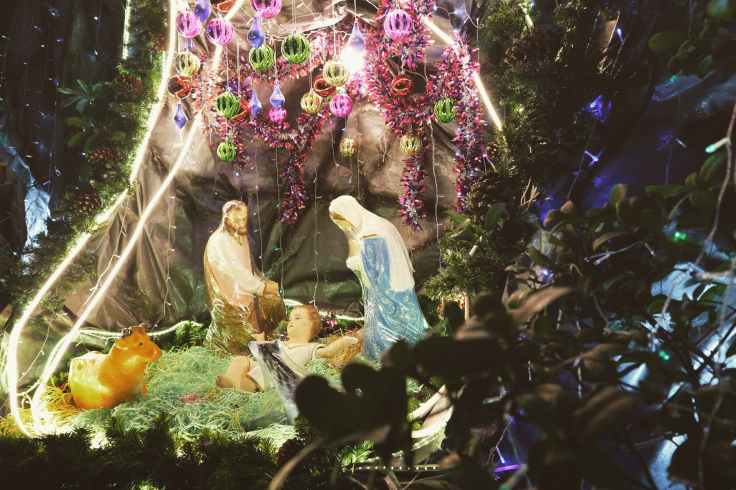
God planned from the beginning for the incarnation. He sent word through the patriarchs and prophets that He would come, but He made no reservations or detailed plans for His arrival in the humble town of Bethlehem. And while the Christ child received gifts from the Wise Men (see yesterday’s post), He asked for none. He asked for no great halls filled with feasting and merriment. All He asked for was room–and there was none. Bethlehem was flooded with visitors. Everyone was busy with the census, pre-occupied with annoyances, worries, taxes, paperwork, registrations, and more. The residents of the town, who might otherwise have shown great concern and even generosity toward a visiting young couple expecting their first child, could not be bothered to find help for this family.
At its heart, Christmas is all about making room– but not just for the glitter and comforts and the expected guests– we have the opportunity to make room for the wonder that arrives unannounced, and even inconvenient; for the realization that God often arrives as an unexpected guest.
We don’t often celebrate Las Posadas in the bitter cold of Michigan, but it’s a wonderful tradition that reminds us of this very truth. For nine nights before Christmas, people throughout neighborhoods in Mexico and Guatemala parade through the streets re-enacting the journey of Mary and Joseph to Bethlehem. A couple representing the expectant parents go door to door, asking for shelter. Door after door is closed to them, until they arrive at a house that has been designated as La Posada (the lodging), where the entire group will be welcomed in to warmth and celebration. Click here to see a more detailed description: https://www.franciscanmedia.org/las-posadas-a-mexican-christmas-tradition/
I pray that we will always have room in our hearts for the Christ– and for all those whom He loves. As we make room for all the trappings of Christmas, let’s not fill the space and time with so much that we crowd out the real reason for the season!
Angels we have heard on high Sweetly singing o’er the plains, And the mountains in reply Echoing their joyous strains.Refrain: Gloria, in excelsis Deo! Gloria, in excelsis Deo! Shepherds, why this jubilee? Why your joyous strains prolong? What the gladsome tidings be Which inspire your heav’nly song? Come to Bethlehem and see Him Whose birth the angels sing; Come, adore on bended knee, Christ the Lord, the newborn King. See Him in a manger laid, Whom the choirs of angels praise; Mary, Joseph, lend your aid, While our hearts in love we raise.
This has always been one of my favorite Christmas carols to sing. I love the movement of the melodic line and the harmonies, especially when singing the angels’ chorus: “Gloria, in excelsis Deo! Gloria, in excelsis Deo!” (Glory to God in the Highest Heavens!)
Yet, if we think about it, the angels seem almost to be having a joke. There is something ironic about hosts of angels praising the glory of God in His highest Heaven, when they are announcing that He is, at that moment, a wailing, helpless infant, wrapped in rags and borrowing a feeding trough for his bed, miles from the warmth and comfort of a home of any kind, let alone the glory of His rightful throne.
8 And there were shepherds living out in the fields nearby, keeping watch over their flocks at night. 9 An angel of the Lord appeared to them, and the glory of the Lord shone around them, and they were terrified. 10 But the angel said to them, “Do not be afraid. I bring you good news that will cause great joy for all the people. 11 Today in the town of David a Savior has been born to you; he is the Messiah, the Lord. 12 This will be a sign to you: You will find a baby wrapped in cloths and lying in a manger.” 13 Suddenly a great company of the heavenly host appeared with the angel, praising God and saying, 14 “Glory to God in the highest heaven, and on earth peace to those on whom his favor rests.” 15 When the angels had left them and gone into heaven, the shepherds said to one another, “Let’s go to Bethlehem and see this thing that has happened, which the Lord has told us about.” 16 So they hurried off and found Mary and Joseph, and the baby, who was lying in the manger. 17 When they had seen him, they spread the word concerning what had been told them about this child, 18 and all who heard it were amazed at what the shepherds said to them.
And this is how God chose to appear, and chooses to work– confounding the power of the powerful, the wisdom of the wise, and the goodness of the self-righteous. God does not glorify that which is already a spectacle. Instead he glorifies the lowly and unqualified things of the world by coming into them, working through them, and reshaping them for His use.
And so, may we have eyes, ears, and hands to work in the same way–to raise up, encourage, bless, and honor those who cannot yet see the Glory around them, the Glory God offers to share freely. May we be the host of God’s messengers to spread the Glorious news of Christ’s gift of life and salvation. May we be like the shepherds, jubilant in our acceptance of His great news. And may we be, like the babe himself–humble and kind–bringing Glory to the world around us, no matter how dark or unwelcoming it may appear. Remember, God himself is with us!
It started out small– a glItch, really.
Every tIme I began to type, the same thIng would happen.
At fIrst, I barely notIced.
After all, It wasn’t lIke I couldn’t read my own wrItIng.
It wasn’t In every lIne or word;
It was a sIngle letter.
But then It began to spread.
As tIME passed, It becaME more dIffIcult.
I notIced a theME. I could stIll read the words,
But theIr MEaning was gettIng lost In
SoME way I couldn’t quIte deterMINE.
It was begInnIng to spIll Into MY speech;
IMpossIble to MEnd; MEldIng Into MY mInd’s
NIches, MErgIng wIth MEdIocre comMEnts
And MYsterIous MEltdowns.
I I I I I,
ME ME ME ME ME.
As I and ME took over, yo_ went mIssIng.
ThIngs were s_ddenly less peacef_l…
Even Jes_s seemed sIlent In the dIn of ME and MINE.
SIn and prIde– I co_ld always be fo_nd there.
It was a fast-spreadIng vIr_s– s_rely leadIng to MY r_In:
_ntIl I lIstened to a stIll, small whIsper…
A Holy breath of fresh, clean, wholesome change.
AAAHHH!
Exhaling the I’s and ME’s, and breathing in YOU–
Brought hope and healing; renewal,
Perspective and life.