11 But Christ having come as a high priest of the coming good things, through the greater and more perfect tabernacle, not made with hands, that is to say, not of this creation, 12 nor yet through the blood of goats and calves, but through his own blood, entered in once for all into the Holy Place, having obtained eternal redemption. 13 For if the blood of goats and bulls, and the ashes of a heifer sprinkling those who have been defiled, sanctify to the cleanness of the flesh: 14 how much more will the blood of Christ, who through the eternal Spirit offered himself without defect to God, cleanse your conscience from dead works to serve the living God? 15 For this reason he is the mediator of a new covenant, since a death has occurred for the redemption of the transgressions that were under the first covenant, that those who have been called may receive the promise of the eternal inheritance.
Some chores just never end– laundry, trash, sweeping, making the bed, doing up the dishes, mowing the lawn/shoveling the drive or sidewalk– the list goes on. Simple chores, but repetitive and sometimes annoying. And they are all necessary– if someone doesn’t do them, the whole family (sometimes the whole neighborhood!) suffers.
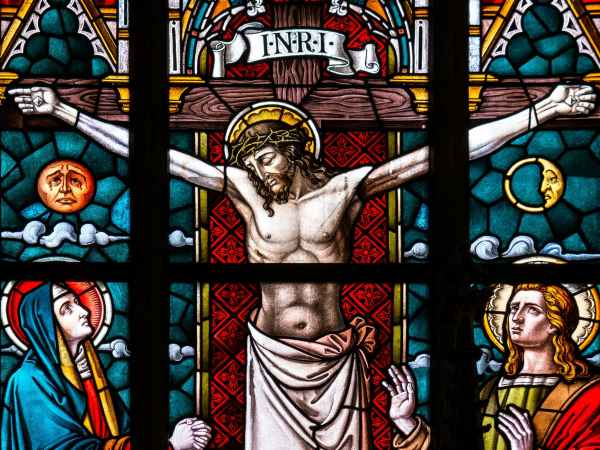
Today, I’m so grateful for the promise that Christ’s sacrifice is sufficient– He redeemed us completely and forever through the shedding of His blood. It’s a done deal! It is FINISHED! All that the ancient sacrifices represented has been fulfilled in the death and resurrection of the Messiah. Atonement and reconciliation are available for the asking. We still need to seek His face; to turn from our sin and humble our hearts before our maker. But the Holy Spirit makes it possible to lay the guilt and burden of sin at the foot of the cross and walk away free and unencumbered.
Someday, even the mundane chores of this world will come to an end. Many of the tasks we do every day involve maintenance– maintenance of our earthly bodies (hygiene, eating and/or dieting, dressing, etc.), maintenance of our earthly homes (dusting, sweeping, washing, painting), and maintenance of the earth around us (lawn care, neighborhood beautification, trash pick-up, caring for trees, pets, gardens, etc.). But better by far, the “chore” of cleaning up after our sins and mistakes and emotional scars will be forgotten in the joy of our eternal restoration.
We live in this knowledge and hope even now– one day we will live in the full reality. Every reminder, every vestige and speck of sin will be banished, never to be dug up or brought to mind. Relationships won’t just be patched up– they will be fully restored. Consequences will be expunged; hurts and damages erased and completely healed.
Once for all–for all time, for all who place their trust in Messiah, for all the breadth and depth of words, actions, thoughts, deeds, consequences, injuries–Once for ALL!
I was challenged the other day by someone who suggested that my prayers are “too little.” Well, not precisely “my” prayers– I head up a small prayer group at church, and we pray for people in our congregation and our community. We keep a running list of people who are suffering from various health issues or housing issues, relationship issues, etc. We also pray for our church staff, for missionaries that our church supports, for upcoming ministry opportunities and programs, and other seemingly “small” requests. These are posted on a list and shared with some of our church members who are shut in or who want to lift up their neighbors in very specific ways.
I don’t think this person meant to be insulting but I see our prayer group quite differently. These “little” prayers are heartfelt, and I believe they reflect the heart of our Savior. Yes, Jesus offered salvation through His death and resurrection to “whosoever believeth” (John 3:16) throughout all the ages, but in His ministry, Jesus was extremely personal and intimate. Among His disciples, Jesus taught them to ask for “our daily bread” and for simple forgiveness as “we forgive” those who have hurt us. (Matthew 6:9-13) And I think our prayer group reflects that aspect of prayer. So, even though our list may seem “small” as we pray for Ned’s pneumonia, or Clarice’s upcoming CAT scan, next week’s teen outing, or Chris’s continuing housing issue, it is also showing compassion and worth to each individual, sharing in their “burdens” (Galatians 6:2) because God loves each of us without condition or limit!
On the other hand, I think I know what this individual was trying to convey. We are also called to pray “big” prayers. Jesus encouraged His disciples to have “big” faith– the kind that moves mountains (see Matthew 17:20– although Jesus says that even faith as small as a mustard seed can result in this kind of answer!) “Little” prayers can be the result of “little” faith. We pray for God to intervene in ordinary things without asking Him to unleash His power and majesty. God is able to do infinitely more than we ask or imagine (Ephesians 3:19-20) through the power of Christ in us! So are we tapping into that promise, or limiting our prayers to what we think God might do on a small scale?
I don’t think our prayer group is doing this at all. We often pray for peace in the Middle East and in other war-torn regions. We pray that the spirits of Anger, Lust, Deception, and Rebellion will be bound and that the eyes of the lost will be opened; that hearts will be softened toward the Gospel, and that our brothers and sisters facing persecution will be, strengthened, emboldened, and protected/rescued. We pray for Revival and renewal across nations and continents. And we pray that in these “little” situations, God’s love, wisdom, and power will be shown clearly– even to those who deny His existence.
Prayer is a huge topic, and a lifelong pursuit. I was challenged by this comment the other day to look closely at how our group functions; at how I present prayer each week; at how we perceive the calling and responsibility of prayer. In the Proverbs, we are told that “As iron sharpens iron, so one person sharpens another.” (Proverbs 27:17) Comments like the one that challenged me the other day are golden opportunities to learn, review, and grow in our daily pursuit. The Church is strengthened when we allow for each member to speak– especially if it stretches our view of things we take for granted!
I don’t believe there are any prayers that are “too little” to bring to God– He delights in our smallest steps of Faith; in our complete and simple dependence on Him. But I also don’t believe that our prayers can or should be limited by the mundane and ordinary. We should come boldly to the throne of Grace– not because of who we are or what we’ve done, but because of the Awesomeness and perfect Sufficiency of the God we serve!
As a young girl, I prayed about being married. Most of my prayers were pretty shallow– more about the wedding than the marriage. I dreamed of dresses and decorations, flowers and a shadowy “prince charming” type of groom, whisking me off into the sunset and living happily, dreamily ever after.
The years went by…MANY years! I prayed and dreamed through my twenties; I prayed and hoped through my thirties; and I prayed with less hope and more desperation in my early forties! But my prayers changed as I saw marriages around me. I saw many marriages that were solid, even through tough times. And I saw many “fairy tale” marriages crumble. I saw a lot of heartbreak, anger, and tears, as people who had once vowed to love one another “’til death us do part” fought over furniture and who got the kids over minor holiday weekends. I heard from frustrated wives who felt like they had made a huge mistake, marrying the “man of their dreams.” Some of them compounded the mistake by looking around for a replacement “Mr. Right.”
Instead of praying about a wedding, I began praying about marriage. Instead of praying for “Mr. Right,” I started praying that God would help me become “Mrs. Right.” And I prayed that God would show me what I should do for others during the time that I was single, as well as what I could do for him in a marriage relationship.
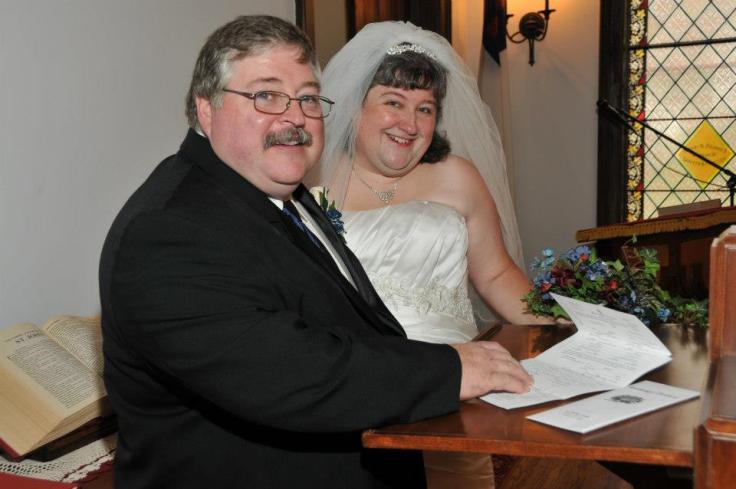
Thirteen years ago, I married my husband, David. He isn’t “Prince Charming,” though he can be charming and noble at times. He is, as I am, a flawed human being. David was married before, and he carries the hurt of betrayal and loss of trust from the past. I carry the hurt of being rejected and passed over for so many years. Marriage doesn’t make the past disappear. Marriage is not a “cure” for such hurts.
But marriage is more. God instituted marriage from the beginning for a man and woman to come together in a mysteriously intimate relationship that models what God’s love is like. (See Genesis 2:24; Matthew 19:5; Ephesians 5:31 and others.) David and I don’t exist to “complete” each other. We don’t cease to be our own individual selves. And yet, we are not the same as we were before our marriage. We are more than the sum of our parts– we are ourselves, yet we are one– the Fairs. He is David Fair, and I am Lila Fair, but WE are THE Fairs. And spiritually, we are also one WITH Christ– as individuals and as a couple. We walk forward as One. We make decisions together. We share hopes and dreams, as well as struggles and disappointments. We fight sometimes– not against each other, but against differences or misunderstandings that could weaken US as a couple and weaken our relationship with Christ.
I don’t pray any less often or less fervently now that I am married, but I pray daily about my marriage. I thank God that He was with me through all the “single” years. I thank God that He continues to work in our marriage– that David and I know more about love and faith, hope and fulfillment than we did 13 years ago! I pray that David and I will grow together for many years to come. I pray that we will impact our family as we live out what a Godly marriage is supposed to be. I pray that our marriage will inspire young men and women who are looking (as I once was) to see what a solid marriage involves– that the way we talk to each other, and behave, and work, and live will give hope to future couples, and glory to God.
Marriage and prayer go hand in hand. Prayer cannot guarantee that marriage will be easy–or even than it will survive. Marriage takes two people praying and walking in the same direction! But marriage–and life– without prayer will never be all that God intends it to be.
The Biblical figure of Daniel is mostly remembered for being thrown into a den of lions as a punishment for praying to the God of Heaven in defiance of a new law (proposed by his enemies, who hoped to set him up). https://www.biblegateway.com/passage/?search=Daniel+6&version=NIV The story is a familiar one– so familiar that we sometimes pass over the context and details. I don’t want to retell the entire story, but I want to put it in context. There is a lot more than just a den of lions and a miraculous rescue.
First, the Book of Daniel is filled with loosely tied stories in the life of Daniel, an Israelite captured by the Babylonians, and living in exile over the course of over seventy years. By the time we get to chapter six, Daniel is likely in his late eighties or early nineties! He has served under at least five monarchs in two empires, and has seen the utter collapse of two major capital cities (Jerusalem and Babylon). Because of the episodic nature of the first half of this book, we have very few details of Daniel’s everyday life– we never learn if he was married or had children; if he was ever allowed to return to the land of Judah; or if he was able to use his position and influence to help other Jewish families or speak out against the idol worship and human sacrifice practiced by his captors. In the story of Belshazzar, it seems that Daniel had been relegated to a lower position within the palace during the years after Nebuchadnezzar’s death– Belshazzar did not know of him; only because the Queen remembered his ability to interpret dreams was Daniel summoned and brought back to court. The events of chapter six are unique and shocking to us, but not in the context of Daniel’s life.
There is a pattern that gets repeated throughout Daniel’s story– it is the confrontation of two great powers– Daniel’s faithful service to God puts him in opposition to the powers of his captors. He is a captive and a foreigner, but that is not what makes him (and his three friends) a target of powerful enemies. It is his prayer life and his obedient devotion to God that causes him to be singled out. In seven decades, that devotion has never wavered, and Daniel’s life of prayer has been consistent, both in private and in public. Daniel doesn’t have to argue, protest, or announce his devotion. When he is praised for his abilities, he quietly gives the glory and credit to God. When he is vilified and betrayed, he quietly waits for his vindication to come from the God he has trusted through the years.
Darius, (like Nebuchadnezzar and Belshazzar and others before him) is impressed by Daniel– enough that he appoints Daniel to a position of great power and authority within the kingdom. Daniel, because of his humility and integrity, is not threat to the rule of Darius–but he does pose a threat to those under him who are hungry for power and prestige. There will always be people in this world who will try to destroy what they do not understand or respect. Darius is not the author of Daniel’s dilemma, but a tool in the hands of corrupt officials. Daniel could have been hurt, enraged, or defeated by this decree from Darius– but he recognized that the real enemy wasn’t Darius, or the crooked satraps who put him up to it (or the hungry lions he faced) — the real enemy was the opposition to Almighty God and the refusal to acknowledge His authority. Darius is quick to learn that God’s power is real and absolute, and that God is gracious in his power, and loving toward his servants. The wicked satraps did not learn this lesson, and they perished.
Notice that, just as in the story of the fiery furnace, God did not remove the danger. Daniel’s friends had to go into the fiery furnace…Daniel had to go into the den of lions. And these were not just overgrown kittens. They would have been captive lions– just as Daniel was held in captivity! They were trapped in this den, unable to hunt for their food; dependent on the whims of their captors. They were kept in a state of uncertainty, fear, and hunger. They were desperate, and hurt, and angry. When Daniel is brought out of the den, and Darius orders the conspirators to be thrown in (with their families), the lions pounce with terrifying ferocity, not even letting the bodies hit the bottom of the den! God may allow us to face some terrifying “lions”– scoffers and rebels and desperate people who will try to take their anger and hurt out on us. Will we trust that God can stop their mouths while we wait for deliverance?
Daniel’s calm response to this entrapment was not the result of Daniel being “holier” than someone else, or more clever; God did not send him a vision of assurance that he would live to see another day. Daniel must have been terrified of facing several starving lions! At his age, he would not have had the strength to fight them. But Daniel’s obedience and trust won the respect of yet another ruler from a very different culture. And God’s miraculous rescue won the awe of Darius– so much so that he issued a decree throughout his realm to all peoples of every language in the kingdom to fear and tremble before the God of Daniel! Faithfulness, humility, and obedience always open up opportunities for God to display His Glory.
Just as Daniel was thrown alone into a lion’s den and sealed inside by a large stone, one day Jesus would be thrown into a tomb to face death and hell. He was sealed in with a large stone, but no one came to his rescue. He stood and faced our enemies– Sin and Death. His flesh was torn and crushed and His blood poured out, and He bore the wrath and punishment that we deserved, so that Sin and Death were defeated. And when He was finished, the stone was removed, and Jesus emerged victorious! His faithfulness, humility, and obedience let to Glory and Life. We may never face a literal den of lions– we may not be tested with persecution, but Jesus has already won the battle; He has permanently closed the mouth of our greatest enemy, and set us free!
Daniel’s prayer life is not marked by spectacular prayers of rhetorical magnificence. He isn’t known for fervent fasting and wailing prayers for the rescue of his nation (though he probably said many). Daniel is noted for his consistent practice of praying– good days, bad days; days of glory or ignominy; days of ease and days of uncertainty; days spent serving wise rulers, and days spent serving madmen and spoiled brats– Daniel quietly and faithfully went to God in prayer. He didn’t make a public spectacle, but he didn’t hide, either. Will we be faithful to seek God’s face throughout the day– in little matters and times of crisis; in praise and in pain; for our daily bread, our neighbor’s health, our nations’ revival, and our world’s salvation and healing?
Last time, we looked at the story from Daniel Chapter 2 (see text here:https://www.biblegateway.com/passage/?search=Daniel+2&version=ESV ) Daniel, his friends, and the entire court of magicians, sorcerers, wise men, and counselors of Babylon are under threat of death if they cannot tell the mighty Nebudchadnezzar the meaning of his dreams– dreams he refuses to disclose to them! The power and wrath of the king of Babylon is imposing. The threat is real and very dire.
But today, I want to focus a little more on the larger picture, just as Daniel was able to do so long ago.
Nebuchadnezzar looms large across all his empire– he is the supreme ruler, a despot, and a madman. But he is not God. Even as he strikes fear in the hearts of his counselors, he causes Daniel and his friends to seek help from a higher power. Already, the other learned men, sorcerers and astrologers have come to Daniel for help. Even though he is young, and a foreign captive, there is something about his character that has earned the respect of others in authority. Daniel could easily have become arrogant and proud. Or he could have folded under the pressure, knowing that he had no answers to give the king.
Instead, he did two key things– first, he asked for help from his friends. He asked for their support in prayer. Never discount the power of prayer– especially the prayers of others on your behalf. So often, we worry and wallow in our problems, waiting for God to work, praying in isolation and silent anguish. God wants us to seek His face; He wants to hear our prayers. But He also wants us to seek help and prayer support from those who are close to us. Even Jesus, in the Garden of Gethsemane, asked for support from His three closest friends. (https://www.biblegateway.com/passage/?search=mark+14%3A32-42&version=ESV) He went off alone to pray and pour out His deepest anguish, but He took His closest friends to “keep watch”. Daniel would face Nebuchadnezzar one-on-one, but he would not be “alone.” Not only would he know that God was with him, he would know that his caring friends were “keeping watch,” and providing faithful support. We should do the same.
In weight training, there is a practice called “spotting”, in which another person stands ready to help a weight lifter as s/he attempts to lift a heavier weight than normal. (https://en.wikipedia.org/wiki/Spotting_(weight_training)) Daniel is preparing to shoulder a big weight. He expects to face Nebuchadnezzar, and, while he doesn’t know (yet) the content of the king’s dreams, he knows that they are disturbing and mysterious. Whatever he says to the king, however tactfully he says it, his life (and the lives of many others) may be at stake. Spotters “keep watch”, and offer to step in and help if the weight is too great to bear. In this instance, Daniel’s friends were there, ready to help. They were not required to step up and face Nebuchadnezzar’s wrath. But their time will come soon enough! As Christians, we need to be prepared to be a Daniel– but we also need to be prepared to be a “spotter” for our brothers and sisters in the faith. We need to “keep watch,” ready to step in with prayer, action, and faithful support.
Secondly, Daniel waited with hope and expectation. The Bible does not tell us what Daniel prayed before God sent His answer, but it does record Daniel’s response to God’s vision. And his prayer is not one of selfish relief– “Thank you, God for giving me what I need to save me from the mighty Nebuchadnezzar…”–instead, Daniel rejoices in God Almighty; the one who causes kings to rise and fall, the one who gives wisdom and who knows the future. It is this God Daniel has trusted, and this God Daniel will honor when he goes in to meet with Nebuchadnezzar. It is this God who will deal with Nebuchadnezzar personally, proving once for all that He is the Almighty and Sovereign LORD. It is also this God who will rescue Daniel’s people from their exile and oppression– though Daniel himself will never return home–and restore their relationship with their TRUE king: God Himself.
Today, may we follow the good example of Daniel. Let’s share our concerns with others, and gladly offer to pray for each other, pray with each other, and “keep watch” for each other. And let us expect great things from our great and faithful God– even if we are living –and praying–under pressure!
Have you ever had an “earworm”? You know– a popular song, often one that’s been overplayed, and you stopped liking it ages ago– “that” song pops into your head and you can’t seem to make it stop. Maybe it’s the theme song from The Flintstones, or a Celine Dion ballad that was wonderful the first fifty times you heard it on the radio; maybe it’s a commercial jingle, or Darth Vader’s theme from Star Wars. Whatever it is, it seems to follow you all day, or even all week.
I had an earworm the other week. It was a song that was popular a few years ago by a group called “Walk the Moon.” My husband and I took a brief vacation, and it seemed like every time we stopped to get a bite to eat, this song was playing. It’s called, “Shut Up and Dance With Me.” It’s a peppy, upbeat tune about a young man who meets his dream girl at a dance and decides that he and the woman are destined to be together forever. But instead of listening to his protestations of instant love, she simply pulls him onto the dance floor, saying, “Shut up and dance with me.” Pop music magic.
I say all this to set up an unexpected revelation. With this earworm playing in my head, it seemed to be distracting me even as I was trying to pray and read my Bible each morning last week. “Please, LORD, make this go away!” But there it was, just the same. Certainly not a song that Jesus would want me singing–even silently, right?
But then, I thought about the subtle message of the song– beyond the “love at first sight” and slightly pushy feminist vibe– “Stop talking. Stop trying to analyze everything. Just enjoy this. Engage with me. BE with me in the moment. Follow my lead.”
And suddenly, I could hear Jesus calling me. He would never use rude language, but how often does He gently ask me to stop fretting or trying to learn more about Him, when I could enjoy being with Him in the moment? When He invites me to “follow” Him, do I think of it as a summons to trudge along behind Him in grim obedience? Or do I see it as an invitation to let Him lead me in a dance? Last week, I wrote about following Jesus “more nearly.” Am I letting Him lead me through the valley of the shadow of death (Psalm 23) or lead me in a dance at the Wedding Feast of the Lamb (Revelation 19)? I think He asks us to do both.
Prayer doesn’t have to be solemn all the time. Yes, I need to acknowledge that Christ is far more than a dance partner at a discotheque. But Jesus wants to celebrate our relationship, to revel in it. There will be days of sorrow, pain, and grieving in this life. But there will be other days, now and throughout eternity, when Christ’s simple request is “dance with me!” Accept my blessings. Choose to revel in My Presence! May today be one of those days!
There is an old comedy/vaudeville gag, where a character enters a stately home, or an office, or arrives at an important event. They are greeted by a “straight man” character, who tells them to “walk this way”. The “straight man” then turns and begins walking in a manner that uses exaggerated mannerisms. The comedic character doesn’t just follow in the general direction of the other character– s/he imitates the exaggerated mannerisms as well.
In the last of three prayers from the song, “Day by Day” (see this past Monday and Wednesday), I want to explore how to “follow Thee more nearly.”
I have this quibble with the song lyrics– I know that “nearly” rhymes with “clearly” and “dearly”, but it is not grammatically correct, as it implies that I almost, not quite, but nearly want to follow Jesus, instead of saying that I want to follow Him more closely, or become a better reflection of His character. That said, I sometimes think that I fall into the comedic trap of thinking that “walk this way” merely means following Christ with exaggerated mannerisms– I follow “more nearly” when I should be following more closely.
Years ago, a good friend of mine suggested that I read a book called “God On a Harley” (Review and summary here) It is a fable, and an interesting read. I don’t recommend it for theological content (the Christ it presents is more of a New-Age life coach, not a Messiah), but I’m glad I read it for two reasons: It challenged my conventional view of Jesus, and it challenged the way I thought about discipleship. At the time I was reading the book, I was also considering making some big changes in my life– changing careers, moving away from my home town, and trusting God to be “sufficient” in my singleness and lack of guaranteed income.
When we talk or think about Jesus’ time on Earth, we generally focus on His birth, His miracles, His death, and His resurrection. We don’t usually think of His everyday life…where He ate or slept or how He lived. If He were to walk among us today, He wouldn’t appear like the paintings we see– flowing long blond hair (which has always been inaccurate), white robe and sandals. He might wear a T-shirt and jeans, ride the bus or subway train, and hang out at Starbucks or the corner convenience store. Jesus didn’t live in a “holy huddle.” And, though He famously walked on water, He mostly walked the streets. He lived and walked and ate and spent His days among ordinary people–in fact, it was His willingness to eat with and talk to the marginalized, the forgotten, the ostracized people of Him time, that got Him in trouble with the religious leaders and those in power.
I don’t think Jesus in our time would be a tattooed, beer swilling, biker– but I’m convinced that He would be found sharing a story or a pizza with one; and with the kinds of people many of His “followers” would shun. The Jesus I want to follow “more nearly” is Holy, but He is not “Holier-than-thou.” I can’t follow Jesus more nearly if I’m following an image that only exists in a picture or my self-righteous imagination. In my youth, I had a picture of what “following Christ” looked like– but it was more about following expectations and selfish desires– successful career, marriage, giving to the “right” charities, becoming a pillar of the community. There is nothing wrong with any of those things, but if God calls me to serve in humble (even humiliating) ways, doing thankless tasks, and spending time, not helping the needy at my convenience, but truly serving– pouring out my time and my heart until only His strength keeps me going–I have learned the joy and honor that transcends anything I once imagined.
I’m not a biker, but I love the image of Jesus on a motorcycle, asking me to come along for a ride. If I want to follow Him “more nearly,” I couldn’t come up with a better metaphor. If Jesus came and asked me to ride off with Him on a Harley, several things would happen that relate to discipleship:
First, I have to commit. You can’t “sort of” ride along — you either get on the bike or you stay behind. You might know all about the motor, you might know how to ride, you might know the traffic laws, you might even watch a video of someone riding, but you won’t experience the horsepower under you, the wind in your face, the road slipping away behind you. The same is true of the Christian life. You can know about God; own a Bible– even memorize it; you can sing God’s praises, all without experiencing a relationship with Him. But you’ll never know the full power of His grace and acceptance until you commit.
Part of that commitment is to be willing to go when and where He’s going…you can’t go on the ride and stay at home. You can’t go two hours after He does. And that brings me to–
Trust! You won’t get on the bike if you don’t trust His ability to drive and His wisdom in knowing how and where to go. Once you’re on the bike, hanging on from behind, you can’t see all of the road ahead. You can’t steer or hit the brakes. In my own experience, I ended up leaving teaching after seven years with no “safety net.” I had no job waiting in the wings, no money saved up, and no “plan” other than to take whatever honest work I could find and follow God’s leading. I learned by experience that I can trust God’s ways to be better than mine; better than my expectations!
Riding together takes teamwork. Just because God is doing the driving and steering doesn’t mean that I just sit back and watch the scenery (though I can do a lot of that, too). If I’m not paying attention at curves, intersections, stops, turns, etc., I can throw everything off-balance.
Riding together, with my arms wrapped around Him is the closest I can “follow” Jesus. It’s not about what I know, or what I can “do” for God– it’s choosing to be in a deepening relationship with Him. As I live with Him, listen to Him, and trust Him, the knowing and doing will come naturally.
I want to follow with abandon– not just to walk several steps behind, or wander in His general direction, or watch what He’s doing from a distance. I want to hang on and share the adventure. That’s the way I want to “walk” with Him. That’s my prayer, “Day by Day.”
In the Broadway musical, Godspell, there is a simple ballad, “Day By Day,” in which the singer(s) express a desire to be closer to Jesus. Day By Day/YouTube There are three “prayers”– 1) to see thee more clearly; 2) Love thee more dearly, and 3) follow thee more nearly. I have heard various opinions and critiques of the musical, from the use of clown makeup and vaudeville tunes, to the marginal grammar of this song. But I’d like to spend some time digging in to the three simple prayers.
Today, I want to look at (literally) the first prayer– “to see thee more clearly”. There is one prayer, but I think it can be broken down into two parts.
First, I want to SEE God. God is Spirit–an invisible essence– and yet he manifests himself in a million different ways all around us. God is in the inky, endless blackness of a moonless night, and in the vibrant colors of spring blossoms; in the glaring reflection of the sun off the lake, or the gray and palpable mist over the meadow. He is in the wrinkled face of my neighbor, and the exuberant smile of a toddler, and the beauty of a horse running or an eagle soaring. But I can see all of this and more and still not see God. I can focus on the creation and miss the creator. I can focus on the beauty and learn nothing of the artist. I can see the amazing variety of people in the world– skin tones and eye shapes, facial expressions, and body language, dimples and hairstyles and nose-wrinkling, and hand-wringing, and miss the Love of God for each one.
Sadly, I can sing this prayer, pray for insight, and still miss seeing God. I can trample His creation, dismiss His presence, and hate the people He loves enough to die for; people who bear the stamp of His image.
And I want to see Him “more clearly”–I want to see him as he really is, and not as I imagine him to be. We live in an age of glossy retouched photos of models and celebrities; we “see” their image, without knowing what they truly look like, and without knowing anything about who they really are inside. In many ways, God is only slightly less invisible than the real people around us. How many people do we ignore in a day’s time? How many do we glance at, only to get stuck on a single detail (a hair on their sweater, or something caught in their teeth, or a receding hairline or blotchy face). How many people surprise us by not being like the image they project? I don’t want to see a Photoshop Jesus; a glossy, smiling image of someone who says only what I want to hear, and looks like nothing ever touches him. I want to see the Jesus who wept over the death of his friend; the Jesus who laughed with delight as he talked with children; the Jesus whose eyes were full of compassion even as he was dying on the cross. I want to see the Living Word of God.
Jesus is close– closer than we think. I want to spend today seeing him more clearly.
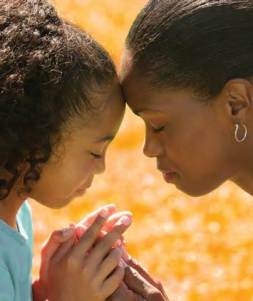
Pursuing a lifestyle of prayer means more than just coming to God with a list of requests and a couple of scattered “Thank You’s” every now and again. Prayer is a discipline– that means being a disciple of prayer! How can I learn to pray for effectively? Commune with God in a richer and more satisfying way? There are many tools and methods that can help with this. One of them is called the ACTS method.
ACTS is an acronym for Adoration, Confession, Thanksgiving, Supplication. And praying in this order can radically transform the way we enter into prayer and the way we respond to God’s answers. On a busy day, I often start prayer with my supplications– my requests, my needs, my hopes and desires. I may be approaching God, but my thoughts and heart are all about “what’s in this relationship for me!” “I want healing for ______, and protection for my family, and a resolution to this problem at work, and…”
But the ACTS method flips this order–it starts with Adoration. It begins by coming to God and acknowledging who HE IS. Worship will outweigh worry. Adoration accentuates God’s Ability and His Authority over whatever is on our mind. It also leads naturally into
Confession. Not the kind that masks false humility– “Woe is me, I’m so unworthy. I am a worm, and I don’t deserve to be happy or free or victorious in Christ.” Rather, confession comes as we recognize who we are in relation to God. We are not worthy of God’s blessings in our own righteousness, but IN CHRIST, we are able to come boldly before God in dependence and joyful acceptance of HIS righteousness. And we can’t accept it if we are still hanging on to old habits and sinful ways of thinking. We must agree with God, let go of whatever is holding us back, and gladly prepare to move forward!
Now we are in Thanksgiving mode. We are reminded of God’s mercy, and His faithful care of us. He has been faithful to answer prayers in the past, and to be with us, even in times of trouble and seeming silence. He IS there. He DOES listen. His mercies are new every morning! (Lamentations 2:22-23)
NOW, we are ready to present our Supplications. In fact, we are ready to follow the direction of the Apostle Paul, when he told the Philippian believers: “Do not be anxious about anything, but in every situation, by prayer and petition, with thanksgiving, present your requests to God. And the peace of God, which transcends all understanding, will guard your hearts and your minds in Christ Jesus.” Philippians 4:6-7 (NIV).
There are many times when we pray in desperation or in a hurry about a specific need, when this approach can be modified. But for deep prayers during a quiet time, or in a small group, the ACTS method can really boost our connection with the Holy Spirit. We begin by thinking we are praying about “something,” and are amazed to re-discover that prayer is really about “someone!”
I have found that such prayers also cause me to more readily ACT in the matters I bring up for request. I’m not just turning them over to God because I am helpless and He is my last resort. Even when I “know” that is not the case, when I focus on the problem and not the Provider and Protector, I forget that He can give me the power to “do all things” (see Philippians 4:13) in Christ’s strength and for His Glory!
Today is Memorial Day. For anyone who is unfamiliar with the American holiday, also known as Decoration Day, it is a day set aside primarily to honor soldiers who were killed in battle. In recent years, it has come under some criticism from those who feel that it celebrates a culture of war, or that it places too much focus on the past– especially a past that has been idealized at the expense of progress. Instead, it has become a time of recreation– backyard barbecues, beach parties, and bargain hunting at flea markets and yard sales.
But much of the real focus of Memorial Day has been lost. Memorials should not be used to idolize or idealize the past; but they serve a purpose in reminding us of hard lessons and the need to keep learning from them. Memorial Day is not about being thrilled or puffed up by our past– it is to be reminded of both the good and the bad, and the need to see the larger picture. We have inherited both freedoms and frustrations; triumphs that came at the expense of others, and trials that will impact future generations. It is right and good that we take time to reflect on such things.
The Bible gives us several examples of memorials– signs and altars and ceremonies that are meant to call things to memory. Some of the memorials involve battles, but many more involve both promises and prophecy. We are to remember God’s faithfulness; His power to rescue, redeem, and restore.
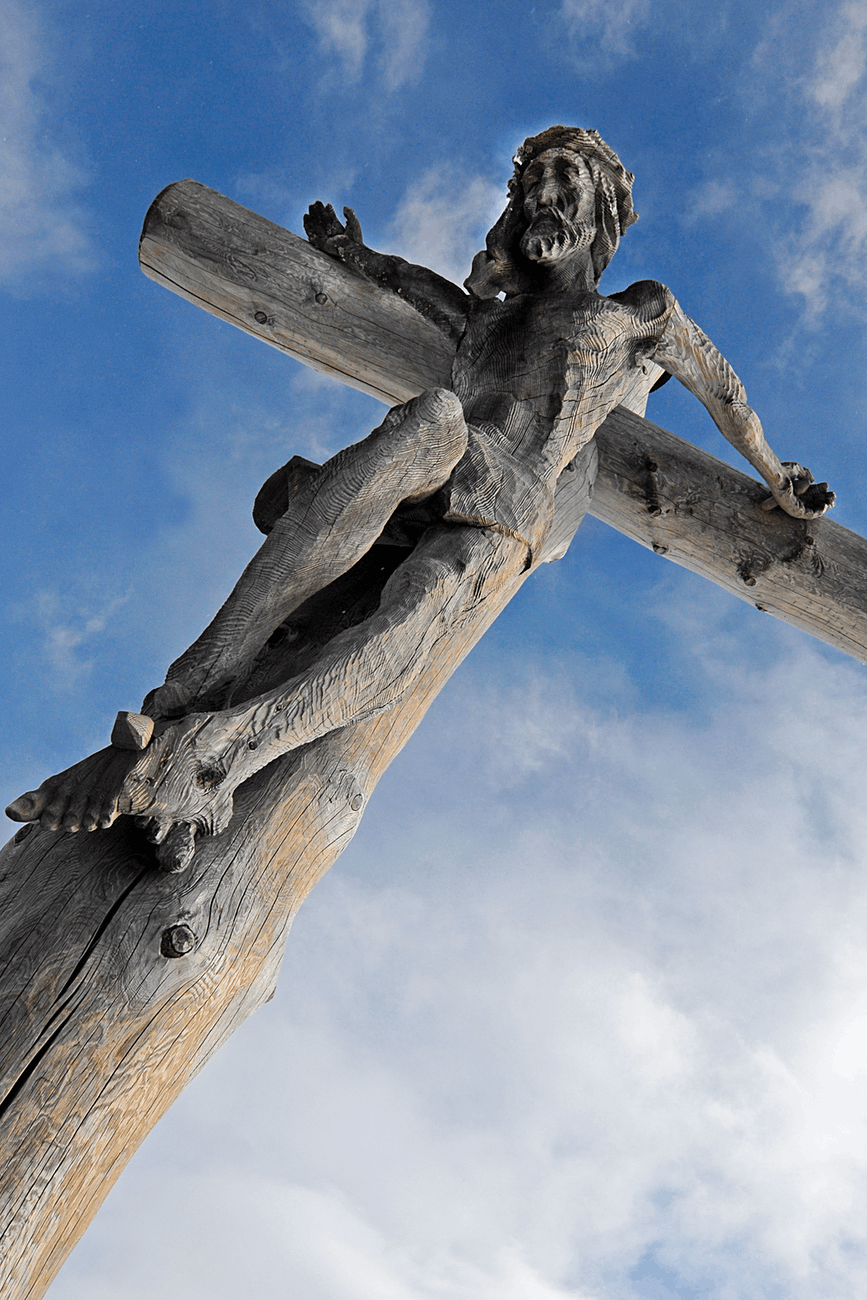
Our greatest memorial as Christians, is not a soldier’s tomb– it is the Empty Tomb! It is the reminder that our greatest battle has already been won, and the one who died to bring us the victory has conquered both Sin and Death.
For God so Loved the world, that He gave His only Begotten Son, that whosoever believeth in Him should not perish, but have everlasting Life. (John 3:16 KJV)
Memorial Day is also a good time to remember others in prayer– pray for those who have lost loved ones in the service of our nation; but also those who sacrifice daily for their families, communities, and around the world. Pray for wisdom and opportunity to serve others around us better. Pray for healing and grace– for those who fight internal battles with unforgiveness, betrayal, guilt, vengeance, and more. And don’t forget praise– thank God for His redemptive plan; for the victory won; for the sufficiency of His grace. Thank others around you for their services and sacrifices. Finally, as we honor the sacrifices of others, let’s look for ways we can serve one another better.































 Pursuing Prayer