I love revisiting the promises of God. But I have to be careful not to make God’s promises into something they are not.
In Matthew 11, Jesus gives a promise– “I will give you rest.” But sometimes, I read more (or less) into this promise than Jesus meant.
28 “Come to me, all you who are weary and burdened, and I will give you rest. 29 Take my yoke upon you and learn from me, for I am gentle and humble in heart, and you will find rest for your souls. 30 For my yoke is easy and my burden is light.”
Matthew 11:28-30 (NIV) via biblegateway.com
First, Jesus bids us come to Him. There are times I want rest, but I want it on my terms– I want ease, comfort, rest, and renewal in the middle of my own plans, activities, and even rebellion. When we pray, we need to come to Jesus, not demand that He come to us.
Next, Jesus offers rest to those who are weary and burdened. Similarly, Jesus said He came to save those who were lost, NOT those who already saw themselves as justified. If I come to Jesus asking for perpetual rest– never willing to trust Him when He asks me to exert myself or carry a burden–I will never know complete rest or fulfillment in Him.
In the very next verse, Jesus offers a yoke– certainly not a symbol of rest for most of us!–and He offers to teach us to find rest. Rest is not a gift like grace or love, even though Jesus “gives” it to us. Rest is a reward. And Jesus makes it clear that He will be with us every step of the way as we work and rest in Him. A yoke has many bad connotations– slavery or bondage, burdens, toil, and hard labor in the hot sun–but it can also have a positive meaning. Oxen who are yoked together share the load– with the lead ox taking the brunt of the burden, and the yoke-fellow carrying a lesser share. Imagine one ox trying to pull the load alone! Yet that is what many of us are doing– trying to carry the weight of the world on our shoulders and pushing away the One who wants to share our load and lead us in the best and most restful paths.
We don’t do much work with teams of horses or oxen in my community. We have powerful machines that make quick work of heavy loads– our burdens have less to do with loads of grain or logs, and more to do with mental and emotional stress. But Jesus reminds us that He is “gentle and humble in heart”–that the rest He promises is rest for our souls.
What a wonderful promise in these turbulent times! Will we take up this offer? Will we claim this promise of our Loving Father to share our burdens and bring us to a place of rest?
I’ve always been intrigued by the story in John’s Gospel about the “woman at the well.” (John 4https://www.biblegateway.com/passage/?search=John%204&version=KJV). Jesus and his disciples are travelling through Samaria, and they decided to rest near Jacob’s well at the town of Sychar. The disciples travel into town for food, leaving Jesus alone at the well. A lone woman comes along, and Jesus asks her for a drink of water.
This would seem to be an ordinary encounter, but there are many clues that tell us a different story. The woman comments that Jews don’t ordinarily speak to or interact with Samaritans. But even more extraordinary, most Jewish men would not strike up a conversation with a lone Samaritan woman, unless he meant to insult her or proposition her. The very fact that she is coming to the well alone and near noon (the sixth hour) puts her at a distinct disadvantage– most of the women would come early in the day to draw water, where their numbers offered protection and support, and the heat of the day would not add to the burden of carrying the water back home.
At first, this woman seems both suspicious and dismissive of Jesus. Why is he asking for a drink of water? Does he want more than just water? Does he mean her harm? He seems thirsty, not threatening– but is he safe? Then Jesus throws a curve ball– he claims to HAVE water that brings total satisfaction and life. Water far better than any of the water he has just asked for! The woman’s tone changes from suspicious to sarcastic. And then, Jesus drops the bombshell– “Go, call thy husband, and come hither.”
Aha! Here it comes… The woman admits that she has no husband. She has no protector, no status. NOW this Jewish man, this stranger, will take advantage. Or he will make improper advances. Or he will despise her even more. But instead, Jesus reveals her darker secret– she has had five husbands, and she is with another man who is not her husband. Maybe he is someone else’s husband. Maybe he refuses to marry her. Maybe he treats her badly– this man who lets her come to the well at midday with no protection and no helper. Maybe the five husbands all died; maybe she has been divorced or abandoned time after time. Jesus knows all this– yet he doesn’t call her names or look at her with disgust. He even commends her for telling the truth!
I don’t know about you, but I’m not sure I would want to meet a stranger who know that much about me. I don’t want to be reminded of my failures, my bad choices, or my past sorrows or shame. Yet this was the heart of the woman’s testimony as she went back into town. “Come, see a man, which told me all things that ever I did: is not this the Christ?”
For years, the profound nature of this encounter was lost on me. What is so exciting about someone who knows your dirty laundry and tells it back to you? There are magicians and illusionists, fortune-tellers, and charlatans galore who attempt to do such “readings.” How is it that this woman’s life could be transformed by such an unlikely and disturbing encounter? Why would she be so eager to share this encounter with all the men (or people) of her town– people who probably despised her?
Because an encounter with Jesus is an encounter with pure and holy compassion. Jesus KNEW the very worst about this woman. He could have shunned her or avoided her. He could have railed at her about her lifestyle or her past. He could have treated her shamefully. Others almost certainly had. But Jesus didn’t just see all the things she had done, or all the things that had happened in her life. He saw HER. He spoke TO her, not at her or through her, not down to her, but face-to-face, and eye-to-eye. Knowing all about her status, he came to HER for help–knowing that she had something of value to offer–not to “put her in her place,” or use her, or demand that she serve him. Jesus welcomes us into the safety of His compassion, so that no matter what we’ve done or what’s been done to us, He looks us in the eyes and wants to be part of our story– part of “all that ever” we WILL do! And THAT is life-changing!
How many people will I encounter today who are outcast, beaten down, shunned, and mistreated? What kind of encounter will it be? Will I see “all that ever they did” and dismiss them as unworthy of my attention? Or will I see THEM–uniquely created by God for a purpose; loved beyond all that I can imagine? Can my friends and family, neighbors and strangers feel safe and loved knowing that I know everything about them? Is it “Safe” to meet me at the well? I pray that God’s love will spill out and overflow to others as I go through the day. May He do the same through you.
Maybe it’s just because I was hungry, but I started thinking about making a pizza from scratch, and how it can be like praying…I know it’s kind of a stretch, but stay with me..
Faith/Crust–every pizza has to have a solid crust–and making crust from scratch usually involves stretching and pulling, flattening and forming it to make a round(ish) base for the toppings. Prayers rely on a solid foundation of faith. Even if it is a “thin” crust, faith is what gives us the confidence to approach God with our thoughts and thanks, our confessions and our concerns. Our faith is often stretched and pounded by circumstances, and it gets strengthened in the fires as God refines us.
Salvation/Sauce– right there with the crust comes a sauce. It is usually red (tomato-based) or white (cream-based). I am reminded that our faith, and our ability to approach God freely is “covered” by the shed blood of Jesus Christ. Our sins, though scarlet, are made white as snow. Whatever weaknesses we have– even our small or weak faith, are “covered”– God pours and spreads His grace and salvation over us. Jesus advocates for us every time we pray.
Content of our Prayers/Toppings–pizzas come in all types of varieties. I’ve had pizzas with goat cheese, tomatoes, onions, shrimp, smoked sausage, carrots, blueberries, ham, scrambled eggs, spinach, olives, gravy, cornmeal, mushrooms, grilled chicken, dried beef, taco meat, cocktail sauce…just not all on the same pizza! My point is that our prayers are as unique and individual as we are. Some of us pray “single topping” prayers– raising a special concern that God has laid on our heart– all day long, or for days or years on end. Some of us pray “scattershot” prayers– a little of this and a little of that as things come to mind. Some of us pray “house favorite” prayers– we follow a formula or a pattern in many of our prayers. But each prayer gives off a delicious aroma– each one has a unique combination of flavors, textures, and pleasing smells as they are offered up to the Father. And we prepare our toppings/our individual prayers…our thoughts may be chopped up, diced, sliced, and spread around. They may get layered and mixed up and melded.
Meditation/Baking– I’ve had fruit and vegetable pizzas that are served “uncooked” (except usually the crust has been pre-baked), but most pizzas have to go in the oven before they can be eaten. Some prayers are spoken in public or “in the moment,” but God wants to spend some time alone with us– even if it is in a “hot” oven for just a few minutes! Taking time to immerse ourselves in God’s presence not only refreshes us, it gives us time and space and openness to hear God’s voice; to catch a glimpse of His vision for our day; to close our eyes and ears to distractions and false promises, guilt and self-justification.
Reading/Recipe–great pizzas don’t just happen by trial and error. Even though I love to experiment with different toppings and different seasonings–even different crust variations–if I don’t follow a recipe, I can ruin an otherwise great pizza. If we’re not reading the Bible regularly, we can begin to fall into bad prayer habits– selfish or prideful prayers, praying in the wrong spirit (bitterness or anger), even praying in ways that don’t recognize God for who He is.
Serving/Serving! Pizzas are not meant to be created and left to sit and grow cold or moldy. Prayers offered up without obedience and active service don’t nourish anyone. Prayer should nourish our souls– we should be strengthened, changed, and experience growth. And God is gracious. Even if our prayer life has grown “cold”– well, cold pizza is still really good!
We live in a wonderfully diverse world, filled with unique individuals. One thing that defines us to our families, neighbors, and friends, is our name. Names can be tricky–some are difficult to pronounce, or spell. Some names are shortened or changed to form “nicknames.” Others are changed by circumstances, like adoption or marriage. Some names are common to several people, or shared as “namesakes” of others, or shared between generations, calling for additions, like “Jr.,” or “the elder” or “the fourth.” Some people reject the name they were given at birth, preferring to use an alias, or going through a legal process to change it. Some names have become symbolic, or stereotyped, famous, or infamous, or iconic.
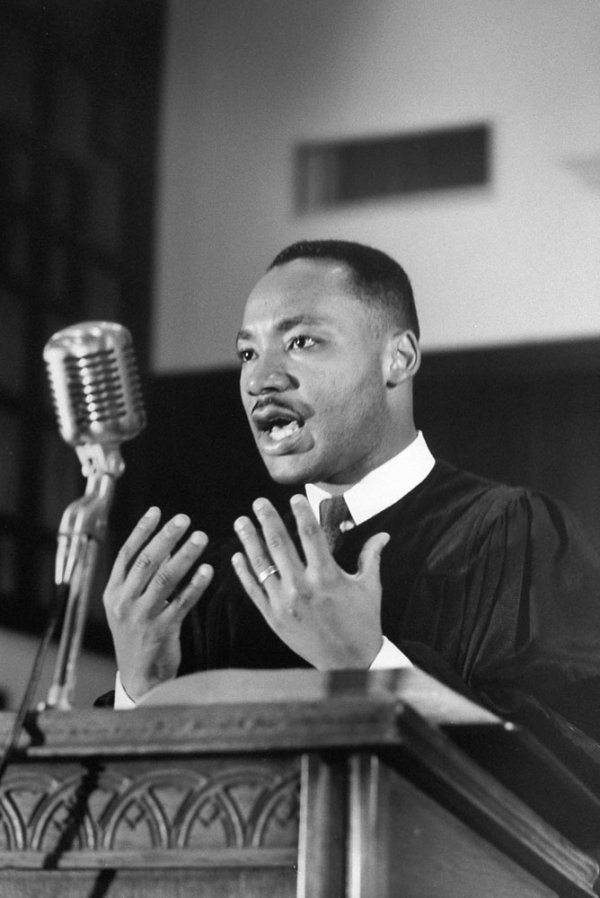
Civil Rights activist Rev. Dr. Martin Luther King Jr. gesturing during sermon at Ebenezer Baptist Church. (Photo by Donald Uhrbrock//Time Life Pictures/Getty Images)
Even though many of us may share a common first name, or surname, (or even both), our name still represents who we are–it becomes a symbolic representation of all that makes us unique– our personality, our history, and our character. And it’s not just people who carry names. We name rivers and mountains, cities, houses, farms, cars, products, pets, works of art…the list goes on. It is deep in the human soul to name things. This is a God-given desire. All the way back in the second chapter of Genesis, God brought all the beasts of the air and land to Adam, to see what name he would give them. Adam and Eve chose the names for their sons– names with very personal meanings. Names are important and carry power; they should never be taken lightly.
God recognizes each one of us by name. The prophets Isaiah and Jeremiah both refer to God calling them before they were even born! Before the great judge Samuel even knew how to recognize God’s voice, God called him by name. God often changes names– Abram to Abraham, Jacob to Israel, Saul of Tarsus to Paul, the disciple Simon to Peter (or Cephas). One reason God changes names is to show His power to transform people and give them, not just a new name, but a renewed nature and spirit.
And when we talk to God, whose very name is sacred, He allows us to call on Him through the Name He gave to Himself/His Son– Jesus. There are many boys and men who carry this name, but when we pray in the name of Jesus, we are referring to the one and only Begotten Son of God the Father; the Jesus of the Trinity; Jesus the Virgin-born Messiah. HIS name is above all other names. There is power in every ordinary name, but THIS name carries eternal, sovereign, immeasurable power. It encompasses His holiness, His compassion, His wisdom, His goodness, His faithfulness, and His Love. There is no other name by which we are saved; no other name by which we can be made new. It is not a name to be taken lightly or in vain. It is a name to be honored, cherished, and exalted. JESUS. The name above all names!
God keeps calling my attention to the book of Jonah. It’s not a very lengthy or in-depth book. It has only four chapters, and it tells a single story of the prophet Jonah and his mission to preach to the people of the Assyrian capital of Nineveh. But it is filled with lessons about prayer, obedience, gratitude, repentance, and Grace. https://www.biblegateway.com/passage/?search=Jonah%201&version=NIV And we learn four important things about God: He sends, He saves, He sustains, and He suspends.
FIrst: God sends. The book of Jonah reminds me of reading Ernest Hemingway. It is compact, terse, and to the point. The very first verse reads, “The word of the Lord came to Jonah, son of Amittai.” There is no other intro, no back story, no conversation between Jonah and God… Yet there IS a back story: elsewhere in the Bible, Jonah is mentioned as a prophet of God. Jonah wasn’t an unlikely choice to take a prophecy to Nineveh. He wasn’t new to the whole “prophet” gig– he wasn’t a farmer or a fisherman or a young shepherd boy. He was an experienced seer and prophet. I mention this because God sends who HE wants to send. He didn’t have to give this message to Jonah. And when Jonah ran away, God didn’t have to chase him down and give him a second chance. There were other prophets who might have delivered the message without any fuss or drama. There were priests, soldiers, merchants, and shepherds who could have done the job (and likely done a better job!) The book of Jonah reminds us that God’s purposes are often multi-faceted. God’s purpose in sending Jonah wasn’t just about the Ninevites– He wanted to work in and around and through Jonah to reveal His character. He also sent the big fish (the Bible never says it was actually a whale), and later a gourd vine and a worm– all to minister to Jonah. They all appear in the story, but only to Jonah, not to any of the others! God will send us–or He will send people (or big fish) TO us. He will send people and things to bless us; and to test our patience! But God sends us what is meant for our good and His glory.
God saves: Each chapter contains an example of God’s salvation– In chapter one, God not only saves Jonah from drowning by sending the big fish; He also saves everyone else on the ship. An entire crew of hardened seamen are stunned by God’s power and grace. In chapter two, God rescues Jonah from the fish’s belly, and gives him another opportunity to fulfill his mission. In chapter three, God sees and hears the pleas of the Ninevites–He withholds His judgment and showers the city with amazing Grace. In the final chapter, Jonah wants to die (twice!), yet God provides comfort, compassion, and correction in response. At the end of this book, in spite of storms and raging seas, prophecies of doom and destruction, dangerous journeys, scorching sun, and disobedience, rebellion, and evil– NO ONE DIES!
God Sustains: God could have rescued Jonah without the “whale.” He could have calmed the storm. He could have caused Jonah to walk on water. He could have created a path of dry land for Jonah to walk on… But God caused Jonah to be in the belly of the fish for three days– a circumstance that Jesus used to foretell His own death and resurrection. God sustained Jonah even in the midst of his bitterness, anger, depression, and rebellion. He gave Jonah a miraculous rescue– one Jonah could have shared with the Ninevites to illustrate God’s Mercy. I find it curious that the King of Nineveh invites everyone to fast and pray, saying “Who knows..” Jonah KNEW! He was a living example of God’s Grace and Power. He could have shared this wonderful news with the people of Nineveh, yet he chose to share only the message of God’s wrath. Jonah had the biggest “fish story” in history, and he chose to keep it a secret! In spite of this, God sustained Jonah’s life– against Jonah’s own wishes! How has God sustained us in moments of crisis, doubt, and infidelity?
God Suspends: What does that mean? Well, in this book, it means several things. God suspends His judgment against the city of Nineveh–in later Bible books, we see that the people of Nineveh and Assyria return to their evil ways. They do not turn completely from their worship of idols and their detestable practices. Within a couple of generations, they experience the total destruction that Jonah predicted. God is Gracious and Merciful; He is also Righteous and Just. Jonah’s mistake was to despise God’s Mercy toward his enemies; the Ninevites’ mistake was to forget God’s Holiness. But God also suspends Jonah’s life– three times Jonah expresses a passive desire to die: he asks to be thrown into the sea (he does not know or expect that God will rescue him); he asks to die after the Ninevites are spared; and he asks to die when the worm destroys the gourd vine. But Jonah’s desire to die goes unfulfilled. God’s purpose is not that Jonah should die, but that Jonah should learn to LIVE and love: love his life; love his God (better); and love his former enemies. Sadly, we never find if Jonah ever learned his lesson. The author of Jonah leaves us “suspended” as well.
Our God sends “whales” to rescue us from our rebellious wandering, and “worms” to take away those comforts that keep us from seeing our real needs. He saves us, even though we don’t deserve a second (or third or thirtieth) chance. He sustains us, even in times of failure. And He suspends us, withholding His wrath and giving us loving compassion and correction. Jonah is not a very lovable character– and that is a great comfort to me in times when I am faced with my own failures and missed opportunities. The people of Nineveh were despicable! They deserved justice and judgment. But God loved Jonah; and He loved the people of Nineveh. And He loves us– more than we deserve; more than we can imagine. He loves the unlovable. He loves the despicable. He loves those who cannot love themselves, and those we are convinced we cannot love.
May we learn a lesson today from the “whale” and the “worm”– we can trust God for Mercy and for Justice. We can trust Him to save and sustain us; to send us and suspend us. And we can rest in His love and care–whether we find ourselves in a raging sea or caught in the scorching heat, or sent on a mission that tests our heart and soul to its limit.
There is a sickness in our world. Call it racism, or bigotry, or prejudice. Call it power, or oppression, or tyranny. Trace its roots to fear, to greed, to a lust for power, to pride, to hatred… Expose it as government overreach, police brutality, white supremacy, corruption, indifference to the suffering of others. Protest it with signs, looting, rioting, tear gas, lines of police officers in riot gear, shouting, and anger. Lots of anger.
There is not enough anger in the world to heal it.
Anger is a natural and even God-given emotion. God gets angry; even wrathful. It is right to be angry at injustice and hatred; division, greed, apathy, inequality, brutality, oppression, poverty, sickness, and death– they are unnatural, wrong, maddening.
But anger, even justified anger, cannot heal. It cannot build up, bind wounds, create peace. Anger feels powerful. It is active, dynamic, it tears down and threatens some of the powers that have, in their time, threatened us or those we love. It draws mobs that seem to share our anger– it looks like solidarity, even unity. It makes headlines. It creates “buzz.” It feels righteous and “right.” And it creates change. In the short term, anger “works.” Surging anger forces the oppressor to be quiet, go into hiding, make some small concessions…for now. Maybe they will pass legislation. Maybe they will give lip service to certain ideals. For now.
God understands anger– he even shares anger. Jesus even got angry. But God does not sanction letting our anger spill into vengeance, violence, and retaliation of sin for sin. Our anger does not give us the right to judge others, oppress others, steal destroy, or condemn.
The New Life 17 Now this I say and testify in the Lord, that you must no longer walk as the Gentiles do, in the futility of their minds. 18 They are darkened in their understanding, alienated from the life of God because of the ignorance that is in them, due to their hardness of heart. 19 They have become callous and have given themselves up to sensuality, greedy to practice every kind of impurity. 20 But that is not the way you learned Christ!— 21 assuming that you have heard about him and were taught in him, as the truth is in Jesus, 22 to put off your old self,[f] which belongs to your former manner of life and is corrupt through deceitful desires, 23 and to be renewed in the spirit of your minds, 24 and to put on the new self, created after the likeness of God in true righteousness and holiness. 25 Therefore, having put away falsehood, let each one of you speak the truth with his neighbor, for we are members one of another. 26 Be angry and do not sin; do not let the sun go down on your anger, 27 and give no opportunity to the devil. 28 Let the thief no longer steal, but rather let him labor, doing honest work with his own hands, so that he may have something to share with anyone in need. 29 Let no corrupting talk come out of your mouths, but only such as is good for building up, as fits the occasion, that it may give grace to those who hear. 30 And do not grieve the Holy Spirit of God, by whom you were sealed for the day of redemption. 31 Let all bitterness and wrath and anger and clamor and slander be put away from you, along with all malice. 32 Be kind to one another, tenderhearted, forgiving one another, as God in Christ forgave you.
If you have read this far, some of you will say that I am being unfair– speaking out against protesters, but not against the evil they are protesting. And if I have never spoken out against injustice, if I have never called upon people to seek peace, never lifted my hand to help my neighbors, never encouraged, never offered help, never shared in others’ grief, then I am the worst of hypocrites. Stop reading.
Anger asks us to act NOW– it asks us to abandon patience, prayer, and the promises of God, and take matters into our own hands–in our own power, in the moment, for the moment. And it tells us that we can and should act in the place of God to achieve what we believe to be His ends. Often, it asks us to act with little information, no time to reflect, and at the behest of others, who wish to use our anger to further their ends. Anger tells us that we can force evil people to surrender their power without being corrupted by it. And anger tells us that it has the only solution– the only action– that can bring peace.
Does this mean that no one should be angry? That we should do nothing active in the face of evil? ABSOLUTELY NOT! We should speak truth to our neighbors– not just the truth of our anger, but the truth of our hope for justice, our dependence on God, our love for our brothers and sisters, and our need for Mercy. We must not turn a blind eye to injustice, but we must work toward justice– not just vengeance. We must not sit silent in the face of bigotry, but we must love extravagantly– even those who seem unlovable and unwilling to love us in return. We must not silence those who are angry and hurt, but listen with respect and compassion–as we would wish to be heard.
And we MUST pray! Pray for the grieving; pray for our enemies; pray for justice; pray for peace. Pray even when we don’t have the answers– especially when we don’t have the answers. Pray–fervently, feverishly– pray on our knees and as we pace in frustration. Pray like we’ve never prayed before. Pray until we break a sweat; until we hunger and thirst for GOD’S presence on every street corner, and in every household, and at every riot, and every government office. Those who would silence our prayers and hold them in disdain are trying to silence the power of God Himself! They cannot win, but they can keep us from sharing in God’s ultimate victory by marching in a fake war, instead of defending the Kingdom. We must take our anger to God and let Him show us the path to justice, action, peace, and healing. He may ask us to step out in ways we never imagined–loving our enemy; sharing the gospel; standing in solidarity with those we used to fear; forgiving those who have hurt us; asking forgiveness from those we have hurt.
Last time Any One Who Is Without Sin…, I looked at a few verses in the gospel of John (8: 1-11), and wrote on four insights. Today, I’d like to look at some practical implications.
If I am “part of the crowd” following Jesus, how easily do I get distracted by the “Pharisees” and critics? How often do I wander off track, looking at fine points in the scriptures that fit a particular argument? How often do I get caught up in senseless debates, allowing myself to be offended or riled up? Over the past several weeks, I have seen arguments via FB , e-mail, or other social media sites where Christians are using Bible verses, Church traditions, the U.S. Constitution, and other teachings and documents to defend such things as wearing a face mask, defying executive orders, practicing (or not practicing) social distancing, and condemning family, friends, and neighbors for taking a different view. We live in a society that reacts– often instantly and with confidence in our own morality– instead of listening and contemplating. We like building strong arguments to defend…scripture? tradition? interpretation? Jesus did none of these things when confronted by this mob. He didn’t dismantle their argument with more argument– he simply got to the heart of the matter– how to deal with Sin.
How often do I come to Jesus “knowing” the answer before I ask the question? The Pharisees in the story were not really interested in Jesus’ thoughts or wisdom concerning the situation at hand. They assumed that Jesus would have to answer in only one of two ways, and that either way, he would look bad. I may not be trying to “trap” Jesus with my prayers, but often, I AM trying to seek his confirmation, rather than his wisdom and teaching. The Apostle Paul wrote to the Corinthians, “Knowledge puffs up, but love builds up. 2 Anyone who claims to know something does not yet have the necessary knowledge; 3 but anyone who loves God is known by him.” (1 Corinthians 8:1b-3 NRSV) Many times, I am busier “loving” how much I know than learning how much God loves!
For me, one of the most amazing new insights about this passage is that once Jesus introduces the phrase, “Any one who is without sin…” everyone leaves– everyone except the one who has been caught in the act of sinning, and the One who has always been without sin. Dealing with Sin is a very personal thing– both confronting our own sinfulness, and acknowledging God’s perfect righteousness. Everyone in the original crowd came to hear Jesus teach. And they were comfortable letting someone else be humiliated and condemned for her sin. But when their own unrighteousness was introduced into the situation–secret sins, unconfessed sins, pride, prejudice, and more–they melted away. How often do I slink away, unwilling or ungrateful to see Jesus show mercy to someone I find “unworthy,” knowing that I am equally undeserving, knowing that I am not “without sin?” Yet the sinful woman in question is the only one who receives the full light of Jesus’ love and mercy. Dozens of others, eager to hear Jesus’ teaching, missed the greatest lesson of all. In the very next verse, at the very next opportunity to speak, Jesus makes one of the most amazing statements in the Gospels, “12 Again Jesus spoke to them, saying, “I am the light of the world. Whoever follows me will not walk in darkness, but will have the light of life.”(John 8:12 ESV) It’s not just showing up to hear him speak; it’s not just knowing the law–it’s following him that leads to light and life.
Finally, Jesus grants mercy. He doesn’t split hairs about the Law of Moses. He doesn’t dismiss the reality of Sin or guilt. He doesn’t give the woman a long list of do’s and don’ts for the future or a proscribed plan of atonement. He doesn’t give her a blank check to keep sinning. The Bible doesn’t give us an epilogue to the story. We don’t hear whether or not the woman gave up her life of adultery– we assume that she did. But why? Would she have given it up because she had “dodged a bullet” with the mob? Part of the reason she was brought to Jesus in the first place was that Roman law overruled Jewish law. The mob was not likely to stone this woman– especially within the city limits. ( In fact, in the book of Acts, we have the story of Stephen, who was stoned by a mob. He was dragged out of town, after facing trial by the Sanhedrin, and stoned because of his testimony against their unbelief. ) Would the woman’s life have changed because her guilty secret had been exposed, even though she had not been condemned? Or is it more likely that her life changed because she had an encounter with the “One who is without sin,” and found in Him a love greater than condemnation? She hadn’t planned to follow Jesus. She may not have taken his teaching seriously if she had been just “one of the crowd.” She wasn’t singled out because of her beauty or righteousness or knowledge or status. But Jesus poured out on her the fullness of His love and mercy. How would/does such an encounter change my life? Yours?
The Pharisees saw this woman as a pawn worthy of stoning; worthy of condemnation. They brought her, intending to throw “sticks and stones,” accusations, and painful, even fatal words. Jesus used words of healing and hope. May we do the same today– as we approach our neighbors and friends, and as we approach the Sinless one who died in our place.
I was re-reading a familiar passage in the gospel of John recently, and I was struck by a truth I had missed before. In the first part of John 8, there is a story about a woman caught in adultery https://www.biblegateway.com/passage/?search=John+8%3A1-11&version=NIV I have read this story many times, and even heard sermons preached on this passage. What struck me this time wasn’t exactly new material, or a new reading, but a new understanding of a detail that was there all along.
The story begins with Jesus teaching a crowd of people in the temple courts in Jerusalem. His teaching is interrupted by a group of Pharisees and teachers of the law. They have a woman caught in the act of adultery, and they come to Jesus asking his opinion about stoning her. They obviously know the laws of Moses, because they cite them. But they cite only a certain portion of the law, and they want Jesus to weigh in (so they can use his own words to trap him).
Jesus turns the tables, and passively bends down to write letters in the sand. He says only, “If any one of you is without sin, let him be the first to throw a stone at her.” One by one, the accusers and the crowd– everyone except Jesus–melts away. Finally, Jesus asks who is left to condemn the woman. There is no one. Jesus refuses to condemn her, and sends her on her way, telling her to “Go, and sin no more.”
There was already a crowd around Jesus before the Pharisees and teachers arrived. They did not bring this woman to Jesus to get an honest answer to a question, or to bring about justice (for that, they should have brought both her AND the man involved!); they brought her to a very public spot to humiliate her and trap Jesus. She was a pawn in a political and religious game, and she was guilty of a crime that was punishable by death. She was accused and forced to stand before a crowd to be condemned without a trial. So often, I read this passage, and my focus is on Jesus and the woman and the Pharisees– I forget that there is a crowd of ordinary people being “played” by the Pharisees for their own purposes.
Jesus never answers the question at hand. According to the laws of Moses, the woman should be stoned. That is the point the Pharisees want Jesus to address. They have set him up. If he agrees with their interpretation of the laws of Moses, he should insist that the woman be stoned. But this will be in violation of the Roman laws, and will lead to Jesus being arrested by the Romans. But if Jesus upholds the Roman law, he will be turning his back on centuries of Jewish tradition dating back to Moses. The problem is that the Pharisees have resorted to some half-truths. The laws of Moses DO speak of stoning; they speak of adultery being punishable by death– for both the man and the woman involved. However, the Priests and leaders of Israel have not followed this practice. King David committed adultery with Uriah’s wife. Neither one was stoned or condemned to death. There are no records of other adulterous couples being stoned throughout Israel’s history. So it is rather disingenuous for the Pharisees to bring this case to Jesus and ask him to speak judgment where they will not. Jesus knows this is not about actual justice; it isn’t really about the law of Moses– because they are not following it themselves! By turning the tables back on them, Jesus exposes their hypocrisy and failure in front of the very crowds they are trying to impress with their clever plans.
One by one, the woman’s accusers melt away. But it’s not just them, it’s the crowd of ordinary people– the ones who were likely riled up by the Pharisees and teachers. Think about the mob mentality–a guilty woman, caught in the act and brought before a teacher with moral authority–there is nothing like scandal to get a crowd of anonymous bystanders worked up and ready for blood. Yet, Jesus’ gentle reminder that any of us could be found “guilty” of something and condemned to shame and punishment puts out the flame of anger and resentment, and causes the mob to evaporate. No one is left to accuse, to curse, to insult, to humiliate, or condemn.
Finally, it’s down to Jesus and the sinful woman. There IS one person there who is without sin– one person who has the right to throw stones, to judge, to punish. Yet he reaches out with compassion and mercy. He is still righteous– he doesn’t shrug off the woman’s sin. He doesn’t say, “Well, that’s no big deal. Let’s just pretend that never happened.” or “I think you’ve learned a valuable lesson here today, young lady.” He simply says, “Neither do I condemn you. Go now and leave your life of sin.”
Next time, I want to address each of these details from a practical standpoint in light of modern circumstances, and what lessons I am taking from Jesus’ actions.
We are living in dark days– days of death counts, and dire predictions; of fear and grief and chaos. Masks, social distancing, angry outbursts, collapsing economies, job loss, political unrest, disease, plague–we are in the grip of a global pandemic. “Bring out your dead.” It’s a phrase from hundreds of years ago, and the horrors of other plagues and other disasters. Tombs, graveyards, skulls and visions of death abound. And yet, as Christians, we celebrate an empty tomb…
It’s been over a month since many Christians celebrated Easter (and almost a month for Orthodox Christians). How soon many of us forget the power of the resurrection. Our world is gripped with fear and anger. But we should be gripped with hope and healing. We celebrate an empty tomb– a testament to the victory of life over death, and hope over chaos!
Even when we use the symbol of the cross, it is not about Christ’s death, but his ultimate victory that we celebrate. Jesus himself even referred to the cross in these terms in John 3:
“Just as Moses lifted up the snake in the wilderness, so the Son of Man must be lifted up, that everyone who believes may have eternal life in him.”
Jesus is speaking with Nicodemus, a Pharisee and religious teacher. He is referring to an historic incident in the wilderness, when the Israelites had rebelled (once again), and the Lord sent venomous snakes among them. Nicodemus would have known about this incident, but Jesus presented it as more than just history– it was a foreshadowing of God’s perfect plan of salvation! https://www.biblegateway.com/passage/?search=Numbers+21%3A4-9&version=NIV God had Moses make a bronze snake to be lifted up on a pole. When the people looked up and saw the bronze snake, they could live. In just such a way, when Jesus was “lifted up” on the cross, he didn’t just die. He battled death to bring life to anyone who “looks up” and believes.
That ancient symbol of a snake on a pole is used by physicians to represent healing. The ancient symbol of Christ on the cross is used to represent redemption and eternal life. Combined with the reality of an empty tomb, we can celebrate life in the midst of any circumstances.
These are difficult days–even with the hope of eternal life, we still have to face the sadness and grief of death, the confusion and hardship of economic chaos, and the uncertainty of what tomorrow will look like– socially, politically, economically, and physically. But we need only “look up” and beyond our circumstances to be reminded that this is not the whole story. There is an empty tomb– ours! There is victory–ours! Won for us by the perfect plan of God, and the perfect obedience of Jesus Christ.
I know many Christians who cite Philippians 4:13 as their favorite verse: “I can do all things through Christ who gives me strength.” And while this is a powerful verse, and holds great promise, I think it has been misused and taken out of context too often in recent years.
The Apostle Paul wrote this– from a prison cell as he awaited trial and a likely sentence of death! And this thought is a summary statement. It follows a list of circumstances in which Paul had experienced needs, and questions, and setbacks, and lack of provision.
In this season of “sheltering in place,” I have a new appreciation for Paul’s letter. I am not in jail, but there are many restrictions (temporary, but seemingly endless) on where I can go and what activities I can pursue in light of the COVID-19 pandemic. I cannot “do all things” in any normal sense. My family could not gather for Mother’s Day this year. We cannot have friends over for a meal, or take our grandchildren to the movies, or meet together for a traditional church service on Sundays. I cannot open my little shop to customers. I can’t go and get a haircut or hang out at the bakery or coffee shop.
And there are others who are struggling, not just with restrictions, but with increased expectations. They cannot “do all things” to help a dying patient, or stop the spread of infection in their nursing home or hospital ward. They cannot answer frenzied questions about timelines and protocols. They cannot work effectively from home and still be available to their children as both parent and surrogate teacher. Or, they cannot meet the needs of their students without face-to-face interaction.
But Paul is not talking about the mere completion of a worldly task, or achieving a personal goal. Paul isn’t suggesting that he (or anyone else) can do anything and everything he might want to do or that others might wish him to do. He has just finished talking about times of lack, of wants and needs and facing uncertainties. Paul did not (even with Christ’s help) skip lightly around Asia Minor, making friends and influencing people.
So what DID he do? What did he mean by “all things?”
Paul speaks often throughout his letter of “running a race.” Paul learned that in all circumstances, with whatever resources, whatever restrictions, and whatever obstacles, he could “run” his race. Under persecution or in times of great success; in times of plenty, or in times of hunger; in prison or on the road (or seas); in Jewish synagogues or Greek amphitheaters; alone or in crowds– Paul could worship God. He could proclaim the Gospel. He could spread the love and grace of Christ Jesus. If he couldn’t travel, he could still speak. If he couldn’t speak, he could write. If he couldn’t write, he could pray. He could do “all things” that were necessary to accomplish his one goal– to run the race; to finish strong; to live a life of purpose and worship.
May we do the same today, through Christ, who gives us strength. I may not be able to gather with friends, but I have the blessing of being able to call, or e-mail, or IM, or send encouragement. I can still write this blog. I can still pray– in fact I have more time to do so! I can do “all things” that will fulfill my purpose and bring honor to God. And so can you. What a privilege–no matter where we are or what our circumstances!














































 Pursuing Prayer