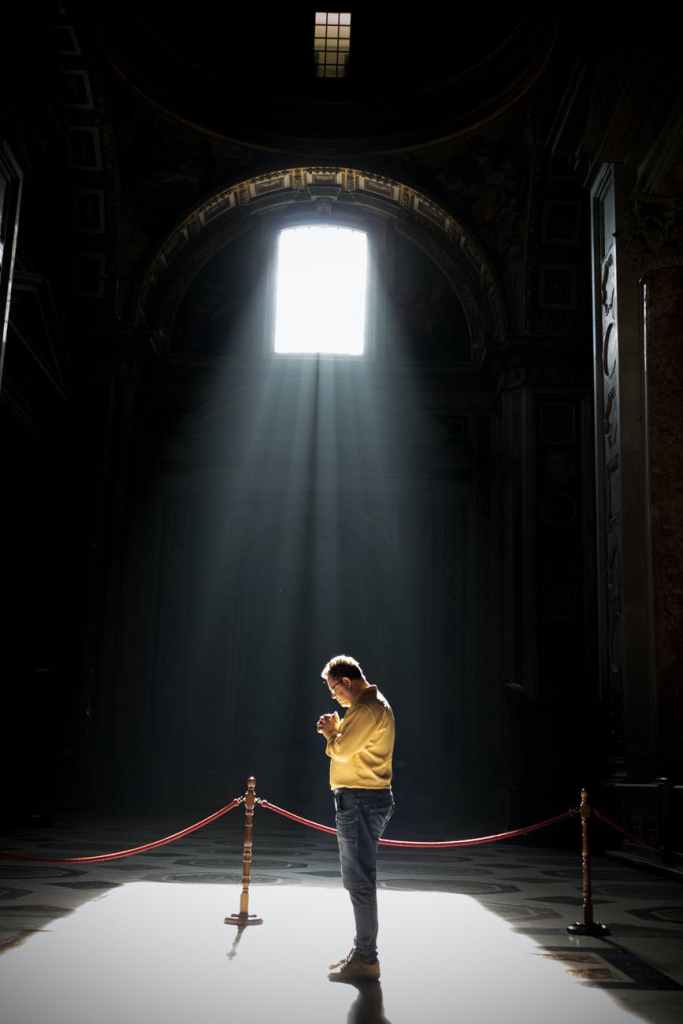
I love optical illusions and “trompe l’oeil” drawings and paintings– artwork that either forces the eye to see things as though they are three-dimensional, or fools the eye into seeing something completely different if you look at it from a different angle or perspective. A duck turns into a rabbit, or a hairy face turns into an ape, or a vase turns into two faces…it is not enough to take a quick glance– you are “drawn” into looking deeper, and studying the art from many angles.
What if we approached prayer this way? Sometimes, I pray from a very fixed perspective– my own desires or in my own wisdom– instead of giving my thoughts and worries entirely over to an all-knowing and all-wise God. What if God wants me to see the situation from a different perspective– HIS?!
Instead of instant healing from an injury, what if God wants me to work harder to maintain my overall health as I recover? Instead of mission work in East Asia, maybe God needs me to work in East L.A. (or vice versa). Instead of my child having the “perfect” job, what if God’s plan is for her to be challenged and unsettled for years before finding the most fulfilling career?
Jesus gave us excellent examples of praying with the proper perspective. “Thy kingdom come. Thy will be done on earth as it is in heaven. Give us this day our daily bread. And forgive us our debts, as we forgive our debtors.” (Matthew 6:10-12) “..yet not my will, but Thine be done.” (Luke 22:42).
I tend to pray “two-dimensional” prayers. Lord, help me to pray with Your eternal perspective!
A fundamental piece of advice for writing fiction is “Show, don’t tell.” A good writer will use words to paint a picture or set a mood. Poets and songwriters are masters of this advice. Metaphors, analogies, figurative language, even alliteration– all create memorable images with very few words.
Jesus (hardly surprising, as He is the Word of God) was a master storyteller, using parables that we still recognize and identify with today–mustard seeds and prodigal sons, good Samaritans and lilies of the field– Jesus didn’t “lecture” about forgiveness or holiness or love; He provided word pictures, even as He demonstrated each concept in His actions.
When Jesus was getting ready to return to Heaven, He commanded His disciples to “Go and make disciples of all nations.. (Matthew 28:19 NIV) He also said to “Go into all the world and preach the gospel to every creature..(Mark 16:15 NKJV). And as I review Jesus’ methods and actions, I see that I need to make some changes.
I need to listen more and lecture less. I need to spend more time with those who are shunned by the “righteous,” but cherished by God. I need to spend less time defending myself and more time testifying about Jesus. And I need to spend less time “telling” and more time “showing” love, obedience, joy, mercy, peace, and hope.
I’ve written dozens of blog posts about prayer, and very little about fasting. Fasting is a practice that is often coupled with prayer, but fasting rarely appears in my blog.
There are several reasons for this. I don’t make a practice of dedicated fasting, so I don’t feel comfortable writing about something I don’t know well. or practice often. I also don’t want to give fasting equal time or importance, because I feel it can become a substitute or even an obstacle to prayer if done for the wrong reasons.
The Lenten season is fast approaching, and it is a time when many people choose to fast, so I am stepping out of my comfort zone a little to give more time and effort to fasting (and discussing it here). Here are a few things I have found:
While we often think of fasting as going without food or water (or both), there are actually many kinds of fasting. Fasting simply means that we do without or set aside something as an act of obedience, reverence, contrition, or worship. Fasting should be done with the goal of getting closer to God, increasing our focus and our dependence on Him. When we fast, we are creating a “space” of dependence– separating ourselves from one thing to be available for another thing– namely prayer and worship. It isn’t about not eating, so much as not allowing food and drink (or other things) to call us away from time with God.
Fasting is Biblical. It was practiced by Biblical figures from Moses to King David, Ezra, Daniel, Nehemiah, Esther, and the entire nation of Israel! Jesus fasted and members of the early church practiced fasting as well. Fasting is encouraged, but not required. It is never prohibited, but there are several biblical warnings about improper fasting (see below).
Fasting is NOT meant to be an end in itself. There are many people who use fasting as a diet plan, or as an exercise in self-control. This is NOT biblical fasting. Whatever you are “setting aside” in your fast should be “filled” with prayer, meditation, and worship, and that should always be your focus. If you have health issues, a history of eating disorders or obsessive behavior, you should be very careful about fasting. Consider seeking advice or an accountability partner to help you remained focused on the real goals.
Fasting will not make you more righteous, or better than someone else who does not practice fasting. In fact, Jesus warned that when we fast, we should not do anything to call attention to the fact– no moaning or sighing, etc. Fasting isn’t about impressing others with our religious devotion. God knows our actions, but He also knows our heart.
Fasting is a commitment, and should not be taken lightly. If you decide to do a fast, and you’ve never done one, it’s best to start small and complete it, than to jump in headfirst and fail to keep your commitment. Not because God will be angry or disgusted– remember that God LOVES you and wants you to desire a closer relationship. But God wants each of us to grow to maturity. God will give us grace to do what He asks us to do; but He won’t honor our efforts to “outdo” Him.
Photo by Paulo Mu00e1rcio Dos Santos on Pexels.com
In taking a closer look at fasting, I am encouraged to do it more often. I have done short fasts, food fasts, and fasting from activities, and I can say that such practices often have surprising results. If you are planning to do any kind of fast for Lent, I pray that you will find it brings you closer to God and helps you in your own pursuit of prayer.
Winter has arrived full force in my part of the world– snow, falling temperatures, ice, and freezing winds make travel difficult and even dangerous. But snow brings about some good things–and one of those things is its color. The white of the snow helps reflect every small bit of light during the short, gray days of winter. When there is no snow cover, some of us can suffer from a condition called “seasonal affective disorder” (SAD). We don’t get enough exposure to sunlight, which can lead to depression, diminished immunity, and other health-related issues. And, while snow doesn’t contain vitamin D or create sunlight, it does reflect it and sometimes that is enough.
I am enjoying the whiteness of the new-fallen snow as I write this. Even though it is late afternoon, and normally, it would seem dark by now, the snow makes it lighter; I can actually see better because of the snow! (Of course I couldn’t say this if I were driving and the snow was blowing about or covering my windshield…) Many people in my community are rejoicing in the snow and cold– it means they can go skiing, snowmobiling, sledding, and build snowmen and snow forts. Some of the children (and their teachers) are hoping to have a “snow day” today. And some people are hoping to make some money from shoveling or plowing driveways and parking lots!
There will be many people praying for snow; and others praying for the snow to end! And in a few days, the pure white snow may end up dingy and gray from being exposed to unclean air particulates, vehicle exhausts, smoke from chimneys, animal tracks, tire tracks, boot tracks, and trash. But for now, it has a purity and beauty that brightens the spirit.
God uses the imagery of snow to speak of His Salvation. In Isaiah 1:18, He says, “Come now, let us reason together, says the Lord: though your sins are like scarlet, they shall be as white as snow; though they are red like crimson, they shall become like wool.” The psalmist David says to the Lord, “Purge me with hyssop, and I shall be clean; wash me, and I shall be whiter than snow.” (Psalm 51:7) And the Apostle John writes, “And everyone who thus hopes in Him purifies himself as He is pure.” (1 John 3:3)
I don’t feel particularly pure most of the time– I know my past; I know my own failings, and the times I have NOT sparkled, or reflected God’s perfection. And God’s salvation doesn’t ignore any of that. God doesn’t declare that I have never sinned–instead, He takes the dirt, shame, and guilt that I deserve, and swallows it up in His grace. In its place, He gives me a renewed mind, a clean heart, and the power to make choices that reflect His heart and mind.
In a “SAD” world that is cold and gray, depressed and weak, God offers redemption that can make us purer, lighter, and fresher than new-fallen snow. We can reflect His light to a darkened world. And, even though the world is filled with contamination and filth, God has the power (and the desire!) to purify us, protect us, preserve us, and give us a sparkling purpose.
Tomorrow marks the Christian observation of Candlemas, or Presentation Day. The Gospel of Luke (Luke 2:21-40) recounts the presentation of the infant Jesus at the temple. This was a purification ritual, and it involved bringing a small sacrifice (https://www.biblegateway.com/passage/?search=Leviticus%2012&version=ESV) Luke records the sacrifice as “a pair of doves,” underscoring that Joseph and Mary were unable to afford a lamb for the sacrifice. Kind of ironic, given that Jesus was the “Lamb of God.”
This would normally have been a quiet ceremony. The sacrifice would be offered. The priest might say a few words of blessing and purification for Mary, and spoken of the traditions of Israel and the redemption of the firstborn son. There might have been a few other “new” parents coming to the temple that day– or not. The priest would have gone through the motions and left the new parents to attend to his other duties of the day.
But on this occasion, Mary and Joseph were surprised by an elderly gentleman, who came up to them and took their son in his arms as he praised God in song:
“Sovereign Lord, as you have promised, now dismiss your servant in peace , For my eyes have seen your salvation, which you have prepared in the sight of all people, a light for revelation to the Gentiles and for the glory of your people Israel.”
We know nothing about Simeon, other than what Luke tells us– He was a man from Jerusalem, devout and religious, who was waiting for the Messiah to be born. He had been told that he would not die before the Messiah appeared, and he had been led by the Holy Spirit to go to the temple on that day.After his song of praise, Simeon blessed Jesus’ parents and spoke prophetic words. Not comforting words about glory and redemption, but rather words of truth and warning.
After the surprising visit from Simeon, Joseph and Mary had another encounter; this time an old prophetess named Anna. Anna was a widow living in the temple, worshiping, praying, and fasting there daily. As soon as she saw the small family, she approached and she too offered blessings, praises, and prophetic words.
Simeon and Anna weren’t the only other people in the temple courts that day. They weren’t high-ranking church officials or priests. But they were the only ones who recognized in this tiny child the wonder and majesty of God Almighty, and His Messiah.
It was an ordinary day; an ordinary Jewish custom; an ordinary occasion. It went largely ignored by most. But for Simeon and Anna (and for the gospel writer Luke) it was a revelation.
I don’t expect Candlemas 2021 to be as momentous as that first presentation day. But I hope that we will have eyes and hearts like Simeon and Anna– ready to see the Salvation of the Lord, to recognize it right before our eyes in a hundred seemingly ordinary moments. May we be ready to step forward in praise and share the glory and wonder with others around us.
*Warning– The following poem is a work of fiction. The first part of this post is meant to reflect emotions that may be associated with depression and suicide. The represent things I have heard, and some things I have said…
Do not ask me, “How are things going?” Things go on around me. Things happen at me. Things are not going– of if they are, I am not going with them…
Do not ask me, “Are you ok?” I will say, “Sure, everything’s fine.” Not because it is; not because I am, and Not because I care whether you believe me. It is what I will say because it gives you permission To feel good about asking, without actually having to Share the pain and fog and futility of my honest answer.
Do not ask me, “How are you doing?” I am not doing– not much of anything. I live surrounded by unfinished tasks– Stacks of unwashed dishes and piles of dirty laundry; Unpaid bills and unopened mail. I forget to eat or brush my teeth; I have trouble finding the energy to remember how to Smile, use polite words, look up, function…
How do I pray for someone like this? How do I pray AS someone like this?
Depression is devious and deadly. It impacts thousands of lives, and takes thousands of lives each day. It is easy enough for me to say, “Snap out of it!”, or to blame the person who chooses to think and act negatively. After all, attitude is a choice. We choose to look at the positive or negative in life, and no one else can choose for us what to think or how to feel.
What we can choose– all of us– is to turn our focus on God and away from the negative. I cannot rescue someone else from their own emotional demons; I cannot save myself with “positive” thoughts. I CAN cry out to the one who loves me more than I love myself– even on my best days–that HE would transform my thinking, and bring light into the darkness of those who cannot see past the fog and mire of their own gloom.
And I can stop asking the surface questions– “How are you?”– prying and digging without being prepared for the raw ooze and festering pus that comes with honesty. Those questions may be well-meant, but they often come without context or conviction. They can become a polite way of skirting the obvious– we EXPECT the reassurance that everything is fine; and when it isn’t, we feel obligated to come up with a quick cure for a problem we haven’t fully diagnosed.
Depression is scary– both for those who experience it and those who encounter it in someone else. Ignoring it, covering it up, or trying to force it into the background doesn’t help. Nor does it help to wallow in it, trying to micro-manage it or hyper-spiritualize it.
The same God who listened to Elijah begging to die just after his momentous victory over 450 prophets of Baal (1 Kings 19: 1-14); the same God who listened to David in exile, Jonah from the belly of the whale, Moses in the midst of rebellion and exhaustion, and Job from the ash heap– He listens to us in our weariness, our grief, our confusion, and our depression. This is the same God who Himself experienced the agony of Gethsemane (Mark 14:32-42), and expressed a soul “overwhelmed with sorrow to the point of death.”
If you are struggling with depression, even if you question whether God is listening, you can still pray. God will never ask, “Are you ok?”– He already knows. Moreover, He already knows the best that He has for you.
If someone you know is struggling with depression, PRAY! But don’t stop there. When Elijah was depressed, God sent food and water. When Moses was struggling with the entire nation of Israel in the wilderness, God sent food and water– and wisdom from Moses’ father-in-law. Practical help, positive reminders, and consistent care DOES make a difference. I cannot begin to tell how many times a random smile or compliment has helped stem the tide for me. Someone I haven’t seen in awhile who doesn’t just jump in asking how I’m doing, or how I’m feeling, but instead comments that it is good to see me–someone who admits that they have struggled, and found grace and healing– someone whose primary goal is not to “check up on me,” or “fix me,” but rather to interact and connect and to be “present” with me.
Losing someone to suicide is horribly painful, and it is tempting to carry a load of guilt and unanswered/unanswerable questions. PRAY! And then PRAY some more! God won’t send easy answers; He won’t take away the pain of loss; though He will provide healing and grace. But God will do as He has promised– to BE with us, no matter what, and to give us a peace that passes all understanding. God never punished the people in the Bible for feeling depressed, or for crying out in despair. God didn’t tell them to “Snap out of it,” or to “Get over it.” But neither did He coddle it. He did not rescue those, like King Saul, who fell on their own swords rather than falling on their knees.
Please pray– but don’t ignore practical help. Even simple steps, like taking a shower, paying attention to sleeping, eating, and drinking habits, making sure you move/exercise/stretch throughout the day, can help. Ask for and accept help– true help–and beware of asking for “substitute” help that will enable you to continue with unhealthy thinking and behavior.
I know several people who had a very Merry Christmas this year. Some of them flew to exotic locations and spent Christmas on the beach, or in a big city with lights and dozens of family members. Some of them spent a cozy Christmas in a cabin with roaring fires and glittering snow-covered trees, eating sumptuous meals and unwrapping expensive gifts.
But most of the people I know spent a Christmas that wasn’t “post-card” perfect. Some of them were alone in a small apartment with no presents and no heat. Some were working at a job they hate because they had no other option. Some were grieving loved ones lost in the past months. Some of them are facing economic mountains– debt, job loss, medical bills or taxes they cannot pay, no money for rent or groceries… Some are battling cancer or alcoholism, anger, or fear. Some are estranged from their families, or separated from loved ones because of COVID, or deployment, or divorce. And some are facing persecution, starvation, homelessness, disease, or war.
Christmas comes, whatever our circumstances– and so does the Christ Child. Jesus didn’t come to the earth to bring us all “better” circumstances or worry-free holidays, but to deliver us from eternal death, and equip us to endure the circumstances we face in life. Jesus himself came in chaotic and stressful circumstances, and He came, knowing that He would face rejection, hatred, injustice, and death on a cross.
There are millions of people who spent a “Merry” Christmas and missed the whole point. Some of us indulged in a gift-giving frenzy that left others in the cold. Some of us allowed envy, fear, greed, or bitterness to color our Christmas. In the process, many of us lost sight of the true gifts of Christmas– Peace, Joy, and Goodwill. In fact, “His divine power has given us EVERYTHING we need for a godly life through our knowledge of Him who called us by His own glory and goodness.” (2 Peter 1:3)
And these gifts are not temporary, like earthly Christmas gifts. They are always available, and they never break, expire, or grow dim. My prayer for this year(and the year to come) is that we all may find–and share!– these eternal and astounding gifts, this “inheritance that can never perish, spoil, or fade…kept in heaven for you” (1 Peter 1:4)
Christmas Day may not always be merry in this life, but because of Christmas we can face an eternity that will never disappoint, and we have a living Hope that can carry us through even the darkest hours!
Every year, we celebrate the birth of Emmanuel– God With Us. It is amazing to consider the Love of God that brought Him from His Heavenly throne to a lowly manger stall, the King of Glory contained in the tiny body of a sleepy infant.
But we should be careful not to miss the rest of the story. As wonderful as it is to think that God would love His creation enough to visit among us, to “taste” life as a human, the story gets gloriously magnified as Jesus leaves the manger to enter a ministry. Jesus didn’t just live among us, He healed, taught, laughed, formed friendships, and served among people– many of whom scoffed, scorned, and rejected Him and His message.
And His message was this: God wants– in fact He passionately yearns– to restore the relationship WE have broken. Jesus didn’t come to “taste” human life– He came to GIVE His life as a sacrifice for those who didn’t deserve it, to extend forgiveness to those who had no right to ask for it. The Holy and Perfect God became the guilt and shame of Sin, so that we could be reconciled to Him. He accepted the penalty of Death, so that we could be given eternal life.
This miracle of reconciliation can be difficult to understand. I sometimes get “stuck” in the weight of my past–I know that Christ offers forgiveness, but I sometimes act as though the penalty hasn’t been removed; only suspended. But that’s not what Jesus taught. Like a leper cured of leprosy, I am clean–no scars, no stains, no relapse–all traces of my disease removed. In this world, I will still feel the sting of the consequences of Sin– betrayal, sickness, injustice, even death. But death is no longer my destiny; it is a temporary rest stop on my way HOME.
Jesus didn’t come to “taste” human life; He came to “taste” death– and He came to destroy its power, so that we could know true Life, and live it to the fullest!
Jesus was born in obscurity– yet he was also born during a Census year…
And it came to pass in those days that a decree went out from Caesar Augustus that all the world should be registered. 2 This census first took place while Quirinius was governing Syria. 3 So all went to be registered, everyone to his own city. 4 Joseph also went up from Galilee, out of the city of Nazareth, into Judea, to the city of David, which is called Bethlehem, because he was of the house and lineage of David, 5 to be registered with Mary, his betrothed wife, who was with child. 6 So it was, that while they were there, the days were completed for her to be delivered. 7 And she brought forth her firstborn Son, and wrapped Him in swaddling cloths, and laid Him in a manger, because there was no room for them in the inn.
This is a Census year in the U.S. (something that has largely been forgotten in the wake of the COVID pandemic.) I actually worked for the Census Bureau for a few weeks this year, doing follow-up interviews for addresses which had not responded for various reasons. Census taking is much different now than it was in Jesus’ day. I had a script, and a smart phone, and several different forms to fill out or hand out to explain what we were doing–one form contained information in at least 14 different languages, and all of them had phone numbers and web addresses where people could “respond” electronically without ever leaving the comfort of their living room, let alone traveling over dangerous hills and trying to find room at crowded inns. I was the one who had to travel– mostly around my small town and within a 20-mile radius. One interview required me to travel 100 miles; another required me to utilize my ability to speak and understand Spanish. Otherwise, the interviews were simple and straightforward. Except when they weren’t.
“Everyone Counts,” the Census Bureau told us, and I did my best to get names and ages for everyone at every address I visited. But many of the addresses were abandoned buildings– even demolished. Others were summer homes or vacation rentals–I had to be careful not to count the same people twice! Often, I could tell that people were living at the residence, but either they weren’t home at that time or they would not come to the door. Some houses required several attempts before I got any response, and it wasn’t always positive or cooperative.
I imagine the scene in Bethlehem, though lacking the technology and ease of travel of our modern age, wasn’t so very different. There were people who wanted to do their civic duty; those who were annoyed at the inconvenience and general bureaucratic chaos; those who hated the Roman Government and everything it represented; and some who just wanted to get it all over with and go back to “normal life.”
We know that Joseph was called up to go to Bethlehem because is was his ancestral home. And we know that Joseph would have been counted as the head of the household. But is it possible that Jesus was counted in that census? That he was numbered among his people and with his family? That the God of all creation became a simple hash mark among thousands of others that year? “Jesus, son of Joseph of Nazareth.” “Infant son.” “Male child.” Jesus was counted. But He was also lost in the shuffle; discounted and ignored.
10 He was in the world, and the world was made by him, and the world knew him not. 11 He came unto his own, and his own received him not.
John 1:10-11 (KJV via biblegateway.com)
This season, it’s easy to feel left out, discounted, passed over. This year, especially, it can be lonely and discouraging as we look out on the world from lockdown, or look at faces covered by masks, unknown or unrecognizable. It’s easy to feel that no one sees us. Rest assured, Jesus knows what it is like to get lost in the numbers. He knows what it is to be discounted and misunderstood, rejected, and scorned.
And He knows exactly who you are and who I am– better than we know ourselves! We count! Not because of who we are, but because He is the creator and author of all life. No matter where you are, no matter who has rejected you in the past, no matter how dark and grim things look– God sees you; God loves you; God has taken you into His count. He doesn’t need a census count to find you, and you can’t get “lost” or hide in the crowd.
It is one of the most popular Christmas Carols– we sing it every year: “Silent Night, Holy Night; All is calm, all is bright; ‘Round yon virgin mother and child– Holy infant, so tender and mild; Sleep in Heavenly Peace– Sleep in Heavenly Peace.”
Each year, we celebrate the coming of Christ– “Son of God; Love’s Pure Light.” God coming to earth to live among His creation– Emmanuel, God with us. And it becomes familiar, and gets mixed in with stories of Santa Claus and gift-giving, decorated trees and flying reindeer.
But stop a minute to reconsider the amazing juxtaposition–the very Word of creation became a speechless baby. The ruler of galaxies came to earth naked and needy, hungry and helpless. Holy Infant–fully God and fully human in His frailty.
God could have come as a ruler of might; He could have stepped out of Heaven in a blinding flash of light, spoken with a voice of thunder, and made the mountains tremble. He could have filled the skies and scattered all the stars and clouds. He could have come in all His Majesty– and someday, that’s how He will return.
But on that Silent, Holy Night, He came in humility. He came in Heavenly Peace.
What an awesome enigma–the One who would break the power of death came in the weakness of an ordinary birth. The Giver of Life choosing to reside in the womb of an ordinary young woman, gasping for air as He took His first breath as a human. The omniscient one having to learn to sit up, and eat, to speak and to hold His mother’s hand; to stand up and walk.
God SO LOVED us that He went to extravagant lengths to meet us in our humanness. He didn’t need to become human for His sake– He did it for us; that WE could know Him more intimately; so that when we talk to Him, we are talking to one who has known hunger, and pain, and heartbreak, and loss– as one of us.
It is terrifyingly easy to miss the significance of the incarnation after the fact. As we remember the Advent season, let us reflect on the world before that Holy birth.. a world so fallen that no one could imagine the face of God; no one could imagine walking with Him or sharing a meal or a smile with Him; no one had ever felt His touch on their cheek or heard Him laugh. No one could have imagined that God would bleed, or cry out in agony, or taste death. But He came. He lived and walked among us. He died. And He paid the penalty for your sins and mine, so that we can share life with Him– eternally.