Lullabies and Hallelujahs

During this season of the year, we hear a lot of “Christmas” music. Much of it is secular music–Santa Claus and magical snowmen, gifts and parties, and the Holiday “blues.” But much of it is related to the real reason for Christmas: the birth of Our Lord. And the number of songs, hymns, cantatas and symphonies related to Christ’s birth is staggering! Popular secular singers record “their” versions of favorite hymns; choirs and orchestras present new songs and ancient melodies. Many of the songs fall into two distinct categories, however. There are quiet lullabies–peaceful and meditative, focused on the infant in the manger; and there are Hallelujahs– joyful and majestic, focused on the wonder of God coming to earth.

I don’t know if there were actually lullabies OR Hallelujahs on that first Christmas. The Bible mentions the visit of the angels, but they were “praising God and SAYING, ‘Glory to God in the Highest..'” We often assume that their praise included singing, but the Bible isn’t specific. But it is interesting to look at the contrast of the quietness of the manger and the Glory of the angel hosts, and hear the contrast in the hymns we raise at this time of year.

Photo by Henlynn on Pexels.com

Lullabies, and quiet songs, like “Silent Night,” or “Away in a Manger” call our minds and hearts to the humility of the Christ child. Babies are cute and engaging. And they are not “silent.” But they do not command authority and majesty. Babies cry out for help. They are needy in a way that God is NOT. And yet…God came in the form of a helpless baby. The God who created the galaxies needed someone to feed and change Him; to carry Him from place to place and rock Him to sleep. “O, Little Town of Bethlehem” reminds us that He came to a cattle shed in a small town, rather than to a palace in the seat of power.

Photo by Blue Ox Studio on Pexels.com

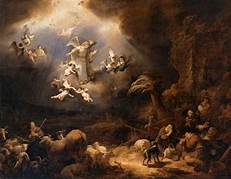
Hallelujahs, like “Joy to the World” and “Hark, the Herald Angels Sing,” remind us that this was no ordinary child. And yet…the angels did not appear IN the manger or even in the little Town of Bethlehem. The Angels were compelled to sing their praises, not to the learned priests, or the courts of power, but to dumb-founded shepherds on a cold hillside. What an explosive visitation! Their praises (whether shouted or sung) shattered the quiet and the darkness. Like a sudden fireworks display, the Glory of God’s servants split the night.

God enters our hearts– sometimes quietly, like the cooing of an infant; sometimes dramatically, like a chorus of angels. God is at work– sometimes in humble moments and ordinary gestures; sometimes in glorious flashes of insight and inexplicable miracles. And this season, our prayers will rise up– sometimes like the humble cries of a newborn baby; sometimes like the soaring songs of angel hosts– prayers of need; prayers of thanksgiving; prayers of awe-struck worship; prayers of simple confession of our own unworthiness, and of God’s sufficiency and everlasting Love. Peace and Glory; lullabies and Hallelujahs; simplicity and majesty– all wrapped up on a manger of hay on one Holy Night.

Photo by Daka on Pexels.com

Christmas is about both the lullabies and the Hallelujahs; the simple light of Truth and the glorious radiance of God’s Holiness.


…And the Word WAS God!

Photo by Daniel Maforte on Pexels.com

In the beginning was the Word, and the Word was with God, and the Word was God. 2 He was with God in the beginning. 3 Through him all things were made; without him nothing was made that has been made. 4 In him was life, and that life was the light of all mankind. 5 The light shines in the darkness, and the darkness has not overcome it…14 The Word became flesh and made his dwelling among us. We have seen his glory, the glory of the one and only Son, who came from the Father, full of grace and truth.

John 1:1-5; 14

Emmanuel– God WITH us. The Baby Jesus in the manger is the same Jesus on the Cross; the same Jesus who was involved in the Creation of the universe.

We love seeing the Baby Jesus in the manger. We like the idea of Jesus, the good teacher and friend. We even bow our heads to honor the Jesus of the cross. We pray to Jesus, acknowledging that He is the God-Man who came to save us from Sin. But sometimes, we get so comfortable seeing Jesus lying peacefully in the manger or serenely enduring the pain of the Cross, that we ignore His absolute Holiness and Power.

Jesus was fully human– he ate, slept, cried, felt cold, and felt pain. But He is also God– fully Divine; fully Sovereign. He doesn’t force us to worship Him– not now, anyway. Someday, though, every knee will bow, and every tongue compelled to confess that Jesus is the Ultimate Authority in Heaven and on Earth (Philippians 2:10-11). Larger than life; more permanent than history; eternally Sovereign.

Photo by Tima Miroshnichenko on Pexels.com

We pray to a God who is so awesome and glorious that no person can see His face and live. And yet, we pray to a God who so loved mankind that He came and walked among us, lived among us, and died among us. We look at Baby Jesus in the manger– we see the face of God. And when we look at our neighbors and friends, we look at those made in the image of God– we see those beloved of God; those Jesus came to save.

Photo by Henlynn on Pexels.com

This is not new theology. This is basic Christianity. But sometimes, in the bustle of the “Season, ” we forget the wonder and the miracle that is the very reason for it all. God is NOT distant. He is not looking for reasons to reject or condemn us. He reaches out to us EXACTLY like a baby reaches out– seeking to be held close. He is as close as the person sitting next to you at the dinner table, or sharing a seat on the bus. GOD! Not a theology; not a list of do’s and don’t’s. Not an esoteric idea. A Presence; a living Christmas Present! An eternal Gift of Love! One with arms and legs; a twinkling eye and infectious smile.

In this season of Advent and Christmas, may we let the Glory of God fill us with awe and wonder. And may we let the Love of God fill us with hope and joy. May our prayers be like the sweet singing of the Angels on that Holy Night so long ago. “Glory to God in the Highest! And, on earth, Peace among those with whom He is pleased.” (Luke 2:14).

Holy, Majestic, Awesome God!

5-9 So don’t lose a minute in building on what you’ve been given, complementing your basic faith with good character, spiritual understanding, alert discipline, passionate patience, reverent wonder, warm friendliness, and generous love, each dimension fitting into and developing the others. With these qualities active and growing in your lives, no grass will grow under your feet, no day will pass without its reward as you mature in your experience of our Master Jesus. Without these qualities you can’t see what’s right before you, oblivious that your old sinful life has been wiped off the books.

2 Peter 1:5-9 (The Message) (emphasis added)
Photo by cottonbro on Pexels.com

I think one of the hallmarks of a Christian is not knowledge about God, but personal experience of God. And one of the signs of such experience is a reverent wonder– an overwhelming AWE– of God. Of who He is and how He works, what He has done, and what He has promised to do. As we grow in faith, good character, understanding, discipline, and patience, we are ready to absorb the absolute WONDER of this majestic, mighty, amazing God we serve. We revel in our own personal experience of Salvation, but we also begin to see the magnitude of God’s Grace, His Power, His Wisdom and His Holiness.

Photo by Min An on Pexels.com

Many of the ancient prophets tried to describe their encounters with God’s presence. Daniel and the Apostle John were paralyzed and prostrate when visited by angels. Paul was blinded by the light. Moses’ face had to be covered after being in God’s presence. because his face was so radiant. Isaiah was struck dumb. The list goes on… We may not experience the presence of angels or receive prophecies like they did, but we can experience a sense of ecstasy in contemplating our marvelous Lord and Savior.

One prophet who had such an experience was Habakkuk. Habakkuk lived in perilous and evil times. His nation was in rebellion toward God’s law, and its citizens, from the leaders and priests to the farmers and townspeople, were paying lip-service to God while prostrating themselves to foreign gods and foreign countries. The leaders lived in splendor, while many of their own people starved, or were sold into slavery. Habakkuk, in frustration, prayed to God, pleading for relief from evil, and judgment for the righteous. He had faith, was of good character, understood the law, had developed discipline, and had a passionate patience– but his patience was mixed with frustration. “How long must I wait to see justice and reform?” “How long will my people keep seeking help from wicked foreigners?” “When will we be free of oppression?”

Photo by Wallace Chuck on Pexels.com

Habakkuk was not just whining. He had a heart for his own people, and wanted to see what God would do. God’s answer was not what Habakkuk was expecting. God promised justice and redemption– but only after invasion, more oppression, and exile! God was sending a vast and merciless army to crush not only His own people, but all the wicked nations in whom they had placed their trust. God was going to “pull the rug out” from under the entire region. But then, He would punish the invaders, wiping out their power and restoring His people to their own land.

What was Habakkuk’s reaction to such news? At first, he was stunned; then confused. But in a very short time, his horror turned to worship. He resolved to stand at his watch; to station himself on the ramparts to see God at work. And as he waited, his perspective changed. God DID see the injustice and wickedness; the violence, lies, and betrayal. God had a plan– a plan so much grander and glorious in scope– a plan that had been in place from long before Habakkuk was born; long before his complaint. It was a plan that would not leave wickedness unpunished, but would bring justice in its proper time, and allow for redemption, restoration and renewal.

Photo by Frank Cone on Pexels.com

Habakkuk’s prayer (chapter 3) is a marvel of praise and worship:
“His glory covered the heavens, and his praise filled the earth. His splendor was like the sunrise; rays flashed from his hand where his power was hidden…” (v. 3b-4)
“You split the earth with rivers; the mountains saw you and writhed. Torrents of water swept by; the deep roared and lifted its waves on high. Sun and moon stood still in the heavens at the glint of your flying arrows, at the lightning of your flashing spear… (v.9b-11)
“I heard and my heart pounded; my lips quivered at the sound; decay crept into my bones, and my legs trembled. Yet I will wait patiently for the day of calamity to come on the nation invading us. Though the fig tree does not bud, and there are no grapes on the vines; though the olive crop fails, and the fields produce no food; though there are no sheep in the pen and no cattle in the stalls, yet I will rejoice in the Lord. I will be joyful in God my Savior. The Sovereign Lord is my strength; he makes my feet like the feet of a deer; he enables me to go on the heights.” (v. 16-19a NIV)

Photo by Orlando Vera on Pexels.com

How often does my heart pound and my lips quiver as I contemplate our Awesome God? How often am I joyful in God my Savior– especially in the midst of expected hardship and continuing evil around me? How often do I limit my sight to what is immediately before my eyes, instead of looking up at the one who holds every moment of the past and future; who controls the vastness of millions of galaxies, yet also sees each individual hair on 7 billions human heads, knows every grain of sand in the desert, and every drop of water in all the oceans; who tracks every molecule in the universe, but knows me by name?!

Photo by Snapwire on Pexels.com

May today be a day filled with reverent wonder, as we consider the Holy, Majestic, and Awesome God who has the power to redeem, inspire, and strengthen us for whatever lies ahead.

The LORD God Almighty Is His Name

He who forms the mountains, who creates the wind, and who reveals his thoughts to mankind, who turns dawn to darkness, and treads on the heights of the earth— the LORD God Almighty is his name.

Amos 4:13 NIV (via biblestudytools.com)
Photo by Quang Nguyen Vinh on Pexels.com

To whom do you pray? I know many people who address their prayers to “Our Father.” Others pray to the Name of Jesus, or to “Abba,” or even through a saint. I’ve heard some even use terms like “Daddy God,” or “The Man Upstairs.” But the One who hears our prayers, the Triune God of the Universe, is altogether Holy, Righteous, Sovereign, and Supreme. We forget that or diminish that to our peril.

Photo by Tima Miroshnichenko on Pexels.com

That doesn’t mean that we cannot draw near to our Creator– in fact, He wants us to call on Him and commune with Him. But He is more than just another someone we can talk to. He sees us– and He sees through us! We may be able to “fool” our friends and even our family with a false smile or half-attentive listening, but God is not fooled by our appearance or our shallow actions.

Photo by Dids on Pexels.com

The people of Israel, during the time of Amos’s writing, had formed a bad habit of “fake” worship. They prided themselves on their rituals– morning sacrifices, tithes, offerings, etc. They were religious– on the surface. But their lives were filled with greed, selfishness, corruption, pride, and apathy. They not only knew there was injustice all around them, they were willing participants!

They had pushed a loving and merciful God to His limits. He had sent plagues, famines, war, and other disasters to humble His people and shake them out of their sinful stupor. Hard times can bring people together; disasters can cause them to turn their eyes to Heaven; to ask for help, and to offer help to their neighbors. But these stubborn people used hard times to take advantage of those who were already in trouble– the rich watched in comfort and disdain as their countrymen starved. They cheated and hoarded while others were dying.

Photo by George Webster on Pexels.com

Sadly, the Israelites of Amos’s time are not so very different from people in our own time and countries. God’s warnings and pleadings don’t sound out of place in 21st century America. Or Europe. Or anywhere else. We have a form of worship– people who brag about their Mega-churches with worship orchestras, bistros, indoor playgrounds for the kids, light shows, and more; people who attend every “Christian” concert that comes to town, or attend retreats and seminars. And there’s nothing overtly “wrong” about such worship. But it has to translate into WORTH-SHIP–recognizing that God is not just another superstar; that His House is not just a place to be entertained or meet other “nice” people. That His Word is not just a bunch of stories about “other” people who messed up, with a list of suggestions on how to live a “better life now.”

Photo by Karolina Grabowska on Pexels.com

He who forms the mountains, who creates the wind, and who reveals his thoughts to mankind, who turns dawn to darkness, and treads on the heights of the earth— the LORD God Almighty is his name.” May we never forget or take for granted WHO God really is. And may we always recognize His Worth and Majesty. May we be quick to listen and obey Him, and quick to repent when we go astray. That’s what He was asking through Amos and the other prophets– that’s what He asks of us today.

Panic, Prayer, Praise, Peace!

Philippians 4:6 New International Version (NIV)

Do not be anxious about anything, but in every situation, by prayer and petition, with thanksgiving, present your requests to God.

https://www.biblegateway.com/passage/?search=Philippians+4%3A6&version=NIV

I hope that today will be filled with peace, joy, and blessing for anyone reading this. But I know that today will bring bad news for some, pain for others, and hardship for many. Life is filled with struggle, disappointment, failures, and loss. Our first reaction is often to worry, which can lead to more worry, and a sense of urgency, even panic. In many cases, we have neither the resources nor the wisdom to overcome our struggles–even sustained effort or a “lucky break” may leave us without much hope. And the more we worry, the less we accomplish. But telling ourselves (or others) to simply “stop worrying” doesn’t banish worry; sometimes it increases it! Now we worry about worrying too much, or we find new things to worry about.

Photo by bruce mars on Pexels.com

But there is a time-honored and proven pattern that can help. Jesus spoke of it in His “Sermon on the Mount.” In Matthew 6, He gives us this advice:

“So do not worry, saying ‘What shall we eat?’ or ‘What shall we drink?’ or “What shall we wear?’ For the pagans run after these things, and your heavenly Father knows that you need them. But seek first his kingdom and his righteousness, and all these things will be given to you as well. Therefore do not worry about tomorrow, for tomorrow will worry about itself. Each day has enough trouble of its own.”

Matthew 6:31-34 (NIV)
Photo by Úrsula Madariaga on Pexels.com

The Apostle Paul expanded on this in his letter to the Philippian believers. He told them to be anxious for nothing–that regardless of our situation or circumstances, we should not panic, but pray (seek God’s grace, righteousness, wisdom, and help). But more than that, we should present all of our prayers, petitions, and requests with thanksgiving and praise!

This is not the same as pretending that our struggles don’t exist, or that they are not important, or that we are glad about the pain, uncertainty, or hardship that they bring. Instead it is lifting our eyes to Heaven and finding that God is bigger than it all; that His grace, His strength, His wisdom is sufficient for the next step– for today’s worries–for today’s battles and burdens.

Photo by Pixabay on Pexels.com

This doesn’t happen naturally or automatically–we must seek, pray, pursue righteousness, ask for help, and continue to stand firm. There are some who point to the words of Jesus, or of Paul as a kind of “magic formula.” If we repeat a few promises from the Bible, or if we pray certain prayers, or convince ourselves and others that we have “enough” faith, God is obligated to change our circumstances and give us the resolution or relief we want. God is not primarily interested in our relief– He is interested in our redemption, our renewal, and our eternal reality. In following this pattern of turning our panic into prayer, and our prayer into praise, He promises that we will experience His peace. Our panic will be transformed–even if our situation stays the same; even if it gets worse before it gets better!

So how do we practice this pattern; how do we train for this transformation?

Photo by Reafon Gates on Pexels.com

Here are a couple of suggestions:

  • Start by seeking God with abandon–pursue Him with your whole heart– thank Him for who He is, and for all He has done. It can be helpful to review some of the names of God–I AM, Almighty, Creator, Lord, King of Kings.. Or read a Psalm or find a song that reminds you of God’s character and power. Think of the times when God has been faithful in your own past.
  • Find something about your situation for which you can be thankful– genuinely thankful. Years ago, when I was young and single, I was laid off from my first full-time job after nine months. Was I worried? Yes! Where would I find another job? How would I pay my bills? But I resolved to start being thankful about all I had learned on the job– I had met new people, learned new skills, purchased a car…God knew my needs for the future, and even though I had to wait another eight months before I found a full-time job, I was able to find temporary work and interview for other jobs in the meantime. And I had friends and family who offered good advice and encouragement along the way. I know some situations are more painful and perplexing than the loss of a job. When I my father died, nothing made the pain less, but I could thank God for Dad’s life and the time we had with him. This is NOT easy, nor is it meant to be…It may not happen for days, or weeks–don’t give up!
  • Cry out to God– in praise, but also in petition, pain, confusion, confession, and raw emotion. God wants a real relationship with us, and that includes walking with us in the “valley of the shadow of death.” We don’t have to fear evil, or worry about the future, not because it holds no danger or dread, but because we never have to walk alone and defenseless!
  • Remember this is a pattern to follow, not a pill to swallow–none of this comes easy, and God’s peace is not an instant “fix.” Instead, it is a growing conviction that God is who He says He is– faithful, loving, victorious, eternal, and sovereign. Such peace defies our panic and erodes our worry, leaving us ready to face the battles before us, and move forward through the struggles.
Photo by Pixabay on Pexels.com

It is not will power or a change of circumstances that brings incomprehensible peace. It is not magic– it is Majesty!

Blog at WordPress.com.

Up ↑