As I write this, votes are being counted in our Presidential/General Election. I don’t know what the final outcome will be, but it looks like the election will be close; it may even be contested for days or weeks to come.
There are consequences to this election– consequences for our legal rights and freedoms– consequences for churches and Christians businesses and services, and the individual free exercise of speech and religion. And the consequences reach beyond just my city or state or even the U.S. This election may impact how (or if) I can continue to write about prayer and Christian living. It may impact how my local church continues to operate. It will impact how mission organizations and religious services continue.
But there are several things that will not change as a result of any election: God is still sovereign; the Bible is still true; I will still be a follower of Christ– committed to living for Him and sharing His Gospel.
In that sense, “what’s next” is exactly the same today as it was yesterday or last year– I am to trust in God’s plan; God’s provision; God’s timing. And I am to obey His word. I am to “do justice, love mercy, and walk humbly with my God” (see Micah 6:8); I am to “love the Lord my God with all my heart, mind, and soul, and my neighbor as myself” (see Matthew 22:37-39).
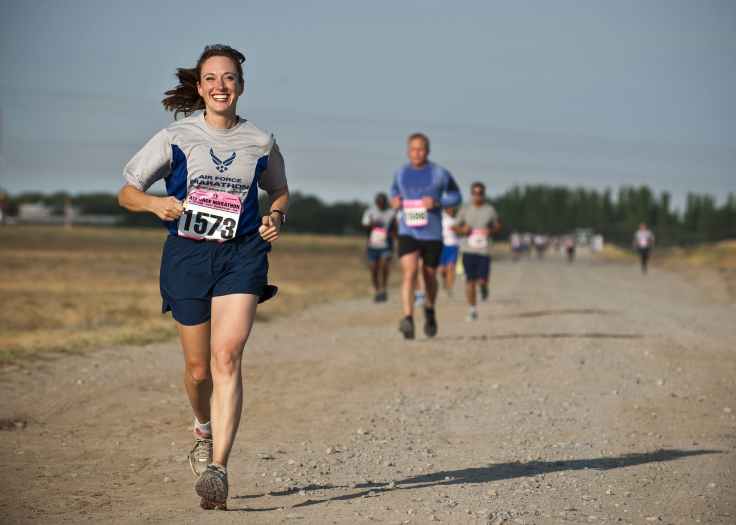
Yesterday, I did my civic duty; I voted my conscience. Today and going forward, I will do my civic duties– I will pay taxes, I will obey laws and guidelines that do not contradict God’s commands. And I will work to make a positive difference in my community and my country. I may have to make changes and adjustments in the way I serve and work and interact with other people. But “what’s next” in my Christian walk doesn’t depend on what happened yesterday, or what will happen tomorrow. My eyes have to be focused, not on any political race, or its immediate consequences, but on the race described by the Apostle Paul in his letter to the Philippians:
12 Not that I have already obtained all this, or have already arrived at my goal, but I press on to take hold of that for which Christ Jesus took hold of me. 13 Brothers and sisters, I do not consider myself yet to have taken hold of it. But one thing I do: Forgetting what is behind and straining toward what is ahead, 14 I press on toward the goal to win the prize for which God has called me heavenward in Christ Jesus...17 Join together in following my example, brothers and sisters, and just as you have us as a model, keep your eyes on those who live as we do. 18 For, as I have often told you before and now tell you again even with tears, many live as enemies of the cross of Christ. 19 Their destiny is destruction, their god is their stomach, and their glory is in their shame. Their mind is set on earthly things. 20 But our citizenship is in heaven. And we eagerly await a Savior from there, the Lord Jesus Christ, 21 who, by the power that enables him to bring everything under his control, will transform our lowly bodies so that they will be like his glorious body.
–Philippians 3:12-14; 17-21 (NIV via biblegateway.com)
Of course, I hope that outcome of this election will honor God and preserve the freedoms I hold dear. But God’s purposes and plans may involve hardship, persecution, and judgment on this nation. I must still run my race, and rejoice in my Heavenly citizenship– one that doesn’t change with election cycles or depend on politicians.
It’s the last word in the Bible. It’s normally the last word of our prayers. It is frequently used by the congregation during a particularly inspiring part of a sermon.
But what does it mean to say, “Amen!”? The original Hebrew word means, “so be it,” or “let it be so.” It is spoken to express confirmation, solemn ratification, or agreement. Saying, “Amen!” is saying that we agree with the words the pastor has spoken, or the words that someone else has just prayed. But, ultimately, it is confirmation that we agree with what God will choose to do, and how He will choose to answer the prayer or speak to us.
When we say, “Amen,” we are letting go of our will and trusting our prayers, our thoughts, our feelings, and our desires to God’s hands. God is sovereign. He can do anything He wants, regardless of our desires or plans; regardless of our feelings or our actions. He can thwart our plans, upset our circumstances, and set His face against us. But that’s not HIS desire. He wants our willing cooperation and approval. He doesn’t need it, but He desires it. He wants to hear us echo His heart, and respond to His loving care with a hearty “Amen!” Not because He needs it– but because WE need it. We need to rest in His sovereign power instead of trying to fight blindly against our circumstances. We need to wake up and act in accordance with His design, instead of wasting time in apathy and disdain.
But “Amen!,” like any other word, shouldn’t be used lightly. “Can I get an Amen?” “In Jesus’ name, Amen” These are solemn oaths. “Amen” isn’t just a word of cheer or enthusiasm. It is an acknowledgement of God’s right to rule our lives. Even when it brings testing; even when it involves struggle and pain. All the time, God is in charge, and His ways can be trusted. “AMEN!”
Maybe it’s just because I was hungry, but I started thinking about making a pizza from scratch, and how it can be like praying…I know it’s kind of a stretch, but stay with me..
Faith/Crust–every pizza has to have a solid crust–and making crust from scratch usually involves stretching and pulling, flattening and forming it to make a round(ish) base for the toppings. Prayers rely on a solid foundation of faith. Even if it is a “thin” crust, faith is what gives us the confidence to approach God with our thoughts and thanks, our confessions and our concerns. Our faith is often stretched and pounded by circumstances, and it gets strengthened in the fires as God refines us.
Salvation/Sauce– right there with the crust comes a sauce. It is usually red (tomato-based) or white (cream-based). I am reminded that our faith, and our ability to approach God freely is “covered” by the shed blood of Jesus Christ. Our sins, though scarlet, are made white as snow. Whatever weaknesses we have– even our small or weak faith, are “covered”– God pours and spreads His grace and salvation over us. Jesus advocates for us every time we pray.
Content of our Prayers/Toppings–pizzas come in all types of varieties. I’ve had pizzas with goat cheese, tomatoes, onions, shrimp, smoked sausage, carrots, blueberries, ham, scrambled eggs, spinach, olives, gravy, cornmeal, mushrooms, grilled chicken, dried beef, taco meat, cocktail sauce…just not all on the same pizza! My point is that our prayers are as unique and individual as we are. Some of us pray “single topping” prayers– raising a special concern that God has laid on our heart– all day long, or for days or years on end. Some of us pray “scattershot” prayers– a little of this and a little of that as things come to mind. Some of us pray “house favorite” prayers– we follow a formula or a pattern in many of our prayers. But each prayer gives off a delicious aroma– each one has a unique combination of flavors, textures, and pleasing smells as they are offered up to the Father. And we prepare our toppings/our individual prayers…our thoughts may be chopped up, diced, sliced, and spread around. They may get layered and mixed up and melded.
Meditation/Baking– I’ve had fruit and vegetable pizzas that are served “uncooked” (except usually the crust has been pre-baked), but most pizzas have to go in the oven before they can be eaten. Some prayers are spoken in public or “in the moment,” but God wants to spend some time alone with us– even if it is in a “hot” oven for just a few minutes! Taking time to immerse ourselves in God’s presence not only refreshes us, it gives us time and space and openness to hear God’s voice; to catch a glimpse of His vision for our day; to close our eyes and ears to distractions and false promises, guilt and self-justification.
Reading/Recipe–great pizzas don’t just happen by trial and error. Even though I love to experiment with different toppings and different seasonings–even different crust variations–if I don’t follow a recipe, I can ruin an otherwise great pizza. If we’re not reading the Bible regularly, we can begin to fall into bad prayer habits– selfish or prideful prayers, praying in the wrong spirit (bitterness or anger), even praying in ways that don’t recognize God for who He is.
Serving/Serving! Pizzas are not meant to be created and left to sit and grow cold or moldy. Prayers offered up without obedience and active service don’t nourish anyone. Prayer should nourish our souls– we should be strengthened, changed, and experience growth. And God is gracious. Even if our prayer life has grown “cold”– well, cold pizza is still really good!
When I was just a girl, many of my cousins and playmates were fans of comic-book heroes: Superman, Batman, Wonder Woman, X-Men, Spiderman, and many others. In fact, in second grade, we had a “superhero” club that met at recess and played out scenarios. Most of us got to be heroes; a few had to take turns being villains. We ran as fast as we could; we pretended to fly; we pretended to save the world!
Each super hero has a special super power (or several super powers), and each one has a “fatal flaw”– some weakness that could keep him (or her) from easy victory over a villain. Superman can fly; but he cannot overcome the effects of Krypton. Batman has a seemingly endless array of cool gadgets, but they are not always enough to counter the cool gadgets of his foes. Spider-man can spin webs, but being a superhero doesn’t pay his bills. Wonder Woman has a lasso of truth and an invisible airplane, but she must struggle between promoting peace and fighting to stop violence and war.
I was reminded recently that we often confuse Biblical characters with comic-book superheroes. Abraham had extraordinary faith. Moses had his staff. Samson had great strength. David wrote poetry and killed giants…and so on. And each “hero” of the faith seemed to have a “fatal flaw”– Abraham did not wait for God’s promise of Isaac. Moses had a temper. Samson was arrogant and forgot the source of his strength. David was tempted by lust, which led him to commit adultery and murder!
There is nothing wrong with honoring men and women of faith and courage and obedience. The entire eleventh chapter of Hebrews is devoted to “heroes” of the faith, and the faith of Godly heroes.
But we can turn heroes into idols, and that leads us to false thinking. We falsely believe that God only calls those who are already heroic and strong. We sometimes feel that God cannot use us unless we first show that we have some super power. We also carry a false guilt about our “fatal flaws,” feeling that we have somehow ruined God’s plans or let the enemy “win” whenever we stumble. Finally, we fail to see that our ordinary obedience–even our shaky and stumbling faith– IS heroic.
Superheroes are not Biblical, and Biblical characters were never “super” heroes. Most of them spent their lives doing mostly ordinary things– farming, fishing, carpentry, tax collecting, herding sheep! There is only one “superhero” in the Bible– God himself–and He has no fatal flaw. Instead, He chooses flawed and ordinary people to obey Him as HE does extraordinary things through them.
One consistent thing about the people we celebrate as “heroes” in the Bible– they all prayed! They all knew that real power (and wisdom and help) comes from God alone. Prayer and obedience are not guaranteed to make us famous or heroic. But God can use the simplest acts and the smallest measure of true faith to do great things in, and around, and through ordinary people just like us!
It is tempting to make bold plans, resolutions, or vague wishes for all the days at once– trying to fold the entire year into a single goal or set of goals. But is this consistent with Biblical principles?
Today, I want to pray, as Jesus did, that God would “give us THIS DAY our daily bread”– that I would walk and talk with my Savior each day, each moment as it comes. That doesn’t mean that I make no plans or goals for the future; rather, I keep things in a proper perspective. God knows the future much better than I do. I know where I am and where I’ve been (hopefully!), but only God knows everything that lies ahead. My job is not to dream about the finish line, but to continue running the race– step by step and moving forward, my eyes fixed on Jesus:
Therefore, since we are surrounded by such a great cloud of witnesses, let us throw off everything that hinders and the sin that so easily entangles. And let us run with perseverance the race marked out for us, 2 fixing our eyes on Jesus, the pioneer and perfecter of faith. For the joy set before him he endured the cross, scorning its shame, and sat down at the right hand of the throne of God. 3 Consider him who endured such opposition from sinners, so that you will not grow weary and lose heart.
Life is like a long race; it’s also like a story. As we enter a new year, we can look around and see where the story has brought us. Some of us are in crisis. Some of us have just defeated a giant, or survived a trip down the raging rapids. Some of us are headed for disaster, or about to head into battle. Some of us are caught in a trap and we can’t see any hope of rescue.
I can’t change the race course I must face in the coming year. Nor can I change the story I’ve lived so far– I can’t change anyone else’s. But I know this– the next unwritten chapter is in God’s expert hands. God, the author of miracles and second chances. God, who turns shepherd boys into heroic kings; God, who transforms prostitutes into saints; God, who sends Himself naked and shivering into His rebellious creation knowing He will suffer and die at the hands of those He loved into being, and knowing that this death is not the end, but a glorious beginning! This God has a triumphant and joyous ending in store for me– for you!
God has given us the amazing story of our lives–and the next chapter is here. God also gives us the amazing opportunity to write the next chapter. He will guide us through the process– bring in new characters and plot twists, or send us to new places through unexpected channels–but we have the power to choose the next step. Today and every day.
My prayer for this new year is a prayer for this new day. Tomorrow, I get the gift of taking the next step; of writing the next sentence!
3 Acknowledge that the Lord is God. He made us, and we are his— his people, the sheep of his pasture.
Psalm 23 New King James Version (NKJV) The Lord the Shepherd of His People A Psalm of David. 23 The Lord is my shepherd; I shall not [a]want. 2 He makes me to lie down in [b]green pastures; He leads me beside the [c]still waters. 3 He restores my soul; He leads me in the paths of righteousness For His name’s sake. 4 Yea, though I walk through the valley of the shadow of death, I will fear no evil; For You are with me; Your rod and Your staff, they comfort me. 5 You prepare a table before me in the presence of my enemies; You anoint my head with oil; My cup runs over. 6 Surely goodness and mercy shall follow me All the days of my life; And I will [d]dwell in the house of the Lord [e]Forever. Footnotes: Psalm 23:1lack Psalm 23:2 Lit. pastures of tender grass Psalm 23:2 Lit. waters of rest Psalm 23:6 So with LXX, Syr., Tg., Vg.; MT return Psalm 23:6 Or To the end of my days, lit. For length of days
The Bible is filled with imagery of sheep and shepherds. Growing up, I lived in the countryside, but we never raised sheep, and I had little experience with livestock of any kind. We had one neighbor who had sheep, however, and he shared a lot of insight into why we should pay attention to what sheep can teach us about ourselves, and our God.
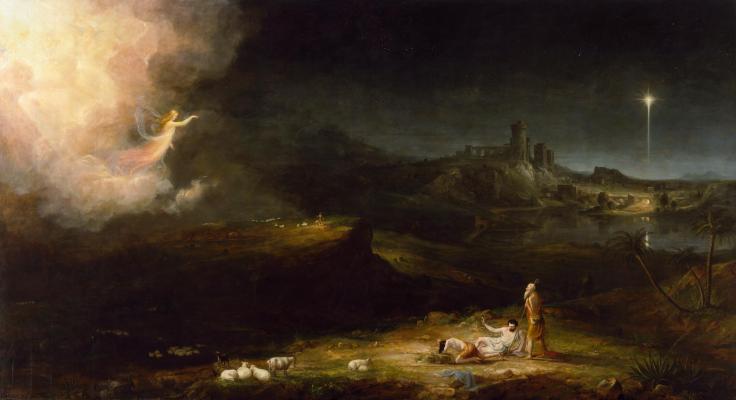
Not only does God use the imagery of sheep and shepherds, He uses examples throughout the Bible of actual sheep and shepherds. Abraham, Isaac, Jacob, the sons of Jacob, David, and the prophet Amos– all were shepherds. When the Messiah was born, the first announcement went to shepherds in the fields, keeping night-watch over their flocks!
Jesus used stories of sheep and shepherds in his parables, as well. There is a lot to understand, and I am not qualified to teach anyone about shepherding, but there are several wonderful principles that don’t require a lot of in-depth knowledge:
Sheep NEED a shepherd. There are breeds of mountain sheep that live independently, but the Bible stories speak of domesticated sheep…they are “high maintenance” animals– they need food and water, shelter, protection, and a lot of guidance and supervision! We NEED God–He understands our situations, our weaknesses, and our strengths, far better than we do. He knows the future; He has a plan, and He provides all that we need. We may not see the road ahead–we may not see the green pasture or the still waters where He wants to lead us–but He IS the WAY, the truth, and the life (John 14:6), and we can trust Him to get us there.
Sheep need to be sheared. Left unsheared, the sheep’s wool will become matted, filthy, and a potential source of danger and disease. The sheep cannot get rid of its wool on its own. However, once the old wool is sheared off, the sheep is clean, and new wool can grow. Not only does God provide for our immediate needs, He provides for our renewal and growth–physical, emotional, and spiritual growth. Sometimes, that means we need to be “sheared” of habits, people, or situations that have become “matted”, and filthy. We haven’t even noticed the change, and we don’t see the danger. God wants to free us from the “baggage” we accumulate, and help us experience new growth.
Sheep depend on others to stay safe, healthy, and fed–there may be “lone wolves”, but there are no “lone sheep”. God will bring us into “flocks”. We learn to eat together, travel together, rest together, live together, and follow our shepherd’s voice together. Trying to be a “lone sheep” makes for a lot of trouble!
Shepherds make great sacrifices to care for their sheep– they provide, protect, rescue, heal, guide, and clean their sheep. A good shepherd is watchful, faithful, caring, and gentle, even as s/he must be strong, brave, and fiercely protective, risking their lives (or even giving their lives) for their flocks. Jesus, our Good Shepherd, knows each one of us intimately– He knows how to heal and guide us. He wants us to recognize His voice above all others, and to stay close to Him. He died to redeem you and me!
May we trust our Good Shepherd today, and every day. May we spend time acknowledging Him as our loving and faithful Shepherd, and call out to Him– in praise, in adoration, in supplication, and in loving gratitude.
In the last post, we looked at how Jacob worked for 20 years for his corrupt father-in-law. Jacob has changed from the scheming young man who cheated his brother, lied to his father, and was sent away for his own safety. But that’s not the end of the story…
After 20 years of keeping Laban’s flocks, establishing his family, playing referee to his squabbling wives, and dealing with Laban’s greedy and capricious nature, Jacob is ready to leave. But we have a couple of curious incidents yet to explore in this relationship. In Genesis, chapter 30 https://www.biblegateway.com/passage/?search=Genesis+30%3A25-43&version=NIV we are given a detailed plan by Jacob to develop and increase his flocks. Jacob outlines part of his plan to Laban, and Laban agrees. Jacob’s flocks will be speckled and spotted, while Laban’s will be “pure.” On the surface, it looks like Laban is getting the better end of the bargain, and, as Jacob points out, there will be no way he can “cheat” by claiming Laban’s animals as his. But Jacob’s plan has a couple of twists and turns.
As Jacob follows his plan, he ends up with the strongest and best of the flocks, while Laban’s flocks are weaker. Once again, Jacob uses a clever scheme to advance at the expense of someone close to him. At the beginning of chapter 31, we see the result– Laban and his sons are angry and resentful– they feel they have been cheated, and plan to retaliate. Jacob leaves in the middle of the night with his wives, children, and livestock, planning to return to his father in Canaan. Jacob explains to his wives that his “plan” was inspired by a dream in which God told him what to do to increase his flocks and then told him to return home. https://www.biblegateway.com/passage/?search=Genesis+31%3A4-13&version=NIV
But is Jacob telling the truth? Has he really changed, or is this just another case of Jacob using his wits to get what he wants?
The Bible doesn’t give us direct confirmation, but indirectly, the story seems to back up Jacob’s statements. Though the Bible says that Jacob “deceived” his father-in-law by sneaking away in the night, and not telling him that he was going, it never says that he deceived Laban by separating the flock as he did, or by preparing to return to Canaan. Furthermore, when Laban pursues Jacob, God warns him in a dream to say nothing to Jacob (advice he quotes, but doesn’t actually take)! Laban also confessed (back in chapter 30) that, via divination, he has learned that he was blessed on account of Jacob.
Why am I taking time to dissect this relationship between Jacob and Laban a second time? What else can we learn from this story?
I think there is a great lesson about deception, and how it often backfires. But just as powerful, I think there is a lesson about how God looks beyond our actions to see our heart.
Laban was not only Jacob’s father-in-law– he was also Jacob’s uncle. They shared similar character traits– both were ambitious, clever, and driven to take advantage of any “edge” that might be to their advantage. God did not “choose” Jacob because of any of this– but neither did he condemn him for any of it. Instead, God appeared to Jacob, and Jacob responded in awe, worship, and obedience. God didn’t change Jacob’s nature; his drive to succeed, his innovation, his ambition. But he did change Jacob’s heart–Jacob didn’t leave his uncle in ruins, in spite of the treatment he and his family (Laban’s own daughters and grandchildren!) had received. Jacob used his cleverness to build a strong flock, but he also used it to prove to his uncle that he was not the liar or thief he had been labeled back in Canaan. Jacob listened to God in formulating his plans– both his clever plan to build the flock, and the plan to return home.
Laban, on the other hand, had seen the hand of God at work blessing him on account of Jacob. Years before, he had seen the hand of God leading his sister, Rebekah to be Isaac’s wife. He had seen how God had blessed his daughters. He even saw that his ill-treatment of Jacob, Leah, and Rachel led to a loss of God’s blessing. But at no time is there any evidence that Laban ever acknowledged God, worshiped Him, thanked Him, or obeyed Him. https://www.biblegateway.com/passage/?search=Genesis+31%3A14-55&version=NIV
In their final encounter, Laban accuses Jacob of theft and duplicity– Jacob confesses that he fears Laban, but then, he gives him a blistering rebuke. Laban’s response is a feeble argument that all Jacob has belongs (or should belong) to him– Laban! “All you see is MINE” (emphasis added). He also claims (even after God tells him to say nothing to Jacob) that he has the power to hurt Jacob. Laban is a controlling user– a bully and a manipulator. Laban is a powerful man who is ruthless in using that power to get what he wants. But all that power is not enough to challenge God– the same God who blessed Laban because of Jacob; the same God who warned him not to act against Jacob. The real power does not belong to Laban or to Jacob. Jacob has been learning this lesson–Laban never will. The most he learns is that Jacob will no longer be under his control and submit to his corrupt authority.
Perhaps you have been in a relationship with someone who is controlling and manipulative. Perhaps they have convinced you that they have all the power to keep you enslaved to their manipulation. There are two essential truths you need to remember:
God sees you. He sees the injustices done to you– and your response to them. He sees your heart– even when it is breaking under the weight of oppression. He asks that you trust HIS power and HIS timing as you are going through this deep valley. Abusers thrive on clever lies– that you can’t make it without them; that no one else will help you, love you, believe you…; that their actions are in your best interest…even going so far as saying that they are making sacrifices for you and that you “owe” them. Don’t let their lies overwhelm God’s truth–
God desires you to submit to HIM. Even when the road is tough and we don’t understand circumstances, God is making a way for you, just as He did for Jacob. God allowed Jacob to grow his flocks in spite of Laban’s crooked ways– He allowed Jacob to be both the agent of Laban’s success and the instrument of Laban’s downfall. Submission to God does NOT mean abject submission to an abuser or a manipulator. If God has shown you a way of escape (even running away without warning) or shown you a way to flourish under harsh circumstances– listen and obey!
A Psalm of David. 103 Bless the Lord, O my soul; And all that is within me, bless His holy name! 2 Bless the Lord, O my soul, And forget not all His benefits: 3 Who forgives all your iniquities, Who heals all your diseases, 4 Who redeems your life from destruction, Who crowns you with lovingkindness and tender mercies, 5 Who satisfies your mouth with good things, So that your youth is renewed like the eagle’s. 6 The Lord executes righteousness And justice for all who are oppressed. 7 He made known His ways to Moses, His acts to the children of Israel. 8 The Lord is merciful and gracious, Slow to anger, and abounding in mercy. 9 He will not always strive with us, Nor will He keep His anger forever. 10 He has not dealt with us according to our sins, Nor punished us according to our iniquities. 11 For as the heavens are high above the earth, So great is His mercy toward those who fear Him; 12 As far as the east is from the west, So far has He removed our transgressions from us. 13 As a father pities his children, So the Lord pities those who fear Him. 14 For He knows our frame; He remembers that we are dust. 15 As for man, his days are like grass; As a flower of the field, so he flourishes. 16 For the wind passes over it, and it is gone, And its place remembers it no more. 17 But the mercy of the Lord is from everlasting to everlasting On those who fear Him, And His righteousness to children’s children, 18 To such as keep His covenant, And to those who remember His commandments to do them. 19 The Lord has established His throne in heaven, And His kingdom rules over all. 20 Bless the Lord, you His angels, Who excel in strength, who do His word, Heeding the voice of His word. 21 Bless the Lord, all you His hosts, You ministers of His, who do His pleasure. 22 Bless the Lord, all His works, In all places of His dominion. Bless the Lord, O my soul!
Often in our churches, we focus on two factors of our relationship with Christ– worship and obedience. Worship focuses on His majesty and worth. Obedience focuses on His power and authority. But when the Psalmist speaks here, he is actually focusing on another element. Blessing isn’t so much about majesty or authority; it isn’t about obedience or worship. It is about communion. We bless and are blessed, not just by a word or deed, but by the speaker or doer–they bless us by what they say or do, but they ARE a blessing to us for who they are.
God is worthy of our worship and obedience, but he wants us to be a blessing– to come to him in Love and fellowship, and to be blessed by Who He Is as we meet with him.
Today, worship God. Obey Him. But let’s take time to bless Him and be blessed in return as we spend time with the Lover of Our Souls.
Wynken, Blynken, and Nod one night
   Sailed off in a wooden shoe,—
Sailed on a river of crystal light
   Into a sea of dew.
“Where are you going, and what do you wish?”
   The old moon asked the three.
“We have come to fish for the herring-fish
   That live in this beautiful sea;
   Nets of silver and gold have we,"
            Said Wynken,
            Blynken,
            And Nod.

The old moon laughed and sang a song,
   As they rocked in the wooden shoe;
And the wind that sped them all night long
   Ruffled the waves of dew;
The little stars were the herring-fish
   That lived in the beautiful sea.
“Now cast your nets wherever you wish,—
   Never afraid are we!”
   So cried the stars to the fishermen three,
            Wynken,
            Blynken,
            And Nod.

All night long their nets they threw
   To the stars in the twinkling foam,—
Then down from the skies came the wooden shoe,
   Bringing the fishermen home:
‘Twas all so pretty a sail, it seemed
   As if it could not be;
And some folk thought ‘twas a dream they’d dreamed
   Of sailing that beautiful sea;
   But I shall name you the fishermen three:
            Wynken,
            Blynken,
            And Nod.

Wynken and Blynken are two little eyes,
   And Nod is a little head,
And the wooden shoe that sailed the skies
   Is a wee one’s trundle-bed;
So shut your eyes while Mother sings
   Of wonderful sights that be,
And you shall see the beautiful things
   As you rock in the misty sea
   Where the old shoe rocked the fishermen three:—
            Wynken,
            Blynken,
            And Nod.
What does a child’s poem have to do with the Bible and prayer?
I’m not sure there is an exact answer to that..I was wistfully thinking of something to write about, and as I looked for a Bible verse for inspiration, I came upon an odd Proverb (which I’ll get to in a minute) about winking. This set me to thinking about the old child’s poem and song– one of my favorites. I wondered– if the Bible has something to say about winking, does it also address blinking and nodding? And, if so, can we draw a connection between the three and then from all three to prayer?
I think we can… bear with me. Since the poem has to do with sleeping as well, I want to start, (and come back in the end) with this passage from Mark, where Jesus is praying, and the disciples are nodding off.
Mark 14:32-42English Standard Version (ESV)
Jesus Prays in Gethsemane
32 And they went to a place called Gethsemane. And he said to his disciples, “Sit here while I pray.”33 And he took with him Peter and James and John, and began to be greatly distressed and troubled.34 And he said to them, “My soul is very sorrowful, even to death. Remain here and watch.”35 And going a little farther, he fell on the ground and prayed that, if it were possible, the hour might pass from him.36 And he said, “Abba, Father, all things are possible for you. Remove this cup from me. Yet not what I will, but what you will.”37 And he came and found them sleeping, and he said to Peter, “Simon, are you asleep? Could you not watch one hour?38 Watch and pray that you may not enter into temptation. The spirit indeed is willing, but the flesh is weak.”39 And again he went away and prayed, saying the same words.40 And again he came and found them sleeping, for their eyes were very heavy, and they did not know what to answer him.41 And he came the third time and said to them, “Are you still sleeping and taking your rest? It is enough; the hour has come. The Son of Man is betrayed into the hands of sinners.42 Rise, let us be going; see, my betrayer is at hand.”
How often have you prayed early in the morning or late in the evening, only to find yourself nodding off? I’ve certainly done it– more embarrassingly, I’ve seen (or rather heard) it happening in a group setting! It’s not a laughing matter at any time, but in this setting, Jesus is in anguish so powerful he was sweating out blood– he even describes it as being “sorrowful even to death”–yet his disciples failed to stay awake, keep watch, or help him pray.
Hold onto that image for a minute.
When I was first thinking about what to write, I didn’t start with nodding. I found a verse about winking in Proverbs 10:10: “He who winks maliciously causes grief, and a chattering fool comes to ruin.” (NIV) There are other verses throughout scripture that talk about the danger of winking.
Photo by Chandrashekar Hosakere Matt on Pexels.com
Winking isn’t exactly the same as nodding or sleeping, but it involves closing ones eyes (or eye) to evil– giving it a momentary pass. Winking “maliciously” is not only turning a blind eye, but actually colluding with evil– giving it a figurative “nod” of approval. We don’t often think of winking as a sin. Winking is winsome, flirtatious perhaps, but it is passive. How can it hurt to wink? We don’t wink at war, or genocide, or injustice…do we? How often do we excuse what is clearly bad behavior because we don’t want to offend someone else, or come across as “judgmental”? How often do we fall into the false justification that “the ends justify the means”–that a small lie or bad habit can be ignored or overlooked in light of “the greater good” we expect will result from our overall actions?
God calls us to integrity– being honest with ourselves as well as with others. When we wink at so-called small sins, we begin to close our eyes (or at least one eye) to the truth. Sin disguises itself as winsome and flirtatious, but it is not passive– it eats away at truth, life, peace, and joy–it is corrosive, poisonous, and deadly.
1 Corinthians 15:52New English Translation (NET Bible)
52 in a moment, in the blinking of an eye, at the last trumpet. For the trumpet will sound, and the dead will be raised imperishable, and we will be changed.
2 Peter 3:8New English Translation (NET Bible)
8 Now, dear friends, do not let this one thing escape your notice, that a single day is like a thousand years with the Lord and a thousand years are like a single day.
Winking at evil is especially dangerous if we lose sight of the urgency of these last days. There is a tension in the Christian view of the future–on the one hand, we expect the “soon” return of Christ. He will come in the “blink of an eye”; like a “thief in the night” with no warning, and with judgment. On the other hand, he is patient, not wanting any to perish. God is beyond and above Time– he is slow to anger, and slow to judgment–but he is also eternally aware and omnipresent.
We don’t choose to blink– and we do it often throughout the day. In fact, it is good and necessary that we do so. But, because blinking is an automatic function, we don’t think about it–even when we are tired and blinking turns into “nodding off.” If we continue to look about, or try to read, or worse, drive in this condition, we will miss important information, and we risk making mistakes and getting into accidents.
The same can be true as we walk through our days waiting for the return of Christ. Sometimes, instead of resting in Grace and looking to God for help, we get focused on all the distractions around us. In our restlessness we put much of our focus on what will happen in the “blink of an eye” and less focus on the single day or even the thousand years that God has given us to bring in a harvest.
And this leads me to the nodding…Jesus had something to say about this very tension of waiting and anticipating his return. He gave several parables, but I want to focus on just one– the parable of the virgins in Matthew 25.
Jesus pointed out that even if we are invited to have a role in the wedding feast, we need to be prepared. The virgins in the story were not punished for having fallen asleep (as all of them might have been), but the five foolish virgins had no oil when the bridegroom finally came. They didn’t just “nod off” waiting for the groom, they were winking at their own lack of preparation, blinking back their false expectation that what they had in their own lamps would be enough, and nodding off with no concern that they might be left out of the festivities.
In the same way, we can be guilty of winking at our own lack of obedience and commitment, blinking in the flashy distractions of the world around us, and nodding off unprepared for the very event we claim to hope for most. If we were with Jesus in the garden, would we be any more faithful or watchful than the disciples? Are we sending up vague and half-hearted prayers as we get sucked into the distractions around us? Are we so busy pointing fingers at others or excusing our own lack of diligence that we have nothing left to bring to God in earnest prayer? Have we given up on prayer in favor of social media or social action to “let our light shine”? Are we winkin’, blinkin’, and nodding off in our Christian walk?
Instead, Jesus asks us to “watch and pray” during these dark and dangerous times.
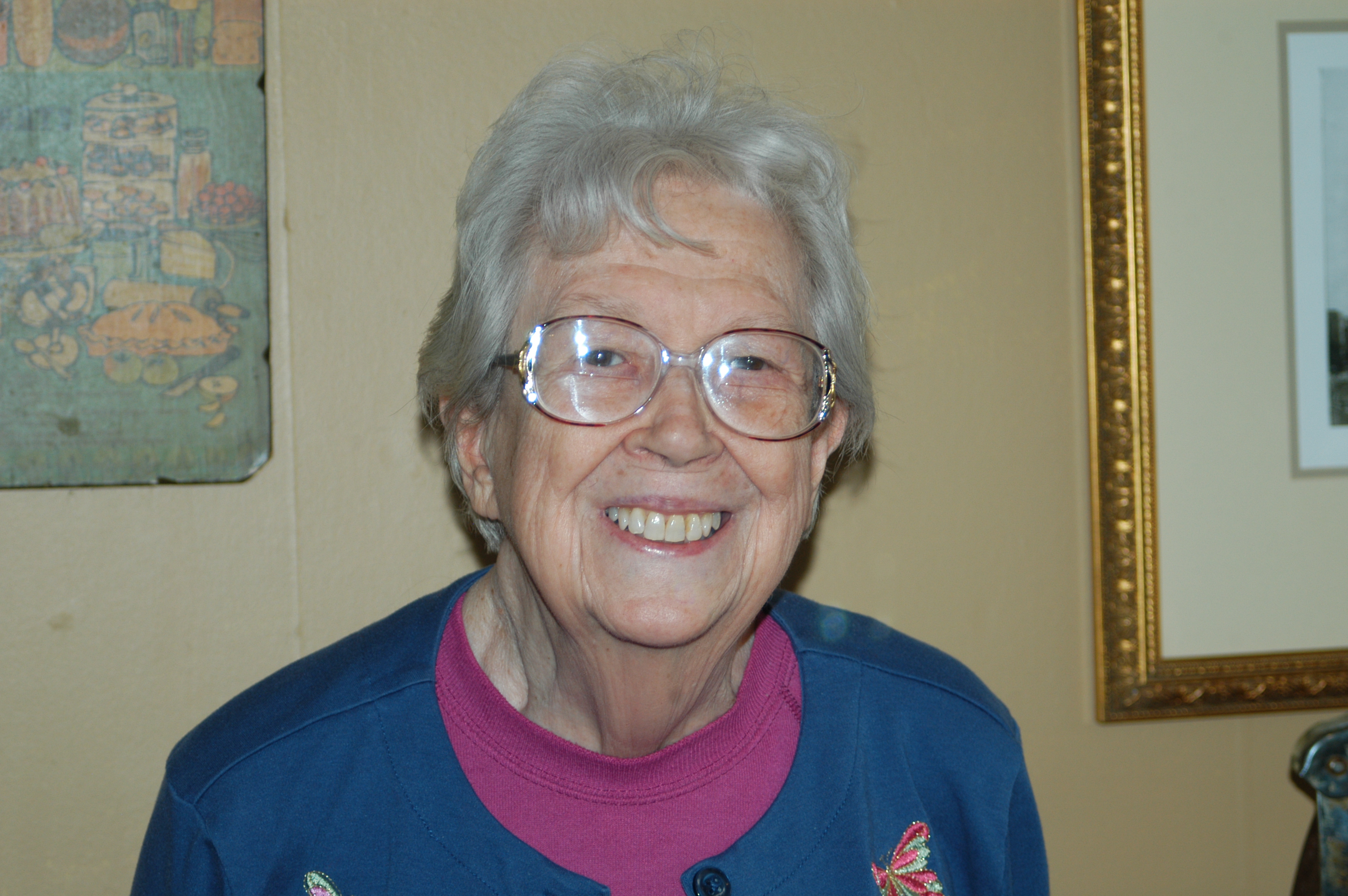
Mother’s Day is coming, and I wanted to say a few words about the mothers in my life and their legacy of prayer. My Mom is a prayer warrior. I blog about prayer, and I pursue a better prayer life, but my Mom is a seasoned soldier, and the daughter of another mighty woman of prayer. Most of what I know about prayer, I learned through the examples of my Mom and Gram, but I have also been blessed by the godly examples of my mother-in-law, sister and sisters-in-law, aunts, cousins, and many more.
From my Mother, I learned to pray from the depths of my heart. I have seen and heard her pray through pain, grief, and despair– not just her own, but more often that of someone else. I have caught her holding back sobs over relatives and neighbors who don’t know or aren’t following Christ. I’ve seen her pause in silent prayer over the plight of a person who is facing a lost job, or chemotherapy, or a migraine. She very seldom offers to pray aloud,”in the moment”, but she prays fervently, nonetheless.
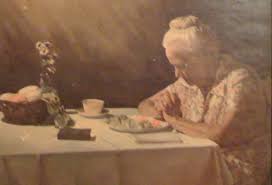
From my Grandmother, I learned to be patient and consistent in prayer. Gram was quiet and unassuming, but she had an unshakable faith. She prayed for years over situations that looked hopeless; often for people who or situations which never changed. I asked her once how she kept from getting angry and frustrated. She looked me straight in the eye and said, “We can’t change somebody else, and we can’t make them do what’s right. That’s not our job. Our job is to love each other, pray for each another, and let God deal with the rest.” She died never seeing answers to some of what she prayed for, but that didn’t stop others from taking up the banner, and it never stopped her from earnestly and joyfully “taking it to the Lord in Prayer.” She never gave up, never lost hope, and never stopped showing compassion.
There have been many other prayer warriors in my life– women (and men) of great faith who sought the Lord, and whose lives and words have had an unimaginable impact. My family, members of my church family, classmates and friends from school or college, neighbors through the years…some of them have held my hand and prayed with me face-to-face; others have prayed on their knees in private; some have prayed for special needs and circumstances; others have prayed at the Holy Spirit’s prompting, never knowing why, but bowing in obedience.
Praying mothers are a treasure. If you have one, or had one, don’t underestimate the value of her example. And don’t just say, “Thank you”…Pay it forward. Pray for family, neighbors and friends. Pray early, pray often, pray without ceasing. We all need more praying mothers, fathers, cousins, neighbors, co-workers, etc. If you did not have a praying mother, you have a golden opportunity to become that good example to someone else. You also have the opportunity to adopt a prayer partner– a surrogate praying mother–to pray with you and for you.








































 Pursuing Prayer