Our Father

Dad.  Daddy.  Pops.  Papi.  Da.  Father.

During my youngest years, I called my father “Daddy.”  Daddy was someone to hold me when I was tired, or frightened, or just in need of a hug.  Daddy had all the answers; he could turn my tears into giggles, my pouts into apologies.  His stern word could melt away rebellion; his smile could fill my heart to bursting.

As I grew older, he became “Dad.”  Dad was wise.  Dad gave good advise– even when I didn’t always take it.  Dad listened and showed interest in what I said.  Dad challenged me to do better, think deeper, try harder, and work smarter.  Dad didn’t pick me up and carry me, but he was there beside me when I needed someone to lean on or lend a hand.  Dad was my coach and advocate.

grace1

As an adult, Dad sometimes became “Pa.”  Pa was someone who had “been there”.  He had experience, and wisdom.  He had patience and compassion.  But his days of coaching and propping me up were fewer; his days of sharing his own faults, his unfulfilled dreams, his regrets–commiserating rather than commanding– grew more and became more precious to me.  He was still my father, but he was also my friend– a fellow traveler on this road; one I knew well and loved dearly.  One I respected and trusted, even though he was not perfect.

I was blessed to have a father who was good and kind; a man of integrity and humor; a man who loved his family more than life, loved his neighbors, his community, music, nature, animals, and good food.  Most of all, he loved God.  Not with fire and brimstone fanaticism, but with humble astonishment that God would send his son to die for him.  He lived in the wonder of that truth– that “whosoever believeth (in him) should not perish, but have eternal life” included him.

I say all this, not just to honor my earthly father, or to thank my heavenly father for that relationship, but to point out how prayer is often a reflection of how we view fatherhood.  Some people have a difficult time praying and trusting God because they have never known an earthly father; or they’ve only known earthly fathers who were distant, unapproachable, or abusive.  If this is the case for you, may I encourage you to ask God to reveal himself in a fresh way, with a name and vision that is personal and distinct from the earthly father you have known.  Some people view God as “Daddy”–someone who fixes everything, holds us close, and keeps us safe.  And he is all those things.  But he is also “Dad” who wants to challenge us and coach us to grow and develop our character.  He is “Abba”, and “Senor”, “Lord,” and “Father” and “Papa”.  He is not “Pa” in the sense I knew my father, in that we are not his peers when we reach adulthood.  He has no faults to share, no regrets.  But he wants to share that precious intimacy that comes with time and familiarity–he wants us to develop trust and love as we get to know him better, however we call him.

superdad

There is one clear difference between God and any of our earthly parents– God is GOD– he is the creator and ruler of galaxies, and of microcosms,  omnipotent and omniscient, omnipresent and eternal, holy and sovereign.

And when I pray, I pray to him– almighty King of Kings– and my Father!

Every Wall Has Two Sides

A mighty fortress is our God;
A bulwark never failing…


bulwark:

noun
    1. a wall of earth or other material built for defense; rampart.
    2. any protection against external danger, injury, or annoyance:The new dam was a bulwark against future floods.
    3. any person or thing giving strong support or encouragement in time of need, danger, or doubt:Religion was his bulwark.
  1. Usually bulwarks. Nauticala solid wall enclosing the perimeter of a weather or main deck for the protection of persons or objects on deck.

see Dicionary.com for further synonyms, etc.

black cannon in front of the brick wall building

Walls, fences, borders, barriers– there are many reasons to build them, and many ways to view them, but they have only two sides, and we can be only on one side or the other.  I enjoy visiting castles and forts, monasteries, and mansions.  Nearly all have impressive walls.  From the outside, they look imposing, intimidating, and often unfriendly (especially those with armed guards and cannons!).  But inside, the walls provide protection, insulation from any outside threats, and often peace.

Most walls provide protection– from nature, from floods or winds, from predators, and from enemies.  But there are a few walls that are built, not to keep danger out, but to keep people trapped within.  Such walls are used to isolate, punish, and imprison.

God is described in the Psalms (and elsewhere) as a fortress, a rock, a safe place, a hiding place, and a sure defense.  But those attributes and qualities are for those who chose to come inside the fortress; to ask for protection and defense.

Sometimes, we approach God as an adversary, rather than a defender and protector.  We find ourselves on the outside, facing dangers unprotected and alone.  The very walls that can shield us and give us peace rise up as barriers,   We feel locked out and vulnerable.  The only difference between peace and peril is where we are in relation to the wall.  We are no stronger, our enemy is no weaker on one side or the other– only the wall makes the difference.  And the level of peace and confidence is related, not to our own ability, but to the stability and strength of the wall between us and disaster.  The higher and stronger the wall, the safer we feel.

selective focis photo of blue betta fish

Other times, we approach God as a jail-keeper.  We have lived inside the walls, and resent His protection.  We have forgotten, or we deny, that there is danger outside the walls.  Or we assume the walls are too close or too restrictive to offer us peace.  But God hasn’t built a wall to keep us near Him or to control us– He IS the wall, the fortress, the bulwark.  To approach Him is to be protected.  To resent His protection is to resent His very presence.

Earthly walls will eventually crumble and return to dust.  Even walls that have stood the test of centuries, like the Great Wall in China, or the Tower of London, or the Wailing Wall in Jerusalem– they are not perfect, nor will they last forever.  But our Bulwark, our Sure Defense, will never fail.  Not only will He never fail to stand, nor fail to protect us, He will never fail to let us in when we seek His salvation.

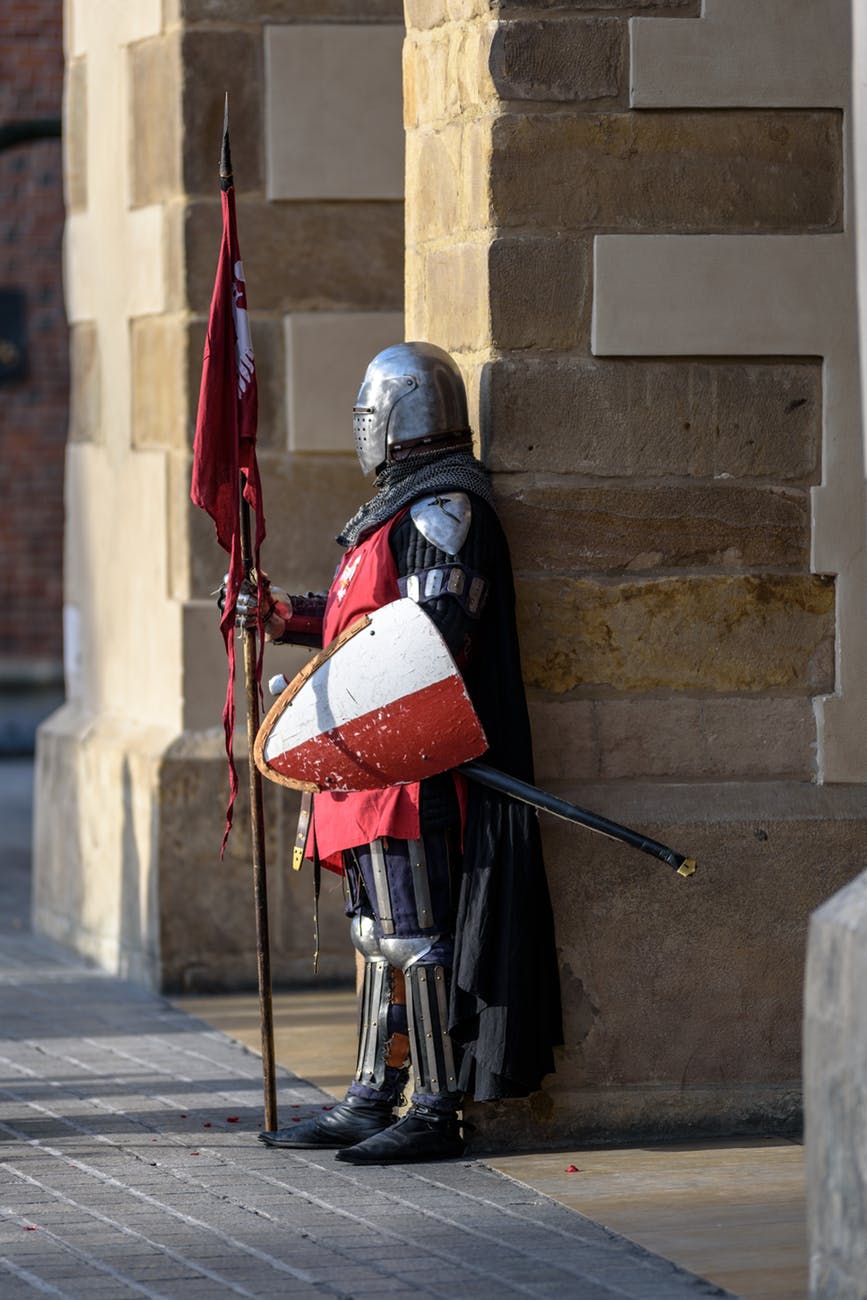
man wearing gray and red armour standing on the streets

Cowardly Prayer

But when you pray, go into your room and shut the door and pray to your Father who is in secret. And your Father who sees in secret will reward you. Matthew 6:6 (ESV)

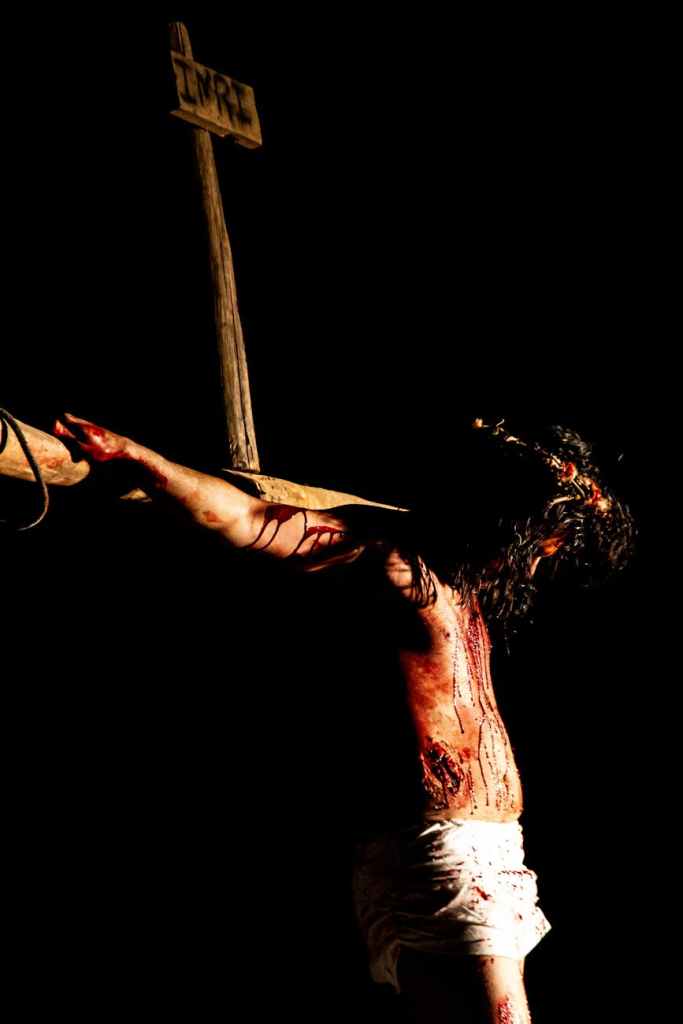
Prayer can sometimes seem like a cowardly action. It seems passive; it relies on faith and, often, patience. We connect courage to action– courageous people DO something; cowards sit on the sidelines or hide in their closets. Yet Jesus told His disciples to go into their rooms or closets, close the door, and pray in secret. Jesus himself often went out into the desert to pray alone. Jesus’s ministry was filled with passive moments. He spoke, or he walked along from town to town. He stopped to heal people by touching them or speaking to them. He rarely raised his voice or let his temper show. He allowed himself to be arrested, tried, sentenced, beaten, and crucified, without making a vigorous defense or protesting his horrific and unjust treatment. On the cross, his one impassioned outburst was a prayer to His Father–“My God, My God, why have you forsaken me?” (Mark 15:34)

We don’t think of Jesus as a coward. Yet, we often sneer at Christians who spend more time praying and less time “doing.” Being active is not a bad thing. Jesus commanded His disciples with many active words– “GO,” “teach,” “feed My sheep.” And there are busy people who are courageous in their own way. They go into dangerous places to preach the Gospel. They risk their health and safety to reach the lost with the Good News that Jesus Saves! They stand firm for the truth, and they defend it with vigor and passion. But Jesus also commanded His disciples to “Follow Me.” That means that we need to look at and model our lives after the ways that Jesus responded to various situations, and how He lived. The question we often ask is “what would Jesus do?” But the real question we should ask is “what did Jesus DO?”

Jesus prayed. He prayed for people; He prayed with people; and He prayed alone for hours and even days. And Jesus prayed courageous prayers. He didn’t pray “safe” prayers. Even His anguished prayer in the garden ended with courageous and humble resignation– “Father, if you are willing, remove this cup from me. Nevertheless, not my will, but yours, be done.” (Luke 22:42) Jesus also engaged lovingly and personally with the kinds of people that others ignored or wrote off or dismissed as broken, damaged, or irredeemable.

Just this week, a young Christian apologist and conservative speaker, Charlie Kirk, was assassinated. He was well-known and admired (or detested) for speaking up about family values, and Christian principles on American college campuses. He often faced hostile critics and smug detractors– atheists, anarchists, and those who called him a racist, a homophobe/transphobe, a bigot, and a “hater.” I never met Mr. Kirk. I watched some of the videos his group posted of him patiently and passionately arguing for marriage, faith, morality, hard work, ethical behavior, and national issues like immigration reform, tariffs, and foreign policy matters. I respected much of what he said, and some of how he said it. One of the things I most respected was his commitment to listening and asking questions, instead of merely attacking. But the most amazing thing about Mr. Kirk was his passionate and outspoken commitment to Jesus Christ. His faith was the center of everything he said, and in the way he interacted with supporters and detractors alike. He did not shy away from difficult questions, and he rarely resorted to easy answers, but he always pointed others to the example and the words of Jesus.

In the wake of his death, many people are asking, “What now?” Mr. Kirk was articulate, passionate, and willing to put himself in danger in order to defend the truth and his personal views. He trusted God to use him, and he was willing to pay a horrible price– being hated, threatened, and ultimately shot to death–to do what he saw as God’s work. He left behind a family (wife and two children), several close friends, and a host of people who followed him on social media and looked to him as a Godly example. Fellow Christians, while we may grieve his loss here, rejoice that he is Home with his Savior for eternity. But many people are wondering what will happen if no one steps forward to take his place and carry on his mission. While I believe that many young people will be inspired to speak out and engage in discussions, I don’t think most of us are meant to step into a spotlight. I think we NEED more people who will commit to going into their closets and pray. While Mr. Kirk put himself in the public arena, there have been hundreds and thousands of people praying for him. They continue to pray for his family, his outreach organization, “Turning Point”, and they even pray for those who instigated and committed this violence.

Prayer is NOT cowardly. Prayer warriors are needed to intercede, to call on Heaven’s Armies to continue in the age-old battle. We should be willing to have the difficult conversations when they arise. Some of us will be called to initiate such conversations openly and with fierce determination. And we should all be ready to “give a reason for the hope that is in you” (1 Peter 3:15) even when it is with “trembling and fear.” And we should always remember to be humble and show kindness, even to those who despise us. But some of us need to be lifting up those who are being attacked. Some of us need to pray more boldly, more often, and more confidently in light of the violence that has exploded in our world. We need to pray, not just for the Charlie Kirks of the world, but for the salvation of all the would-be assassins. We need to pray for the hearts and minds of those who want to argue and “cancel” all those who stand for God’s Word. And for all those who do not know the truth, who are confused, befuddled, or deceived.

We need those who can be courageous– whether in the public square or in a private room.

In This World You Will Have Trouble…

When will the violence end?  How long, O Lord, must we wait for justice?  Why did you allow this to happen?

And it has happened again.  A school-related shooting, this time in Minneapolis, Minnesota.  News feeds were filled with information, speculation, analysis, and commentary for days after the incident.  A week later, the fury seems to have moved on, and the fate of the two murdered children, their families, and the other wounded victims of the shooter’s rampage are dwarfed by the cries of those with a political agenda.  Some are raising concerns over gun control; others want to look at the effect of puberty blockers and other treatments used for those in the trans community. Everyone looking for a quick explanation and a quick solution, so that this “never happens again.”

Senseless violence, natural disasters, sudden tragic circumstances, still have the power to shock us, overwhelm us, shake our confidence, our composure, our beliefs.  Most of us want to believe that we live in a predictable world, a safe and orderly world, a world that has been tamed, and groomed, and civilized.  And we don’t want those beliefs shattered with the truth– life is unpredictable, filled with tragedy, evil, and danger, and it will end in death.  I’m not saying this as a cynic or a pessimist– life is also wonderful, filled with love, laughter, achievement, delight, and eternally precious.  But why are we so deeply disturbed to face the truth about our troubled world?

I believe it is due, in part, to the recognition that this is a fallen world.  It was not made for evil and tragedy and death, but every tragedy reminds us that the whole earth groans for restoration to what it was always meant to be.  The echo of Eden, and the hope of Heaven live in us, and the reality of our lost state cannot be denied when tragedy strikes.  The pleasant facade of the triumph of reason and humanity cracks, and we are forced to see that evil resides next door, down the street, across town, perhaps even in our own hearts and minds.

I love the movie “The Princess Bride” (ask any of my friends–I can quote whole scenes!), but when I first saw it in the theater, there was one line that struck me like a punch in the stomach.  The Dread Pirate Roberts (a.k.a. Westley) kidnaps/rescues Buttercup from her original captors, and after she tells him of the pain and desolation of losing her true love, he doesn’t comfort her by revealing that he is, indeed, her own sweet love, still alive and well.  Instead, he says, “Life is pain, highness.  Anyone who tells you differently is selling something.”   Wha-what?!   What kind of lover, when confronted by that kind of tragic outpouring, says something so callous?  To quote another line from the movie, “Why don’t you give me a nice paper cut and pour lemon juice on it?”  But Westley is not heartless.  The line is memorable, both because it is jarring in its context, and because we recognize that it holds a truth.  Anyone who tells you that this life will be free of pain and suffering IS selling something.  In the movie, Humperdink is “selling” the idea that he is going to make Buttercup a princess and marry her, and they will live happily ever after; all the while planning to kill her.  In today’s world, there are people trying to sell us ideas– that they “have it all figured out”; that truth and justice and morality  and even a person’s worth and value are all relative; that God doesn’t exist or that he doesn’t care; that evil is a figment of our imagination, or that human institutions can create a perfect society and “save” the planet from other human activities and institutions.

Jesus tells us in John 16:33 that in this world, we will have trials, trouble, tribulation, and/or suffering (depending on which version you read).  Not because God doesn’t care; not because he is incapable of stopping tragedies, but because we (humankind) have turned away from God, and the consequence of our rebellion is tragedy and death.  He doesn’t tell us this because he is callous or insensitive or cynical.  In fact, in the next phrase, he tells us to take heart, and to be of good cheer, for he has overcome the world.  HE has overcome the world, and in doing so, he has given us hope, and peace, and strength– not to avoid or deny tragedy, but to overcome it, and to triumph over it.

How does this relate to the pursuit of prayer?  Prayer is not a magic panacea in times of trouble– it isn’t a chocolate-coated miracle pill.  Prayer (and sharing thoughts and prayers with those who are suffering) doesn’t make the suffering disappear– it doesn’t lessen the horror or the evil of an event, and it doesn’t guarantee that future hate, violence, injustice, or tragedy will disappear or even diminish.   But prayer reminds us that evil will not always triumph; that it need not overwhelm us, paralyze us, or defeat us.  I believe it can bring us from being “mostly dead” in despair, fruitless rage, divisive finger-pointing and fault-finding, “inconceivable” arguments, vengeful fantasies, and conceited self-indulgence, back to abundant life in Christ, and renewed courage to do what is kind and loving, even in the face of evil.  Prayer should also restore our focus on what is good, and noble, and true, so that we can be equipped to fight for what is right, instead of just ranting against what is wrong.

Finally, brothers and sisters, whatever is true, whatever is noble, whatever is right, whatever is pure, whatever is lovely, whatever is admirable—if anything is excellent or praiseworthy—think about such things.– Philippians 4:8

I pray, in the wake of this newest tragedy, that God would show me where I am wrong in my thoughts and actions toward Him and toward others; that he would surround those who are suffering pain and loss, giving them comfort, strength and renewed purpose in the days ahead; that he would lead us to have the tough conversations, and take the right steps to bring renewal, restoration, hope, and healing to our communities and our land; and finally, that we would listen to, and acknowledge the truth, and take heart as we focus on the One who has overcome the world.

Not Enough Prayer..

There is a dangerous idea that sometimes appears in Christian circles.  If we are struggling with circumstances, someone, usually with good intentions, will ask us if we have prayed.  Then they may suggest that we haven’t prayed “enough” or that maybe we haven’t prayed the “right” way.

We want to see results– immediate, dramatic, positive results.  It’s what we expect from everything else in life; from the drive-thru fast food place, the vacation resort, weight loss program, graduation, manicure, even marriage.  When results are not evident, or slow in coming, we think we can and must do something to speed up the process.  We begin looking around for what else we can try– what else we “should have” done– to get the results we want.  We even say to ourselves that God wants more from us before he will provide blessing or healing or a breakthrough.

But that’s not always the case.  God makes everything good–IN HIS TIME.  He has the power to bring about immediate change, but he frequently chooses to walk with us through the times of stress and shadows, when we can’t see the end from the beginning, and we are tempted to turn back or doubt.  He doesn’t do this because he enjoys seeing us go through struggles, but because he knows that we learn to lean on him, to trust him, and to find our strength in him by traveling the narrow road.

13423899_10206741318640863_20981142957496268_n

Our prayers need to focus on God’s love and faithfulness.  He knows our need, sees our situation, and hears our prayers.  Our job is to know His word, look for his hand in our situation, and listen for his counsel as we trust him.  We should not grow weary of praying or give up in our efforts.  But neither should we doubt God’s wisdom or try to manipulate his timing with empty gestures or endless repetition.

Sometimes, we may find that God changes our desires, or opens our eyes to habits we need to change or worries we need to give over to him.  Hear out those well-meaning folks–some of them may carry God’s wisdom.  But in the end, our prayers– our life’s struggles and triumphs– are in God’s hands, not theirs.  It’s not the quantity or the quality of your prayer that makes the difference.  It’s the perfect love and timing of God.

Remember that even Jesus prayed in the Garden of Gethsemane– he prayed with so much intensity that he sweat blood drops.  He prayed more than once that God might let the burden of death and separation pass from him.  It wasn’t that Jesus didn’t pray “enough”, or that his prayers weren’t valid.  It wasn’t that God didn’t listen or care about his own son.  But God sent the assurance that Jesus needed to end his prayers with “Thy will be done.”  So it should be with our prayers.

pexels-photo-576926.jpeg

Green Eggs and Prayer?

Have you ever read the Dr. Seuss classic, “Green Eggs and Ham”? In this early childhood reader, the narrator (nameless) is accosted by an enthusiastic character named Sam (Sam I Am), who wants him to try a dish called green eggs and ham. But the narrator refuses. Sam keeps offering, but the narrator continues to refuse, saying he does not like green eggs and ham, and will not try them under a variety of circumstances (in a box, with a fox, on a train, in the rain, etc..) offered by the optimistic Sam.

Finally, Sam’s persistence wears down the narrator’s resistance, and he agrees to try the dish. To his surprise, he LOVES them. In his newfound enthusiasm, he declares he WILL eat them in a box, with a fox, in a tree, in a boat, with a goat, on a train, in the rain, here or there…in fact, he WILL eat them anywhere! He ends by thanking Sam.

So what does a children’s book have to do with prayer?

Well, I believe that the pursuit of prayer as an integral part of living a Christ-like lifestyle is kind of like green eggs and ham. Most people who dismiss the power of prayer have never really pursued it. They have seen it, heard about it– maybe even gotten a whiff of it. They may have “sampled” prayer many years ago as a child or in a single moment of desperation. And the result was disappointment or confusion. Prayer didn’t solve all their problems in an instant. They didn’t get the miracle they hoped for. They didn’t get the bike for Christmas. Their neighbor’s leukemia wasn’t cured. Their situation at work got even worse. Their wife still left and filed for divorce. “Prayer” left a bad taste in their mouth. And they have heard others dismiss prayer and faith as obsolete, ignorant practices, designed for backward and unenlightened people. Like the slightly nauseating color of green eggs and ham, prayer has been deemed unappetizing and best avoided.

And now, when someone mentions a lifestyle of prayer– when someone talks about praying as a daily habit, or a natural part of their worship–the reaction is scorn and suspicion. Prayer doesn’t look powerful. It doesn’t look appetizing. How can something so simple and tame have any effect? Why is the world still suffering so much injustice and evil if there are people out there praying every day? And why do Christians (and others with a prayer tradition) cling to prayer as though it will solve life’s problems?

But prayer, like eggs, can have a bad reputation. For years, we were told that eggs were awful for you– high in protein, yes, but also high in cholesterol, and likely to contribute to diabetes and colon cancer. Recent studies contradict each other, but many now say that eggs are actually good for you. Similarly, during times of crises or disasters, prayer is often derided as inactive and ineffective, and we get mixed messages about people who offer to pray for victims and their families.

Recently, I was challenged about my pursuit of prayer. What good does my prayer do in the face of injustice and disease, death and suffering that people experience? Why do I pray to a God that allows bad things to happen? I have been challenged before, and my answer remains the same. I pray because I have known the peace that comes from trusting God’s wisdom, HIS timing, and His Love for each of us. I don’t have answers for all the “what-ifs” or the “whys.” But I continue to trust that God DOES! And daily prayer is not about “me,” or my questions or what I wish for. It’s about communing with the God who has been faithful all my life and continues to be faithful in every season. The God I love, and the God who knows the end from the beginning.
So what if more of us prayed daily– not just as a reaction to disasters– but pro-actively? What if we prayed, not in anger or bitterness, not transactionally, expecting a particular outcome, but with gratitude for who God is, what He has already done, and what He will choose to do in His loving sovereignty? What if we prayed with open minds and hearts, trusting that we are talking to a God who loves us and knows what is best, not just in the temporary, but in the eternal scope of our lives? We would still see evil in this fallen world, but what if our prayers DO make a difference– we just don’t see the whole scope of what God has provided, or the evil He has NOT allowed to touch us?

I speak as one who has pursued prayer for more than half a century. I’m not perfect. Sometimes, I get frustrated when my desires don’t align with God’s answers. But that’s not the fault of Prayer. Prayer DOES change things– maybe not instantly, and maybe not in the ways I imagine in the short term– but I have seen and experienced the power of prayer. I have felt it in my own life, and I have seen in in studying history and talking to people whose lives were radically transformed by their prayers and the prayers of others.

Philippians 4: 6 says: “Do not be anxious about anything, but in every situation, by prayer and petition, with thanksgiving, present your requests to God.” After this, Paul promises in verses 7 and 8 “And the peace of God, which surpasses all understanding, will guard your hearts and minds through Christ Jesus. Finally, brethren, whatever things are true, whatever things are noble, whatever things are just, whatever things are pure, whatever things are lovely, whatever things are of good report, if there is any virtue and if there is anything praiseworthy—meditate on these things.” (taken from the King James Bible online).

In every situation, we can pray. So, to paraphrase Sam I Am, I WILL pray here and there! I will pray most anywhere (except I won’t close my eyes if I am driving!) So to end:

“I’ll be praying in a boat,
I could be praying with a goat.
I may be praying in the rain.
Or in the dark. Or on a train.

And in a car (eyes open of course). And in a tree.
Because Prayer, it is so good, you see!


So I would still pray in a box.
And I would still pray with a fox.
I will pray inside my house.
And I will pray beside a mouse.

And I will write “Pursuing Prayer”
Because I serve a Lord who Cares!

What if we all had the same enthusiasm for prayer as Sam had about Green Eggs and Ham? What if we keep praying “without ceasing” (1 Thessalonians 5:17) and with confidence (1 John 5:14-15) each day?

“Try it! Try it!”

You’ll be so glad you did.

Praying to Win

Have you ever watched a sporting event–a real nail-biter–and prayed for your team to win?  Do you wonder if God is concerned about Little League or High School Basketball, or which team wins the Superbowl?  And what about the parents and coaches on both teams praying to him–one side has to “lose”–how does God answer such prayers?  DOES he answer such prayers?

While the Bible doesn’t give us a specific answer, I think there are some general principles that apply.  When teams prepare for a big game, they may talk about their desire to win, they may study their opponents, assess their own strengths and weaknesses, and give themselves pep-talks about winning, but they don’t practice winning– they practice playing their best, improving those areas where they are weakest, and working to bring their best on game day.  They don’t pray to win by default or by bad sportsmanship.

The apostle Paul uses athletic analogies for the Christian life– he talks about running the good race, fighting the good fight, and working to be worthy of the prize.  But he doesn’t direct Christians to pray that God gives us a victory.  Instead, he points out that the greatest victory– that over sin and death– has already been won!  We don’t fight the battles wondering if our victory or loss will turn the tide of the war.  We fight in the hope of strengthening our fellow warriors and bringing our victorious Savior more glory and honor.

This holds true in other areas as well.  In politics, we fight to win, but not in desperation or despair, knowing that if we lose this battle, God is not defeated or even surprised by the outcome.  Even in situations of corruption, despotism, and chaos, God can raise up leaders, topple evil powers, and bring renewal and revival.  In war, we fight to win, we fight to defend what we know to be right; but even if we lose the battles, we don’t lose faith.

God doesn’t always give us “wins.”  He doesn’t guarantee that we will never face setbacks or disappointments.  In fact, sometimes we need to “lose.”  We need to lose our selfish ambition, our pride, our drive to compare ourselves with others, our envy and greed, and our failure to submit to God’s best plan.

We pray for victory, but more than victory at any cost, we pray for God’s will to be victorious– for his strength to be shown even in and through our own weakness.  We pray for victory on God’s terms– which may mean a painful loss today, and grieving for the night, but joy that comes in the morning.  Great teams, great nations, great leaders– are not forged in continuous expectation of easy victory.  Sometimes we learn more and become greater by learning from our failures.

Let’s not just pray to win– let’s pray to be more than conquerors (Romans 8:37)!

pexels-photo-415571.jpeg


The Road to Hell…

I started down the boulevard,
Freshly paved, smooth and gleaming,
Its lanes clearly marked and a gentle rise
Toward a glorious horizon.

New construction sites caught my eye;
Here was progress– here was the future!
I drove on, excited in my new course,
Dreaming of destiny and fulfillment.

view of city street
Photo by IKRAM shaari on Pexels.com

Gradually, the scenery changed.
Construction gave way to abandoned projects:
Half-finished high-rises, silent storefronts,
Driveways leading nowhere, weedy parking lots.

Now the road, so smooth at the beginning,
Twisted and turned without purpose.
Gravel and broken pavement lined with
Abandoned cars and broken glass.

white and black house painting
Photo by Pixabay on Pexels.com

Frightening thoughts intruded–
I had seen no open stores, no gas stations,
No houses, or other cars for miles.  I was alone.
There were no crossroads; no places to turn around.

The road that had begun with so much promise
Was now a rutted path going nowhere.

photography of railway
Photo by MESSALA CIULLA on Pexels.com

I woke up in a cold sweat– it had been a dream.
More– it had been a warning.

I had “good intentions” for my journey.
But the easy road, the appearance of future success
Had lured me away from the path marked with suffering
And paved with ancient truths.

I had packed no maps, ignored the GPS, and trusted to “instinct”
To lead me, not to a fixed destination, but to “discovery.”

I drifted back to sleep, and dreamed that I was back at the beginning.
Roads branched out all around me.
The gleaming new boulevard no longer held any appeal.
But now I studied the other roads.

aerial photo of buildings and roads
Photo by Aleksejs Bergmanis on Pexels.com

There were so many; roads leading to “enlightenment”;
Roads offering “fame” and “immortality”;
Narrow paths promising “mysticism”;
Superhighways advertising “happiness.”

Off to the right, there was a tiny filling station–
The old fashioned kind, with a service man.
He offered to fill my tank, but then he said,
“They all end up in the same place, you know.”

abandoned business classic dirty
Photo by Pixabay on Pexels.com

I looked up into his eyes–eyes that held in them
The wisdom of the ages and boundless love.
“Enter in at the narrow gate…”
“I am the way, the truth, and the life…”
“This is the way, walk ye in it…”

He turned and walked through the back door
And I followed him down a sunlit path,
Up a small rise, and into glory.

landscape photo of pathway between green leaf trees
Photo by Skitterphoto on Pexels.com

Why Do I Pray?

I pray every day. But why? There are short, glib answers– “Prayer works,” or “The Bible tells me to.” Or I could say that it’s just a “good” habit, or that it “does something” for me. But prayer is more complex than that. I can give a lot of generic reasons for someone to pray. I can list (and have listed) many benefits of regular prayer. But what are my personal reasons for praying?

Prayer does “do something” for me– lots of somethings. Not every time; not always in the same measure, but prayer can:

  • Put me in a better mindset; it changes my focus and my attitude. When I pray, the world around me shrinks, along with all the worries and distractions it presents. Instead, I begin to focus on “God” things– the metaphysical reality that I am not the center of the universe, and my limited understanding is not enough to navigate life in its fullest sense. Jesus offers “abundant life” (See John 10:10)– life to the full. And prayer ignites that, taps into that, and lifts me from futility and confusion to meet with One who sees the end from the beginning.

  • “Recharge my batteries.” Prayer, meditation, “quiet time”– they are all similar, and they all have a physical benefit. Spending time in prayer can lower blood pressure, promote clearer thinking, and increase a person’s ability to withstand stress. Prayer can improve mood, but it can also improve the body’s ability to fight off depression, infection, and other stress-related issues. This is very personal for me, because I have struggled with stress and depression at various times in my life, and prayer can calm me, help me to change negative thought patterns, and endure hardship better than anything else. (Please note this does not mean that I don’t also need to do other things– proper diet, plenty of sleep, hydration are all necessary. Some people may require medication– prayer is not a substitute for good health advice, rather it is an integral part of being physically and spiritually healthy.)
  • Deepen my faith. God doesn’t always give immediate and clear answers to my prayers. In fact, it may feel sometimes as though He has forgotten me. So why continue to pray? Because God DOES answer prayer. Often, He answers in surprising and unexpected ways. Sometimes His answers come so slowly, so subtly, that I might miss them– if I weren’t keeping track. This is one of the great benefits of keeping a prayer journal or diary…I will often see an old entry, one that I had given up on or forgotten, and realize that God answered it weeks ago without any startling revelation or dramatic rescue. If I only pray when I expect God to do the impossible immediately, I may miss the development of something even more amazing that I imagined!

  • Become a vital part of my discipleship. Being a disciple literally involves discipline…I can’t say that I follow Christ part-time. Ignoring daily habits, like prayer and Bible study; failing to make time for fellowship with others; depending on my feelings instead of God’s Truth to guide my life– is hypocritical. Also, prayer should open my heart and mind to others who need to BE discipled. And this leads me to another benefit…Prayer can
  • Help me develop empathy for others. As I pray for others, I learn more about the struggles they face; I learn about their deeper needs. For instance, I may begin praying for someone with a chronic illness to be healed. And that is good. But as I pray for them daily, I learn that along with healing, they desire help with everyday chores that they can no longer do, or they need support and encouragement. Maybe they need rides to doctor appointments and tests. If I am praying for someone struggling with past mistakes or addictions, I learn to see with eyes of compassion and encouragement, rather than judgment and self-righteousness. It’s not just about praying for the “big” needs but learning to pray for (and find ways to help with!) intermediate needs as well. Finally, prayer can…
  • Remind me that I am never alone! I don’t pray to a brick wall, nor do I pray in a vacuum. I LOVE meeting with our local prayer group every week. I love hearing the others pray. I love being reminded that God listens to my prayers– The Father listens; The Son is my intercessor; The Spirit translates even my groans and mumbles–God delights in hearing from me! (See Zechariah 3:17; Hebrews 13:5; others)

So, Yes, I would say that “Prayer works.” But not in the sense that I can show that God has answered my requests exactly how or when I wanted. There are prayers I have prayed for most of my life that have not been answered “my way” yet. Reckoning with hurtful words and deeds from my past; family members who still haven’t accepted Christ; friends who are still facing the consequences of sinful life choices; situations and circumstances that I would like to see changed. And I don’t have any jaw-dropping evidence that my prayers can cure cancer or end world hunger or make my life problem-free. Quite the opposite. But I DO have evidence that Prayer has made a difference in my life; that I HAVE seen lives changed in ways that are impossible to explain away; that prayer is worth pursuing.

And that is why I pray.

Jesus’s Prayer List

Meanwhile, the moment we get tired in the waiting, God’s Spirit is right alongside helping us along. If we don’t know how or what to pray, it doesn’t matter. He does our praying in and for us, making prayer out of our wordless sighs, our aching groans. He knows us far better than we know ourselves, knows our pregnant condition, and keeps us present before God. That’s why we can be so sure that every detail in our lives of love for God is worked into something good. God knew what he was doing from the very beginning. He decided from the outset to shape the lives of those who love him along the same lines as the life of his Son. The Son stands first in the line of humanity he restored. We see the original and intended shape of our lives there in him. After God made that decision of what his children should be like, he followed it up by calling people by name. After he called them by name, he set them on a solid basis with himself. And then, after getting them established, he stayed with them to the end, gloriously completing what he had begun. So, what do you think? With God on our side like this, how can we lose? If God didn’t hesitate to put everything on the line for us, embracing our condition and exposing himself to the worst by sending his own Son, is there anything else he wouldn’t gladly and freely do for us? And who would dare tangle with God by messing with one of God’s chosen? Who would dare even to point a finger? The One who died for us—who was raised to life for us!—is in the presence of God at this very moment sticking up for us. Do you think anyone is going to be able to drive a wedge between us and Christ’s love for us? There is no way! Not trouble, not hard times, not hatred, not hunger, not homelessness, not bullying threats, not backstabbing, not even the worst sins listed in Scripture:
They kill us in cold blood because they hate you.
We’re sitting ducks; they pick us off one by one.
None of this fazes us because Jesus loves us. I’m absolutely convinced that nothing—nothing living or dead, angelic or demonic, today or tomorrow, high or low, thinkable or unthinkable—absolutely nothing can get between us and God’s love because of the way that Jesus our Master has embraced us. (Romans 8:26-38– The Message. Emphases added)

I keep a Prayer Journal– (for more info, click here: Prayer Journal). In my prayer journal, I have lists of names– people I pray for on their birthday or anniversary; people I pray for on the anniversary of a loved ones’ death; people who are hurting or in need at a particular time– and some days, the list seems very long. Sometimes the names on my lists are people I know well, but other names are there because I knew them well in the past, or because they are important to people I know well, but I don’t really know them personally. Often, I don’t really know how best to pray for an individual on my list. But imagine if Jesus were to keep a written prayer journal! He doesn’t just pray for people on special occasions or even in their time of trial– He prays continually for all who are His! And He knows each one intimately– He knows our every need better than we do!

You and I (if we are followers of Christ) are CONTINUALLY on His mind, and CONTINUALLY in His prayers! In fact, His Spirit even inhabits our groans and fumbled or aborted prayers. There is not a moment or a set of circumstances in which Jesus has turned His back on us or been distracted by something else. He is our Eternal Advocate, our Ever-Present Help, and our Heavenly prayer-warrior!

What a comfort to know that I don’t have to know exactly how or what to pray in order to lift up my heart-cry to God. My words may be muddled, my mind distracted by fleeting worries or doubts, but if I have placed my trust in Christ, I will never pray in vain. I may not be able to understand how or why or when God will work; I may not understand how my prayers fit into God’s overall plans. But I can pray with confidence that comes from knowing that God is Good, and Christ is my liaison with all that is Sovereign and Good. I cannot be separated from any of that by my own inadequacies or my lack of understanding. I cannot be kept apart from God by any personal failings or any forces working against me. And my fumbling prayers cannot be intercepted or twisted or negated by the enemy.

Your name is on Jesus’s prayer “list”; you are in His constant prayers before the Father. And each of your prayers is personally siphoned through the Holy Spirit and the Son to be presented– perfected– to the Father! What a captivating and encouraging thought! What an Amazing God we serve!

Blog at WordPress.com.

Up ↑