The Twenty-third Psalm is one of the most quoted and well-known poems in the Bible. In its short six verses are contained some of the deepest truths and most beautiful images in scripture.
Today, I want to look at just the first five words of the psalm: The Lord is my shepherd. Familiarity with these words can rob them of their true power. Imagine if we used a modern-day analogy: The Prime Minister (or King or President) is my life coach, or home health care nurse, or bodyguard. Can you imagine!?
How often do we gloss over these words and fail to see the amazingly powerful message there. The LORD– Yahweh, the Almighty, Ruler of the Universe– is MY shepherd. He does all the kind of things a shepherd does for his sheep– feeds, leads, protects, and provides. He fights off predators, binds up wounds, and shears off the extra wool that can get us entangled in briers or slow down our progress. He stands with us in the heat and cold, and finds shelter for us from the wind and rain. He does all of this for me, when I can’t; because I can’t. He knows everything about me– my strengths and weaknesses and limitations. He knows everything about what I need– where the best grass and water are and how to get there; how much rest I need before the next stage of our journey; the likelihood that I will wander off and need to be called back to the flock. He knows what dangers lie ahead, and how to deal with them.
The Lord IS my shepherd– He is always on the job. He hasn’t left me alone in green pastures, or sent someone else to take me through the valleys. He didn’t start out as my shepherd and then decide to quit. He isn’t waiting for me to reach a certain stage or measurement before I qualify to be His sheep.
The Lord is my Shepherd– not my task-master, nor yet my servant. He is both my Lord and my caretaker– my master and my minister. When I pray today, it is not to someone remote and aloof or powerless and malleable– I am bleating in my sheepish voice all my praise, my love, my irrational worries, and my sincerest gratitude, to the eternal and all-powerful shepherd who calls me by name.
How often do I recite this favorite Psalm without really thinking about it? In the words of this Psalm, I am loved, cherished, sustained, and led by Him. But am I in reality? Do I submit to His leadership and guidance? When I pray, am I really coming to meet with my Shepherd, or am I trying to meet with God on some other level or in some other relationship?
I’ve been reading through the first few books of the Bible. I’m in Numbers right now, and Moses is leading the Israelites through the wilderness. The spies have just returned from Canaan, and the people have rebelled against God, weeping and accusing God of leading them to the Promised Land only to have them die in battle with the giants of the land.
I read through this and shake my head, but haven’t I done similar things in my walk with God? I want to avoid the wilderness. I want to walk in the green pastures, but I don’t want to travel through the valley of the shadow of death to get there! I look at obstacles and setbacks as though God were sitting far away, arms akimbo, laughing at my struggles; in reality, He is right beside me all the way, waiting to help me overcome each obstacle and gain victory together with Him. I’m looking at the giants, when He wants me to trust Him for the milk and honey He has promised. I still have to face the giants, and the battles ahead– but I don’t have to face them alone. I don’t have to face them in my own strength, my own limited wisdom, or my limited vision.
But here’s what I am learning as I read through this section of the Bible right now:
God IS with me. He doesn’t leave me or give me anything HE can’t handle. But I have to walk through the wilderness. I have to fight battles. I have to face giants. I have to learn to trust for my daily bread– whether it is manna or money to buy bread–daily. I have to listen to His voice; not impose my plans and ask for Him to bless them.
God doesn’t want me wrapped up or caged: He will not take away my freedom to follow (or NOT follow) Him. And when I wander, He may allow me to wander in circles for a while (hopefully not forty years!), but He will still be right there, ready to lead me when He sees that I am ready to move forward.
He will supply all that I really need– water from the rock, bread from Heaven– not because I have the money or resources, I think I’ve earned, but because He IS my provider. He can part the Red Sea; He can destroy Pharaoh’s armies. He can make the earth swallow up those who threaten me and defy Him. I am safe, even in the wilderness, when I stay close to the Shepherd!
He will counsel and correct me. He will offer forgiveness again and again. He will not leave me lost or unable to return to His side. He will be a “Presence” in my life, wherever I go– day or night.
He sees me and He hears me– which is both comforting and fear-inducing. But it is a healthy fear; an awesome and reverent fear; one that keeps me humble. After all, I am a sheep, NOT the Shepherd! I can call out to Him, and He knows where I am (because He is right there, too), and He knows what I need. God saw the Israelites worshipping the Golden Calf even as He was speaking to Moses up on the mountain. God heard Moses as he pleaded for mercy, even in His anger and wrath.
He calls me by name. The Bible, especially the Old Testament, is full of individual names. Not just the ones we study in Sunday School; not just the ones in the children’s stories; but names of the leaders of the various tribes of Israel, and names of the spies, names of craftsmen God had selected to build the Ark and all the items needed for the Tabernacle, and names of those who rebelled. I am not lost in the crowd; I am not forgotten among the many. God knows me intimately– just as He knows you!
Even when my prayers seem like whining, bleating, plaintive “baa-ing”, I know my Shepherd hears. And He delights to hear from me. He delights in leading me through the wilderness and providing for my every need. And His promises sustain me when I don’t know what’s coming next, or I fear what I see on the horizon.
So I will pray today, and tomorrow, and every day, knowing that even my– especially my– “sheepish” prayers are not in vain.
This has been a somewhat laid-back week. I ran some errands on Monday, did some cleaning Tuesday, went to Prayer Meeting on Wednesday, and relaxed yesterday. But I wanted to share a few observations from this quiet week:
The corn is coming on fast in this area. Rain and heat mean that much of the corn was more than “knee-high by the fourth of July.” I am so thankful for farms and farmers– thankful for their hard work and planning, but also thankful for how God gives rain and sunshine in its season. It is so nice to see green fields gently swaying in the warm breezes, soaking up all the recent rains.
Other crops are blossoming, as well. It is blueberry season, and David and I hope to pick a few quarts in the next week or so. I have a small herb garden, and we are enjoying fresh basil, chives, and sage. I also have a couple of tubs of tomato plants with medium-sized green tomatoes getting ready to turn red, and some cilantro and rosemary that got a late start, but what salads we will enjoy!
While driving on my errands and to church the other day, I saw a lot of wildlife (and not-so-wild life) along the way. I saw cranes and geese, deer, a random turtle, squirrels and rabbits, sheep and cows and horses, all with their young. I saw flowers of every color and size, enjoyed the shade of trees, and enjoyed watching the clouds float through the cheery blue sky.
Everywhere, there is life! There is color and movement, singing of birds and whispers of wind. And everywhere, there is evidence of God’s goodness!
Sometimes, it is very good to push back against the busyness of errands and schedules, and just marvel at God’s creation and His provision. Nature waits on God. He supplies all the needs of the plants, the wild creatures, and the earth. And He will supply all our needs, too. Not just physical and material needs, but soul-deep needs for peace, joy, rest, purpose, and even discipline. God can lead us in “green pastures” and also through the “valley of the shadow of death.” And though the way may be challenging and even difficult sometimes, we can trust in His wisdom and guidance.
So today, I choose to use my time and space to witness God’s glory in Nature; to praise His creativity and His wisdom; and to rest in His Grace.
10 The thief comes only to steal and kill and destroy. I came that they may have life and have it abundantly. 11 I am the good shepherd. The good shepherd lays down his life for the sheep.
John 10:10-11 (ESV)
I know a very wonderful and kind-hearted woman who put out a table with several items she wanted to give away to anyone in need. She set up the table, taped a sign to the front, reading, “Free”, and went about her day. She returned to find that not only were all the items gone, but so was the table!
I also know many other people (including my husband and I) who have been victims of theft, shoplifting, pick-pocketing, mugging, etc. The world is full of honest people, but it is also full of thieves. One of the worst things about theft is not the loss of “stuff.” It is the loss of security; the loss of trust; the loss of innocence and faith. Theft is invasive, even when it is non-violent and impersonal, like fraud or shoplifting. Theft is almost never random– a thief “comes.” A thief has a plan, and a target. Thieves tend to choose their targets based on two factors– the risk and the perceived “payoff.” A thief will target a person or place where the risk is worth the prize–if a target is low-risk, a thief may strike even for a small amount. A high-risk target may still attract thieves, but they will not take such a risk without a lot of planning.
Thieves also come unannounced and unexpected. While thieves plan carefully, their victims have little or no warning. Theft is shocking and upsetting. We don’t set aside a time to be robbed, or items that are meant to be stolen. Thieves creep in, or distract and deceive us. It would be very foolish to leave valuables or cash around unattended or unprotected. As my friend found out, even a table left unguarded can be lost.
Most of us take precautions against theft. We lock our doors, put our valuables in a safe or in hiding, and even install security cameras and alarms to alert us to possible theft. We avoid dark alleys and dangerous places. We keep watch.
We guard our valuables, but how well do we guard our hearts? Jesus compared us to sheep– helpless and vulnerable to predators, including thieves. He warns that the thief– Satan– comes only to steal and kill and destroy. Satan doesn’t want our money or our watch, though– he wants our time, our attention, our desires, and our worship. He wants to steal them, and kill us, and destroy our relationship with the Eternal Lover of our Souls. He wants us to be distracted by worry, greed, fear, pride, addictions, dysfunctional relationships, anger, abuse, emotional entanglements, empty pursuits, and endless doubts and questions.
Satan doesn’t wait for us to seek him out. He doesn’t give us warning about his intentions. But he does come like a thief. He comes to steal our joy, our faith, our innocence, our rest, our security, our gratitude, our focus, our sense of purpose, and our hope. How much of an effort have we taken to stop him? How much effort do we take to guard what is more valuable than our money– our families, our character, our very soul? We wouldn’t walk down a dark alley with a wad of cash– but will we walk into temptation? Will we ignore warnings, believing it just “won’t happen” to us?
Luckily, we have a Good Shepherd. Even when we, like sheep, aren’t paying attention, and don’t see the enemy, God is still there, laying down His life, so that we can have a more abundant, more joy-filled life. The thief will still come– that’s not just an abstract warning, it’s a guarantee. There will be troubles in life that will threaten to steal all that God intends for us to enjoy. And, if we insist on going it alone, we will become victims of theft– our relationships, our character, our futures– we are at great risk. But if we trust in the Shepherd, we will have the best protection. The thief will still come to attack, but he cannot take what is in the Father’s hand– US!
The thief comes– to take; to destroy. The Shepherd comes– to give; eternal and abundant Life!
When I was just over a year old, I became very ill. Several doctors were consulted, but no one seemed to know what was wrong. I was losing weight, growing weaker, lost the strength to walk (something I had just started doing), and losing the will to thrive. I cried and moaned throughout the day, and had trouble falling asleep normally– demanding constant attention and comforting, but not showing any signs of fever or infection.
Our minister at church anointed my head with oil for healing. Everyone prayed fervently. Mom and Dad took turns staying with me at the hospital, trying to calm my fears and hope that I would get better. Finally, one of the doctors (a third- or fourth-opinion at that point) suggested that I might have a protein deficiency–that my body was not processing proteins correctly, as I had just started eating meat and more complex dairy. He suggested a course of booster shots that lasted well into my fifth year; it was one part nightmare, and three parts miracle– daily, then weekly, monthly, and quarterly trips to get the dozens of booster shots, but I lived, grew, and was able to live a normal life. My childhood was filled with nightmares and many sleepless nights, even after my health began to improve. But I learned to love meat and dairy, trust the doctor and nurses who administered the dreaded shots, and embrace life.
I tell this story in relation to Psalm 23:5, not to make a plug for anointing as a miracle “cure” or magical ritual. I realize that healing comes in God’s time and will, and that not everyone who prays for (or anoints for) healing receives it in this life. But I DO believe in the power of prayer, and I do believe in the act of anointing. It is not the oil, or the ritual involved that brings about powerful healing, however. It is a representation of God’s power to heal– and it brings with it an awareness of His presence and sovereignty.
When David talks of anointing, he speaks from multiple layers of experience. As a shepherd, David would pour oil over the heads of his sheep. This served two purposes– it would keep insects from burrowing in and around the eyes, nose, ears, and necks of the sheep, where they could do untold damage, and where sheep could not dislodge them; and it would help them as they grazed among briers and rocks where they might get snagged, cut, or scraped. Oil brought protection and healing.
But David was also a King. He had been anointed by Samuel to be the next King of Israel as a young man. Even though he had to wait through years of danger, war, and exile, he had been chosen and set aside by God. God had seen him through and raised him to prominence, and He had signaled all that through anointing.
God is our Good Shepherd. He anoints our heads with oil– for protection, for healing, for service, and for ordination. Our Shepherd cares deeply for our physical and spiritual needs. And He appoints us to His service–He has a purpose and a position for each of us in His kingdom.
In days of confusion and suffering, we can forget to look for the Shepherd’s presence and His provision. We may lose strength, and even the will to thrive. But God can and will strengthen us with “spiritual protein” in His word and through fellowship. He will provide us with “booster shots” of blessings– friends who pray for us and with us; scripture that inspires and convicts; hymns and songs that remind us of His amazing grace and love; moments of prayer and meditation that carry us through the day. God will provide the daily anointing we need– and when we turn our face toward His, we will see eyes of love and feel His gentle hands of grace as He gives us all we need.
For more on Biblical anointing– it uses, meanings, and symbolism, check out these resources:
3 Acknowledge that the Lord is God. He made us, and we are his— his people, the sheep of his pasture.
Psalm 23 New King James Version (NKJV) The Lord the Shepherd of His People A Psalm of David. 23 The Lord is my shepherd; I shall not [a]want. 2 He makes me to lie down in [b]green pastures; He leads me beside the [c]still waters. 3 He restores my soul; He leads me in the paths of righteousness For His name’s sake. 4 Yea, though I walk through the valley of the shadow of death, I will fear no evil; For You are with me; Your rod and Your staff, they comfort me. 5 You prepare a table before me in the presence of my enemies; You anoint my head with oil; My cup runs over. 6 Surely goodness and mercy shall follow me All the days of my life; And I will [d]dwell in the house of the Lord [e]Forever. Footnotes: Psalm 23:1lack Psalm 23:2 Lit. pastures of tender grass Psalm 23:2 Lit. waters of rest Psalm 23:6 So with LXX, Syr., Tg., Vg.; MT return Psalm 23:6 Or To the end of my days, lit. For length of days
The Bible is filled with imagery of sheep and shepherds. Growing up, I lived in the countryside, but we never raised sheep, and I had little experience with livestock of any kind. We had one neighbor who had sheep, however, and he shared a lot of insight into why we should pay attention to what sheep can teach us about ourselves, and our God.
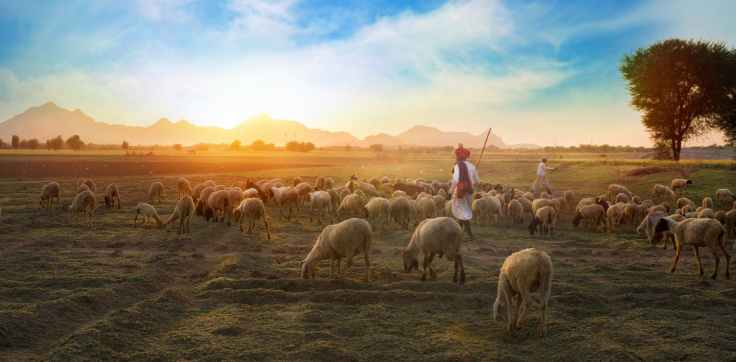
Not only does God use the imagery of sheep and shepherds, He uses examples throughout the Bible of actual sheep and shepherds. Abraham, Isaac, Jacob, the sons of Jacob, David, and the prophet Amos– all were shepherds. When the Messiah was born, the first announcement went to shepherds in the fields, keeping night-watch over their flocks!
Jesus used stories of sheep and shepherds in his parables, as well. There is a lot to understand, and I am not qualified to teach anyone about shepherding, but there are several wonderful principles that don’t require a lot of in-depth knowledge:
Sheep NEED a shepherd. There are breeds of mountain sheep that live independently, but the Bible stories speak of domesticated sheep…they are “high maintenance” animals– they need food and water, shelter, protection, and a lot of guidance and supervision! We NEED God–He understands our situations, our weaknesses, and our strengths, far better than we do. He knows the future; He has a plan, and He provides all that we need. We may not see the road ahead–we may not see the green pasture or the still waters where He wants to lead us–but He IS the WAY, the truth, and the life (John 14:6), and we can trust Him to get us there.
Sheep need to be sheared. Left unsheared, the sheep’s wool will become matted, filthy, and a potential source of danger and disease. The sheep cannot get rid of its wool on its own. However, once the old wool is sheared off, the sheep is clean, and new wool can grow. Not only does God provide for our immediate needs, He provides for our renewal and growth–physical, emotional, and spiritual growth. Sometimes, that means we need to be “sheared” of habits, people, or situations that have become “matted”, and filthy. We haven’t even noticed the change, and we don’t see the danger. God wants to free us from the “baggage” we accumulate, and help us experience new growth.
Sheep depend on others to stay safe, healthy, and fed–there may be “lone wolves”, but there are no “lone sheep”. God will bring us into “flocks”. We learn to eat together, travel together, rest together, live together, and follow our shepherd’s voice together. Trying to be a “lone sheep” makes for a lot of trouble!
Shepherds make great sacrifices to care for their sheep– they provide, protect, rescue, heal, guide, and clean their sheep. A good shepherd is watchful, faithful, caring, and gentle, even as s/he must be strong, brave, and fiercely protective, risking their lives (or even giving their lives) for their flocks. Jesus, our Good Shepherd, knows each one of us intimately– He knows how to heal and guide us. He wants us to recognize His voice above all others, and to stay close to Him. He died to redeem you and me!
May we trust our Good Shepherd today, and every day. May we spend time acknowledging Him as our loving and faithful Shepherd, and call out to Him– in praise, in adoration, in supplication, and in loving gratitude.
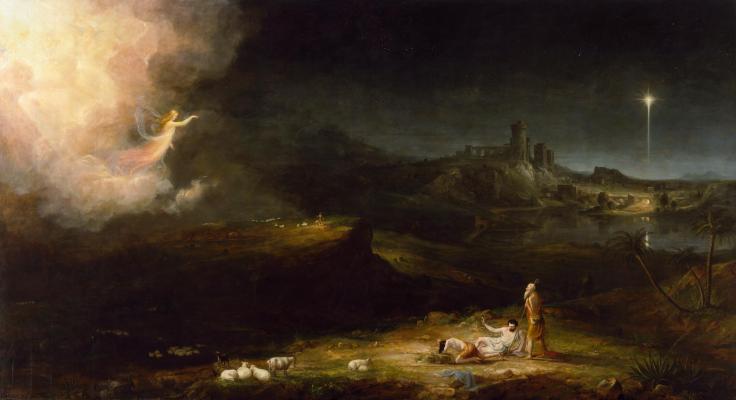
While shepherds watched their flocks by night, All seated on the ground, The angel of the Lord came down, And glory shone around. “Fear not!” said he, for mighty dread Had seized their troubled mind; “Glad tidings of great joy I bring To you and all mankind. “To you, in David’s town, this day Is born of David’s line A Savior, who is Christ the Lord, And this shall be the sign: “The heav’nly Babe you there shall find To human view displayed, All meanly wrapped in swathing bands, And in a manger laid.” Thus spake the seraph and forthwith Appeared a shining throng Of angels praising God on high, Who thus addressed their song: “All glory be to God on high, And to the Earth be peace; Good will henceforth from heav’n to men Begin and never cease!”
Words by Nahum Tate
Why the shepherds? Angels might have appeared to the rulers and priests of Israel, announcing the birth of their long-awaited Messiah, but they did not. Nor did they appear to the common citizens (and other visitors) in Bethlehem. We make much of the shepherds being lowly and humble, and that is true enough. But there were other poor and humble people throughout the land. And there were “important” people who waited to hear the news.
There is something about shepherds that is close to the heart of God. All the way back in Genesis– Abel was a shepherd. The early patriarchs– Abraham, Isaac, Jacob– were all shepherds. Moses, when God called him, was working as a shepherd. King David started as a shepherd, tending his father’s sheep, while his older brothers were serving in the army. The prophet Amos was a shepherd. Jesus used several parables about and allusions to shepherds and sheep as well. (See Matthew 18:10-14; John 10 among others.)
Shepherds are humble, yes, but there are other traits that I think are at work in the story of the Nativity– some important, and others incidental:
Shepherds watch. That seems pretty self-evident from songs and passages, but it’s also important. The shepherds weren’t watching for angels that night, but they were alert, combing the area for dangers, pitfalls, straying sheep, wandering predators…There is nothing in the Bible that says that the angels were invisible to anyone else in the neighborhood; only that the angel appeared to the shepherds and was joined by the hosts of heaven.
Shepherds must focus on others. Much is made of the “lowly” station of shepherds. But that is the nature of the job. A “Good” shepherd is one whose focus and efforts are directed at the sheep. He doesn’t “climb the ladder of success”, “toot his own horn”, “keep banker’s hours”– in fact the shepherds of the Nativity story were the “night shift”, tending the flocks when it was cold, dark, dangerous, and thankless!
Shepherds were familiar with “unconventional” birth. An announcement that Messiah was born in a stable and could be found wrapped in strips of cloth would come as a surprise to shepherds, but not as an impossibility or a cruel joke. Shepherds (anyone whose livelihood depends on the safe delivery of livestock) would understand and rejoice over new life, even in unexpectedly humble or unconventional circumstances.
Shepherds were often “left out” of ceremonies and celebrations, because of their frequent contact with blood and death. The angel’s announcement had special meaning in the inclusion of shepherds, which was to show that even those who had been deemed ritually unclean were to be included in the “Good news of Great Joy!”
The shepherds were “abiding” in the fields. These were not the temporary visitors thronging to Bethlehem for the census. They were not the patriarchs of great families living in walled compounds or great estates; neither were they awake in the middle of the night plotting, scheming, or creating havoc. They were humble, but they were faithfully doing their work.
This Advent season, may we consider the shepherds and learn to be watchful, other-focused, joyful, ready to accept the Good News, and faithful in all that we do and say in response to our Good Shepherd!

















 Pursuing Prayer