I have a friend who wants to sue God. She’s not entirely serious, but she has a lot of anger toward God. She feels that God “owes” her an explanation for her life circumstances, as well as a general justification for war, famine, and other evils that she reads about in the paper or sees on the news. She believes He (or She or S/he or It– my friend isn’t sure that God exists, but cavils at the idea of calling God “Father” or “He”–she finds it sexist) is being unfair in a thousand different ways.
My friend doesn’t read the Bible, and is only vaguely familiar with the story of Job. Job wanted to take God to court. His life had crumbled around him, and he wanted God to explain why, especially as he didn’t “deserve” the circumstances he faced. Amazingly, in the Biblical account, we learn that Job was “right.” He didn’t deserve to lose his family, wealth, and health. He had done nothing “wrong.” That doesn’t mean that he was sinless. But he confessed any sins, made atonement– he even sacrificed to make atonement for any sins his children might have committed. Job was a “righteous dude!” My friend– not so much. Like most of us, she would probably be ready to admit that she’s made some mistakes here and there, though she doesn’t feel that they are particularly heinous. She’s more than willing to “let bygones by bygones” for herself and others– shouldn’t God do the same, without making us confess and humble ourselves? Who does God think He is, anyway?!
But this is the point. God is GOD–He is not a man, or even a superman, that He is compelled to explain Himself to us; to seek our approval or accommodate our whims, wishes, or plans. In the story of Job, God never gives Job the explanation he’s looking for (again, amazingly, WE the readers are given a “behind the scenes” look and told exactly why Job is being tested and allowed to suffer). Nor does God justify Job’s circumstances or spell out his list his “rights.” Instead, He presents Job with a few keen questions to remind Job (and us!) of who God is, and who Job is not!
Like my friend, I am often disturbed, puzzled, and saddened by some of life’s circumstances, and by the evils I see around me. But when I begin to question why, the Bible reminds me to ask a few keen questions: Did I create the world? Do I have the power or authority to re-create or re-order the world around me? Can I change my own circumstances, or those of others? Can I change nature, weather, geography, biology? Can I make times and seasons obey my instructions? Can I see a thousand years into the future, or remember a thousand years in the past? Am I immortal? Omniscient? Omnipotent? Holy?
But more than that, I have to ask: If God never gives me answers or explanations for what has happened or is happening, or will happen– what will change? If God answers all my questions– what can I say or do about it? Can I teach God how to oversee the Universe? Can I explain to God what He already knows better than I do? Job’s ultimate response was worship. I have a choice to rage against my creator, or I can trust Him with my past, present, and future. I can worship God right now, in my “not-knowing,” or I can rebel against the one who gives me life and breath– the one who created everything around me, before me, behind me, under and over me– the one who is sovereign over the entire universe.
My friend wants to sue God– or at least demand answers from Him. I hope she will consider pur-suing Him, instead. He is big enough to meet our anger and our questions, and He is big enough to handle all the things we don’t know or understand.
God is interested in the little things. We praise Him for his glory, majesty, and power–rightly so–but He is also the God of atoms, and quiet moments, and insect wings and snowflakes.
God celebrates with us in our smallest victories–biting our tongue instead of bragging, shaving a minute off our 5K run, not burning the dinner rolls, remembering to put gas in the car for my spouse. He also sees our smallest sins–when no one else is looking; when no one else knows our motives or inner struggle– God sees every detail, every motive. God hears our prayers– not just our big urgent prayers, but our whispered secret prayers; our quick cries for help; our relieved sighs of gratitude; our shameful confessions.
God often uses yeast as a metaphor for sin–just a tiny bit can ruin everything. One tiny act– a fib, passing along a rumor, snubbing a neighbor at the store, watching “soft” porn on TV, hanging out with the “fun” crowd and taking dangerous risks, gambling “for fun” with money you promise to pay back later, drinking a little too much just a little too often, spending more time with that co-worker who “understands” your marital woes better than anyone…Most of us don’t set out to become addicts, thieves, adulterers, bullies, sexual predators, rage-aholics, embezzlers, or compulsive liars. But Jesus warns us that big sins start small: “murder” really starts with disdain and anger and hate (Matthew 5:21-22); adultery begins with lust; and the love of money (greed) is the root of all kinds of evil (1 Timothy 6:10). Selfishness, pride, envy, rebellion– they lurk in little lies and delayed obedience and easy justification we allow in our daily lives.
But God is not only watching us under a microscope, waiting to catch us in some small act of sin. In fact, that is not His primary desire in watching us. God is searching eagerly for signs of obedience, faith, goodness, love, and kindness.
Jesus used parables about small things– a lost coin, a mustard seed, a pearl, a speck of dust, the eye of a needle, a narrow door/gate, a lily of the field– to illustrate joy, faith, self-control, obedience, trust, and even the kingdom of God. Small things are important, sometimes even glorious, in God’s eyes. Even some of Jesus’ miracles started with small, humble, simple things– water, five loaves and two fish, a few quiet words, a few tears.
Today, I want to pray that I will see God moving– not just in grand gestures and eloquent sermons (though I love to see Him move in those ways, too!)–but in the small moments. I pray that I will be sensitive, not to the world’s crushing words of hatred and deception, but to the still small voice of encouragement; to the hopeful smile of a stranger; to the rushing wind that lifts dust mites to glory in the sun; to the unshed tears of a widowed friend. I want to plant the mustard seed of faith and watch how God will grow it. I want to be that cheerful giver of my last coins in gratitude for the riches of Grace that cost me nothing but cost my Savior everything.
It’s gardening season– many with gardens are reaping an early harvest of tomatoes, peas, beans, and other vegetables. I live in town, and have no space for a garden, but I have memories of working in my mom’s and grandma’s gardens. Gardening takes a lot of work, and involves a lot of elements. A life of prayer also requires a lot of discipline and certain elements:
Plowed ground– we need hearts that are softened and humble, ready to listen and respond.
Seeds of faith– even those as small as a mustard seed!
“Son”-shine–we can follow the examples of the prayers of Jesus, as well as His teachings on prayer.
Living Water–Jesus gives us living water in His words and His life. The more we spend time with Him (through prayer and in His Word), the more we will experience the nourishment He provides!
Cultivation– it is not enough just to plant a seed and leave it. We need to spend time in devotion, worship, prayer, scripture reading, and fellowship daily if we want growth. We also need to “weed out” sinful habits and thoughts that keep us from trusting God’s will and timing.
Workers for the harvest–Our lives should be producing fruit. But fruit that isn’t harvested and shared will go to waste! And we should also be ready to harvest the fruit of others– encouraging and building one another to better growth and adding to the Kingdom.
(Please note: This is a re-post from a couple of years ago..)
Growing up in the age before digital cameras, I remember waiting for photos to be developed from a roll of film. We would drop off a roll at the pharmacy or photo shop, and pick up a package containing the prints and several strips of negatives from the original roll of film.
I was fascinated by these negatives–images with the exact opposite of the prints– dark was light, light was dark, and everything seemed topsy-turvy. Sometimes things seemed creepy and even somewhat sinister–people with white hair and white pupils shining out of dark eyes; icy trees against a dark sky.
Of course, the negatives were not the prints, nor were they intended to be the finished product. The negatives were included so that new prints could be made at a later time. We didn’t put the negatives in our photo album; we hid them away in a dark place, out of sight and far from the light. Most of them eventually got ruined or degraded over time, while the photos they produced were preserved and cherished.
Life holds a lot of “negatives”– negative experiences, negative emotions, negative thoughts, bad memories, scars–we all have them. But we are given the opportunity to produce something positive out of even the most negative of circumstances. It’s what God does– His light shines in the darkness and changes our view.
But we need to be exposed to the truth, and developed by faith, just like film. And we need to come back into the light, not as a negative, but as a faithful image of what (and who) God intends us to be.
The world is full of negatives– distorted images and situations caused by exposure to sin, pain, grief, anger, bitterness, and hatred. We can dwell on such images, and fill our days staring at the negatives, never seeing the reality of what God has done all around us. Or we can allow God to develop the negatives in our life and create albums of God’s Grace–filling our eyes and minds with the truth and beauty that comes only from our Loving Father.
Philippians 4:6-8 NIV
Donot be anxious about anything, but in every situation, by prayer and petition, with thanksgiving, present your requests to God. And the peace of God, which transcends all understanding, will guard your hearts and your minds in Christ Jesus. Finally, brothers and sisters, whatever is true, whatever is noble, whatever is right, whatever is pure, whatever is lovely, whatever is admirable—if anything is excellent or praiseworthy—think about such things. (taken from bible.com)
Someday, God will finish destroying all the “negatives” in this fallen world, and reveal His full Glory. What a sight that will be!
Earlier this week, my husband and I went fishing. As we were enjoying our time on the lake, and catching a few fish, I was reminded of the old song I learned in Sunday School: “I will make you “fishers of men”…if you follow me.” Jesus said these words to His early followers, who were fishermen by trade (see Matthew 4:19). But what does it mean to be a “fisher of men?”
The primary meaning is that we have a commission– found in Matthew 28:19: “Therefore, go and make disciples of all nations..” We are to go and “catch” men and women, taking them out of the sinful lifestyles we see around us, and bringing them into the Kingdom of God, much as fishermen take fish out of a lake or sea and bring them into the boat. But what practical implications can we take from the practice of fishing, that might help us as we carry out our spiritual commission?
First we much go where the “fish” are, and actively work to catch them. I can go to the lake, dip my toes in the water, even get into a boat and go sailing, and never catch a fish. The fish will not jump into my boat, or jump out of the water into a net. I must make an effort. I can follow Christ, and go to church every Sunday, participate in many spiritual activities, even pray every day, but if I never interact with lost and hurting people I am unlikely to become a “fisher of men.”
Next, we must recognize that we won’t “catch” all the fish! I know some Christians who become discouraged and depressed if they go out for one day of “evangelizing” and don’t make converts. They give up after one negative or unsuccessful encounter. “I’m not an evangelist.” “I can’t share the gospel– I just don’t have what it takes…” Imagine if fishermen responded that way– “I cast out three times, and never got a fish– I give up!” This is especially discouraging because our Great Commission is not to “convert” everyone; not just to go out and “catch” men and women with a hook or a net, but to make disciples. It is a process, but it comes with risks and no guaranteed “return” on our investment. Some “fish” are not ready to be caught. Some are meant for other fishermen. This should not lead us to be apathetic about lost neighbors or relatives, but it should remind us that we are God’s witnesses, not His SWAT team. Even Jesus didn’t “convert” everyone He met! But He did love them!
Third, and closely related, we must expect resistance. It is not natural for most people to respond immediately to the Good News of the Gospel. After all, it involves admitting our need for salvation, and submitting to the will of God. Fish that are taken from the water will die! And we must “die” to our selves and our selfish nature if we are to become Disciples of Christ.
Finally (and this is a bit of a stretch of the analogy, but bear with me…), we must have the right bait. This is not to say that the Gospel is inadequate or insufficient for the task. Rather, that we are not meant to hit people over the head with only our words– even when they come from Scripture! We do not create disciples by offering a bare hook. People are hungry– hungry for answers; hungry for hope; hungry for peace; and hungry for love. The Gospel lives in US– WE need to offer more than just the words of the Gospel–we need to LIVE the Gospel! To offer only condemnation or smug arrogance makes a mockery of the very Gospel we are supposed to share. Likewise, we do not create disciples by offering a shiny but “fake” gospel of easy answers and “cheap” grace without truth or repentance. It may hook a few desperate or gullible people for a moment, but once again, it is not our mission to merely “hook” people.
David and I enjoy fishing– we enjoy spending time in God’s beautiful nature; we enjoy the quiet and peace; and we enjoy the challenge of finding where the fish are “biting” on a particular morning. And I’m so glad that Jesus gave us such wonderful analogies and word-pictures to help us understand His love for us and His plan for spreading the Good News. Finally, I’m glad that I’ve been taken from the “lake” of sin and given new life by the great “Fisher of Men!” I pray that I can help others find and follow Christ, as well.
“The Spirit of the Lord is upon me, because he has anointed me to proclaim good news to the poor. He has sent me to proclaim liberty to the captives and recovering of sight to the blind, to set at liberty those who are oppressed…”
Yesterday, we observed a holiday, relatively “new” on the national scale, of “Juneteenth.” Many people across the United States (and elsewhere) still don’t know the meaning behind this day. On the nineteenth of June, 1865, federal soldiers entered the city of Galveston, Texas, with news of the Emancipation Proclamation and the victory of the Union over the Confederate Army in the Civil War. The Emancipation Proclamation, in which President Abraham Lincoln declared freedom for all slaves throughout the Confederate States, had been signed on January 1, 1863. The war had been over for more than two months. President Lincoln had been assassinated in April. But news of the proclamation had never reached as far as Galveston; nor had news of the defeat of the Confederacy. Far from the ravages of the war, and far from the events of Washington or Richmond, the people of Galveston continued with life as it had been. For two-and-a-half years, people who had been declared free continued to live as slaves. News of their freedom came with shock and joy! Finally, those who were considered free in the eyes of the law KNEW they were free, indeed!
It would take more than 100 years for many of the injustices to be addressed that had grown up around slavery. Many of them are still being contested. But the celebration of the good news of Freedom continues, along with the hope that we will continue to build a better Union for All.
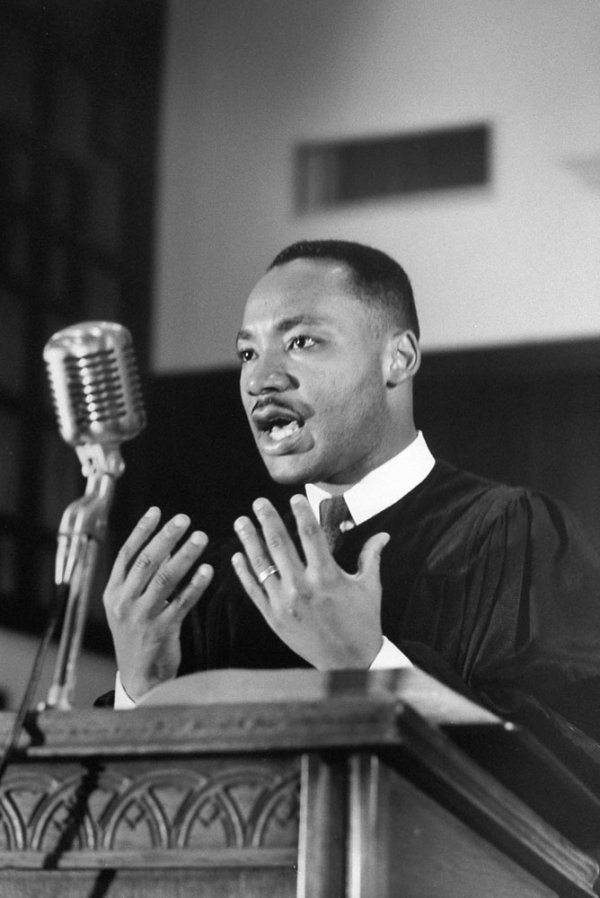
Civil Rights activist Rev. Dr. Martin Luther King Jr. gesturing during sermon at Ebenezer Baptist Church. (Photo by Donald Uhrbrock//Time Life Pictures/Getty Images)
Several centuries before the American Civil War, Jesus stood in the synagogue and read a prophetic passage from the book of Isaiah, in which He declared that He had been anointed to proclaim, among other things, “liberty for the captives.” He wasn’t talking about those who were in physical or institutionalized slavery, but for all of us who are slaves to sin. Unlike the slaves of Galveston, many of us are unaware of our captivity. But like them, we have been declared Free. What good news! Yet, we continue living in ignorance, both of our slavery, and of our potential freedom.
How many of us, even those of us who claim the Salvation of Christ, continue to live as though we are slaves? How many of those around us live as slaves without knowing they can be free? Today is a great day to proclaim the Good News– Jesus Saves! We can walk in Freedom and Newness of Life! Hallelujah! Carry the Good News to those who have not heard. Proclaim Freedom to the captives, and Liberty for those who are oppressed.
Juneteenth is a time of celebration and exhilaration– for those who understand the gift of freedom. God offers us freedom–not from the trials or work of ordinary life– but freedom TO LIVE–abundantly, eternally, and fruitfully! In Christ, life has purpose, promise, hope, and joy. Death and sin and shame have been defeated– the war is over! Freedom is ours!
8 In the sixth year, in the sixth month on the fifth day, while I was sitting in my house and the elders of Judah were sitting before me, the hand of the Sovereign Lord came on me there. 2 I looked, and I saw a figure like that of a man. From what appeared to be his waist down he was like fire, and from there up his appearance was as bright as glowing metal. 3 He stretched out what looked like a hand and took me by the hair of my head. The Spirit lifted me up between earth and heaven and in visions of God he took me to Jerusalem, to the entrance of the north gate of the inner court, where the idol that provokes to jealousy stood. 4 And there before me was the glory of the God of Israel, as in the vision I had seen in the plain. 5 Then he said to me, “Son of man, look toward the north.” So I looked, and in the entrance north of the gate of the altar I saw this idol of jealousy. 6 And he said to me, “Son of man, do you see what they are doing—the utterly detestable things the Israelites are doing here, things that will drive me far from my sanctuary? But you will see things that are even more detestable.” 7 Then he brought me to the entrance to the court. I looked, and I saw a hole in the wall. 8 He said to me, “Son of man, now dig into the wall.” So I dug into the wall and saw a doorway there.9 And he said to me, “Go in and see the wicked and detestable things they are doing here.” 10 So I went in and looked, and I saw portrayed all over the walls all kinds of crawling things and unclean animals and all the idols of Israel. 11 In front of them stood seventy elders of Israel, and Jaazaniah son of Shaphan was standing among them. Each had a censer in his hand, and a fragrant cloud of incense was rising. 12 He said to me, “Son of man, have you seen what the elders of Israel are doing in the darkness, each at the shrine of his own idol? They say, ‘The Lord does not see us; the Lord has forsaken the land.’” 13 Again, he said, “You will see them doing things that are even more detestable.” 14 Then he brought me to the entrance of the north gate of the house of the Lord, and I saw women sitting there, mourning the god Tammuz. 15 He said to me, “Do you see this, son of man? You will see things that are even more detestable than this.” 16 He then brought me into the inner court of the house of the Lord, and there at the entrance to the temple, between the portico and the altar, were about twenty-five men. With their backs toward the temple of the Lord and their faces toward the east, they were bowing down to the sun in the east. 17 He said to me, “Have you seen this, son of man? Is it a trivial matter for the people of Judah to do the detestable things they are doing here? Must they also fill the land with violence and continually arouse my anger? Look at them putting the branch to their nose! 18 Therefore I will deal with them in anger; I will not look on them with pity or spare them. Although they shout in my ears, I will not listen to them.”
Ezekiel 8 (NIV) via biblegateway.com
We make a big fuss in our culture about privacy. What I do in my own home, with my own life, in my own time, is private. And, for many of us, our privacy is sacred. We rage and fight and panic about who may be invading our privacy– listening in or watching us when we least expect it.
I must admit, I don’t like the idea of anyone spying on me or listening in on my private moments. I especially don’t like the thought of someone manipulating or using my private words, images, or ideas without my knowledge or consent.
But there is a danger in our quest for privacy– we are inclined to believe that anything we do in private CANNOT ever be discovered; that we are safe to do whatever we please, regardless of the consequences. The internet has made this idea even more dangerous–we can be private and anonymous behind the screen. We can say things we know we shouldn’t; we can view things we would be ashamed to acknowledge watching; we can explore fantasies, mask our inadequacies, pretend to be who and what we are not; all behind the “safety” of the screen.
And this is nothing new. In Ezekiel’s day, the moral, legal, political, and religious leaders of the day thought they were “safe” to indulge in idol worship behind closed doors. But more than that, they believed that God would never see as they practiced divination, witchcraft, ritual prostitution, violent orgies, even child sacrifice! They had built hidden rooms where they practiced vile rites and indulged in the very behaviors they taught others to avoid. Worse, they condemned and vilified others when they “got caught” doing the same things they practiced with impunity. And when prophets came to them with warnings–the very words of God– they had them ruined, imprisoned, tortured, and killed.
In the eighth chapter of Ezekiel, God shows his prophet a vision. He allows Ezekiel to “go behind closed doors” and see the priests and leaders at their worst–over and over again–secret rituals, detestable practices, flagrant disobedience, arrogant rebellion…And all of this was happening as the nations of Israel and Judah had collapsed, and many thousands had died from war, disease, and starvation. People had been sent into exile– defeated, starving, enslaved. Yet their leaders were keeping up an image of righteousness and proud endurance, instead of turning to God for help and hope.
God was very clear–Jerusalem WOULD be captured and destroyed. Babylon WOULD take God’s people captive and send most of them to the sword or to exile. Defiance and pride– especially relying on the great victories of the past– would not save them. Rebellion and violence would not hold back God’s judgment.
The same is true today. It is easy to write about praying and walking closely with God–I’m hidden behind a screen. I can sound righteous and Godly for a few minutes three times a week. And it is easy to point fingers and call out the bad behavior of others behind the anonymity of a computer screen. We need to speak up, speak out, and defend the cause of those who are oppressed, abused, enslaved, and silenced. But we also need to beware that we are not crying, “Shame on you!” from a locked closet, while waving banners or buying merchandise supporting the abusers.
And God sees all of it. What we may find shocking and reprehensible, God has already seen through to its conclusion! God WILL bring judgment and punishment for those who shed blood and bring violence and injustice. But God also sees what I do in the watches of the night; when I’m alone with my thoughts; when I’m not on my guard against what I view on Facebook or YouTube. God knows what celebrity gossip I crave, or what I’m “watching” on eBay. He knows if I am ignoring or justifying evil happening all around me. He watches over my shoulder when I’m reading that new novel, or I’m driving down the road (hopefully not at the same time!), or when I’m wallowing in self-pity or jealousy or anger.
When I read about Ezekiel weeping over the behavior of Israel’s leaders, I am convicted. How often do I weep and seek God’s mercy over the behavior of our leaders–all of them, and not just the ones I voted for? Or do I just fume and post about how awful “they” are (whoever “they” my be) and how “they” need to be punished? How often do I ignore my own bad behavior? I may not have a “hidden room” filled with detestable images and idols, but God is still watching how I react to challenging times. He knows if I am obeying His voice or merely pretending to follow Him while leaning on my own understanding or my own image of self-righteousness. He knows if I have made money, politics, status, safety, health, or even “religion” into idols, hoping that one or more of them will carry me through tough times. He knows if I am condemning others for their bad behavior, while hiding or justifying my own.
I want everyone to see me when I am noble and righteous–but I need to see myself as He sees me every day–His much-loved, and ever-needy, child.
Father, may I be quick to remember that You ALWAYS see me– and that You ALWAYS want me to see You as well. Help me to see You in the middle of challenging times. Help me to see You when I interact with others. Help me to obey You in the private moments when no one else is watching.
This coming Monday we will be celebrating Memorial Day in the U.S. It is a day to remember those who gave their lives in battle, defending our nation, our people, and our way of life over the course of almost 250 years. We decorate the graves of fallen soldiers with flowers and flags and plaques honoring their sacrifices. It is a strange sort of “holiday.” We don’t like to think of wars and battles– we ache for those who are terrorized by wars in the current days. We don’t celebrate war and violence– our highest goal is to achieve and preserve peace and safety. And it can seem somewhat morbid to “celebrate” the fallen soldiers of bygone days.
But we are not celebrating their deaths. We are celebrating the causes for which they fought and died. We celebrate freedom, and justice; the rights of individuals to pursue liberty and fulfill their dreams. These are causes worth fighting for, and yes, even dying for. We mourn the loss of life, and we grieve the necessity of fighting and struggling to preserve basic rights. But we are grateful for and humbled by the examples of those who have shown the courage and strength to give their all. We honor these sacrifices when we decorate the graves of fallen soldiers, or hold services and memorials at cemeteries. It is not meant to be a time of joyful celebration, but a time of solemn reflection and humble gratitude.
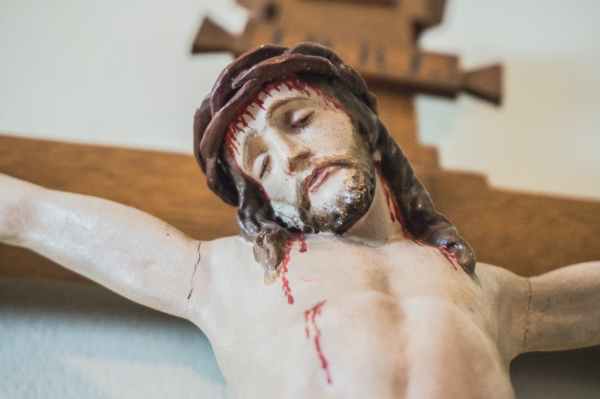
But Memorial Day can also be a time of reflecting on an empty grave– that of Jesus Christ, who gave His all for a cause even greater than liberty and justice in a particular nation or time or for a particular group of people. Jesus gave His life to reconcile an unholy human race with a Holy and Righteous God. He fought against Sin and Death, and conquered them both. And we cannot decorate a grave to honor His sacrifice, because, unlike all the soldiers we honor next week, Jesus did not just preserve a cause or a way of life– He became Life for us. His grave is empty as a symbol of Death’s defeat!
It was Jesus Himself who said, “Greater love has no one than this, that one lay down his life for his friends.” (John 15:13 NASB) Soldiers who lay down their lives often do so to save the lives of their comrades at arms– their friends and fellow warriors– as well as their countrymen and women, their neighbors, and their families. And it isn’t just soldiers who give their lives. Recent news stories tell of teachers, police officers, and other individuals who have sacrificed their lives for the sake of innocent shoppers, students, and neighbors. Such sacrifices are tragic, but they are also heroic, and deserving of our acknowledgement.
We take time to honor those who died for a cause. How much more should we honor the One who died to bring eternal freedom and life to each one of us! And how much more should we be willing to give our lives for the sake His Kingdom! There is no greater love that we can show.
Yesterday at church we were challenged to share our testimony. I have shared my testimony several times, but I haven’t shared it in this space in a long while (if ever), so here goes:
When I was about 4 1/2 years old, I became a big sister. I was excited about this, but after my younger sister arrived, I had a terrible time with jealousy and resentment. She was tiny and adorable, and she had my Dad’s blue eyes (they later changed to a greenish/hazel color like mine, but everyone commented on her eyes, and never on mine). One day, filled with this resentment, I made a rather impulsive decision to poke my sister in the eye with a sharp stick. At that age, I wasn’t completely aware of the danger and damage I would have done, but I still knew it was wrong. I didn’t succeed– my mother caught me in time and got a stern talking-to about what had almost happened. Not wanting to face punishment and Mom’s anger, I burst into tears and said I was sorry. Surely a show of remorse would make everything all right. That’s how it worked on television, and it had worked for me that way in the past.
But this time was different. Mom was frightened by what might have happened, and unimpressed with my tears. She explained quite clearly that what I had attempted could have ended in disaster, and that no amount of “sorry” would have undone my action. I had to face punishment (probably less severe than I deserved, but it felt awful at the time). She also explained that she was both frightened of and disappointed in my action. She would tell my father, who would also be ashamed of my behavior. Now I was truly frightened. What if Mom and Dad never got over their disappointment? What if they stopped loving me? Not only that, but Jesus had seen everything: He knew what I had been about to do and WHY! I had learned about Jesus in Sunday School. He was kind and gentle and loved all the little children. What if He stopped loving me after He saw what I did? What if I had succeeded in hurting my sister and it could never be made right? What if I said I was sorry, and no one believed me? Even Jesus?
I can still remember the feelings of terror and shame– that kind and gentle and Holy Jesus might be disgusted with me; that my resentment and anger had separated me from Him, and that I could not “undo” it or “sorry” my way out of it. Certainly, I was coming to realize that He had (through my mom) stopped me from completing my evil plan –WHEW!– but He KNEW that I would have done it. And I wouldn’t have been sorry for my jealousy, or for my sister’s pain in that moment. Not really sorry. I recognized in that moment that I wasn’t a nice person or a good or righteous person. If Jesus loved me, I didn’t deserve it.
Mom must have seen the change in me, because she stopped and took the time to walk me through the lessons I was still learning in Sunday School. We are all sinners, and unworthy of the love and blessing of a Holy God. Yet Jesus came and offered to love us– to love us SO much that He was willing to die to remove the sting and shame of Sin and its consequences. And Jesus’ love is SO powerful that it can take a rotten, sinful heart and cleanse it completely. Mom and Dad could love and forgive me. But it would involve more than just saying, “I’m sorry.” I had to mean it. I had to choose to let Jesus take control of my resentment, and my wrong thinking, and ask Him for forgiveness. In fact, only Jesus can offer complete and everlasting forgiveness! I am not a righteous person; others can see that I am not a righteous person– yet Jesus can see me, not as I have been, but as I can be– perfected through Him! I asked Jesus to do just that– to come into my heart; to live in and through me; to renew me and change my mind and heart to be more like His.
Jesus Loves ME– this I KNOW For the Bible tells me so. Little ones to Him belong. They are weak, but He is strong!
I had sung this song many times, but now it made sense to me in an entirely new way. That was over 50 years ago, and I must admit that I have had moments of failure and embarrassment; times when I have chosen my own will and emotions over what I know to be right. I have had moments of doubting whether Jesus could still love me after things I’ve said and done. But time after time, I come back to that simple truth that Jesus, for reasons I cannot explain or fully understand, Loves Me– He Really Loves Me! His offer of forgiveness isn’t phony or conditional or limited. Not because I deserve unconditional love or a thousand “second chances.” Simply because HE LOVES ME!
And He Loves You, too! Right now, right where you are, just as you are– He Loves You! Whether you’ve never known that, or been sure of that, or whether you’ve had moments of doubt because of something you’ve said or done (or left undone or said)–Jesus Loves You! And He wants to give you a New heart and a New Life– one that is free of lingering shame and fear; one that is eternal and filled with joy and peace!
Yesterday was Easter (in parts of the world)–the celebration of Christ’s resurrection and victory over Sin and Death. We have much to celebrate. But we also have a mission. We have the assurance of eternity in Heaven, but in THIS world, Jesus warned us, “you will have trouble.” (John 16:33). We will be misunderstood, mocked, and persecuted. We will have to face the temporary consequences of living in a fallen world– anger, greed, abuse, violence, betrayal–even bad weather and natural disasters!
In giving the Beatitudes, Jesus turned common expectations upside-down. Blessed are the poor in spirit; blessed are the meek; blessed are those who are persecuted for righteousness’ sake… We don’t consider poverty, powerlessness, suffering and persecution blessings to be desired. Yet Jesus, the One we follow, gladly endured all of these for our sake! Notice that the “blessing” is the same here as in the first of the Beatitudes– “for theirs is the kingdom of heaven.” The Kingdom of Heaven is not reserved for those who are victorious in their own power or through force of will or extraordinary effort. But it is reserved for those who persevere in the face of evil–those who lean, and those who rest, and those who stand IN THE POWER of God.
Notice, too, that we are blessed if we are persecuted “for righteousness’ sake.” There is no blessing for suffering due to our own stubbornness or foolishness. There is no blessing for those who are persecuted for their own pride and judgmental nature and unforgiveness toward themselves or others. (see 1 Peter 3) https://www.biblegateway.com/passage/?search=1+Peter+3%3A8-17&version=CEV
We live in a culture that celebrates “victimhood.” Those who suffer injustice– even perceived of implied injustice–are considered to have a special status. Those who claim to have been offended or hurt by individuals or groups often demand recognition for their “bravery” or retribution for their suffering. This happens even among certain Christians, who claim to be “persecuted,” when they are merely suffering the consequences of their own hubris and self-righteous posturing. This is a monstrous injustice to fellow Christians who are truly suffering persecution “for righteousness’ sake.”
My prayer today is that I will emulate the example of Christ– that I will serve, humbly, willingly, sacrificially, enduring any persecution that comes as a result, and lifting up fellow Christians who are suffering, as well as their persecutors! For righteousness’ sake– for the sake of the Kingdom of Heaven.