
Green Eggs and Prayer?

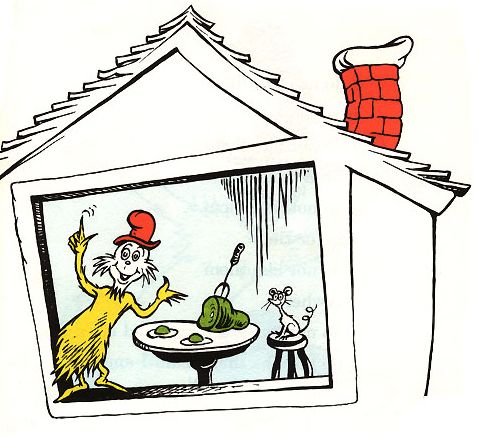
Have you ever read the Dr. Seuss classic, “Green Eggs and Ham”? In this early childhood reader, the narrator (nameless) is accosted by an enthusiastic character named Sam (Sam I Am), who wants him to try a dish called green eggs and ham. But the narrator refuses. Sam keeps offering, but the narrator continues to refuse, saying he does not like green eggs and ham, and will not try them under a variety of circumstances (in a box, with a fox, on a train, in the rain, etc..) offered by the optimistic Sam.

Finally, Sam’s persistence wears down the narrator’s resistance, and he agrees to try the dish. To his surprise, he LOVES them. In his newfound enthusiasm, he declares he WILL eat them in a box, with a fox, in a tree, in a boat, with a goat, on a train, in the rain, here or there…in fact, he WILL eat them anywhere! He ends by thanking Sam.
So what does a children’s book have to do with prayer?

Well, I believe that the pursuit of prayer as an integral part of living a Christ-like lifestyle is kind of like green eggs and ham. Most people who dismiss the power of prayer have never really pursued it. They have seen it, heard about it– maybe even gotten a whiff of it. They may have “sampled” prayer many years ago as a child or in a single moment of desperation. And the result was disappointment or confusion. Prayer didn’t solve all their problems in an instant. They didn’t get the miracle they hoped for. They didn’t get the bike for Christmas. Their neighbor’s leukemia wasn’t cured. Their situation at work got even worse. Their wife still left and filed for divorce. “Prayer” left a bad taste in their mouth. And they have heard others dismiss prayer and faith as obsolete, ignorant practices, designed for backward and unenlightened people. Like the slightly nauseating color of green eggs and ham, prayer has been deemed unappetizing and best avoided.

And now, when someone mentions a lifestyle of prayer– when someone talks about praying as a daily habit, or a natural part of their worship–the reaction is scorn and suspicion. Prayer doesn’t look powerful. It doesn’t look appetizing. How can something so simple and tame have any effect? Why is the world still suffering so much injustice and evil if there are people out there praying every day? And why do Christians (and others with a prayer tradition) cling to prayer as though it will solve life’s problems?

But prayer, like eggs, can have a bad reputation. For years, we were told that eggs were awful for you– high in protein, yes, but also high in cholesterol, and likely to contribute to diabetes and colon cancer. Recent studies contradict each other, but many now say that eggs are actually good for you. Similarly, during times of crises or disasters, prayer is often derided as inactive and ineffective, and we get mixed messages about people who offer to pray for victims and their families.

Recently, I was challenged about my pursuit of prayer. What good does my prayer do in the face of injustice and disease, death and suffering that people experience? Why do I pray to a God that allows bad things to happen? I have been challenged before, and my answer remains the same. I pray because I have known the peace that comes from trusting God’s wisdom, HIS timing, and His Love for each of us. I don’t have answers for all the “what-ifs” or the “whys.” But I continue to trust that God DOES! And daily prayer is not about “me,” or my questions or what I wish for. It’s about communing with the God who has been faithful all my life and continues to be faithful in every season. The God I love, and the God who knows the end from the beginning.

So what if more of us prayed daily– not just as a reaction to disasters– but pro-actively? What if we prayed, not in anger or bitterness, not transactionally, expecting a particular outcome, but with gratitude for who God is, what He has already done, and what He will choose to do in His loving sovereignty? What if we prayed with open minds and hearts, trusting that we are talking to a God who loves us and knows what is best, not just in the temporary, but in the eternal scope of our lives? We would still see evil in this fallen world, but what if our prayers DO make a difference– we just don’t see the whole scope of what God has provided, or the evil He has NOT allowed to touch us?

I speak as one who has pursued prayer for more than half a century. I’m not perfect. Sometimes, I get frustrated when my desires don’t align with God’s answers. But that’s not the fault of Prayer. Prayer DOES change things– maybe not instantly, and maybe not in the ways I imagine in the short term– but I have seen and experienced the power of prayer. I have felt it in my own life, and I have seen in in studying history and talking to people whose lives were radically transformed by their prayers and the prayers of others.

Philippians 4: 6 says: “Do not be anxious about anything, but in every situation, by prayer and petition, with thanksgiving, present your requests to God.” After this, Paul promises in verses 7 and 8 “And the peace of God, which surpasses all understanding, will guard your hearts and minds through Christ Jesus. Finally, brethren, whatever things are true, whatever things are noble, whatever things are just, whatever things are pure, whatever things are lovely, whatever things are of good report, if there is any virtue and if there is anything praiseworthy—meditate on these things.” (taken from the King James Bible online).

In every situation, we can pray. So, to paraphrase Sam I Am, I WILL pray here and there! I will pray most anywhere (except I won’t close my eyes if I am driving!) So to end:
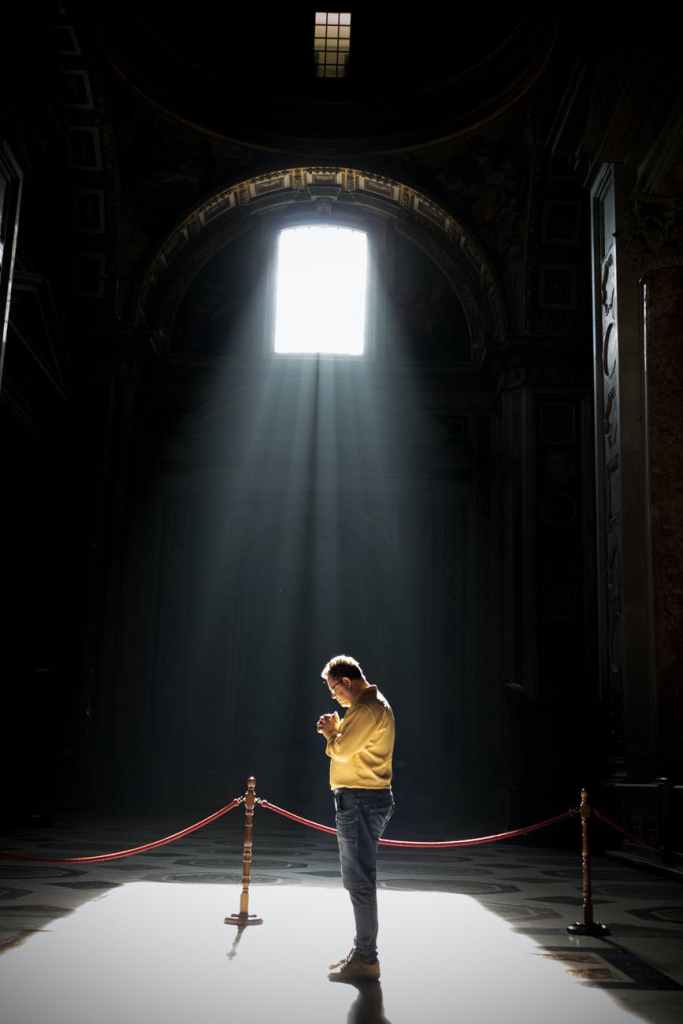
“I’ll be praying in a boat,
I could be praying with a goat.
I may be praying in the rain.
Or in the dark. Or on a train.

And in a car (eyes open of course). And in a tree.
Because Prayer, it is so good, you see!


So I would still pray in a box.
And I would still pray with a fox.
I will pray inside my house.
And I will pray beside a mouse.

And I will write “Pursuing Prayer”
Because I serve a Lord who Cares!

What if we all had the same enthusiasm for prayer as Sam had about Green Eggs and Ham? What if we keep praying “without ceasing” (1 Thessalonians 5:17) and with confidence (1 John 5:14-15) each day?

“Try it! Try it!”

You’ll be so glad you did.

Prayers That God Will Not Hear

We like to point out scripture that assures us that God will hear (and answer) our prayers. We like to remember God’s promises of blessing and peace and grace. And we tend to ignore or forget that there are some prayers that God has said He will not hear or answer.

God will not answer prayers that are selfish, or hypocritical. He will not answer prayers offered in pride, self-righteousness, or unbelief (see Luke 18:9-14, and Hebrews 11:6). He will not listen to prayers offered by those who oppress the poor, those who worship idols, or those who practice violence. And He will not listen to the prayers of those who reject Him, and remain in sin. https://www.gty.org/library/questions/QA160/does-god-answer-the-prayers-of-unbelievers (Please note: I don’t totally agree with the general conclusion here, but there are several great references for the individual points..)

Please note that God does not say that He will not answer prayer based on WHO a person is–God does not refuse to answer prayers based on a person’s age, nationality, gender, physical health, mental health, height, weight, social status, or any other label, including their past religious affiliation! This means that a sincere prayer of a person who is seeking God may be heard ahead of (or instead of) a prideful prayer of someone who claims to be a Christ-follower.

God is sovereign and omniscient– He knows what is in each heart, and He answers, not according to who we are, but according to who HE is. And just as He can separate our sins “as far as the east is from the west” (Psalm 103:12), and “remember (our) sins no more”(Hebrews 8:12), He can choose not to hear prayers that are offered with wrong motives or offered in defiance of His sovereignty and holiness.

None of this takes away from the fact that God DOES hear and answer prayer…God LOVES to hear from anyone and everyone who seeks His face. Nothing external can separate you from His love. Come with your anger, questions, sorrows, pains, gratitude, hope; bring your failures, your fears, and your triumphs. But God, like a wise father, doesn’t suffer fools and fakers. Even if you can fool your neighbors, friends, family, or yourself, you cannot fool God. He doesn’t want a false narrative– He wants you as you really are. He wants you to acknowledge who He REALLY is. And He will listen with an everlasting love and compassion to all such prayers!

The Chimp and the Typewriter

I’m really not sure at all how this post relates to prayer, but it is a subject that’s been stewing in my brain for awhile, so I thought I would “write out” my thoughts.

I have long been disgusted with a certain argument used by those who discount Creation (by a supreme God with intelligent design and purpose as put forth in Scripture). Their claim of a universe that is the result of a series of random accidents is compared to a chimpanzee with a typewriter. Supposedly, given enough time, there is a possibility that the chimp could “randomly” type a masterpiece– a Shakespearean play or the text of the New Testament.. It is a very tiny probability, but, the argument goes, enough of a probability to suggest that the universe came about in a similarly unexpectedly random way. The proponents of this argument always seem to leave their chimp typing away, convinced that their argument is unassailable– that they can drop the mic, walk off stage to the thunderous applause of their peers, and sit smugly back while creationists pick up their jaw from the floor and stammer in defeat. (To further explore how this analogy works, see https://www.npr.org/sections/13.7/2013/12/10/249726951/the-infinite-monkey-theorem-comes-to-life)

I’m flabbergasted that this argument still gets any credence. It is laughable in its illogical assumptions and disregard for the complexity and wonder of Creation. AND it refutes its own basic assumption– that of randomness. Let me break it down:

Photo by lil artsy on Pexels.com
  • First their example is NOT random at all. And, once true randomness is introduced, the idiocy of the argument is obvious. What if we replace the chimpanzee with any other random animal? A hedgehog. A butterfly. A hippopotamus. A fish. What is the probability of any of THEM typing a masterpiece? None. The theory hangs on the mathematical principle of probability theory, but probability rests, not on random unknowns, but on specific factors and specified outcomes, i.e. an agent (such as a chimpanzee) with the ability to use a specific type of tool (such as a keyboard) to produce a certain outcome (such as a specific phrase or work of literature).
  • The same thing applies if we replace the typewriter. Oh, modern arguments have replaced the typewriter with a computer keyboard– in fact computer models have even been tasked with trying to figure up the most likely probability percentage of this “random” event. But what if we take away the keyboard filled with letters, and give the chimp a crayon of a ball point pen. What chance then of the simian “creating” a work of fiction or a sacred book? As soon as it becomes apparent that the “probability” of such random factors producing a specific outcome is not just tiny, but non-existent, the analogy becomes ludicrous.
  • Finally, we don’t have random literature. Generally, we have “Hamlet.” But barring that, we have “random” works by Shakespeare, or Milton, or the King James Bible. The chimpanzee doesn’t have an Arabic keyboard. It never seems to type out classic works in Chinese literature (though it “could” in theory, I suppose). What we have is a very specific example of a single creative act that “might” statistically be “produced” (see the discussion on this below) given an infinite amount of time. And it is a visual image that our brains are tricked into thinking of as a “possible” outcome of random chance.
  • But it is not just the absence of true randomness, but the absence of reality that distresses me. The proponents of this argument not only want us to assume that the chimpanzee CAN type out a masterpiece, but that it WILL type out a masterpiece. On what theoretical plane is it logical to assume that the average (or even above-average) chimpanzee will spend any length of time pounding away at a keyboard to produce literature? To what purpose? Why should it? Or that the typewriter will never “jam” or run out of ribbon; or that a word processor will never experience a “glitch” or lose power, or have enough memory to store all the “failed” attempts. Will “auto correct” kick in? At what point does reality suggest that this “random” event is not only not probable, but not logical? As one wit suggested, “A million chimps at a million typewriters will never write Hamlet, but they will break the typewriters and fling their poop.”(I found this on the internet– I have no attribution for the “quote” as it was simply included with an image of a chimp at the typewriter.)
  • And how long will this take? You can’t realistically have a single, immortal chimpanzee in this scenario. You need infinite generations of chimps (supplied with typewriters) with nothing better to do than prove an illogical “random” theory. How many humans will it take to “witness” this process? How do they determine that the outcome has been reached successfully? And they all–chimps, machinery, witnesses– have to work toward this single goal; NOT of their own free will (and not “randomly”), but enslaved to a very human need to suggest what can only be theorized.
  • This brings me to another failing of the argument. One of the reasons we still use the word “theory” when speaking of Evolution or the “Big Bang” is that they can be theorized, but never demonstrated. No one can demonstrate how a universe can be formed out of nothing, because the universe and all its materials are already here. The most one could ever do is “re-create” or “simulate” what happened “In the beginning.” Similarly, the theoretical chimpanzee (or aardvark, or whatever) will never “create” Hamlet or the book of Matthew, or Paradise Lost. At most, it might create a reproduction–by “accident” rather than earnest intent–of an already existing masterpiece. This is not Creation. It is not even imitation, in the way that “West Side Story” re-creates “Romeo and Juliet” or a new translation of St. Matthew “modernizes” the King James Version of the same gospel. If a chimpanzee successfully photocopies a page of Shakespeare, we would never suggest that it was a literary “creation.”
  • And this brings me to my last baffling observation– that the Creation of the Universe would be compared to the creation of a single artistic product, and that Art and Literature would be dismissed as mere random “occurrences,” the likes of which any monkey could produce.
Photo by Pixabay on Pexels.com

The Apostle Paul warned of this kind of futile thinking in his letter to the Romans:

18 The wrath of God is being revealed from heaven against all the godlessness and wickedness of people, who suppress the truth by their wickedness, 19 since what may be known about God is plain to them, because God has made it plain to them. 20 For since the creation of the world God’s invisible qualities—his eternal power and divine nature—have been clearly seen, being understood from what has been made, so that people are without excuse.21 For although they knew God, they neither glorified him as God nor gave thanks to him, but their thinking became futile and their foolish hearts were darkened. 22 Although they claimed to be wise, they became fools 23 and exchanged the glory of the immortal God for images made to look like a mortal human being and birds and animals and reptiles.24 Therefore God gave them over in the sinful desires of their hearts to sexual impurity for the degrading of their bodies with one another. 25 They exchanged the truth about God for a lie, and worshiped and served created things rather than the Creator—who is forever praised. Amen.

Romans 1:18-25 (NIV)

The world is filled with awesome and majestic reminders of God’s Power, His Character, His Faithfulness, His Wonder, and His Glory. God created the chimpanzee– and the kangaroo, the pineapple, the ostrich, the Milky Way, and YOU! And He created individuals with the creative capacity to invent typewriters, write sonnets, paint murals, and compose sonatas. He is a God of infinite variety, and amazing consistency. Many of those who study the origins of life on Earth– really study it, rather than trying to “figure it out,” have concluded that the factors necessary to “create” and sustain life– and more amazingly, to sustain the life we see around us in its beauty, power, and complexity–require such exquisite precision and timing that the “probability” of life on Earth (and the probability of “Earth” itself) without a supreme and purposeful Creator is beyond human calculation– and even beyond computer calculation!

Photo by Pixabay on Pexels.com

So I guess this does bring me back to prayer– We don’t pray to a theoretical “god,” but the God of Creation, and Wonder, and Majesty! Let’s remember to Praise Him today!

Inconceivable?

One of my favorite movies is “The Princess Bride.” Based on a modern “fractured” fairy tale by William Goldman, it tells the story of a young couple whose “fairy tale” romance is complicated by his death, her kidnapping on the eve of her wedding to an evil prince, and rodents of unusual size…

One of the kidnappers is a Sicilian mercenary named Vizzini. Vizzini brags about his intellect, and claims to know more than anyone. He also claims that his plot to kidnap Princess Buttercup is perfect to the last detail. But when a mysterious stranger begins following them, and foils each of Vizzini’s efforts to shake him, Vizzini grows more and more rattled. His brilliant plan turns out to be less than perfect. In fact, the mysterious stranger (who turns out to be Princess Buttercup’s long-lost true love) succeeds in rescuing the princess and defeating Vizzini in a battle of wits.

As each of Vizzini’s efforts fails, he declares it is “inconceivable” that the stranger should win. Even in the face of clear evidence, Vizzini finds it unbelievable that his plan should have failed–and failed again! Finally, one of the other kidnappers turns to Vizzini and says, “You keep using this word; I do not think it means what you think it means”.

I often hear people scoff at faith in God– “it doesn’t make sense.” “There’s no proof that God exists.” “How can you believe all those old myths–Noah and the Ark; Moses and the Red Sea; David and Goliath–they’re impossible in ‘real life’.” “It’s inconceivable!” “Stop saying all that stuff about God!” “Stop saying you’ll pray for me.” “Prayer is nothing more than wishful thinking.”

Photo by 3Motional Studio on Pexels.com

And it can be difficult to have faith, sometimes. We don’t ‘see’ what God is doing in our lives and circumstances.” We don’t understand the bigger picture. We don’t believe that God sees or hears us in the middle of our struggles. But God tells us time and time again that nothing is impossible for Him; that He knows all that happens, and that He works all things together for the good of those who follow Him (Romans 8:28). God is able to do “exceedingly, abundantly, above all that we ask or think..”(Ephesians 3:20)

Those stories in the Bible; those “unbelievable” stories we hear or read about miraculous healings and lives transformed…we can choose to ignore them, or scoff at them. We can, like Vizzini, claim that they are “inconceivable,” or try to explain them away while trusting our own knowledge and experiences to get us through life. We can ignore the wise counsel of others, ignore our conscience, and laugh in the face of danger. But in the end, we are human. We are fallible. We are not all-knowing or all-powerful. And we are not immune to sin and its poisonous consequences. The only chance of escape is to be rescued by someone who is “immune” to sin– our Savior, Jesus the Lamb of God.

Photo by Pixabay on Pexels.com

It may seem “inconceivable” that God would part the Red Sea, or save Noah in the Ark; it may seem beyond belief that Jesus would be born as a human, live among people who denied Him, die on the cross and be resurrected on the third day, so that He could take away the power of sin and death for anyone who will trust Him. But it is precisely this Good News that has transformed the lives of millions of people throughout the centuries since he came.

Photo by Matheus Bertelli on Pexels.com

It may seem “inconceivable” that God would listen to our “little” prayers and care about our every need– but He does! His Love may be beyond our ability to comprehend or explain– His power extends beyond our wildest imagination. But if we have faith– even as small as a mustard seed (Matthew 17:20)– we can experience God’s Love, Power, Grace, and Salvation in miraculous ways.

Blog at WordPress.com.

Up ↑