It’s fall here in western Michigan, and that means falling leaves…lots of them! In cities and larger towns, there are leaf “pick up” schedules. Trucks come along at appointed times to pick up leaves that have been raked and piled up by the roadside or placed (along with other yard waste, sticks and such) into waste bins. In smaller towns and around the countryside, leaves will be raked, piled up and burned or placed in compost heaps and bins. In a few cases, leaves will be left where they fall or are carried by the wind until the snow covers them, to be rediscovered in the spring when the snow melts off.
Falling leaves are part of the cycle of every year. They announce the advent of autumn, delighting us with their colors for a few short weeks. But when that task is done, they fall beneath our feet to be stepped on, swept up, burned up or forgotten. Gone are the memories of shoots and buds blooming in the spring, or rich green leaves shading us from the intense heat and light of summer. Leaves are ephemeral. They pass out of memory and time, their swirling colors lost in a heap of crunchy detritus underfoot.
People are not leaves. We share the same creator, but God has placed eternity in the minds, hearts, and souls of humankind. Whether we are blooming, changing color, falling, or being swept aside in this world, God will gather us all in a great harvest of souls. But we will not be turned to ash or mulched into compost. We face an eternal destiny; one where our true “colors” will be permanent, and our placement fixed. We will either be raised to vibrant life, attached to the source of life and abundance; or we will be eternally “fallen”, swept away by judgment and guilt and the consequences of rebellion.
That may sound harsh and dramatic, but it is written in our soul–we feel it as we watch the withering leaves let go of the tree or smell the acrid of the burn pile. We feel the pain and injustice of people being treated like no more than dead leaves– swept away as just another inconvenience.
Today, I want to look for fallen leaves–we are all “fallen” from Grace, but some have also “fallen” through the cracks or by the wayside–look for people and seek ways I can pray for, reach out to, and offer Hope and Grace, especially to those whom life has swept aside. Someone did it for me…Now it’s time to pass it forward. It’s time to turn over a new “leaf”. Let’s not “leave” the job unfinished–“branch” out beyond our comfort zone and bring in some leaves this autumn!
Wynken, Blynken, and Nod one night
   Sailed off in a wooden shoe,—
Sailed on a river of crystal light
   Into a sea of dew.
“Where are you going, and what do you wish?”
   The old moon asked the three.
“We have come to fish for the herring-fish
   That live in this beautiful sea;
   Nets of silver and gold have we,"
            Said Wynken,
            Blynken,
            And Nod.

The old moon laughed and sang a song,
   As they rocked in the wooden shoe;
And the wind that sped them all night long
   Ruffled the waves of dew;
The little stars were the herring-fish
   That lived in the beautiful sea.
“Now cast your nets wherever you wish,—
   Never afraid are we!”
   So cried the stars to the fishermen three,
            Wynken,
            Blynken,
            And Nod.

All night long their nets they threw
   To the stars in the twinkling foam,—
Then down from the skies came the wooden shoe,
   Bringing the fishermen home:
‘Twas all so pretty a sail, it seemed
   As if it could not be;
And some folk thought ‘twas a dream they’d dreamed
   Of sailing that beautiful sea;
   But I shall name you the fishermen three:
            Wynken,
            Blynken,
            And Nod.

Wynken and Blynken are two little eyes,
   And Nod is a little head,
And the wooden shoe that sailed the skies
   Is a wee one’s trundle-bed;
So shut your eyes while Mother sings
   Of wonderful sights that be,
And you shall see the beautiful things
   As you rock in the misty sea
   Where the old shoe rocked the fishermen three:—
            Wynken,
            Blynken,
            And Nod.
What does a child’s poem have to do with the Bible and prayer?
I’m not sure there is an exact answer to that..I was wistfully thinking of something to write about, and as I looked for a Bible verse for inspiration, I came upon an odd Proverb (which I’ll get to in a minute) about winking. This set me to thinking about the old child’s poem and song– one of my favorites. I wondered– if the Bible has something to say about winking, does it also address blinking and nodding? And, if so, can we draw a connection between the three and then from all three to prayer?
I think we can… bear with me. Since the poem has to do with sleeping as well, I want to start, (and come back in the end) with this passage from Mark, where Jesus is praying, and the disciples are nodding off.
Mark 14:32-42English Standard Version (ESV)
Jesus Prays in Gethsemane
32 And they went to a place called Gethsemane. And he said to his disciples, “Sit here while I pray.”33 And he took with him Peter and James and John, and began to be greatly distressed and troubled.34 And he said to them, “My soul is very sorrowful, even to death. Remain here and watch.”35 And going a little farther, he fell on the ground and prayed that, if it were possible, the hour might pass from him.36 And he said, “Abba, Father, all things are possible for you. Remove this cup from me. Yet not what I will, but what you will.”37 And he came and found them sleeping, and he said to Peter, “Simon, are you asleep? Could you not watch one hour?38 Watch and pray that you may not enter into temptation. The spirit indeed is willing, but the flesh is weak.”39 And again he went away and prayed, saying the same words.40 And again he came and found them sleeping, for their eyes were very heavy, and they did not know what to answer him.41 And he came the third time and said to them, “Are you still sleeping and taking your rest? It is enough; the hour has come. The Son of Man is betrayed into the hands of sinners.42 Rise, let us be going; see, my betrayer is at hand.”
How often have you prayed early in the morning or late in the evening, only to find yourself nodding off? I’ve certainly done it– more embarrassingly, I’ve seen (or rather heard) it happening in a group setting! It’s not a laughing matter at any time, but in this setting, Jesus is in anguish so powerful he was sweating out blood– he even describes it as being “sorrowful even to death”–yet his disciples failed to stay awake, keep watch, or help him pray.
Hold onto that image for a minute.
When I was first thinking about what to write, I didn’t start with nodding. I found a verse about winking in Proverbs 10:10: “He who winks maliciously causes grief, and a chattering fool comes to ruin.” (NIV) There are other verses throughout scripture that talk about the danger of winking.
Photo by Chandrashekar Hosakere Matt on Pexels.com
Winking isn’t exactly the same as nodding or sleeping, but it involves closing ones eyes (or eye) to evil– giving it a momentary pass. Winking “maliciously” is not only turning a blind eye, but actually colluding with evil– giving it a figurative “nod” of approval. We don’t often think of winking as a sin. Winking is winsome, flirtatious perhaps, but it is passive. How can it hurt to wink? We don’t wink at war, or genocide, or injustice…do we? How often do we excuse what is clearly bad behavior because we don’t want to offend someone else, or come across as “judgmental”? How often do we fall into the false justification that “the ends justify the means”–that a small lie or bad habit can be ignored or overlooked in light of “the greater good” we expect will result from our overall actions?
God calls us to integrity– being honest with ourselves as well as with others. When we wink at so-called small sins, we begin to close our eyes (or at least one eye) to the truth. Sin disguises itself as winsome and flirtatious, but it is not passive– it eats away at truth, life, peace, and joy–it is corrosive, poisonous, and deadly.
1 Corinthians 15:52New English Translation (NET Bible)
52 in a moment, in the blinking of an eye, at the last trumpet. For the trumpet will sound, and the dead will be raised imperishable, and we will be changed.
2 Peter 3:8New English Translation (NET Bible)
8 Now, dear friends, do not let this one thing escape your notice, that a single day is like a thousand years with the Lord and a thousand years are like a single day.
Winking at evil is especially dangerous if we lose sight of the urgency of these last days. There is a tension in the Christian view of the future–on the one hand, we expect the “soon” return of Christ. He will come in the “blink of an eye”; like a “thief in the night” with no warning, and with judgment. On the other hand, he is patient, not wanting any to perish. God is beyond and above Time– he is slow to anger, and slow to judgment–but he is also eternally aware and omnipresent.
We don’t choose to blink– and we do it often throughout the day. In fact, it is good and necessary that we do so. But, because blinking is an automatic function, we don’t think about it–even when we are tired and blinking turns into “nodding off.” If we continue to look about, or try to read, or worse, drive in this condition, we will miss important information, and we risk making mistakes and getting into accidents.
The same can be true as we walk through our days waiting for the return of Christ. Sometimes, instead of resting in Grace and looking to God for help, we get focused on all the distractions around us. In our restlessness we put much of our focus on what will happen in the “blink of an eye” and less focus on the single day or even the thousand years that God has given us to bring in a harvest.
And this leads me to the nodding…Jesus had something to say about this very tension of waiting and anticipating his return. He gave several parables, but I want to focus on just one– the parable of the virgins in Matthew 25.
Jesus pointed out that even if we are invited to have a role in the wedding feast, we need to be prepared. The virgins in the story were not punished for having fallen asleep (as all of them might have been), but the five foolish virgins had no oil when the bridegroom finally came. They didn’t just “nod off” waiting for the groom, they were winking at their own lack of preparation, blinking back their false expectation that what they had in their own lamps would be enough, and nodding off with no concern that they might be left out of the festivities.
In the same way, we can be guilty of winking at our own lack of obedience and commitment, blinking in the flashy distractions of the world around us, and nodding off unprepared for the very event we claim to hope for most. If we were with Jesus in the garden, would we be any more faithful or watchful than the disciples? Are we sending up vague and half-hearted prayers as we get sucked into the distractions around us? Are we so busy pointing fingers at others or excusing our own lack of diligence that we have nothing left to bring to God in earnest prayer? Have we given up on prayer in favor of social media or social action to “let our light shine”? Are we winkin’, blinkin’, and nodding off in our Christian walk?
Instead, Jesus asks us to “watch and pray” during these dark and dangerous times.
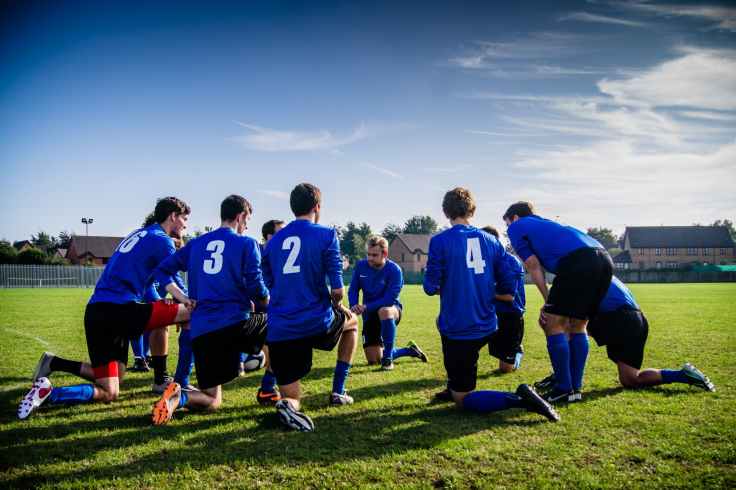
Last Friday, I attended a high school football game in my home town. It was homecoming, complete with floats and balloons, face paint, and screaming fans (myself included).
My hometown team is having a fantastic season so far– their record is 6 and 0, and they are winning by wide margins each week. I’m a little biased, not only since this is my home town, but because I have a nephew and a cousin on the team! They have already qualified for a spot in the playoffs for their division, and they have dreams of becoming state champions.
I hope they make it. I pray that they will play their best; that they will stay safe and healthy, too. I want them to win, and I think they have a good chance. But the season’s not over yet. They still have to play a couple of tough teams in the regular season, and they will face stiff competition in the playoffs.
As good as they have been so far, the teammates and coaches will still drill, train, and learn how to adjust the way they play based on whatever the next game throw at them. Next week’s team may be better at passing, or rushing. Their players may be bigger, or more agile, or more experienced than others. The weather conditions may play a bigger role next week.
All that to say that we all go through seasons– sometimes even “winning” seasons– and each one requires that we prepare, work, train, and persevere until the season is over. Some of us are facing a season of trials and losses–we’re waiting and hoping for the season to end. And it will. But the season’s not over yet. Stay in the game– keep praying, keep training, and keep believing that there will be a new season of hope. Some of us are in a season of victory! That’s great, but the season’s not over yet. Stay focused– keep training and preparing, and learning, knowing that there will come a season of trial. Some of us are watching others in their success–but the season’s not over yet. Stop comparing– reach out and connect. Show respect; show compassion.
This is true in all areas of life– there are seasons in our education, seasons in parenting and relationships, seasons in our careers and service, seasons in politics, economics, and even in our faith walk. And in every season, God is there. Like a proud parent or an ardent fan, He is cheering you on; like a great coach, He gives guidance and instruction; like a cherished teammate, He has your back. In all of this, God roots for all His children– not that some will “win” and others will “lose”, but that all will learn to play their very best and become “victors”.
No matter what kind of season we are in, or where we are in our season, we should remember a few things:
Life is both an individual and a team activity. None of us can “win” on our own, nor can we expect the team to “carry” us to victory without any effort on our part.
We can’t see the end from the beginning (or even the middle). But God can. And we can trust His guidance and His timing, even if we don’t see the whole picture.
God goes not see “winning” and “losing” in the same way the world judges it. What looks like “winning” to us may be superficial and false. What feels like losing may be building a Godly character that will overshadow the temporary struggles of this season.
Seasons come and go, but not everyone experiences them the same way or at the same time. In other words, don’t compare your winning swim season to someone else’s losing soccer season, or your dry summer to someone else’s monsoon season. Instead, focus on your own season and your own growth. Don’t close yourself off to others– you may have an opportunity to give or accept help, advice, training, and encouragement along the way–but don’t let others become more powerful (or less worthy of respect) than they really are.
At the end of the “season”, if we know Jesus Christ, we will share in the ultimate victory. The celebration that occurs over each person who comes to Christ makes any celebration here on earth seem dull and timid–no amount of parade floats, lights, fireworks, screaming fans, balloons, or other excitement can compare to the joy of welcoming a lost soul into the Kingdom of Heaven.
I witnessed a blow-out high school football game last week. The final score was 57 to 0! Once the point differential was over 50, they invoked the “mercy rule.” The game clock would not stop for downs; there would be no more “time out” calls– as this happened late in the game anyway, it just meant that the end came quickly and “mercifully” for the losing team. It also meant that players were less likely to take dangerous risks in the forlorn hope of scoring big points.
High school football has a “mercy rule” so that struggling teams don’t become victims of absolute despair. This team deserved to lose, and they did. They lost big; but they could’ve lost by a wider margin. And they didn’t lose for lack of effort– they pushed hard and gave it a mighty try. But they were not up to the challenge of a better team.
In life, when we come up against Sin, we can give our best effort, and still lose big. Oh, there are certain sins that seem easily “tamed” or “defeated,” but there are others that end up crushing us– maybe it’s an addiction to porn, or a tendency to spread rumors; maybe we harbor bitterness or doubt, or we can’t control angry outbursts.
In the end, we are all losers in the game against Sin– whether the loss seems like a close shave or a blowout, the result is the same. But the consequences are much more dire. The penalty for Sin is Death. Not just a single lost game, but an eternal loss of life and hope and light and love! We are no match for Sin, and Sin shows no mercy. Even with a mercy rule, our situation seems hopeless. But it is not.
Death may seem like a a harsh and undeserved judgment. We “can’t” win. Or, more correctly, we will always lose. Even a “mercy rule,” while it may mean that we don’t get the death we deserve, wouldn’t keep us from being “losers.” This is how many people see God’s offer of salvation– as some sort of mercy rule that keeps us from the fate we can’t avoid. But even if God only offered mercy, it would be infinitely better than we can imagine. Because God’s mercy is not just a “rule”, it is a priceless gift of restoration. We can be free from the “loss” and penalty we deserve, no matter what the “point differential.” Even a close “loss” to sin is wiped out by God’s mercy.
God’s offer of salvation doesn’t just stop at mercy, however. It includes something that will never happen in a football game or anywhere else in life. God extends His Grace– all that we don’t deserve, and never could deserve–above and beyond the already infinite and superior mercy we needed to escape the judgment of Death. We don’t just escape the horrors of death and hell. We are gifted with all we need to win the game– to be co-victors over Death and Sin. God, in His mercy keeps us from losing. In His Grace, He coaches us, plays alongside us, cheers for us, and gives us the power to become all that we need to be to play our best. AND, He has already secured the victory. Far from being in a position where we “can’t” win– God offers us the opportunity to be in a position where we can’t LOSE!
It is my ongoing prayer that if you are reading this, you have already responded to God’s invitation, through Jesus Christ, to be victorious; that God’s spirit would guide me to write what will be helpful in encouraging you and strengthening your faith (as well as my own). I pray that you will grow in faith and make the pursuit of prayer part of your daily walk in Faith. If that is not the case, and you have not accepted both God’s mercy and His grace, I pray that you will take that opportunity today.
Don’t wait for a “mercy rule”– accept the mercy of the Ruler!
My husband and I own a small retail business. Last winter, we were victimized by shoplifters. They stole several items, worth over $1,000. The same couple stole items from other businesses in the area. The police investigated, compared descriptions of the suspects, traced their movements, and got an arrest warrant. The couple fled, and it took months to find them and bring them into custody. They have been arrested, and we have been to court for a preliminary hearing, with another potential court date in about a month.
The court sent us a long series of papers to fill out, including a victim impact statement, where we were to describe how the suspect’s alleged actions impacted us personally, as well as how our business was damaged. Even though this was not a personal crime (we weren’t physically threatened or harmed, or specifically targeted with an intent to ruin our business), there are still scars–distrust, fear, frustration, and loss, to name a few. Just because a crime isn’t personal, doesn’t mean that no one suffers. It has been an awkward process to write out the victim statement, and to appear in court and recount all that happened that day, but it has also been a good process.
Being a victim is not a pleasant experience. It is frightening, humiliating, maddening, and bewildering. “How could this have happened?” “Why did it happen to me/us?” “What did I/we do wrong?” These are honest questions that go unanswered. But the biggest question may be “Where was God when this happened?” Didn’t he know? Didn’t he care? Why didn’t he act to stop this crime? Why did he allow it to touch us?
In the months since this happened, I’ve learned to ask some other questions of God–
What other “bad” things have you kept from us without our knowledge? What good things have you showered on us that we took for granted?
Who else has suffered the same or worse things– how can I reach out with empathy or understanding?
Where are people suffering without justice? Even though we have had a long wait, we know that the police and court system have been working for us. Where are people living who suffer without hope, in silence, and in fear of seeking help?
What can we learn from this experience? How can we make our store and our community “safer”? How can we heal, and bring justice instead of wallowing in hurt or seeking revenge?
God has a plan, even in times of trial and questioning. We all will be victims at some point in our life–of injustice, of crime, of disease, of poverty, of losses, of disaster, and of sin’s consequences– our own sins and the sins of others. We can also be victors, through the power of the Holy Spirit. We can overcome bitterness and addiction; we can triumph through cancer, depression, or heartbreak; we can rise above setbacks and circumstances; we can choose forgiveness and healing over hatred and self-sabotage. We can move from being perpetual victims to eternal victors, through Jesus Christ our Lord!
I got to spend the day with my granddaughter earlier this week. She’s three, and has all the energy of a firecracker, and the curiosity of a kitten. She is learning to discern what things and which people are trustworthy (or not). Having worked with children from infants to teens over the years, I have seen this progression in others– sometimes with good results, and sometimes ending in disaster.
We hear about “childlike” faith–Jesus spoke of it; even praised it. Yet we see examples of people whose simple faith puts them in danger from predators, bullies, scam artists, and other perils. Is this really what Christ wants from us? No! Jesus didn’t commend foolishness; he told dozens of parables warning of foolishness and simple-mindedness. The Apostle Paul also talks of “babies” in the faith needing to grow wiser and stronger. There is a difference between having the faith of a child, and having the brain of a child. Jesus doesn’t want us to be ignorant, gullible, or bratty, but He loved the willingness of children to ask questions, seek out answers, and listen with open minds and hearts.
Most people become cynical over the years– some far earlier than others. They trust no one and nothing but themselves, thinking they know best, or frightened to find out what they don’t know. In many ways, they are as vulnerable (or even more so) as those who trust everyone.
My granddaughter is still at the stage where she trusts her parents and grandparents to watch out for her, give her good advice, and answer all her many questions. As she learns new skills, she often “consults” with us; asking our approval, wanting our input–as she meets new people, she will also take many of her cues from us. Should she be polite, informal, respectful, quiet, reserved, loud, assertive? She is still learning, but she still trusts us more than, say, her brothers or peers. There will come a time when she will develop the habit of either following the examples we have set for manners, traditions, habits, and such, or looking to other models.
Watching her, I was reminded of two very important questions I need to ask myself?
What does she see and hear from me? Am I trustworthy in the way I talk to (and about!) others? About her? Am I giving her solid advice and good examples that will help her develop good habits and relationships? Am I “present”– not being distracted or half-hearted in responding to her needs? Am I teaching her wisdom about the dangers she must face in this world? Or do I pretend they don’t exist or won’t touch her?
Who am I trusting? The obvious “right” answer is Jesus Christ, but is that the reality? Do I lean on my own understanding, or consult with “experts” without asking for God’s wisdom or seeking His approval? Am I seeking to learn from Him how to navigate the dangers of this world, or pretending they won’t touch me?
Having childlike faith is not the same as having a childish faith; it’s not the same as being foolish or ignoring facts. Smart children ask questions– lots of them! But they listen to the answers. Foolish children (and foolish adults) claim to know all the answers, and refuse to listen to advice.
I’m getting a double whammy this week–two Bible study groups; one studying Daniel and the other Job. Some of you will groan just reading the first sentence. Along with the book of Revelations, these are two of the most difficult and misunderstood books in the Bible. And for good reason. The book of Daniel doesn’t just contain the favorite stories of Daniel in the Lions’ Den and Shadrach, Meshach, and Abednego, it also contains prophetic visions that seem to foreshadow two distinct sets of events– one set that happened in the time between Daniel’s life and the birth of Christ, and another set of events yet to come.
The book of Job is puzzling– there are no good clues as to when it took place, or exactly where, or even if it is real or a parable. There is a curious interchange between God and Satan that is unlike any other passage in scripture. Finally, it is filled with difficult dialogues from Job and his friends, as they try to make sense of his suffering as God stays silent. When God finally speaks, He doesn’t directly answer Job’s questions or his friends’ misleading statements.
What happens when I don’t understand what God is doing (or seemingly NOT doing) in my life or the lives of others? What happens when the world doesn’t make sense, and the Bible doesn’t seem to shed any light? What happens when I pray, but God seems silent?
I think the answer has a lot to do with where I am in my relationship with Christ:
I can panic, lose faith, or become angry and insolent. If I don’t know God or don’t trust him; if I doubt his goodness or wisdom or power, I may run from his word and his presence.
I can lean on my own understanding. I can substitute my own limited wisdom for God’s, and try to “explain away” all the things I don’t quite understand. I may ignore the Bible passages I don’t understand, in favor of doubling down on the ones I think I know. I can insist on my own interpretations of difficult or disturbing passages, even if someone points out inconsistencies in my logic, or context clues that disagree with my view.
I can lean on someone else’s understanding, listening to their views without question or without reading and praying through it myself. If someone else has an answer, shouldn’t that be enough? Even if I still don’t fully understand, at least I have an answer…
I can ignore the question–after all, do I really need to know about God? Isn’t it enough that He exists and He is good? If I say it loud enough and often enough, won’t that make the questions go away?
It seems that there is a better way– God never promises us easy answers or complete answers to all the questions in this life. We can be angry or grateful for that truth, but most of all we must accept it. God will answer many of our questions–maybe not in the time and manner we expect. And some of them we won’t understand this side of heaven. But the Bible is clear in calling us to pursue answers, and be honest when we don’t understand. God may not give us a simple answer, but He promises to give us wisdom– wisdom to seek, and wisdom to wait; wisdom to trust, and wisdom to keep knocking.
Ask, Seek, Knock, Wrestle, Search, Pray, Plead, Study, and Learn.
I’m revisiting Jonah today. The book of Jonah is a fascinating study–it’s just four short chapters, but they are packed with messages that inspire, convict, and encourage. More about Jonah here…
At the beginning of the book, Jonah is sent by God to preach disaster to a city steeped in evil and violence. Nineveh was an ancient metropolis of the Assyrian empire, located near modern-day Mosul, Iraq. The people of Nineveh had been responsible for attacks against Israel, and it is believed that Jonah may have lost family members in these attacks. Now God is sending him into the “belly of the beast” to preach judgment and doom. Instead of following God’s command, Jonah tries to run away and gets swallowed by a big fish.
This is the part of the story with which most people are familiar– Jonah and the “Whale”. But this covers only the first quarter of the story! Inside the fish, Jonah prays. It is a beautiful prayer of praise and acknowledgement of God’s might and power to save. This is not the sniveling coward of chapter one, but the great prophet he could have, should have been. God gives him another chance and this time, Jonah is faithful to preach the message God sends– forty more days and He will wipe out Nineveh.
But something unexpected happens. The people of Nineveh hear Jonah’s dire warning– a lone voice calling in the streets with a gloomy message– and they repent. From the least to the greatest, they cry out for mercy, they fast and mourn and do a complete about-face. Just as God saved Jonah from the fish, He relents and saves Nineveh from destruction. Jonah’s enemies get to live to see a new day!
The Ninevites repented, God relented, and Jonah resented. The last chapter tells of Jonah’s temper tantrum in the light of God’s mercy. God even sends him an object lesson in the form of a gourd vine. The book of Jonah ends abruptly with God’s last statement. We never read Jonah’s response; we never find out if he learned his lesson a second time or not.
Even with its abrupt end, the book of Jonah teaches about three important responses:
The people of Nineveh repented. When faced with judgment, they humbled themselves and called for mercy. They received it. In spite of their former violence, idolatry, and wickedness, God sent them a warning, and He extended the grace and mercy they did not deserve.
Two words of warning here:
1) Their response was immediate, sincere, and dramatic. That makes for an exciting story, but repentance sometimes comes over time and quietly. God knows if our repentance is real. It is not our place to judge someone else’s conversion or apology.
2) In the case of Nineveh, their repentance was short-lived. God eventually destroyed the city and the Assyrian empire. Just because we have a moment of sincere regret or keenly feel a need for mercy doesn’t mean that God has an obligation to extend mercy or to withhold judgment indefinitely. Grace is a gift, not a negotiation!
God relented. God listens, ready to extend His grace. He does not punish us as we deserve. He does not mete out immediate judgment without hope of redemption. God sent Jonah with a message of potential doom to Israel’s sworn enemy in the knowledge that they (EVEN THEY) would repent. God sent dozens of prophets to the nation of Israel warning of doom and exile, and they mocked and even killed the messengers! God is patient, loving, and kind. But He is also just– evil will not be forgotten or left unpunished. God will relent, but He won’t retreat, back down, or surrender.
Jonah resented. We don’t know if he stayed resentful, or rediscovered gratitude for God’s grace to Nineveh or to himself, but we are left with a picture that Jesus echoes in the story of the prodigal son. Jonah is like the older brother who worries more about his brother’s misdeeds than his brother’s soul. How many of us who have experienced grace sulk and pout when we see others enjoying their first delightful taste of it? Do we stamp our feet at God when he sends us to bring the Gospel to people we have written off as uninterested in or unworthy of it? Do we resent being corrected and humbled by a loving God? Do we worry and fret over our creature comforts as Jonah worried over his gourd vine, while others live without hope, food, or shelter?
Three words, so similar in spelling and sound, but so very different in impact!
Lord, I pray that my repentance would always be immediate and sincere; that I would see others, and their need for your grace, through your eyes of compassion; and that I would not resent your goodness and patience toward others. Thank you for your patience and mercy toward me, and may I give the same to those who need to see Your face. Give me the wisdom to trust you and obey, even when my flesh would run away. May I see the gourd vines and big fish in my life as your gifts.
Last week, I was called upon to give testimony in court as a witness to a crime. The crime itself occurred months ago, so I was very nervous, trying to remember the sequence of events, and trying to make sure I didn’t add or leave out important details.
There is a reason the judge asks for “the truth, the whole truth, and nothing but the truth.” It is very easy to exaggerate, to leave out details that may reflect poorly on us or on those we know, or to add commentary or opinion. Even the way a lawyer asks a question can evoke a certain memory or reaction that is more or less than the original event warrants.
As hard as I tried, I couldn’t tell the entire “truth”–not because I lied or withheld evidence, but because I only witnessed a portion of the crime, and because I don’t have total and perfect recall. No one does. Three witnesses may testify and get certain details “wrong” or mix up the sequence of events, or be confused or hazy months after the event. Even seeing the same event from a different perspective can alter one’s testimony. One person hears a conversation clearly, but cannot see one speaker’s facial expressions or gestures. Another sees the event close up, but cannot see what is happening “behind the scene.” One person’s personal biases may come out in the way they give testimony, even if they are unaware of it. While I hope and believe that I told the truth as I witnessed it, my witness alone is not enough to determine the defendant’s guilt or innocence–nor should it be.
The ninth Commandment (in Exodus 20) warns about giving or “bearing” false witness. We usually equate this with lying, but it is more than telling “a whopper.” Bearing false witness includes spreading rumors, “sharing” questionable posts, omitting facts, and even “faking it” until you make it– pretending to be what we are not; hypocrisy, and false appearances.
As a follower of Jesus, I am a full-time witness. This is far more important even than being a witness in a court case. I should always speak and behave as if I am “under oath.” Not just when I know all eyes may be watching; not just when I’m with other “witnesses.” Always. This doesn’t mean that I aggressively volunteer my opinion and beat people over the head with commentary everywhere I go. It doesn’t mean that I smile and say only what I think others want to hear. It means that I speak less than I listen, but when I speak, it is truth–loving, sometimes harsh, spoken with the intent to help, heal, encourage, challenge, and bring justice.
In prayer, it means that I repent of falsehood, pride, envy, anger, and bitterness. It means that I acknowledge God for who He is, and myself for who I am in Him. It means that I ask for wisdom to seek and see truth, and to see through deception and falsehood–even in my own heart and mind. And it means that I thank God for His Truth, which is perfect and victorious. I pray that the Truth will shine in, around, and through my life and my words, and in the lives of others.
Many people will point out when I get it “wrong.” They will point to other Christ-followers, other “witnesses” whose lives may look different from mine, who speak differently, act differently, vote differently, even worship differently than me. And I need to trust that the “whole” truth will come from each of us bearing honest and full witness to what we know and experience of God’s goodness, His power, and His love. I don’t have the “whole” truth– but I am a witness of the one who IS the whole Truth!
Do you not know that in a race all the runners run, but only one receives the prize? So run that you may obtain it. I Corinthians 4:24 (ESV)
I mentioned the other day that the county fair is on in our area. Each day of the fair, young people from around the county (and some from neighboring counties) have been showing livestock. The animals are judged on their general health and appearance, weight, height, and other factors that mark them as the best of their breed or class. The young people are judged on their presentation, their knowledge of their animal (anatomy, breed, hygiene, health, etc.), and their ability to “show” the animal– to keep in still, to pose it, and, in some cases, to walk or trot it in a pattern. Different shows and different judges will determine which animals are worthy of prizes and which of the youth deserve a prize for “showmanship.” Both are coveted awards.
The young competitors spend countless hours and work incredibly hard to get their animals (and themselves) ready for the judging. Animals and their handlers are scrubbed, groomed, brushed, gussied, and polished. They preen and pose for the judges, and the students answer questions, listening for instruction and correction, and show both self-confidence and respect for those in charge of the show. They also show respect for each other, and often lend a hand (or a brush) to help someone else.
The Apostle Paul spoke of the Christian life as a race–one that we should run so as to receive the prize. When we serve, when we worship, when we pray, when we study– we should be giving it all our passion, all our energy, all our focus.
Most of these competitors will not win the trophy or the purple ribbon– but most of them will still go home winners– because they gave it their all. They did the work, and built the discipline, and came prepared to win or lose with grace. The trophies and ribbons are wonderful and colorful, but the true prize is the discipline, the knowledge, and the character that are built long before the judgment day.
May that be true for all of us as we travel through this life– may we grow in discipline and character to be more like Christ. He is the prize for which we work and train and run and pray. May we “show ourselves approved” (2 Timothy 2:15).
And may we pray for a spirit that does not grow weary or apathetic; a spirit willing to listen for correction and instruction; may we show up ready to give our best, even if the prize (and the praise) goes to someone else today.