We celebrate Christmas–we play music, dance, laugh, hang up festive decorations, feast, and exchange gifts. But for many years, Christmas was a holiday overshadowed by Advent. Advent is all about preparing for the coming of Messiah, much as Lent is about preparing for the crucifixion and resurrection of Good Friday and Easter. Advent can be a joyful time, but it can also be a time of fear, darkness, and atonement. Added to that, Advent comes during the darkest months of the year for the northern hemisphere; the farther north, the darker it gets in December.
The early Protestants, especially the Puritans, feared the admixture of Christian teachings with pagan rituals associated with the Winter Solstice, and in doing so, they smothered much of the joy and celebration that had come to be associated with Christmas. However, certain songs and carols survived. Among these was “God Rest Ye Merry, Gentlemen.” The title and many of the lyrics seem strange to our modern ears, but the title simply means, “may God keep you merry (or happy, blessed, joyful, even hearty or healthy), Gentlemen (and Gentle Ladies).” It was a blessing sung by peasants (or the local watchman) to their local lords and ladies, but it was also an excellent and joyful summation of all that the season really means. (See more explanation of the origins and meaning of the song here.. https://www.carols.org.uk/god_rest_ye_merry_gentlemen.htm www.acecollins.com/books/storiesbehindchr.html )
Advent IS a good time for reflection and preparation, but it should also be full of joyful anticipation. Christmas, and all that follows, is all that the angels heralded– good news of great tidings. And the Gospel is news of comfort and joy! Not the temporary comfort of a warm fire or the fleeting joy of a delicious feast in the company of merry men and women. Christmas offers the comfort of knowing that Christ has fulfilled the ancient promises– He has come; he has lived among his own; he has defeated death and the grave; he has risen and ascended! There is nothing left to fill the Christian with dismay or terror. It is fear and pain that are temporary–life and peace are eternally promised for those who accept the good tidings!
This life will still hold pain, grief, injustice, and darkness– but it is not inevitable and it will not prevail! God is greater than our most pressing problem, deeper than our grief, wider than our capacity to stray, and more powerful than Satan’s thorniest snares. Christmas Day reminds us of these truths, and allows us to live in true love and brotherhood with those around us, no matter our current circumstances.
“Of the Father’s Love Begotten” by Aurelius C. Prudentius, 413, cento Translated by John. M. Neale, 1818-1866 and Henry W. Baker, 1821-1977
1. Of the Father’s love begotten Ere the worlds began to be, He is Alpha and Omega, He the Source, the Ending He, Of the things that are, that have been, And that future years shall see Evermore and evermore.
2. Oh, that birth forever blessed When the Virgin, full of grace, By the Holy Ghost conceiving, Bare the Savior of our race, And the Babe, the world’s Redeemer, First revealed His sacred face Evermore and evermore.
3. O ye heights of heaven, adore Him; Angel hosts, His praises sing; Powers, dominions, bow before Him And extol our God and King. Let no tongue on earth be silent, Every voice in concert ring Evermore and evermore.
4. This is He whom Heaven-taught singers Sang of old with one accord; Whom the Scriptures of the prophets Promised in their faithful word. Now He shines, the Long-expected; Let creation praise its Lord Evermore and evermore.
5. Christ, to Thee, with God the Father, And, O Holy Ghost, to Thee Hymn and chant and high thanksgiving And unending praises be, Honor, glory, and dominion, And eternal victory Evermore and evermore.
Christ’s Humility and Exaltation 5 Adopt the same attitude as that of Christ Jesus, 6 who, existing in the form of God, did not consider equality with God as something to be exploited.[a 7 Instead he emptied himself by assuming the form of a servant, taking on the likeness of humanity. And when he had come as a man, 8 he humbled himself by becoming obedient to the point of death— even to death on a cross. 9 For this reason God highly exalted him and gave him the name that is above every name, 10 so that at the name of Jesus every knee will bow— in heaven and on earth and under the earth— 11 and every tongue will confess that Jesus Christ is Lord, to the glory of God the Father.
An early Christian poet penned the words for this Christmas Hymn over 1500 years ago. He was echoing the words of the Apostle Paul from 400 years before that. Paul’s “hymn” was expressing truths penned by prophets and songmakers stretching back centuries before his time. From the earliest recorded writings of Moses we see the same themes: God is eternal–eternal in existence, eternal in power, eternal in glory; God extends himself on behalf of his creation–giving, sacrificing, inviting, forgiving; God exalts the humble–he notices the overlooked, elevates the lowly, honors the meek.
These themes have not changed in centuries, but our interpretation and usage of them has. I still love this old hymn, and the passage from Philippians, but I see people, Christians and non-Christians alike, using phrases like, “Let no tongue on earth be silent,” and “Every knee shall bow” not as invitations or extensions of God’s glory and sacrifice, but as threats. I find this understandable, but not defensible– especially coming from Christians.
I think our modern world has lost much of its wonder and ability to see “honor, glory and dominion.” We spend our days “debunking” any idea or person who might seem worthy of respect or honor, but we replace them with ideas and people who are less worthy of respect, because they make us feel superior and smug in our own complacent, convenient lives. We are satisfied by glitter, instead of seeking glory. We have given the word “dominion” the same negative connotation as “colonialism” or “conquest”. We do not choose to honor humility or service– we celebrate what is brash, flashy, loud, and self-serving.
Some of our modern churches and worship services fall into the same trap. We give more honor to the worship band and the comfortable seats than we do to the creator of the heavens. We spend our money on t-shirts and CDs proclaiming the wonders of OUR faith, but we don’t have any money to share with those in need just two streets away. I am not saying that this is unique to our time, or that the early Church was without fault. But there is a very different feeling one gets in entering a medieval church or cathedral–they were not built for human comfort, but to inspire the sort of knee-bowing, tongue-confessing awe found in the ancient hymns. Jesus grabbing a cup of Joe and plopping down next to us in a climate-controlled, renovated movie theater does not have the same effect. We are sometimes left with the impression that Glory is ephemeral and glittery, and God is more interested in our comfort than in our transformation.
So when we read that God is eternally glorious and that every knee WILL bow and every tongue WILL confess– we see this as coming from a self-important little-g “god” who compels his creation to worship him out of a vain desire for imputed glory. In contrast, the Bible presents a God whose very nature IS Glorious. We worship him when we see him as he is. When we choose in this life to exalt ourselves and ignore God’s invitation, and the ways in which he reveals his glory here on earth, it doesn’t diminish his glory or change his nature.
Consider a beautiful sunset. There was a glorious sunset in our area last Saturday night. Several of my friends posted pictures of it– it was awe-inspiring! That was its very nature. But many people missed seeing it, or recognizing its beauty. After all, the sun sets every day. This sunset came and went like all the others. The sky didn’t force anyone to look at it, but it was visible to anyone who would see it. God’s presence, when fully revealed, will be stunning in its Glory and impossible to ignore. Every knee WILL bow and every tongue WILL confess– simply in awe of it. God invites us to open our eyes, to catch glimpses (like Saturday’s sunset) of the glory he imputes to even the most ordinary and humble things in life.
And so it was in the incarnation. God’s glory arrived in the form of a baby– one among thousands in Judea, His divine nature wrapped in the ordinariness of arms and legs, cooing and crying like any other baby, born in obscurity, yet announced from the beginning and heralded by the very hosts of heaven– Here HE is! Come and behold Him! Worship and adore Him! Evermore and Evermore!
Thou didst leave Thy throne and Thy kingly crown, When Thou camest to earth for me; But in Bethlehem’s home was there found no room For Thy holy nativity. (Refrain 1-4): O come to my heart, Lord Jesus, There is room in my heart for Thee. Heaven’s arches rang when the angels sang, Proclaiming Thy royal degree; But of lowly birth didst Thou come to earth, And in great humility. The foxes found rest, and the birds their nest In the shade of the forest tree; But Thy couch was the sod, O Thou Son of God, In the deserts of Galilee. Thou camest, O Lord, with the living Word, That should set Thy people free; But with mocking scorn and with crown of thorn, They bore Thee to Calvary. When the heav’ns shall ring, and her choirs shall sing, At Thy coming to victory, Let Thy voice call me home, saying “Yet there is room, There is room at My side for thee.” Refrain 5: My heart shall rejoice, Lord Jesus, When Thou comest and callest for me.
Christmas is a time of gathering: with friends or family, co-workers or congregations. But, as we gather, we must make room– room for a tree; room for decorations; room for tables laden with food and drink; room for guests; room for gifts; “room” in our schedules–for shopping, programs and parties, travel time, etc.
We spend a large part of the holiday season making room for all these things. We plan ahead, and rearrange our lives and rooms for all the trappings of Christmas. Do we make room for the Christ?
God planned from the beginning for the incarnation. He sent word through the patriarchs and prophets that He would come, but He made no reservations or detailed plans for His arrival in the humble town of Bethlehem. And while the Christ child received gifts from the Wise Men (see yesterday’s post), He asked for none. He asked for no great halls filled with feasting and merriment. All He asked for was room–and there was none. Bethlehem was flooded with visitors. Everyone was busy with the census, pre-occupied with annoyances, worries, taxes, paperwork, registrations, and more. The residents of the town, who might otherwise have shown great concern and even generosity toward a visiting young couple expecting their first child, could not be bothered to find help for this family.
At its heart, Christmas is all about making room– but not just for the glitter and comforts and the expected guests– we have the opportunity to make room for the wonder that arrives unannounced, and even inconvenient; for the realization that God often arrives as an unexpected guest.
We don’t often celebrate Las Posadas in the bitter cold of Michigan, but it’s a wonderful tradition that reminds us of this very truth. For nine nights before Christmas, people throughout neighborhoods in Mexico and Guatemala parade through the streets re-enacting the journey of Mary and Joseph to Bethlehem. A couple representing the expectant parents go door to door, asking for shelter. Door after door is closed to them, until they arrive at a house that has been designated as La Posada (the lodging), where the entire group will be welcomed in to warmth and celebration. Click here to see a more detailed description: https://www.franciscanmedia.org/las-posadas-a-mexican-christmas-tradition/
I pray that we will always have room in our hearts for the Christ– and for all those whom He loves. As we make room for all the trappings of Christmas, let’s not fill the space and time with so much that we crowd out the real reason for the season!
We three kings of Orient are; Bearing gifts we traverse afar, Field and fountain, moor and mountain, Following yonder star.Refrain: O star of wonder, star of night, Star with royal beauty bright, Westward leading, still proceeding, Guide us to thy perfect light. Born a King on Bethlehem’s plain Gold I bring to crown Him again, King forever, ceasing never, Over us all to reign. Frankincense to offer have I; Incense owns a Deity nigh; Prayer and praising, voices raising, Worshiping God on high. Myrrh is mine, its bitter perfume Breathes a life of gathering gloom; Sorr’wing, sighing, bleeding, dying, Sealed in the stone cold tomb. Glorious now behold Him arise; King and God and sacrifice; Alleluia, Alleluia, Sounds through the earth and skies.
The Visit of the Wise Men 2 Now after Jesus was born in Bethlehem of Judea in the days of Herod the king, wise men came from the east to Jerusalem, 2 saying, “Where is He who was born King of the Jews? For we have seen His star in the east and have come to worship Him.” 3 When Herod the king heard these things, he was troubled, and all Jerusalem with him. 4 And when he had gathered all the chief priests and scribes of the people together, he inquired of them where Christ should be born. 5 They told him, “In Bethlehem of Judea, for this is what the prophet wrote: 6 ‘And you, Bethlehem, in the land of Judah, are no longer least among the princes of Judah; for out of you shall come a Governor, who will shepherd My people Israel.’[a” 7 Then Herod, when he had privately called the wise men, carefully inquired of them what time the star appeared. 8 And he sent them to Bethlehem and said, “Go and search diligently for the young Child, and when you have found Him, bring me word again, so that I may come and worship Him also.” 9 When they heard the king, they departed. And the star which they saw in the east went before them until it came and stood over where the young Child was. 10 When they saw the star, they rejoiced with great excitement. 11 And when they came into the house, they saw the young Child with Mary, His mother, and fell down and worshipped Him. And when they had opened their treasures, they presented gifts to Him: gold, frankincense, and myrrh. 12 But being warned in a dream that they should not return to Herod, they returned to their own country by another route.
Matthew 2:1-12 (MEV)
Yesterday, I revisited the account of the shepherds; today, I’d like to take a closer look at the wise men from the East. First, a bit of clarification:
They are (most likely) NOT three kings– at least not in the literal account given in Matthew. (See more about the number and possible names and places of origin of the wise men in various traditions here: https://en.wikipedia.org/wiki/Biblical_Magi)
They did not arrive alongside the shepherds on the night of Christ’s birth. Again, tradition says they may have arrived as early as twelve days after his birth, or up to two years later. Matthew’s account is very vague. It quotes the prophesy about Bethlehem, but does not say that this is where the wise men actually found the child (notice that Matthew does not call him and infant or babe). Their arrival in Jerusalem to make inquiries suggests that some time had elapsed, and the travelers were expecting to find ready knowledge of the birth (or perhaps the child himself) in the capital city.
They came “from the East”– which leads me to ask: Why were there no wise men in Judea studying this star and its significance? These wise men had traveled for weeks or months, bringing gifts. They were ready to honor a king they knew only from a few prophecies and their study of the night sky. Matthew’s account tells of their arrival and their questions. They came looking for “the king of the Jews”, suggesting that they were aware of some of the prophecies about Messiah, but they were unaware of Micah’s prophecy concerning his birth in Bethlehem. Yet the scholars and wise men of Jerusalem were “disturbed” rather than elated or excited by these revelations. God had not spoken through the prophets of Israel for over 400 years, but He had not forgotten His promises, nor had He abandoned His people. They, however, had lost their desire to study the prophecies; they had lost much of their hope and faith. Not everyone had fallen into complacency– the book of Luke points out two specific people who eagerly awaited the coming of Messiah (See Luke 2:21-40).
I am not an astronomer, but everything about this story brings a sense of awe… If this was an actual star (either a new star or a star exploding into a supernova of intense bright light), its light would be traveling several millions of miles, even light years to be visible on Earth. The star would have to have been burning several years before the birth it announced, and its light would have to reach the Earth in coordination with the events taking place across the vast emptiness of space. If the “star” was actually a configuration of planets or another astronomical event, the same impeccable timing needed to be activated across the span of eons– just waiting for this exact moment for all the planets and other cosmic elements to align. It is yet another incredible example of God’s sovereignty and omniscience that all of time, space, history, politics, and celestial objects came together to fulfill multiple prophecies given over multiple centuries and studied by people the world over.
What can we learn from all this? I pray that we would be open to the wonder and awe of every aspect of the Advent and Nativity. I pray that we would seek as intently as these wise men of the East– that we would not be “disturbed” and taken aback when God fulfills His promises and sends signs and portents. And I pray that we would shine in such a way as to draw people to the wonder of the Savior, even those from distant lands who have never heard the gospel.
While shepherds watched their flocks by night, All seated on the ground, The angel of the Lord came down, And glory shone around. “Fear not!” said he, for mighty dread Had seized their troubled mind; “Glad tidings of great joy I bring To you and all mankind. “To you, in David’s town, this day Is born of David’s line A Savior, who is Christ the Lord, And this shall be the sign: “The heav’nly Babe you there shall find To human view displayed, All meanly wrapped in swathing bands, And in a manger laid.” Thus spake the seraph and forthwith Appeared a shining throng Of angels praising God on high, Who thus addressed their song: “All glory be to God on high, And to the Earth be peace; Good will henceforth from heav’n to men Begin and never cease!”
Words by Nahum Tate
Why the shepherds? Angels might have appeared to the rulers and priests of Israel, announcing the birth of their long-awaited Messiah, but they did not. Nor did they appear to the common citizens (and other visitors) in Bethlehem. We make much of the shepherds being lowly and humble, and that is true enough. But there were other poor and humble people throughout the land. And there were “important” people who waited to hear the news.
There is something about shepherds that is close to the heart of God. All the way back in Genesis– Abel was a shepherd. The early patriarchs– Abraham, Isaac, Jacob– were all shepherds. Moses, when God called him, was working as a shepherd. King David started as a shepherd, tending his father’s sheep, while his older brothers were serving in the army. The prophet Amos was a shepherd. Jesus used several parables about and allusions to shepherds and sheep as well. (See Matthew 18:10-14; John 10 among others.)
Shepherds are humble, yes, but there are other traits that I think are at work in the story of the Nativity– some important, and others incidental:
Shepherds watch. That seems pretty self-evident from songs and passages, but it’s also important. The shepherds weren’t watching for angels that night, but they were alert, combing the area for dangers, pitfalls, straying sheep, wandering predators…There is nothing in the Bible that says that the angels were invisible to anyone else in the neighborhood; only that the angel appeared to the shepherds and was joined by the hosts of heaven.
Shepherds must focus on others. Much is made of the “lowly” station of shepherds. But that is the nature of the job. A “Good” shepherd is one whose focus and efforts are directed at the sheep. He doesn’t “climb the ladder of success”, “toot his own horn”, “keep banker’s hours”– in fact the shepherds of the Nativity story were the “night shift”, tending the flocks when it was cold, dark, dangerous, and thankless!
Shepherds were familiar with “unconventional” birth. An announcement that Messiah was born in a stable and could be found wrapped in strips of cloth would come as a surprise to shepherds, but not as an impossibility or a cruel joke. Shepherds (anyone whose livelihood depends on the safe delivery of livestock) would understand and rejoice over new life, even in unexpectedly humble or unconventional circumstances.
Shepherds were often “left out” of ceremonies and celebrations, because of their frequent contact with blood and death. The angel’s announcement had special meaning in the inclusion of shepherds, which was to show that even those who had been deemed ritually unclean were to be included in the “Good news of Great Joy!”
The shepherds were “abiding” in the fields. These were not the temporary visitors thronging to Bethlehem for the census. They were not the patriarchs of great families living in walled compounds or great estates; neither were they awake in the middle of the night plotting, scheming, or creating havoc. They were humble, but they were faithfully doing their work.
This Advent season, may we consider the shepherds and learn to be watchful, other-focused, joyful, ready to accept the Good News, and faithful in all that we do and say in response to our Good Shepherd!
I heard the bells on Christmas day Their old familiar carols play; In music sweet the tones repeat, “There’s peace on earth, good will to men.” I thought how, as the day had come, The belfries of all Christendom Had rolled along th’ unbroken song Of peace on earth, good will to men. And in despair I bowed my head: “There is no peace on earth,” I said, “For hate is strong, and mocks the song Of peace on earth, good will to men.” Then pealed the bells more loud and deep: “God is not dead, nor does He sleep, For Christ is here; His Spirit near Brings peace on earth, good will to men.” *When men repent and turn from sin The Prince of Peace then enters in, And grace imparts within their hearts His peace on earth, good will to men. O souls amid earth’s busy strife, The Word of God is light and life; Oh, hear His voice, make Him your choice, Hail peace on earth, good will to men. Then happy, singing on your way, Your world will change from night to day; Your heart will feel the message real, Of peace on earth, good will to men.
Words by Henry Wadsworth Longfellow, with alterations and *additional text by Harlan D. Sorrell.
Some Christmas Carols are the joyous outpouring of Christmas cheer, filled with the laughter of wonder of the season. Others are forged in pain and doubt that has been turned to the light of hope and renewal. Such is the story behind this hymn. http://suvcw.org/mollus/art005.ht
The famous American poet, H. W. Longfellow had lost his wife in a tragic fire just three years before he nearly lost his son in the horrors of the Civil War. When his son was severely wounded in battle, Longfellow went to the military hospital, and, when he could, he transported his son home, knowing the journey would be painful and the outcome might not be a happy one. (His son lived, but never recovered fully– see the article above.) As he sat with his wounded son over the Christmas season, he could hear the bustle and chatter, and the bells ringing from the church steeples, announcing the good news of Christmas. As his pain and bitterness churned, he wrote about it, and about how his heart was turned from bitterness to hope. (See the original poem here: https://www.hymnsandcarolsofchristmas.com/Poetry/christmas_bells.htm
Photo of C. A. Longfellow
Christmas is a time of warmth and good cheer for many–the ringing of bells, the singing of merry tunes, the tinsel and glitter of decorations–but for others, it is a time of deep soul-searching. “My life is a mess. I have suffered greatly. There is no Peace On Earth!” Yet, the hope and promise of Christmas rings out greater than the darkness and the blast of gunfire, the angry outcries and the weeping of those in grief.
How can this be?
Christmas reminds us that our circumstances, though very real and very painful, are confined to this time and space. They are temporary– not in the sense that we will forget our pain or loss– but that we can still experience hope and joy and healing in their midst. “The Wrong shall fail”–there will still be evil in the world, injustice, hunger, abuse, sickness–wrong will still exist, but it does not have the power to define us, to enslave us and take away our ability to do good. “The Right, prevail”–God’s promise of Messiah (among several hundred other prophetic promises!) has been fulfilled. God is Faithful. God’s word endures. God’s Justice Will Be Done, and there will be “Peace on Earth, Good Will to Men.”
Christmas also reminds us that it is just in those very small things– the tolling of bells, being able to hug your child, to share memories of loved ones who are no longer here, being grateful for small gifts, giving a word of encouragement–that hope and joy are spread like ripples of water and echoes of sound. Christ’s birth was humble, but it was heralded with the hosts of angels from the highest heavens.
My prayer today is that we would listen for the true message of Christmas, and that we would echo and repeat the message– even if it seems that we are being drowned out by sirens and protests, or silenced by those who are hurting and cannot hear the sweetness in the music of the season.
During the Christmas season, we often focus on giving. And it’s certainly appropriate. But there is another aspect of Christmas that sometimes gets overlooked– Telling.
Christ came to earth humbly, but he didn’t come secretly. Angels announced his arrival to the shepherds; stars aligned and shone brightly as a signal to the wise men. Prophets had foretold his coming for centuries. John the Baptist even went ahead of Jesus, baptizing and preparing his hearers for the good news yet to come. The earliest followers of Christ were eager to tell of his words, his deeds, and his glorious resurrection. Many lost their lives doing so.
If the birth of Christ was reason to fill the night sky with songs and wonders, reason enough to send angels and stars, prophets and messengers; what about the news of his life, death, resurrection, and ascension? Why do we allow this amazing news to sit on a dusty shelf, unopened and unshared? Or treat it like a secret, good news for only the few, the righteous?
We have the greatest news in all of history– more important than any political scandal, more amazing than the latest technology, more joyous than any other announcement imaginable. Emmanuel– God WITH US–He came, he lived, worked, spoke, laughed, shared, loved, cried, ate, slept, and died, WITH US. And he died and rose so that we could continue to live WITH HIM!
God didn’t send all the signs and wonders– he didn’t come into the world to be a guilty secret. And though there is still a risk involved in proclaiming the gospel, it is no less good, and no less NEWS now than it was nearly 2000 years ago. Let’s TELL it! SHOW it! POST it! SING it out!– Everywhere!
Father, Thank you for this wonderful news. Thank you for the Greatest Gift–Yourself. Give us hearts filled with joy and courage, and lips eager to share your grace and love with those we meet. Help us to be faithful messengers of that grace and love; transparent and true in word and deed. May every mountain and valley, forest, meadow, desert and ocean ring with the hope and glory of your nativity, your ministry, and your death and resurrection.
Angels we have heard on high Sweetly singing o’er the plains, And the mountains in reply Echoing their joyous strains.Refrain: Gloria, in excelsis Deo! Gloria, in excelsis Deo! Shepherds, why this jubilee? Why your joyous strains prolong? What the gladsome tidings be Which inspire your heav’nly song? Come to Bethlehem and see Him Whose birth the angels sing; Come, adore on bended knee, Christ the Lord, the newborn King. See Him in a manger laid, Whom the choirs of angels praise; Mary, Joseph, lend your aid, While our hearts in love we raise.
This has always been one of my favorite Christmas carols to sing. I love the movement of the melodic line and the harmonies, especially when singing the angels’ chorus: “Gloria, in excelsis Deo! Gloria, in excelsis Deo!” (Glory to God in the Highest Heavens!)
Yet, if we think about it, the angels seem almost to be having a joke. There is something ironic about hosts of angels praising the glory of God in His highest Heaven, when they are announcing that He is, at that moment, a wailing, helpless infant, wrapped in rags and borrowing a feeding trough for his bed, miles from the warmth and comfort of a home of any kind, let alone the glory of His rightful throne.
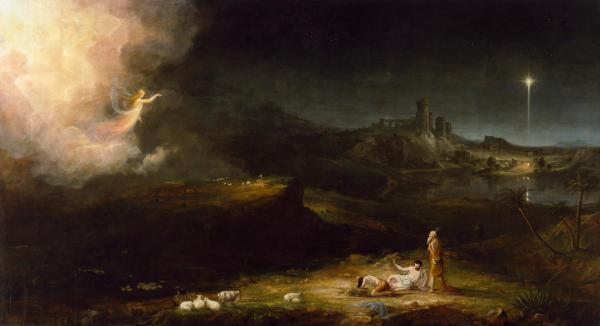
8 And there were shepherds living out in the fields nearby, keeping watch over their flocks at night. 9 An angel of the Lord appeared to them, and the glory of the Lord shone around them, and they were terrified. 10 But the angel said to them, “Do not be afraid. I bring you good news that will cause great joy for all the people. 11 Today in the town of David a Savior has been born to you; he is the Messiah, the Lord. 12 This will be a sign to you: You will find a baby wrapped in cloths and lying in a manger.” 13 Suddenly a great company of the heavenly host appeared with the angel, praising God and saying, 14 “Glory to God in the highest heaven, and on earth peace to those on whom his favor rests.” 15 When the angels had left them and gone into heaven, the shepherds said to one another, “Let’s go to Bethlehem and see this thing that has happened, which the Lord has told us about.” 16 So they hurried off and found Mary and Joseph, and the baby, who was lying in the manger. 17 When they had seen him, they spread the word concerning what had been told them about this child, 18 and all who heard it were amazed at what the shepherds said to them.
And this is how God chose to appear, and chooses to work– confounding the power of the powerful, the wisdom of the wise, and the goodness of the self-righteous. God does not glorify that which is already a spectacle. Instead he glorifies the lowly and unqualified things of the world by coming into them, working through them, and reshaping them for His use.
And so, may we have eyes, ears, and hands to work in the same way–to raise up, encourage, bless, and honor those who cannot yet see the Glory around them, the Glory God offers to share freely. May we be the host of God’s messengers to spread the Glorious news of Christ’s gift of life and salvation. May we be like the shepherds, jubilant in our acceptance of His great news. And may we be, like the babe himself–humble and kind–bringing Glory to the world around us, no matter how dark or unwelcoming it may appear. Remember, God himself is with us!
My mother is famous (in our corner of the world, at least) for sending greeting cards–hundreds each year for birthdays and anniversaries. Nearly every day, she sits down and chooses birthday cards, signs them, puts them in envelopes, addresses them, stamps them, and dates them to put in the mail box. She has learned over many decades just how long it takes for cards and letters to travel to various parts of the country and world, and times each card to arrive as close to the actual date of the event as possible.
As a girl growing up, I found this ritual time-consuming, wasteful, and bizarre. The calendar was a crowded mass of names, copied faithfully from last year’s calendar and crammed full of new births and recent marriages. Once the card had been chosen and signed, Mom would have to look up addresses in an ancient address book crammed with scraps of paper and index cards with changes, notes, and other esoteric information. Mom sent cards to people I had never heard of or met– old friends she knew from school, people my father knew from his army days, distant cousins, people who used to live in the neighborhood from before I was born. Each year, there would be cards returned to sender as people we barely knew moved and mom lost contact with them, often for good.
When I was old enough and sassy enough, I asked her why she bothered. What value did she see in doing something so simple, yet so complicated– who cared whether someone they had never met (or barely remembered) sent them a 2-cent greeting card? She patiently answered that perhaps no one cared (though she hoped it meant something), but she did it because one year, when she was young and times were very tough, she had received a beautiful birthday card from an unlikely source– the only card she received that year. It came from her “uncle” Ralph, who was not actually her uncle, but a dear friend of the family. “Uncle” Ralph had grown up in an abusive home, and had lost two sisters in childbirth. He knew the pain of being forgotten on his own birthday, and wanted to make sure it didn’t happen to his “niece.” Mom’s birthday wasn’t “forgotten” that year, but there was no money for fancy cards that year– just enough for a small, unfrosted cake and many good wishes. Mom faced other “tough” years as a young wife and mother, when she couldn’t afford gifts or cards for birthdays. This one small gesture so impressed my mother that she made it her mission, when she could afford to do so, to send as many greeting cards as she could to as many people as she could. As a follower of Christ, moreover, she does it from a heart that wants constantly to show love to just one more person for whom Christ died.
In the many years since my impertinent question, I have seen the incredible ministry my mother has had, and have heard from some of the many lives she has touched with her cards and her kind thoughts. Time after time, I have heard of people who were strengthened and encouraged by her example and her thoughtfulness. She is the living extension of God’s heart as she lovingly signs each card, walks it out to the mail box, and sends it on its way.
Many people have stopped sending greeting cards– we are more likely to send a text message or tweet a birthday greeting– if we think about it, or if it pops up in our news feed and we can just click a button. Yesterday was my birthday…I received three actual paper greeting cards (and yes, one was from my mother, one from my mother-in-law, and one from the ladies’ group at church). I was blessed and touched by each one– and by the dozens of on-line greetings and random birthday wishes in the days before (and probably after), as well as the hugs and special time spent with my husband and other family members.
I don’t send cards through the mail as my mother does, but I find myself typing Happy Birthday greetings on all my friends’ news feeds– sending happy thoughts to them, their children and grandchildren; their spouses and cousins (though I’ve never met them)–and each time, I am reminded that even a seemingly small gesture can make an enormous difference in someone’s life. And, because of Mom’s example, I write every name in my prayer journal. As I turn the pages each day, I see the names of two, three, or even ten precious souls– all infinitely and passionately cherished by the creator of the universe–and I have the honor to lift each one up in prayer to the One who knows and loves them best.
A couple of days ago, while the weather was still cold, but clear, my husband and I visited one of the many beaches along the eastern coast of Lake Michigan. The beaches are popular throughout the summer months, especially those with lots of dunes and smooth sand for sunbathing and picnics and beach volleyball. We’re the sort of odd ducks who like to visit in the off-season, bundled in parkas and combing the rocky shores looking for unique stones and beach glass.
I was reminded of Jesus’ parable of the two men– one who built his house upon the rock, and the other who built his on sand. https://www.biblegateway.com/passage/?search=Matthew+7%3A24-27&version=ESV. Sandy beaches are wonderful to visit in the summer, when the weather is perfect, the sun is shining, and the lake is calm. But over the winter months, people avoid sandy beaches (as we did) because the wind and waves can erode great patches of sand, moving it about and changing the shoreline considerably. On the bigger public beaches, crews put up fences to keep the winter gales from blowing sand away from the shore and into the parking lots and streets. The fences also trap the sand and snow on the shore. Snow banks that form on the beach can melt and carry the sand back into the lake, forming new sand bars that can cause damage to small boats. Even in the summer, large waves can produce undertows and dangerous currents for the unwary.
In many ways, sand is like sin. Sand is attractive– smooth and glistening in the sun. It is warm and seems to yield to the touch. But sand shifts; it blows and drifts easily, but it sticks in place where we least want it, tiny grains getting into hair and clothes, shoes, and beach towels. It slips away, slides from under our feet, fails to hold its shape, unless we wet it down and pack it, and then it crumbles under the action of the waves.
Rock, on the other hand, is secure. It takes centuries to erode; it doesn’t shift or fall away. A rocky coast may not seem as inviting for pleasure, but it makes a far better foundation for a home or a lighthouse. Even the smaller stones along the beach do not blow around in a strong wind, nor do they melt away with the snow.
Beach stones can offer further illustrate how God works in our lives. Stones on the beach start out with sharp edges. They are cold and hard and uneven. But over time, the rocks are slowly churned by the waves and the movement of smaller rocks and sand, and they are smoothed and polished by their environment. Among the sharp rocks are beautiful agates and quartz, their varied colors seeming to absorb sunlight and heat. Just so, we are transformed from hard and cold isolated individuals as we absorb the Son’s character. And, as we are churned up against others, and the hard edges get smoothed away, His beautiful character is revealed in us, and we shine. With further polishing, the stones reveal the kind of strength and beauty that make them worthy of being displayed or set in jewelry. Not every rock along the beach will go through this transformation..some will remain hard and sharp; others will be ground into sand. But some will cry out in their beauty and strength as testimonies of God’s eternal process of redemption.










































 Pursuing Prayer