19 1-2 Ahab reported to Jezebel everything that Elijah had done, including the massacre of the prophets. Jezebel immediately sent a messenger to Elijah with her threat: “The gods will get you for this and I’ll get even with you! By this time tomorrow you’ll be as dead as any one of those prophets.” 3-5 When Elijah saw how things were, he ran for dear life to Beersheba, far in the south of Judah. He left his young servant there and then went on into the desert another day’s journey. He came to a lone broom bush and collapsed in its shade, wanting in the worst way to be done with it all—to just die: “Enough of this, God! Take my life—I’m ready to join my ancestors in the grave!” Exhausted, he fell asleep under the lone broom bush. Suddenly an angel shook him awake and said, “Get up and eat!” 6 He looked around and, to his surprise, right by his head were a loaf of bread baked on some coals and a jug of water. He ate the meal and went back to sleep. 7 The angel of God came back, shook him awake again, and said, “Get up and eat some more—you’ve got a long journey ahead of you.” 8-9 He got up, ate and drank his fill, and set out. Nourished by that meal, he walked forty days and nights, all the way to the mountain of God, to Horeb. When he got there, he crawled into a cave and went to sleep. Then the word of God came to him: “So Elijah, what are you doing here?” 10 “I’ve been working my heart out for the God-of-the-Angel-Armies,” said Elijah. “The people of Israel have abandoned your covenant, destroyed the places of worship, and murdered your prophets. I’m the only one left, and now they’re trying to kill me.” 11-12 Then he was told, “Go, stand on the mountain at attention before God. God will pass by.” A hurricane wind ripped through the mountains and shattered the rocks before God, but God wasn’t to be found in the wind; after the wind an earthquake, but God wasn’t in the earthquake; and after the earthquake fire, but God wasn’t in the fire; and after the fire a gentle and quiet whisper.
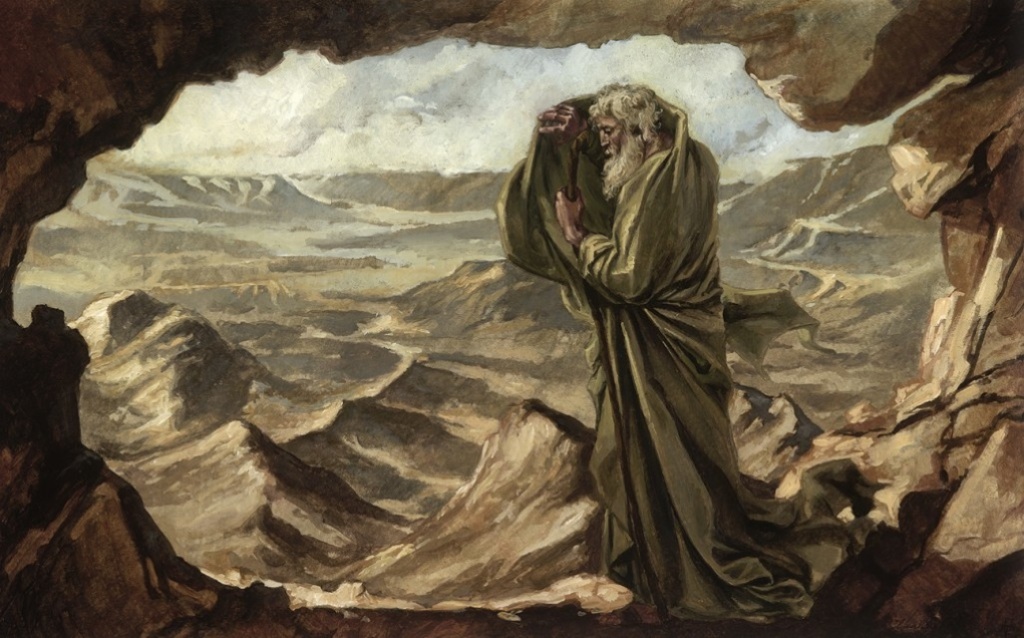
13-14 When Elijah heard the quiet voice, he muffled his face with his great cloak, went to the mouth of the cave, and stood there. A quiet voice asked, “So Elijah, now tell me, what are you doing here?” Elijah said it again, “I’ve been working my heart out for God, the God-of-the-Angel-Armies, because the people of Israel have abandoned your covenant, destroyed your places of worship, and murdered your prophets. I’m the only one left, and now they’re trying to kill me.” 15-18 God said, “Go back the way you came through the desert to Damascus. When you get there anoint Hazael; make him king over Aram. Then anoint Jehu son of Nimshi; make him king over Israel. Finally, anoint Elisha son of Shaphat from Abel Meholah to succeed you as prophet. Anyone who escapes death by Hazael will be killed by Jehu; and anyone who escapes death by Jehu will be killed by Elisha. Meanwhile, I’m preserving for myself seven thousand souls: the knees that haven’t bowed to the god Baal, the mouths that haven’t kissed his image.” 19 Elijah went straight out and found Elisha son of Shaphat in a field where there were twelve pairs of yoked oxen at work plowing; Elisha was in charge of the twelfth pair. Elijah went up to him and threw his cloak over him. 20 Elisha deserted the oxen, ran after Elijah, and said, “Please! Let me kiss my father and mother good-bye—then I’ll follow you.” “Go ahead,” said Elijah, “but, mind you, don’t forget what I’ve just done to you.” 21 So Elisha left; he took his yoke of oxen and butchered them. He made a fire with the plow and tackle and then boiled the meat—a true farewell meal for the family. Then he left and followed Elijah, becoming his right-hand man. 1 Kings 19 (The Message)
As a child, I was confused by this story from the life of Elijah the prophet. Just before this, Elijah had challenged the prophets of Baal and Asherah. He was outnumbered 850 to one, yet he stood defiantly, and asked the people of Israel to choose between their false gods and the one true God. God had produced fire on the mountain and shown His mighty power, while the false prophets were humiliated and later slain. It was a stupendous victory! And yet, Elijah, when told of Queen Jezebel’s anger, fled in terror, hid in the wilderness, and asked for death! Surely, Elijah remembered what God had just accomplished. Surely he knew that the same God who sent fire and ended the drought could protect Elijah from harm. Didn’t he? And I expected that God would react with consternation at this display by Elijah–how ungrateful to throw such a pity party after God had done such a miracle!
But God did the most curious thing. He could have sent a powerful reassurance. He could have ordered Elijah to return to the palace to deal with the wicked king and queen–finish the job and bring divine justice to Israel’s ruling family. He could have called Elijah out over his bad behavior and lack of faith. But God let Elijah whine and run away. And after Elijah threw a temper tantrum, God sent an angel to bring him food and water. Finally, God allowed Elijah to see His power in the forms of a mighty wind, an earthquake, and a fire. And it was THEN, and only then, that God spoke to Elijah in a still, small voice– a whisper– something so intimate and comforting that Elijah could not fail to recognize that it was the voice of God.
God CAN and will do mighty miracles. But so often, He prefers to work in a whisper. He is Glorious, and Powerful, and Omnipotent– yes. But He is also intimate and gentle and nurturing– especially with those who have ears to listen; those who have been broken down; those who need a quiet voice of reassurance and peace.
As I have grown older, I see so much in this passage that I couldn’t see as a child. I see how often I “lose it” just after I think I’ve won a great victory. I see how many times God has come to me in whispers and little gestures– just when I need a gentle hug and a simple reminder of His care. God is not the one who points out my temper tantrums and lack of faith. God doesn’t yell recriminations at me– even when I know I deserve them! I see how often I throw a tantrum, and expect God’s wrath, only to be met with His arms around me, calming me, lifting my head so I can look into His eyes of compassion and mercy. God is my Father– and a gentle, wise, and loving Father. And when He draws me close– He whispers of His Love.
Yes, God sent fire from the mountain. He caused justice to be done upon the false prophets. It was mighty; it was fierce; it was devastating. God IS a God of wrath– and even prophets can get wounded in the fight. There is evil in the world, and when we stand up to it, it is exhausting– even when we know God is with us. But God knows our limits. He will often give us more than we can handle– in our own power– and He will pull us through the kind of trials that test and stretch those limits. But He is also preparing a time and place of rest and His quiet whispers of encouragement and hope when we are tempted to give up.
God didn’t just whisper empty promises or nice-sounding platitudes when He finally spoke to Elijah. He brought a new message– someone else would be God’s instrument of justice for Ahab and Jezebel. Someone else would come alongside Elijah in his ministry. And someone else (7,000 someone else-s in fact!) WERE being faithful. Not only had God been with Elijah in the past, God had been preparing the future for Elijah to receive rest, and for others to rise up and carry on. He could have shouted this message from the mountaintop. But He wanted to whisper His message of hope to a faithful prophet who needed quiet reassurance after a difficult battle.
I don’t know what God wants to whisper to me (or to you) today. But I pray that we will have ears to hear, and hearts to respond. And God will whisper to us, whether we just defeated an army of enemies, or just woke up from a much needed nap! He will gently remind us that He loves us in our tantrums just as He loves us in our victories. And He will whisper, because that’s how close He really is in our every moment!
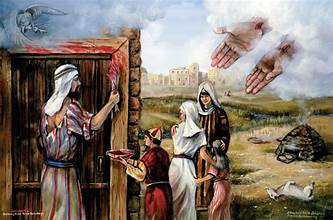
Candlemas, the celebration on which Groundhog Day is founded, is actually the day of the Baby Jesus’ presentation in the Temple (see Luke 2:22-40). Forty days after his birth, every first-born male child in Israel was to be presented at the temple, and a sacrifice was to be made for his redemption. This traces back to the Passover tradition, when the angel of death passed over the houses of the Jewish families who had painted their door frames with blood. Meanwhile, the first born sons (and animals) throughout Egypt were slaughtered. In this way, God showed His Power and His Mercy, leading Israel out of Egypt in triumph, while showing judgment on the Egyptians. (See Exodus 12).
History and tradition cast long shadows. The Jews had been slaves in Egypt for nearly 400 years. A new tradition helped them remember where they had come from and celebrate the promise that God would lead them to their own land. The Jewish people had kept this sacrificial tradition for centuries, reminding them of God’s mercy in saving their sons, and in redeeming them as a people from slavery in Egypt. Christians, realizing that this tradition “foreshadowed” the coming of Christ, adapted it into a new celebration. Christians celebrated Candlemas for centuries, remembering that Jesus was presented as OUR sacrifice, OUR redemption from Death into eternal Life Jesus came to be our Sacrifice, and also our Light.
But somewhere along the way, pagan beliefs and rituals were woven into the story of this day, until it has become “Groundhog Day.” Instead of the Lamb of God, we celebrate a common rodent. Somewhere in Pennsylvania (Punxsutawney), a small crowd gathers as someone lifts up a frightened groundhog and pronounces a weather prediction (one that is less than 50% accurate!) And everyone is looking for a shadow, instead of celebrating the Light.
The thing about shadows is that you cannot see them when you are looking INTO the light. You have to look away, turn around, look back, to see a shadow. Shadows are cast when something gets between the source of light and a flat surface. History casts shadows. Memories cast shadows. Sin casts a huge shadow. But Jesus is pure light. The Word of Life came to be a “lamp unto (our) feet and a light unto (our) path” (Psalm 119:105 KJV). We are meant to learn from the shadows of the past, but not to walk in them. We are to walk in the light, looking forward to the fulfillment of God’s promises, even as we celebrate the faithfulness of His past actions in the lives of others.
Light casts no shadow. But it banishes the darkness where shadows live. Our choices have consequences. We can turn away from the light, or step in opposition to the light, and cast shadows that may follow for generations–cycles of abuse, isolation, hatred, anger, or regrets. Or we can choose to follow the light, and banish the shadows of the past– bringing peace, repentance, reconciliation, and hope.
Heavenly Father, today, I pray that I will be a reflection of Your light in the world; that my actions would help banish shadows of doubt and despair, and shine with Your truth and hope for others to see. Where there are shadows in my life from the past, may I learn from them and leave them behind as I follow you more closely. Where I have cast shadows in the lives of others, help me to bring light and healing in Your name. Amen.
I’ve been posting a lot lately about going through my Mom’s “stuff.” Mom was a saver– a pack rat– a hoarder, really. She kept boxes and piles of useless things. But she also kept things that have value to those she left behind. My siblings and I have found old photographs, momentos, letters, documents, etc., that bring the past alive again..not just our past, but our family roots going back generations.
My mother with her mom and younger sister c. 1944
What prompts us to keep such memories; to hold tightly to faded papers, worn objects, shadows of days gone by? Sometimes, it is an unhealthy focus on past memories– good and bad– that keep us in the grip of “glory days” or old and festering wounds. But there IS a value to keeping a record of the past.
When I was young, we had dozens of books around the house, including Bible Story books. The stories of Abraham and Sarah, Isaac, Moses, Samson and Samuel, King David, Queen Esther, Elijah, and then Jesus, his disciples, the Apostle Paul…they were mesmerizing– and very instructive! God didn’t just give us Ten Commandments and a list of rules to follow. He left us with a rich tapestry of stories of real people, and their very real adventures. He has given us Parables, and Psalms, Prophets and Promises– the Bible is a living book that speaks to each new generation with timeless truths. I learned about the Faithfulness of God, His Holiness, and His Mercy in those pages.
The stories and photos that get passed down in families can also be instructive. I now have a baby picture of the grandfather I never got to meet, as well as a photo of him as a young man, and another candid shot of him wearing a milk bucket on his head (He was a dairy farmer)! I can see and sense his humor and love of family in new ways, and appreciate the way his life and early death helped shaped my own dad’s life. I have letters my great-grandparents wrote to each other when they were first married and starting their family. I have some of Mom’s letters when she was struggling as a single mother on a limited income. Many of these items I will keep–not only as a reminder of the past that shaped me, but to pass on to future generations. Other photos, letters, and objects have been given to certain other family members– it is part of the legacy THEY will pass on. Still other items I will let go– they have served their purpose and other items will take their place.
The little country church I attended as a child.
It has been tempting, with the amount of “stuff” that my Mom kept, to just throw everything out. Much of it has to be cleaned off, sorted, identified– and room must be found to keep it! So I also have to look around at what I have been hanging on to, and ask, “Why?” What lessons to I want to pass on? What objects tell an instructive story about my life? What impact will I have on others in the years to come?
One of the most difficult things to go through are the photos and letters my Mother kept. She kept nearly every letter and greeting card she ever received. They meant that much to her. Not the actual cards and paper– the thoughts, the love and connection–the people they represent were her greatest treasures on this earth. And I can’t keep them all. I don’t have space, and many of the people are strangers to me– her elementary classmates, co-workers from years gone by, great-aunts–people long since dead and, with my mom’s passing, forgotten by most. But I will keep some, because they are a testament to Mom’s love of others– her deep and abiding love for everyone who touched her life, and allowed her to touch theirs. I have thrown out, recycled, or given away many of Mom’s clothes and books, and I’m working to give away the thousands of unused greeting cards she had stockpiled but never sent. But most of all, I will keep the stories– stories of God’s faithfulness in her life; stories of how He worked in and through her life to touch hundreds of others; stories of how God’s Love blooms in the simple acts of kindness and baby steps of Faith; in the ordinary joys and tears and minor miracles of daily life.
And I will hold tightly to the stories of my childhood– of Moses and the Burning Bush; of Jesus the Good Shepherd; of David trusting God to face Goliath; of the women finding an empty tomb on the first Easter Morning. One of the pictures I inherited is a print of Jesus on the Road to Emmaus. Two men are walking along, talking to a third man. Such a simple act. Such an ordinary occurrence. But this is no ordinary walk– the man in the middle is the Risen Christ–the One who conquered death to bring eternal life to the two unsuspecting travelers. The print hangs on my wall now. The print itself is not of much material value– but the story! That is worth my life– to keep, to share, to cherish, to proclaim to those yet to come!
I am always drawn by the stories in the Bible. Stories of ordinary and extraordinary people used by God– sometimes in spite of themselves–to rescue others, to teach others, to serve as examples, and to show how God wants to interact (or discipline) those He loves.
One such person was a man named Saul, son of Kish. Of all the young men of Israel, God chose Saul to be their first king. This was a mixed blessing for the nation. In asking for a human king, they were saying that the did not want to be “ruled” by God or His prophets. God warned Israel through the prophet Samuel that they might come to regret having a human king. They were rejecting the pattern established by God under Moses, and asking for a system of leadership that matched the surrounding nations. This would make it easier to make treaties, do business, and interact with neighboring countries, but it would also bring some of the same problems (succession, power struggles, greed, etc.) that plagued all the other monarchies and empires around them. The choice of Saul reveals not only God’s character, but the character of Israel. God chose a man from one of the least of the families of the least of the tribes of Israel. Saul’s father, Kish, was a man of some power and wealth, but his family line was one of younger sons of younger sons. God often chooses the “least” among us to lead. He is not a respecter of rank or birth, wealth or experience. However, God also chose Saul as a man who “looked” the part. Saul was “head and shoulders” taller than others. He was good-looking and well-educated. Wasn’t this exactly was Israel wanted in a king?
On the day Samuel called a great assembly to publicly anoint the new king, lots were cast to show God’s choice. Among the 12 tribes of Israel, the tribe of Benjamin was chosen– the youngest of the sons of Jacob, and the smallest of the tribes. A lesser family among the tribe was then selected. Finally, the choice was narrowed down to Saul, son of Kish. But Saul could not be found! A search ensued, and he was eventually found– hiding among the baggage! The tallest man in the kingdom– the one who already had been confirmed as God’s choice– tried to hide from his own coronation! And it was God who revealed Saul’s hiding place and forced him to face his exaltation!
The ongoing story of Saul’s reign as king is filled with both triumph and tragedy. Time and again, Saul tries to “hide” behind excuses. He fails to obey God’s command, but blames his weakness on others. God takes away His favor, and His spirit leaves Saul, who descends into paranoia, anger, and madness.
But today, I want to look at the idea that Saul thought he could hide “among the baggage.” (1 Samuel 10:22) Other translations say he was “among the stuff” or “among the supplies.” Saul did not run away from the assembly altogether; he did not reject his role. Yet he tried to hide from the gravity and responsibility of kingship. In many ways, this shows good qualities of humility and an understanding of his own limitations. Saul’s problem wasn’t that he thought he was “born to be king.” Saul wasn’t born to be king– it was an honor thrust upon him. Saul’s problem was that he wasn’t prepared to let God rule through him. Saul would be the titular King of Israel. But who would be the King over Saul’s own life and heart? Saul, like the nation he ruled, ended up rejecting God’s rule. He tried to follow the letter of the law, and the traditions of his people, but he did not always choose to follow the God who had created them, nor did he humble himself to accept God’s correction.
We may not be chosen for a position of leadership. But what responsibilities are we hiding from today? Are we surrounding ourselves with baggage? Do we hide in the busyness of our hobbies or our job? Do we cover ourselves with “obligations” that leave us drained to no real purpose? How many hours do we spend hiding in chit-chat, or watching television, or shopping, or daydreaming? How many times are we volunteering to work with strangers in order to avoid spending time with difficult relatives or neighbors? How often do we offer up the sacrifice of generic worship instead of the sacrifice of a teachable spirit?
Saul had many gifts, which he used to strengthen his nation and expand its territory. He had the opportunity to do even more great things for God and for Israel. But he is mostly remembered for his failures– his defiance of Samuel’s orders and excuses about disobedience; his ongoing murderous pursuit of his anointed successor, David; his consultation in the dead of night with the witch of Endor; his ignoble death in battle… We too, have opportunities to do great things with God’s help and in His power. We cannot hide forever among the “stuff” of life. God will reveal our hiding places– to others, even if we don’t acknowledge them!
Today, I pray that I will come out from behind the baggage of my everyday activities, and be available for God’s good purposes!
At least once a month throughout this year, I want to write about some practical ways to freshen the pursuit of a life of prayer. Today I want to discuss several ways of praying scripture.
Probably the most common way people think of praying scripture is to actually pray the words of a Psalm or Biblical prayer. Many of the psalms ARE prayers in poetic form, so this makes sense. Some excellent “prayer psalms” include Psalm 3, 8, 15, 16, 18, 25, 30, 51, 54, 57, 63, 66, 71, 84, 98, 101, 103, 108, 123, 130, 138, 139, 142, 143, 145, 146, and 150 (among several other passages throughout the others). There are also wonderful “prayer” passages throughout the rest of the Bible. In the New Testament, there are the prayers of Jesus, as well as prayers throughout the Epistles. Choose a familiar one. Choose one that is new to you. Choose an entire passage, or just a few verses…
A second way to “pray scripture” is to read a passage and “pray it back” in your own words. Echo the praises (or the confessions or requests) of the original speaker. Add your own personal words and thoughts to those of others through the ages.
Another method is to read a passage of scripture, or a story from scripture, study it, meditate on it–then use what you have just learned about God’s character to inform your prayer. Did God show Himself to be powerful, merciful, faithful, Holy, patient? Reflect that back to Him in prayer.
Related to this method is praying back to God His attributes and names as found in Scripture. “The God who sees.” “The God who hears.” “The Almighty.” “The God of Abraham, Isaac, and Jacob.” The God of Israel.” “Wonderful Counselor.” “The Son of Man.” “The Lamb of God.” etc.
Yet another way to use scripture in prayer is to reflect on a person in the Bible and how God used that person, blessed that person, or dealt with that person. David, Daniel, Ruth, Hannah, Jonah, Samson, Gideon, Esther, Paul, Peter, Mary Magdelene– there are several examples of real, fallible, often ordinary people who encountered God. How did God find them? What did He do for them (or in spite of them!)? What could He be planning to do in YOUR life if you follow Him?
Finally, there are scriptures that leave us with questions. Why not use these questions as a opportunity to pray!? Take a passage of scripture that you find confusing or even contradictory, and pray about it. Ask God for wisdom and understanding. Come to Him believing that there is a purpose to each word and passage of the Bible, and that He can reveal Himself through even those words that seem to make no sense!
Of course, not all of our prayers will be “scripture-based” in this way. But what might happen if we try praying this way once this week? Prayer is so mysterious and multi-faceted–we should engage and explore as we pray. After all– it’s more than just prayer– it’s a pursuit!
This is not a great secret or a new discovery, but a reminder that we can “pray” the Scriptures. Sometimes, we do this in corporate prayer, as in a congregation reciting “The Lord’s Prayer” together. But often, it is when we are reading God’s word, or a particular verse haunts our memory that we echo the words in our prayer life. There are so many benefits from this:
We are joining in a great tradition– much of Scripture records the prayers of the patriarchs and of Jesus Himself. When we echo those words, we affirm them–both to God and to ourselves.
We are praying in the light of the truth–God’s own words on our lips can keep us from trying to put our words in God’s voice!
We are deepening our understanding and experience of Scripture– making it personal, rather than just a learning exercise or a daily duty.
We are deepening our experience of Prayer– it is more than just me talking to God. It is me agreeing with God’s Word, and God’s Word literally speaking through me.
We are reminded of what prayer can do– many of the prayers of Scripture are followed by answers, from prophecies to miracles to movements of the Holy Spirit.
We are reminded that God answers prayer that is consistent with His will– not all Biblical prayers were answered in the ways that their petitioners hoped or expected!
The Bible is full of wonderful examples of prayers. Here are just a few to get started:
Abraham’s prayer for God to spare Sodom in Genesis 18 (v. 23-32).
Moses praying for God to forgive Israel’s sin and disbelief in Exodus 32 (v. 31-32)
Moses praying for a successor to lead Israel into the Promised Land (Numbers 27:16-17)
Gideon’s prayer for guidance in Judges 6
Manoah’s prayer for help in raising his son Samson in Judges 13
David’s prayer in 2 Samuel 7 (v.18-29)
Elijah’s prayer for God to send fire from Heaven in 1 Kings 18 (v.36-37)
Several of the Psalms, including 3, 51, 90, 102, 103, 105, and many others.
Hezekiah’s prayer for God to save Israel from their enemies in Isaiah 37 ( v.16-20)
The prayer of Jebez in 1 Chronicles 4:10
Habakkuk’s prayer for revival in Habakkuk 3: 2-19
Jesus’ prayer in Matthew 11:25
Jesus’ prayer for His disciples (John 17)
Jesus’ prayer in the Garden of Gethsemane (Matthew 26:39-44)
In addition, Bible passages that describe the Character and Majesty of God the Father, the Son, and the Holy Spirit can be used as prayers of worship and adoration. Bible stories and events can be lifted up in worship of God’s power and faithfulness through the ages. Jesus’ teachings (such as the Beatitudes) can be lifted up as the desire of our hearts, and as requests for the strength and wisdom to follow Him.
Now unto him that is able to keep you from falling, and to present you faultless before the presence of his glory with exceeding joy, To the only wise God our Saviour, be glory and majesty, dominion and power, both now and ever. Amen.
There is an old joke about a man whose house was in the path of a great flood. He prayed and prayed for God to rescue him from the rising waters. As the water crept closer to his front door, a man in a canoe came paddling by. He said he had room in the canoe, if the man wanted to evacuate. “No, no,” the man replied. I have faith that God will rescue me.
But the water kept rising. The man was now trapped upstairs, as the water had flooded his ground floor and continued pouring into his house. A Coast Guard rescue boat came by. It was crowded with people, but the rescue workers assured the man that there was still room for one more. “No, no,” the man replied. I’ve been praying, and I know God will rescue me.
Just before sundown, the man was forced to climb onto his roof, as the waters kept rising. A Marine rescue helicopter hovered, and a Marine was lowered with a rope to rescue the man. By this time, the man was hungry, exhausted and shivering, but he refused to accept the Marine’s help, once again claiming that God would rescue him.
As night fell, and the waters were creeping up to his perch on the roof, the man cried out to God,” Where are you, Lord? I prayed for your help, and I trusted you to rescue me. Yet here I am, clinging to the roof. I’m wet, scared, cold, hungry, and tired. Didn’t you hear me? Don’t you care?”
From the darkness above, a voice answered: “I sent two boats and a helicopter. What more do you want?”
This is a silly story, but it made me think– how often do I miss God’s answer to my prayers because of my own narrow focus or selfish expectations? When God sends a canoe, do I dismiss it because I want a different outcome? The story doesn’t say why this man refused to see God’s hand in the reasonable rescue attempts that came his way– perhaps he thought God would simply redirect the floodwaters away from his house, or provide a supernatural rescue. And we never find out what happens next– maybe the man gets his miracle, after all.
God’s ways are not our ways, but God often uses practical, even humble means to answer our prayers. And He rarely ever tells us what His answers will look like.
Even the Apostle Paul had to be rescued– several times. In Acts 27 and 28, we find an amazing story in which God revealed to Paul that he would be shipwrecked and rescued. Several attempts were made to save the ship, but Paul’s focus was on saving the lives of all on board. And God answered his prayer. https://www.biblegateway.com/passage/?search=Acts+27-28&version=NIV Strangely, God chose not to reveal that Paul would face a new danger as soon as he was safely on land. Paul trusted God to make sure he arrived safely in Rome– no matter WHAT crisis arose, no matter what surprising disaster loomed. When he was bitten by a poisonous viper, Paul didn’t panic. The same God who had led him safely to shore kept him from harm yet again. This same God would bring him to Rome, where he would be executed for his faith. While in jail, Paul wrote many letters, sometimes asking for basic necessities– including a warm cloak and some parchment. Paul never lived to see his letters become part of the New Testament. He never lived to see generations of martyrs and missionaries reading and sharing his words around the world. But he left a testimony of faith that God would be with him, wherever he went and whatever circumstances he faced.
The character of Lot in the Biblical book of Genesis is one that often gets overlooked in favor of his uncle, Abram/Abraham. Yet Lot lingers in the background, following Abram to Canaan, and later to the area between Bethel and Ai. (See the end of Genesis 11 and the beginning Genesis 13.) Curiously, we don’t hear anything of Lot when Abram and Sarai travel to Egypt during a period of famine. He isn’t there to support his uncle, or share his burden. He isn’t there to alleviate any of Abram’s fears relating to Sarai (See Genesis 12). Abram resorts to lying about his relationship, and causing difficulties with Pharaoh, but there is no mention of Lot until Abram and Sarai return from Egypt. Lot rejoins his uncle and they move into a fertile region– so fertile, in fact, that their flocks and herds soon grow too big for the area.
At the beginning of Genesis 13, things have come to a crisis point. Abram, as the elder, could have used his age and position to demand the best grazing land and force Lot to fend for himself elsewhere. But he doesn’t. God has already promised that Abram and he will become a great nation and own the land of Canaan. Abram, in faith, tells Lot that he can have his choice of the land– anywhere he goes, Abram will pull back and take the leftovers.
It must have felt like winning a prize–being given carte blanche– first dibs on the best land in the region, while your elder agrees to give you even more space to expand. And Lot makes the most of this golden opportunity. He chooses the best land in the area– well watered, green, and near wealthy centers of commerce and culture–what could go wrong?
Before we explore the answer to that question, let’s stop and consider Lot’s character and choice in comparison to his uncle’s character and offer.
Abram reveals much of his character in a pattern of “calling on the Lord.” He does it in Genesis 12:7, 13:4, and again after the separation from Lot in Genesis 13:18, where he built an altar. There is no mention of Lot ever calling on the Lord for anything. Not to seek His face, or give Him praise, or memorialize an event. Lot is not a giver– he is a taker. He takes advantage of his uncle’s wealth and standing time after time, but we never see him thanking his uncle or showing deference to him as an elder. This is not to say that Lot never showed gratitude or deference, but he seems not to have made a habit of it. In taking the best land for himself, Lot acted with supreme self-interest. He could have sought out good land elsewhere, leaving his older uncle in possession of good land close by. He could have taken time to consider more than just the obvious good points of the land he chose. But he didn’t. He jumped at what looked like an amazing stroke of luck. But in the end it turned out to be more of a curse than a blessing.
How often am I like Lot? When have I jumped at the chance to take the “easy” path, never bothering to consider how it impacts others? Have I developed the bad habit of taking “good fortune” for granted? Do I thank God, and those who have poured into my life, for their care and help? Am I dependable– am I “there” for my friends and family in good times and in times of famine, hardship, or pain?
Lord, help me to learn these lessons from your word. Help me to be more like Abram, and less like Lot as I go through the day and week ahead. And Thank You for Your character of faithfulness and grace, that chose to rescue Lot (twice!) in spite of his selfish choices. Help me to show the same grace to others I encounter.
I spent part of last year taking a closer look at some of the figures of the Old Testament. This week, I’d like to take a closer look at one of the lesser figures of Genesis: Abraham’s nephew, Lot.
We tend to focus on the teachings of Jesus, and the writings of the apostles in the New Testament. We should. But we should not neglect the lessons to be found in these ancient stories. They have a “lot” to teach us about human nature, and about God’s response to it. They are rich with characters, patterns, metaphors, and foreshadowing.
We first meet the character of Lot, along with his family, at the end of Genesis 11: 27 This is the account of Terah’s family line. Terah became the father of Abram, Nahor and Haran. And Haran became the father of Lot. 28 While his father Terah was still alive, Haran died in Ur of the Chaldeans, in the land of his birth. 29 Abram and Nahor both married. The name of Abram’s wife was Sarai, and the name of Nahor’s wife was Milkah; she was the daughter of Haran, the father of both Milkah and Iskah. 30 Now Sarai was childless because she was not able to conceive. 31 Terah took his son Abram, his grandson Lot son of Haran, and his daughter-in-law Sarai, the wife of his son Abram, and together they set out from Ur of the Chaldeans to go to Canaan. But when they came to Harran, they settled there. 32 Terah lived 205 years, and he died in Harran. (Genesis 11:27-32 NIV, taken from http://www.biblegateway.com)
When I was reading this passage the other day, I was struck by something I never noticed before, and have never heard in any sermon or Bible study–Lot’s mother is never mentioned, and there is a strong implication that Lot’s parents were never married. The text merely says that Haran became the father of Lot, and that he died. The next sentence, however, says that both his uncles married– and it names their wives. The Bible does not state explicitly that Lot was illegitimate, or that he never knew his mother, but if that is the case, it makes certain things about his life stand in sharp contrast. And, though it says Haran died while his father was still alive, we don’t know how long he was a part of his son’s life. Lot is part of a family, but his position is not well-defined. He is a grandson, and a nephew, but he has no parents or siblings, and he is not adopted or named as an heir by either of his uncles. (Even before Abraham becomes a father, his “heir” is a servant named Eliezer of Damascus, not his nephew– see Genesis 15:1-3) He travels with his grandfather, and then “moves about” with Abraham (Genesis 13), but doesn’t seem to be a part of Abraham’s household. Instead, he is raised by his grandfather, who seems to have given him his father’s portion of the inheritance. Lot isn’t abandoned by his father’s family, but he is not embraced, either.
Lot seems almost to be included in this family history by chance. And, indeed, his name connotes chance and happenstance. People cast lots, play the lottery, and talk about their “lot in life.” Lot, much like his name, seems to depend on chance as he travels through life. His birth is mysterious and obscure, but he has connections to a great and wealthy family. He has great success in building his flocks and herds, enough that the “land could not not support (he and Abraham) while they stayed together” (Genesis 13:6a), but he doesn’t seem to be able to stay out of trouble. He gets used as a pawn in a territorial war (Genesis 14), and must be rescued by his uncle, only to return to the wicked city of Sodom. Angels must drag him out of the city to rescue him again, when God decides to destroy both Sodom and Gomorrah for their wickedness. Bitter and pouting, Lot becomes a pawn for his own daughters in the aftermath of his rescue, ending his days as a footnote in history, as the ancestor of two of Israel’s fiercest enemies– the Moabites and Ammonites.
Why is the story of Lot woven into the chronicles of Abraham? What can we learn from his character and life story? How does Lot play a part in the genealogy of Jesus?
I’ve challenged myself to learn more–may I pray that you might do the same? Nothing about Lot’s story is written without some purpose–let’s search out what a “lot” God has to share with us in the life of this one man.
God’s ways are not our ways. God often turns our expectations on their heads– choosing Abraham and Sarah to become parents at an advanced age; choosing Moses, reluctant, disgraced, and hot-tempered, to shepherd close to a million refugees across the wilderness; choosing David, young and poorly armed to defeat the mighty giant, Goliath; choosing to send His Messiah as an infant, the son of a teenage girl stranded miles from home in a cattle shed…
Not only that, but God chooses to include cryptic and seemingly random details in many of the stories we read in the Bible. When Abraham and Sarah received news that they would become parents, Sarah laughed. Such a small detail, but God called attention to it, even giving the name Isaac (Laughter) to this promised son. When God called Moses, He didn’t just include the details of the burning bush and the miraculous signs, He chose to include Moses’s excuses and objections, and a curious command to Moses to remove his shoes.
Recently, I found a short discussion about the “five smooth stones” David used to defeat Goliath. https://www.biblegateway.com/passage/?search=1+Samuel+17%3A26-50&version=MSG Some teachers spend time talking about the number of stones– why five? Did David doubt God’s power and provision? Can we attach significance or apply principles to each stone? But someone commented (I’m sorry, I lost the reference, or I would attach a link) on the fact that the stones were smooth–I’d never really noticed that detail before. David chose five smooth stones from the brook, not five heavy rocks, not sharp-edged stones of flint, not round balls made of iron– five smooth stones. The smooth stones in the brook may seem like a strange choice to us if we are not used to using a sling, but to David, such stones meant greater accuracy and speed. Five such stones would have been about a handful– easy to carry, load, and fire in rapid succession, if necessary.
I would like to suggest that there are some principles here that apply to both prayer and Christian living, especially involving how we can pray for and interact with the “giants” and “enemies” in our lives:
First, understand the reality of the “Giant”—Goliath was huge; bigger than any single warrior in Israel. But he wasn’t bigger than God. Goliath was also hampered by his heavy armor, his size, and his arrogance. David was offered armor and weapons similar to Goliath’s, but David’s greatest weapon was his understanding that Goliath was no match for the God of Angel Armies! We often make the mistake of magnifying our enemies. We see their size, their shining armor, and heavy weaponry. We forget that God is the maker of smooth stones!
Second, actions really do speak louder than words. Goliath inspired fear; he taunted the army of Israel. Yet he never landed a blow against David. Goliath scoffed, bullied, and talked a good game, but David paired his words with action. Goliath demanded that David (or any other warrior) “Come down to me..” He had a javelin and a spear, but he never used either one. I find it interesting that many “enemies” of the Church behave the same way. They want to challenge the followers of Christ in debates; they publish books and articles filled with arrogant words, accusations, and complex arguments. It is tempting to respond in kind– to get into a war of words; to match their arrogance with our self-righteous assertions. What if we fought their words with action, instead of spending so much of our time answering and defending ourselves against empty arguments and accusations. We will not “win” any culture wars; we will not “win” the hearts and minds of the next generation; we will not “defend” morality by using bigger, better, or more persuasive words, or by having better armor and sharper weapons than our enemies. We need smooth stones from the brook–small acts of kindness and humility and grace that defy all the logic and brute force of those who trust in their own understanding.
Third, accuracy is better than power. Goliath had one spear–and it was impressive–” His spear shaft was like a weaver’s rod, and its iron point weighed six hundred shekels.” (verse 7). Still, Goliath had a javelin, a sword, and several pounds of armor. David had no armor, one shepherd’s staff, and his sling and five smooth stones. But he only used one stone! It was accurate and true; it was sufficient, and it won the battle! Sin likes to flaunt it’s power–shiny armor, impressive weapons.. But if we are “true”–if we hold fast to the truth and follow the words and example of Jesus Christ–if we are faithful in our everyday walk with Christ, it is sufficient. There is an amazing climax in the movie, Star Wars (episode 4, A New Hope), where the young Luke Skywalker is sent with a group of fighters on a seemingly impossible task– destroy the “indestructible” Death Star! There is only one weakness–one small target. Luke’s small fighter plane is old and outdated; he and his fellow soldiers are under attack, and the pressure is on. But Luke’s accurate shot leads to victory. It is a modern retelling of the story of David and Goliath (with several space-age gadgets and extra plot twists). How many of our interactions with others get “sidetracked” by anger, envy, bitterness, and pride, to the point that we no longer reflect Christ accurately? How often do we consistently pray to stay “true” to God’s word, rather than praying for more powerful opportunities or platforms?
Fourth, know your strengths and weaknesses (and those of your enemy). David knew that his strength was, first and foremost, in God. And David’s passion for God’s honor gave him focus and commitment beyond all that was found among the skilled soldiers of either side. He knew that fancy weapons and armor could not improve his skill with the sling, and that his skill had been tested in battle before. But David also knew better than to aim the stone at Goliaths’s breastplate, shield, or greaves. Goliath’s weakness was in his head! His first weakness was in thinking that his power was enough to defy the God of Israel’s army. But he also left his head unprotected from attack. Some scholars have even suggested that Goliath may have had very poor eyesight– that he was a fierce warrior in hand-to-hand combat, but literally could not see the stone coming at his forehead. Perhaps all his blustering and taunting was, in part, to distract from his very real vulnerability. I am reminded that this is also true of many of the “giants” we face. Their weakness is in their head and in their vision–they trust in their own understanding and in human arguments, or in their “vision” of who God is, or “isn’t”, or “should be”. They rely on what they can comprehend and control. They wave their swords and rattle their shields; they have gleaming armor and they “talk a good game”. They have locked away their hearts and bodies, often hiding painful scars and deep hurts. Goliath was a giant–but he wasn’t a god. He was once a little boy (or maybe never a “little” boy, but a young boy..). David was a young man (probably in his mid-to-late teens), who was a simple shepherd. How do we see ourselves? How do we see others around us? Do we know our weaknesses? Do we see the vulnerability in those who would threaten us?
Last, God’s “weapons” are not like those of the world. Five smooth stones do not look like weapons. In fact, five smooth stones from the brook may have looked charming and harmless and even comforting in David’s hand. Four of those stones may have gone back into the brook, to be polished some more by the current, or carried out to the sea. Christ’s followers have armor and weapons, but they are spiritual in nature. We are to put on the “whole armor of God” (https://www.biblegateway.com/passage/?search=Ephesians+6%3A11-18&version=ESV, including the “sword of the Spirit”, which is the word of God. Truth, Righteousness, Peace, Good News, Faith, Salvation– This is how we prepare for battle! And we are to pray at all times! Imagine dropping the weapons of sarcasm and self-righteous posturing, and picking up a smooth stone of grace! God calls us to use unconventional “weapons”– not to kill or destroy those around us, but to demolish lies, tear down walls of hatred, and defend the helpless. Has God placed you in a situation where you need to pick up “five smooth stones” today?






































 Pursuing Prayer