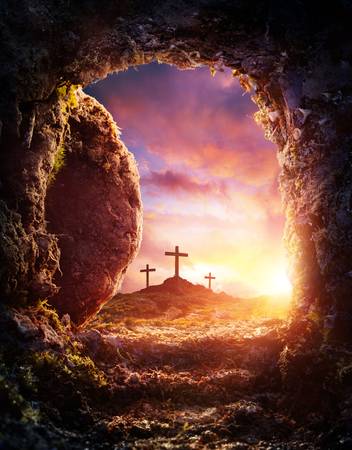
The Empty Tomb


We are living in dark days– days of death counts, and dire predictions; of fear and grief and chaos. Masks, social distancing, angry outbursts, collapsing economies, job loss, political unrest, disease, plague–we are in the grip of a global pandemic. “Bring out your dead.” It’s a phrase from hundreds of years ago, and the horrors of other plagues and other disasters. Tombs, graveyards, skulls and visions of death abound. And yet, as Christians, we celebrate an empty tomb…

Photo by Matthias Zomer on Pexels.com

It’s been over a month since many Christians celebrated Easter (and almost a month for Orthodox Christians). How soon many of us forget the power of the resurrection. Our world is gripped with fear and anger. But we should be gripped with hope and healing. We celebrate an empty tomb– a testament to the victory of life over death, and hope over chaos!

Photo by Felix Mittermeier on Pexels.com

Even when we use the symbol of the cross, it is not about Christ’s death, but his ultimate victory that we celebrate. Jesus himself even referred to the cross in these terms in John 3:

“Just as Moses lifted up the snake in the wilderness, so the Son of Man must be lifted up, that everyone who believes may have eternal life in him.”

John 3:14-15 NIV via http://www.Biblegateway.com

Jesus is speaking with Nicodemus, a Pharisee and religious teacher. He is referring to an historic incident in the wilderness, when the Israelites had rebelled (once again), and the Lord sent venomous snakes among them. Nicodemus would have known about this incident, but Jesus presented it as more than just history– it was a foreshadowing of God’s perfect plan of salvation! https://www.biblegateway.com/passage/?search=Numbers+21%3A4-9&version=NIV God had Moses make a bronze snake to be lifted up on a pole. When the people looked up and saw the bronze snake, they could live. In just such a way, when Jesus was “lifted up” on the cross, he didn’t just die. He battled death to bring life to anyone who “looks up” and believes.

That ancient symbol of a snake on a pole is used by physicians to represent healing. The ancient symbol of Christ on the cross is used to represent redemption and eternal life. Combined with the reality of an empty tomb, we can celebrate life in the midst of any circumstances.

These are difficult days–even with the hope of eternal life, we still have to face the sadness and grief of death, the confusion and hardship of economic chaos, and the uncertainty of what tomorrow will look like– socially, politically, economically, and physically. But we need only “look up” and beyond our circumstances to be reminded that this is not the whole story. There is an empty tomb– ours! There is victory–ours! Won for us by the perfect plan of God, and the perfect obedience of Jesus Christ.

Photo by 3Motional Studio on Pexels.com

Look up– and Live!

Resent, Relent, or Repent…

We’re getting ready to enter the Lenten season–six and a half weeks of reflection and preparation before Easter. Lent is not a celebration in the traditional sense– it is solemn and reflective, personal and, sometimes, painful. It is a time of getting “real” about our sinful condition. The Bible says we have all fallen short of the Glory and Holiness of God (Romans 3:10) and deserve God’s wrath. The natural consequence of sin is death (Romans 6:23), and permanent separation from the goodness of God.

Photo by Engin Akyurt on Pexels.com

There are many ways we can react to this reality. I know many people who resent God’s Holiness and His laws. They do not want to face God’s righteous judgment; they believe that God’s laws are cruel and unjust, and that they do not have to answer to anyone greater then themselves.

Others want to bargain with God. They feel that if they relent– if they set a goal to do more good than harm, if they strive to be better than “the next guy”–God will weigh their good deeds in the balance and judge them in comparison with how bad they “might have been.”

Photo by mentatdgt on Pexels.com

But God doesn’t judge on a curve– He doesn’t judge us by our measure, but by His. And none of us “make the grade.”

If that were the final word– the end of the story– there would be no reason to relent, and it wouldn’t make any difference if we were resentful. But God, from the very beginning, designed a different outcome. His judgement is just, but it is not without hope or remedy. God Himself has given us the chance to change– to repent. Repentance is agreeing with (not resenting) God’s judgment, and responding (not bargaining) with changed behavior and a changed attitude.

Lent begins when we confront the great gulf between God’s Holiness and our sinfulness. It stretches through the realization that sin and its consequences surround us, hem us in, and poison our world. It is a time of sadness and gaping loss, when we long for healing, for hope, and for a home we’ve never seen. It is a time for reflecting on the cost involved–not just in human suffering, but in God’s suffering as a human. God, who could have, in His righteousness, destroyed even the memory of mankind, chose to share our sufferings– hunger, cold, exhaustion, rejection, heartbreak, betrayal, death– to that we could be delivered into everlasting life.

Lent ends as we remember Jesus’ death and burial– His ultimate sacrifice for our debt. It ends with a shattering trumpet-blast of hope and joy on Easter Morning. Our sadness and loss is NOT the end– Sin’s power and poison are illusory. They have no power over our Great God.

Photo by Pixabay on Pexels.com

It can be tempting to respond to our present circumstances with resentment. It can be tempting to relent in our rebellion– trying to bargain with God, and minimize the cost He had to pay, trying to pay the price ourselves with a show of good behavior and a superficial devotion.

But God’s great Love and Mercy should draw us to worship and true devotion. As we reflect on the great gulf between sin and holiness, it should cause us to gladly repent– to lay on the altar all the substitutes and lesser things that keep us from full communion with the Lover of Our Souls.

Photo by sergio omassi on Pexels.com

Our prayers during this season may be difficult. They may be filled with grief, loss, and pain. But they may also be filled with hope and joy as we anticipate the gift of Grace. And they should be filled with praise. After all, Lent is a season; a season to reflect, a season to repent, a season to mourn, but a season with a beginning and an end; a season that gives way to celebration and a sure hope of resurrection!

Forgiveness is Free: It Isn’t a Free Pass

Yesterday, I posted about praying for our enemies– those who have hurt us.  We are commanded to forgive those who have wronged us, to do good to them, and to pray for them.  But I want to make sure I don’t give the wrong impression about offering forgiveness.

Forgiveness doesn’t ask us to excuse the inexcusable, or trust the untrustworthy.  Forgiveness is trusting that God, in His wisdom, His Holiness, and His timing, will bring justice, healing, and peace, when nothing else can.  This is important to remember, both as someone who asks for forgiveness, and as someone who gives it.

Jesus offers forgiveness–full, and free, and perfect– he died to make that offer.  He gave it to whoever believes on His Name.  But here’s the catch…he didn’t make that offer so you can temporarily wipe the slate clean and go on sinning without consequence.

Oscar Wilde wrote a chilling novel, “The Picture of Dorian Gray”, Dorian Gray/Wikipedia    in which the title character finds a way to trap his soul, with all its ugliness, hatred, anger, and sin, inside a portrait.  No matter what Dorian does, no matter how twisted or evil, he continues to look fresh, young, innocent, and handsome.  The effects of his dissipated lifestyle–drug addiction, sleepless nights, years of hard living, even murder–are all trapped in the portrait.  Over the years, the portrait haunts Dorian with its monstrous transformation from young man to gnarled wraith.  In desperation, he “kills” the portrait– and himself– in disgust and anguish.

dorian_gray_by_pti_spb-d6f1lmr

We live in an age of appearances– if all appears well on the surface, we ignore the deeper, long-term consequences of our sin.  If we “get away with” small sins, we run the risk of sinking deeper into a sham lifestyle.  We go through the motions of asking forgiveness, when what we really seek is escape from the consequences of our own actions.  We begin to see sin as a valid alternative to obedience–I can obey God if it is convenient, but when it’s not, I can just ask forgiveness.  This is a road strewn with lies, excuses, evasions, and it ends in death.  It is a lifestyle that makes a mockery of God, of his Holiness, His Sacrifice on the cross, and His loving offer of restoration.

God doesn’t just want to transfer your ugliness and rebellion into a painting to hide it away.  He wants to remove it “as far as the east is from the west.”  We don’t become perfect in an instant, but our past is expunged so that we can be free to choose obedience and live more abundantly in fellowship with a Holy God.  When we are truly sorry for our sins and seek true forgiveness, we want to make better decisions, we want to right wrongs– we want to redeem the past rather than merely escape from it.

pexels-photo-1018478.jpeg

When we, as imperfect people, offer forgiveness to someone else, we are not able to do what God does.  Our forgiveness is imperfect; like love, or discipline, or a new habit, it needs to develop and grow.  Forgiveness is not about freeing the offender, or wiping the slate clean for the other person.  It’s about freeing yourself to heal, to move away from slavery to the pain of the past, and to learn to trust God to bring justice.

Forgiveness isn’t natural or easy.  No one deserves forgiveness– that’s what makes it a miracle that God offers it to anyone who asks.  But God doesn’t undo our sin.  He doesn’t erase our actions, or clean up the messes we have made.  If I commit murder, God can forgive me, wash away the guilt of what I’ve done, and give me the power to live a life that seeks to do good, rather than evil.  But he’s not going to bring my victim back to life, or cause a judge and jury and the family of my victim to say, “Aw, that’s alright– you’ve probably learned your lesson.  No hard feelings.”  He can (and has) caused amazing healing to happen in such situations, but that’s the exception, not the expectation.

Similarly, if you have been hurt and you offer forgiveness, it doesn’t mean that the other person is no longer responsible for his/her actions.  It doesn’t mean that you were never hurt or betrayed, and it doesn’t mean that you trust them immediately and without reservation. It is not hateful, intolerant, or unforgiving to allow justice to catch up with someone who has hurt you– it IS unforgiving to seek beyond justice to vengeance and self-defined retribution.

pexels-photo-133170.jpeg

This is particularly important in cases of abuse.  If someone has abused you, physically, emotionally, or mentally, they are likely to make you feel the guilt they don’t want to deal with.  “You drove me to it.”  “You are the only one who understands my anger.”  Forgiving this person does not mean– it NEVER means– that you agree with their tactics and false accusations, or that you are giving them a pass.  But it DOES mean that you are giving them, and the damage they caused, over to the God of all justice.  Your case is closed; your final judgment is in his hands, and you are free to begin again– begin to heal, begin to see how God can bring something important and good and eternal out of something broken.  Forgiveness is impossible, but God will give you the power to do it– it may take several attempts, and several years, but when it comes, it will be the miracle of God working through you to glory!

Can You Hear Me Now?

We experienced some storms last week, and while we didn’t have a lot of damage from the winds and rain, my husband and I lost our internet connection over the weekend.  No wireless internet meant no Facebook, no WordPress, no e-mail, and no cash register at our little shop downstairs.  We had to do every transaction by hand until we could rig up something so our smart phone could accept cards; no new chip cards, no Apple Pay or PayPal.  And while our phone could begin to accept limited credit payments, it could not provide any printed receipts, nor could it do double duty– we either had a phone or a point-of-sale device, but not both!

It was an inconvenience, but not a disaster.  I thought about thousands of people who are stuck in the aftermath of hurricanes, tornadoes, floods, earthquakes, and blizzards who have no electricity, no phone lines, no cell service, no roads, no water or sewer lines–cut off from common necessities and basic communication.  Suddenly, an emergency becomes even more tragic because of the isolation, and the inability to ask for help or to hear any message of hope.  (Of course, my husband would like me to put in a short plug here about the advantages of amateur radio– the radios can run on battery power and still connect over hundreds of miles!)

sound-speaker-radio-microphone.jpg

Isolation is an earthly concept.  God is eternally Triune.  He created us for relationship; from the very beginning, he declared that it is not good for “man” to be alone (Genesis 2:18)  God instituted marriage, and families, and communities so that we would stay connected, and he himself came to walk and talk with mankind in the Garden of Eden before the Fall.  It is mankind who hid from God and broke off communication– one of the effects of Sin is the desire to run away, to separate, to isolate and cut off relationships and break off contact.

That is one reason that prayer is so basic; so essential.  It is a lifeline to the one who loves us best, who knows what we need, and has the power to hear us, to help us, to lift us up wherever we may be, whatever our circumstances.

pexels-photo-787452.jpeg

But sometimes, even when we want to talk to God, it seems impossible to speak or feel like he hears us.  Sometimes, we are the ones who can’t come up with words, or can’t settle our minds to seek his face.  Sometimes, we pour out our hearts and wait in silence for an answer.   Why should it be that just when we need it most, prayer seems the hardest?

I wish I had a pithy, perfect answer.  I don’t know.  I have a few incomplete thoughts, though:

  • what comes easily has less value to us.  Cheap and pointless conversation doesn’t make us work hard, but it also leaves us empty and unsatisfied.  Crying out to God is hard–it humbles us, it strips us bare and uncovers all our pretenses and subterfuge.  The true depth of our need is ripped out of us like a tumor, and it hurts, but it is a healing hurt.  Waiting in silence can cause us to become restless and to doubt, but it also can cause us to listen more attentively– we strain to hear the answer; we stop the white noise of busyness and half-hearted hand-wringing, and listen with our whole being.  And the smallest whisper– that still, small voice– has the power of the first rain after a long drought.  We are revitalized and our strength renewed as never before.

pexels-photo-546657.jpeg

  • sometimes, though not always, we find prayer difficult because we have not really prayed for a long time (if ever)– we have developed a habit of saying words to the empty air and thinking that the words themselves hold some power of hope or magic or self-fulfilling prophecy.  When life’s realities cannot be wished away with simple words, we search for distractions, for other types of words, for other “realities”, when we should be searching for our maker and the lover of our souls.
  • sometimes, it is a matter of unacknowledged or unconfessed sin that keeps us from breaking through in prayer.  However, there are many people who will use this as a default position, and that, too, is wrong.  Jesus had such difficulty in praying at Gethsemane that he sweat drops of blood— NOT because of unconfessed sin, but because his heart was that overwhelmed.  Still, we should examine ourselves to see if we have started to move away from God– better to turn back than to go father afield.
  • sometimes, as with Christ in the Garden, our hearts are just overwhelmed in the moment– it’s hard to breathe!  It’s hard to go on; it’s hard to ask for help; it’s hard to keep the faith.  Just because it’s difficult, don’t give up– even if all you can do is groan or whimper–even if it feels like God has closed up the heavens and left you alone–don’t give up.  God DOES hear, he DOES care.  Sometimes, we are inches from victory– don’t give up!

And what can we do during those times?  Again, I wish I had better answers, but what I have, I want to share– some from my own experience, some wisdom from others, some of both:

  • Learn to “pray outside the box”–
    • Sing–sing the blues, sing an old hymn, sing along with the radio, sing like nobody else is listening
    • Write it out– write a letter, write an angry letter if you have to– write a rant, write a poem, write out all your questions
    • Move– dance, pace, run, punch a pillow, do some sit-ups, mop the floor, scrub the sink– as you get a rhythm going, add your thoughts or questions to your movements
    • Cry it out– it’s ok to cry, moan, sob, weep, or just stare into space and rock yourself to sleep after all the tears have dried up.  Jesus wept (John 11:35)– what makes us think that we can’t?

landscape-nature-man-person.jpgpexels-photo-256658.jpeg

  • Count your blessings
    • Make a list of what you have; what you have to be grateful for; what you have experienced and enjoyed now or in the past
    • Make a list of your questions, concerns, needs, wants, wishes–Now think back ten years and make a list of what you wanted then, and how many of those concerns have been answered, altered, or forgotten.
    • Put yourself in another time or place– what do you have here and now that others lack?  How do your present troubles compare to what others have had to deal with?
  • Ramp up your pursuit of God in other areas–
    • Search for answers in His word
    • Seek the companionship of someone you trust who will help you keep on going
    • Seek out counselors, web sites, and/or a church group or family who can keep you from becoming isolated

pexels-photo-935944.jpeg


The single most important thing is to continue the pursuit– seek God with all your heart–and you will find him sufficient through the silent times, as well as through the roaring of the fiercest storms.


The Smallest Detail

Have you ever looked at a series of pictures that “zoom” in or out (or both)?  Something that seems “normal” in size suddenly becomes a tiny detail in a much larger picture.  Or one tiny detail grows large enough to show intricacies hitherto unseen.  It is mind-blowing to think of how many details there are in God’s universe–little things that go unnoticed and unappreciated every day.  But not by God.  God knows and cares about every single detail– from the  individual hairs on your head, to the variations and whorls of each of your fingerprints; from the gradations of colors in each moment of each sunrise, to the exact air temperature in each square foot of atmosphere around the world; from the wings of every butterfly to the fins of every fish– nothing escapes his notice or falls through the cracks.

pexels-photo-121646.jpeg

We can pray with confidence that God hears every word we say, and knows the thoughts we can’t even put into words.  I believe God loves to hear all our details.  He loves listening to us, because of his great love for us.  He wants us to hold nothing back.  This is especially true when we pour out our deepest delights and our most pressing burdens.  He wants to share them with us– to double our joy, and shoulder our pain.sea-nature-animals-fish.jpg

I was reminded about God’s attention to detail while reading His word this morning.  I was reading through one of the books of history (II Kings) in which the various kings of Israel and Judah are listed, along with short accounts of “what happened” during their reigns–some kings are given several paragraphs or a couple of chapters;  others merely a sentence or two.  In the midst of all this, there is a curious reference in II Kings 14:25.  King Jeroboam II of Israel is accounted a generally wicked king, but he did restore some of the ancient boundaries of the country, “in accordance with the word of the Lord, the God of Israel, spoken through his servant Jonah, son of Amittai, the prophet from Gath Hepher”– that’s right, THAT Jonah– the one of the giant fish and the adventure in Ninevah (see Paltry Prayer ).  How many times have I read the story of Jonah, and passed right over this reference to him in another book!  The Bible is full of such hidden hints and corroborating details.  I believe that God put them there to remind us of his great attention to detail.  The God who lists genealogies throughout his word— long lists of otherwise forgotten names;  the one who makes a point of listing palace guards and minor officials, and builders and temple workers–this God sees ME!  He sees YOU!  He hears us when we call.  He knows all of our quirks and idiosyncrasies– and loves each unique detail of our makeup.

Praying hands

Blog at WordPress.com.

Up ↑