I didn’t pray for my enemies. I didn’t pray for their health or safety. I didn’t pray for their spiritual well-being. I didn’t pray that God might show me ways to bless them, or encourage them.
I prayed that they would be stopped. That they would be exposed as frauds and liars. I prayed for “justice” to be done– to them. That they would be humiliated. That they would get all that they deserved.
And perhaps that is what they prayed for me, as well. That I would “see the light”, and change my mind. That I would be punished for my words and actions that didn’t agree with theirs.
I prayed “around” my enemies. I didn’t pray for them. I didn’t lift them up before the throne of grace. I didn’t pray that they would be shown mercy– I certainly didn’t pray to meet them with humility and grace…
4 Love is patient, love is kind. It does not envy, it does not boast, it is not proud. 5 It does not dishonor others, it is not self-seeking, it is not easily angered, it keeps no record of wrongs. 6 Love does not delight in evil but rejoices with the truth. 7 It always protects, always trusts, always hopes, always perseveres. 8 Love never fails. But where there are prophecies, they will cease; where there are tongues, they will be stilled; where there is knowledge, it will pass away.
God, forgive me for holding bitterness and anger in my heart. I will never meet a human being– “friend” or “enemy” that you didn’t create in Your own image. You have commanded that I am to love my neighbor– even one who disagrees with me; even one who considers me an “enemy.” I cannot delight in evil, or rejoice at injustice; but I must reach out in Love and not Self-Righteousness.
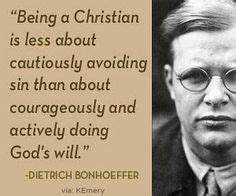
Being a Christian is less about cautiously avoiding sin than about courageously and actively doing God’s will.
Dietrich Bonhoeffer
Dietrich Bonhoeffer was a German pastor and writer who ended up sacrificing his life as he protested the Nazi regime in his homeland. Many of the things he wrote are uncomfortable for modern Christians to read. Sometimes, we want to coast along, joyfully celebrating our own Salvation, and ignoring the evil around us. After all, the ultimate victory is already won in Christ, isn’t it?
I write a lot about the power of prayer. And I stand behind what I write. But a life of prayer and Bible Study that doesn’t result in actively living out and spreading the Gospel is a life of lukewarm and selective obedience. This is not to say that we should skitter around trying to earn our Salvation with random acts and self-righteous crusades. But we must have the courage to “come out of the closet” as Christians in a dark and unfriendly world.
What does this look like? Does it mean wearing a badge or getting in people’s faces with “the Truth.” Perhaps. But mostly, it means every day living out the kind of love and truth that Jesus demonstrated. Jesus didn’t march in protests, hand out pamphlets with convicting messages, or start arguments to humiliate atheists in front of crowds. But He didn’t back down in the face of arguments and tough questions asked by His opponents. He ate with sinners– but He didn’t wink at their sin, or send them away reassured that they were “good enough” to please God. He went where God sent, spoke God’s Truth, and DID God’s work.
Jesus wasn’t a writer; He wasn’t a professor of Theology, or an elected official. The Pharisees were constantly frustrated with His lack of “credentials.” But their frustration came because Jesus spoke with the kind of authority they could never achieve– Jesus was authentic. He spoke, not from cold and lofty intelligence, but from wisdom and love. And Jesus didn’t just speak. He served. He listened. He lived out all that He spoke. He “courageously and actively” DID the will of the Father.
Jesus prayed and studied scripture. Jesus spent time alone communing with the Father. He spent time in rest. He spent time being social with His family and friends. But in every activity, He wove in the Truth of God’s word. And crowds followed Him. They wanted to listen, even as He spoke uncomfortable truths. And some of them came to love Him. Others came to hate Him, and even kill him.
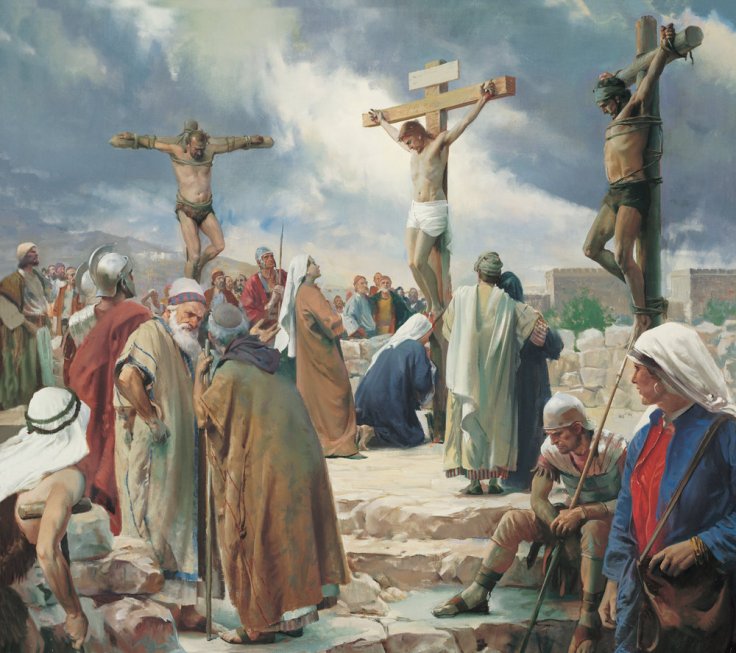
We can’t be true followers of Christ and not risk being mocked, and hated. We WILL be misunderstood, laughed at, persecuted, ignored, and inconvenienced. We should not invite this with obnoxious or arrogant behavior. But we must not shrink away from it when it comes at us, or try to avoid it by being silent in the face of evil and injustice.
One of the recent charges leveled against Christians is that we meet evil with “thoughts and prayers” but little action. We must be wise and careful with such charges. Often, the taunt is thrown at us in an effort to get us to take a specific, ungodly “action” INSTEAD of praying. But we must honestly examine ourselves and ask what Godly actions SHOULD I be taking to make a difference? What actions should I be denouncing as ungodly, even if they are popular and seem to be “right?” And what must I do to defend the power of prayer in the face of ridicule?
One of the other charges leveled against Christians is that we are “intolerant.” Again, we need to be wise and careful in answering this charge. Are we quick to judge others, while giving ourselves a “pat on the back” for merely avoiding a particular sin or sinful lifestyle? What is if about our life and work that makes others see us as “intolerant?” Are we exclusive and prejudiced in our interactions? Or are we humble in presenting the truth of God’s word? Do we speak from a need to defend our own actions or from a desire to help others? Are others offended by our words and actions, or by the truth of God as it convicts them?
During this season of the year, we hear a lot of “Christmas” music. Much of it is secular music–Santa Claus and magical snowmen, gifts and parties, and the Holiday “blues.” But much of it is related to the real reason for Christmas: the birth of Our Lord. And the number of songs, hymns, cantatas and symphonies related to Christ’s birth is staggering! Popular secular singers record “their” versions of favorite hymns; choirs and orchestras present new songs and ancient melodies. Many of the songs fall into two distinct categories, however. There are quiet lullabies–peaceful and meditative, focused on the infant in the manger; and there are Hallelujahs– joyful and majestic, focused on the wonder of God coming to earth.
I don’t know if there were actually lullabies OR Hallelujahs on that first Christmas. The Bible mentions the visit of the angels, but they were “praising God and SAYING, ‘Glory to God in the Highest..'” We often assume that their praise included singing, but the Bible isn’t specific. But it is interesting to look at the contrast of the quietness of the manger and the Glory of the angel hosts, and hear the contrast in the hymns we raise at this time of year.
Lullabies, and quiet songs, like “Silent Night,” or “Away in a Manger” call our minds and hearts to the humility of the Christ child. Babies are cute and engaging. And they are not “silent.” But they do not command authority and majesty. Babies cry out for help. They are needy in a way that God is NOT. And yet…God came in the form of a helpless baby. The God who created the galaxies needed someone to feed and change Him; to carry Him from place to place and rock Him to sleep. “O, Little Town of Bethlehem” reminds us that He came to a cattle shed in a small town, rather than to a palace in the seat of power.
Hallelujahs, like “Joy to the World” and “Hark, the Herald Angels Sing,” remind us that this was no ordinary child. And yet…the angels did not appear IN the manger or even in the little Town of Bethlehem. The Angels were compelled to sing their praises, not to the learned priests, or the courts of power, but to dumb-founded shepherds on a cold hillside. What an explosive visitation! Their praises (whether shouted or sung) shattered the quiet and the darkness. Like a sudden fireworks display, the Glory of God’s servants split the night.
God enters our hearts– sometimes quietly, like the cooing of an infant; sometimes dramatically, like a chorus of angels. God is at work– sometimes in humble moments and ordinary gestures; sometimes in glorious flashes of insight and inexplicable miracles. And this season, our prayers will rise up– sometimes like the humble cries of a newborn baby; sometimes like the soaring songs of angel hosts– prayers of need; prayers of thanksgiving; prayers of awe-struck worship; prayers of simple confession of our own unworthiness, and of God’s sufficiency and everlasting Love. Peace and Glory; lullabies and Hallelujahs; simplicity and majesty– all wrapped up on a manger of hay on one Holy Night.
Poor Fruitcake– the butt of dozens of Christmas jokes. Someone once said that there were 20 Fruitcakes produced in France in 1541– and they are all still in circulation today! I know a few people who like fruitcake, but most people just make fun of it. Technically, it IS a cake, but it is mostly made up of fruit and nuts soaked in rum or brandy or candied for preservation. Fruitcakes can be mailed, shipped, and saved for months without rotting, but the fruits never taste fresh, and much of their flavor is overwhelmed by the sugars used to preserve them. Fruitcake is heavy, and sweet. It is full of things that are “good for you,” but the end result is not very healthful.
I was reading the other day in Galatians, and a couple of days later in Philippians– two passages that speak of Christians producing fruit. Our lives are to be characterized by virtues and acts of service that bring health and healing, joy and peace to those around us. And these virtues are the products of our Faith in Action– of The Holy Spirit working in and through us.
22 But when the Holy Spirit controls our lives he will produce this kind of fruit in us: love, joy, peace, patience, kindness, goodness, faithfulness, 23 gentleness and self-control; and here there is no conflict with Jewish laws.
Galatians 5:22-23 (Living Bible–emphasis added)
So this is my prayer: that your love will flourish and that you will not only love much but well. Learn to love appropriately. You need to use your head and test your feelings so that your love is sincere and intelligent, not sentimental gush. Live a lover’s life, circumspect and exemplary, a life Jesus will be proud of: bountiful in fruits from the soul, making Jesus Christ attractive to all, getting everyone involved in the glory and praise of God.
“Fruit of the Spirit” is not something we can manufacture ourselves. Only God’s Spirit at work IN us can produce such fruit. And, while it is Fruit that will last, it doesn’t need to be dried or candied or soaked for preservation. Unlike the fruit in Fruitcake, the Fruit of the Spirit is eternally fresh and bursting with life and flavor. There is nothing wrong or evil about Holiday Fruitcake. But it cannot compare with fresh fruit for wholesomeness and healthfulness.
Sometimes, we try to manufacture our own “Fruit of the Spirit.” And this can be far worse than a harmless but calorie-laden Holiday Fruitcake. Even those who are opposed to Christ can manufacture a certain amount of Joy, or Patience, or Self-Control. Anyone can appear Gentle or Kind when they choose. But, separated from the source of life and growth, we cannot produce fresh fruit. Our Joy may be soaked in Rum. Our Patience may dry up. Our Kindness may be candy-sweet, but hiding malicious or selfish motives. Or we may surround our fruit with worldly “wisdom,” disguising and transforming it with cake and nuts.
This holiday season, let’s not become dried out or artificially sweetened in our acts of service and Love. Let’s be producers of Godly Fruit– Love that reaches out to the Lost, the lonely, and the “unlovable” with true love and not just sentimentality; Joy that bubbles up from a thankful heart and a transformed mind; Peace that transcends our current trials and circumstances; Patience that endures hardship without losing hope; Kindness that wraps itself around the unworthy and never tires; Goodness that knows no conceit and seeks no credit; Faithfulness that inspires and produces hope in a faithless world; Gentleness that smooths over troubled waters without being overcome; and a rock-solid Self-Control and steadiness that produces trust– not in our own power or wisdom, but in the One who produces it in our lives. We should be humble and grateful, teachable, and ready to forgive, encourage, and pray for others.
3 If anyone advocates a different doctrine and does not agree with sound words, those of our Lord Jesus Christ, and with the doctrine conforming to godliness, 4 he is conceited and understands nothing; but he has a morbid interest in controversial questions and disputes about words, out of which arise envy, strife, abusive language, evil suspicions, 5 and constant friction between men of depraved mind and deprived of the truth, who suppose that godliness is a means of gain. 6 But godliness actually is a means of great gain when accompanied by contentment. 7 For we have brought nothing into the world, so we cannot take anything out of it either. 8 If we have food and covering, with these we shall be content. 9 But those who want to get rich fall into temptation and a snare and many foolish and harmful desires which plunge men into ruin and destruction. 10 For the love of money is a root of all sorts of evil, and some by longing for it have wandered away from the faith and pierced themselves with many griefs.11 But flee from these things, you man of God, and pursue righteousness, godliness, faith, love, perseverance and gentleness. 12 Fight the good fight of faith; take hold of the eternal life to which you were called, and you made the good confession in the presence of many witnesses.
“Godliness with contentment is great gain.” (1 Timothy 6:6) We are entering a season of Thanksgiving and Christmas, and it can be a wonderful time to count one’s blessings and give praise with a humble and thankful heart. But it can also be a season of discontent, envy, overspending, and even depression. Many people are restless. They want “more”– more stuff, more respect, more power, more popularity, better health, a bigger house, trendier clothes…the list can be endless. Advertisers work hard to stir up this kind of discontent in the hope that people will buy their products. Politicians stir up discontent and fear to get more votes. Even religious leaders can stir up discontent in the hope of gaining influence, respect, and money.
God will not stir up discontent in our hearts. Instead, He wants us to learn to be content and grateful for the blessings we already have, and to trust Him for the things we both need and desire. He will see to it that we get what we need to live a Godly life, even if it seems meager compared to others who boast of their circumstances. Those who trust in their wealth or power will find it is never “enough.” Discontent breeds more discontent– envy gives rise to anger and bitterness. Greed gives way to dishonesty and violence. It is the enemy of Godliness and Humility. It is the enemy of the Christian Walk.
But there is another danger to the Christian. We should desire to develop a spirit of contentment, but we must be careful not to let contentment become complacency. The Apostle Paul does not stop in his message to Timothy, but reminds him to both “flee” the temptation of greed and discontent, and “pursue righteousness, godliness, faith, love, perseverance and gentleness.” Contentment is not an excuse for complacency. We are to “fight the good fight of Faith.” We are to be content with what we have, but not complacent about where we stand or how we live.
Discontent says– “I don’t have enough. I need more! (Even if I must take it by force or manipulation)”. Complacency says–” I have everything I need. I am an island of self-sufficiency. I don’t need anything (including God!) Both attitudes are conceited and fail to acknowledge God’s provision and His Sovereignty. The discontented, greedy person will be at war with God’s laws. The complacent person may not be fighting against God’s laws, but s/he will ignore God’s will, and refuse to stand up for justice or mercy. The complacent person is complicit in evil, even when they are not the ones doing it. The complacent Christian is ungrateful, and has only half-hearted praise for the Author of the blessings they enjoy.
There are many “Christians” in both categories. Many who claim to follow Christ, but are really following what they think will bring them power, wealth, health, or popularity. Many are being lulled into complacency by their blessings and comfortable circumstances. Both groups have lost their focus. God is to be the center of our lives– not our own comfort or our own pursuit of it.
This season, may we be content, humble, and willing to give God the Thanks, Praise, and Worship He deserves. And may we not become complacent about doing good, standing firm in the Faith, and helping others.
18 And a ruler asked him, “Good Teacher, what must I do to inherit eternal life?” 19 And Jesus said to him, “Why do you call me good? No one is good except God alone. 20 You know the commandments: ‘Do not commit adultery, Do not murder, Do not steal, Do not bear false witness, Honor your father and mother.’” 21 And he said, “All these I have kept from my youth.” 22 When Jesus heard this, he said to him, “One thing you still lack. Sell all that you have and distribute to the poor, and you will have treasure in heaven; and come, follow me.” 23 But when he heard these things, he became very sad, for he was extremely rich. 24 Jesus, seeing that he had become sad, said, “How difficult it is for those who have wealth to enter the kingdom of God! 25 For it is easier for a camel to go through the eye of a needle than for a rich person to enter the kingdom of God.” 26 Those who heard it said, “Then who can be saved?” 27 But he said, “What is impossible with man is possible with God.”
Luke 18:18-27 ESV via biblegateway.com
I love that Jesus didn’t just give pithy answers to questions, but often went in roundabout ways to explore the motives behind them. I also love how He would use others’ questions, mixed with parables, metaphors, or other figurative language to stimulate further thought. And His parables and word pictures, while short and simple, have layers of meaning that cause us to ponder deeper issues.
The “Rich Young Ruler” in the above story came to Jesus with a question. “What must I do to inherit eternal life?” Instead of answering the question, Jesus seems to get distracted by the young man’s greeting. “Why do you call me ‘Good?'” Did the young man really think that Jesus was better, or wiser, or more righteous than the religious leaders of the day? Or was he trying to flatter Jesus? Or did he think that Jesus would see him as an equal (or even superior) when he found out how righteous the ruler was? Jesus got to the heart of the greeting– “No one is good except God alone.” And therein lies the true answer to the ruler’s question, as well. There is nothing anyone can do to be “Good” enough to inherit eternal life.
Jesus could have said this, but would the young ruler have accepted this answer? Probably not. His question betrays an assumption that he WAS good enough– that he had already done all that was required and that Jesus would surely be impressed and announce to the crowd that here was an example of someone who was worthy of eternal life. Instead, Jesus led the man through his pride by naming a few of the commandments– the very ones the ruler was so sure of. Indeed, this seemed to be exactly what the ruler was hoping to hear– proof that he had “passed the test.” Ironically, he was addressing Jesus as “Good teacher, ” but seemed to miss that fact that he was also addressing the only One who is truly Good! Jesus–God in the flesh — the very one whose death would guarantee that anyone would “inherit” eternal life. This young ruler doesn’t want Jesus to be his “Lord” and “Savior,” he just wants Jesus’s opinion.
But then, Jesus pulled the rug out from under this man’s assumptions. “One thing you still lack.” One thing…I’m sure the young ruler thought it would be a fine point in the laws or traditions he know so well– some minor point that could be cleared up with a gift or a small offering. I find this a fascinating statement, because it is followed by “sell all you have and distribute to the poor…” It seems like such an oxymoronic statement. You lack one thing, therefore, you must give away all that you have. How is that possible? Because the “one thing” the rich man lacked was not an object; not something he could check off a list of “things I can do to impress the religious leaders.” This man lacked humility; he lacked a self-awareness of his own need. And he lacked the understanding of what it means to “inherit” eternal life. No one “earns” an inheritance. Even someone who is rewarded with an inheritance must trust in the goodwill of the person writing the will, and will only inherit under the terms of the will. Jesus’s “terms” were not that the man had to become destitute or spend the rest of this life as a beggar. But faced with the choice of his comfortable life in the here and now, or eternal and abundant life in heaven on God’s terms, this man chose earthly wealth and spiritual poverty.
Almost lost at the end of Jesus’s surprising answer are the last two phrases, “and you will have treasure in heaven; and come, follow me.” This man wanted eternal life as an extension of his comfortable life on earth. He did NOT want eternal life enough to sacrifice his present comforts or his preconceived notions of “goodness.” He did not want to follow Christ– he only wanted to consult with Him.
I find it uncomfortable to hear about the young ruler’s rejection of Christ. I understand the initial shock of the disciples as Jesus uses the illustration of a camel going through the eye of a needle to compare with a “rich” person coming into the kingdom of God. Wasn’t Abraham wealthy? Wasn’t Solomon rich? What about King David? If riches make it impossible to follow Christ, who can gain eternal life? Thankfully, Jesus redirects the focus– it’s not about the riches; and it’s not about what we “do”– it is God’s “Good” pleasure to give eternal life to those who choose to “follow” Him.
“Good Teacher and Lord, help me to remember this lesson as I come before you in prayer. You have not asked me to ‘earn’ my inheritance. It is your gift to answer my prayers as you see fit; to be the Lord of my life; to be merciful and gracious to me; to prepare a place for me to live with You for eternity. What you ask of me is that I ‘follow’ you– that I listen to your call; that I accept Your “terms” of inheritance; that I share Your Grace and Mercy with those around me.”
5-9 So don’t lose a minute in building on what you’ve been given, complementing your basic faith with good character, spiritual understanding, alert discipline, passionate patience, reverent wonder, warm friendliness, and generous love, each dimension fitting into and developing the others. With these qualities active and growing in your lives, no grass will grow under your feet, no day will pass without its reward as you mature in your experience of our Master Jesus. Without these qualities you can’t see what’s right before you, oblivious that your old sinful life has been wiped off the books.
8 “For my thoughts are not your thoughts, and your ways are not my ways.” This is the Lord’s declaration. 9 “For as heaven is higher than earth, so my ways are higher than your ways, and my thoughts than your thoughts.
Isaiah 55:8-9 (Christian Standard Bible)
I do not understand God’s ways. If I try to work it out with human understanding, I will never make sense of how God works. I don’t have His wisdom or omniscience; I don’t have His eternal perspective or omnipotence. God will never answer all of my questions; He will never reveal all of His plans or reasoning to me. He calls me to walk in Faith, not by sight (2 Corinthians 5:7) This is a stumbling block to many. It is especially frustrating for those who think they already DO know (almost) everything, and believe that they should be able to speak to God as a peer, even to be able to consult Him! I knew of a man (a convicted felon) who refused to repent of his actions. He admitted that he had done wrong, and that his prison sentence was deserved, but when challenged with how he would answer before God, he simply said–“God and I will come to an understanding.” He simply felt that if he explained “his side of the story,” God would change his immutable commandments and make an exception.
God doesn’t need anyone to “explain” anything to Him. Nor does He “owe” any of His creation an explanation for His actions or seeming inactions. I will never understand why certain injustices are allowed to happen, and seem to go unpunished in my lifetime. I don’t understand God’s timing in my life– why my father died when he did, or why I had to wait so long to be married. But I am learning to trust that God knows every injustice, every need, every situation we face, and that He WILL make all things “right” in HIS time and in His perfect way.
Spiritual Understanding has to come from the Spirit. It cannot come through our own wisdom or learning. It has to be built, not just on Faith, but on acting in Faith and walking humbly in conformity to our Good Shepherd’s example. We must become, not just “fans” of Christ, or even just students of Christ, but disciples of Christ, if we want to begin to have greater understanding. Like the apprentice, who must learn by doing, so we must learn through practice of God’s Word. We must also ASK for wisdom and understanding. (James 1:5) They are gifts, just like Salvation. We don’t earn understanding; we are granted it as we walk in obedience and faith.
Today, my prayer is that I would receive insight as I learn to trust, and I would trust that God will give the wisdom I need for the day ahead– no more or less, and not a moment too late or too soon. And experience confirms that He is faithful to do just that!
I live just about an hour away from one of the Great Lakes. Within a comfortable driving distance, there are at least three beautiful lighthouses along the lake. Driving to or from the lighthouses, we pass through an area known as the “Fruit Belt.” Orchards, vineyards, and croplands are bursting this time of year–the very air is redolent with the smell of ripening apples, grapes, corn, beans, berries, wheat, and more. Some of the orchards and vineyards still have old watchtowers, though many have been removed or replaced with digital cameras.
Lighthouses and watchtowers serve a purpose– one that is still important today. Lighthouses help ships and other lake traffic avoid dangerous reefs and rocks along the shore, as well as sandbars. They guide travelers in the dark, and through storms. Watchmen in towers protect crops from dangers such as fire and predators. They watch for storms, and signs of draught and frost. Both lighthouses and watchtowers are fixed, steady, visible, and convey safety and security.
I’ve been reading through the prophets lately– Isaiah, Jeremiah, Ezekiel…the prophets were sending out a warning to the rebellious people of Israel and Judah. Even though the imagery is often graphic and stark, the message was one of steady love and warning from God. God loves us enough to guide us through the rocks and perils of life. He sends warnings– not to harm us but to keep us from harm. He sends faithful friends and other messengers to stand firm with us through the storm and drought and danger around us.
Just like the light from the lighthouse, or the sound of a foghorn, the message may be glaring and unpleasant, sometimes. We may be sailing along with no notion of the rocks ahead. Or we may be strolling through the vineyard, unaware of a prowling animal or a fire just over the next rise. We may even resent the warnings we read in the Bible or hear from friends. We may be afraid to BE the one giving out the warning– afraid of being misunderstood or resented or even rejected.
God asks us to be watchmen– to be lighthouses– ready to shout out a warning to those who may be in danger. He also asks us to be vigilant and ready to heed the warnings He sends through others.
How do we know when “friendly” reminders and warnings are true? How can we be sure that they are not just petty criticism or overreactions?
Check them against Scripture. And check them in the context of Scripture. A single verse, taken out of context, that seems to contradict other passages should always be suspect. But a general principle, found throughout the Old and New Testaments should be heeded.
Look for consistency. Lighthouses and watchtowers don’t bend and sway with the winds of change. “Warnings” that change with circumstances, or seem relative to certain situations should be suspect.
Listen for (and speak with) Love. Friends may speak words of warning, but they will also speak of mercy and hope.
Listen for (and speak) truth–warnings should contain specifics, rather than vague fears or blanket accusations.
Listen (and speak) with humility. That doesn’t mean that we cannot speak in our defense, but we should not be defensive or resentful– even if the warnings are spurious. Remember, Jesus was accused of being “from Satan” during His own ministry, yet He answered firmly and gently, not with anger or hatred.
Give Thanks! Give thanks that God sends us warnings, and gives us opportunities to recognize danger and error, and opportunities to repent and change course, and encourage others to do the same!
If you are a woman who has grown up “in the church,” you are probably familiar with Proverbs 31. It is the chapter about a virtuous woman. She is the role-model that is held up for young girls and older women alike. And she is, like Mary Poppins, “practically perfect in every way.” She gets up before the sun, stays up late into the night–always busy, always productive; she never slows down. She never has a bad hair day, never loses her temper, never forgets to pack a lunch or fold the laundry. She never nags, never scolds, never pouts, and never has to raise her voice.
It helps that she has serving girls to do her bidding, and has her own business. She appears to be independently wealthy and active, yet she has time to raise children who “rise up and call her blessed,” and satisfy her husband, who “lacks nothing of value.”
I would love to say that I am just like that woman. Most days, however, I feel nothing like her. I don’t have money to buy a new field. I don’t get up before the sun and my hands are not eager to work. I don’t make and sell linen garments. No one is running around calling me “blessed” or singing my praises… I can never measure up to this woman. I feel cursed.
But a closer reading of this chapter makes me think again.
While the woman described in this chapter is a model to emulate, she is not the norm. Nor is she the standard to which I must adhere to “earn” my way into God’s good graces. Indeed, God’s Mercy is the richer and His Grace more precious for knowing that I cannot “measure up.”
Instead of using Proverbs 31 to beat myself up for not being perfect (or using it to discourage or intimidate others), I need to learn from it. Here are a few things I’m hanging on to as I read through it this week:
“She brings him (her husband) good, not harm…” (v. 12) What are some ways I can bring good, not harm, into my home and marriage? How can I listen more, nag, less, be more available, and otherwise show love and care? I won’t be perfect, but I can look for ways to improve!
“She works with eager hands..” (v. 13) “She sets about her work vigorously…”(v. 17) I may not be spinning wool or flax in the early light; I may not have serving girls to order, but I have hands and work to do throughout the day. How can I do a better job of seeing chores as opportunities, rather than oppression and drudgery? How can I bring a greater sense of purpose to my tasks? I may not have serving girls, but I have appliances–am I “ordering” them properly by taking care of them, instead of just taking them for granted? And am I grateful for their help?
“She opens her arms to the poor and extends her hands to the needy…” (v. 20) What can I do to “give” more–donate, volunteer, provide hospitality and encouragement? How can I keep in mind that during various seasons of life the “poor” and “needy” may be in my own home and family–children or grandchildren needing nourishment and discipline; parents needing care and support…How can I be more available to those outside of my home, or during my work hours? Can I send an e-mail or make a call to offer encouragement? Can I share a recipe with a friend, or invite them to come with me shopping or to church? Can I make time to pray with a neighbor? Can I clean out a closet and donate clothes or linens?
“She speaks with wisdom, and faithful instruction is on her tongue..” (v. 26) What a challenge!? What is “on my tongue?” Gossip? Criticism? Complaining? Idle chatter? Do I speak too much? Do I remain silent when I could offer needed instruction, encouragement, or correction? Do I speak with gentleness and compassion? With conviction and truth?
“…she does not eat the bread of idleness..”(v27). Ouch! Everyone needs to rest– even the seemingly indefatigable woman of Proverbs 31! But am I becoming “fat” on leisure time? How much time to I waste on distractions and entertainment that could be put to better use?
“Charm is deceptive, and beauty is fleeting, but a woman who fears the Lord will be praised..” (v30) I may strive to be an “accomplished” woman– someone who is poised, talented, successful in business and society, with a picture-perfect house and garden, children on the dean’s list or the winning sports team; I can be will-traveled and well-educated, someone who seems to “have it all”–and still NOT be a woman of noble character. God isn’t impressed by my clothes or my achievements; He doesn’t give me credit for being “better” than my next door neighbor, or having the best kitchen on the block; God will not love me any more for being more successful or productive than anyone else. If my house is cluttered, my hair is untame-able, my kids have public melt-downs, and I don’t belong to the “in” club; if my business fails, my car is rusty (or I don’t have one), and my husband and I wear second-hand clothes, God still sees my heart. I can still be a woman who fears, trusts, and serves the Lord– one who is loved, accepted, and even “praised” by the One who matters most!
Finally, I can Pray to become a woman/wife of noble character (v.10), striving for good habits, rather than fretting over and wallowing in bad ones. I can trust God’s willingness and ability to transform my life and my attitudes. In fact, I am reminded of a seemingly unrelated portion of scripture from Philippians:
8-9 Summing it all up, friends, I’d say you’ll do best by filling your minds and meditating on things true, noble, reputable, authentic, compelling, gracious—the best, not the worst; the beautiful, not the ugly; things to praise, not things to curse. Put into practice what you learned from me, what you heard and saw and realized. Do that, and God, who makes everything work together, will work you into his most excellent harmonies.
I need to spend less of my time worrying about getting things “done”, than getting them done God’s way! I don’t need to fear the “curse” of Proverbs 31– failure to measure up to a model– instead, I need to see the opportunity to become a woman after God’s own heart– one who accepts God’s help and wisdom to become the woman HE wants me to be. I pray that God will give me the chance to develop–and help others–today and each new day.
It’s gardening season– many with gardens are reaping an early harvest of tomatoes, peas, beans, and other vegetables. I live in town, and have no space for a garden, but I have memories of working in my mom’s and grandma’s gardens. Gardening takes a lot of work, and involves a lot of elements. A life of prayer also requires a lot of discipline and certain elements:
Plowed ground– we need hearts that are softened and humble, ready to listen and respond.
Seeds of faith– even those as small as a mustard seed!
“Son”-shine–we can follow the examples of the prayers of Jesus, as well as His teachings on prayer.
Living Water–Jesus gives us living water in His words and His life. The more we spend time with Him (through prayer and in His Word), the more we will experience the nourishment He provides!
Cultivation– it is not enough just to plant a seed and leave it. We need to spend time in devotion, worship, prayer, scripture reading, and fellowship daily if we want growth. We also need to “weed out” sinful habits and thoughts that keep us from trusting God’s will and timing.
Workers for the harvest–Our lives should be producing fruit. But fruit that isn’t harvested and shared will go to waste! And we should also be ready to harvest the fruit of others– encouraging and building one another to better growth and adding to the Kingdom.