I really need to go on that diet. I really should call my Aunt Kay. I need an hour of peace and quiet. And time to sit and pray.
But I’m scrolling through Facebook. I’m following the news. I just need another look; This meme has so many views..
I should greet that new couple at church. I should make them feel at home. But I need a cup of coffee first. And my hair should be re-combed.
My Bible waits by my chair– Unread these past four days. Later, I know it will still be there– Ready to catch my gaze
Tomorrow, or the next day. God will understand. I want to follow His Way, But this wasn’t what I planned.
I got caught up in a magazine I stopped to shoot the breeze– My house is needing to be cleaned Before I get on my knees.
I “had to,” “should have,” “had a mind” To spend time with God, and yet My day’s flown past, and now I find I’ve only time to fret.
“Not yet” was my sad refrain “Not yet” kept me on the go. “Not yet” robbed me once again Of time spent with One who loves me so.
And so my day was filled and rife With wasted time and small regrets. I missed the more abundant life Of trust grown from obedience.
The internet will still be there Tomorrow and the next day; But the trust built up in an hour of prayer Can never be taken away.
Today may be busy with “urgent” needs and countless distractions. But there will only be one “today” to meet with God– in prayer, Bible study, meditation, and worship. What is my priority today? Even if I can’t “find” an entire hour in my busy schedule, have I made a plan and a priority to meet with God? Am I searching for opportunities to serve Him and encourage others, or am I too busy searching for my own entertainment and fulfillment? What are the empty things in my life that I should be telling, “Not yet?”
“Let every heart prepare Him room, And Heaven and Nature sing!”
from “Joy to the World”, by Isaac Watts
I cleared a space in my living room for a tree. I placed a Nativity set on our newly-cleaned mantle place.
I found a cozy nook to wrap all the Christmas gifts, And I used candles and decorations to fill all the empty space.
I cashed in my Christmas club money to buy the gifts For friends and family.
I set aside money to buy stamps for Christmas cards And to give to charity.
I cleared my schedule and made time for All the extra running this Holiday season.
For parties and shopping with friends; For Church and family–all excellent reasons!
But it wasn’t until I made time and space for the Babe– God come to Earth as a baby Boy–
It wasn’t until I let go of all of “it” for “HIM,” That my heart was transformed with Unspeakable Joy!
Christmas has room for bells and lights, For carols, and cookies, and festive nights.
Christmas has room for laughter and presents. But it isn’t really Christmas without HIS PRESENCE.
“Let every heart prepare Him room” this year. Let every heart be filled with true cheer.
Let us Adore Him–far and wide– This Savior who was born; who died
And rose victorious over the tomb! Who entered our world in a Virgin’s womb,
The one who came to save the human race; The one who is filled with “redeeming Grace!”
May Christmas Day, and ALL our days Be filled with Wonder, Joy, and Praise!
Today, as we celebrate the coming of Jesus Christ into the world, let us remember that He came into a world that wasn’t prepared. There was no room in the inn. There was no baby shower, anticipating the arrival of a long-expected birth. In fact, His birth came without all the trappings that we have added to the Holiday. I love all the wonder of the Christmas Season– all the lights and songs; gathering with family, and friends, Advent services and Christmas Eve candlelight vigils, gifts and cookies, Christmas movies and Christmas cards– I could go on for pages!
But the heart of Christmas comes quietly and simply; when we step back from all the glitter and activity and take in the absolute wonder that the God of the Universe stepped into all the limitations of His Creation– a world of time and space, dirt and disease, broken hearts and broken bodies–and He did it for YOU and for ME. He had to be fed and changed–the ruler of Nations!–and placed in a manger to lie in all the helplessness of infancy. He had to walk wherever He wanted to go. He had to eat and sleep and wait in lines and wash away the dirt and sweat of His exertions. He had to listen to the foolish arguments and explain Himself to critics whose very souls He had lovingly created. And He let them condemn Him unfairly and kill Him in the most painful and humiliating way they could dream up.
Christmas is about Joy bursting into a world that was NOT prepared for it. It is about the inextricable link between suffering and celebration; between seeking and being sought out; between salvation and sacrifice.
Our Joy at Christmas cannot be manufactured by songs or gifts or entertainments. It can’t even be found in rituals and traditions. But when Jesus finds room in our meditations, our relationships, and our lives, Joy is the overflow.
May we all find Joy this Christmas– whether or not we prepared in advance; whether or not we checked off all the items on our “to-do” lists; whether we can afford all the trimmings and decorations; even if we are crying out in the darkness– may the Joy of Christmas burst upon us, just as Jesus burst upon a weary world so long ago!
Christmas is a time of joy and light. But the time of Advent is often a time of somber reflection. We remember a time we have never known– a time before the coming of Christ the Messiah– a time before the mysteries of Heaven were revealed and before the victory of Salvation was accomplished. Advent reminds us of the spiritual darkness that existed before God, in human form, in humble obedience, and in sacrificial love, became the Light of the World, and the Hope of All Nations.
Before the bells rang, and the angels sang; before the kings brought gold and the shepherds ran to tell the news; before there were Christmas Carols, Christmas decorations, or Christmas pageants– there was solemn silence, fear, dread, and waiting. God had been silent. The prophets had been silent. The world had grown hard and cold.
Jesus stepped out of the unfathomable glory of the Highest Heaven– surrounded by armies of angels all worshiping Him and ready to do His bidding. In an instant, He became a helpless fetus inside a helpless young woman, a subject of the Roman Empire, and at the mercy of her culture. Her fiance could have repudiated her; her parents could have disowned her; her community could have had her stoned to death, along with her unborn child. No one, even those who were anticipating the arrival of a Christ, was expecting this tiny baby growing inside the womb to change the course of history.
He was born in obscurity, in ignominious squalor. He was the Lord of All Creation, wrapped in rags and laid in a feeding trough in an overcrowded city at tax time. There were no bells or carolers, no glittering trees or festivals of lights, no sounds of joy and celebration– not in that manger in Bethlehem. Instead, there were strangers pushing and shoving, shouting, and snoring in the inns and houses and streets, being watched by soldiers and pickpockets alike, as they made their way through narrow, unfamiliar streets and tried to lock out the worry and danger and dread. There may have been silence in the fields and valleys outside of town, but not near the stable where Jesus was born. No. The “silence” we sing about during Advent is the silence inside our own hearts– a call to “be still,” and know that this baby we celebrate is God Incarnate. He is the One to whom every knee will one day bow, and every tongue confess that He is LORD.
In the stillness and silence of Advent, in the darkness lit only by candles and faint hope, we being to understand the contrast. We re-imagine what came before the joy and hope and eternal clouds of witnesses shouting, “Holy, Holy, Holy!” We remember the days and years before the angels sang, and the star danced across the night sky– before the shocking crucifixion and the glorious resurrection of this still unborn Savior.
Let us spend these days of Advent preparing our hearts for the true wonder of Christmas. It doesn’t come in the wrapped packages under a festive tree, or in the feasting with friends or family. It doesn’t come with sirens and parades, or speakers at the mall blaring out favorite tunes. It doesn’t come in the majesty of a Cathedral ringing with the voices of a choir and organ. It comes when the silence and darkness of our sin and dread are pierced with the overwhelming glory of God With Us– Emmanuel is coming! But for now, for these moments, Let All Mortal Flesh Keep Silence.
“Praise Him, Praise Him, Jesus our Blessed Redeemer…” “Here I am to Worship. Here I am to bow down. Here I am to say that You’re my God…”
Have you prayed a hymn lately? Or maybe meditated on a single phrase from a recent worship chorus at Church? Music is often a language unto itself, and can be a great tool for prayer. Recently, I spoke of praying scripture. This is very similar, and in fact, many of the Psalms are both prayer AND scripture. There is something about music that can transcend words alone to communicate our thoughts, emotions, and even memory as we pray.
Just like praying scripture, there is also a temptation to use music to substitute for prayer, and we should seek to avoid that. But in general, music can be a great inspiration and addition to our pursuit of prayer. I find that hymns reach back through my memory to pull out great truths of faith that I can pray back to God, while newer worship choruses often capture emotions, including both praise and confession. At times, I have even used secular music, including love songs and the blues, to tap into emotions that I want to share with the One who loves me eternally and cheers me when no other can.
King David is the quintessential “singer/prayer” in the Bible, and his Psalms are wonderful to use. Many of them are still being put to new music and can be sung, as well as read or recited. But there are thousands of hymns, songs, choruses, cantatas, operatic masses, chants, raps, and more that can be presented as prayer. How?
Use whatever method fits you best– use the radio, an MP3, streaming service, CD, etc., to play a song, or sing it a capella; if you are a musician, you can play the song on your instrument and sing along or think of the lyrics as you play.
Go through one verse of the song over and over– or one line or phrase that has a particular meaning. Meditate on it before the one who inspired it. “A Mighty Fortress is our God…A Mighty Fortress are you, God… A bulwark never failing… NEVER failing…”
Do a “mash up” as you are singing one song another one may come to mind. Create a medley of personal worship. Some songs might even run into each other!
Don’t be afraid to add dance or movement. Clap along. Lift your hands. Sway.
If you are having trouble getting started, find a book of hymns or songs, or tune the radio to a station that plays good music.
Make up a song from your heart! Reach back into your memory for a children’s chorus (if you grew up in church). Change the lyrics to “redeem” a classic rock song (it sounds strange, but it is not impossible for most tunes!)
Make a joyful noise!– Don’t worry if you are not a great singer. God listens to your heart!
At least once each month, I want to give some practical tips I have learned that have improved my pursuit of prayer over the years. Today, I want to talk about praying scripture.
On its surface, praying scripture just means reading or saying Bible verses back to God. Of course, some Bible verses or passages lend themselves to this practice, while others do not. (Lists of genealogies in the Chronicles come to mind…) Sometimes, it requires that we change a pronoun or verb tense, or otherwise personalize the scripture, but we are echoing God’s “Word” back to Him in an act of worship. We may be echoing God’s literal words, or repeating words of worship spoken centuries earlier. Some examples:
“Lord, in the beginning YOU created the heavens and the earth”…(from Genesis 1:1) “Give praise to the Lord, proclaim his name; make known among the nations what he has done. Sing to him, sing praise to him; tell of all his wonderful acts. Glory in his holy name; let the hearts of those who seek the Lord rejoice. Look to the Lord and his strength; seek his face always.” 1 Chronicles 16:8-11
Create in me a pure heart, O God, and renew a steadfast spirit within me. Do not cast me from your presence or take your Holy Spirit from me. Restore to me the joy of your salvation and grant me a willing spirit, to sustain me. (Psalm 51:10-12)
“On my bed I remember you; I think of you through the watches of the night” (Psalm 63:6)
“Search me, God, and know my heart; test me and know my anxious thoughts. See if there is any offensive way in me and lead me in the way everlasting” (Psalm 139: 23-24)
Now to YOU who are able to do immeasurably more than all we ask or imagine, according to Your power that is at work within us, to You be glory in the church and in Christ Jesus throughout all generations, for ever and ever! Amen. (taken from Ephesians 3:20-21)
There are some benefits of doing this, but also some pitfalls. First the benefits:
Praying scripture can help us when we just don’t know what to say. Sometimes, we are so burdened or so exasperated, or so overwhelmed with emotion, that our words are swallowed up. But a remembered passage of scripture may allow us to speak our emotions in a way that our own words cannot. Sometimes, scripture will give us a focus that we lack, allowing us to put aside distracting thoughts, as well.
Praying scripture can help us memorize or review scripture. It can be helpful to read scripture aloud as a prayer, or even repeat key verses as prayer. Sometimes, we will be studying scripture and it speaks to us in a way that causes us to stop and pray it back.
Praying scripture can keep our prayers grounded. When we are tempted to pray selfish, momentary requests, scripture reminds us of God’s majesty, sovereignty, and timeless nature. Scripture magnified God and puts our petty worries and desires in their proper perspective.
In a group setting, praying scripture can help others focus better, or inspire them to remember another scripture passage that relates to what you have just prayed!
There are many other benefits of praying scripture, but there are also a few pitfalls:
Beware of using scripture as a substitute for your own thoughts and concerns. It is powerful to pray the Bible as it relates to your own worship and emotions, but God doesn’t want to hear only the echo of His words– He wants to hear them coming from your heart, as well as your lips. The ancient prophets warned against those who used a form of worship that lacked conviction and submission to His will.
Don’t feel bad when you say a prayer that does not contain a direct scriptural quotation– praying scripture is a tool and a guide, not a ritual or requirement. Don’t feel arrogant or superior when you DO pray scripture– it is a tool and a guide, but it does not make your prayer more effective or more Godly than an earnest prayer without a scripture reference.
Don’t “cherry-pick” scripture to pray in a way that is out of context or goes against the overall flow of scripture. Two of the most overused and misused scripture passages are Romans 8:28 and Jeremiah 29:11. They are both verses of promise and encouragement, and certainly can be used in prayer. But in context, they are meant to encourage those who are in the midst of anguish and despair, NOT promises to make life carefree or answer a selfish desire for an immediate good outcome.
If you have never (or rarely) tried praying scripture, I hope you will incorporate this tool into your pursuit of prayer. Whether you use a print Bible, scroll through a list of verses on line, or draw upon memory, you will find God’s words to be uplifting, convicting, encouraging, and wholly sufficient as you pour out your heart to your Maker. And if you already use this practice, I hope these tips will help you remember to use scripture wisely and appropriately as you pursue and practice a closer walk with God.
At least once each month this year, I want to post some practical tips on strengthening our pursuit of prayer. Today, I want to re-post an entry about making intimate space for prayer.
Prayer is a very personal pursuit. Yes, there is group prayer, and corporate prayer– and they are important and valid. But most of our prayer takes place alone; just pouring our heart out to the Father. There is no “rule” for where or how to pray, but Jesus did say that prayer should not be done for show. In fact, He advised that when we pray, we should go into our closets (or inner room, or away by ourselves) and lock the door! Why would He give such advice? I don’t have a full answer, but I can think of several advantages of “secret” prayer:
If you are alone and isolated, you are less likely to be interrupted. No phones, no text messages, e-mails, or drop-in visitors. Just you and God, intimate and focused.
A closet or inner room is not just free of interruptions, it is free of distractions– looking out of the window, hearing traffic noises, etc. So many times, we try to multi-task during prayer. Sometimes it is unintentional; other times, we feel guilty when we are not “doing” something. It’s not “wrong” to pray while we are cleaning, or driving (except don’t close your eyes!), or listening to music. But it is more likely that we will lose our focus. Even keeping a prayer list or journal can become a distraction– we’re more focused on “checking off” items on our list than communicating with our Loving Father.
A small , private, designated space can sometimes alter our perspective. God is Spirit– He can fill vast spaces, and His presence can go anywhere. But we are creatures of time and space; when I am in a small room, I feel my own smallness; it is easier to “be still” and to be humbled.
A closet is a room with purpose–it is where we keep things that we need, and store things we don’t want to lose. Praying in a designated “spot”– whether it is an actual closet or a corner of your bedroom, or a special chair or desk–can act as an anchor for our emotions and energy. “This is the spot where I pray” can set a mood and even become a cue to our bodies that it is time to meditate; to “be still and know” (see Psalm 46:10) that we are in God’s presence.
As Jesus noted, God knows what is done in secret. We have a human tendency to need affirmation and admiration. God will affirm, encourage, and even reward us for what we do– including what we pray– but it is tempting to seek human admiration, instead. This doesn’t just refer to the actual praying, but our need to announce our actions and prayers to the world. Once again, it isn’t “wrong” to let others know you are praying for them– in fact, it can be a great encouragement! But it IS wrong to make that our focus. Are you praying for the victims of a crisis or war– Great! Keep doing it! But be very careful about posting it on FB and announcing it to everyone in an effort to look “better” in their eyes. Are you praying for someone dealing with cancer or depression– Great! But are you doing more announcing than actual praying? Are you doing anything else to encourage and help the person in question?
6 “Be careful not to practice your righteousness in front of others to be seen by them. If you do, you will have no reward from your Father in heaven.2 “So when you give to the needy, do not announce it with trumpets, as the hypocrites do in the synagogues and on the streets, to be honored by others. Truly I tell you, they have received their reward in full. 3 But when you give to the needy, do not let your left hand know what your right hand is doing, 4 so that your giving may be in secret. Then your Father, who sees what is done in secret, will reward you. 5 “And when you pray, do not be like the hypocrites, for they love to pray standing in the synagogues and on the street corners to be seen by others. Truly I tell you, they have received their reward in full. 6 But when you pray, go into your room, close the door and pray to your Father, who is unseen. Then your Father, who sees what is done in secret, will reward you. 7 And when you pray, do not keep on babbling like pagans, for they think they will be heard because of their many words. 8 Do not be like them, for your Father knows what you need before you ask him.
Matthew 6:1-8 NIV (emphasis added)
This passage immediately preceded the example of “The Lord’s Prayer.” Jesus modeled for us, not just what words to pray, but how to think about prayer. For many of His followers, this was radical and new thinking. They were used to gathering for prayer. They were used to prayer being limited to rituals and practiced at festivals and worship services. The great patriarchs of the faith prayed as individuals, the priests prayed– long elaborate, and intimidating prayers. Jesus was removing the intimidation of history and tradition, and encouraging people to return to the kind of personal relationship that God intended for us from the beginning– the kind that would be possible with His own defeat of Sin and Death!
Even though I have this intimate access to the Father, and even though I write about it, I still need to be reminded of the importance of seeking God’s face and His approval above that of anyone or anything else. I hope you will also be encouraged to set some time aside today to spend in intimate communication with the One who loves you best!
The world is filled with language–there are well over 5,000 recognized languages and dialects around the globe. And within each language are thousands upon thousands of words– nouns and verb forms and adjectives; names and even grunts and sighs and “clicks” that vary from language group to language group.
In spite of this, we often find ourselves “speechless”– unable to find a word or sound that adequately communicates our thoughts or feelings in the moment. We stammer or sigh, gesture, or scream– but the words either don’t come or they don’t exist.
God knows and understands our innermost heart– with or without words. The Apostle Paul refers to this in Romans, chapter 8, when he talks about the Spirit interceding for us with groans that words cannot express (v. 26). And it’s not always groaning– sometimes there are no words for our joy– only dancing or tears of gladness. Sometimes, there are wails and cries that come straight from our broken hearts. Sometimes, our excited thoughts come so fast that we cannot form words and sounds to keep up.
Prayer isn’t always about words– carefully drafted lists of requests or thank-you’s for our blessings–sometimes prayer is a spontaneous gush of sound or movement; sometimes, it is an intense stillness and profound silence, such that your heartbeat is deafening and the very air sings in your ears. Sometimes, it is the eruption of pain and guilt, regret and despair–the sound of your soul being pulled up through your throat and ripped almost in two. And sometimes, miraculously, it is the overwhelming presence of God in all of his Holiness, Splendor, and Might that defies any human utterance, but draws out pure praise, unfiltered by language!
Today, whatever words (or utterances, clicks, gestures, or groanings) you use, don’t neglect to express your heart and soul to the one who made you. Prayer is more than just mere words, just as God is more than just someone else to talk to! He knows every language, every thought and emotion, and each individual intimately. He will understand– even beyond words!
Many years ago (never mind how many..) there was a television show called “Green Acres.” It was a comedy about a couple from New York City, who moved to a small town in the country. The husband was excited about the move– he was tired of the rat race and bustle of the city; his wife, however, was reluctant to leave all the opportunities– she missed the shops and activity.
Green Acres was one of a group of shows that both celebrated and poked fun at rural life in America in the sixties and early seventies. The shows were very popular among viewers, but were panned by critics, and cancelled by network executives, even at the height of their popularity. https://www.closerweekly.com/posts/cbs-rural-purge-mayberry-rfd-green-acres/
More than fifty years later, you can often see these shows on networks like TV Land. They are still popular among some viewers, who like the nostalgia and the gentle humor. These shows all have happy endings. They don’t involve grotesque murders, lots of foul language, preachy lectures on social issues like homelessness, domestic abuse, or drug addiction, or copious amounts of sex, violence, or nudity. They don’t talk about war and gangs, poverty or prejudice, or urban sprawl. They celebrate family, fresh air, hard work, community, truth, justice, kindness, and humility.
What does “Green Acres” (or Andy Griffith or any other old TV show) have to do with Psalm 23 and Pursuing Prayer? Not a lot, but I would like to look at the phrase in verse 2– “He maketh me to lie down in green pastures..” Not the same as “Green Acres,” but I think the green pastures of God are viewed by the world in much the same way as “Green Acres;” scorned by a small and vocal group, but quietly cherished by many others.
Our Shepherd causes us to lie down– to find rest and nourishment and refreshing– in green pastures. That doesn’t mean that He won’t lead us through times of bustling stress, struggle, anxious moments, or rugged paths. But He will make us lie down. He will cause us to stop our frantic rushing, and renew our strength in green pasture. He doesn’t offer green pastures as an “escape from reality”, but as a reminder that dealing with reality requires us to see beyond the immediate stresses of the day and listen beyond the distracting noises around us.
God’s green pastures won’t look like “Green Acres” with old tractors and fresh-mown hay. They may not look like the small town simplicity of Americana. In fact, God’s green pastures may not be places at all, but practices– spending time in Scripture, time in prayer, times in fellowship and encouragement, time in meditation, even time in service to others. You may find green pastures in the heart of a barrio, or in the quiet of a walk in the forest, or in praying as you climb a flight of stairs or fold laundry. But you will find spiritual nourishment and renewal in God’s green pastures, wherever they are and whatever they look like. https://www.biblestudytools.com/commentaries/treasury-of-david/psalms-23-2.html
God’s green pastures will have many critics, who will ask that you cancel these practices. They will call them old-fashioned, failed practices– naive, simplistic, even laughable. But as we respond to God who make us lie down in green pastures, others are watching– and taking heart. The critics in our life may be loud and insistent. It may seem like they have the power to “cancel” our rest, and pave over the green pastures to build another fast food restaurant. But others are watching in silence, longing to experience the kind of rest and refreshment they see in us– the kind that cannot come from sophisticated treatises on war or crime, or harsh critics’ disdain, or yet another trip to an upscale shop or fast food restaurant or spa. God may ask us to stay in Manhattan, or Tokyo, or Nairobi, but He doesn’t want us to live in the same way as many of our neighbors. We are to stand out and stand apart. And that will make us targets for criticism, but it will also make us shining examples!
A few years ago, I left a full-time job– a job I loved–to help my husband open up a second-hand store that also sells amateur radio equipment. Most people would look on our store as a failure–it doesn’t make a lot of money; we don’t have hundreds of sales in a week; it hasn’t made us famous or important. But it gives me the opportunity to spend time talking and listening to the customers we do have, many of whom are lonely. It gives David the opportunity to do the same. And it gives me time to pray more, spend more time in God’s word, and write and edit this blog. It has allowed me more flexibility to spend time with my family. And it has reminded me that God is our provider and protector in ways I took for granted when I drew a bigger salary and had a more prominent position. From a worldly perspective, this is a move I would never have chosen. I spend most of my days unnoticed and unpaid–hardly a recipe for worldly fulfillment. And many days, I actually miss the bustle of deadlines, the drama of staff conflicts, and the extra money in the bank. Some days I am frustrated and ungrateful and restless–God has led me to the green pastures, but I refuse to lie down and receive the rest He wants to give me. I’d rather be shopping, or running the rat race. And God may choose to make me get up and move through valleys, up hills, or over rocky paths to the next pasture. But for this season, in this pasture, He is teaching me to lie down–to be less busy about my business, and more open to His.
The world may offer us Times Square; God offers us fresh air. The world may offer us clever ways to spend our time and money– God gives us peace that passes all understanding. God’s “Green Acres” is the place to be–resting where and how our Shepherd leads us.
But that is an illusion. I have the same amount of time as anyone else. And I can’t do anything to add to the amount of time I have in a day, or a week, or even a lifetime.
27 Can any one of you by worrying add a single hour to your life?… 33 But seek first his kingdom and his righteousness, and all these things will be given to you as well. 34 Therefore do not worry about tomorrow, for tomorrow will worry about itself. Each day has enough trouble of its own.
What’s more, I was created for eternity– I have all the time in the world! Or, at least, I will. Right now, I feel bound and limited by time. And sometimes, I feel controlled by it. Deadlines, promises, schedules–all hem me in and press in on me, making life stressful and forcing me to make tough choices.
Will I choose to use my time each day wisely? Will I let pressing tasks and urgent interruptions throw me off-stride or make me feel guilty? Will I see time as a resource, or let it become my master?
Over the years, I have found several things to be true about time– you’ve probably noticed them too (and maybe even more!), but it’s nice to have a reminder every now and again:
Time spent with God in prayer, meditation, worship, and Bible study is NEVER wasted time. It is an investment in eternity. No matter how long or short, it never seems as though I’ve spent “too much” time with God at the expense of other things. It’s when my quiet time turns into self-talk or daydreaming, or when my mind is divided with worry and distraction that it eats into the rest of the day.
Time spent caring for others is better than time spent amusing myself. That doesn’t mean that I don’t need “down” time, and “self-care”, and boundaries– everyone does. But hoarding time for my entertainment and achievement at others’ expense is a recipe for depression and emptiness.
Time IS a resource. It should be managed wisely. That means having a schedule, but not being enslaved by it. There is always something you CAN be doing, something you probably SHOULD be doing, and something you SHOULDN’T be doing. None of them matter. What you CHOOSE to be doing is what will get done. Someone may argue that they have no choice–” when I’m at work, I don’t get to choose what I do; when I have chores or housework or family obligations, I don’t have a choice”–but that’s a false argument. You CHOOSE to go to work, to fulfill your obligations and family commitments, to do the “next right thing” that comes your way. And every time you make a choice, you show what is important to you. The difference is owning up to your choices– both good and bad– and recognizing that time (in this life) is a finite commodity. You can’t be everywhere at once or do everything at once.
God is beyond time and the giver and keeper of time. He doesn’t want us to waste His gift, and He won’t give us “more” time in our day, but He can redeem some of the mistakes we’ve made with time, and He can give us the wisdom to make the most of today, and help us manage each day to come.
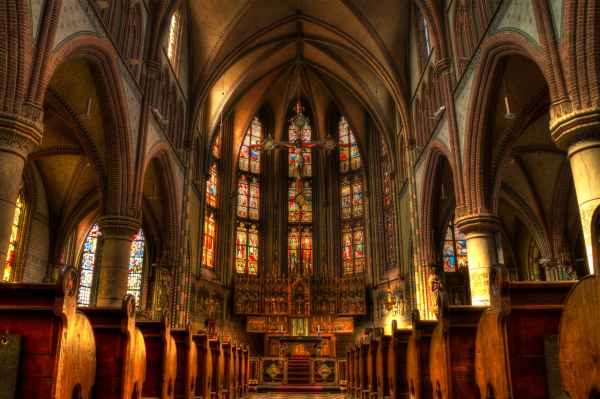
I love visiting old churches and cathedrals, with their vaulted ceilings and solid stone walls infused with centuries of incense and the echoed prayers. And I love being outdoors surrounded by the glorious beauty of creation. These spaces seem infused with a special sense of the sacred. It is easy to feel close to God is such spaces.
But God is omnipresent. A crowded bus is no farther from God’s presence than a majestic mesa. The hush of a hospital ward is just as close to His heart as the swelling choir in a cathedral. In fact, when Jesus lived among us on earth, He spent much of His time walking dusty roads, talking and working miracles among the noisy “rabble” of ordinary people. He did not seek out “sacred spaces;” instead, He took the “sacred” into the dark and dirty streets where it was often ignored or dismissed.
Sometimes, Jesus would go off by Himself into the wilderness or into the hills to pray, as well. It is important to make a time or space to do this. But there is nothing especially sacred about particular spaces– even ones designed to be places of worship. It may not be easy to find a physical space for prayer and worship, but we can make a mental “space”– close off distractions, move or turn away from others for a few precious minutes–focus on God’s presence. Remember, His presence is always with us; we just need to acknowledge it!
Prayer connects us to God– wherever and whenever we pray. That doesn’t mean that we should not seek out special times and places to be alone with God. But we needn’t wait for a certain moment or location or position in which to meet with God. He is eternally, immediately available to listen. Are we?



























 Pursuing Prayer