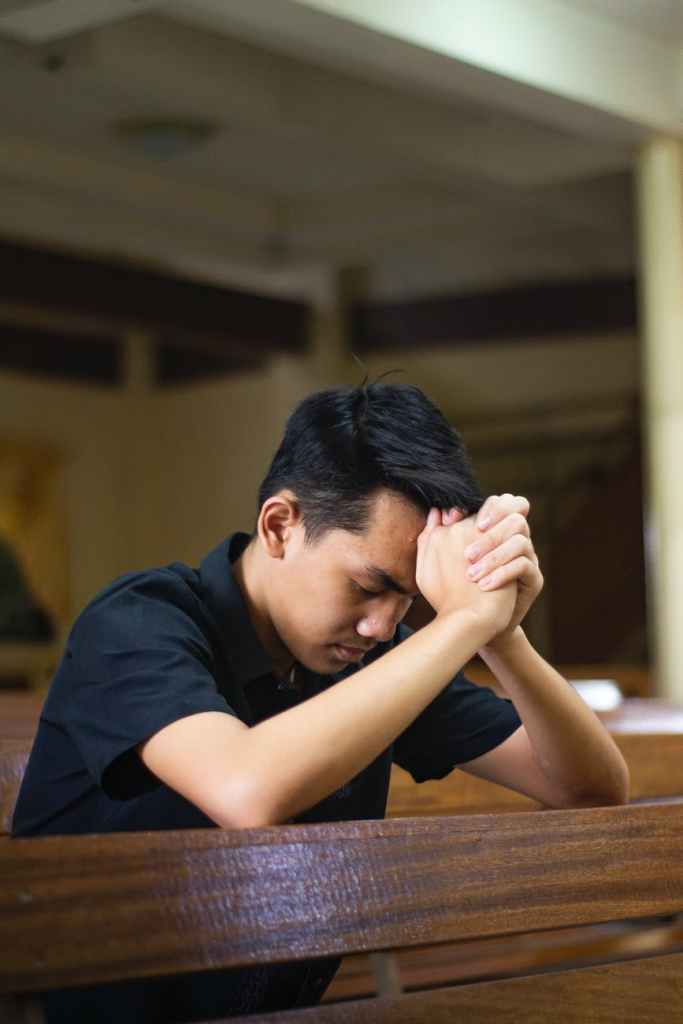
Prayer is a wonderful thing; sometimes it’s also a curious thing. Why do we pray to a God who is omniscient? If He already knows our needs, why do we bother to ask? If He already knows everything we’ve done, why do we need to confess? If He already knows about my neighbor’s cancer, why do I start a prayer chain?
Prayer is much more than sharing information with God. It is sharing my heart with God. What I pray, who I pray for, how and when and even where I pray– all come from my heart. God knows the information. He knows my heart, too. But He longs for me to take the time and effort to share it with Him (and to listen to His response!). God doesn’t want to be the one I turn to when I’ve tried all the other options. He is my Father, and He wants me to come to Him at every opportunity.
Moreover, when I pray, God is not surprised by anything I say, but sometimes I am! I find that one confession often leads to another– God already knew all that I had done and all about my attitude, but I lied to myself about my motive or about a small act or comment. Only in prayer does God have my full attention, and His Spirit uses that opportunity to help me see myself better, and clean the slate. Sometimes, I ask God for something I want, and God’s Spirit causes me to see what I really need, instead. Often, when I pray for someone I know, the Spirit will remind me of other ways I can pray for them, or bring another person to my thoughts. I may not know the other person’s need– but God already knows!
Finally, I find it a great comfort to pray to the one who holds everything together– the one who knows the end from the beginning, and everything in between. I don’t pray to a God who is kind, but ineffective. I don’t pray to a God who knows, but doesn’t care. God is the maker and sustainer of the universe; He is the lover of my soul, and the Almighty and Eternal One.
Today may be full of surprises– some good, some disappointing, some even overwhelming. God already knows. He knows our anguish, our hopes, our faults, and our triumphs (even the tiny ones). Many things about my life are difficult to understand or anticipate. I don’t have to know all the answers. I don’t even have to know all the “right” questions. God already knows!
When I was in elementary school, we learned about nutrition. Back then, we were taught that there were four basic food groups (nutrition education has gone through several “cycles” since then– food pyramid, healthy plate, “eating the rainbow”, etc.). Eating a healthy balance of foods is essential to good health. If I only eat meat, or only sweets, I will not be healthy. If I just eat whatever or whenever I feel like it, my body won’t get all the necessary nutrients to grow, fight off diseases, and stay strong.
Pursuing a healthy prayer life includes essential “building blocks” or nutrients, as well. Over the course of many years, I have seen various guidelines and acronyms to help include different building blocks in prayer. I want to share a couple of them again today. These guidelines are just that– guidelines. But they can help balance our prayer life, and help it grow.
The first acronym I learned, and the one I have used for decades, is ACTS. Here’s how it works:
Adoration/Acknowledgement– begin each prayer by acknowledging God’s Sovereignty, His Holiness, His Goodness, and other qualities worth worshipping. This helps put you in the right frame of mind when talking to God. I am not just talking to a neighbor or a “good buddy”– I am speaking with the One who holds all of Creation in His hands! And He WANTS a relationship with me! He is all-powerful: there is nothing I can ask that He cannot do! His is all-loving: there is nothing I can ask that He won’t filter through His loving wisdom and will. Even if I don’t know what to ask for; even if I ask for the “wrong” thing– God will only allow those things that He can use for good. God is beyond space and time: He knows all that has happened– all the triumphs and tragedies of my life so far, and all that is to come. He is LORD: He is in control– now and forevermore. Whatever seemingly impossible circumstances I face, they are nothing compared to the eternal, almighty plans of God.
Confession–This doesn’t mean an endless repetition of all my failures and sins from six months ago, or raking myself over the coals for not being “holy enough.” This is an honest assessment of who I am in relation to God. God is Holy and perfect. I am not. If I acknowledge God’s goodness, I must also acknowledge that I fall short. I don’t know everything. I don’t always act with the right motives. I NEED the Holy Spirit’s guidance, and I DEPEND on Christ’s finished work on Calvary for my Salvation. This should naturally lead to
Thanksgiving/Trust– I can trust God to save me, NOT because of who I am, but because of what He has done. I can see God’s hand working in and around and through me as I yield to His Spirit in me. I can recall, and acknowledge so many of the ways that God has blessed me and others around me. Once I have these building blocks in place, I can bring burdens to God through
Supplication– this is just a fancy term for asking God to work His will in specific areas– healing, guidance, encouragement, strength, understanding, submitting to His will, and following Him. I can ask for personal help, or lift up family members, neighbors, friends, and yes, even enemies! I can pray about situations great and small–from wars and famines to lost keys and short tempers.
I learned about ACTS when I was in college, and I have found it to be a great guideline. While I don’t use it for every prayer– sometimes an issue calls for immediate and direct supplication, for instance– I find that using this in daily prayer helps me grow in faith, patience, endurance, and hope. When I come to God in panic or stress, and I haven’t built up a healthy, consistent practice of prayer, my words can be anemic– lacking in faith and based on my fear or anger. I pray with my focus on problems, rather than on God’s power to overcome any circumstance. Using ACTS helps me remember that it is GOD who “acts,” and always for the best!
The second acronym I have used is PRAY. It is very similar to ACTS, but the end focus is slightly different:
Praise/Adoration– once again, it begins with praising the God who is worthy; the God who hears me, sees me, loves me, and knows what is best. I cannot live victoriously without remembering the source of hope and victory, and putting my heart in HIS hands.
Repentance– as with Confession above, this is not an act of groveling and rehearsing past shame. It is acknowledging anything that I might be holding on to that gets in the way of my worship of and submission to God’. E.M. Blaiklock, the Christian apologist from New Zealand once said: “God alone knows how to humble us without humiliating us and how to exalt us without flattering us.” Repentance is not about humiliation or holding on to guilt, but rather about staying humble and honest about our need for God’s Grace and Power. And turning from anything that might get in the way of following Jesus Christ.
Ask– once we have a right view of who God is, and who we are, we are free to ask Him whatever is on our mind, and share our questions, fears, burdens, etc., with the One who has all the answers!
Yield/ “Yes, LORD!”– The final step is making sure we are ready to listen and respond to God as we expect His answer. No matter what God’s answer may be, we should trust and obey His wisdom above our own.
I have come to value PRAY as a wonderful tool to help in my pursuit of prayer, and in my broader pursuit of Christlikeness. Both ACTS and PRAY help me pray “better.” It’s not that God grades my prayers or listens more or responds differently: but it helps me to better appreciate the power of prayer, and the power behind prayer. Individual prayers can change circumstances, but the pursuit of prayer is meant to change US as well. Prayer that shapes us, helps us grow– if that isn’t at least part of our pursuit of prayer, we are missing out on what God wants to do through us, and not just for us.
It is important, just as with nutrition, that we have a healthy balance in our prayer life. That balance consists of worship, repentance, sharing our burdens, showing gratitude, and offering ourselves in humble service. Prayer is too important to just “wing it.” We need to pursue it with the same (or better!) dedication that we give to our physical health.
“Praise Him, Praise Him, Jesus our Blessed Redeemer…” “Here I am to Worship. Here I am to bow down. Here I am to say that You’re my God…”
Have you prayed a hymn lately? Or maybe meditated on a single phrase from a recent worship chorus at Church? Music is often a language unto itself, and can be a great tool for prayer. Recently, I spoke of praying scripture. This is very similar, and in fact, many of the Psalms are both prayer AND scripture. There is something about music that can transcend words alone to communicate our thoughts, emotions, and even memory as we pray.
Just like praying scripture, there is also a temptation to use music to substitute for prayer, and we should seek to avoid that. But in general, music can be a great inspiration and addition to our pursuit of prayer. I find that hymns reach back through my memory to pull out great truths of faith that I can pray back to God, while newer worship choruses often capture emotions, including both praise and confession. At times, I have even used secular music, including love songs and the blues, to tap into emotions that I want to share with the One who loves me eternally and cheers me when no other can.
King David is the quintessential “singer/prayer” in the Bible, and his Psalms are wonderful to use. Many of them are still being put to new music and can be sung, as well as read or recited. But there are thousands of hymns, songs, choruses, cantatas, operatic masses, chants, raps, and more that can be presented as prayer. How?
Use whatever method fits you best– use the radio, an MP3, streaming service, CD, etc., to play a song, or sing it a capella; if you are a musician, you can play the song on your instrument and sing along or think of the lyrics as you play.
Go through one verse of the song over and over– or one line or phrase that has a particular meaning. Meditate on it before the one who inspired it. “A Mighty Fortress is our God…A Mighty Fortress are you, God… A bulwark never failing… NEVER failing…”
Do a “mash up” as you are singing one song another one may come to mind. Create a medley of personal worship. Some songs might even run into each other!
Don’t be afraid to add dance or movement. Clap along. Lift your hands. Sway.
If you are having trouble getting started, find a book of hymns or songs, or tune the radio to a station that plays good music.
Make up a song from your heart! Reach back into your memory for a children’s chorus (if you grew up in church). Change the lyrics to “redeem” a classic rock song (it sounds strange, but it is not impossible for most tunes!)
Make a joyful noise!– Don’t worry if you are not a great singer. God listens to your heart!
At least once each month, I want to give some practical tips I have learned that have improved my pursuit of prayer over the years. Today, I want to talk about praying scripture.
On its surface, praying scripture just means reading or saying Bible verses back to God. Of course, some Bible verses or passages lend themselves to this practice, while others do not. (Lists of genealogies in the Chronicles come to mind…) Sometimes, it requires that we change a pronoun or verb tense, or otherwise personalize the scripture, but we are echoing God’s “Word” back to Him in an act of worship. We may be echoing God’s literal words, or repeating words of worship spoken centuries earlier. Some examples:
“Lord, in the beginning YOU created the heavens and the earth”…(from Genesis 1:1) “Give praise to the Lord, proclaim his name; make known among the nations what he has done. Sing to him, sing praise to him; tell of all his wonderful acts. Glory in his holy name; let the hearts of those who seek the Lord rejoice. Look to the Lord and his strength; seek his face always.” 1 Chronicles 16:8-11
Create in me a pure heart, O God, and renew a steadfast spirit within me. Do not cast me from your presence or take your Holy Spirit from me. Restore to me the joy of your salvation and grant me a willing spirit, to sustain me. (Psalm 51:10-12)
“On my bed I remember you; I think of you through the watches of the night” (Psalm 63:6)
“Search me, God, and know my heart; test me and know my anxious thoughts. See if there is any offensive way in me and lead me in the way everlasting” (Psalm 139: 23-24)
Now to YOU who are able to do immeasurably more than all we ask or imagine, according to Your power that is at work within us, to You be glory in the church and in Christ Jesus throughout all generations, for ever and ever! Amen. (taken from Ephesians 3:20-21)
There are some benefits of doing this, but also some pitfalls. First the benefits:
Praying scripture can help us when we just don’t know what to say. Sometimes, we are so burdened or so exasperated, or so overwhelmed with emotion, that our words are swallowed up. But a remembered passage of scripture may allow us to speak our emotions in a way that our own words cannot. Sometimes, scripture will give us a focus that we lack, allowing us to put aside distracting thoughts, as well.
Praying scripture can help us memorize or review scripture. It can be helpful to read scripture aloud as a prayer, or even repeat key verses as prayer. Sometimes, we will be studying scripture and it speaks to us in a way that causes us to stop and pray it back.
Praying scripture can keep our prayers grounded. When we are tempted to pray selfish, momentary requests, scripture reminds us of God’s majesty, sovereignty, and timeless nature. Scripture magnified God and puts our petty worries and desires in their proper perspective.
In a group setting, praying scripture can help others focus better, or inspire them to remember another scripture passage that relates to what you have just prayed!
There are many other benefits of praying scripture, but there are also a few pitfalls:
Beware of using scripture as a substitute for your own thoughts and concerns. It is powerful to pray the Bible as it relates to your own worship and emotions, but God doesn’t want to hear only the echo of His words– He wants to hear them coming from your heart, as well as your lips. The ancient prophets warned against those who used a form of worship that lacked conviction and submission to His will.
Don’t feel bad when you say a prayer that does not contain a direct scriptural quotation– praying scripture is a tool and a guide, not a ritual or requirement. Don’t feel arrogant or superior when you DO pray scripture– it is a tool and a guide, but it does not make your prayer more effective or more Godly than an earnest prayer without a scripture reference.
Don’t “cherry-pick” scripture to pray in a way that is out of context or goes against the overall flow of scripture. Two of the most overused and misused scripture passages are Romans 8:28 and Jeremiah 29:11. They are both verses of promise and encouragement, and certainly can be used in prayer. But in context, they are meant to encourage those who are in the midst of anguish and despair, NOT promises to make life carefree or answer a selfish desire for an immediate good outcome.
If you have never (or rarely) tried praying scripture, I hope you will incorporate this tool into your pursuit of prayer. Whether you use a print Bible, scroll through a list of verses on line, or draw upon memory, you will find God’s words to be uplifting, convicting, encouraging, and wholly sufficient as you pour out your heart to your Maker. And if you already use this practice, I hope these tips will help you remember to use scripture wisely and appropriately as you pursue and practice a closer walk with God.
I love to cook. I love looking at new recipes, and finding new ways to use fresh ingredient, use up that last bit of leftovers, or stretch staple foods like beans, flour, or rice. And I love to pray. I love being able to lift up praises, requests, and even questions. I love knowing that I can confess even my most shameful thoughts or deeds to a God who already knows, loves me more than I can imagine, and stands eager to forgive me and strengthen me to make wiser choices.
Cooking can be exciting, challenging, and creative. But it doesn’t have to be. I don’t have to cook at all in our culture. I can (at some expense) dine out every day, and let someone else do all the work. Or, I can buy pre-made meals, “processed” foods and “instant” mixes– “just add water,” “cooks in 6 minutes,” “ready to eat.” I can pray “processed” prayers, too. I can recite prayers of others, mumble graces by rote, and even read off a list of requests with little or no effort or emotion.
But processed prayer isn’t healthy– no more than processed food. Oh, it won’t seem much different– at first. And it isn’t “bad”–every once in a while. But a steady diet of praying someone else’s words and thoughts doesn’t build a personal relationship. We miss out on the “process” of praying, and the end result is not as fresh and healthful.
When I cook from scratch, I have to follow a process:
I need to make sure I have the proper ingredients.
Some ingredients need to be seeded, skinned, peeled, chopped, or otherwise readied before they can be used.
Ingredients need to be added in the proper order.
Measurements are important. 1 teaspoon of salt is not the same as 1/2 cup of salt!
I need to use the proper methods– simmer, boil, chill, bake, etc.
Timing is crucial, too. Cookies may take 10 minutes to bake– a roast may take 3 hours.
I want to include all the “ingredients” of a deep prayer– Adoration and Praise; Acknowledging God’s Sovereignty and Power; Confession and Repentance; Thankfulness; Presenting my requests; Lifting up the needs of others; and Committing to Listen and Obey God.
Timing is important–I need to make time to visit with God in Prayer. It shouldn’t be an afterthought or another activity to squeeze in IF I have a chance!
That doesn’t mean that we can’t (or shouldn’t) pray “in the moment” or recite The Lord’s Prayer, or the Prayer of St. Francis, or another written prayer. It doesn’t mean that we should make all our prayers from a “recipe” or a formula. But if our prayer “diet” is becoming dependent on “processed” prayers, we may need to go back to the kitchen!
At least once a month this year, I hope to include a post on helpful tips to improve our pursuit of prayer. These are tips I’ve gathered over the years, and it helps me to remember as I write about them.
Today, I want to talk about starting and finishing well.
Beginning prayer with a Hallelujah helps focus my attention where it should be– on God! Too many times, I start praying with a “need” mindset. I’m focused on a need or a situation in my life or the lives around me. But the greatest “need” I have is to lift my eyes and focus on the ONE who is higher and greater and more powerful than any situation; the ONE who can satisfy every “need” and bring justice, restoration, and hope to any situation.
I have learned two different acronyms for prayer over the years– ACTS and PRAY. ACTS stands for Adoration, Confession, Thanksgiving, and Supplication. PRAY stands for Praise, Repent, Ask, and YES! (action). In both, the first step is to bring praise and adoration to the One who is worthy of it.
Sometimes, this is easy to do. Sometimes, it is painful. When I am stressed, worried, grieving, or convicted, my focus is inward and downward– and I can spiral into depression, isolation, and fear. The last thing I want to do is turn my focus away. God’s glory and righteousness can be blinding in the face of dark depression and despair. And yet–
Start small. Begin with one aspect of God’s character that you have experienced– His Grace, His Faithfulness, His Love. Meditate on it. Express it. Expand on it. Recall some of the specific ways in which God has been gracious, faithful, or loving. Think about some of God’s other attributes– His wisdom, power, omnipresence; His eternal nature, His creation. Soon, it becomes easier to speak, and even sing, His Praise!
Often, this will lead naturally into confession and repentance. When we begin by focusing on God’s greatness, His Holiness, and His majesty, our worries show themselves for lack of faith; our needs, while still real, reveal opportunities for God to “show up!” and for us to learn new depths of His character IF we are humble, obedient, and willing to learn.
Praise and Adoration are important first steps in prayer. But it is equally important to end our prayers well. Sometimes, our “Amen” is muted as our focus returns to our requests. And sometimes, it can be difficult and even painful to say “Amen!” I KNOW God is all-gracious, all-knowing, and all-powerful. But I also know that I don’t have enough money to pay the latest bill, or that I have been diagnosed with an incurable disease, or that my son or daughter is still lost. And I know that God may be asking me to walk through the valley of the shadow of death. He will be beside me, but He’s not going to remove the shadow or the valley to make it easier.
Over the years, I have found that it is better to wrestle IN prayer than to end with a half-hearted Amen. I must go back to Adoration; find my Thanksgiving, reclaim my Yes, Lord! before I say, “AMEN!” Otherwise, I am like the double-minded person in the book of James: being tossed like a wave in the ocean and filled with petty doubts in spite of my knowledge of God’s goodness.
End your prayer on a high note today. Remember to sandwich requests and concerns between hymns of praise and odes of thanksgiving. “Amen” should always echo our “Hallelujah!”
In blogging about prayer and in keeping a prayer journal, there is one type of prayer I don’t dwell on very often. Prayers of confession and repentance are very important, but I don’t include them in my journal and I don’t spend much time analyzing them. It’s not that I want to ignore them or that I want to give a false impression that I don’t say them.
I’m a saint–but only in the sense that Christ’s blood is my atonement and my only hope of salvation. He who started the work is still working, and there’s a lot of work yet to be done. So, while I include prayers of confession and repentance in my practice of pursuing prayer, I don’t write them down or share them publicly.
Here are some of the reasons I don’t spend more time talking about confession:
Confession is not meant to be a public spectacle. It is generally private and very personal between an individual and God. Apologies may be public, and repentance may include public atonement or recompense, but those are not prayer; rather they are the actions taken in conjunction with and as a result of prayer and confession.
Confession is fundamental– it’s not a prayer option, or a stylistic preference–every one of us has sinned, and we all need to admit to our sins, bring them before the throne of God’s grace, and ask for his forgiveness. Hiding sins, denying sins, or lying about them will get in the way of all our other prayers.
Writing about past sins keeps them alive and keeps the focus on me and on my faults, rather than on God and on His Grace.
Making confession public has a tendency to devolve into gossip and self-justification. Descriptions of my sinful actions will necessarily be from my incomplete and very biased point of view. Other people can be misrepresented and hurt.
But the last reason is my favorite– I don’t waste time writing down and discussing past sins because GOD HAS FORGOTTEN THEM! Writing them down, rehearsing them, analyzing them–even analyzing how I might approach confession won’t change God’s response:
10 he does not treat us as our sins deserve or repay us according to our iniquities. 11 For as high as the heavens are above the earth, so great is his love for those who fear him; 12 as far as the east is from the west, so far has he removed our transgressions from us.
Psalm 103:10-12New International Version (NIV)
The key is that we DO confess– humbly, consistently, and with a heart of true repentance. What follows is a free and forgiven conscience, no longer weighted down or pulled off focus by guilt and doubt.
whose sin the Lord will never count against them.”
Romans 4:7-8 (NIV) via biblegateway.com (See also Psalm 32:1-2)
Ask me about my most embarrassing moment, or my greatest failure..better yet, ask one of my friends or relatives! We tend to hang on to our past, especially our mistakes, our hurts, our missed opportunities, and our shortcomings. When I taught public speaking in a local high school, I heard horror stories about why “I can’t get in front of people and talk.” The fear of public speaking rates higher in some studies than the fear of Death! And often, the fear is based on an incident from early childhood of people laughing at a small, but very public mistake. Such moments haunt us.
As we grow older, we let our regrets live large– those things we “would have, should have, could have” done, or the things we shouldn’t have said, but can never un-say. And even if we try to move on or forget the past, there always seems to be someone who cannot let go, cannot forgive, or cannot forgive. Lives have been stunted and ruined by the ghosts of “what happened” when…
God is all-knowing. There is nothing we’ve ever done, said, or even thought, that He “missed,” ignored, or “lost track of.” God has total recall over all the centuries and eons of time– past, present, and even future! And yet, God offers to forgive ALL our sins, and to “remember them no more.” God will never bring up “that time when you disappointed me…” God will never look at you with condemnation over anything you have confessed and repented over. It’s not that God will never be able to recall what happened; but He will no longer “charge it to your account.” He has chosen to pay the consequences in His own Blood, so that you can be debt free.
Imagine if you had no bills. If all your mortgages, utility payments, credit card debt, medical bills–everything that you were responsible to pay– all were stamped “Paid in full.” You never had to worry about interest payments, late fees, repossession, evening phone calls from bill collectors, credit scores, etc. What a weight off your shoulders! Imagine if you had no reason to fear getting in front of a room full of people to speak or sing or give a presentation– no fear that others would judge your every hesitation, or whether your tie was straight, or your hair was mussed, or you stumbled over a word or phrase or tripped on the steps leading up to the podium. Imagine being accepted and embraced by the very one who, by rights, should be your most severe critic.
Sometimes, when we see God as our critic, our judge, or our opponent, we’re not seeing God as He really is– we’re seeing a reflection of ourselves– harsh, judgmental, unwilling to forgive others; unwilling to forgive ourselves. The very first deception of the Enemy was to distort God’s image from Creator and Sustainer to Judge and Tyrant. Yet Satan is called “The Accuser,” not God. God’s Holy Spirit may convict us of Sin– causing us to see that we have done wrong– but His purpose is always to correct and restore us, not to haunt and condemn us. Even the “worst” sins are not beyond God’s ability or willingness to forgive. Jesus forgave His accusers, His betrayers, and His executioners from the Cross!
Forgiveness is not easy. Sin is real; it has real and terrible consequences. Sin hurts, humiliates, victimizes, and traumatizes. And its effects do not simply vanish if we say, “I forgive.” But hanging on to the pain and anger keeps us from finding and experiencing the healing and wholeness that Jesus offers. Forgiveness does not mean that the sin, or the pain, never happened– God will not “forget” injustice just because we forgive the unjust. Forgiveness means that we no longer need to try to collect the debt from someone else– because God has already promised to pay it back with interest! And forgiving yourself doesn’t mean that your past actions didn’t happen or didn’t cause pain. In fact, whenever there are opportunities to atone for past actions, or ask forgiveness from those we have wronged, we should take them. But where such opportunities are impossible for us, even when we cannot see how such pain could be redeemed or relationships restored, God has promised that we can move beyond our past mistakes and live a new , blessed, and debt-free life.

When we approach God in prayer, we come as we are– people with past mistakes, very human emotions, including doubt and fear, and unworthy to stand on our own before a perfect God. But it is God who invites us to come to Him– debt free and embraced by His limitless Grace!
I could have smiled when I paid my utility bill the other day– When the clerk asked if she could help me, and thanked me, and sent me on my way.
I might have offered my unused coupons to that young man who was shopping– The one with two boisterous kids in the cart, and very few groceries. Maybe he would have been offended. But maybe it would have given him an opportunity And a little hope.
I thought about calling an old friend and asking if we could pray together. Maybe we could have met for tea or gone for a walk together.
I had planned to clean out the closet and set aside some clothes to take to a local shelter.
I considered calling my sister, sending a card to that widower from church, or e-mailing my cousin…
I really needed to spend a little time in confession and repentance, and cleansing. I needed to be renewed, recharged, and transformed. At least, I thought I did. But something else claimed my thoughts, and my good intentions. Now, I just feel worn and guilty and unworthy.
And the “thing” is– I didn’t do anything horrible. I didn’t make anyone cry, or rob a bank. I didn’t burn dinner or break the speed limit. I didn’t break my marriage vows or embezzle a fortune. I didn’t break the law– I didn’t even break a sweat!
I just Didn’t.
Lord, today, I pray that you would light a fire under me. Help me to see the opportunities all around me– tiny acts of kindness, and truths that I need to hold tight. Show me people who need a listening ear, or a helping hand, or a word of encouragement. Help me to move “at the impulse of your love.” And when You direct me to be still, help me to be still and KNOW that You are a God of purpose and hope; joy and abundance. Help me to BE first–to Be obedient, to Be humble, to Be available. But then, help me to DO what you would have me do for Your Great Name. Thank you for second (and third) chances to BE and DO all that brings You honor. Amen.
I grew up in a church that made prayer a priority. I know many churches that still do this, but I know that some churches today just leave prayer up to the individual Christian. They may open the service with a prayer, and close with a prayer, and even offer a prayer service in the mid-week, but they do not focus on prayer as a congregation. With many churches, corporate prayer doesn’t seem very practical– they are just too large, or too focused on spending their time in worship. But I think something of value is lost when the church doesn’t come together in prayer.
Prayer IS an individual pursuit. It should be part of each Christian’s daily walk. And most of what I write (and practice) about prayer happens personally. But Jesus practiced both personal and corporate prayer. Even in His agonizing prayer in the Garden of Gethsemane, He wanted close friends to be nearby praying, rather than sleeping (see Matthew 26:36-46 and Luke 22: 39-46). When instructing His disciples in how to pray, He used the term, “Our Father,” not “My Father.” Christianity , including prayer, cannot be practiced in isolation. We need to pray for others, and with others, and be prayed for by others!
In the small country church where I grew up, prayer was woven into the service. Prayer requests would be shared, and people would take turns praying aloud, until one prayer leader would close the prayer time with an “Amen!” In the church where I currently attend, we still share prayer requests on-line, and a list of requests gets sent out once a week. Occasionally, we will break into small groups during service to pray for particular focus or a specific request. Additionally, we have a mid-week prayer meeting, where we spend an hour just praying as a small group.
Why do I emphasize the need for group or corporate prayer? Over the years, I have seen many benefits:
I love “hearing” the hearts of others. We don’t all pray exactly the same. Even if we are reciting a prayer (like The Lord’s Prayer) there are different voices, different inflections, different tones, that bring a richness and diversity to prayer. And that is a great reminder that God is the God of ALL of us, even as He is the God of EACH of us. He is OUR God, every bit as much as He is MY God.
There is comfort and even power in praying together. My personal prayer may be sincere, but it is usually silent, and may be influenced by my surroundings, my mood, my distracting thoughts, etc.. But there is a different atmosphere when two or three (or more) are taking turns praying, adding to the thoughts and prayers of others, and pouring out their hearts in concert with other believers. I get a broader perspective when I pray with others. I hear more than just my own voice and my own thoughts. It doesn’t change whether or not God listens to my prayer, but it changes the way I think and feel– it isn’t just “MY” prayer– it is “OUR” prayer.
I learn more about prayer by practicing with others. I know many people who will not pray in a group, because they feel their prayers are “lacking” somehow. And this is a dangerous way to think! I have learned amazing lessons of faith from simple prayers; amazing lessons of doctrine from eloquent prayers; amazing insight from broken and contrite prayers; and even lessons from “runaway” prayers that go on and on. And praying in a group is not about how much you say, but by how much you are present in the moment.
Corporate prayer is a rich tradition. Jewish priests would lead the entire nation of Israel in prayer during various festivals. Many of the psalms are written as prayer-songs for a congregation to sing together. The early church made prayer a part of their meeting together (see Matthew 18:20, Acts 2:40-47, Romans 15:6, others…)
Corporate prayer strengthens my faith and the faith of others. Intellectually, I “know” that God listens to and answers my prayers, but when I pray with others, it strengthens my experiential knowledge that God is listening– because I am listening, and being listened to!
Corporate prayer challenges my perspective in relation to my own sinfulness and God’s grace. Corporate prayer should not be used as a “True Confessions” session, where we try to outdo each other in confessing secret sins or wallowing in self-righteous recitations. But it should bring us into a realistic awareness of our very human nature, and of God’s amazing Grace. Corporate prayer takes us out of our “self” and focuses on God’s sovereignty in ways that personal prayer sometimes misses. Corporate prayer tends to focus on gratitude, humility, and thinking of others more highly than yourself. And that is often a stepping stone to confession and the awareness of God’s forgiveness.
Corporate prayer lends itself to structure. That’s not to take away from unstructured and spontaneous prayer, but corporate prayer tends to have a stated purpose, and sometimes a stated format. From “round robin” prayer, where people pray in a particular order around a circle; to “popcorn” prayer, where people jump in and take turns until a certain time has elapsed; to structured prayer, where people pray in a strict order and with definite purpose for a slotted time, corporate prayer tends to be more disciplined that personal prayer. That doesn’t make it better or worse, but it is a different way to pray, which can help foster discipline in other areas.
Are you part of a prayer group at your church or in your community? If so, cherish this rich opportunity. If not, make a point of connecting with other believers– at church, in your community, or even on-line. Share requests. Set aside time to pray together, or even separately, but at the same time. Live stream prayer. Pray with someone over the phone, if you don’t have a prayer group or congregation nearby.